Summary
Table of Content

Polybags Market
Get a free sample of this report
Form submitted successfully!
Error submitting form. Please try again.
Thank you!
Your inquiry has been received. Our team will reach out to you with the required details via email. To ensure that you don't miss their response, kindly remember to check your spam folder as well!
Request Sectional Data
Thank you!
Your inquiry has been received. Our team will reach out to you with the required details via email. To ensure that you don't miss their response, kindly remember to check your spam folder as well!
Form submitted successfully!
Error submitting form. Please try again.
Polybags Market Size
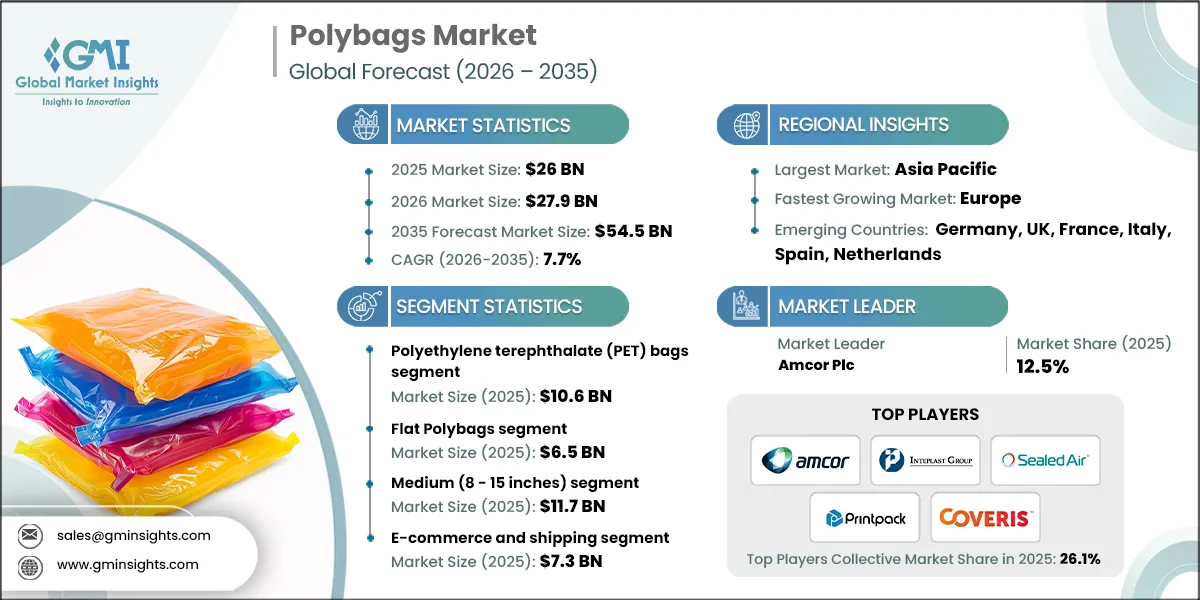
The global polybags market was valued at USD 26 billion in 2025. The market is expected to grow from USD 27.9 billion in 2026 to USD 54.5 billion in 2035, at a CAGR of 7.7%, according to the latest report published by Global Market Insights Inc.
Polybags Market Key Takeaways
Market Size & Growth
- 2025 Market Size: USD 26 Billion
- 2026 Market Size: USD 27.9 Billion
- 2035 Forecast Market Size: USD 54.5 Billion
- CAGR (2026–2035): 7.7%
Regional Dominance
- Largest Market: Asia Pacific
- Fastest Growing Region: Europe
Key Market Drivers
- Rising demand from packaging industry.
- Expansion of e-commerce and logistics.
- Low manufacturing and material cost.
Challenges
- Recycling infrastructure limitations.
- Volatility in raw material prices.
Opportunity
- Development of biodegradable polybags.
- Technological advancements in manufacturing.
- Customization and branding demand.
Key Players
- Market Leader: Amcor Plc led with over 12.5% market share in 2025.
- Leading Players: Top 5 players in this market include Amcor Plc, Inteplast Group, Sealed Air Corporation, Printpack, Inc., Coveris AG, which collectively held a market share of 26.1% in 2025.
Get Market Insights & Growth Opportunities
- Polybags are plastic bags, flexible packaging materials made primarily of polyethylene, are widely used for storing, carrying, and protecting products in homes as well as in industries. These polybags are lightweight, durable, and cost-effective. There are transparent as well as coloured ones, depending on the use. Their flexibility makes it easier to handle and store them.
- These are manufactured from polymers such as LDPE, HDPE and LLDPE. Strength, thickness and flexibility of the bag reflect by the quality of this material. The thickness of polybags is sometimes measured in microns. The manufacturing technology adopted in production includes advanced extrusion and blowing techniques. Durability of machines may also be improved by adding other necessary additives for UV resistance or better print quality. The technical standards then ensure uniformity in performance.
- Polybags are predominantly used to pack food, garments, and consumer items. They act as a barrier between the products and dust, moisture, or damage. Lightweight, hence very easy to carry, polybags are also used in storing good items at home or for disposal. The low cost and easy availability of polybags have also made them very popular among manufacturers. They are also highly versatile in applicability.
- Polybags have been a matter of concern for the environment. Being non-biodegradable, the use of polybags induces pollution and harms wildlife. They block drains and degrade the soil with improper disposal. Recycling and reuse can help reduce their negative impacts. Governments promote eco-friendly and biodegradable alternatives to polybags. Awareness about the responsible use of polybags is rising.
- In fact, the industry dynamically shifts into more green packaging practices these past few years. The industries, therefore, process polybags from recyclable and biodegradable materials. Consumers, too, have become more aware of protecting the environment. Advancement in technology is beneficial for greener production processes. This consideration integrates people's convenience with ecological awareness. Modern sustainability needs are being met by developing the polybags industry.
To get key market trends
Polybags Market Trends
- Flexible packaging has been on the rise and is a huge growing factor in foam bag economics. It is more convenient, more durable, and cheaper than rigid packaging. Being light, it saves manufacturers and retailers transportation costs. It can cater to almost every industry. Demand for polybags continues to increase since the need for packaging material continues to increase.
- The increase in online shopping keeps rising the market. Much of e-commerce is about being able to deliver successfully using the least weight and safest kinds of packing. Polybags help hold products together while moving and do not add extra logistics costs. The biggest advantage of polybags, however, is their adaptability to different product sizes. This increases overall market consumption.
- Packaged goods are always on demand due to rising urbanization and changing consumer lifestyles. People with busy lifestyles mostly crave ready-to-use and well-packaged products. Polybags keep daily-use items safe and easy handling. This gradual shift in consumer behaviour makes a healthy market growth. More so, the demand is fed by the urban population growth.
- Low production costs and raw material availability thus add to the growth of the market. Polybags are manufactured using existing technologies, which do not require complex processing. Hence, maximizing the scale of production becomes easier and faster for manufacturers. Economically priced polybags attract a wider customer base. This thus continues to increase market penetration.
- With innovations in manufacturing processes, more focused improvements are being made in the quality and efficiency of products. Enhanced with newer technology, machines would be able to strengthen, seal, and print polybags in far better ways than before. This would also reduce wastage of materials and operational costs. Better efficiency in products would tend to gain greater acceptance from the users. This results in continued growth for the market.
Polybags Market Analysis
Learn more about the key segments shaping this market
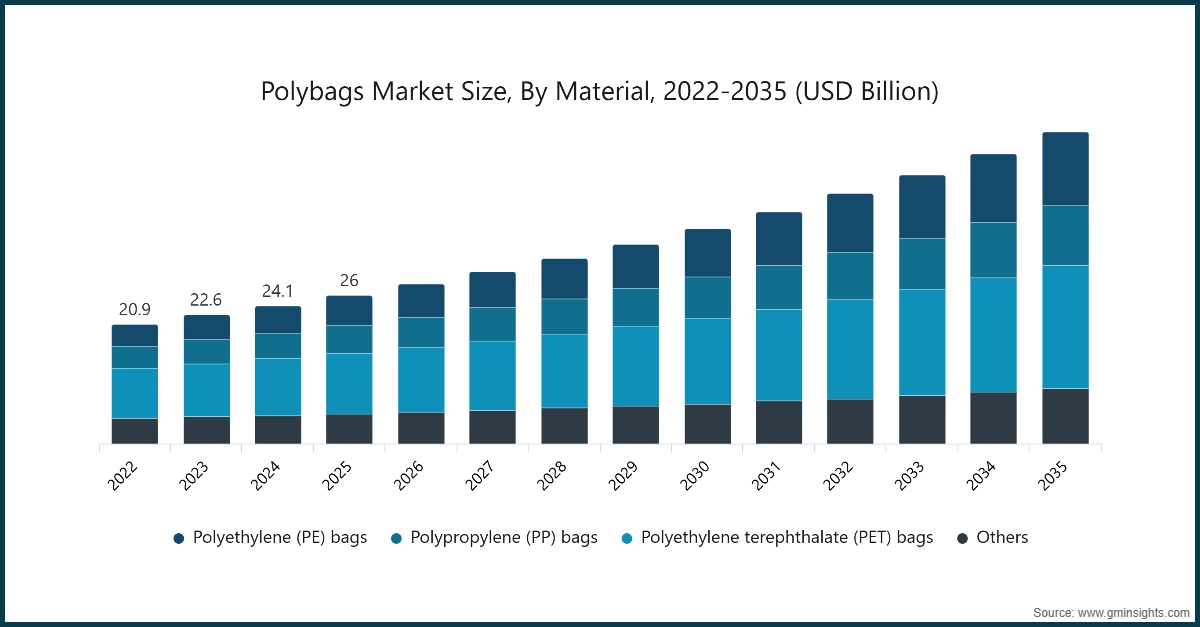
The polybags market by material is segmented into polyethylene (PE) bags, polypropylene (PP) bags, polyethylene terephthalate (PET) bags and others. Polyethylene terephthalate (PET) bags hold the largest market value of USD 10.6 billion in 2025.
- Polyethylene bags are the most used plastic bags due to their ease of use, strength, and moisture resistance. These bags are frequently used for packaging consumer goods, foods, and industrial materials due to the properties of polyethylene, such as tightly sealed and protected from external elements. Polypropylene (PP) bags are known due to their chemical, and heat resistance property as compared to PE bags. PP bags are ideal for use in items that require a good presentation and durability for storage, such as textiles, electronics, and items of food.
- Polyethylene Terephthalate (PET) bags are niche type of polybags which are known for their high tensile strength, clarity, and the ability to prevent stretching and shrinking. Most industries prefer using PET bags that have excellent packaging aesthetics and durability, such as retail and food packaging, especially for frozen and refrigerated products. The other category includes bags made of composite materials, probably including biodegradable plastics, or laminates, or in some cases, specialty films designed for specific performance needs in certain industries.
The polybags market by product is segmented into flat polybags, gusseted polybags, ziplock polybags, wicketed polybags, poly mailers, bubble mailers and other polybags. Flat Polybags holds the largest market value of USD 6.5 billion in 2025.
- Flat polybags are the simplest and most widely used polybags due to their easy usability, cost-effectiveness, and utility for packing lightweight and non-bulky items. Gusseted polybags are an alternate and added feature for expanding the capacity of bags inside or bottom supports to bulkier products like food, garment, and heavy industrial components. Ziplock polybags are of greater advantage due to the added convenience and reusability of their resealable closures; product protection and consumer appeal are immensely enhanced, especially in groceries, pharmaceuticals, and retail packaging.
- Wicket poly bags are intended for high-speed automated packaging processes in the food and agricultural industries, where efficiency and reliability are important. With the advances in e-commerce, poly mailers have become quite popular as very lightweight and resistant-to-tear, tamperproof shipping containers for non-fragile goods. Bubble mailers are made of poly film, but are internally padded, making them suitable for shipping delicate articles and have hence gained acceptance in the electronics and accessories shipment. The "Other Polybags" category includes specialized and customized bags developed for niche applications and the market's ability to develop into future applications and end-user demands.
The polybags market by size is segmented into small (below 8 inches), medium (8 - 15 inches) and large (above 15 inches). Medium (8 - 15 inches) holds the largest market value of USD 11.7 billion in 2025.
- Polybag size segmentation plays a crucial role in determining their suitability for different packaging applications and end-use industries. Small polybags below 8 inches in size, are used for lightweight products such as pharmacies, accessories, and food portions in their packaging. The compactness reduces material usage and the cost of packaging while providing protection for smaller products, hence making them prefer a choice in a retail and industrial setting, taking into consideration efficiency and space optimization.
- The moderate-sized polybags (8-15 inches) are very useful especially for packaging clothes or papers, consumer items, and even food. The size of these polybags makes them ideal for post-retail and e-commerce as there would be that optimum balance between handling convenience and capacity. Polybags that go above 15 inches are made for bulky or oversized things, including clothing items, parts in industries, agricultural accessories, and larger shipping containers. Such polybags are designed with better strength and with increased storage capacity, which ensures safe handling and transporting, especially in logistics and wholesale distribution channels.
Learn more about the key segments shaping this market
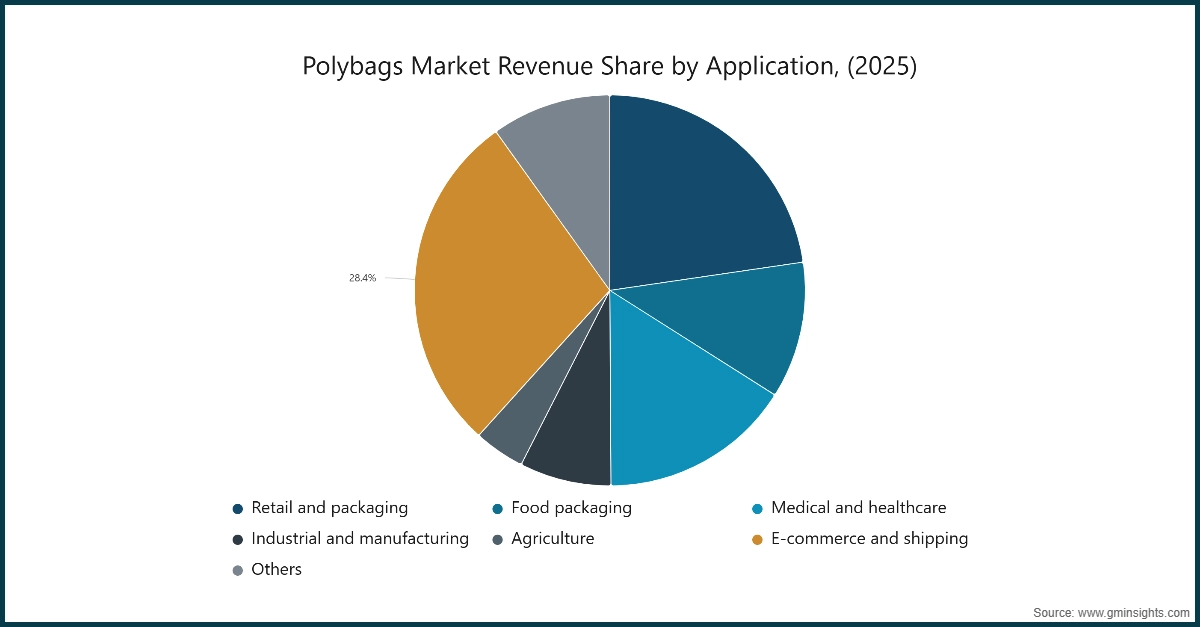
The polybags market by application is segmented into retail and packaging, food packaging, medical and healthcare, industrial and manufacturing, agriculture, e-commerce and shipping and others. E-commerce and shipping hold the largest market value of USD 7.3 billion in 2025.
- Segmentation of polybags have extensive use across industries due to their versatility, strength, and cost-effective nature. Retail packaging represents a key area of application whereby polybags are put to frequent use for product display, storage, and protection of consumer goods. Another major segment in food packaging is promoted by hygienic, moisture resistance, and light packaging for fresh, frozen, and processed foods. Polybags are also used for medical and healthcare applications, which require safe storage, sterilization, and transportation of medical supplies, pharmaceuticals, and disposable equipment, thus ensuring product integrity and prevention against contamination.
- Industrial and manufacturing applications are using polybags as a packing medium for components, raw materials, and finished goods. They benefit from the strength, chemical, and moisture resistance of polybags. Providing bags with utility in agricultural applications include seed packaging, packaging of fertilizers, storage of produce, and crop protection, which ultimately leads to their efficient handling and longer shelf life. Growth in e-commerce and rapid shipping has unleashed demand for polybags, particularly when it comes to mailers and protective packaging, because these transport media are light and therefore cost-effective in terms of logistics. Other segments falling under this category include specialized uses such as promotion packaging, waste management, and customized applications, showing the flexibility of polybags in catering the demand in industry.
Looking for region specific data?
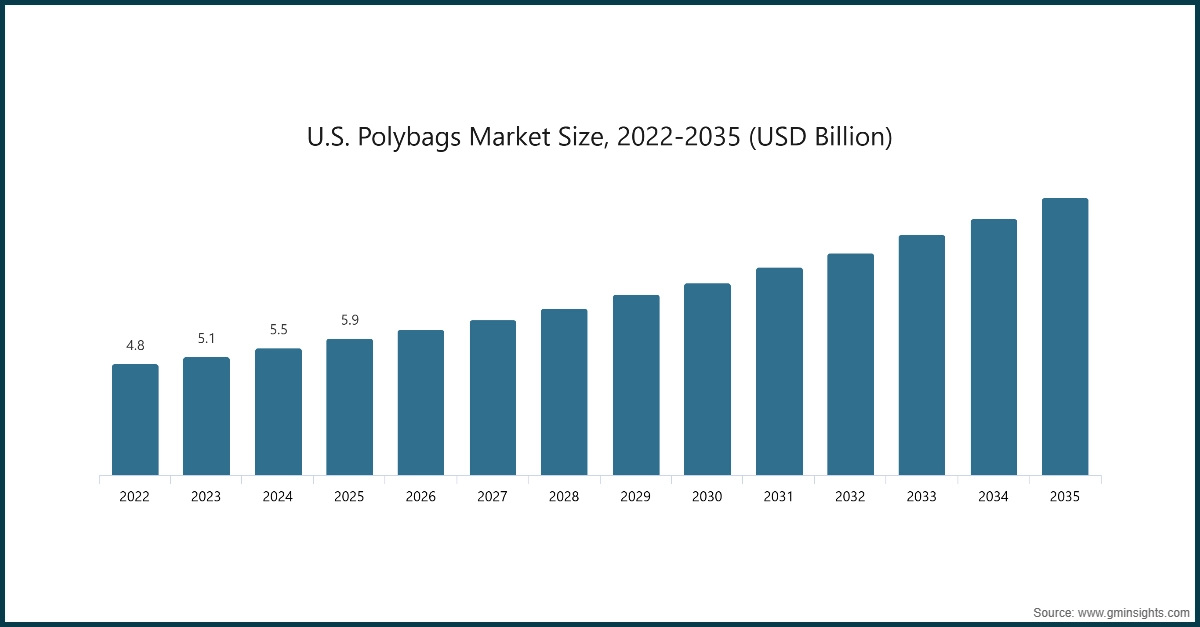
The market in the North America is expected to experience significant and promising growth from USD 6.8 billion in 2025 to USD 14 billion in 2035. The U.S. polybags market accounted for USD 5.9 billion in 2025.
- The market for polybags in North America is driven by strong demand from retail, e-commerce, and food packaging coupled with ever-increasing regulatory pressure against single-use plastics. Sustainability drives the shift towards recyclable and bio-based polybags, particularly in secondary and tertiary packaging. In the United States, demand continues to remain strong due to the high consumption in logistics and apparel packaging, thus the state bans and impose taxes on plastic bags which is pushing manufacturers to shifts towards reusable and compostable alternatives.
The market in the Europe is expected to experience significant and promising growth from USD 4.8 billion in 2025 to USD 10.3 billion in 2035.
- The market for polybags in Europe is heavily influenced by stringent environmental legislation and circular economy policies that reduces the growth of conventional plastics and promotes modern sustainable options. The region witnesses high acceptance of recycled-content and biodegradable polybags, both in consumer and industrial sectors. Germany emerges as a prominent market for advanced recycling infrastructure and stricter compliance, driving premium voluminous mono-material reusable bags.
The polybags market in Asia Pacific is expected to experience increasing growth from USD 8.4 billion in 2025 to USD 19.5 billion in 2035.
- Asia-Pacific is the fastest-growing market for polybags in the world, due to urbanization, industrial activity, and development of retail outlets. Due to significant price advantage and greater demand, production for various polybag applications, APAC is the hub of polybags. In China, the fast-growing market is due to e-commerce, gadgets, and food delivery, whereas revised local regulations are also encouraging biodegradable alternatives.
Middle East & Africa market is expected to experience significant and promising growth from USD 2.5 billion in 2025 to USD 4.6 billion in 2035.
- Construction, food distribution, and retail modernization sectors drive the polybags market in the Middle East & Africa. Conventional plastic variants have, however, continued to maintain a dominant position due to cost considerations. Initiatives driven by sustainability are emerging but continue to remain in their infancy across much of the region. The market in the United Arab Emirates is more advanced comparatively, with sustainable programs of the government and modern retail formats driving demand for recyclable and reusable polybags.
Latin America is expected to experience significant and increasing growth from USD 3.1 billion in 2025 to USD 6 billion in 2035.
- The polybags market in Latin America is developing steadily due to the growth in food packaging, agriculture, and informal retail channels. Regulation and price sensitivity affects material choices across the region. Brazil has a large consumer base and packaging industry thus leading the Latin America market, as a result increasing adoption of oxo-biodegradable and recyclable polybags with an improved awareness of sustainability.
Polybags Market Share
- The markets are moderately consolidated with players like Amcor Plc, Inteplast Group, Sealed Air Corporation, Printpack, Inc., and Coveris AG. holding 26.1% market share and Amcor Plc being the market leader holding the market share of 12.5% in 2025.
- A company secures its existence in the polybags market through diversification in the product portfolio continuously, as end-use applications will always fall into categories such as retail, food, agriculture, and e-commerce. It is different kinds of sizes and thicknesses that give rise to different kinds of material types through which dependency on a single application or market can be minimized, and revenues can be stabilized. Customization also places the companies in good positions for long-term relationships with big buyers.
- Another way is to invest in sustainable materials and technologies to match what the changing environmental requirements and consumers want. It is now seen in the major players that they will adopt recyclable, biodegradable, and post-consumer recycled content to future-proof their respective offerings. It promises compliance and facilitates the park of the company positioning as an environmentally responsible supplier.
- Cost efficiency and economies of scale play a critical role in competitiveness in price-sensitive markets. Companies invest in automation and source efficient resin and logistics to reduce production costs. They are enjoying the economies of scale at large-scale operations, allowing them to charge competitively while managing acceptable profit margins.
- Companies protect their market presence by strong distribution networks and strategic partnerships. Collaborations with retailers, logistics firms, and raw material suppliers assure supply reliability and greater market reach. Long-term contracts with key customers also shield against market fluctuations and the impact of new entrants.
- Innovation and adaptability to regulations help enterprises to maintain a step ahead of market shifts. Continuous improvements in products enhance performance per unit volume through weight saving and increased strength are instances of improvement. Those enterprises that follow the trend of proactive adaptation to local regulations and invest in compliance facilities are always able to sustain their leadership in the polybags sector.
Polybags Market Companies
Major players operating in the polybags industry are:
- Amcor Plc
- Sealed Air Corporation
- Novolex
- Coveris AG
- Inteplast Group
- Huhtamaki Group
- Printpack, Inc.
- Winpak Ltd.
- A-Pac Manufacturing Co., Inc.
- Arihant Packers
- PPC Flex
Amcor plc a multinational packaging company, specializes in the development of a range of flexible and rigid packaging, specialty cartons, and closures for the food, beverage, pharma, and personal care industries. The company is focused on innovating to deliver responsible package solutions that accelerate brand growth while addressing environmental challenges faced by all companies today.
Inteplast Group is a large manufacturing group involved in the production of plastic products specializing in films, bags, and packaging materials mainly for food, medical, and industrial applications. Known for its great expertise in quality and innovation, it manufactures a range of polyethylene-based products bringing efficient and sustainable packaging solutions across North America.
Sealed Air Corporation is recognized mostly for its innovative protective packaging products like Bubble Wrap and Cryovac food packaging. The company solves its customers' challenges through modern technology and sustainable practices, enhancing the safety and shelf life of their products while reducing the detrimental environmental impact.
Printpack, Inc. is a flexible and specialty packaging company. It's private and gives solutions for food, beverage, and consumer products. It is known for its printing quality and innovative designs, as it delivers customized packaging that boosts brand visibility and product protection.
Coveris AG is European packaging company which is a well-known name in flexible packaging and label solutions. The company offers a diverse products packaging for the food, pet care, and industrial markets. Within its structural emphasis, the company maintains an operational excellence focus on sustainability, innovative packaging technologies improving the shelf life of a product while reducing the environmental footprint.
Polybags Market Report Attributes
| Key Takeaway | Details |
|---|---|
| Market Size & Growth | |
| Base Year | 2025 |
| Market Size in 2025 | USD 26 Billion |
| Market Size in 2026 | USD 27.9 Billion |
| Forecast Period 2026-2035 CAGR | 7.7% |
| Market Size in 2035 | USD 54.5 Billion |
| Key Market Trends | |
| Drivers | Impact |
| Rising demand from packaging industry | The growing need for flexible and lightweight packaging across retail and FMCG sectors is driving polybag consumption. Their cost efficiency makes them a preferred choice |
| Expansion of e-commerce and logistics | The rapid growth of e-commerce has increased demand for secure and protective packaging solutions. Polybags play a key role in safe product delivery |
| Low manufacturing and material cost | Polybags are economical to produce due to affordable raw materials and simple processing. This helps manufacturers maintain competitive pricing |
| Pitfalls & Challenges | Impact |
| Recycling infrastructure limitations | Lack of proper recycling systems reduces effective waste management. This worsens environmental impact and sustainability issues. |
| Volatility in raw material prices | Fluctuations in petroleum-based raw material prices affect production costs. This can impact profit margins for manufacturers. |
| Opportunities: | Impact |
| Development of biodegradable polybags | Growing environmental awareness is boosting demand for eco-friendly alternatives. Biodegradable polybags offer strong growth potential. |
| Technological advancements in manufacturing | Improved production techniques enhance strength and reduce material usage. This increases efficiency and product quality. |
| Customization and branding demand | Businesses prefer customized polybags for branding and marketing. This trend opens opportunities for value-added products. |
| Market Leaders (2025) | |
| Market Leader |
Market share 12.5% |
| Top Players |
Collective market share of 26.1 % in 2025 |
| Competitive Edge |
|
| Regional Insights | |
| Largest Market | Asia Pacific |
| Fastest growing market | Europe |
| Emerging countries | Germany, UK, France, Italy, Spain, Netherlands |
| Future outlook |
|
What are the growth opportunities in this market?
Polybags Industry News
- In April 2025, Amcor plc announced the combination of all its stock with Berry Global which further helps to create a stronger global player in consumer and healthcare packaging. The merger creates a much larger and more complete portfolio with better material science, innovation capabilities, and global scale for Amcor to address an evolving customer base and sustainability requirements. The combination is set to deliver significant long-term value through operational synergies, better growth prospects, and stronger cash flow generation.
- On February 2023 PPC Flexible Packaging, LLC announced that it has acquired StePac MAPfresh Holdings, mainly deals in providing a technology for sustainable packaging solutions for fresh produce. This acquisition enhances PPC’s capability in advanced atmosphere- and humidity-controlled packaging and increases its activity in high-value agricultural and specialty produce markets. This acquisition will help support PPC’s growth strategy by further developing its innovation portfolio and helping reinforce consolidation trends within the polybags and flexible packaging market.
The polybags market research report includes an in-depth coverage of the industry with estimates and forecast in terms of revenue in USD Billion and volume in terms of kilo tons from 2022–2035 for the following segments:
Market, By Material
- Polyethylene (PE) bags
- Polypropylene (PP) bags
- Polyethylene Terephthalate (PET) bags
- Others
Market, By Product
- Flat polybags
- Gusseted polybags
- Ziplock polybags
- Wicketed polybags
- Poly mailers
- Bubble mailers
- Other polybags
Market, By Size
- Small (Below 8 Inches)
- Medium (8 - 15 Inches)
- Large (Above 15 Inches)
Market, By Application
- Retail and packaging
- Small (Below 8 Inches)
- Medium (8 - 15 Inches)
- Large (Above 15 Inches)
- Food packaging
- Small (Below 8 Inches)
- Medium (8 - 15 Inches)
- Large (Above 15 Inches)
- Medical and healthcare
- Small (Below 8 Inches)
- Medium (8 - 15 Inches)
- Large (Above 15 Inches)
- Industrial and manufacturing
- Small (Below 8 Inches)
- Medium (8 - 15 Inches)
- Large (Above 15 Inches)
- Agriculture
- Small (Below 8 Inches)
- Medium (8 - 15 Inches)
- Large (Above 15 Inches)
- E-commerce and shipping
- Small (Below 8 Inches)
- Medium (8 - 15 Inches)
- Large (Above 15 Inches)
- Others
- Small (Below 8 Inches)
- Medium (8 - 15 Inches)
- Large (Above 15 Inches)
The above information is provided for the following regions and countries:
- North America
- U.S.
- Canada
- Europe
- Germany
- UK
- France
- Spain
- Italy
- Rest of Europe
- Asia Pacific
- China
- India
- Japan
- Australia
- South Korea
- Rest of Asia Pacific
- Latin America
- Brazil
- Mexico
- Argentina
- Rest of Latin America
- Middle East and Africa
- Saudi Arabia
- South Africa
- UAE
- Rest of Middle East & Africa
Frequently Asked Question(FAQ) :
What was the market size of the polybags market in 2025?
The global market was valued at USD 26 billion in 2025, with a CAGR of 7.7% expected through 2035, driven by increasing demand for flexible packaging and growth in e-commerce.
What is the projected value of the global polybags market by 2035?
The market is expected to reach USD 54.5 billion by 2035, fueled by urbanization, changing consumer lifestyles, and the rising need for lightweight and cost-effective packaging solutions.
What is the projected size of the polybags market in 2026?
The market is expected to reach USD 27.9 billion in 2026.
How much revenue did the polyethylene terephthalate (PET) bags segment generate in 2025?
Polyethylene terephthalate (PET) bags held the largest market value of USD 10.6 billion in 2025.
What was the valuation of the flat polybags segment in 2025?
Flat polybags generated USD 6.5 billion in 2025, leading the market by product type.
Which application segment dominated the polybags market in 2025?
The e-commerce and shipping segment held the largest market value of USD 7.3 million in 2025, driven by the growing demand for lightweight and adaptable packaging solutions.
Which region leads the polybags market?
North America is expected to experience significant growth, with the market projected to rise from USD 6.8 billion in 2025 to USD 14 billion by 2035. The U.S. market accounted for USD 5.9 billion in 2025, supported by strong e-commerce growth and packaging innovations.
What are the upcoming trends in the polybags industry?
Key trends include the rising adoption of flexible packaging, increasing demand from the e-commerce sector, and the shift towards lightweight, cost-effective, and adaptable packaging solutions.
Who are the key players in the polybags market?
Major players in the market include Amcor Plc, Sealed Air Corporation, Novolex, Coveris AG, Inteplast Group, Huhtamaki Group, Printpack, Inc., Winpak Ltd., and A-Pac Manufacturing Co., Inc.
Polybags Market Scope
Related Reports