Summary
Table of Content

Poly Aluminum Chloride Market
Get a free sample of this report
Form submitted successfully!
Error submitting form. Please try again.
Thank you!
Your inquiry has been received. Our team will reach out to you with the required details via email. To ensure that you don't miss their response, kindly remember to check your spam folder as well!
Request Sectional Data
Thank you!
Your inquiry has been received. Our team will reach out to you with the required details via email. To ensure that you don't miss their response, kindly remember to check your spam folder as well!
Form submitted successfully!
Error submitting form. Please try again.
Poly Aluminum Chloride Market Size
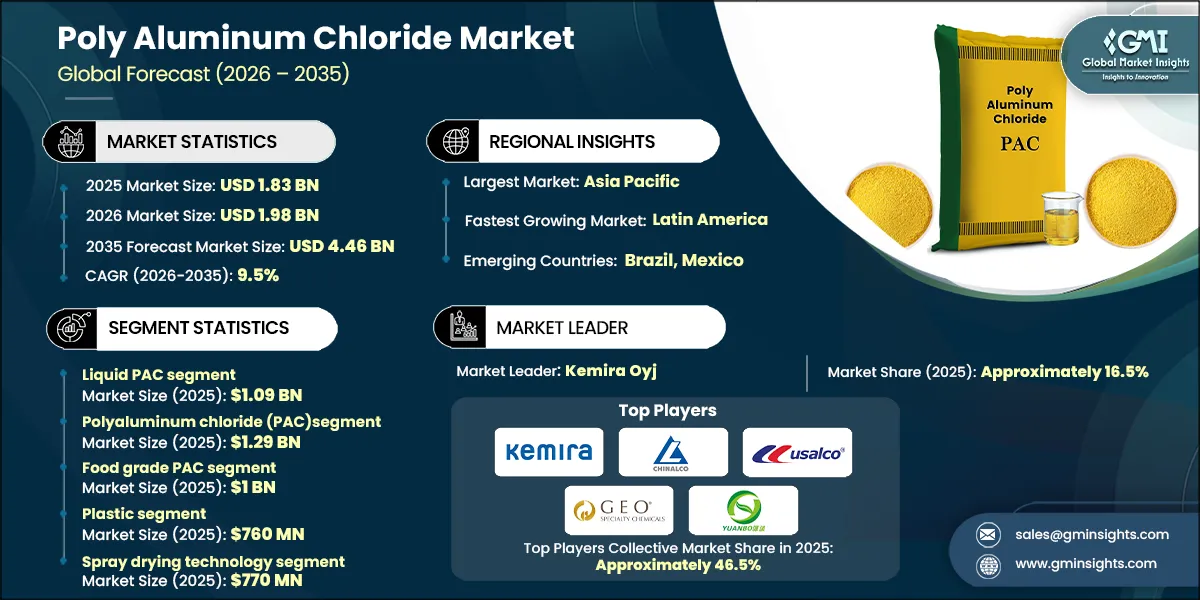
The global poly aluminum chloride market was valued at USD 1.83 billion in 2025. It is projected to grow from USD 1.98 billion in 2026 to USD 4.46 billion by 2035, representing 9.5% CAGR from 2026 to 2035, according to latest report published by Global Market Insights Inc.
Poly Aluminum Chloride Market Key Takeaways
Market Size & Growth
- 2025 Market Size: USD 1.83 Billion
- 2026 Market Size: USD 1.98 Billion
- 2035 Forecast Market Size: USD 4.46 Billion
- CAGR (2026–2035): 9.5%
Regional Dominance
- Largest Market: Asia Pacific
- Fastest Growing Region: Latin America
Key Market Drivers
- Increasing global water scarcity & treatment demand.
- Stringent drinking water quality regulations.
- Expanding industrial wastewater treatment requirements.
- Growing adoption in emerging economies.
Challenges
- Residual aluminum concerns in treated water.
- Price volatility of raw materials (aluminum, HCL).
- Competition from alternative coagulants.
Opportunity
- Nano-PAC technology development.
- Composite PAC formulations for specific applications.
- AI & IoT-enabled smart dosing systems.
- Circular economic initiatives.
Key Players
- Market Leader: Kemira Oyj led with over 16.5% market share in 2025.
- Leading Players: Top 5 players in this market include Kemira Oyj, CHALCO Advanced Material Co., Ltd., USALCO, GEO Specialty Chemicals, Henan Yuanbo Environmental Technology Co., Ltd., which collectively held a market share of 46.5% in 2025.
Get Market Insights & Growth Opportunities
- The poly aluminum chloride business is witnessing strong growth owing to the growth of demand in both municipal and industrial water treatment uses. The rapid urbanization and other infrastructure development in the emerging economies are supporting the governments to invest a huge amount of money in the drinking water and wastewater treatment plants. This has led to increased usage of poly aluminum chloride since it is very effective in the removal of turbidity and contaminants. Moreover, several issues to do with water quality standards are increasing the use of sophisticated coagulants like poly aluminum chloride.
- Another major aspect that favors growth of the market is increasing industrialization in the textiles, pulp and paper, chemicals and food processing sectors. The industries produce a huge quantity of wastewater that has to be successfully treated and then discharged. Poly aluminum chloride has a higher coagulation rate and low sludge formation when compared to traditional coagulants, thus it is better than the traditional coagulants. The sustained growth of industrial activities is thus translating into its sustained demand of poly aluminum chloride.
- The rising trend of focusing on cost effective and sustainable methods of treating water is also enhancing the market prognosis. The development of poly aluminum chloride has led to a rise in the efficiency of treatment and lower dosage levels and general cost of operation. This has made it competitive to the traditional options like alum and ferric salts. Consequently, the change towards the use of poly aluminum chloride based solutions is gradually going towards the utilities and industrial users.
- The strategic efforts by manufacturers such as capacity expansions, regional distribution strengthening, and customization of products also contribute to growth in the market. Research and development is also making it possible to launch application specific grades that can apply in different water conditions. These are strategies that are enhancing availability of its products as well as uniformity in their performance across the regions.
To get key market trends
Poly Aluminum Chloride Market Trends
- Poly aluminum chloride market is showing tendency towards higher end user and more performance product forms because end users require products that assist them in achieving lower dosage needs and better treatment results. Manufacturers are working on making modified PAC grades that have a higher solubility grade and coagulant grade. This change is informed by the necessity of decreasing the cost of operations and the handling of sludge in both domestic and industrial water treatment. The increase in the level of complexity of treatment is associated with an ever-growing demand of advanced formulations.
- The other current trend is the use of digital and automated water treatment systems; this is affecting the use of coagulants such as poly aluminum chloride. The adoption of smart dosing systems, real time monitoring and process optimization tools are intended to increase the accuracy of treatment and minimize chemical waste. The trend is allowing the facilities to gain better control over coagulant usage and remain on track with the regulations. The combination of digital technology and chemical treatment is transforming procurement and consumption trend in the industry.
- The poly aluminum chloride market is experiencing a transformation into more environmentally friendly supply chains and manufacturing processes that are motivated by sustainable thinking and environmental compliance. Manufacturers are also investing in the adoption of energy efficient production methods and minimizing environmental impact of their business. It is also becoming increasingly popular to find raw materials with lesser environmental impact. These actions are part of wider industry guarantees on sustainability, which strengthens the attractiveness of PAC as a relatively environmentally friendly coagulant choice over an alternative of some of the traditional.
- One of the trends is the growth of strategic partnerships and regional production centers to enhance market access and minimize the lead times. Global manufacturers are also moving in forming alliances with the local distributors and setting up production plants near the major demand centers. This strategy aids in alleviating the supply chain bottlenecks and fluctuation of currency and increasing responsiveness to local regulations.
Poly Aluminum Chloride Market Analysis
Learn more about the key segments shaping this market
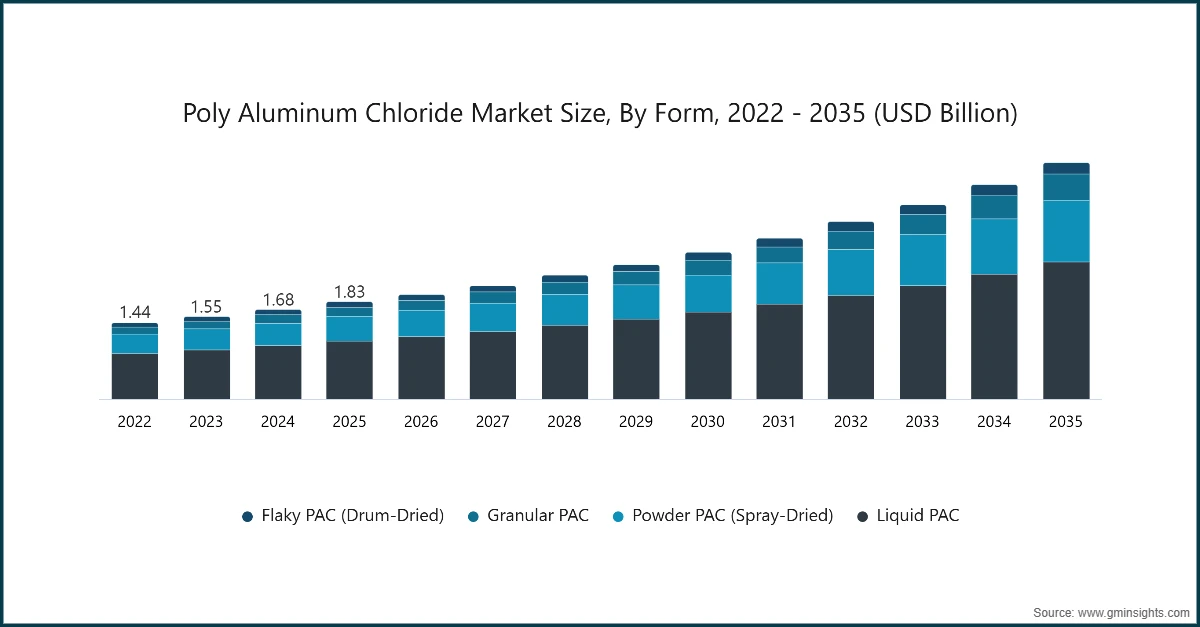
Poly aluminum chloride market based on form is segmented into standard liquid PAC, powder PAC (spray-dried), granular PAC, and flaky PAC (drum-dried). The liquid PAC segment was valued at USD 1.09 Billion in 2025, and it is anticipated to expand to 9.2% of CAGR during 2026-2035.
- Expansion in various varieties of poly aluminum chloride is highly associated with handling, dosing, and storage needs that are application-based. The use of liquid PAC is being adopted into large-scale municipal and industrial treatment plants because it is easy to pump, uniform dosing and quicker reaction time in water treatment operations. The use of powder, granular and flaky is gaining more acceptance in areas with disaggregated treatment facilities, where transportation efficiency, longer shelf life, and versatile use play an important role. This variety of form application indicates a change in the market orientation of operation flexibility, and not the standard product adoption.
- Small to medium size facilities and remote sites, where liquid logistics tend to be difficult, are also adopting powder (spray-dried), granular and flaky (drum-dried) PAC. Such forms enhance the decentralized water treatment models and seasonal demand variability. Granular and flaky PAC is especially being used where there is need to control dissolution as well as caking. The increasing demand in numerous physical forms signifies market growth in the form of customization and appropriateness to diverse end-user operating cultures.
Poly aluminum chloride market based on product type is segmented into polyaluminum chloride (PAC), polyaluminum chlorosulfate (PACS), aluminum chlorohydrate (ACH), composite PAC, and nano-PAC. The polyaluminum chloride (PAC)segment was valued at USD 1.29 billion in 2025, and it is anticipated to expand to 9.2% of CAGR during 2026-2035.
- The evolution in the market of varied types of products indicates a growing differentiation on the basis of performance requirements and water chemical conditions. Traditional poly aluminum chloride remains quite popular because it offers a cost-to-performance spectrum which is balanced between municipal and industrial applications. Simultaneously, polyaluminum chlorosulfate and composite PAC are being implemented whereby a complex wastewater mix requires improved coagulation and stability. This is an indication of a change towards customized chemical solutions as opposed to the one size fits all approach to treatment.
- High-technology versions like aluminum chlorohydrate and nano-PAC are aiding market expansion in areas that demand the purity, rate of floc formation as well as reduced residual aluminum levels. Such types of products are also being considered in terms of specialized drinking water and expensive industrial processes. The progressive incorporation of the nano-enabled formulations is also an indicator of the innovative idea in its initial stage in the market. In general, product type growth is encouraged by the growing performance requirements and a change in regulatory and quality demands.
Poly aluminum chloride market based on grade is segmented into food grade PAC, drinking water grade PAC, industrial grade PAC, and filter grade PAC. The food grade PAC segment was valued at USD 1 billion in 2025, and it is anticipated to expand to 9.3% of CAGR during 2026-2035.
- The high quality standards in food processing, drinking water and industrial businesses influence market growth across PAC grades. There are even increased applications of food grade and drinking water grade PAC owing to the stricter safety standards and growing interest in chemical residues. The procurement practices are being affected by the focus of the utilities and processors on certified and traceable inputs. This tendency is increasing the pressure on more purity grades with regulated chemical composition.
- PAC has also been used in wastewater and filtration systems applications as well as in process water where industrial and filter grade PAC have continued to support market growth. They are selected to be preferred by their practical utility and cost congruence in non-consumable applications. The demands across the grades are being strengthened by the growing volumes of industrial wastewater and reuse programs. The grade-based segmentation shows that the market is expanding with compliance-based differentiation and application-based quality standards.
Poly aluminum chloride market based on basicity is segmented low basicity, medium basicity, high basicity, and ultra-high basicity. The plastic segment was valued at USD 0.76 billion in 2025, and it is anticipated to expand to 9.3% of CAGR during 2026-2035.
- Increasing awareness of the sensitivity of coagulation performance to water traits is characterized by growth by basicity level. PAC with both low and medium basicity are also finding applications in applications which have variations in raw water quality because they have a consistent performance at different pH and turbidity levels. These ranges embrace flexibility in treatment operation and are being incorporated in the municipal and industrial systems. Their utilization depicts expansion in the market based on operational consistency and not concentration per se.
- High and ultra-high basicity PAC are being used in high-technology installations in pursuit of fewer sludge and lower dosage levels. These are also making more variants on high-efficiency plants and water reuse systems. Their excellent capacity to work at reduced chemical inputs is in line with changing practices of optimization of the treatment.
Poly aluminum chloride market based on manufacturing process is segmented into spray drying technology, drum drying technology, electrodialysis process, and acid-soluble aluminum ash method. The spray drying technology segment was valued at USD 0.77 billion in 2025, and it is anticipated to expand to 9% of CAGR during 2026-2035.
- Growing market through manufacturing process indicates growing concern on consistency of the products, scalability and efficiency of the production process. The use of spray drying technology is facilitating increased use of powdered PAC through the ability to achieve homogeneous particle most size, enhanced solubility, and stability in chemical characteristics. This is a well-timed process since the growth in demand is pursued by the decentralized treatment facilities and export-driven suppliers.
- Cost optimization and resource efficiency encompass the use of drum drying technology, and other methods such as electrodialysis, acid soluble aluminum ash, etc. Application drying of flake-form PAC is still being used in applications requiring controlled dissolution and long-term storage. Processes using electrodialysis and aluminum ash are being considered as having the ability to minimize impurities and use secondary sources of aluminum.
Poly aluminum chloride market based on end-user industry is segmented into water treatment, pulp & paper industry, textiles industry, oil & gas industry, pharmaceutical & cosmetics, and others. The water treatment segment was valued at USD 1.2 billion in 2025, and it is anticipated to expand to 9.2% of CAGR during 2026-2035.
- The market is growing in the end-user sectors due to the growing water quality management demands outside of the municipal system. The applications of water treatment have been expanded and now include drinking water, wastewater reuse, and industrial effluents treatment. This is the promotion of long-term intake of PAC at various levels of treatment. Water treatment is evolving into an ongoing operation priority and not a compliance-based activity, a fact that is making the market grow.
- Pulp and paper, textile, oil and gas, pharmaceutical, as well as cosmetics industries are also adding to the growth of the markets with increasing intensity of wastewater treatment. These industries produce multi complicated effluents which need effective coagulation and elimination of contaminated effluents. PAC has entered the treatment processes to enhance the quality of water reuse and discharges.
Learn more about the key segments shaping this market
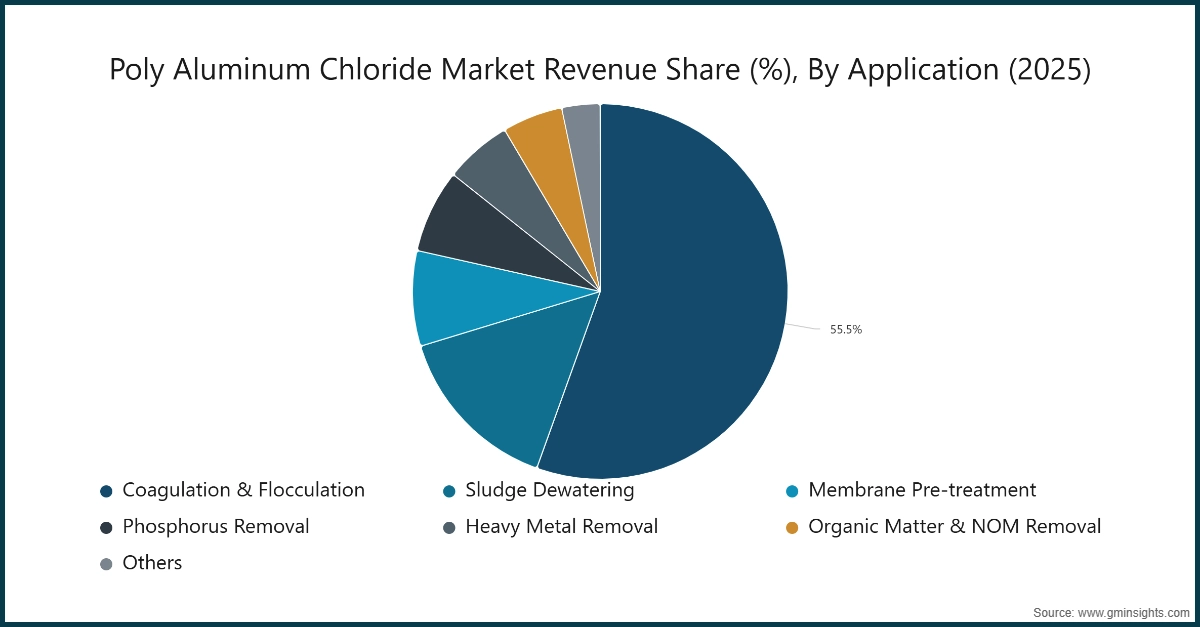
Poly aluminum chloride market based on application is segmented into coagulation & flocculation, sludge dewatering, membrane pre-treatment, phosphorus removal, heavy metal removal, organic matter & NOM removal, and others. The coagulation & flocculation segment was valued at USD 1.02 billion with a market share of with a market share of 55.5% in 2025, and it is anticipated to expand to 9.2% of CAGR during 2026-2035.
- The use of coagulation and flocculation have stayed constant, whereas PAC has increasingly been applied in a more strategic manner in order to benefit the downstream processes. The use of sludge dewatering and membrane pre-treatment applications is growing because treatment plants take into consideration the operational efficiency and low-cost maintenance. Diversification of its application is transforming the consumption trends.
- Phosphorus removal, heavy metal removal and organic matter and NOM reduction are some of the advanced applications that are aiding the market growth in areas with tougher discharging standards. The flexibility of PAC to the various contaminant profiles is allowing application of PAC in the treatment of specialized purposes. With the progression of treatment systems at the higher performance and reuse scale, PAC is increasingly finding a role as a supporting chemical in various steps.
Looking for region specific data?
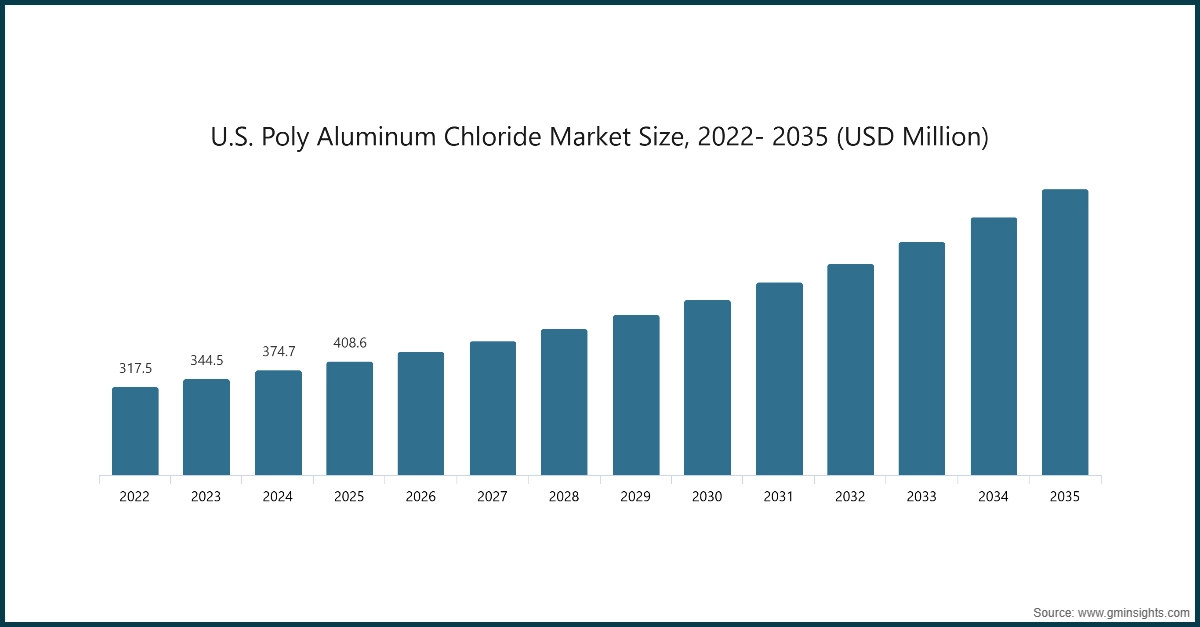
The North America poly aluminum chloride market accounted for USD 0.46 billion in 2025 and is anticipated to show lucrative growth over the forecast period.
The market in North America is on the steady growth due to the increased investment in aging water systems and the stricter regulatory requirements of the potable and wastewater treatment. The trend is towards budget allocations by the municipal utilities and industrial users to the more advanced coagulation solutions which enhance the efficiency of treatment and lower the cost of sludge handling. Among the states, the United States can be distinguished by a faster adoption of high-performance grades of PAC with the assistance of federal and state-level funding programs directed at the modernization of treatment facilities. Rising awareness on water reuse program and strict contaminant discharge restrictions are supporting the demand of PAC in the municipal and industrial segments.
The Europe poly aluminum chloride market accounted for USD 0.38 Billion in 2025 and is anticipated to show lucrative growth over the forecast period.
The market is developing in Europe as the regulatory bodies undergo changes to compel them to have stringent water quality and effluent discharge streams. Modernization of treatment plant and application of optimized chemical dosing is the priority of the countries in achieving the environmental compliance and circular economic objectives. There is a positive trend in Germany (especially) where industrial wastewater management activities are strong, and significant investments in sustainable technology are made by the government and industries. German utilities and industrial operators are incorporating custom PAC formulations to improve coagulation, phosphorus removal and membrane pre-treatments. This interest in water treatment solutions that are both efficient and sustainable is adding value to the expansion of markets in the region.
Asia Pacific poly aluminum chloride market accounted for 43.5% market share in 2025 and is anticipated to show lucrative growth over the forecast period.
Asia-Pacific market is growing at a high rate that is driven by massive urbanization, industrialization, and water scarcity issues. Governments in the region are focusing more on the water quality improvement programs as well as the construction of major infrastructures and this has generated a lot of pressure on the use of the effective coagulants. China is also becoming the fastest-growing market in the APAC because of the aggressive development of municipal and industrial water and wastewater treatment units. The consumption of PAC is further increasing due to the rapid development in areas like textiles, chemicals, and food processing. The ongoing development of technologies in the treatment business, the active participation of environmental regulations in the country to decrease the loads of pollutants, contributes to stable market growth.
Latin America poly aluminum chloride market is anticipated to grow at a CAGR of 10.8% during the analysis timeframe.
Latin America market will increase steadily in the future as the water and wastewater treatment infrastructure are re-examined. Some of the factors affecting market expansion are economic development, growth in the urban population and the need to have readily available clean water. The regional growth is taking place in Brazil where both municipal and industrial treatment projects are undergoing massive investments. The threat to the quality of effluents and contamination of fresh water sources through the regulation effort is causing the utilities to consider the use of effective coagulants such as PAC. Along with this, Brazil has emphasized on the renovation of old structures and infrastructures as well as increasing the availability of safe drinking water, which is driving a better demand curve towards poly aluminum chloride.
Middle East & Africa poly aluminum chloride market is expected to grow at a CAGR of 10.3% during the analysis timeframe.
The market is improving in the Middle East and Africa due to the growing demand for efficient water treatment technologies in the arid regions, where the problem of insufficient water is one of the most acute problems. To guarantee sustainable water, countries are spending a lot of money on desalination, wastewater reuse as well as advanced treatment facilities. The kingdom of Saudi Arabia is undergoing a significant pace of market development due to its ambitious national water policies and its massive infrastructural projects that would be used in improving the industries and municipal water treatment. There is an increase in the adoption of high-performance PAC grades because the operators aim to achieve high coagulation rates, reduce the amount of chemicals used, and meet the high environmental and reuse requirements within the region.
Poly Aluminum Chloride Market Share
- Kemira Oyj, CHALCO Advanced Material Co., Ltd., USALCO, GEO Specialty Chemicals, and Henan Yuanbo Environmental Technology Co., Ltd. are a significant part of the market and with further standing of being slightly consolidated with the top five players steadily holding 46.5% market share in the year 2025.
- Concentrate on the innovation of products on a continuous basis to improve the performance of treatment and achieve the required water quality to improve more efficient coagulation, less sludge development and lower operational costs to the end-users.
- Growth of production facilities and geographical coverage in order to offer reliability in the supply of major growth areas in order to provide faster supply times and responsiveness to changes in demand in the regions.
- Strategic alliances and channels of distribution enhance accessibility to market and services to customers, enabling quick entry into the new and available markets with localized services.
- Research and development to develop product formulations that are suitable to particular uses (e.g., grade of high basicity, specialty PAC derivatives), to match the levels of various water in different end-user markets.
- There are cost optimization and scale efficiencies achieved by sophisticated manufacturing processes and economies of scale which keep the prices competitive without reducing on quality.
- Technical support and customer-centric training of water treatment facilities enhance the result of the treatment process and the establishment of long-lasting relations with clients, strengthening the recurring procurement.
- Adherence to regulatory and sustainability standards increases the credibility of the market, because the products are consistent with the strict environmental requirements and contribute to the environmentally friendly treatment objectives.
- Buyer preference in the municipal and industrial markets is affected by brand reputation and trust-building practices that is created after constant performance delivery, reliability, and quality assurance.
- Market insights and specific solutions make it possible to react to any regional trends, say, more intensive water reuse or stricter discharge standards, place an offer in a vanguard of a change in industry demands.
Poly Aluminum Chloride Market Companies
The major players operating in poly aluminum chloride industry include:
- Kemira Oyj
- CHALCO Advanced Material Co., Ltd.
- USALCO
- GEO Specialty Chemicals
- Henan Yuanbo Environmental Technology Co., Ltd.
- Others
•Kemira Oyj pays attention to sophisticated coagulant formulations and technical service, which enables the treatment plants to be more effective and use less chemical. Innovation, application expertise and their geographical localization keep the company relevant in the market.
•CHALCO Advanced Material Co., Ltd. enjoys integrated production and good access to raw materials to provide the stable quality of PAC grades. The focus on supply scaling and satisfying the needs of regional authorities helps to maintain its involvement in the market.
•USALCO also focuses on customized water treatment systems and customer training, which allow optimizing the use of PAC. Close working with municipal and industrial users strengthens the presence of the company in the market.
•GEO Specialty Chemicals is devoted to the development of products with performance orientation guaranteeing that the variations of PAC response to the changes in the treatment needs. The attractive nature of the various applications can be maintained because of continuous improvement and the ability to formulate them flexibly.
•Henan Yuanbo Environmental Technology Co., Ltd. has made cost-effective production and flexible product supply under different water conditions as its priorities. Its competitive position is maintained by strong regional distribution and attention to the end-user needs.
Poly Aluminum Chloride Market Report Attributes
| Key Takeaway | Details |
|---|---|
| Market Size & Growth | |
| Base Year | 2025 |
| Market Size in 2025 | USD 1.83 Billion |
| Market Size in 2026 | USD 1.98 Billion |
| Forecast Period 2026-2035 CAGR | 9.5% |
| Market Size in 2035 | USD 4.46 Billion |
| Key Market Trends | |
| Drivers | Impact |
| Increasing global water scarcity & treatment demand | Expanding building activity boosts professional paint roller demand |
| Stringent drinking water quality regulations | Homeowners increase retail sales of convenient roller products |
| Expanding industrial wastewater treatment requirements | Demand rises for rollers compatible with eco-friendly coatings |
| Growing adoption in emerging economies | Specialty rollers needed for hygienic and medical surface applications |
| Pitfalls & Challenges | Impact |
| Residual aluminum concerns in treated water | Low-cost alternatives limit premium roller market growth |
| Price volatility of raw materials (aluminum, HCL) | Spray technologies reduce roller usage in large projects |
| Competition from alternative coagulants | Fluctuating foam and fabric costs pressure manufacturer margins |
| Opportunities: | Impact |
| Nano-PAC technology development | Sustainable roller options attract environmentally conscious buyers |
| Composite PAC formulations for specific applications | Healthcare projects drive uptake of specialized roller materials |
| AI & IoT-enabled smart dosing systems | Sensor-enabled rollers support productivity and controlled paint usage |
| Circular economic initiatives | Construction growth in developing regions increases roller consumption |
| Market Leaders (2025) | |
| Market Leader |
Market Share Approximately 16.5% |
| Top Players |
Collective Market Share Approximately 46.5% |
| Competitive Edge |
|
| Regional Insights | |
| Largest Market | Asia Pacific |
| Fastest growing market | Latin America |
| Emerging countries | Brazil, Mexico |
| Future outlook |
|
What are the growth opportunities in this market?
Poly Aluminum Chloride Market News
- On January 15, 2026, Kemira and Hazer Group Ltd signed a memorandum of understanding to develop methane pyrolysis technology deployment and the test of Hazer carbon application in the treatment of water. This may have an impact on the market of PAC by potentially offering complementary carbon materials in the process of adsorption and control of pollution in complex effluents, which is an indication of trends in innovation as opposed to conventional coagulants.
- On January 9, 2026, Kemira Oyj has acquired AquaBlue, Inc., which will enhance its position in the industrial water and wastewater treatment business in North America, combining the service skill of AquaBlue with the solutions offered by Kemira. This is a major step to the PAC market because it facilitates wider service-based products, and not only chemicals, which end-users embrace in the industrial water treatment.
The poly aluminum chloride market research report includes in-depth coverage of the industry with estimates & forecasts in terms of revenue (USD Billion) & (Kilo Tons) from 2022 to 2035, for the following segments:
Market, By Form
- Liquid PAC
- Powder PAC (spray-dried)
- Granular PAC
- Flaky PAC (drum-dried)
Market, By Product type
- Polyaluminum chloride (PAC)
- Polyaluminum chlorosulfate (PACS)
- Aluminum chlorohydrate (ACH)
- Composite PAC
- Nano-PAC
Market, By Grade
- Food grade PAC
- Drinking water grade PAC
- Industrial grade PAC
- Filter grade PAC
Market, By Basicity
- Low basicity
- Medium basicity
- High basicity
- Ultra-high basicity
Market, By Manufacturing Process
- Spray drying technology
- Drum drying technology
- Electrodialysis process
- Acid-soluble aluminum ash method
Market, By End-User Industry
- Water treatment
- Pulp & paper industry
- Textiles industry
- Oil & gas industry
- Pharmaceutical & cosmetics
- Others
Market, By Application
- Coagulation & flocculation
- Sludge dewatering
- Membrane pre-treatment
- Phosphorus removal
- Heavy metal removal
- Organic matter & NOM removal
- Others
The above information is provided for the following regions and countries:
- North America
- U.S.
- Canada
- Europe
- UK
- Germany
- France
- Italy
- Spain
- Rest of Europe
- Asia Pacific
- China
- India
- Japan
- South Korea
- Australia
- Rest of Asia Pacific
- Latin America
- Brazil
- Mexico
- Argentina
- Rest of Latin America
- MEA
- UAE
- Saudi Arabia
- South Africa
- Rest of Middle East and Africa
Frequently Asked Question(FAQ) :
What was the market size of the poly aluminum chloride market in 2025?
The market size was USD 1.83 billion in 2025, with a CAGR of 9.5% expected from 2026 to 2035, driven by increasing demand for advanced water treatment solutions and cost-efficient coagulants.
What is the projected value of the poly aluminum chloride market by 2035?
The market is expected to reach USD 4.46 billion by 2035, fueled by advancements in product formulations, rising adoption of digital water treatment systems, and growing industrial applications.
What is the projected size of the liquid PAC segment in 2026?
The liquid PAC segment is anticipated to reach USD 1.09 billion in 2026, with a CAGR of 9.2% during the forecast period (2026-2035).
How much revenue did the polyaluminum chloride (PAC) segment generate in 2025?
The polyaluminum chloride (PAC) segment generated USD 1.29 billion in 2025 and is projected to grow at a CAGR of 9.2% from 2026 to 2035.
What was the valuation of the food grade PAC segment in 2025?
The food grade PAC segment was valued at USD 1 billion in 2025 and is expected to grow at a CAGR of 9.3% during the forecast period (2026-2035).
Which region leads the poly aluminum chloride market?
North America led the market with USD 0.46 billion in 2025, driven by strong industrial infrastructure and increasing demand for advanced water treatment solutions.
What are the upcoming trends in the poly aluminum chloride industry?
Key trends include the development of modified PAC grades with higher solubility and coagulant properties, adoption of digital and automated water treatment systems, and the integration of smart dosing systems and real-time monitoring tools to optimize chemical usage and ensure regulatory compliance.
Who are the key players in the poly aluminum chloride market?
Key players include Kemira Oyj, CHALCO Advanced Material Co., Ltd., USALCO, GEO Specialty Chemicals, and Henan Yuanbo Environmental Technology Co., Ltd.
Poly Aluminum Chloride Market Scope
Related Reports