Summary
Table of Content

Plenoptic Camera Market
Get a free sample of this report
Form submitted successfully!
Error submitting form. Please try again.
Thank you!
Your inquiry has been received. Our team will reach out to you with the required details via email. To ensure that you don't miss their response, kindly remember to check your spam folder as well!
Request Sectional Data
Thank you!
Your inquiry has been received. Our team will reach out to you with the required details via email. To ensure that you don't miss their response, kindly remember to check your spam folder as well!
Form submitted successfully!
Error submitting form. Please try again.
Plenoptic Camera Market Size
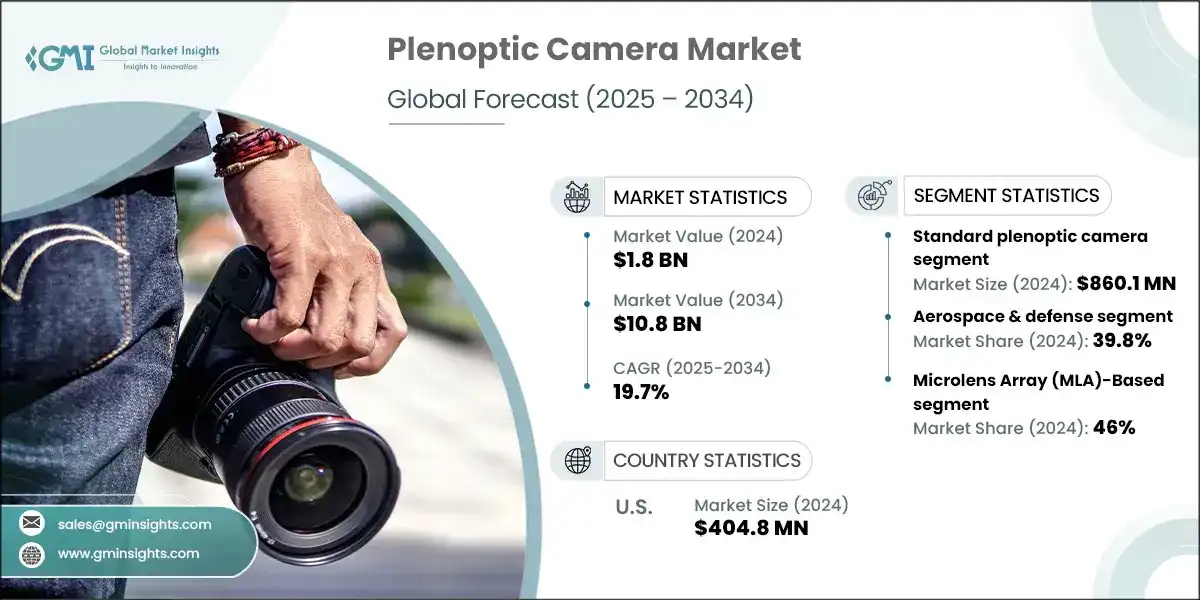
The global plenoptic camera market was valued at USD 1.8 billion in 2024 with a volume of 1,11,996 units. The market is expected to grow from USD 2.1 billion in 2025 to USD 5.1 billion in 2030 and USD 10.8 billion in 2034, growing at a CAGR of 19.7% during the forecast period of 2025-2034, according to Global Market Insights Inc.
Plenoptic Camera Market Key Takeaways
Market Size & Growth
- 2024 Market Size: USD 1.8 billion
- 2034 Forecast Market Size: USD 10.8 billion
- CAGR (2025–2034): 19.7%
Key Market Drivers
- Rising adoption in 3D imaging and computer vision.
- Expansion of AR/VR and immersive media applications.
- Development of compact, mobile-compatible plenoptic modules.
- Integration in medical imaging and life sciences.
- Use in autonomous vehicles and smart transportation.
Challenges
- High implementation and hardware integration costs.
- Competition from alternative 3D imaging and depth-sensing technologies.
Opportunity
- Increasing adoption in emerging imaging applications.
- Advancements in computational imaging and software optimization.
Key Players
- Market Leader: Lytro led with over 38% market share in 2024.
- Leading Players: Top 5 players in this market include Lytro, Raytrix, Pelican Imaging, Intel RealSense, Canon, which collectively held a market share of 63.1% in 2024.
Get Market Insights & Growth Opportunities
- The growing need for advanced imaging with depth perception, refocusing, and volumetric data capture from automotive industry is one of the primary drivers of the plenoptic camera market. Also, wide applicability of Plen optic cameras in industrial inspection, medical imaging, and immersive media account is another reason expected to increase its demand from industrial sector. Moreover, enterprises, research institutions, and content creators are increasingly adopting plenoptic systems to support real-time depth mapping, 3D visualization, and enhanced post-processing flexibility. This surge in demand is amplified by applications in AR/VR, robotics, and computational photography, which require high-precision spatial imaging and robust data reconstruction, with some facilities integrating over 50–100 units per large-scale deployment.
- The transition to light-field imaging technology is significantly accelerating plenoptic camera adoption. Plenoptic systems capture both the intensity and direction of light rays, enabling capabilities such as post-capture refocusing, depth extraction, and 3D reconstruction. Early integration into industrial and creative workflows has prompted OEMs and imaging solution providers to upgrade systems, resulting in supporting the market growth.
- The integration of plenoptic cameras across a broadening array of applications beyond traditional photography and research is further driving market expansion. These systems are now being utilized in autonomous vehicles, industrial robotics, smart factories, and immersive media production. The diversification of use cases is making plenoptic cameras a core component in next-generation visual computing ecosystems, prompting continued investment in multi-lens architectures, high-resolution sensors, and AI-powered depth processing, with larger deployments often consisting of 20–50 cameras per production setup.
- In 2024, Asia Pacific dominated the plenoptic camera market with a 36% share, driven by the widespread deployment of advanced imaging systems across industrial automation, robotics, and smart factory initiatives in countries such as China, Japan, and South Korea. Also, high market share of Asia Pacific is further supported by increased investments in AR/VR, immersive media production, and autonomous vehicle testing by major technology companies and research institutions. Additionally, strong demand for high-resolution plenoptic cameras in industrial inspection, medical imaging, and content creation workflows has contributed to Asia Pacific’s prominent position in the market.
To get key market trends
Plenoptic Camera Market Trends
- The integration of plenoptic cameras into next-generation industrial, medical, and immersive media systems is accelerating globally, driven by the growing need for 3D imaging, depth mapping, and high-precision spatial data capture. Since 2020, the rapid expansion of smart factories, AR/VR content production, and autonomous vehicle testing, especially in Asia Pacific, North America, and Europe has pushed enterprises and research institutions to prioritize upgrades to high-resolution plenoptic imaging systems. This trend is expected to strengthen through 2030, with increasing applications in robotics, telemedicine, and computational photography driving plenoptic camera deployments across enterprise, industrial, and creative environments.
- Manufacturers should focus on developing high-resolution, multi-lens plenoptic cameras optimized for industrial inspection, robotics, and AR/VR workflows. Emphasis on enhanced depth accuracy, low-light performance, and AI-powered post-processing capabilities will be critical. Collaborating with technology integrators, autonomous vehicle developers, and media production studios will enable camera vendors to capture rising demand in imaging-centric applications across emerging and developed markets through 2030.
- Smart factories, autonomous vehicles, and AR/VR platforms are increasingly incorporating advanced plenoptic cameras to meet real-time depth sensing and volumetric imaging needs. These systems are gradually replacing traditional 2D imaging setups, enabling more accurate inspection, immersive content creation, and 3D perception in robotics and autonomous systems. Adoption has grown significantly since 2020 and is anticipated to expand further by 2030, driven by the need for high-resolution, spatially accurate imaging across connected and intelligent systems.
- Enterprise-grade imaging software and AI-powered computational photography tools are enhancing plenoptic camera deployment, monitoring, and post-processing optimization, particularly in industrial inspection, medical imaging, and content production workflows. Since 2020, imaging solution providers have been ramping up investment in intelligent depth processing and light-field data orchestration to meet growing performance, accuracy, and reliability demands expected to persist into the next decade.
Plenoptic Camera Market Analysis
Learn more about the key segments shaping this market
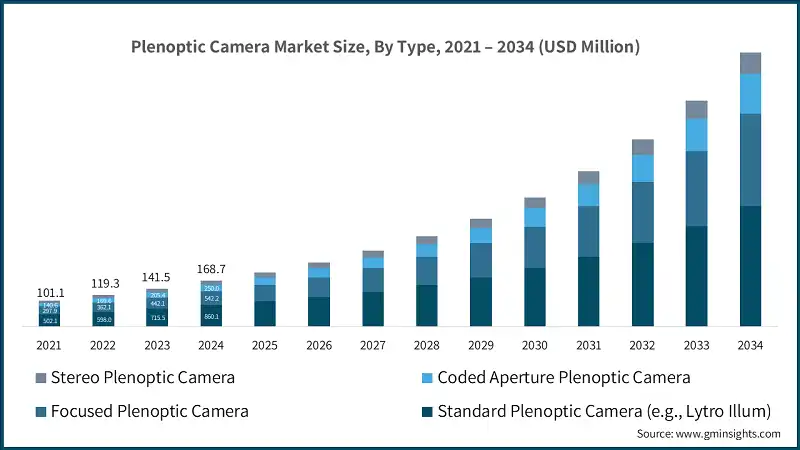
Based on the type, the market is segmented into standard plenoptic camera, focused plenoptic camera, coded aperture plenoptic camera, stereo plenoptic camera.
- In 2024, the standard plenoptic camera segment was valued at USD 860.1 million. Its dominance in the plenoptic camera market is driven by widespread usage in industrial inspection, AR/VR content creation, robotics, and medical imaging. The growing demand for high-resolution, depth-sensing imaging solutions in research institutions, creative studios, and industrial applications has significantly boosted the adoption of standard plenoptic cameras. With the global surge in autonomous systems, immersive media production, and smart manufacturing, these cameras remain a preferred choice due to their versatility, robust post-processing capabilities, and compatibility with existing imaging workflows.
- To meet the developing requirements of enterprise, creative, and industrial segments, companies are investing in R&D to develop higher-resolution, faster, and more energy-efficient standard plenoptic cameras. Enhanced depth accuracy, low-light performance, and AI-assisted image reconstruction are key innovation areas. Product adoption is further accelerated through collaborations with imaging solution providers, AR/VR studios, and robotics integrators. Leading camera manufacturers are maintaining market competitiveness by balancing performance, versatility, and cost-effectiveness across diverse end-user needs.
- The focused plenoptic camera segment is projected to grow at a CAGR of 21.2% during the forecast period of 2025–2034, driven by increasing demand for advanced imaging solutions across industries such as media & entertainment, healthcare, robotics, and industrial inspection. These cameras offer superior depth mapping, post-capture refocusing, and 3D image reconstruction capabilities, making them ideal for applications requiring precision and flexibility.
- To harness this growth opportunity, manufacturers should invest in the development of high-resolution, compact, and software-optimized focused plenoptic cameras that cater to evolving requirements in professional and industrial imaging. Emphasizing features like real-time depth processing, enhanced light-field calibration, and seamless integration with AI/ML workflows will be critical to gaining traction. Strategic collaborations with imaging software developers, OEMs, and system integrators can help extend market reach, while offering user-centric benefits such as modular designs, plug-and-play compatibility, or cloud-enabled analytics can reinforce brand value in this rapidly advancing segment.
Learn more about the key segments shaping this market
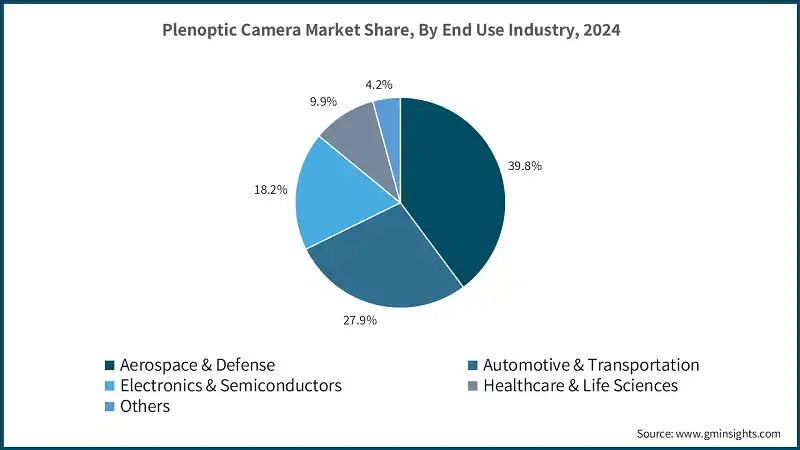
Based on end use industry, the market is divided into aerospace & defense, automotive & transportation, electronics & semiconductors, healthcare & life sciences and others.
- The aerospace & defense segment held a dominant 39.8% market share in the plenoptic camera market in 2024, driven by the increasing need for advanced imaging systems in surveillance, reconnaissance, navigation, and simulation applications. Plenoptic cameras offer significant advantages such as depth sensing, real-time refocusing, and 3D image capture—making them invaluable for mission-critical environments where precision and situational awareness are essential. The segment’s growth is further fueled by investments in autonomous drones, smart defense systems, and next-generation cockpit displays, all of which benefit from the enhanced capabilities of light-field imaging.
- The automotive & transportation segment is projected to grow at a CAGR of 20.6% from 2025 to 2034, driven by the rising integration of advanced imaging systems in autonomous vehicles, ADAS (Advanced Driver-Assistance Systems), smart traffic management, and in-vehicle AR displays. Plenoptic cameras, with their ability to capture multidimensional light-field data, enable precise depth sensing, object recognition, and real-time environmental mapping—making them critical for enhancing safety and navigation in next-generation mobility solutions. The shift toward electric and autonomous vehicles is further accelerating the demand for intelligent vision technologies across the automotive ecosystem.
- To capitalize on this growth, plenoptic camera manufacturers should focus on developing automotive-grade, low-latency imaging modules with robust environmental tolerance, compact form factors, and seamless integration into AI-powered vehicle systems. Strategic collaborations with OEMs, Tier 1 suppliers, and mobility tech firms will be vital to embed plenoptic solutions across mainstream and premium vehicle platforms. Additionally, aligning product development with evolving automotive standards and sensor fusion architectures will ensure long-term adoption and relevance in the rapidly transforming transportation sector.
Based on technology, the market is divided into microlens array (MLA)-based, multi-aperture imaging, light field imaging, others
- Microlens Array (MLA)-Based plenoptic cameras held the largest market share at 46% in 2024, owing to their widespread adoption across photography, industrial imaging, and academic research. These systems enable high-resolution depth sensing and refocusing capabilities, making them ideal for applications in 3D imaging, autonomous vehicles, and biomedical imaging. The mature design framework, compatibility with existing optical systems, and scalability for integration into compact devices further solidify MLA-based solutions as the dominant architecture in the global plenoptic camera landscape.
- Multi-Aperture Imaging systems are projected to grow at a CAGR of 21.4% from 2025 to 2034, fueled by rising demand for compact, lightweight, and high-speed imaging solutions across mobile devices, automotive applications, and robotics. This technology captures multiple perspectives simultaneously through an array of small lenses, enabling advanced features like real-time depth estimation, motion tracking, and post-capture refocusing. Its ability to deliver rich 3D data in a space-efficient format makes it particularly attractive for integration into smartphones, AR/VR headsets, and autonomous vehicle vision systems.
- To leverage this growth, manufacturers should invest in miniaturized sensor arrays, low-power processing units, and edge-AI compatibility to support real-time imaging applications. Strategic partnerships with consumer electronics brands, automotive OEMs, and wearable tech developers will further drive adoption of multi-aperture plenoptic solutions across mainstream and emerging platforms.
Looking for region specific data?
The North America plenoptic camera market accounted for a 27.9% share in 2024, driven by the growing adoption of advanced imaging technologies in sectors such as healthcare, automotive, augmented reality, and industrial inspection. The region’s strong presence of research institutions, tech companies, and investments in AI and machine vision further accelerate the demand for plenoptic cameras, enabling enhanced depth perception, 3D imaging, and improved image processing capabilities across diverse applications.
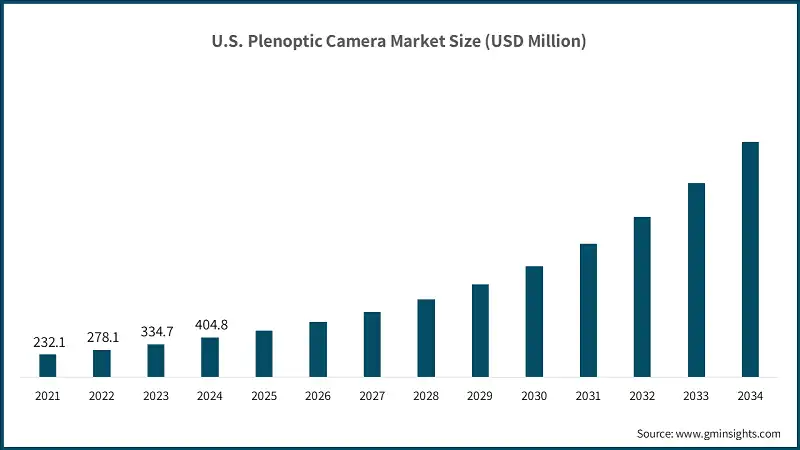
- In 2024, the U.S. plenoptic camera market was valued at USD 404.8 million. The growth is driven by increasing adoption of light-field imaging technologies in healthcare diagnostics, automotive sensing, augmented reality, and industrial inspection applications. Rising investments in AI-powered image processing and 3D visualization further propel demand for plenoptic cameras in both commercial and research sectors.
- To strengthen their position in the U.S. market, manufacturers should focus on developing advanced plenoptic camera solutions optimized for specific applications such as medical imaging, autonomous vehicles, and immersive AR/VR experiences. Strategic partnerships with technology integrators, research institutions, and key end users will be essential to capitalize on market growth while delivering scalable, high-resolution, and real-time imaging capabilities.
- The Canada plenoptic camera market is projected to grow at a robust CAGR of 18.7% during the forecast period, driven by increasing adoption of advanced imaging technologies across healthcare, automotive, and industrial sectors. Growing investments in AI-enhanced visualization, 3D imaging, and augmented reality applications are fueling demand for plenoptic cameras, particularly in research institutions and smart manufacturing initiatives.
- To expand in the Canadian market, plenoptic camera manufacturers should focus on key verticals such as medical imaging, autonomous systems, and industrial inspection. Collaborating with local technology integrators, academic research centers, and government programs will be crucial to deepen market penetration. Additionally, offering innovative, cost-effective, and energy-efficient solutions tailored to meet the evolving needs of Canadian industries will be key to capturing value in this rapidly growing market.
The Europe plenoptic camera market is projected to grow at a strong CAGR of 19% during 2025–2034. This growth is driven by increasing investments in advanced imaging technologies for healthcare, automotive, industrial automation, and augmented reality applications. The region’s focus on digital sovereignty, AI integration, and smart manufacturing through initiatives like “Digital Europe” and “Industry 5.0” is further accelerating the adoption of plenoptic cameras across diverse sectors, enhancing imaging capabilities and data accuracy.
- The U.K. plenoptic camera market is projected to reach USD 590.6 million by 2034, driven by strong demand from healthcare imaging, automotive sensing, augmented reality, and industrial inspection sectors. The country’s focus on innovation, AI integration, and advanced manufacturing technologies is fueling adoption of plenoptic cameras in both research and commercial applications.
- Manufacturers targeting the U.K. market should prioritize developing energy-efficient, high-resolution plenoptic camera systems tailored for medical diagnostics, autonomous vehicles, and immersive AR experiences. Compliance with local data privacy and quality standards, along with partnerships with leading research institutions, automotive OEMs, and tech integrators, will be essential to maximize market reach and impact.
- The Germany plenoptic camera market accounted for USD 92.3 million in 2024, supported by the country’s strong industrial and research infrastructure, early adoption of AI-driven imaging technologies, and growing demand across automotive, healthcare, and manufacturing sectors. Increasing investments in smart factories, autonomous systems, and medical diagnostics are driving the need for advanced plenoptic camera solutions.
- To effectively tap into the German market, plenoptic camera manufacturers should focus on delivering high-precision, energy-efficient imaging systems optimized for industrial automation, automotive sensing, and healthcare applications. Collaborations with leading automotive OEMs, research institutions, and industrial automation providers will be key to expanding market presence. Leveraging Germany’s commitment to Industry 4.0 and AI innovation can provide a strategic advantage in this technology-driven market.
Asia Pacific accounted for 36% of the plenoptic camera market in 2024, fueled by rapid growth in electronics manufacturing, expanding AI and machine vision applications, and increasing adoption of augmented reality, autonomous systems, and industrial inspection technologies across key economies such as China, India, Japan, and South Korea. Government initiatives supporting smart cities, digital transformation, and innovation in healthcare and automotive sectors are further driving demand for advanced plenoptic camera solutions throughout the region.
- The China plenoptic camera market is expected to grow at a robust CAGR of 21.5% during the forecast period 2025–2034, driven by the country’s rapid advancements in AI, cloud computing, and electronics manufacturing. Expanding smart city initiatives, growing demand for autonomous vehicles, and increasing adoption of industrial automation technologies are fueling the need for advanced plenoptic imaging solutions. China’s role as a global technology hub and its investments in high-precision optics further amplify domestic market growth.
- To effectively capture opportunities in China’s dynamic market, plenoptic camera manufacturers should focus on localized product innovation and strategic partnerships with leading Chinese OEMs, AI developers, and industrial integrators. Compliance with national cybersecurity regulations and alignment with Chinese-developed computing platforms will be essential to unlock the region’s full market potential.
- The Japan plenoptic camera market is expected to reach USD 619.8 million by 2034, driven by the country’s advanced electronics industry, growing demand for high-performance imaging in industrial automation, and widespread adoption of AI-powered applications. Japan’s strong leadership in robotics, automotive innovation, and semiconductor manufacturing fuels continuous investments in imaging technologies that require precise and scalable plenoptic camera solutions.
- To capture growth in Japan, manufacturers should focus on delivering high-reliability plenoptic cameras optimized for industrial IoT, automotive-grade systems, and advanced robotics. Partnerships with local OEMs, component suppliers, and government-backed R&D programs will be key to gaining market traction. Adhering to Japan’s rigorous quality standards and supporting edge computing use cases will further enhance competitive positioning in this precision-driven market.
- The India plenoptic camera market is expected to grow at a strong CAGR of 22.6% during the forecast period, driven by rapid digital transformation, expanding data center infrastructure, and government initiatives such as Make-in-India and Digital India. Increasing adoption of AI/ML applications, cloud computing, and enterprise digitization across BFSI, healthcare, and education sectors is fueling demand for high-performance, cost-effective plenoptic camera solutions. Additionally, a growing base of tech-savvy consumers and startups is accelerating the need for advanced imaging in AR/VR, autonomous systems, and industrial inspection.
- To capitalize on India’s fast-growing market, plenoptic camera manufacturers should focus on affordable, scalable imaging solutions tailored for SMBs, hyperscalers, and government IT projects. Collaborations with domestic system integrators, cloud providers, and electronics OEMs will enhance market penetration. Localizing production and aligning with national policy priorities will further strengthen competitiveness and ensure sustained growth in this dynamic economy.
The Latin America plenoptic camera market was valued at USD 148.3 million in 2024, driven by increasing investments in digital infrastructure, expanding data centers, and modernization of enterprise IT systems. Countries like Brazil, Mexico, and Chile are seeing growing adoption of cloud services, AI-powered imaging, and advanced computing across sectors such as banking, telecommunications, and education fueling demand for reliable, high-performance plenoptic camera solutions.
The Middle East & Africa (MEA) plenoptic camera market is anticipated to reach USD 81.4 million by 2034, driven by growing investments in digital infrastructure, national transformation initiatives, and rising demand for advanced imaging technologies in smart cities, education, and public sector modernization. Programs like Saudi Arabia’s Vision 2030 and the UAE’s Smart Dubai are accelerating the adoption of AI, cloud computing, and smart governance, all of which are boosting demand for high-performance plenoptic camera solutions in data centers, surveillance, and connected device ecosystems.
- The South Africa plenoptic camera market is projected to grow at a CAGR of 18.1% during the forecast period, driven by gradual advancements in digital infrastructure, increasing adoption of AI-powered imaging solutions, and modernization initiatives across sectors such as education, public services, and financial institutions. Rising demand for smart surveillance, industrial inspection, and healthcare imaging is accelerating the uptake of high-performance plenoptic cameras in the region.
- To strengthen the market position in the South African market, plenoptic camera providers should focus on delivering affordable, energy-efficient systems tailored for developing IT and industrial ecosystems. Also, collaborations with local resellers, government ICT agencies, and academic institutions will be key to expanding reach and supporting digital transformation, while addressing regional challenges like power constraints, budget limitations, and infrastructure readiness.
- The Saudi Arabia plenoptic camera market was valued at USD 15 million in 2024, driven by national initiatives under Vision 2030 that prioritize digital transformation, smart infrastructure, and technological innovation. The expansion of data centers, increasing investment in AI-powered public services, and the integration of advanced imaging in sectors like education, healthcare, and smart cities are fueling demand for plenoptic camera solutions across the Kingdom.
- To capitalize on growth opportunities in Saudi Arabia, plenoptic camera manufacturers should align their offerings with Vision 2030 priorities—focusing on high-precision, secure imaging systems for smart governance, healthcare digitization, and cloud-based educational platforms. Strategic partnerships with government agencies, telecom providers, and public sector IT integrators will be essential for building a strong market presence and enabling sustained growth in this rapidly evolving digital ecosystem.
- The UAE plenoptic camera market is projected to grow at a CAGR of 19.3% during the forecast period (2025–2034), supported by national digital transformation efforts, expanding cloud infrastructure, and government-led AI initiatives. Demand is rising for advanced imaging technologies in sectors such as smart cities, education, and public services, where high-precision, real-time visual data is essential.
- To strengthen their presence in the UAE, plenoptic camera manufacturers should focus on delivering enterprise-grade imaging systems tailored for smart infrastructure, government data centers, and AI-driven applications. Strategic collaborations with public sector tech agencies, system integrators, and local IT providers will be vital for tapping into national innovation goals and meeting the growing demand for intelligent visual solutions.
Plenoptic Camera Market Share
- The plenoptic camera industry is moderately consolidated, with the top five players—Lytro, Raytrix, Pelican Imaging, Intel RealSense, and Canon—collectively accounting for 63.1% of the market share in 2024. This concentration highlights the dominance of a few innovative imaging companies, each leveraging proprietary technologies and specialized applications to maintain competitive advantage.
- Lytro leads the market with a 24% share, driven by its pioneering role in light field imaging technology. The company’s focus on depth mapping, refocusing capabilities, and VR/AR integration has positioned it at the forefront of high-end computational photography and immersive imaging solutions.
- Raytrix follows with a 14% market share, specializing in industrial and scientific plenoptic camera systems. Its strength lies in high-resolution 3D imaging, particularly for applications in robotics, microscopy, and quality inspection.
- Pelican Imaging holds a 10% share, recognized for its compact light field camera modules suitable for mobile devices and AR applications. Its emphasis on miniaturization and integration with consumer electronics makes it a key player in portable 3D imaging technologies.
- Intel RealSense captures 8.5% of the market, known for combining light field imaging with real-time depth sensing. Its application in robotics, gesture control, and spatial computing has broadened its relevance across multiple smart device ecosystems.
- Canon, with a 6.5% market share, brings its legacy in optics and imaging to the plenoptic space, focusing on professional photography and emerging industrial imaging solutions. Its integration of light field capabilities into conventional camera formats supports adoption in both creative and technical domains.
Plenoptic Camera Market Companies
The major companies operating in the plenoptic camera industry are:
- Apple
- Canon
- FoVI 3D, Inc.
- Fraunhofer IZM
- imec
- Intel RealSense
- Light Field Lab
- Lytro
- Microsoft
- Nokia
- Pelican Imaging
- Raytrix
- Sony
- TNO
- Zebra Medical Vision
- Ricoh Company, Ltd.
- Toshiba Corporation
- Magic Leap
- Samsung Electronics
- Panasonic Corporation
- Leia Inc.
- Japan Display Inc.
- Meta Platforms (formerly Facebook Reality Labs)
- Himax Technologies, Inc.
- Leading players in the plenoptic camera market include Lytro, Raytrix, Pelican Imaging, Intel RealSense, and Canon. These companies dominate the global market owing to their technological leadership in light field imaging, depth mapping, and computational photography. Their stronghold is supported by proprietary software-hardware integration, advanced R&D capabilities, and strategic partnerships across industries such as VR/AR, medical imaging, autonomous systems, and industrial inspection.
- Challenger companies such as Light Co., Pi Imaging Technology, and Ricoh Imaging are gaining momentum by targeting emerging use cases in mobile photography, consumer electronics, and robotics. These firms focus on delivering compact, cost-effective plenoptic solutions with user-friendly interfaces, though they remain limited in terms of adoption across high-end industrial and enterprise-grade applications.
- Market followers like Panasonic, Xiaomi, and Sony (experimental divisions) explore light field imaging as part of broader innovation portfolios. While their work in camera sensors and imaging systems lends them technical credibility, their plenoptic camera initiatives are often in early or conceptual stages, and lack the market penetration and specialization of category leaders.
- Niche and emerging players such as Raytrix GmbH (industrial focus), Quidient, and Focal Point Positioning cater to specialized domains like medical imaging, machine vision, and spatial intelligence. These companies differentiate themselves through precision, application-specific performance, and integration into complex imaging ecosystems. However, their limited commercial scalability and sector-specific focus restrict broader market adoption.
Plenoptic Camera Market Report Attributes
| Key Takeaway | Details |
|---|---|
| Market Size & Growth | |
| Base Year | 2024 |
| Market Size in 2024 | USD 1.8 billion |
| Forecast Period 2025 - 2034 CAGR | 19.7% |
| Market Size in 2034 | USD 10.8 billion |
| Key Market Trends | |
| Drivers | Impact |
| Rising adoption in 3D imaging and computer vision | Contributes to approximately 28% of market demand, driven by applications in industrial inspection, robotics, and augmented reality (AR) systems requiring high-precision depth sensing. |
| Expansion of AR/VR and immersive media applications | Drives around 25% of market growth, supported by increasing demand for real-time refocusing and spatial imaging in gaming, entertainment, and virtual production environments. |
| Development of compact, mobile-compatible plenoptic modules | Forecasted to contribute about 14%, enabled by miniaturization for smartphones, drones, and wearable cameras with advanced depth-sensing capabilities. |
| Integration in medical imaging and life sciences | Estimated to add 18% to market growth, as plenoptic technology enhances surgical imaging, microscopy, and diagnostic visualization with depth-aware capture. |
| Use in autonomous vehicles and smart transportation | Expected to account for 15% of growth, fueled by adoption in LiDAR-enhanced cameras, ADAS systems, and depth-based navigation in self-driving platforms. |
| Pitfalls & Challenges | Impact |
| High implementation and hardware integration costs | The elevated cost of plenoptic camera systems, especially for industrial, medical, and automotive use cases—limits adoption among small and mid-sized enterprises and budget-conscious institutions, slowing overall market penetration. |
| Competition from alternative 3D imaging and depth-sensing technologies | Technologies such as stereo vision, structured light, LiDAR, and time-of-flight (ToF) cameras offer simpler and often more cost-effective depth-sensing solutions, posing a competitive threat to plenoptic cameras in mainstream and mobile applications. |
| Opportunities: | Impact |
| Increasing adoption in emerging imaging applications | Growing use of plenoptic cameras in autonomous vehicles, robotics, and smart manufacturing is unlocking high-value use cases in depth sensing, object recognition, and real-time 3D mapping for AI-driven systems and Industry 4.0 environments. |
| Advancements in computational imaging and software optimization | Innovations in light field processing algorithms, depth reconstruction, and AI-enhanced image optimization are improving plenoptic camera performance, integration ease, and user experience across both industrial and consumer applications. |
| Market Leaders (2024) | |
| Market Leaders |
Top two companies hold 38% market share |
| Top Players |
Collective market share in 2024 is 63.1% |
| Competitive Edge |
|
| Regional Insights | |
| Largest Market | North America |
| Fastest Growing Market | Asia Pacific |
| Emerging Country | China, India, South Korea, Brazil, Mexico |
| Future Outlook |
|
What are the growth opportunities in this market?
Plenoptic Camera Industry News
- In April 2025, Lytro introduced its next-generation light field camera system optimized for immersive VR/AR content creation and scientific imaging applications. Featuring enhanced spatial resolution and real-time depth capture, the system supports faster image rendering and greater detail accuracy, reinforcing Lytro’s position in high-end industrial and creative segments.
- In February 2025, Raytrix launched a new line of R42-Series plenoptic cameras tailored for high-speed industrial inspection and 3D microscopy. Equipped with improved depth accuracy and high frame rates, the models are designed for integration into automated vision systems and robotics.
- In October 2024, Pelican Imaging announced a compact multi-lens light field module for smartphones and wearable devices. This innovation brings advanced depth sensing and refocusing capabilities to consumer-grade electronics, targeting AR applications, facial recognition, and computational photography.
- In August 2024, Intel RealSense unveiled updates to its depth-sensing camera lineup, incorporating machine learning algorithms for enhanced spatial awareness and scene reconstruction. These upgrades are geared toward developers building AR/VR, robotics, and autonomous navigation systems.
- In May 2024, Canon revealed a prototype plenoptic imaging sensor aimed at professional cinematography and medical imaging markets. The sensor enables precise 3D imaging and post-capture refocusing, expanding Canon’s capabilities in next-gen imaging solutions beyond traditional optics.
This plenoptic camera market research report includes in-depth coverage of the industry with estimates & forecasts in terms of revenue (USD Million) and units from 2021 to 2034, for the following segments:
Market, By Type
- Standard Plenoptic Camera (e.g., Lytro Illum)
- Focused Plenoptic Camera
- Coded Aperture Plenoptic Camera
- Stereo Plenoptic Camera
Market, By Technology
- Microlens Array (MLA)-Based
- Multi-Aperture Imaging
- Light Field Imaging
- Others
Market, By End Use Industry
- Aerospace & Defense
- Automotive & Transportation
- Electronics & Semiconductors
- Healthcare & Life Sciences
- Others
The above information is provided for the following regions and countries:
- North America
- U.S.
- Canada
- Europe
- UK
- Germany
- France
- Italy
- Spain
- Netherlands
- Asia Pacific
- China
- India
- Japan
- South Korea
- ANZ
- Latin America
- Brazil
- Mexico
- Argentina
- MEA
- UAE
- Saudi Arabia
- South Africa
Frequently Asked Question(FAQ) :
What is the market size of the plenoptic camera in 2024?
The market size was USD 1.8 billion in 2024, with a CAGR of 19.7% expected through 2034, driven by adoption in 3D imaging, AR/VR, and computer vision applications.
What is the projected value of the plenoptic camera market by 2034?
The market size for plenoptic camera is expected to reach USD 10.8 billion by 2034, supported by growth in autonomous vehicles, robotics, medical imaging, and immersive media.
What is the current plenoptic camera market size in 2025?
The market size is projected to reach USD 2.1 billion in 2025.
How much revenue did the standard plenoptic camera segment generate in 2024?
The standard plenoptic camera segment generated USD 860.1 million in 2024.
What was the valuation of the aerospace & defense end-use segment in 2024?
The aerospace & defense segment held 39.8% market share in 2024.
What was the valuation of the U.S. plenoptic camera market in 2024?
The U.S. market was valued at USD 404.8 million in 2024, driven by adoption in healthcare diagnostics, automotive sensing, AR applications, and industrial inspection
What is the growth outlook for focused plenoptic cameras from 2025 to 2034?
The focused plenoptic camera segment is projected to grow at a 21.2% CAGR through 2034.
What are the upcoming trends in the plenoptic camera industry?
Key trends include integration in autonomous vehicles and smart transportation, AI-powered depth processing, miniaturized plenoptic modules for smartphones/wearables, and growing adoption in medical imaging and robotics.
Who are the key players in the plenoptic camera market?
Key players include Lytro, Raytrix, Pelican Imaging, Intel RealSense, Canon, Sony, Panasonic, Microsoft, Google, and Magic Leap, with the top five holding 63.1% market share in 2024.
Plenoptic Camera Market Scope
Related Reports