Summary
Table of Content

Planting and Fertilizing Machinery Market
Get a free sample of this report
Form submitted successfully!
Error submitting form. Please try again.
Thank you!
Your inquiry has been received. Our team will reach out to you with the required details via email. To ensure that you don't miss their response, kindly remember to check your spam folder as well!
Request Sectional Data
Thank you!
Your inquiry has been received. Our team will reach out to you with the required details via email. To ensure that you don't miss their response, kindly remember to check your spam folder as well!
Form submitted successfully!
Error submitting form. Please try again.
Planting and Fertilizing Machinery Market Size
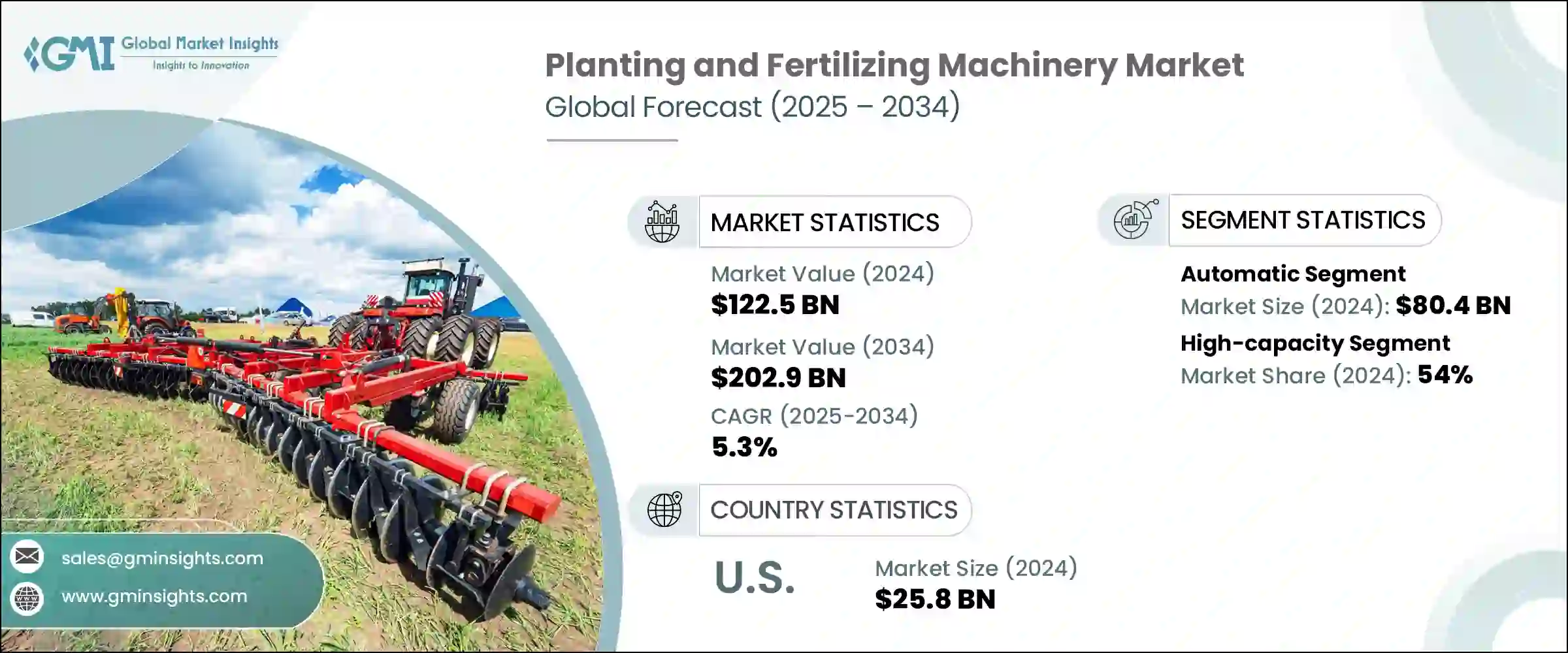
The global planting and fertilizing machinery market was valued at USD 122.5 billion in 2024 and is projected to grow at a CAGR of 5.3% between 2025 and 2034.
Planting and Fertilizing Machinery Market Key Takeaways
Market Size & Growth
- 2024 Market Size: USD 122.5 Billion
- 2034 Forecast Market Size: USD 202.9 Billion
- CAGR (2025–2034): 5.3%
Key Market Drivers
- Rising global food demand.
- Mechanization of agriculture.
Challenges
- High initial capital investment.
- Environmental and regulatory pressure.
Get Market Insights & Growth Opportunities
The global planting and fertilizing machinery industry is expected to experience substantial expansion due to the rising demand for food around the world as well as the increasing pace and spread of mechanization of agriculture. Supported by increasing population of over 10.3 billion by the year 2080, as reported by World Bank Organization, hence increasing agricultural productivity is a major priority. The growing demand for food is leading producers around the world, farmers, and agribusinesses alike, to use new planting and fertilization machinery that leverages efficiencies, conserves inputs, and maximizes yields.
At the same time, mechanization is modernizing methods of agriculture away from traditional practices, particularly in transitioning economies and emerging markets. Labor shortages, increasing price of labor, and the need to deliver planting and fertilizing operations faster and more precisely are pushing producers into mechanized agriculture. Newer farm machinery reduces the amount of labor that goes into critical agricultural practices and enables precision agriculture that reduces wasted seeds and fertilizers for sustainability reasons.
These factors are driving high adoption rates of planting and fertilizing machinery globally. Emerging technologies such as GPS-guided seed drills and variable-rate fertilizer applicators are also further increasing the value of this kind of machinery. Therefore, we are witnessing increased investment in this area by farmers, equipment manufacturers, and governments that are seeking to improve food security and agricultural production efficiently. Overall, the dynamics of growing food demand and mechanization will put the global market in a favorable position for growth.
To get key market trends
Planting and Fertilizing Machinery Market Trends
- One of the trends impacting the global planting and fertilizing machine market is precision agriculture and smart farming. Farmers are using advanced technology like GPS-guided equipment, IoT sensors, and data analytics to enhance planting and fertilizing processes. This progress has given farmers more precise control of the planting and fertilizing process, allowing greater input efficiency and crop-specific nutrient application.
- This has increased productivity and decreased costs to farmers while lowering the negative effects these processes can have on the environment, by actually reducing the use of fertilizers and seeds, instead of over-applying inputs to try to meet crop needs. John Deere in February 2025 introduced their new seed level and fertilizer level sensing technology with active vacuum automation. This new technology provides real time data feedback which optimizes planting efficiency and reduces fertilizer waste.
- At the same time, a heightened concern for environmental sustainability is changing how planting and fertilizing machinery is conceived and used worldwide. Sustainability and Eco-friendly Practices are becoming more relevant in agricultural machinery design, as farmers and manufacturers alike comply with increasingly stringent rules and growing consumer interest in environmentally friendly food production.
- Manufacturers are developing modern machinery with a view to both limit soil compaction and exhaust emissions, and better placement of fertilizers that avoids runoff and pollution. Yanmar in April 2025 partnered with a Japanese government funded research institute to develop a new deep planting technology for sugarcane with improves yields as well as significantly reduce environmental impact, promoting sustainability in agriculture.
Planting and Fertilizing Machinery Market Analysis
Learn more about the key segments shaping this market
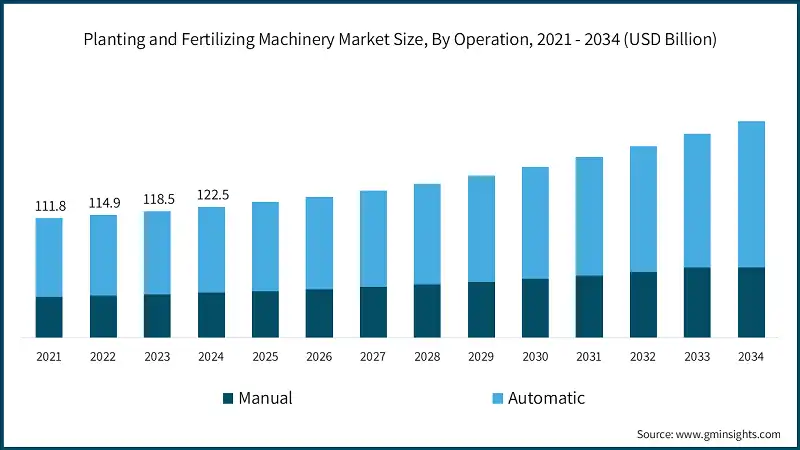
Based on the operation, the planting and fertilizing machinery industry is divided into manual and automatic. In 2024, automatic dominated the market generating revenue of USD 80.4 billion and expected to grow at a CAGR of 5.7% during the forecast period.
- The automatic machinery segment is seeing continued growth due to changing technology and precision agriculture. Automatic systems provide increased accuracy in the planting and fertilizing process which results in optimized input use and better crop productivity. Features like GPS guidance systems, variable rate application, and integration with data management systems, increase efficiency while minimizing environmental risks.
- Automatic systems continue to appeal to farmers and agribusinesses/commercial farmers seeking to maximize productivity while minimizing costs and waste, which will ultimately lead to larger market share moving forward.
- Manual machinery is still popular in small operating farms, where cost and simplicity are of highest importance. Furthermore, trends such as the rising costs of labor and the need for increased productivity are limiting the growth of manual machinery in the global market and amongst commercial large-scale farming.
Learn more about the key segments shaping this market
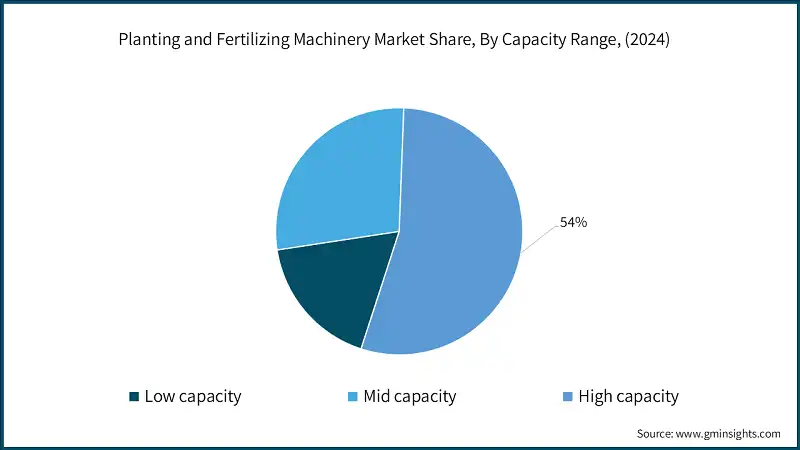
Based on capacity, the planting and fertilizing machinery market is segmented into low capacity, mid capacity, and high-capacity machinery. In 2024, high-capacity machinery segment dominated the market with 54% market share and the segment is expected to grow at a CAGR of 5.6% from 2025 to 2034.
- High-capacity planting and fertilizing machines have experienced higher growth because of increasing demand for efficiency in large-scale agriculture. These machines provide faster planting and fertilizing ability over a wider area, which improves productivity and saves time. Also, higher-end features that support precision agriculture make these machines an attractive option for commercial farming operations that aim to maximize output as much as possible.
- Mid-capacity machines have grown steadily as they provide a good middle ground for efficiency and costs and are applicable to medium-sized farms. The segment satisfies farmers that need more efficiency than low-capacity producers but not necessarily an entire high-capacity machine in terms of full utilization or cost. Additional manufacturing advances in technology have increased the versatility and effectiveness of mid-capacity equipment and has remarkably improved its credibility for adoption.
- Low-capacity machinery remains relevant primarily for small-scale farming operations where the cost is a major consideration and has the benefit of being straightforward to use. The popularity of low-capacity machinery is higher in developing countries with large number of small scale and family-owned farming is prevalent.
Looking for region specific data?
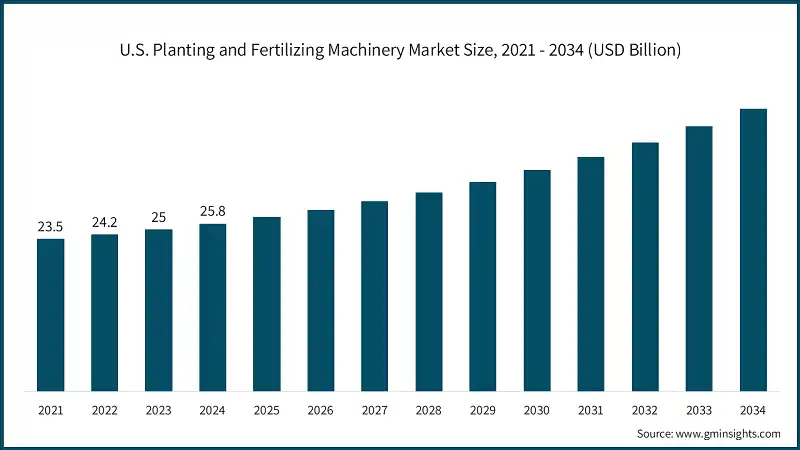
In terms of country, the United States led the planting and fertilizing machinery market with about 76% of the North American market share and revenue of USD 25.8 billion in 2024.
- The United States market for planting and fertilizing machinery is highly influenced by the developments in precision agriculture and automated technology. Farmers in the country are looking for GPS-enabled technologies for improved efficiency and smart controlled devices to optimize seed and fertilizer performance. This shift to more precise input placement is being propelled by a desire to reduce waste and increase operational efficiency. Similarly, the growth in automation, technologies that are semi-autonomous and autonomous, is a reaction to increased labor shortages and the need for effective scalability and efficiency on larger farm operations.
- Sustainability is an additional driver contributing to growth of the market in the country. Equipment designed to enable conservation practices, such as reduced tillage, controlled fertilizer application, and minimizing environmental footprints, is also on the rise. This change is reinforced because of a larger goal to implement the practices responsible for long-term soil health and water conservation, not to mention the implications of changing environmental liabilities. As economic and environmental priorities increase, machinery that allows for sustainable and high-efficiency farm practice have an even larger impact on the market.
The planting and fertilizing machinery market in Europe is expected to experience significant and promising growth from 2025 to 2034.
- The European market for planting and fertilizing machines is fueled by increasing acceptance of the precision farming and automation technologies in agriculture, and the agriculture industry is focused on environmental efficiency as well as compliance with environmental regulatory processes. Farmers are using GPS-driven systems as well as variable-rate technology, and sensor technology to optimize input usage and minimize waste. Germany as an established agricultural engineering market, forcing investments in agriculture-tech innovations and support by government systems promoting smart farming. The demand for low emissions and energy-efficient machinery continues to rise as the it is supported by the EU's sustainability objectives and local subsidy programs supporting investments. Additionally labor shortages around the country and region have also fueled the mechanization of agriculture.
The planting and fertilizing machinery market in the Asia Pacific is expected to experience significant and promising growth from 2025 to 2034.
- The Asia-Pacific market is progressing steadily, as precision agriculture and automation continue to be adopted to enhance further productivity and deal with labor shortages in the region. Farmers in the region are using GPS guided machinery, variable rate applicators, and sensor technology to reduce inputs and to operate more efficiently. Sustainability is a key trend, with more farmers interested in electric and low emissions equipment that protect soil health and conserve precious resources. India and China are leading growth in the region, with the Government of India encouraging mechanization through its funding programs for small and mid-size farms, and China investing heavily in smart farming technology and autonomous machinery. As China and India aim to enhance agricultural productivity more efficiently, additionally demand for advanced planting and fertilizing equipment will increase.
The planting and fertilizing machinery market in the Saudi Arabia is expected to experience significant and promising growth from 2025 to 2034.
- The planting and fertilizing machinery industry in Saudi Arabia is evolving, with a focus on automation, sustainability, and adaptability to dry agricultural conditions. There are government-backed initiatives now encouraging a move from traditional farming to high-yielding and climate-resilient farming practices which can include controlled-release fertilizers and precision spraying applications under strategic Vision 2030 programs. The drive to develop as much domestic food production as possible and lessen reliance on imports has influenced more investment in modern planting machinery suited for desert agriculture, which equally augments demand for the mining machinery across the board.
Planting and Fertilizing Machinery Market Share
- The top five companies in planting and fertilizing machinery industry are Amazone, CLAAS, CNH Industrial, John Deere, and Kubota and they collectively hold a share of 12%-15% in the market.
- These companies continue to acquire and merge with others, expand facilities, and make various collaborations to increase their product offerings, access customer bases, and secure their market positions.
- In January 2023, John Deere introduced their new fertilizing technology called the ExcatShot at CES 2023. This new technology reduces the fertilization wastage by up to 60% by using sensors and robotics to apply precise amounts directly onto seeds during the planting process. This minimizes waste and environmental impact as well. This new technology has helped John Deere maintain their key position in the global market.
- To improve the product and market share key players are constantly investing in technological activities and are also entering into partnerships to provide improved and better solutions for the customers. These investments are benefiting both companies and customers as they help develop and offer solutions as per the changing technological trends and thus the customer requirements.
- In February 2025, Kinze announced their year 2026 model of front fold planter 5900 series, which features a dual fertilizer system, allowing for dual-product spraying. This machine also includes row by row section control for optimized spraying. This new machinery will help Kinze in achieving advantage over competitors in the market.
Planting and Fertilizing Machinery Market Companies
Major players operating in the planting and fertilizing machinery industry are:
- AGCO
- Amazon
- CLAAS
- CNH Industrial
- Deutz-Fahr Group
- CNH Industrial
- Kinze Manufacturing
- Kubota
- Kverneland
- Lemken
- Mahindra & Mahindra
- Maschio Gaspardo
- Salford Group
- Väderstad
- Yanmar
Planting and Fertilizing Machinery Market Report Attributes
| Key Takeaway | Details |
|---|---|
| Market Size & Growth | |
| Base Year | 2024 |
| Market Size in 2024 | USD 122.5 Billion |
| Forecast Period 2025 - 2034 CAGR | 5.3% |
| Market Size in 2034 | USD 202.9 Billion |
| Key Market Trends | |
| Growth Drivers |
|
| Pitfalls & Challenges |
|
What are the growth opportunities in this market?
Planting and Fertilizing Machinery Industry News
- In April 2025, Yanmar partnered with JIRCAS (Japan International Research Center for Agricultural Sciences) a Japanese government research institute to develop a new deep-planting technology for sugarcane to increase yields. This development also aimed at minimizing environmental impact which aligns with global trend of sustainable crop production.
- In July 2023, CLAAS introduced a new planter to their lineup, a 30-foot model with enhanced features like vertical contouring and their proprietary SmartFrame technology to increase efficiency and performance. This new planter replaces older 30-foot models with advanced technology and higher performance.
- In May 2022, CNH Industrial completed the acquisition of Specialty Enterprises, a North American manufacturer of lightweight aluminum spray booms. This acquisition has strengthened CNH Industrials sprayer portfolio and reinforced their position as a key player in the market.
The planting and fertilizing machinery market research report includes in-depth coverage of the industry with estimates & forecasts in terms of revenue (USD Billion) and volume (Thousand Units) from 2021 to 2034, for the following segments:
Market, By Type
- Planting machinery
- Broadcast seeders
- Air seeders
- Planters
- Drill seeders
- Others(transplanters, etc.)
- Fertilizing machinery
- Broadcast spreaders
- Drop spreaders
- Liquid sprayers
- Granular applicators
- Others(fertigation systems, etc.)
Market, By Operation
- Manual
- Automatic
Market, By Capacity
- Low capacity
- Mid capacity
- High capacity
Market, By End Use
- Family-owned farms
- Large-scale commercial farms
Market, By Distribution Channel
- Direct sales
- Indirect sales
The above information is provided for the following regions and countries:
- North America
- U.S.
- Canada
- Europe
- Germany
- UK
- France
- Spain
- Italy
- Netherlands
- Asia Pacific
- China
- Japan
- India
- Australia
- South Korea
- Latin America
- Brazil
- Mexico
- Argentina
- MEA
- South Africa
- Saudi Arabia
- UAE
Frequently Asked Question(FAQ) :
How big is the planting and fertilizing machinery market?
The market for planting and fertilizing machinery was valued at USD 122.5 billion in 2024 and is expected to reach around USD 202.9 billion by 2034, growing at 5.3% CAGR through 2034.
What is the size of automatic segment in the planting and fertilizing machinery industry?
The automatic segment generated over USD 80.4 billion in 2024.
How much planting and fertilizing machinery market share captured by U.S. in 2024?
The U.S. market held around 76% share in 2024.
Who are the key players in planting and fertilizing machinery industry?
Some of the major players in the industry include AGCO, Amazone, CLAAS, CNH Industrial, Deutz-Fahr Group, CNH Industrial, Kinze Manufacturing, Kubota, Kverneland, Lemken, Mahindra & Mahindra, Maschio Gaspardo, Salford Group, Väderstad, Yanmar.
Planting and Fertilizing Machinery Market Scope
Related Reports