Summary
Table of Content

Plant-Based Seafood Ingredients Market
Get a free sample of this report
Form submitted successfully!
Error submitting form. Please try again.
Thank you!
Your inquiry has been received. Our team will reach out to you with the required details via email. To ensure that you don't miss their response, kindly remember to check your spam folder as well!
Request Sectional Data
Thank you!
Your inquiry has been received. Our team will reach out to you with the required details via email. To ensure that you don't miss their response, kindly remember to check your spam folder as well!
Form submitted successfully!
Error submitting form. Please try again.
Plant-Based Seafood Ingredients Market Size
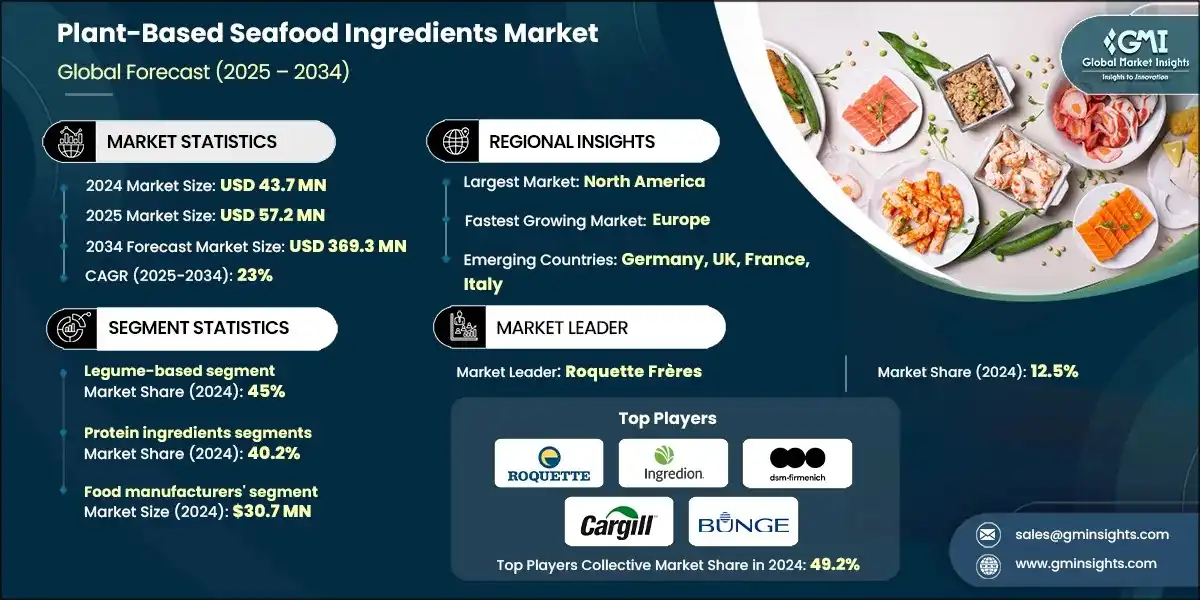
The global plant-based seafood ingredients market size was valued at USD 43.7 million in 2024. The market is expected to grow from USD 57.2 million in 2025 to USD 369.3 million in 2034, at a CAGR of 23% according to latest report published by Global Market Insights Inc.
Plant-Based Seafood Ingredients Market Key Takeaways
Market Size & Growth
- 2024 Market Size: USD 43.7 Million
- 2025 Market Size: USD 57.2 Million
- 2034 Forecast Market Size: USD 369.3 Million
- CAGR (2025–2034): 23%
Regional Dominance
- Largest Market: North America
- Fastest Growing Region: Europe
Key Market Drivers
- Rising vegan and flexitarian populations.
- Expanding foodservice sector adoption.
- Innovative product development.
Challenges
- Taste and texture challenges.
- High production costs.
Opportunity
- Increasing product variety.
- Strategic collaborations.
- Sustainability labeling.
Key Players
- Market Leader: Roquette Frères led with over 12.5% market share in 2024.
- Leading Players: Top 5 players in this market include Roquette Frères, Ingredion Incorporated, dsm-firmenich, Cargill, Incorporated, Bunge Limited, which collectively held a market share of 49.2% in 2024.
Get Market Insights & Growth Opportunities
- The plant-based seafood ingredients market is growing exponentially, connecting with the consumers' inclination towards sustainable, healthy, and ethical foods. The plant-based alternatives are now favored by most consumers because of their mimicry for real seafood products, owing to the rising concerns of over-fishing, marine pollution, and climate change. The increasing awareness about health benefits associated with a plant-based diet, including cholesterol reduction, reduced incidence of cardiovascular diseases, and better management of body weight, also improves the market.
- Primary application of the plant-based seafood ingredient is the provision of a sustainable, healthy alternative to conventional seafood products for the booming vegan, vegetarian, and flexitarian consumer segments. The ingredients can be used by manufacturers of fish and shellfish analogues that mimic taste, texture, and appearance to satisfy consumer preference without compromising sensory experience. The carbon footprint from traditional seafood production is reduced with these products, thus playing a vital role in the transition to more sustainable food systems.
- Plant-based seafood ingredients can be used for different applications, including ready-to-eat meals, snacks, and functional ingredients used by food service companies. They can be used in the manufacture of vegan fish fillets as well as shrimps and crab analogs. Other products that use these ingredients include soups, spreads, and sauces.
- North America is the largest market for plant-based seafood ingredients due to advancement in food sector and growing vegan population in U.S. & Canada.
- Europe is the fastest growing region for plant-based seafood ingredients market, due to increasing need from food industry, also the region can enhance its performance in this market in the coming years.
To get key market trends
Plant-Based Seafood Ingredients Market Trends
- The growth of the plant-based seafood ingredients industry is significant and focused on key market trends such as technological advancement, evolving regulatory frameworks, and product innovation. Technology progress in food processing and ingredient development has played a vital role in making plant-based seafood products more realistic and palatable. Cell-based fermentation, plant protein extraction, texture enhancement methods, and other innovations enable producers to more accurately replicate the taste, texture, and appearance of conventional seafood products, increasing consumer acceptance.
- Regulatory frameworks have emerged to spearhead the growth of plant-based foods, creating motivation for many governments and other regulatory institutions to establish standards to guide plant-based ingredients and labeling. This way, clearer regulations gather consumer trust in product safety and trade facilitation across borders which then spurs brands into expanding their product lines and entering new markets. In addition, further governmental regulatory endorsement in sustainability and health claims enhances consumer confidence in plant-based seafood.
- Innovation in products is at the forefront of all market trends with companies working hard to create new species such as fish fillets, shrimp or crab substitutes for plant-based seafood items. Such product innovation aims to suit as many consumers’ preferences & dietary needs as possible by providing the widest product portfolio and market reach.
Plant-Based Seafood Ingredients Market Analysis
Learn more about the key segments shaping this market
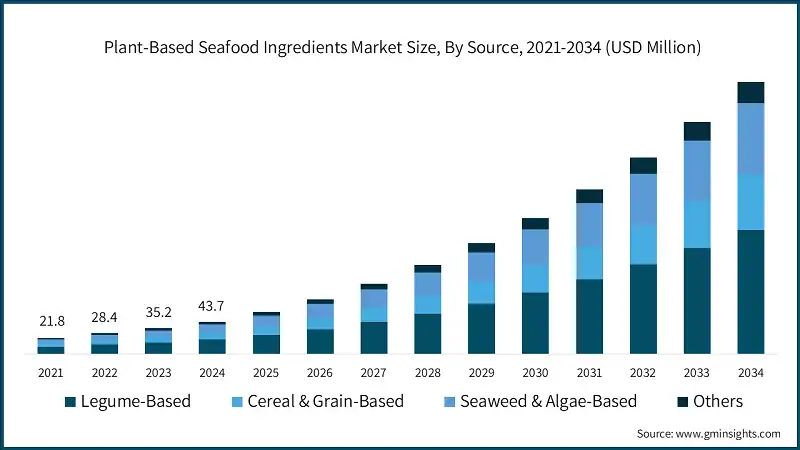
Based on source, the plant-based seafood ingredients market is segmented into legume-based, cereal & grain-based, seaweed & algae-based, and others.
- Legume-based sources continue to dominate the market by 45% in 2024 owing to their higher protein content, versatility, and sustainability credentials. Soy, pea, and chickpea-based ingredients are gradually being deployed to mimic seafood textures and flavors for health-savvy and environmentally conscious consumers. Advances in processing technology are working on their functional properties to be much more suitable for seafood alternatives.
- Cereal- & grain-based ingredients have gained momentum as cheap and readily available sources of carbohydrates and proteins. Ingredients such as rice, wheat, and oats are being incorporated into formulations for purposes of texture, mouthfeel, and nutrition. These sources are especially popular in geographical areas with proficient cereal agriculture thus promoting local production and reducing dependence on imports.
- Seaweed & algae-based ingredients are increasingly becoming one of the key trends in the market, due to their natural umami flavor, mineral-rich composition and sustainability in cultivation. They are finding more applications in imbuing seafood flavors, increasing nutritional value with omega-3 fatty acids, and pushing for authenticity in products. Their acceptance is further buoyed by increasing consumer demand for clean-label and natural ingredients.
Learn more about the key segments shaping this market
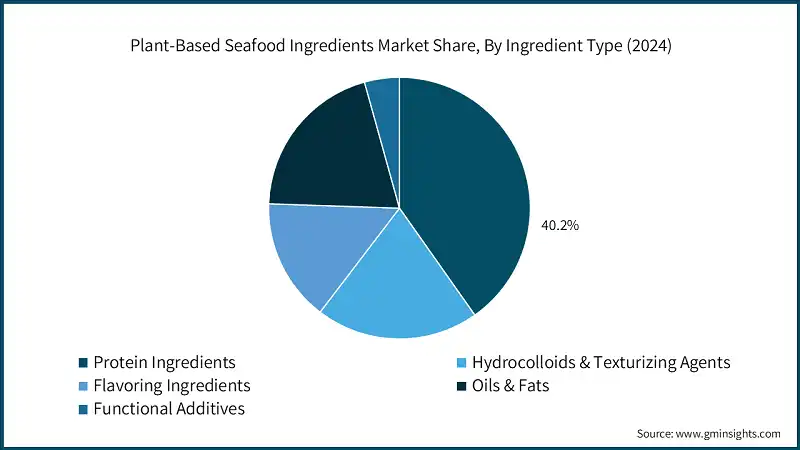
Based on ingredient type, the plant-based seafood ingredients market is segmented into protein ingredients, hydrocolloids & texturizing agents, flavoring ingredients, oils & fats, and functional additives.
- Protein ingredients has a maximum share of 40.2% in 2024 which are focused on pea, soy, or other plant-based proteins for functionality and nutritional profile. Innovations developed by evolving protein extraction and processing have made plant proteins appealing for improved texture and taste. Naturally, clean-label and allergen-free trends are also pushing product developments.
- Hydrocolloids & texturizers are becoming most critical in mimicking a traditional texture and mouthfeel of seafood. Market trends show ever increasing demand for natural hydrocolloids free of allergens. These ingredients help develop firm, fibrous, and gel-like textures, enhancing consumer acceptance of plant-based seafood.
- Oils & fats are directed towards a plant-based omega-3 oil like algal oil, that has gained popularity among health-conscious consumers. They enrich mouthfeel, flavor, and nutritional content and hence enhance the creation of more holistic seafood alternatives.
- Functional additives are used increasingly in extending self-life, stability, and nutritional benefits. Natural preservatives, antioxidants, and binding agents have become very popular because of the clean-label trend and the standard regulatory requirements.
Based on functionality, the plant-based seafood ingredients market is segmented into protein & nutrition enhancement, texture & structure formation, flavor & taste enhancement, binding & gelation, color & appearance, and others.
- Plant-based seafood ingredient demand that primarily focuses on protein and nutrition boosting is increasing with preference among consumers for health and wellness. Innovations in plant protein extraction and fortification offer products that have nutrition levels comparative to traditional seafood. Hence, companies include superfoods and other functional ingredients mostly improving proteins, fibers, and essential nutrients, aimed at promoting the increase of vegetarian and vegan populations, as well as flexitarians who opt for healthier choices.
- Texture and structure formation are the crucial features needed to produce the mouthfeel of seafood. Advances in plant-based texturizers, such as isolates, concentrates, and hydrocolloids, enable more realistic seafood analogs. The focus should be on developing a fibrous, flaky, and firm texture like that of fish and shellfish, thereby fostering innovations in processing techniques. This trend enhances the acceptance level among, and sensory experiences of, consumers.
- Binding and gelation functionalities are essential for the integrity of products and imitate the structure of seafood. Innovations in plant-based binders, including agar, carrageenan, and novel hydrocolloids, improve firmness and cohesiveness.
- In plant-based seafood, color and appearance are two fields where consumer perception regarding authenticity relies heavily on. Keeping in mind that there are developments in natural colorants that are derived from algae, vegetables, and minerals, they highlight the appeal to the eyes. A flesh-like realistic color and appearance will instill consumer confidence and acceptance, particularly in highly visual products such as fish fillet and shellfish.
Based on end user, the plant-based seafood ingredients market is segmented into food manufacturers (B2B), foodservice & restaurants, and retail brands.
- Plant-based seafood ingredients are becoming more common in food manufacturers' product lines with a market size of USD 30.7 million in 2024 due to growing consumer demand for sustainable options. Innovations in texture, flavor, and nutritional profile enable the creation of different seafood analogs, such as fish fillets and shellfish. Increasing collaborations with ingredient suppliers lead to the improvement of product quality and scalability.
- Consumer demand for ethical dining is driving the foodservice industry to actively incorporate plant-based seafood options into their offerings. Some restaurants have apparently been busy preparing experimental recipes with plant-based fish and shellfish to attract diners’ health-consciousness and awareness of the environmental challenges. Trends toward clean label and transparency are shaping the composition of menus, as most offer a variety of vegan and pescatarian options.
- Retail brands tend to expand their portfolios into plant-based seafoods to cater to the increasing demand from consumers for convenience, healthy and sustainable options. Ready-to-eat meals, frozen fillets and snack items containing plant-based elements are part of the product innovations being carried out.
Looking for region specific data?
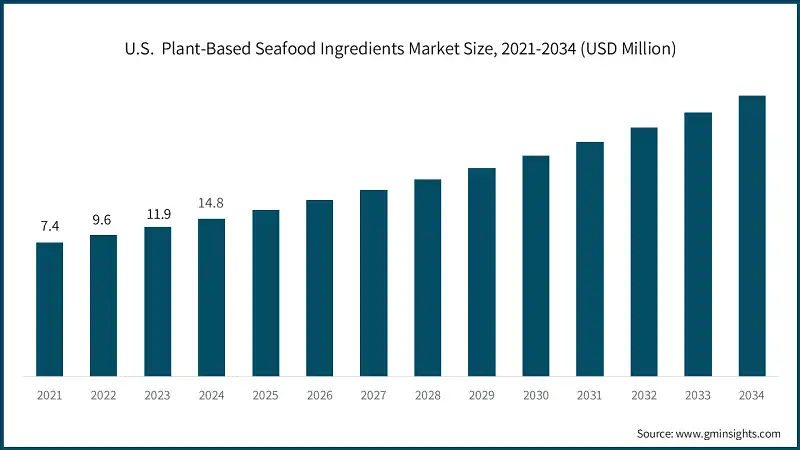
North America accounted for the largest share of the plant-based seafood ingredients market with 42.3% of the revenue share in 2024 and 23.1% CAGR through 2034 and US has a market size of USD 14.8 million in 2024.
- In North America, particularly the U.S. and Canada, the plant-based seafood ingredients market is growing rapidly, driven by increasing consumer health consciousness and sustainability as well as concern for animal welfare. The advancements in technology related to plant protein extraction and fermentation have enabled the development of more seafood-like analogs. Additional market growth is driven by supportive regulatory frameworks and rising product launches in retail and food service.
Europe plant-based seafood ingredients market accounted for USD 12.8 million in 2024 and is anticipated to show fastest growth over the forecast period.
- A growing market for plant-based seafood ingredients in Europe is fueled by strict environmental regulations, an increasing population of vegans and flexitarians, and awareness of the impact of overfishing and marine conservation. Germany, the UK, are among the trendsetters in adopting innovative plant-based products. The regulatory structures in Europe enforce transparency and sustainability therefore encouraging brands to manufacture eco-friendly and ethically sourced products.
The Asia Pacific plant-based seafood ingredients market is anticipated to grow at the CAGR of 22.8% during the analysis timeframe to 2034.
- Asia Pacific is the growing market for plant-based seafood ingredients pushed by traditional seafood consumption, health consciousness and the increase in urbanization. The focus on product innovation to satisfy localized tastes with regional ingredients like soy, mung bean and konjac is flourishing in China, Japan & South Korea. With innovations in plant protein processing, product quality and texture are being improved, creating appeal for consumers looking for sustainable alternatives.
Latin America plant-based seafood ingredients accounted for 5% market share in 2024 and is anticipated to show steady growth over the forecast period.
- The Latin American plant-based seafood ingredients market is still on the rise due to the growing concern for environmental issues and health benefits. Brazil and Argentina are among the countries beginning to explore plant-based options as part of a broader food trend toward sustainability and health. Legumes and native grains are now regional ingredients incorporated into pioneering seafood analogs. The fast-expanding foodservice industry and increasing retail availability are expected to support that advancement in the coming years.
Middle East & Africa plant-based seafood ingredients market accounted for 3.2% market share in 2024 and is anticipated to show lucrative growth over the forecast period.
- The Middle East & Africa is at the starting point of adopting plant-based seafood ingredients, thus far influenced by rising health awareness, increasing vegetarian and vegan populations, and sustainability for food options. Cultural and religious dietary issues are steering the direction of product development; halal and kosher certifications have thereby gained importance for market acceptance. Local manufacturers are gradually supported by technological advancements to design region-specific plant-based seafood products.
Plant-Based Seafood Ingredients Market Share
The top 5 companies in the plant-based seafood ingredients industry include Roquette Frères, Ingredion Incorporated, dsm-firmenich, Cargill, Incorporated, Bunge Limited. These are prominent companies operating in their respective regions covering 49.2% market share. These companies hold strong positions globally due to their experience in plant-based seafood ingredients market. Their diverse product portfolios, backed by robust production capabilities and distribution networks, enable them to meet the rising demand across various regions.
- Roquette Frères is one of the foremost companies active in the plant-based sector because of its expertise on plant proteins and specialty, functional ingredients. To tap the new segment of seafood analogs, the company is developing functional, high-quality plant proteins based on innovation in texturization and flavor enhancement.
- Ingredion is one of the players within the landscape of plant-based ingredients. The company proposes an extensive collection of starches, proteins, and texturizers highly required by seafood analogs. The company strives for innovativeness through its R&D and development of functional ingredients for advanced texture, mouthfeel, and flavor for the new seafood alternatives made from plants.
- dsm-firmenich is exceptionally distinguished by its biotechnology orientation, sustainability and product innovations. The company invests a lot in producing plant-based proteins and flavoring solutions, highly enhancing the sensory experience of seafood alternatives. It’s partnerships with start-ups in food tech and research institutions strengthen its competitive capabilities to make the best innovative solutions in texture, flavoring, and nutritional enhancement of plant-based seafood ingredients.
- Cargill makes it one such global player in plant-based products as well as functional ingredients for seafood analogs. Cargill's investments in innovative processing technologies and development of products allow it to build very high-quality, scalable ingredients demanded by large food manufacturers. Cargill's stronghold market is therefore enhanced with its product offering in this rapidly growing market of ingredients for plant-based seafood.
- Bunge is among the major players within the plant-based ingredients space making use of its high-level expertise in oilseed processing and plant protein extraction. The firm is focused on the cost-effective creation of high-quality plant proteins which can be used as seafood analogs. The integrated supply chain and the global footprint of Bunge automatically provide advantages in sourcing raw materials and efficiently distributing finished products.
Plant-Based Seafood Ingredients Market Companies
Major players operating in the plant-based seafood ingredients industry include:
- AGT Foods & Ingredients
- Algama Foods
- Angel Yeast Co., Ltd.
- BENEO GmbH (Südzucker Group)
- Bunge Limited
- Cargill, Incorporated
- CP Kelco (J.M. Huber Corporation)
- dsm-firmenich
- FMC Corporation (BioPolymer Division)
- Ingredion Incorporated
- Kalys (MERIDIS Group)
- Mara Renewables Corporation
- MGP Ingredients, Inc.
- Paleo (formerly Miruku)
- Roquette Frères
Plant-Based Seafood Ingredients Market Report Attributes
| Key Takeaway | Details |
|---|---|
| Market Size & Growth | |
| Base Year | 2024 |
| Market Size in 2024 | USD 43.7 Million |
| Market Size in 2025 | USD 57.2 Million |
| Forecast Period 2025 – 2034 CAGR | 23% |
| Market Size in 2034 | USD 369.3 Million |
| Key Market Trends | |
| Drivers | Impact |
| Rising vegan and flexitarian populations | Increasing numbers of people adopting vegan, vegetarian, or flexitarian diets are driving demand for plant-based seafood options as part of their dietary choices.Expanding foodservice sector adoption |
| Expanding foodservice sector adoption | Restaurants, fast-food chains, and institutional food providers are increasingly incorporating plant-based seafood items into their menus, broadening consumer access and acceptance. |
| Innovative product development | Advances in food technology enable the creation of more realistic, palatable plant-based seafood products, driving market expansion. |
| Pitfalls & Challenges | Impact |
| Taste and texture challenges | Difficulty in perfectly mimicking the taste and texture of real seafood can hinder consumer acceptance. |
| High production costs | Developing high-quality plant-based seafood ingredients often involves expensive technology and ingredients, impacting affordability. |
| Opportunities: | Impact |
| Increasing product variety | Growing availability of diverse plant-based seafood products, including fish fillets, shrimp, and crab analogs. |
| Strategic collaborations | Partnerships between food tech companies and seafood brands to innovate and expand product offerings. |
| Sustainability labeling | More products are being marketed with eco-friendly and sustainable claims to attract environmentally conscious consumers. |
| Market Leaders (2024) | |
| Market Leaders |
12.5% |
| Top Players |
Collective Market Share 49.2% in 2024 |
| Competitive Edge |
|
| Regional Insights | |
| Largest Market | North America |
| Fastest growing market | Europe |
| Emerging countries | Germany, UK, France, Italy |
| Future outlook |
|
What are the growth opportunities in this market?
Plant-Based Seafood Ingredients Industry News
- In July 2024, NH Foods-an Osaka-based food processing company-introduced a plant-based imitation of tuna sashimi in the restaurant market in Japan. This product focuses on the odor and texture of raw tuna, providing the consumer with real culinary experience.
- In October 2023, NESTLE launched an entirely new series of plant-based alternatives to white fish, including fillets, nuggets, and fingers. These products are vegan-approved and have received praise for their taste, texture, and nutritional quality.
This plant-based seafood ingredients market research report includes in-depth coverage of the industry, with estimates & forecasts in terms of revenue (USD Million) and volume (Kilo Tons) from 2025 to 2034, for the following segments:
Market, By Source
- Legume-based ingredients
- Cereal & grain-based ingredients
- Seaweed & algae-based ingredients
- Others
Market, By Ingredient Type
- Protein ingredients
- Pea protein
- Soy protein
- Wheat gluten
- Hydrocolloids & texturizing agents
- Carrageenan
- Alginate
- Agar
- Konjac glucomannan
- Other hydrocolloids
- Flavoring ingredients
- Yeast extract
- Seaweed seasoning & extracts
- Vegetable umami & natural flavors
- Oils & fats
- Algal oil (omega-3)
- Microbial oils (precision fermentation)
- Plant oils (canola, coconut, sunflower)
- Functional additives
- Starches
- Fibers (cellulose, citrus, flax, chia)
- Natural colorants (phycobiliproteins, vegetable concentrates)
Market, By Functionality
- Protein & nutrition enhancement
- Texture & structure formation
- Flavor & taste enhancement
- Binding & gelation
- Color & appearance
- Others
Market, By End Use
- Food manufacturers (B2B)
- Foodservice & restaurants
- Retail brands
The above information is provided for the following regions and countries:
- North America
- U.S.
- Canada
- Europe
- Germany
- UK
- France
- Spain
- Italy
- Rest of Europe
- Asia Pacific
- China
- India
- Japan
- Australia
- South Korea
- Rest of Asia Pacific
- Latin America
- Brazil
- Mexico
- Argentina
- Rest of Latin America
- Middle East and Africa
- Saudi Arabia
- South Africa
- UAE
- Rest of Middle East and Africa
Frequently Asked Question(FAQ) :
What is the market size of the plant-based seafood ingredients in 2024?
The market size was USD 43.7 million in 2024, with a CAGR of 23% expected through 2034. The growth is driven by increasing consumer demand for sustainable, healthy, and ethical food options.
What is the projected value of the plant-based seafood ingredients market by 2034?
The market is poised to reach USD 369.3 million by 2034, fueled by advancements in food processing technologies, regulatory support, and product innovation.
What is the expected size of the plant-based seafood ingredients industry in 2025?
The market size is projected to reach USD 57.2 million in 2025.
What was the market share of legume-based sources in 2024?
Legume-based sources accounted for 45% of the market share in 2024, led by their high protein content, versatility, and sustainability.
What was the share of protein ingredients segment in 2024?
Protein ingredients held a 40.2% market share in 2024, with a focus on pea, soy, and other plant-based proteins for improved texture and nutritional profiles.
What is the growth outlook for the North American plant-based seafood ingredients sector?
North America led the market with a 42.3% revenue share in 2024 and is set to expand at a CAGR of 23.1% through 2034, propelled by increasing consumer demand for sustainable food options.
What are the upcoming trends in the plant-based seafood ingredients market?
Key trends include advancements in food processing technologies, regulatory frameworks supporting plant-based labeling, product innovation in seafood analogs, and increasing collaborations with ingredient suppliers to enhance product quality and scalability.
Who are the key players in the plant-based seafood ingredients industry?
Key players include AGT Foods & Ingredients, Algama Foods, Angel Yeast Co., Ltd., BENEO GmbH, Bunge Limited, Cargill, Incorporated, CP Kelco, dsm-firmenich, FMC Corporation, Ingredion Incorporated, and Kalys.
Plant-Based Seafood Ingredients Market Scope
Related Reports