Summary
Table of Content

Piezoelectric Polymers for Energy Harvesting Market
Get a free sample of this report
Form submitted successfully!
Error submitting form. Please try again.
Thank you!
Your inquiry has been received. Our team will reach out to you with the required details via email. To ensure that you don't miss their response, kindly remember to check your spam folder as well!
Request Sectional Data
Thank you!
Your inquiry has been received. Our team will reach out to you with the required details via email. To ensure that you don't miss their response, kindly remember to check your spam folder as well!
Form submitted successfully!
Error submitting form. Please try again.
Piezoelectric Polymers for Energy Harvesting Market size
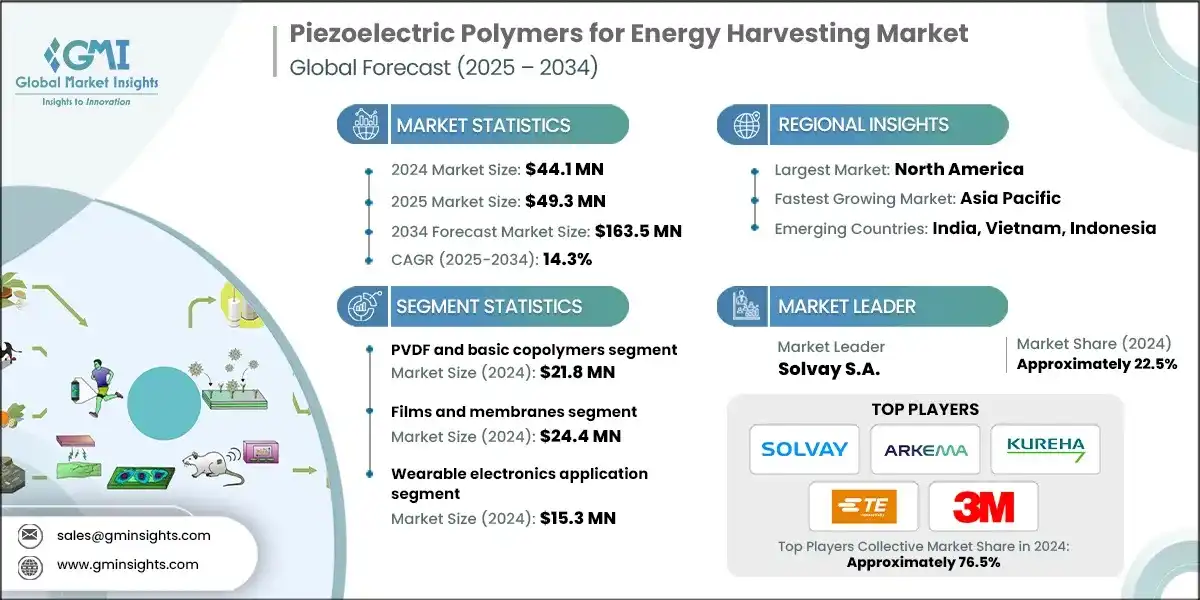
The global piezoelectric polymers for energy harvesting market was valued at USD 44.1 million in 2024. It is projected to grow from USD 49.3 million in 2025 to USD 163.5 million by 2034, representing a 14.3% CAGR from 2025 to 2034, according to latest report published by Global Market Insights Inc.
Piezoelectric Polymers for Energy Harvesting Market Key Takeaways
Market Size & Growth
- 2024 Market Size: USD 44.1 million
- 2025 Market Size: USD 49.3 million
- 2034 Forecast Market Size: USD 163.5 million
- CAGR (2025–2034): 14.3%
Key Market Drivers
- Rapid adoption of wearable and IoT devices demanding flexible, lightweight energy sources.
- Advances in PVDF and PVDF-TrFE polymers enhancing piezoelectric performance and durability.
- Rising demand for self-powered sensors in industrial automation and smart infrastructure.
- Growing regulatory and corporate focus on energy efficiency and battery-free technologies.
Challenges
- Low power density compared to conventional batteries.
- Limited performance under variable vibration frequencies.
- Material fatigue and environmental degradation affecting long-term reliability.
Opportunity
- Integration in wearable medical and healthcare devices for continuous monitoring.
- Deployment in smart cities and structural health monitoring applications.
- Development of hybrid energy harvesters combining multiple mechanisms.
- Strategic collaborations with automotive, aerospace, and consumer electronics OEMs.
Key Players
- Market Leader: Solvay S.A. led with over 22.5% market share in 2024.
- Leading Players: Top 5 players in this market include Solvay S.A., Arkema Group, Kureha Corporation, TE Connectivity, 3M Company, which collectively held a market share of 76.5% in 2024.
Get Market Insights & Growth Opportunities
- The market for piezoelectric polymers in energy harvesting is experiencing a high growth rate due to the high rate at which wearables and IoT devices are being integrated which need compact, lightweight and flexible sources of power. With increased demand for continuously portable generation of energy, these polymers prove to present a sustainable solution to powering sensors, health trackers, and connected devices without necessarily having to change their batteries frequently. This has been especially witnessed in the consumer electronics, health care and fitness monitoring applications.
- The PVDF and PVDF-TrFE polymers have been improved to achieve high piezoelectric performance, mechanical flexibility and durability that would be used in the next generation energy-harvesting systems. Their energy conversion efficiency has been enhanced by constant research and material innovations to expand their application in flexible electronics and micro-energy harvesting systems. These advances are helping achieve a higher level of commercialization and increase the number of applications of piezoelectric polymers in both industrial and consumer sectors.
- Another significant growth factor is the increasing use of self-powered sensors in automation of industries and intelligent infrastructure. These sensors are important in predictive maintenance, machinery monitoring and structural health assessment fields where maintenance free and reliable energy sources are required. With the shift of industries to smart factories and interconnected systems, the need to use efficient and self-sustaining materials of power generation such as piezoelectric polymers among others keeps increasing.
- Besides, regulatory programs that are supporting energy efficiency and sustainability are boosting market growth. Governments and companies are promoting the use of battery-free, and more eco-friendly technologies to cut down on the electronic waste and enhance the use of power. This regulatory movement together with the augmenting corporate sustainability responsibilities is causing more R&D investment and commercialization of piezoelectric polymer-based energy choices in a variety of industries.
To get key market trends
Piezoelectric Polymers for Energy Harvesting Market Trends
- A shift towards the combination of piezoelectric polymers with other energy harvesting methods, including thermoelectric and triboelectric systems, to form hybrid systems is on the increase. These hybrid systems are designed to increase the energy capture under wider conditions in the environment and make energy harvesting apparatus reliable and efficient. The trend is relevant to this specifically in applications where the energy sources are non-linear or intermittent, i.e. in wearable electronics and remote sensors.
- The consumer electronics trend of miniaturization is pushing the adoption of piezoelectric polymers in miniaturized and lightweight energy harvesting systems. Such polymers are already used to power small electronic parts, including sensors and actuators, without using conventional sources of power. Integration helps in creating more efficient and sustainable electronic devices, which goes in line with the increasing consumer demand of portable and environmentally friendly technology.
- Piezoelectric polymers are also finding more applications such as structural health monitoring systems, predictive maintenance systems, and other applications. They are good at powering sensors and devices in locations that are not practical to use the traditional sources of power due to the effort required in converting mechanical vibrations to electrical energy. This growth is also leading to the wider use of energy harvesting technologies in areas where automation and development of smart infrastructure are concerned.
Piezoelectric Polymers for Energy Harvesting Market Analysis
Learn more about the key segments shaping this market
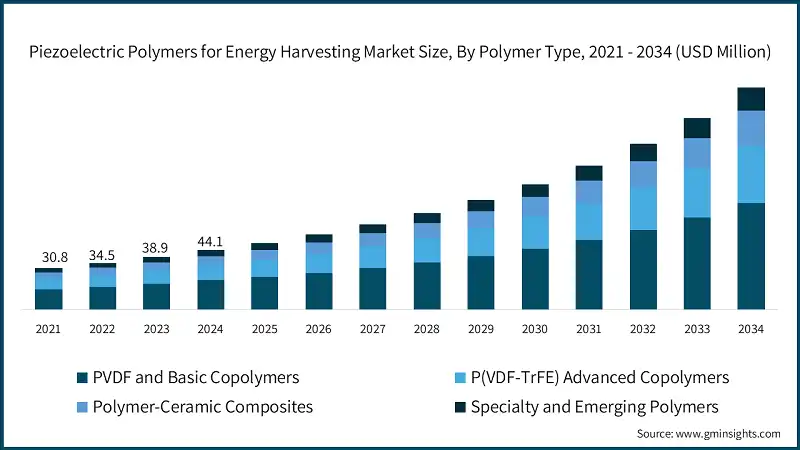
Piezoelectric polymers for energy harvesting industry based on polymer type segmented into PVDF and basic copolymers, P(VDF-TrFE) advanced copolymers, polymer-ceramic composites, and specialty and emerging polymers. The PVDF and basic copolymers segment was valued at USD 21.8 million in 2024, and it is anticipated to expand to 13.9% of CAGR during 2025-2034.
- PVDF and basic copolymers are gaining momentum in the piezoelectric polymers for energy harvesters because of their dependable piezoelectric characteristics, adaptable characteristics, and ease of manipulation. The polymers find extensive applications in wearables, miniature sensors and consumer electronics and provide lightweight, versatile, and self-powered solutions. The affordability and versatility are helping them to maintain a constant level of adoption in both industrial and consumer uses.
- The Piezoelectric polymers in energy harvesting market are also experiencing further growth in the case of advanced copolymers such as P (VDF-TrFE), polymer-ceramic composites and the emerging/specialty polymer. These materials have increased energy performance, longer mechanical stability and tailored properties which allow them to be incorporated into flexible electronics, medical devices, smart infrastructure and hybrid energy harvesting systems. Ongoing material performance and durability innovation is expanding their range of applications and aids in market diversification.
Piezoelectric polymers for energy harvesting market based on form segmented into films and membranes, fibers and textiles, and bulk and composite structures. The films and membranes segment was valued at USD 24.4 million in 2024, and it is anticipated to expand to 14.4% of CAGR during 2025-2034.
- The most used form is films and membranes since it is very flexible, can be easily made and has the capability of being incorporated into wearable and electronic device systems. They make it possible to come up with small device designs and are easy to layer or pattern to increase their energy conversion efficiency. Smart clothing and flexible electronics Fibers and textiles are gaining importance to smart clothing and flexible electronics, where in-garment power generation provides the flow of user actions.
- The Piezoelectric polymers evolution to offer energy harvesting in the market is being supported by the use of bulk and composite structures in industrial, automotive and aerospace settings. Such structures are more mechanical and durable as they can be used in energy harvesting systems that are heavy duty and high performing. Particularly, polymer-ceramic composites provide an increase in piezoelectric performance and retain flexibility, which makes it possible to integrate them into load bearing or vibration-sensitive parts. The combination of these forms is broadening the practical application of piezoelectric polymers in both consumer and industrial spaces that would facilitate the shift of the market towards more efficient and sustainable energy harvesting technologies.
Learn more about the key segments shaping this market
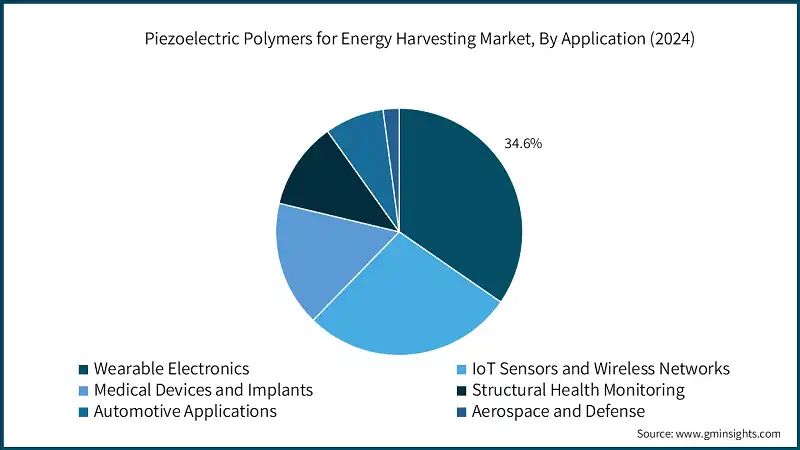
Piezoelectric polymers for energy harvesting market from wearable electronics application segment was valued at USD 15.3 million in 2024, and it is anticipated to expand with a CAGR of 13.9% and holding a market share of 34.6% during 2025-2034.
- Piezoelectric polymers in energy harvesting is a growing field in wearable electronics as industries shift to small and self-reliant power sources. Piezoelectric polymers are finding use in wearable electronics to make lightweight, flexible, and energy-efficient designs that can be used in the continuous motion generation of power.
- IoT sensors and wireless networks are embracing these materials to facilitate the maintenance free functions of smart homes, industrial automation and remote monitoring systems. Their biocompatibility and capability to produce power by physiological motion render them the best choice to be used in pacemakers and long-term health monitoring systems in medical devices and implants.
- In addition to medical and personal applications, structural health monitoring, automotive, and aerospace systems are some of the market segments that are growing in the use of the Piezoelectric polymers as energy harvesting. These substances are currently being incorporated into building structures, bridges and aircraft structures in order to allow the use of vibrations as a means to generate power and structural monitoring. They are used in motion and pressure variation energy recovery in the automotive industry and sensor systems in aerospace and defense to make the system more efficient and self-sufficient.
Looking for region specific data?
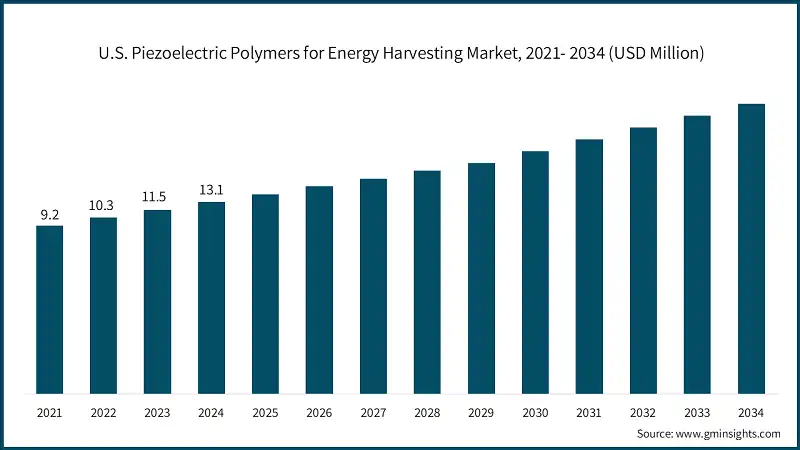
The North America piezoelectric polymers for energy harvesting market dominated the global market with a market share of 33.5% in 2024.
Piezoelectric polymers are finding an increasing demand in North America with organizations in the industrial automation, healthcare, and infrastructure sectors becoming more and more users of self-powered sensing solutions. Wearables, smart infrastructure and military uses are also experiencing a high uptake by the U.S. in particular, as a result of the R&D efforts and regulatory focus on energy efficiency. Efforts to invest in smart cities and national infrastructure projects are enabling possibilities of integrating energy harvesters made of polymers into sensors fitted on roads, bridges, and built environment. Durability is being countered by the manufactures with strong, more efficient polymer materials used in harsh environments and long lifespan, creating a possibility of commercial scale implementation.
U.S. dominates the North America piezoelectric polymers for energy harvesting market, showcasing strong growth potential.
United States is gaining its market share in this market at the fastest rate as more government and private money is being invested in clean energy technologies. Medical and implantable devices are also driving demand particularly in those devices which are advantaged with flexible and biocompatible polymers. It is also in encouraging polymer-ceramic composites in the U.S. to gain greater output in the energy harvesting modules and also incorporating them into wireless sensor networks. The synergies between academic innovation and good IP environment in combination with the market demand ( commercial and defense ) are driving commercialization of piezoelectric devices that are based on polymers.
The Europe market accounted for USD 12.7 million in 2024 and is anticipated to show lucrative growth over the forecast period.
The piezoelectric polymers market in Europe is developing due to the effect of stringent environmental laws, robust automotive and industrial industries, and the growing demand of energy-efficient appliances. Germany is one country that has a high adoption in the use of applications such as vehicle sensors, structural health monitoring, and robotics. German manufacturing and regulatory policies are particularly applicable to the push of lead-free and sustainable polymer materials and composites. The partnership between German research institutes and manufacturing companies facilitates innovation in the development of improved copolymers, materials with increased life cycles and increased piezoelectric coefficients.
Germany dominates the Europe piezoelectric polymers for energy harvesting market, showcasing strong growth potential.
Germany is expanding at a rate that is higher than most of its European counterparts, with the advantage of its high population in the automobiles industry and its high exports in electronics. German firms are integrating polymer and composite piezoelectric materials into automotive systems (such as tire pressure sensors, vibrations in engines), as well as in infrastructure (bridges, rail) as a health monitoring. The industrial digitization programs and Industry 4.0 programs contribute to the increasing demand in embedded polymer energy harvesters in sensors and flexible shapes in the country. Increasing investment in specialty applications, such as aerospace, where light weight and flexibility is of high concern is also observed with preference being given to the polymers as opposed to traditional ceramics.
The Asia Pacific piezoelectric polymers for energy harvesting are anticipated to grow at a CAGR of 15.1% during the analysis timeframe.
The market of piezoelectric polymers in Asia-Pacific is growing at a very rapid rate in comparison to the global market, with a significant part of it being China. The convergence of fast industrialization scaled production of electronics and wearable devices, and intelligent infrastructure development is driving the need to have flexible energy harvesters based on polymer. The research institutions and technology companies in China are working on enhancement of performance (sensitivity, durability) of such polymers as PVDF and P(VDF-TrFE) and the creation of polymer-ceramic composites to increase the output. The system of smart cities, renewable energy, and sustainable technologies promoted by the government also contributes to the increased production and implementation.
China Asia Pacific piezoelectric polymers for energy harvesting market is estimated to grow with a significant CAGR, in the Asia Pacific piezoelectric polymers for energy harvesting.
China is faster than other APAC nations in growth particularly consumer electronics and automotive electronics as well as industrial automation markets. The domestic manufacturers are shifting toward the high volume production of piezoelectric polymers flexible sensors, films, and composite structures. Smart wearable electronics, smart textiles, and built-in networks of IoT sensors are gaining rapid use. The push of the Chinese policy toward localization and less reliance on imports to source high-technology materials is also promising in-country investment in polymer processing, material development, and implementation other than demonstration projects.
The Latin America market accounted for 10.1% in 2024 and is anticipated to show lucrative growth over the forecast period.
Latin America is still an infant when it comes to piezoelectric polymers in energy harvesting, but infrastructure, agriculture, and IoT applications are gaining popularity. Brazil is the leader of this region, and there is growing interest in sustainable and renewable energy technologies both on a pilot project and governmental level. The local demand is driven by remote sensing requirements, environmental monitoring requirements, and infrastructure health monitoring requirements. Scale, supply of materials, and cost continue to be problematic, but industry and academia are increasingly interested in a more flexible energy source based on polymers, which is low maintenance.
Brazil leads the Latin America piezoelectric polymers for energy harvesting market, exhibiting remarkable growth during the analysis period.
The large industrial base and the developing electronics and telecommunications markets are contributing to the growth of Brazil. With the pressure of importation cost, and logistical barriers driving to local production, there is a trend to produce local polymer based energy gathering products and composites. Wearables and medical devices have also become real opportunities, with flexible polymer forms being appreciated. In Brazil, there are positive policy incentives and infrastructure expenditure that are conducive to implementation in structural health monitoring and remote wireless sensor networks.
Middle East & Africa market is anticipated to grow at a CAGR of 14.8% during the analysis timeframe.
The knowledge of the energy harvesting technology with piezoelectric polymers in MEA is gradually rising, particularly in smart infrastructure, remote monitoring, and healthcare. Markets are more likely to adopt more mature or off-the-shelf technologies initially, but governments are increasingly taking interest in ensuring that they are no longer dependent on batteries and external power supply, especially in distant or in extreme climate regions. The market is gradually being drawn towards polymer based energy harvesting solutions due to electrification objectives, sustainability objectives and investments in smart city infrastructure.
Saudi Arabia piezoelectric polymers for energy harvesting market to experience substantial growth in the Middle East and Africa market in 2024.
Saudi Arabia is one of the countries that are registering a higher rate of growth of MEA of polymer piezoelectric devices. As big projects in smart cities, renewable energy, and infrastructure development projects are being pursued, the demand on lightweight, strong, and low-maintenance energy harvesting is emerging. In the country, there is growing-academic-industry cooperation on the development of appropriate materials in hot, dusty environments. In addition to that, polymer and composite development are being driven by import substitutions and incentives of advanced materials investment. The use of remote sensors, wearable health monitoring, and infrastructure monitoring is likely to pick up further in the near future.
Piezoelectric Polymers for Energy Harvesting Market Share
- The piezoelectric polymers for energy harvesting industry is a moderately consolidated industry with a combination of established chemical manufacturers, materials technology, and specialty energy harvesting innovators. These firms are constantly working on in-house research and development in the effort to improve the performance attributes of piezoelectric polymers including PVDF and their copolymer to excel flexibility, energy conversion efficiency, and environmentally stability.
- The unremitting improvement in the material compositions and nanocomposites structures have assisted companies to be technologically competitive so that their products are in tandem with the ever-changing performance demands of industrial automation, and medical and wearable systems.
- In order to maintain their market positions, the main participants aim at increasing production volumes and creation of application grades of piezoelectric polymers. Collaborations with electronic manufacturers, IoT developers, and research institutions help them to co-design built-in energy-harvesting systems that would be applicable in the real world.
- Another trend being implemented by many companies is the use of hybrid energy systems which use piezoelectric polymers, with either thermoelectric or triboelectric systems, to improve energy performance and stability in operation. This kind of collaboration and innovation would enable these players to remain top of a market that is becoming more performance efficient and flexible.
- Vertical integration and global expansion have also helped global companies to enhance their competitiveness. These firms control the whole value chain, i.e., the synthesis of the raw material to the production of the film and the membrane and, in this way, guarantee the supply and stability of the cost.
- Setting up regional R&D and manufacturing facilities particularly in Asia-Pacific and North America will help them cover markets more effectively as well as meet the local regulations and sustainability objectives. This global-local equilibrium enables them to react rapidly to the dynamics in the market and customer needs.
- Sustainability and compliance have been at the center of keeping up with the competitiveness of this market. Firms are moving towards use of lead-free, bio-based and recyclable polymer materials due to the tightening of environmental provisions, especially in Europe and North America.
- These companies can develop high-performing and at the same time environment-friendly polymers, not only helps to build brand positioning, but also resonates with the current growth in regulation and consumer focus on green technology. Such emphasis on sustainability distinguishes market leaders and enhances their sustainability on the long-term basis.
- The market of piezoelectric polymers as energy harvesting materials has its growth trends shaped by the dominance of the leading companies in the market that determine the performance standards and move toward technological standardization. Their long-term innovation, strategic alliance and sustainability initiatives have enhanced faster commercialization of polymer-based energy-harvesting solutions in various industries.
Piezoelectric Polymers for Energy Harvesting Market Companies
The major players operating in piezoelectric polymers for energy harvesting industry include:
- Solvay S.A.
- Arkema Group
- Kureha Corporation
- TE Connectivity
- 3M Company
- Others
- Solvay S.A. concentrates on complicated polymers and specialty chemicals to harvest piezoelectric energy, and it is continuous to invest in R&D in order to increase the performance and durability of polymers. The company continues to hold onto its place by coming up with high efficiency PVDF and copolymer solutions that are used in industrial, medical and wearable purposes.
- Arkema Group is able to use its experience in high performance materials to manufacture flexible piezoelectric polymers and composites. It maintains its market presence by ensuring that it has strategic alliances with electronics manufacturers and undertakes innovations continuously in polymer formulations to ensure effectiveness in energy conversion.
- Kureha Corporation focuses on polymers based on PVDF, and enhanced copolymers with a focus on the quality and reliability of the material. The company reinforces its presence through the provision of tailored solutions and widening in the use of IoT sensors, medical devices, and structural health monitoring systems.
- TE Connectivity is a manufacturer of piezoelectric polymers in sensors and energy-harvesting devices in industrial and automotive markets. It is relevant in the market through product development, hybrid energy, and working with the OEMs in cases where the high performance applications are involved.
- 3M Company offers energy harvesting solutions using innovative polymer films, membranes, as well as composite. Its management is supported with the ongoing material innovation, high level of production, and creation of flexible and durable polymers of wearable electronics, intelligent sensors, and industry.
Piezoelectric Polymers for Energy Harvesting Market Report Attributes
| Key Takeaway | Details |
|---|---|
| Market Size & Growth | |
| Base Year | 2024 |
| Market Size in 2024 | USD 44.1 million |
| Market Size in 2025 | USD 49.3 million |
| Forecast Period 2025 - 2034 CAGR | 14.3% |
| Market Size in 2034 | USD 163.5 million |
| Key Market Trends | |
| Drivers | Impact |
| Rapid adoption of wearable and IoT devices demanding flexible, lightweight energy sources | Drives demand for flexible piezoelectric materials in compact, battery-free energy solutions |
| Advances in PVDF and PVDF-TrFE polymers enhancing piezoelectric performance and durability | Boosts polymer efficiency and lifespan, expanding use in harsh and dynamic environments |
| Rising demand for self-powered sensors in industrial automation and smart infrastructure | Accelerate integration of piezoelectric harvesters in smart infrastructure and industrial automation |
| Growing regulatory and corporate focus on energy efficiency and battery-free technologies | Encourage shift toward sustainable, maintenance-free energy systems using piezoelectric polymers |
| Pitfalls & Challenges | Impact |
| Low power density compared to conventional batteries | Limits applicability in high-energy-demand devices, requiring hybrid or supplementary systems |
| Limited performance under variable vibration frequencies | Reduces reliability across inconsistent motion environments, affecting deployment versatility |
| Material fatigue and environmental degradation affecting long-term reliability | Impacts long-term operational stability, especially in outdoor or industrial settings |
| Opportunities: | Impact |
| Integration in wearable medical and healthcare devices for continuous monitoring | Enables continuous health monitoring with lightweight, non-invasive energy harvesting layers |
| Deployment in smart cities and structural health monitoring applications | Supports autonomous sensor networks for real-time structural and environmental monitoring |
| Development of hybrid energy harvesters combining multiple mechanisms | Enhance output by combining piezoelectric with solar, thermal, or electromagnetic systems |
| Strategic collaborations with automotive, aerospace, and consumer electronics OEMs | Expands market reach through co-development with automotive, aerospace, and electronics manufacturers |
| Market Leaders (2024) | |
| Market Leaders |
Market Share Approximately 22.5% |
| Top Players |
Collective market share in 2024 is Collective Market Share Approximately 76.5% |
| Competitive Edge |
|
| Regional Insights | |
| Largest Market | North America |
| Fastest Growing Market | Asia Pacific |
| Emerging Country | India, Vietnam, Indonesia |
| Future Outlook |
|
What are the growth opportunities in this market?
Piezoelectric Polymers for Energy Harvesting Industry News
- In September 2025, Daikin declared a five-year deal with ENGIE North America to supply all the businesses of the company with 100% renewable electricity, such as the Daikin Texas Technology Park, where its largest manufacturing facility, together with the North American headquarters, resides. This partnership highlights the use of renewable energy sources by Daikin. The adoption of solar power solutions will be in line with the work of Daikin in development of energy harvesting technologies in many applications.
- In March 2025, with monolithic design, the polymer-free design ensures high degree of stiffness and durability such that the actuators are applicable in industrial dispensing and printing and also in dynamic precision positioning applications such as those required in optics, medical technology and semiconductor manufacturing.
- In July 2024, 3M made a strategic investment in Ohmium International, the maker of green hydrogen production electrolyzer systems. This investment falls under 3M investment in new technologies to enable the transition to a low-carbon economy and could also assist the company to discover more ways of decarbonizing its own activities.
- In June 2023, Arkema purchased a majority stake to PI Advanced Materials, and this diversified its portfolio of high-performance polymers. The move is strategic in boosting the ability of Arkema in the manufacture of piezoelectric polymers to be used in the energy harvesting processes. The diversified portfolio makes Arkema more efficient in the offering of sustainable and efficient materials in the energy harvesting systems.
- In March 2023, Solvay launched a new grade of its Xydar liquid crystal polymer (LCP) portfolio, which is a high-heat and flame-retardant product, aimed at serving the most important safety requirements of EV battery parts. The Xydar LCP G-330 HH material is expected to meet some of the more difficult thermal and insulation goals and will mostly be focused on battery modules plates of EV models that can operate under higher voltage systems. The move highlights the fact that Solvay has been keen to supply the energy market with sophisticated materials. These materials have been introduced to meet the rise in the self-powered sensors required in the industrial automation and smart infrastructure.
The piezoelectric polymers for energy harvesting market research report includes in-depth coverage of the industry with estimates & forecast in terms of revenue (USD Million) & (Kilo Tons) from 2021 to 2034, for the following segments:
Market, By Polymer Type
- PVDF and basic copolymers
- Pure PVDF films
- PVDF-HFP copolymers
- Basic PVDF composites
- P(VDF-TrFE) advanced copolymers
- P(VDF-TrFE) thin films
- P(VDF-TrFE) nanofibers
- MEMS-compatible P(VDF-TrFE)
- Polymer-ceramic composites
- PVDF-BaTiO3 composites
- PVDF-ZnO nanocomposites
- Multi-phase ceramic-polymer systems
- Specialty and emerging polymers
- Bio-based piezoelectric polymers
- Conductive polymer blends
- Research-stage novel polymers
Market, By Form
- Films and membranes
- Thin films (<10 μm)
- Standard films (10–100 μm)
- Thick films (>100 μm)
- Fibers and textiles
- Electrospun nanofibers
- Core-spun yarns
- Woven piezoelectric fabrics
- Bulk and composite structures
- 3D-printed structures
- Molded components
- Layered composite systems
Market, By Application
- Wearable electronics
- Smart textiles and e-fabrics
- Fitness trackers and health monitors
- Smart watches and accessories
- Electronic skin (e-skin) applications
- IoT sensors and wireless networks
- Environmental monitoring sensors
- Industrial IOT sensors
- Smart city infrastructure sensors
- Agricultural and remote monitoring
- Medical devices and implants
- Implantable pacemaker systems
- Biosensors and monitoring devices
- Prosthetics and assistive devices
- Drug delivery systems
- Structural health monitoring
- Bridge and infrastructure monitoring
- Building structural monitoring
- Pipeline and utility monitoring
- Automotive applications
- Tire pressure monitoring systems
- Vehicle structural monitoring
- In-cabin sensor networks
- Aerospace and defense
- Aircraft structural monitoring
- Military sensor networks
- Space applications
The above information is provided for the following regions and countries:
- North America
- U.S.
- Canada
- Europe
- UK
- Germany
- France
- Italy
- Spain
- Rest of Europe
- Asia Pacific
- China
- India
- Japan
- South Korea
- Australia
- Rest of Asia Pacific
- Latin America
- Brazil
- Mexico
- Argentina
- Rest of Latin America
- MEA
- UAE
- Saudi Arabia
- South Africa
- Rest of Middle East and Africa
Frequently Asked Question(FAQ) :
What is the market size of the piezoelectric polymers for energy harvesting industry in 2024?
The market size was USD 44.1 million in 2024, with a CAGR of 14.3% expected through 2034 driven by rapid adoption of wearable and IoT devices demanding flexible, lightweight energy sources.
What is the current piezoelectric polymers for energy harvesting market size in 2025?
The market size is projected to reach USD 49.3 million in 2025.
What is the projected value of the piezoelectric polymers for energy harvesting market by 2034?
The market is expected to reach USD 163.5 million by 2034, driven by advances in PVDF and PVDF-TrFE polymers enhancing piezoelectric performance and durability.
How much revenue did the PVDF and basic copolymers segment generate in 2024?
The PVDF and basic copolymers segment generated USD 21.8 million in 2024, supported by their dependable piezoelectric characteristics and versatility across wearable and electronic devices.
What was the valuation of the films and membranes segment in 2024?
The films and membranes segment accounted for USD 24.4 million in 2024.
What is the growth outlook for the wearable electronics application from 2025 to 2034?
The wearable electronics segment is projected to grow at a 13.9% CAGR through 2034.
Which region leads the piezoelectric polymers for energy harvesting market?
North America held a 33.5% share in 2024. The U.S. market leads regional growth due to strong R&D investments, energy efficiency regulations, and rapid adoption in smart infrastructure and healthcare devices.
What are the upcoming trends in the piezoelectric polymers for energy harvesting industry?
Key trends include hybrid energy harvesters combining piezoelectric and triboelectric mechanisms, miniaturization in consumer electronics, and use of piezoelectric polymers in structural health monitoring and smart city applications.
Who are the key players in the piezoelectric polymers for energy harvesting market?
Key players include Solvay S.A., Arkema Group, Kureha Corporation, TE Connectivity, and 3M Company, collectively holding approximately 76.5% market share through material innovation and scalable fabrication technologies.
Piezoelectric Polymers for Energy Harvesting Market Scope
Related Reports