Summary
Table of Content

Physical Security Market
Get a free sample of this report
Form submitted successfully!
Error submitting form. Please try again.
Thank you!
Your inquiry has been received. Our team will reach out to you with the required details via email. To ensure that you don't miss their response, kindly remember to check your spam folder as well!
Request Sectional Data
Thank you!
Your inquiry has been received. Our team will reach out to you with the required details via email. To ensure that you don't miss their response, kindly remember to check your spam folder as well!
Form submitted successfully!
Error submitting form. Please try again.
Physical Security Market Size
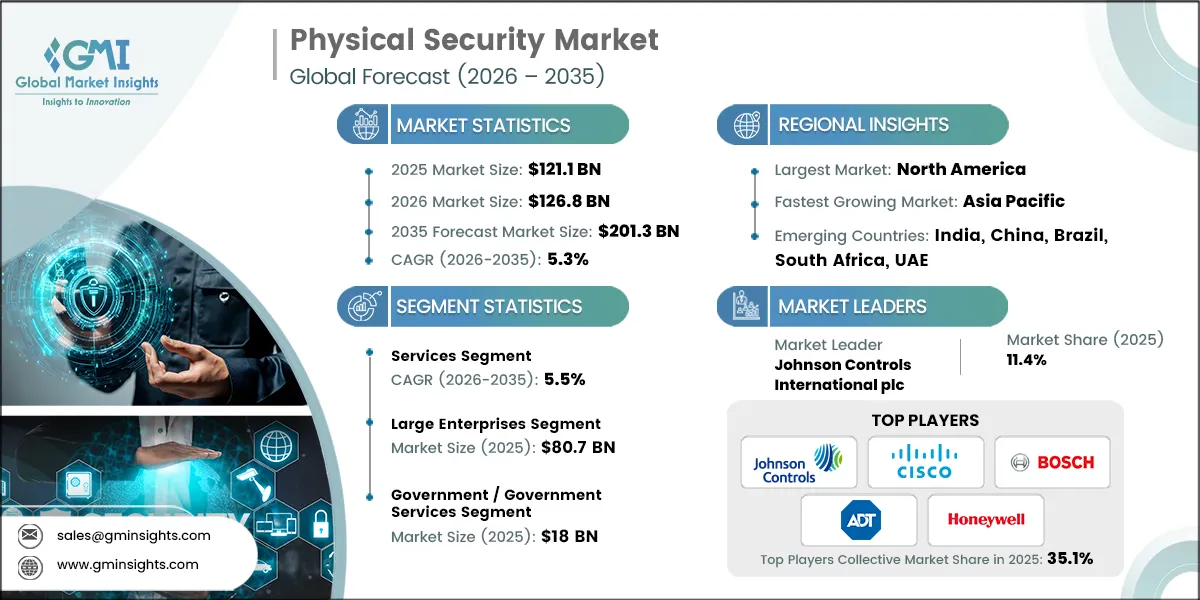
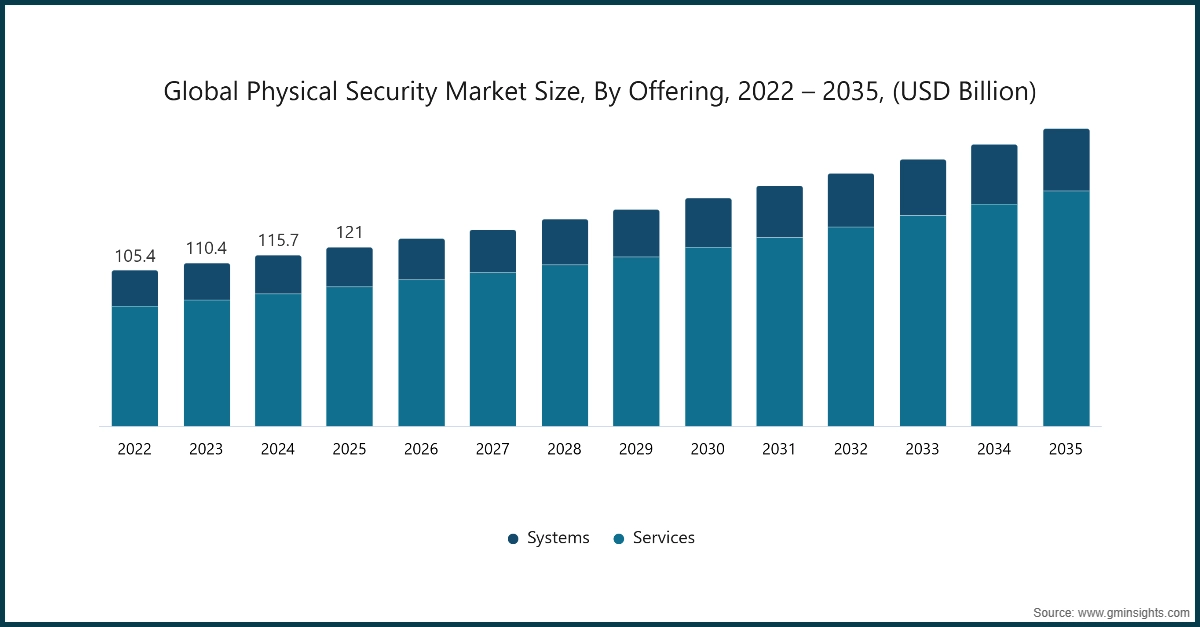
The global physical security market was valued at USD 121.1 billion in 2025. The market is expected to grow from USD 126.8 billion in 2026 to USD 162.3 billion in 2031 and USD 201.3 billion in 2035, at a CAGR of 5.3% during the forecast period, according to the latest report published by Global Market Insights Inc.
Physical Security Market Key Takeaways
Market Size & Growth
- 2025 Market Size: USD 121.1 Billion
- 2026 Market Size: USD 126.8 Billion
- 2035 Forecast Market Size: USD 201.3 Billion
- CAGR (2026–2035): 5.3%
Regional Dominance
- Largest Market: North America
- Fastest Growing Region: Asia Pacific
Key Market Drivers
- AI-Enabled Surveillance and Intelligent Video Analytics.
- Growth in Commercial Real Estate and Industrial Facilities.
- Increasing Terrorism, Cyber-Physical Threats, and Critical Infrastructure Protection.
- Integration of IoT, Cloud, and Access Control Technologies.
- Rising Urbanization and Smart City Initiatives.
Challenges
- Data Privacy Concerns and Regulatory Restrictions.
- High Initial Deployment and Integration Costs.
Opportunity
- Advancement of Smart, AI-Enabled Security Platforms.
- Growth in Security Solutions for E-Commerce and Retail Logistics.
Key Players
- Market Leader: Johnson Controls International plc led with over 11.4% market share in 2025.
- Leading Players: Top 5 players in this market include Johnson Controls International plc, Bosch Security Systems (Robert Bosch GmbH), Honeywell International Inc., ADT Inc., Cisco Systems Inc., which collectively held a market share of 35.1% in 2025.
Get Market Insights & Growth Opportunities
The physical security market is expanding, owing to AI-enabled surveillance and intelligent video analytics, growth in commercial real estate and industrial facilities, increasing terrorism, cyber-physical threats, and critical infrastructure protection, integration of IoT, cloud, and access control technologies, and rising urbanization and smart city initiatives.
Development of commercial real estate and industrial facilities is also a major boost in the market as these industries require a strong solution to protect high value assets, staff, and processes. Business complexes, shopping centers, logistic centers, and factories are becoming places that combine a sophisticated surveillance system, access control and perimeter security to reduce the risks of crime, vandalism and malfunction of operations. Critical infrastructure plans offered by the U.S. government focus on the collaborative approach to security in commercial facilities using risk management models to direct physical security upgrading in the sector. For instance, in April 2025, in the UK, the Terrorism (Protection of Premises) Act 2025 (often abbreviated as Martyn’s Law) was given Royal Assent. The law requires the owners and operators of the public facilities whose capacity is 200 or more people to install security measures to enhance preparedness such as risk assessment and in larger facilities, implement security measures which are specific and proportionate.
Physical security systems are changing due to the implementation of Internet of Things (IoT), cloud computing, and high-end access control technology, which allow implementing real-time monitoring, expandable data storage, and connectivity between devices. The technologies facilitate smart building ecosystems and industrial environments, which provide better situational awareness, automated notifications, and the ability to manage the security infrastructure remotely. The significance of developing trusted networks to engage in interactions with the device is highlighted in the government guidelines on how the safest onboarding of IoT devices should be carried out. For instance, in November 2025, the National Institute of Standards and Technology (NIST) in the U.S. released detailed recommendations on safe onboarding of internet of things devices to networks, which are used to aid in ensuring that IoT-enabled physical security systems to become resilient and secure as they grow into cloud and networked systems.
Physical security refers to the protection of people, assets, facilities, and critical infrastructure from physical threats such as theft, vandalism, terrorism, unauthorized access, and natural disasters. It includes systems and measures such as surveillance cameras, access control systems, biometric authentication, perimeter security, intrusion detection, and security personnel. Physical security aims to prevent incidents, detect threats in real time, and enable rapid response to ensure operational continuity and public safety
To get key market trends
Physical Security Market Trends
- Artificial intelligence is making physical security systems be more of a reactive tool of monitoring than a predictive intelligence tool. AI-based video analytics are able to identify abnormal behavior, real-time potential threats, and minimize redundant alarms by automatically recognizing patterns. Companies are turning towards machine learning to support their facial recognition, object detection and behavioral analytics to gain better situational awareness, escalate response time, and increase the efficiency of security workforce in both commercial and critical infrastructure settings.
- Physical security architecture is being reconfigured as a result of the move to cloud-based and hybrid deployment models. Companies are changing to cloud-managed video surveillance, remote access control and multi-site centralized dashboards to enhance scalability, flexibility and the control of multiple sites. Hybrid models enable businesses to use their own resources to store sensitive information and use the cloud services to conduct analytics and remote processes. This transition simplifies infrastructure and allows a faster update of software and integration of systems.
- The integration of physical and cybersecurity has become one of the significant trends as the security devices are IP-enabled and connected to each other. Cameras, access control systems and sensors are now part of larger IT networks, which demand combined threat management plans. This intersection enhances security against cyber-physical attacks, increases the visibility of risks, and facilitates incident response. SOCs are becoming more and more involved with managing digital and physical threat environments.
- The current access control systems are becoming mobile-based, touchless, and biometric authentication systems. Smartphone credentials, iris tracking, fingerprint identification, and facial scanning are substituting the traditional keycards and PIN. These technologies increase the accuracy of security and optimize user convenience and operation efficiency. Intelligent identity management systems are being rolled out at high rates due to demand for frictionless entry solutions in corporate offices, medical facilities, airports and industrial plants.
Physical Security Market Analysis
Learn more about the key segments shaping this market
Based on offerings, the market is divided into systems and services.
- The systems segment was valued at USD 27.1 billion in 2025. Increasing adoption of integrated surveillance, access control, and perimeter security systems across government, commercial, and industrial sectors is driving demand. Enterprises are investing in scalable, AI-enabled solutions for improved threat detection and operational efficiency.
- Deployment of advanced technologies such as IoT sensors, biometric authentication, and cloud-based monitoring in smart cities and critical infrastructure enhances situational awareness, driving substantial investment in physical security systems globally.
- Manufacturers should focus on developing comprehensive, AI-powered, and IoT-integrated systems, ensuring interoperability, reliability, and scalability to meet the requirements of large enterprises and government infrastructure projects.
- The services segment was the fastest growing market during the forecast period, growing at a CAGR of 5.5% during the forecast period. Rising demand for security consulting, system integration, maintenance, and managed services supports growth, as organizations seek continuous monitoring, remote management, and professional expertise to optimize physical security operations.
- Emergence of predictive maintenance, analytics-driven threat assessment, and cloud-based security services fuels adoption, enabling organizations to reduce downtime, improve operational efficiency, and enhance overall safety across multiple facilities.
- Service providers should expand managed services, remote monitoring, and consulting offerings, while leveraging AI and analytics to deliver value-added services that strengthen client retention and recurring revenue streams.
Learn more about the key segments shaping this market
On the basis of organization size, the physical security market is divided into SMEs (small & medium-sized enterprises), and large enterprises.
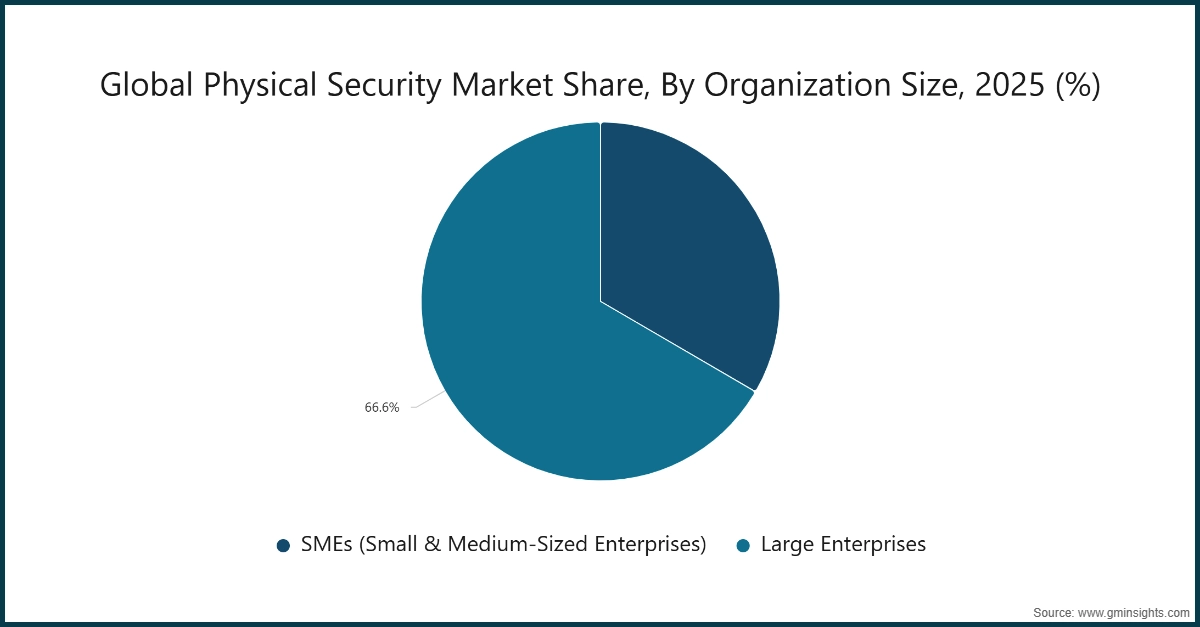
- The large enterprises segment accounted for the largest market and was valued at USD 80.7 billion in 2025. Large enterprises are increasingly investing in comprehensive security infrastructures to protect multi-site operations, critical assets, and employee safety. Integration of AI, IoT, and cloud-based platforms drives adoption of advanced physical security solutions.
- Regulatory compliance and stringent corporate governance requirements compel large organizations to deploy end-to-end surveillance, access control, and monitoring systems, ensuring operational continuity, risk mitigation, and protection of sensitive data.
- Manufacturers should design scalable, enterprise-grade solutions with centralized management, advanced analytics, and integration capabilities to meet complex operational, regulatory, and security needs of large organizations.
- The SMEs (small & medium-sized enterprises) segment was the fastest growing market during the forecast period, growing at a CAGR of 6.4% during the forecast period. SMEs are adopting cost-effective, easy-to-deploy security solutions to safeguard offices, retail outlets, and manufacturing units, driven by growing awareness of theft, workplace safety, and cyber-physical threats.
- Cloud-enabled services, modular access control, and subscription-based monitoring enable SMEs to access advanced security features without high upfront investments, fueling adoption and market growth in this segment.
- Vendors should offer affordable, modular, and cloud-integrated security systems with flexible pricing models and simplified installation to address SME budgets and resource constraints effectively.
Based on end-user industry, the physical security market is divided into banking, financial services & insurance (BFSI), healthcare, government, retail & e-commerce, energy & utilities, telecommunications, transportation & logistics, residential, education, aerospace & defense, IT & ITeS, and other.
- The government / government services segment accounted for the largest market and was valued at USD 18 billion in 2025. Governments are increasingly deploying advanced surveillance, access control, and perimeter security systems to protect critical infrastructure, public facilities, and sensitive data, driven by rising threats from terrorism, cyber-physical attacks, and urban crime.
- Public sector initiatives and regulatory mandates for national safety, disaster management, and law enforcement compliance accelerate adoption of integrated physical security solutions across government offices, transport hubs, and military installations.
- Manufacturers should focus on delivering highly secure, scalable, and government-compliant solutions with AI-driven analytics, remote monitoring, and robust integration capabilities tailored to public sector requirements.
- The retail & ecommerce segment was the fastest growing market during the forecast period, growing at a CAGR of 8% during the forecast period. Retailers and e-commerce warehouses are increasingly adopting video surveillance, AI-based analytics, and access control to prevent theft, fraud, and operational disruptions while enhancing customer and employee safety.
- Integration of smart sensors, IoT-enabled monitoring, and cloud-based security platforms supports real-time inventory protection, loss prevention, and seamless operations, driving rapid adoption in retail outlets and distribution centers.
- Vendors should provide cost-effective, AI-enabled, and cloud-integrated security solutions for retail and e-commerce operations, focusing on theft prevention, operational efficiency, and scalable deployments across multiple store and warehouse locations.
Looking for region specific data?
North America Physical Security Market
North America dominated the market and held a market share of 34.3% in 2025 of the global market.
- North America’s market growth is fueled by increasing demand for integrated security solutions across enterprise, commercial, and government sectors.
- Organizations are adopting AI-powered surveillance, smart access control, and centralized monitoring platforms to improve operational efficiency and threat detection.
- Regulatory compliance, cybersecurity integration, and investment in smart city projects further reinforce market growth, supporting the deployment of advanced solutions for industrial facilities, transportation hubs, and corporate campuses.
- Manufacturers should prioritize scalable, interoperable platforms tailored for federal and enterprise clients, enhancing compliance and integration with AI and cloud systems for differentiated offerings.
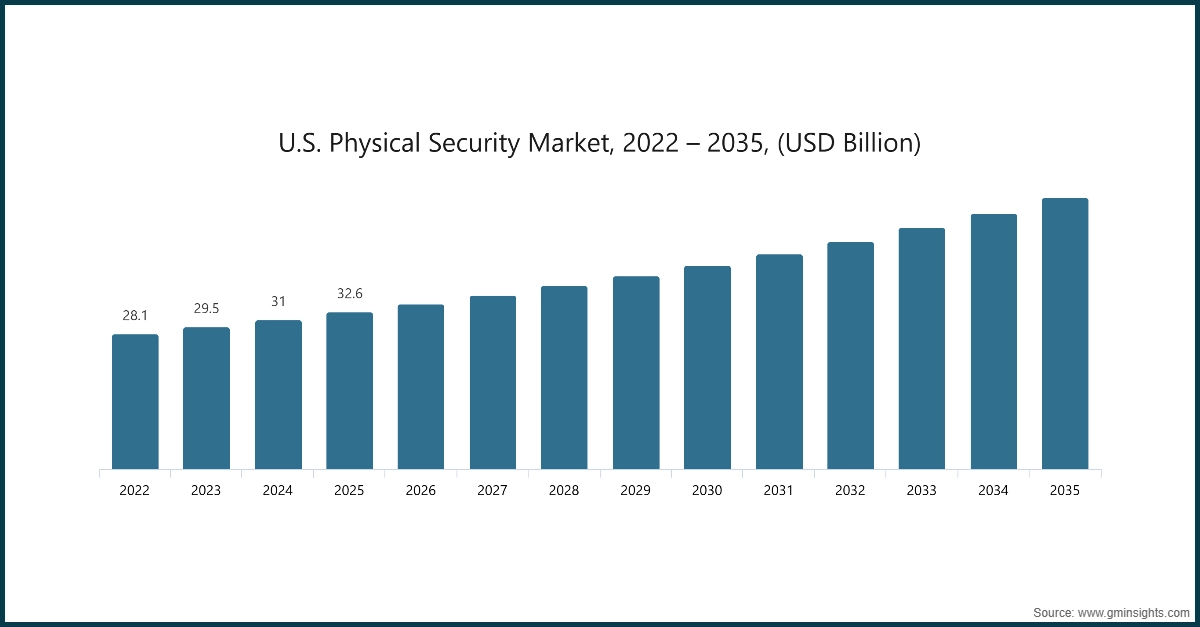
The U.S. physical security market was valued at USD 28.1 billion and USD 29.5 billion in 2022 and 2023, respectively. The market size reached USD 32.6 billion in 2025, growing from USD 31 billion in 2024.
- In the U.S., physical security trends emphasize critical infrastructure resilience, AI‑driven surveillance, and expanded monitoring frameworks guided by federal agencies.
- The Department of Homeland Security’s 2025 threat assessment highlights persistent threats to national infrastructure, underscoring the need for robust security systems against physical and cyber‑physical attacks.
- For instance, in October 2025, the U.S. Department of Homeland Security (DHS) and the Cybersecurity and Infrastructure Security Agency (CISA) highlighted an intensified threat landscape to U.S. critical infrastructure, driving a renewed, nationwide focus on both physical and cyber security.
- U.S. suppliers should align products with DHS and federal infrastructure priorities, integrating advanced analytics and threat detection to support government disaster and threat response frameworks.
Europe Physical Security Market
Europe market accounted for USD 25 billion in 2025 and is anticipated to show lucrative growth over the forecast period.
- Europe’s physical security growth is driven by smart city adoption, industrial automation, and stringent regulatory compliance requirements such as GDPR.
- Organizations are investing in AI-enabled surveillance, integrated access control, and cloud-based monitoring to protect assets, personnel, and operations. Governments are encouraging infrastructure modernization and public safety enhancements, particularly in transport and energy sectors.
- Increasing cross-border collaboration and security standards for critical infrastructure further reinforce market adoption, while enterprises focus on privacy-centric and scalable solutions to address evolving threats across densely populated urban environments and industrial hubs.
- Vendors must ensure GDPR compliance and provide modular, privacy‑centric solutions that bridge physical security with emerging smart infrastructure demands.
Germany dominated the Europe physical security market, showcasing strong growth potential.
- Germany’s market is growing due to government initiatives addressing urban safety, industrial protection, and counter-drone measures.
- Adoption of AI-driven analytics, integrated access control, and smart surveillance solutions is accelerating across transportation, commercial, and industrial sectors. Enhanced focus on critical infrastructure, public safety, and national security mandates is driving technology deployment.
- For instance, in October 2025, the German government approved legislation allowing police to neutralize unauthorized drones threatening airspace and public safety, reinforcing investment in advanced monitoring and threat detection technologies.
- German market players should develop counter‑UAV systems and sensor fusion technologies aligned with law enforcement and airport security needs to capture emerging demand.
Asia Pacific Physical Security Market
The Asia Pacific market is the fastest growing market and is anticipated to grow at the CAGR of 6.3% during the analysis timeframe.
- Asia Pacific’s market is expanding rapidly due to urbanization, industrialization, and smart city development.
- Governments in China, India, Japan, and Southeast Asia are investing in integrated surveillance, AI analytics, biometric access, and IoT-enabled security systems to enhance safety and operational efficiency.
- Regional regulatory frameworks and technology adoption incentives further encourage deployment of modern security solutions, creating opportunities for manufacturers to supply scalable, cost-effective, and interoperable physical security systems.
- OEMS should focus on cost‑competitive, scalable solutions that support urban safety and IoT ecosystems to capitalize on APAC infrastructure projects and digital transformation.
China is estimated to grow with a CAGR of 7.4% during the forecast period, in the Asia Pacific physical security market.
- China’s physical security growth is driven by nationwide adoption of large-scale surveillance networks, facial recognition, and AI-driven analytics.
- Investments in smart city programs, critical infrastructure protection, and law enforcement surveillance amplify demand. Rapid industrial expansion and rising urban populations also contribute to higher security needs.
- Organizations are adopting IoT-enabled sensors, cloud analytics, and integrated access control to enhance situational awareness, operational efficiency, and threat mitigation in densely populated and strategically critical regions.
- Manufacturers should tailor high‑performance video analytics and facial recognition systems to meet China’s large‑scale deployments and government security standards.
Latin American Physical Security Market
Brazil leads the Latin American market, exhibiting remarkable growth during the analysis period.
- Brazil’s market is expanding due to rising urban crime, public safety concerns, and demand for secure infrastructure in commercial and industrial sectors.
- Businesses and municipalities are increasingly adopting AI-enabled monitoring, cloud-based platforms, and integrated security solutions to mitigate risks, enhance operational efficiency, and protect critical assets.
- Public awareness campaigns and regulatory frameworks promoting safe urban environments support continued market adoption, encouraging manufacturers to provide affordable, scalable, and reliable physical security technologies.
- Vendors should localize offerings to address Brazil’s urban safety needs with cost‑effective surveillance and access control solutions adapted to diverse city environments.
Middle East and Africa Physical Security Market
South Africa to experience substantial growth in the Middle East and Africa market in 2025.
- South Africa’s physical security growth is driven by heightened demand for urban safety, crime prevention, and protection of public and private infrastructure. Regulatory measures controlling private security operations and firearm use further encourage adoption of advanced monitoring and non-lethal security technologies.
- Organizations are deploying AI-based surveillance, access control, and integrated command systems to enhance situational awareness and operational efficiency.
- Increasing investments in critical infrastructure, commercial real estate, and industrial facilities also drive demand.
- Suppliers should emphasize non‑weaponized security technologies, such as advanced surveillance, intrusion detection, and monitoring software, suited for regulated private security contexts.
Physical Security Market Share
The market is moderately concentrated, with leading manufacturers collectively capturing a substantial portion of global revenues. Key players such as Johnson Controls International plc, Bosch Security Systems (Robert Bosch GmbH), Honeywell International Inc., ADT Inc., and Cisco Systems, Inc. dominated the competitive landscape, accounting for approximately 35.1% of the total market share in 2025. These companies maintain strong positions through extensive product portfolios, advanced AI-driven surveillance systems, cloud-enabled access control solutions, and integrated monitoring platforms.
They serve sectors including government, commercial, industrial, transportation, and critical infrastructure. Strategic initiatives such as global partnerships, localized support expansion, and investments in smart security platforms enhance their presence across key international markets.
Despite this concentration, specialized and regional players remain active, focusing on niche applications, cost-effective solutions, and emerging technologies like biometric systems, IoT-enabled devices, and predictive analytics. This ensures ongoing innovation, competitive intensity, and market diversification across both mature and emerging regions.
Physical Security Market Companies
Prominent players operating in the physical security industry are as mentioned below:
- Johnson Controls International
- Honeywell International Inc.
- Bosch Security Systems (Robert Bosch GmbH)
- Hikvision Digital Technology Co., Ltd.
- Dahua Technology Co., Ltd.
- Axis Communications AB
- ASSA ABLOY AB
- Allegion plc
- Siemens AG
- Schneider Electric SE
- Genetec Inc.
- Motorola Solutions, Inc.
- Hanwha Vision (Hanwha Group)
- ADT Inc.
- Thales Group
- Johnson Controls International plc leads the physical security market with an 11.4% share, driven by its extensive portfolio of integrated security solutions, including video surveillance, access control, fire safety, and building management systems. The company emphasizes scalable, AI-enabled platforms and centralized management, serving enterprises, government facilities, and commercial installations. Strategic collaborations with technology partners, integrators, and service providers strengthen its presence and enhance operational reliability, security, and efficiency across global markets.
- Bosch Security Systems (Robert Bosch GmbH) holds an 8.8% market share, leveraging advanced sensor technologies, AI-driven video analytics, and integrated intrusion detection solutions. Bosch provides comprehensive security systems for commercial, industrial, and critical infrastructure sectors. Continuous R&D investment and partnerships with integrators enable modular, scalable, and high-performance solutions, enhancing situational awareness, operational efficiency, and real-time threat detection.
- Honeywell International Inc. commands a 6.7% share, focusing on connected physical security solutions, including access control, intrusion detection, and building automation. Honeywell emphasizes networked platforms, predictive analytics, and smart monitoring to enhance safety and operational efficiency for enterprises, smart buildings, and industrial facilities. Strategic collaborations with system integrators support rapid deployment and interoperability across multiple sites.
- ADT Inc. represents 5.6% of the market, specializing in managed security services, alarm monitoring, and cloud-based access control. ADT serves residential, SME, and commercial clients with 24/7 surveillance, emergency response, and remote security management, leveraging advanced analytics and scalable solutions to improve safety and operational control.
- Cisco Systems, Inc. accounts for 2.6% of the market, driven by network-centric security solutions that integrate video surveillance, IoT sensors, and cybersecurity frameworks. Cisco focuses on real-time monitoring, secure data handling, and predictive analytics to enhance situational awareness and operational efficiency for enterprise, government, and industrial deployments worldwide.
Physical Security Market Report Attributes
| Key Takeaway | Details |
|---|---|
| Market Size & Growth | |
| Base Year | 2025 |
| Market Size in 2025 | USD 121.1 Billion |
| Market Size in 2026 | USD 126.8 Billion |
| Forecast Period 2026-2035 CAGR | 5.3% |
| Market Size in 2035 | USD 201.3 Billion |
| Key Market Trends | |
| Drivers | Impact |
| AI-Enabled Surveillance and Intelligent Video Analytics | Accelerates demand for advanced surveillance systems as organizations deploy AI-driven video analytics to detect anomalies, prevent unauthorized access, and optimize security operations in real time across enterprises, government, and industrial sites. |
| Growth in Commercial Real Estate and Industrial Facilities | Drives adoption of integrated physical security solutions in offices, shopping centers, warehouses, and factories to protect assets, ensure employee safety, and comply with regulatory requirements, increasing demand for video surveillance, access control, and perimeter systems. |
| Increasing Terrorism, Cyber-Physical Threats, and Critical Infrastructure Protection | Strengthens deployment of comprehensive security systems in government facilities, transportation hubs, and energy infrastructure to mitigate physical and cyber-physical threats, ensuring public safety and continuity of operations. |
| Integration of IoT, Cloud, and Access Control Technologies | Promotes adoption of connected and remotely manageable security systems, enabling centralized monitoring, predictive alerts, and scalable deployment across multiple locations, improving operational efficiency and decision-making for security teams. |
| Rising Urbanization and Smart City Initiatives | Fuels large-scale deployment of smart surveillance, access management, and sensor-based monitoring in urban infrastructure projects, supporting public safety, traffic management, and city-wide threat detection initiatives. |
| Pitfalls & Challenges | Impact |
| Data Privacy Concerns and Regulatory Restrictions | Restrict adoption of AI-powered surveillance and cloud-based solutions, requiring manufacturers and service providers to implement strict data protection, compliance frameworks, and privacy-preserving technologies. |
| High Initial Deployment and Integration Costs | Limits adoption among SMEs and smaller public facilities, as expensive infrastructure, integration, and training requirements increase total cost of ownership, potentially slowing market penetration. |
| Opportunities: | Impact |
| Advancement of Smart, AI-Enabled Security Platforms | Will enhance real-time threat detection, predictive analytics, and automated response capabilities, improving operational efficiency and reducing human intervention across enterprise, government, and urban facilities. |
| Growth in Security Solutions for E-Commerce and Retail Logistics | Will generate sustained demand for intelligent access control, video analytics, and sensor-based monitoring systems such as e-commerce warehouses, logistics hubs, and retail outlets expand, requiring optimized security management and asset protection. |
| Market Leaders (2025) | |
| Market Leader |
11.4% Market Share |
| Top Players |
Collective market share in 2025 is 35.1% |
| Competitive Edge |
|
| Regional Insights | |
| Largest Market | North America |
| Fastest growing market | Asia Pacific |
| Emerging countries | India, China, Brazil, South Africa, UAE |
| Future outlook |
|
What are the growth opportunities in this market?
Physical Security Market News
- In August 2025, Rhombus, a leader in cloud-managed physical security, announced the launch of four new purpose-built cameras designed to enhance situational awareness and security for modern businesses. These new cameras run on the unified Rhombus cloud-managed platform and include advanced AI features such as facial recognition, vehicle detection, and people counting.
- In June 2024, Honeywell completed its $4.95 billion all-cash acquisition of Carrier’s Global Access Solutions business. The deal aligns with Honeywell's strategy to focus on three megatrends: automation, the future of aviation, and energy transition.
- In July 2024, Hikvision updated its portfolio with second-generation professional access control solutions and advanced 4K IP cameras featuring AI-driven analytics, such as the Acu-Sense series, to enhance high-security environments like data centers.
- In September 2024, Genetec launched the ‘Operations Center’, a cloud-based, specialized work management solution designed to enhance collaboration, communication, and efficiency for physical security teams. Available as a standalone product or within Security Center SaaS, it allows for real-time tracking of tasks, such as maintenance and patrols, via web and mobile interfaces.
The physical security market research report includes in-depth coverage of the industry with estimates & forecasts in terms of revenue (USD Billion) from 2022 to 2035, for the following segments:
Market, By Offerings
- Systems
- Physical access control system
- Video surveillance systems
- Perimeter intrusion detection and prevention
- Physical security information management (PSIM)
- Physical identity and access management (PIAM)
- Security scanning
- Imaging & metal detection
- Fire & life safety
- Services
- Professional services
- Managed services
Market, By Organization Size
- SMEs (Small & Medium-Sized Enterprises)
- Large Enterprises
Market, By End-User Industry
- Banking, financial services & insurance (BFSI)
- Healthcare
- Government
- Retail & ecommerce
- Energy & utilities
- Telecommunications
- Transportation & logistics
- Residential
- Education
- Aerospace & defense
- IT & ITeS
- Others
The above information is provided for the following regions and countries:
- North America
- U.S.
- Canada
- Europe
- Germany
- UK
- France
- Spain
- Italy
- Netherlands
- Asia Pacific
- China
- India
- Japan
- Australia
- South Korea
- Latin America
- Brazil
- Mexico
- Argentina
- Middle East and Africa
- Saudi Arabia
- South Africa
- UAE
Frequently Asked Question(FAQ) :
What was the market size of the physical security market in 2025?
The global physical security market was valued at USD 121.1 billion in 2025, with a CAGR of 5.3% projected during the forecast period, driven by advancements in AI, cloud-based solutions, and integrated security systems.
What is the projected value of the physical security market by 2035?
The market is expected to reach USD 201.3 billion by 2035, fueled by increasing adoption of AI-enabled solutions, hybrid deployment models, and the integration of physical and cybersecurity.
What is the projected size of the physical security market in 2026?
The market is expected to reach USD 126.8 billion in 2026.
How much revenue did the systems segment generate in 2025?
The systems segment generated USD 27.1 billion in 2025, driven by the adoption of integrated surveillance, access control, and perimeter security systems across various sectors.
What was the valuation of the government services segment in 2025?
The government services segment was valued at USD 18 billion in 2025, as governments increasingly deployed advanced security systems to protect critical infrastructure and public facilities.
Which region led the physical security market in 2025?
North America dominated the market with a 34.3% share in 2025, supported by strong adoption of advanced security technologies and infrastructure investments.
What was the market size of the U.S. physical security market in 2025?
The U.S. market reached USD 32.6 billion in 2025, growing from USD 31 billion in 2024.
What are the upcoming trends in the physical security industry?
Key trends include the adoption of AI-driven video analytics, the transition to cloud-based and hybrid deployment models, and the integration of physical and cybersecurity to combat cyber-physical threats.
Who are the key players in the physical security market?
Key players include Johnson Controls International, Honeywell International Inc., Bosch Security Systems (Robert Bosch GmbH), Hikvision Digital Technology Co., Ltd., Dahua Technology Co., Ltd., Axis Communications AB, ASSA ABLOY AB, Allegion plc, Siemens AG, and Schneider Electric SE.
Physical Security Market Scope
Related Reports