Summary
Table of Content

Pharmaceutical Glass Packaging Market
Get a free sample of this report
Form submitted successfully!
Error submitting form. Please try again.
Thank you!
Your inquiry has been received. Our team will reach out to you with the required details via email. To ensure that you don't miss their response, kindly remember to check your spam folder as well!
Request Sectional Data
Thank you!
Your inquiry has been received. Our team will reach out to you with the required details via email. To ensure that you don't miss their response, kindly remember to check your spam folder as well!
Form submitted successfully!
Error submitting form. Please try again.
Pharmaceutical Glass Packaging Market Size
The rise in global pharmaceutical demand is a major growth drive in the market. The increasing aging population and increasing prevalence of chronic diseases is pushing the expansion of pharmaceutical industries which demand durable and high-quality packaging, making glass preferred material due to chemical stability and preserving drug effectiveness. According to a Statista report, global pharmaceutical industry accounted for USD 1.6 trillion dollars in the year 2023. In addition, the rise in the use of generic injectable drugs, which depend on specialized glass packaging solutions such as vials and ampoules, is also adding to the growth of the market.
Pharmaceutical Glass Packaging Market Key Takeaways
Market Size & Growth
- 2025 Market Size: USD 23.9 Billion
- 2026 Market Size: USD 26.1 Billion
- 2035 Forecast Market Size: USD 63.1 Billion
- CAGR (2026–2035): 10.3%
Regional Dominance
- Largest Market: North America
- Fastest Growing Region: Asia Pacific
Key Market Drivers
- Stringent Regulations on Drug Safety.
- Aging Population and Chronic Disease.
- Rising Global Pharmaceutical Demand.
- Technological Advancement in Glass Packaging.
- Preference for Ready to Use Packaging.
Challenges
- Fragility and Breakage Risks.
- High Cost of Glass Packaging.
Opportunity
- Preference for Ready to Use Packaging.
- Adoption of Sustainable and Eco-Friendly Glass Packaging Solutions.
Key Players
- Market Leader: SCHOTT Pharma led with over 14.2% market share in 2025.
- Leading Players: Top 5 players in this market include SCHOTT Pharma, Gerresheimer, Corning, Nipro Corporation, Stevanato Group S.p.A., which collectively held a market share of 49.1% in 2025.
Get Market Insights & Growth Opportunities
The pharmaceutical glass manufacturers need to develop vials and ampoules that are durable and chemically resistant to meet the growing demand from the pharma industry. Innovation in lightweight, break-resistant, and eco-friendly glass packaging will improve drug safety, regulatory standards, and competitiveness in the market.
Another significant growth driver in pharmaceutical glass packaging market is the stringent packaging regulations for drug safety. Various regulatory bodies such as FDA (U.S. Food and Drug Administration), EMA (European Medicines Agency), and WHO (World Health Organization) enforces strict packaging guidelines to ensure drug stability and contamination prevention for injectable drugs and vaccines. This regulatory need is propelling the transition from conventional glass to Type 1 borosilicate glass packaging because of its enhanced chemical resistance and extreme temperature resistance benefits.
The preference for ready to use packaging such as pre-sterilized vials, ampoules and syringes pushes the growth of market. These packaging eliminates the need for in-house sterilization of drugs and ensures smooth drug manufacturing and filling process. Moreover, pharmaceutical manufacturing companies are adopting ready to use packaging, as it reduces operational cost and reduces contamination risk while complying with regulatory requirements.
Pharmaceutical glass packaging manufacturers must prefer Type 1 borosilicate glass for highest chemical resistance and compliance with norms. Increasing demand for pre-sterilized, ready-to-use vials, ampoules, and syringes will reduce contamination threats, streamline drug production, and save cost for the pharmaceutical industry.
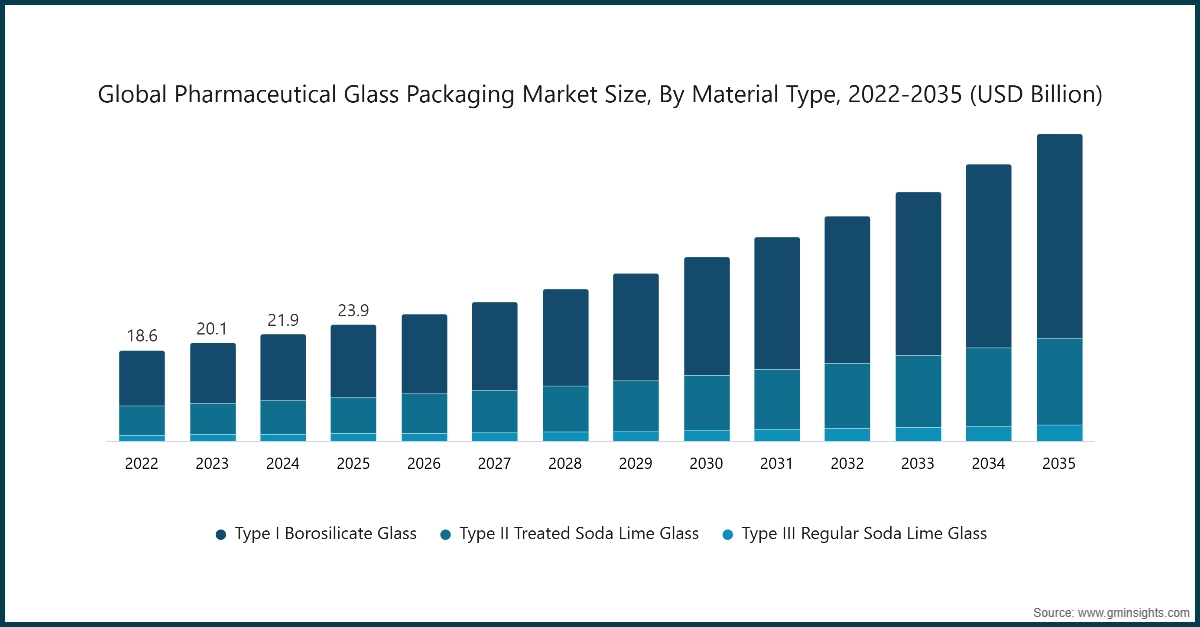
The pharmaceutical glass packaging market expanded steadily from USD 18.5 billion in 2022 to USD 21.9 billion in 2024, driven by the rising demand for safe, sterile, and high-quality packaging solutions for injectable drugs, vaccines, and liquid formulations. During this period, the global production of biopharmaceuticals and parenteral drugs increased, prompting manufacturers to adopt advanced automated filling and packaging systems, specialty glass formulations, and sterilization-compliant packaging.
The global pharmaceutical glass packaging market was valued at USD 23.9 billion in 2025. The market is expected to grow from USD 26.1 billion in 2026 to USD 41.8 billion in 2031 & USD 63.1 billion in 2035 with a volume of 16.9 billion units in 2025, at a CAGR of 10.3% during the forecast period, according to the latest report published by Global Market Insights Inc.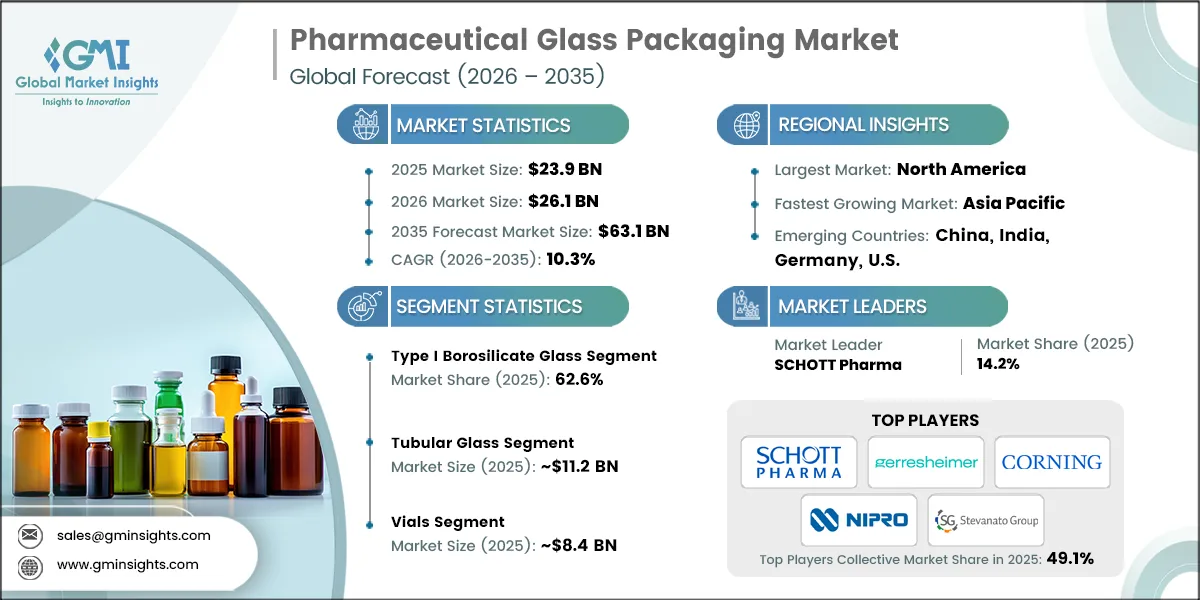
To get key market trends
Pharmaceutical Glass Packaging Market Trends
- One of the major trends observed in the market is the adoption of RFID, NFC tags, and the track and trace system in the pharmaceutical glass packaging industry for improving the security of drugs. The companies are increasingly using tamper evident seals and unique identification codes to improve the efficiency of the supply chain.
- Another major trend observed in the market is the adoption of Type 1 borosilicate glass packaging. The Type 1 borosilicate glass packaging is of high quality and provides advantages of drug stability and sterility.
- Break resistant and delamination free glass coatings are gaining rapid traction in the market. These coating offers prevention of glass breakage and chemical leaching advantages while reducing interaction with drug to ensure safe delivery and patient safety. These advanced coatings are emerging as significant trend in the market.
Pharmaceutical Glass Packaging Market Analysis
Learn more about the key segments shaping this market
Based on material type, the pharmaceutical glass packaging market is divided into Type I Borosilicate Glass, Type II Treated Soda Lime Glass, and Type III Regular Soda Lime Glass.
- The Type I Borosilicate Glass segment led the market in 2025, holding a 62.6% share. The growth of this segment is driven by the surge in demand for biologics, vaccine and injectable drugs which require chemically stable packaging. This material offers highest chemical resistance and temperature stability which makes them ideal for various high value drugs. Moreover, strict government regulations mandate the use of borosilicate glass packaging for sensitive drug is pushing the adoption of type 1 material.
- The Type II Treated Soda Lime Glass segment is expected to grow at a CAGR of 9.2% over the forecast period. The growing demand for oral liquid drugs and low acidity injectables are the key growth drivers of this section. This material offers cost effective alternative to type 1 material where moderate chemical resistance is required such as parental drugs packaging.
Learn more about the key segments shaping this market
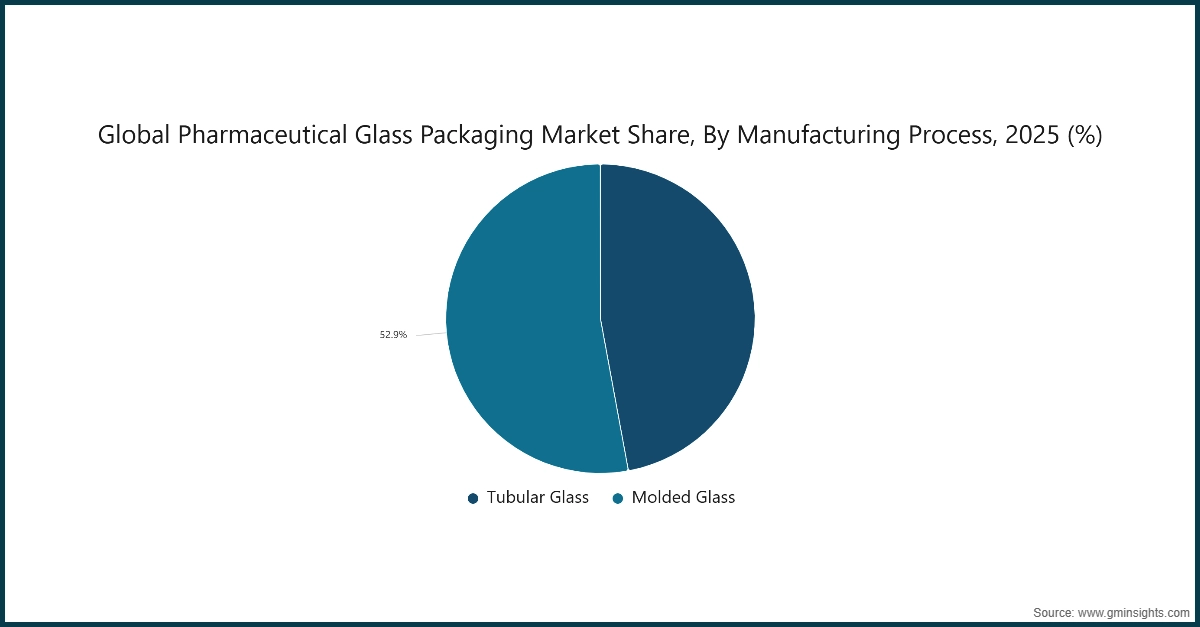
Based on manufacturing process, the global pharmaceutical glass packaging market is segmented into tubular glass and molded glass.
- The tubular glass segment had the largest market size in 2025 and was valued at around USD 11.2 billion because of its high accuracy, chemical resistance, and ability to be used for high-quality injectable drugs. Tubular glass is commonly used in vials, ampoules, and prefillable syringes, especially for biologics and sensitive drugs. Its uniform wall thickness, excellent hydrolytic stability, and suitability for automated filling lines have led to its widespread acceptance among pharmaceutical manufacturers.
- The molded glass market is expected to register a CAGR of 9.3% during the forecast period. The usage of molded glass is currently restricted to larger packaging containers such as infusion bottles and syrup bottles, which offer excellent mechanical strength and are economical. Its suitability for mass production, transportation resistance, and widespread use in generic drug packaging ensure its continued use in the developed and emerging pharmaceutical markets.
The pharmaceutical glass packaging market based on the product is bifurcated into vials, bottles, cartridges & syringes, ampoules and others.
- The vials segment accounted for the largest market size in 2025 and was valued at approximately USD 8.4 billion, due to the rising demand for injectable therapies, biologics, and vaccines. Glass vials offer excellent chemical resistance, outstanding sterility assurance, and the ability to be processed for freezing. Their extensive usage in parenteral therapies and the rising production of biopharmaceuticals have been major contributors to market growth.
- The bottles segment is expected to register a CAGR of 9.4% during the forecast period. Glass bottles are primarily used for oral liquid dosage forms, syrups, and bulk pharmaceuticals. Their robustness, non-reactive properties, and capacity to maintain drug stability make them ideal for large-scale applications, especially in emerging countries and generic pharmaceutical production.
Looking for region specific data?
North America Pharmaceutical Glass Packaging Market
North America held a share of 35.3% of the market in 2025.
- The North American pharmaceutical glass packaging industry is rapidly shifting towards quality assurance, regulatory requirements, and sustainable manufacturing processes. The pharmaceutical industry is promoting high-purity borosilicate glass and advanced coating technology to improve the stability of drugs and prevent contamination. In addition, the rising production of injectable drugs and biologics is fueling the demand for high-performance glass vials and prefillable systems.
- The rising demand for injectable drugs and biologics is some of the key drivers in North America. Various government initiative supports the adoption of sustainable packaging material which is propelling the demand for Type 1 borosilicate glass packaging for enhanced drug safety.
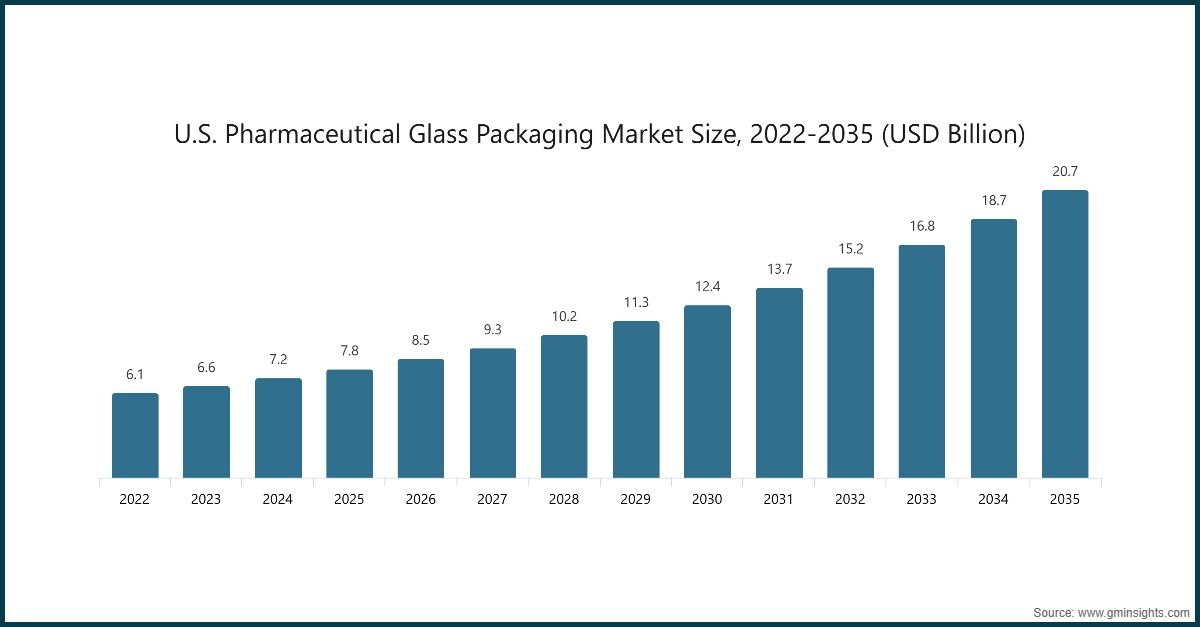
The U.S. pharmaceutical glass packaging market was valued at USD 6.1 billion and USD 6.6 billion in 2022 and 2023, respectively. The market size reached USD 7.8 billion in 2025, growing from USD 7.2 billion in 2024.
- The U.S. market is growing at a steady rate due to rising demand for injectable drugs, biologics, and vaccines, along with increasing production of generic and specialty pharmaceuticals. The expansion of domestic drug manufacturing and growing prefillable syringes and sterile vials are further supporting market growth.
- The country has developed pharmaceutical industry, and the increasing production and export of biologics and vaccines are the key growth drivers in the region. For instance, according to Statista, the U.S. was the largest pharmaceutical industry in the year 2023, generating more than USD 670 billion in revenue. In addition, the rapid expansion of contract development and manufacturing organizations (CDMOs) further supports the growth of market in the region.
Europe Pharmaceutical Glass Packaging Market
Europe market accounted for USD 5.3 billion in 2025 and is anticipated to show lucrative growth over the forecast period.
- Europe is at the forefront of adopting high-quality and sustainable solutions in the pharmaceutical glass packaging industry. The stringent regulatory requirements and the European Union's emphasis on drug safety, traceability, and the principles of a circular economy are encouraging companies to improve the recyclability of glass and lower carbon emissions during manufacturing. The growing demand for biologics, specialty drugs, and sterile injectable drug packaging is also encouraging the use of advanced borosilicate glass vials and prefillable systems.
- Countries such as Germany, France, and the UK are encouraging local pharmaceutical production and advanced packaging solutions through investments in automated manufacturing lines, high-purity glass technology, and sustainable manufacturing processes.
Germany dominates the Europe pharmaceutical glass packaging industry, showcasing strong growth potential.
- Germany is a leading market for pharmaceutical glass packaging in Europe, supported by its strong pharmaceutical manufacturing base and stringent quality standards. Regulatory frameworks aligned with EU GMP guidelines and sustainability regulations are encouraging the adoption of highly recyclable and high-purity glass packaging solutions. The country’s robust production of biologics, vaccines, and injectable drugs is significantly driving demand for high-performance vials, ampoules, and bottles.
- The country has developed pharmaceutical industry coupled with stringent government policies for drug packaging which drives constant demand for pharmaceutical glass packaging solutions. Furthermore, the approval of biologic drugs production is pushing the demand for pre-filled syringes and cartridges.
Asia Pacific Pharmaceutical Glass Packaging Market
The Asia Pacific market is expected to grow at the highest CAGR of 11.4% during the forecast period.
- The Asia-Pacific pharmaceutical glass packaging industry is growing at a fast pace due to the strong presence of pharmaceutical companies, contract development and manufacturing organizations, and vaccine manufacturers in the region. Countries such as China, India, and Japan are experiencing a growing demand for quality vials and bottles due to the increased production of biologics and generic drugs.
- The Asia-Pacific region is experiencing fast-paced urbanization, improvements in access to healthcare, and growing disposable incomes, which are fueling the consumption of pharmaceuticals in the region. The growing immunization programs, prevalence of chronic diseases, and development of biosimilars are also fueling the demand for high-performance glass packaging solutions in the region.
China pharmaceutical glass packaging market is estimated to grow with a significant CAGR, in the Asia Pacific market.
- China represents one of the largest markets for pharmaceutical glass packaging in Asia-Pacific, supported by its expansive domestic pharmaceutical manufacturing base and strong presence of vaccine and injectable drug producers. Rising production of biologics, biosimilars, and generic injectables is significantly driving demand for high-quality vials and bottles.
- Government initiatives such as the expansion of centralized drug procurement programs and regulatory alignment with international quality standards are encouraging the adoption of high-performance borosilicate glass packaging. Strengthening GMP compliance requirements is further pushing manufacturers toward premium tubular glass solutions with superior chemical resistance and dimensional accuracy.
Middle East and Africa Pharmaceutical Glass Packaging Market
Saudi Arabia pharmaceutical glass packaging industry to experience substantial growth in the Middle East and Africa market.
- The market for pharmaceutical glass packaging in Saudi Arabia is growing steadily due to the rise in domestic pharmaceutical production, demand for injectable pharmaceuticals, and development of hospital and specialized healthcare infrastructure. The rising incidence of chronic diseases and government efforts to develop vaccine and biologic production are also fueling demand for high-quality pharmaceutical vials and bottles.
- Government support for localization of pharmaceutical production through the Saudi Vision 2030 initiative, improvements in regulations by the Saudi Food and Drug Authority (SFDA), and development of sterile manufacturing facilities are all fueling market development. Saudi Arabia is thus becoming an attractive growth market for pharmaceutical glass packaging in the Middle East region.
Pharmaceutical Glass Packaging Market Share
The pharmaceutical glass packaging industry is highly competitive and fragmented with the presence of established global players as well as local players and startups. The top 5 players in the global market are Schott AG, Gerresheimer AG, Corning Incorporated, Stevanato Group S.p.A., and Nipro Corporation, collectively accounting for over 49.1% market share.
Major players in the market are investing in sustainable material and high-quality glass packaging to meet the strict regulatory requirements and growing demand for eco-friendly packaging. The next-generation pharmaceutical glass packaging are focusing on the break resistant and chemically stable glass, which ensures drug safety while aligning sustainability goals.
New developments in surface coatings and barrier technology have pushed the adoption of Type 1 borosilicate and aluminosilicate glass packaging, improving durability and drug compatibility. Moreover, the increasing cases of diabetic cardiovascular and cancer is pushing the demand for pharmaceutical vials and ampules, which contributes to growing demand for pharmaceutical glass packaging.
Pharmaceutical Glass Packaging Market Companies
Prominent players operating in the pharmaceutical glass packaging industry are as mentioned below:
- Ardagh Group S.A.
- Beatson Clark Ltd.
- Bormioli Pharma S.p.A.
- Corning Incorporated
- DWK Life Sciences / DWK Life Sciences GmbH
- Gerresheimer AG
- Hindustan National Glass & Industries Ltd.
- Nipro Corporation
- Owens‑Illinois, Inc.
- Piramal Glass Limited
- Schott AG
- SGD Pharma (SGD S.A.)
- Shandong Pharmaceutical Glass Co., Ltd.
- Stevanato Group S.p.A.
- Stölzle Glass Group
SCHOTT Pharma is a global leader in pharmaceutical glass packaging, offering high-quality borosilicate glass vials, ampoules, cartridges, and syringes for injectable drugs. The company emphasizes advanced glass compositions, strong regulatory compliance, and ready-to-use (RTU) sterile solutions. Its global manufacturing footprint and focus on biologics and high-value therapies strengthen its position in regulated markets worldwide.
Gerresheimer provides a broad portfolio of pharmaceutical glass packaging solutions, including molded and tubular glass vials, bottles, and ampoules. The company focuses on high-quality primary packaging for injectable and oral drugs, supported by strong design capabilities and global production facilities. Strategic investments in high-value biologics and RTU solutions enhance its competitive positioning.
Corning leverages its materials science expertise to offer advanced pharmaceutical glass solutions such as high-strength borosilicate and aluminosilicate glass vials. Its Valor Glass technology enhances durability, reduces breakage, and improves filling line efficiency. Strong innovation capabilities and partnerships with leading pharmaceutical manufacturers reinforce its role in premium injectable packaging.
Nipro Corporation supplies pharmaceutical glass vials, ampoules, and cartridges, integrated with its broader medical device and drug delivery portfolio. The company benefits from vertical integration, strong presence in Asia, and growing expansion in North America and Europe. Its focus on sterile, high-precision packaging supports biologics and vaccine applications.
Stevanato Group offers comprehensive pharmaceutical glass packaging solutions, including vials, cartridges, and prefillable syringes, alongside analytical and assembly services. The company differentiates through engineering expertise, integrated drug containment and delivery systems, and strong collaboration with biopharma companies. Continuous investments in capacity expansion and high-value injectable platforms strengthen its global market presence.
Pharmaceutical Glass Packaging Market Report Attributes
| Key Takeaway | Details |
|---|---|
| Market Size & Growth | |
| Base Year | 2025 |
| Market Size in 2025 | USD 23.9 Billion |
| Market Size in 2026 | USD 26.1 Billion |
| Forecast Period 2026-2035 CAGR | 10.3% |
| Market Size in 2035 | USD 63.1 Billion |
| Key Market Trends | |
| Drivers | Impact |
| Stringent Regulations on Drug Safety | Drives ~18% growth as regulatory compliance ensures safer, contamination-free pharmaceutical packaging, increasing adoption of high-quality glass vials, ampoules, and bottles globally. |
| Aging Population and Chronic Disease | Drives ~16% growth by elevating demand for injectable drugs, vaccines, and long-term therapies, thereby boosting requirement for durable and reliable glass packaging solutions. |
| Rising Global Pharmaceutical Demand | Drives ~20% growth as higher production of generics, biologics, and vaccines expands the market for standardized and high-volume pharmaceutical glass containers. |
| Technological Advancement in Glass Packaging | Drives ~14% growth through innovations like Type I borosilicate glass, multi-layer coatings, and pre-filled syringes, enhancing durability, safety, and ease of use. |
| Preference for Ready to Use Packaging | Drives ~12% growth by increasing adoption of pre-filled syringes, cartridges, and vials that save time, reduce contamination, and simplify drug administration. |
| Pitfalls & Challenges | Impact |
| Fragility and Breakage Risks | Restrains market growth as premium manufacturing, specialized processing, and higher raw material costs make glass packaging less affordable for small-scale pharmaceutical producers and cost-sensitive markets. |
| High Cost of Glass Packaging | Restrains market growth as premium manufacturing, specialized processing, and higher raw material costs make glass packaging less affordable for small-scale pharmaceutical producers and cost-sensitive markets. |
| Opportunities: | Impact |
| Preference for Ready to Use Packaging | Supports market growth as pre-filled syringes, cartridges, and vials reduce preparation time, minimize contamination risk, and enhance convenience for healthcare providers and patients globally. |
| Adoption of Sustainable and Eco-Friendly Glass Packaging Solutions | Supports market growth by promoting recyclable, reusable, and low-carbon glass packaging, aligning with environmental regulations and increasing demand from eco-conscious pharmaceutical manufacturers. |
| Market Leaders (2025) | |
| Market Leader |
14.2% market share in 2025 |
| Top Players |
Collective Market Share for top 5 players is 49.1% in 2025 |
| Competitive Edge |
|
| Regional Insights | |
| Largest Market | North America |
| Fastest growing market | Asia Pacific |
| Emerging countries | China, India, Germany, U.S. |
| Future outlook |
|
What are the growth opportunities in this market?
Pharmaceutical Glass Packaging Industry News
- In February 2026, Gerresheimer showcased its sustainable glass packaging solutions for food, natural cosmetics, and nutraceuticals at BIOFACH 2026 in Nuremberg. The company highlighted lightweight, refillable, and high post-consumer recycled glass designs, emphasizing reduced carbon footprint, product safety, and premium aesthetics. This initiative reinforces Gerresheimer’s commitment to sustainability, supporting clients in achieving circular economic goals while expanding adoption of eco-friendly glass packaging across global markets.
- In August 2025, SCHOTT launched local production of high-precision syringe and cartridge glass tubing at its Jambusar, Gujarat facility, becoming the first in India to do so. This expansion, leveraging German technology, aimed to meet growing demand for GLP-1-based injectables like semaglutide, enhance India’s pharmaceutical self-reliance under the “Make in India” initiative, and strengthen the supply of borosilicate FIOLAX tubing for prefillable syringes, cartridges, vials, and ampoules across India and Asia.
- In October 2024, Nipro Pharma packaging company launched their D2F (direct 2 fill) glass vials. These vials offer high quality and a ready to use solution while meeting the packaging standard and to cater the growing demand of the pharmaceutical industry.
The pharmaceutical glass packaging market research report includes in-depth coverage of the industry with estimates and forecast in terms of revenue (USD Billion) and volume (Million Units) from 2022 – 2035 for the following segments:
Market, By Material Type
- Type I Borosilicate Glass
- Type II Treated Soda Lime Glass
- Type III Regular Soda Lime Glass
Market, By Manufacturing Process
- Tubular Glass
- Molded Glass
Market, By Product Type
- Vials
- Bottles
- Ampoules
- Cartridges & Syringes
- Others
Market, By Drug Delivery Route
- Injectable Drugs
- Oral Drugs
- Ophthalmic Drugs
- Topical Drugs
- Others
Market, By End User
- Pharmaceutical Companies
- Contract Manufacturing Organizations
The above information is provided for the following regions and countries:
- North America
- U.S.
- Canada
- Europe
- Germany
- UK
- France
- Spain
- Italy
- Netherlands
- Asia Pacific
- China
- India
- Japan
- Australia
- South Korea
- Latin America
- Brazil
- Mexico
- Argentina
- Middle East and Africa
- South Africa
- Saudi Arabia
- UAE
Frequently Asked Question(FAQ) :
What is the market size of the pharmaceutical glass packaging market in 2025?
The market was valued at USD 23.9 billion in 2025, supported by increasing demand for sterile and chemically stable packaging for injectable drugs and vaccines across the global pharmaceutical industry.
What is the current size of the pharmaceutical glass packaging industry in 2026?
The pharmaceutical glass packaging industry is projected to reach USD 26.1 billion in 2026, driven by expanding biologics production, rising injectable drug demand, and stricter pharmaceutical packaging regulations worldwide.
What is the projected value of the pharmaceutical glass packaging market by 2035?
The market is expected to reach USD 63.1 billion by 2035, growing at a 10.3% CAGR, supported by rising pharmaceutical manufacturing, increasing biologics production, and the need for high-purity drug containment solutions.
Which material type dominates the pharmaceutical glass packaging industry?
Type I borosilicate glass dominated the pharmaceutical glass packaging market with a 62.6% share in 2025, driven by its superior chemical resistance, temperature stability, and regulatory preference for packaging biologics and injectable drugs.
How much revenue did the tubular glass segment generate in the pharmaceutical glass packaging market?
The tubular glass segment generated around USD 11.2 billion in 2025, leading the pharmaceutical glass packaging industry due to its precision manufacturing, uniform thickness, and suitability for vials, ampoules, and prefillable syringes.
Which region leads the pharmaceutical glass packaging market?
The U.S. market reached USD 7.8 billion in 2025. The growth of the pharmaceutical glass packaging industry in the country is driven by rising biologics and vaccine production along with expanding pharmaceutical manufacturing capacity.
Who are the key companies operating in the pharmaceutical glass packaging market?
Major companies in the pharmaceutical glass packaging industry include SCHOTT Pharma, Gerresheimer AG, Corning Incorporated, Nipro Corporation, Stevanato Group S.p.A., Ardagh Group S.A., SGD Pharma, Piramal Glass Limited, and Shandong Pharmaceutical Glass Co., Ltd., focusing on high-purity glass technologies and sustainable packaging solutions.
Pharmaceutical Glass Packaging Market Scope
Related Reports