Summary
Table of Content

PFAS Alternative Chemicals Market
Get a free sample of this report
Form submitted successfully!
Error submitting form. Please try again.
Thank you!
Your inquiry has been received. Our team will reach out to you with the required details via email. To ensure that you don't miss their response, kindly remember to check your spam folder as well!
Request Sectional Data
Thank you!
Your inquiry has been received. Our team will reach out to you with the required details via email. To ensure that you don't miss their response, kindly remember to check your spam folder as well!
Form submitted successfully!
Error submitting form. Please try again.
PFAS Alternative Chemicals Market Size
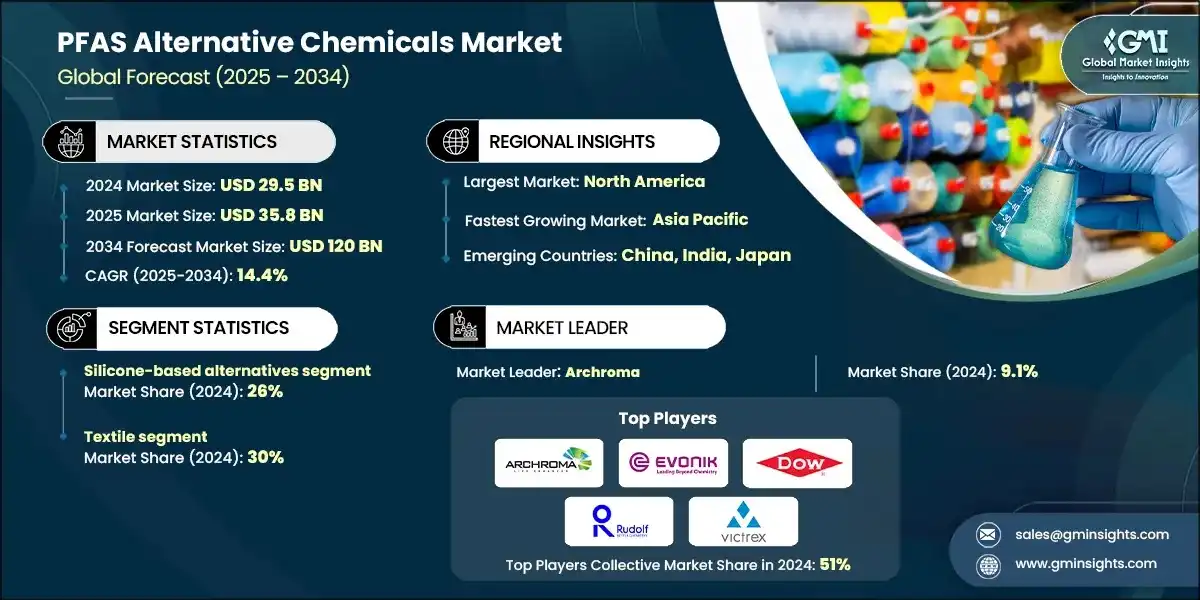
The global PFAS alternative chemicals market was valued at USD 29.5 billion in 2024. The market is expected to grow from USD 35.8 billion in 2025 to USD 120 billion in 2034, at a CAGR of 14.4%, according to latest report published by Global Market Insights Inc.
To get key market trends
- The main reason of implementing substitute chemicals is the growing number of protections against PFAS by the much-needed markets. Being established in the comprehensive US EPA PFAS Strategic Roadmap 2021-2024, owing to actions like the drinking water standards, hazardous substance designations, requirements in manufacturing reporting, and discharge limits. The universal PFAS restriction proposed by the EU through REACH could have implications on several thousands of substances and applications. Various states actions in California, Minnesota, Colorado, and New York have established additional PFAS bans in products and set deadlines which are expected to comply between 2025 and 2032.
- The awareness of the public on PFAS contamination stems more from a high-profile contamination incident of drinking water. The National Institute of Environmental Health Sciences says practically all Americans, 97% have detectable PFAS in their blood. That contamination is due to earlier exposures to consumer products, contaminated water, and food coming from the packaging where PFAS could be found. Quite a few major brands and retailers like outdoor apparel manufacturers, cosmetics companies, and food services are introducing changes in favour of the voluntary out-phasing of PFAS in their products in response to NGO campaigns and consumer awareness. An even greater public concern is related to the assessment of PFAS health risk by the World Health Organization and the framing of guidelines for its drinking water.
PFAS Alternative Chemicals Market Report Attributes
| Key Takeaway | Details |
|---|---|
| Market Size & Growth | |
| Base Year | 2024 |
| Market Size in 2024 | USD 29.5 Billion |
| Market Size in 2025 | USD 35.8 Billion |
| Forecast Period 2025 - 2034 CAGR | 14.4% |
| Market Size in 2034 | USD 120 Billion |
| Key Market Trends | |
| Drivers | Impact |
| Growing adoption of bio-based and non-fluorinated alternatives to PFAS in industrial applications | Growing adoption of bio-based and non-fluorinated alternatives to PFAS in industrial applications increases market adoption. |
| Increasing regulatory pressures leading to mandatory phase-out of traditional PFAS compounds. | Increasing regulatory pressures leading to mandatory phase-out of traditional PFAS compounds accelerate the shift towards alternatives. |
| Rising demand from end-use industries such as automotive, electronics | Rising demand from end-use industries such as automotive and electronics drives innovation and adoption of alternative chemicals. |
| Pitfalls & Challenges | Impact |
| High costs associated with developing and deploying alternative chemicals | High costs associated with developing and deploying alternative chemicals may hinder widespread adoption and market growth. |
| Opportunities: | Impact |
| Rising development of environmentally safe and sustainable surfactants, non-fluorinated repellents | Rising development of environmentally safe and sustainable surfactants and non-fluorinated repellents presents significant market expansion opportunities. |
| Market Leaders (2024) | |
| Market Leaders |
9.1% market share |
| Top Players |
Collective market share is 51% in 2024 |
| Competitive Edge |
|
| Regional Insights | |
| Largest Market | North America |
| Fastest Growing Market | Asia Pacific |
| Emerging Country | China, India, Japan |
| Future Outlook |
|
What are the growth opportunities in this market?
PFAS Alternative Chemicals Market Trends
- Growing adoption of bio-based and non-fluorinated alternatives to PFAS in industrial applications: Slowly emerging increase in interest by manufacturers to try using environmentally safe bio-derived alternatives has begun to find its feet, such as the adoption of epoxidized cottonseed oil in textile finishing. The research institutions such as Fraunhofer ISC have come up with ORMOCER-based fluorine-free coatings and bio-based alternatives, which offer apposite levels of water repellence and durability when compared to conventional PFAS.
- Increasing regulatory pressures leading to mandatory phase-out of traditional PFAS compounds: U.S. EPA on April 2024 designated both PFOA and PFOS as CERCLA hazardous substances. California provisions of PFAS prohibitions for textiles, cosmetics, and food packaging in January 2025. Environment and Climate Change Canada added that most PFAS, other than fluoropolymers, should be added to Schedule 1 of CEPA and have phased restrictions beginning in 2025.
- Rising demand from end-use industries such as automotive, electronics, and textiles for eco-friendly chemical solutions: Targets and requirements to go PFAS-free in coatings, lubricants, and sealants were put in place within the automotive industry. The electronics and semiconductor industries are in search of technological replacements of high performance for thermal management, dielectric insulation, and moisture protection. Textile industry are under pressure due to the bans established regarding apparel and home textiles enforced by the EU along with some states in the U.S.
PFAS Alternative Chemicals Market Analysis
Learn more about the key segments shaping this market
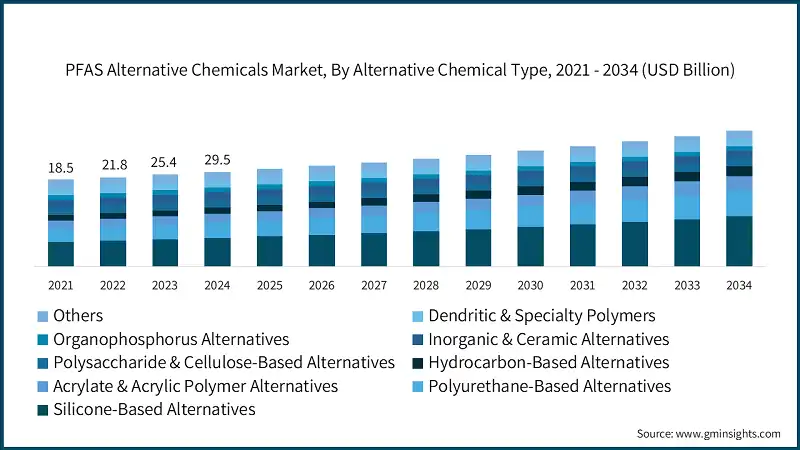
- Based on alternative chemical type, the market is segmented as silicone-based alternatives, polyurethane-based alternatives, acrylate & acrylic polymer alternatives, hydrocarbon-based alternatives, polysaccharide & cellulose-based alternatives, inorganic & ceramic alternatives, organophosphorus alternatives, dendritic & specialty polymers, and others.In 2024, Silicone-based alternatives held around 26% of the market. Good water repellency, thermal stability, and chemical resistance are the qualities shown by silicone polymers through the use of polydimethylsiloxane (PDMS), siloxane copolymers, and reactive silanes in coatings, sealants, release agents, and processing aids.
- Polyurethane Alternatives account for about 17% of the market share in 2024. Unit operations involving protective coatings, adhesives, or textile treatment can be carried out without the use of fluorinated components by means of waterborne polyurethane dispersions. The major performance determinant is the isocyanate utilized, with aliphatic examples yielding superior resistance to UV attack and yellowness compared to aromatic types. Compared to the traditional solvent borne systems, the waterborne formulations definitely lessen the exposure to isocyanate monomers and organic solvents. Applications can include durable water-repellent finishes for outdoor textiles, breathable waterproof membranes, and protective coatings for automotive and industrial substrates.
- The major disadvantage of alternate polyurethanes is the possible toxicity of the isocyanate precursor and some solvents, which requires major occupational health management. Development focus areas include bio-based polyols, unblocked isocyanates for safer handling, and hybrid systems combining polyurethanes with other technologies.
Learn more about the key segments shaping this market
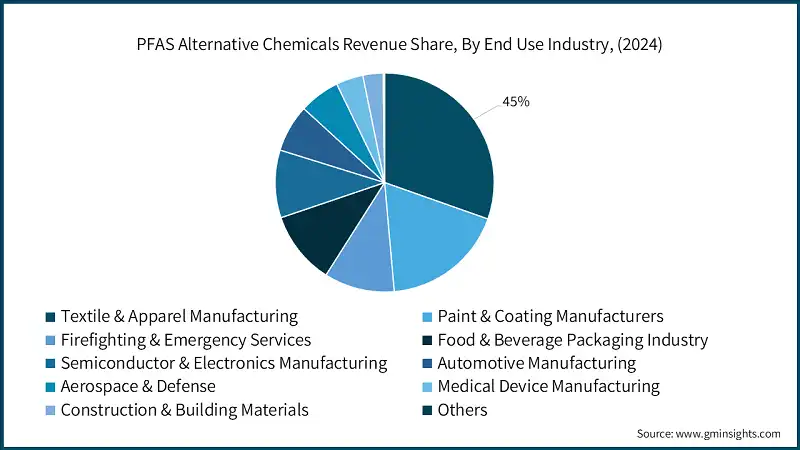
- Based on end use industry the PFAS alternative chemicals market is segmented as textile & apparel manufacturing, paint & coating manufacturers, firefighting & emergency services, food & beverage packaging industry, semiconductor & electronics manufacturing, automotive manufacturing, aerospace & defense, medical device manufacturing, construction & building materials, and others. Textile sector account for 30% market share.
- Hence, the pressure from regulations is mounting on the textile sector considering California AB 1817 (effective January 2025) along with REACH restrictions in the European Union, while brands have committed to phase-out PFAS. Uses of PFAS are very widespread in durable water repellents for outdoor apparel, stain-resistance treatments for upholstery and carpets, and various processing aids, surfactants, buoyancy agents, etc. ZDHC Foundation MRSL v3.0 bans the use of PFAS formulations in any fashion and textile applications and is accelerating the global adoption of alternatives. Other technologies like paraffin-based systems, silicone treatments, and bio-based finishes have now reached a saleable level.
- Paint & Coating Manufacturers represent an 18% market share in 2024. PFAS have been used in architectural, automotive, industrial, and specialty coatings as surfactants, defoamers, wetting agents, and leveling additives. Evonik already provides an extensive range of alternatives to PFAS such as TEGO Airex for defoaming, TEGO Wet for wetting, and biosurfactants that equal or exceed the performance characteristics of fluorinated additives.
- Firefighting & Emergency Services account for 10% market share in 2024. Aqueous film-forming foams (AFFF) containing PFAS have been the standard for fuel fire suppression since the 1970s, particularly for aviation, military, and petrochemical applications. The U.S. DoD extensively used PFAS AFFF historically, contaminating groundwater at military bases across the country. Hydrocarbon-based, protein-based, and detergent-based fluorine-free foams have effectively extinguished fires in many situations.
Looking for region specific data?
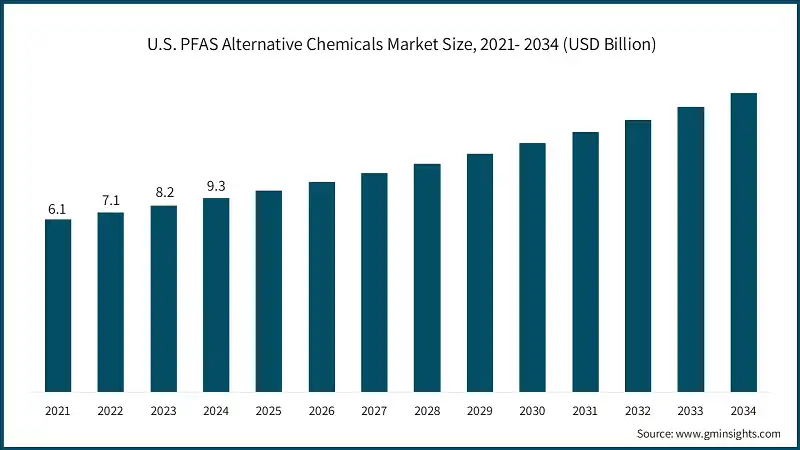
- The U.S. PFAS alternative chemicals market valued at USD 9.3 billion in 2024 and estimated to grow to almost USD 334.5 billion by 2034.
- North America holds 39% of the market share in 2024. The U.S. has established itself as a fast-growing region as the total regulatory actions by the EPA, and innumerable constraints being posted at the state level essentially harmonize development. The immediate demand for water treatment technologies and alternative chemistries in water contact applications was created as a result of the EPA's maximum contaminant levels for six PFAS established under the drinking water rule in April 2024.
- Europe PFAS alternative chemicals market represents 29% share in 2024, owing to the stringent REACH restriction framework, and an industry willing to undertake initiatives proactively. On the one hand, the revised PFAS restriction proposal published by the European Chemicals Agency in August 2025 will mark the most rigorous regulatory regime anywhere in the world. The proposal envisages three restriction options for PFAS, ranging from an outright ban with an 18-month transition to risk-based conditional use, with final opinions of the ECHA committee expected by the end of 2026 and European Commission decision sometime in 2027-2028.
- Asia Pacific PFAS alternative chemicals market has 23% share in 2024 attributed to the rapid industrialization, manufacturing capacities, and changing regulatory frameworks. China, Japan, and South Korea are all restricting PFAS while building domestic capabilities in alternative chemistries.
- Latin America will see growth in the Brazilian market driven by the textile, automotive, and agricultural industries. Comprehensive PFAS regulations are still evolving in Latin America however, the export-oriented industries will presently have to comply with the requirements in the destination markets. In Brazil, textile manufacturers that supply to European and North American brands are slowly shifting to PFAS-free finishing systems. The automotive industry in Brazil and Mexico is also switching to PFAS alternatives to comply with OEM specifications and for export requirements.
- Middle East & Africa PFAS alternative chemicals market shows a 4% share in 2024. The rapidly growing petrochemical and manufacturing sectors in the GCC are demanding specialty chemicals, including those as alternatives to PFAS. In South Africa, work is now being undertaken in respect of chemical industry strength and regulatory frameworks to address PFAS. Limited local production of alternative chemicals, reliance on imports, and varying levels of regulatory development from one country to another across different national jurisdictions in the region, provide even more challenges.
PFAS Alternative Chemicals Market Share
In the PFAS alternative chemicals industry concentration is moderately low as the top five players Archroma, Evonik Industries, Dow Inc., Rudolf GmbH, Victrex together accounted for about 51% of the market in 2024. This state of concentration underlines the technical difficulty in the development of the alternative chemicals, the heavy R&D investments going into it, and long-standing relationships that are otherwise established between major chemical producers and downstream customers of all sorts of industries. Evonik is one of the major player in the market, the company is well-positioned due to its varied portfolio comprising PFAS-free coating additives and specialty chemicals. Under the TEGO brand, the company has several product lines aimed at PFAS substitution including TEGO Airex defoamers (grades 900, 923, and 944 for marine and protective coatings), TEGO PPA polymer processing aids, using sustainable feedstocks with a lower carbon footprint.
PFAS Alternative Chemicals Market Companies
Major players operating in the PFAS alternative chemicals industry are:
- Archroma
- Evonik Industries
- Dow
- Daikin Industries
- Rudolf
- HeiQ Materials
- NICCA Chemical
- CHT Group
- Cerakote
- James Walker Group
- Victrex
- Archroma
- Archroma is one of the companies in specialty chemicals engineering providing solutions for sustainable development applicable to textiles, papers, and packaging materials. It has also developed some patented wettable water-repellents based on polyacrylate copolymers with blends of high molecular weight paraffin waxes suitable for the durable finishing of textiles. The water-repelling system suited for all PFAS-free textile treatments from the company includes Arkophob DAN, Arkophob SR, Cassurit FF cross-linkers, Ceraperm SFC silicone softeners, and Cerol EX melamine resins.
- Evonik Industries
- Evonik Industries AG operates in specialty chemicals amid a plethora of PFAS alternatives, including industrial coating additives, polymer additives, and specialty materials. For the TEGO brand, the company markets defoamers (Airex curtains 900, 923, 944), wetting agents (Wet 270 eCO, Wet 570/580 Terra biosurfactants), and foam control additives (Foamex grades 8051,812 eCO,8420).
- Dow Inc
- Dow Inc. is a global elastomers, polymer, silicone, and specialty chemical company. In September 2025, this global company announced the availability of DOWSIL 5-1050 Polymer Processing Aid. It infused silicone-based alternative materials for products like fluoropolymer PPAs that aim to reduce melt fracture and avoid die building up in film packaging, while complying with food-contact regulations. Come August 2025, Dow Inc. opened with its next invention in TRITON FCX surfactants designed for bio built-up resistance with PFAS-like block resistance towards biodegradable paints.
- Rudolf GmbH
- Rudolf GmbH, a German company, maintains expertise in chemicals and textiles, particularly in the field of application and functional treatment. Ruco-Guard WEB isolated isocyanate cross-linkers of the company for PFAS-free textile treatments. Thus, Rudolf provides fluorine-free water-repellent systems and offers technical support for the end use of compatible textile manufacturers attempted to venture out of the PFAS.
- Victrex
- Victrex is a global leader in high-performance polymer solutions and the manufacturer of advanced materials such as PAEK (polyetheretherketone) for various industrial applications. The company aims to supply innovative, sustainable, and high-quality materials able to address complex engineering problems. Victrex services aerospace, automotive, electronics, and healthcare industries, providing products with unique strength, durability, and chemical resistance.
PFAS Alternative Chemicals Industry News
- In September 2025, Dow launched DOWSIL 5-1050 Polymer Processing Aid, a silicone-based replacement for fluoropolymer PPAs used for blown and stretch film packaging applications. The product was successfully tested for industrial-scale demonstration purposes, benefiting widely from the reduction of melt fracture and haze, die lip build-up, and die pressure.
- In June 2025, Clariant announced the launch of an AddWorks PPA manufacturing line selling PFAS-free polymer processing aids for polyolefin extrusion, targeting EMEA, the Americas, and the Southeast Asia/Pacific markets. The product line addresses the growing demand for fluoropolymer-free processing aids driven by regulations and brand commitments.
- In June 2023, The Chemours Company, DuPont de Nemours, Inc. and Corteva, Inc announced they have reached an agreement in principle to comprehensively resolve all PFAS-related drinking water claims of a defined class of public water systems that serve the vast majority of the U.S. population.
The PFAS alternative chemicals market research report includes in-depth coverage of the industry, with estimates & forecast in terms of revenue (USD Billion) and volume (Kilo Tons) from 2021 to 2034, for the following segments:
Market, By Alternative Chemical Type
- Silicone-based alternatives
- Polyurethane-based alternatives
- Acrylate & acrylic polymer alternatives
- Hydrocarbon-based alternatives
- Polysaccharide & cellulose-based alternatives
- Inorganic & ceramic alternatives
- Organophosphorus alternatives
- Dendritic & specialty polymers
- Others
Market, By End Use Industry
- Textile & apparel manufacturing
- Paint & coating manufacturers
- Firefighting & emergency services
- Food & beverage packaging industry
- Semiconductor & electronics manufacturing
- Automotive manufacturing
- Aerospace & defence
- Medical device manufacturing
- Construction & building materials
- Others
The above information is provided for the following regions and countries:
- North America
- U.S.
- Canada
- Europe
- UK
- Germany
- France
- Italy
- Spain
- Rest of Europe
- Asia Pacific
- China
- India
- Japan
- South Korea
- Australia
- Rest of Asia Pacific
- Latin America
- Brazil
- Mexico
- Argentina
- Rest of Latin America
- Middle East & Africa
- UAE
- Saudi Arabia
- South Africa
- Rest of Middle East & Africa
Frequently Asked Question(FAQ) :
Who are the key players in the PFAS alternative chemicals market?
Key players include Archroma, Evonik Industries, Dow Inc., Rudolf GmbH, HeiQ Materials, NICCA Chemical, CHT Group, Cerakote, James Walker Group, and Victrex.
What are the upcoming trends in the PFAS alternative chemicals industry?
Key trends include rapid adoption of bio-based and non-fluorinated chemicals, expansion of silicone and hydrocarbon-based alternatives, and advancement in eco-friendly surfactants.
Which region leads the PFAS alternative chemicals market?
The U.S. market was valued at USD 9.3 billion in 2024, making it the strongest regional contributor.
What is the growth outlook for polysaccharide & cellulose-based alternatives from 2025 to 2034?
The report indicates rising adoption of polysaccharide and cellulose-based alternatives during the forecast period.
What was the valuation of polyurethane-based alternatives segment in 2024?
Polyurethane-based alternatives held about 17% market share in 2024. Increasing use in coatings, textiles, and adhesives drives segment growth as industries shift away from fluorinated materials.
How much revenue did the silicone-based alternatives segment generate in 2024?
Silicone-based alternatives accounted for around 26% share in 2024, making them one of the leading segments.
What is the current PFAS alternative chemicals market size in 2025?
The market size is projected to reach USD 35.8 billion in 2025.
What is the projected value of the PFAS alternative chemicals market by 2034?
The market size for PFAS alternative chemicals is expected to reach USD 120 billion by 2034, fueled by large-scale phase-out mandates for traditional PFAS compounds.
What is the market size of the PFAS alternative chemicals industry in 2024?
The market size was USD 29.5 billion in 2024, with a CAGR of 14.4% expected through 2034 supported by rising adoption of PFAS-free specialty chemicals across industrial applications.
PFAS Alternative Chemicals Market Scope
Related Reports