Summary
Table of Content

Pet Food Packaging Market
Get a free sample of this report
Form submitted successfully!
Error submitting form. Please try again.
Thank you!
Your inquiry has been received. Our team will reach out to you with the required details via email. To ensure that you don't miss their response, kindly remember to check your spam folder as well!
Request Sectional Data
Thank you!
Your inquiry has been received. Our team will reach out to you with the required details via email. To ensure that you don't miss their response, kindly remember to check your spam folder as well!
Form submitted successfully!
Error submitting form. Please try again.
Pet Food Packaging Market Size
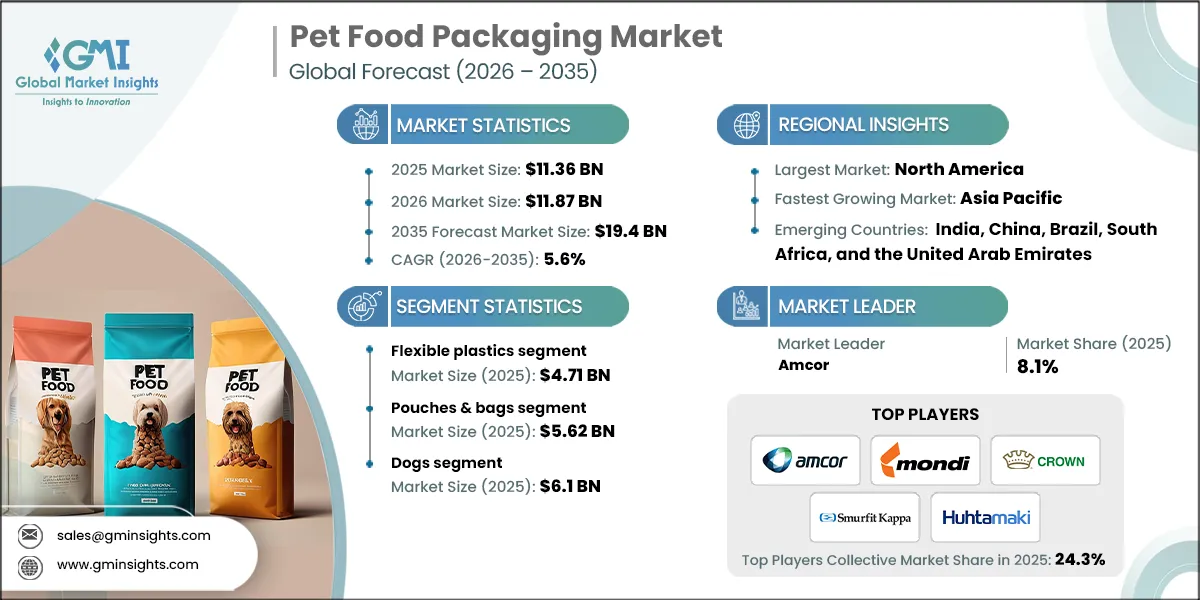
The global pet food packaging market was valued at USD 11.36 billion in 2025. The market is expected to grow from USD 11.87 billion in 2026 to USD 15.2 billion in 2031 and USD 19.4 billion in 2035, at a value CAGR of 5.6% during the forecast period, according to the latest report published by Global Market Insights Inc.
Pet Food Packaging Market Key Takeaways
Market Size & Growth
- 2025 Market Size: USD 11.36 Billion
- 2026 Market Size: USD 11.87 Billion
- 2035 Forecast Market Size: USD 19.4 Billion
- CAGR (2026–2035): 5.6%
Regional Dominance
- Largest Market: North America
- Fastest Growing Region: Asia Pacific
Key Market Drivers
- Rising pet adoption and ownership.
- Increasing demand for premium and organic pet food.
- Growing e-commerce and online retail channels.
- Innovations in sustainable and eco-friendly packaging.
- Expansion of ready-to-eat and convenient pet food products.
Challenges
- High cost of advanced packaging materials.
- Stringent regulatory standards and compliance requirements.
Opportunity
- Adoption of smart and interactive packaging.
- Growth of sustainable subscription and direct-to-consumer models.
Key Players
- Market Leader: Amcor led with over 8.1% market share in 2025.
- Leading Players: Top 5 players in this market include Amcor, Mondi, Crown Holdings, Smurfit Kappa, Huhtamäki, which collectively held a market share of 24.3% in 2025.
Get Market Insights & Growth Opportunities
The pet food packaging market is expanding, owing to rising pet adoption and ownership, increasing demand for premium and organic pet food, growing e-commerce and online retail channels, innovations in sustainable and eco-friendly packaging, and expansion of ready-to-eat and convenient pet food products.|
The growing demand for premium and organic pet food is supported by the changes in the regulation on the governmental levels that allow making those products more accessible and credible to consumers. An example is that in October 2023, the Council of the European Union adopted updated labelling requirements on organic pet food which harmonize the requirements with those of organic food used by people by enabling products with at least 95% organic agricultural ingredients to bear the EU organic logo. The new regulatory changes allow the producers to enter organic pet food industry without many restrictions and gain confidence in consumers towards certified organic products, which drives the demand of high-quality products and their specialized packages.
Another significant growth contributor to the market of pet food packaging has been the increasing respite in pet adoption and ownership due to the growing government policies in favor of responsible pet custodianship and welfare. For instance, the French government has launched a national plan to improve the welfare of pets in May 2024, which brought with it a certificate of commitment and knowledge to adopt a companion animal because potential owners are well aware of the commitments of care, nutrition and food, before a pet is brought home. Such a regulating emphasis would promote more responsible and long-term pet keeping, thus supporting the increased need in pet food products and their packaging.
The pet food packaging market is about designing, manufacturing and marketing of packaging solutions for pet food products, such as dry, wet and semi-moist. It is concerned with keeping products fresh, safe, and convenient and satisfying the regulatory standards. The trends of increasing the number of pets, rising the quality of premiumization, and sustainability are among the factors that promote the demand in innovative, durable, and eco-friendly packaging solutions in global markets.
To get key market trends
Pet Food Packaging Market Trends
- Sustainability is becoming a key factor in the pet food packaging industry, with pet food brands and converters seeking solutions that are recyclable, biodegradable, and made of mono-material to minimize environmental impact and purposefully meet the goals of the circular economy. As an illustration, recyclable flexible films, including mono-polyethylene pouches and paper-based bags are becoming eminent as they are recyclable and less dependent on plastic. These green packages are solutions to increasing consumer and governmental demands to reduce waste and carbon emissions with no effect on product quality and shelf life.
- The growth of online retailing of pet food is driving packaging solution based on e-commerce at a faster pace. These solutions focus on delivering lightweight durability and transportation performance, as well as delivering convenience in the direct-to-consumer delivery. The resealable pouches, stand-up bags and right-sized containers packaging styles increase the product protection in shipping and minimize the amount of material used and wasted. These capabilities enable the promotion of the subscription-based model and omnichannel retail approaches to enhance the attractiveness of the products and make them cost-effective both to brands and customers.
- Smart packaging technologies This is becoming an important trend in the pet food industry with digital capabilities like QR codes, NFC tags, and traceability tools being built into packaging designs. Through these technologies, pet owners can receive more product information, sourcing of ingredients, and sustainability messaging through mobile gadgets. Smart packaging further supports brands by providing better transparency, traceability, and consumer engagement, which will improve brand trust, product differentiation, and satisfy the increased need to access information in the pet nutrition market.
- The packaging of pet foods has been transformed by premiumization and customization as the consumers regard pets as family members and demand high quality and attractive packaging. The new designs of packaging are now depicted with advanced graphics, customized features and its practical features like transparent windows, easy handling and its portion features. These attributes enable the brands to demonstrate quality, cater to the niche dietary demands, and stand out in the competitive retail and online marketplaces.
Pet Food Packaging Market Analysis
Learn more about the key segments shaping this market
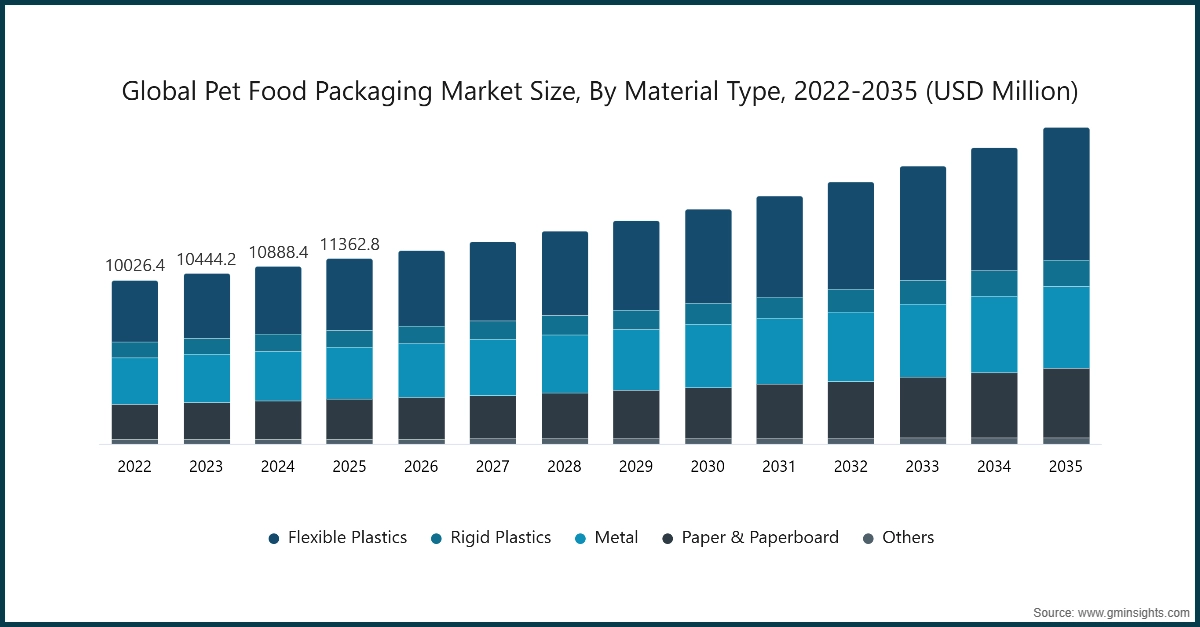
Based on material type, the market is divided into flexible plastics, rigid plastics, metal, paper & paperboard, and others.
- The flexible plastics segment accounted for the largest market and was valued at USD 4.71 billion in 2025. Recyclable flexible plastic (RFP) demand grows because governments are increasing the requirements to recycle food-contact plastics and circular economy policy frameworks that promote the use of sustainable materials by the industry that meet regulatory safety standards and minimize environmental impact.
- As an example, in September 2022, the European Commission proposed new regulations to improve the safety of recycled plastics in food contact, which will allow the use of recycled plastics in food packaging at a higher rate with the safety of the population.
- Manufacturers should focus on the creation of recycled and mono-material plastics of flexible solutions that meet changing EU food-contact recyclability requirements to remain accessible to the market and are attractive to sustainability-conscious consumers.
- The paper & paperboard segment is anticipated to grow at a CAGR of 5.8% during the forecast period. Government anti-waste and circular economy laws favor paper and board over plastics by incentivizing recyclable and compostable packaging to reduce landfill waste in support of national environmental commitments and consumer sustainability expectations.
- France’s anti-waste and circular economy law supports the uptake of paper-based packaging formats that help achieve national recycling goals and extended producer responsibility frameworks.
- Companies should broaden their paper & paperboard packaging lines and certification in order to comply with eco-design requirements by positioning products as compliant, recyclable, and in line with circular economic legislation.
Learn more about the key segments shaping this market
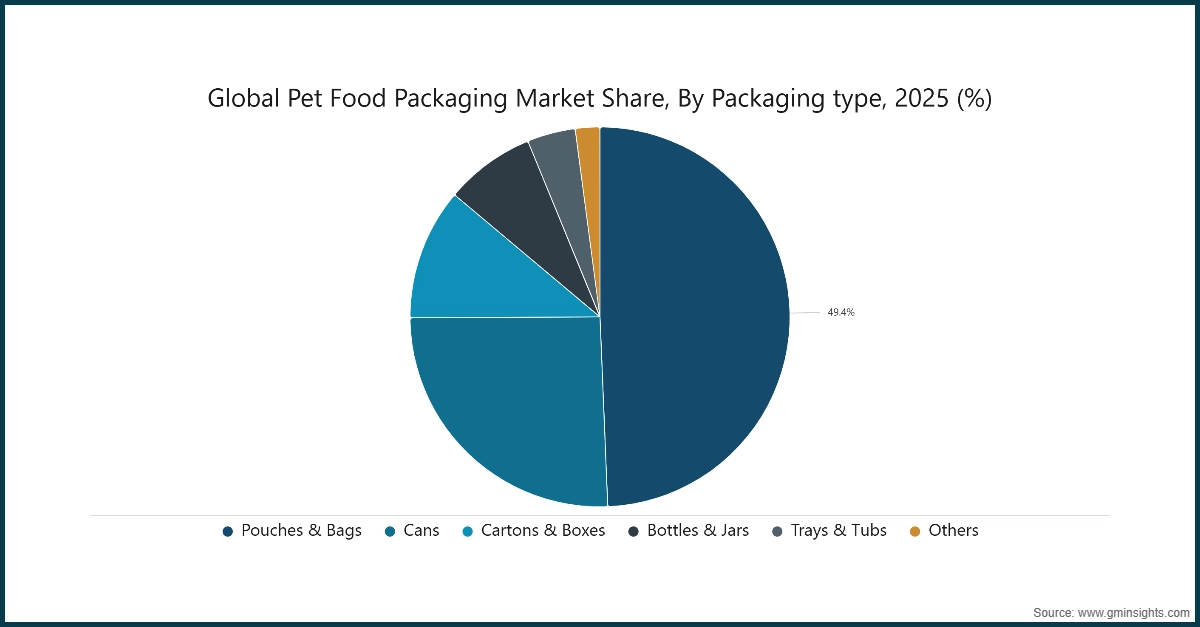
On the basis of packaging type, the pet food packaging market is divided into dogs, cats, birds, fish, and others.
- The pouches & bags segment accounted for the largest market and was valued at USD 5.62 billion in 2025. Regulatory emphasis on recyclability spurs growth in recyclable pouch solutions, as brands shift from multi‑material films to mono‑material formats that meet legal recyclability thresholds and minimize waste. This trend is already evident among major brand owners who have made commitments to move away from non-recyclable packaging formats.
- The EU’s Packaging and Packaging Waste Regulation will come into force in 2025. Under this regulation, mandates for recyclability and recycled content will accelerate the shift to recyclable pouches and bags.
- Pet food manufacturers should focus on recyclable pouch designs with certified recyclability and recycled content to comply with PPWR requirements and meet retailer sustainability requirements.
- The bottles & jars segment is anticipated to grow at a CAGR of 6.1% during the forecast period. Government taxation and recycled content mandates on plastic bottles under policies like plastics taxes incentivize adoption of bottles & jars with high recycled content and refillable formats.
- Extended producer responsibility schemes and packaging taxes in several EU states drive innovation in lightweight, high‑recycled‑content bottles & jars, reducing environmental costs and regulatory burden.
- OEMs should integrate recycled materials into bottles and jars and explore refillable systems to lower tax exposure and meet compliance with national recycled content and EPR frameworks.
Based on pet type, the pet food packaging market is divided into flexible plastics, rigid plastics, metal, paper & paperboard, and others.
- The dogs segment accounted for the largest market and was valued at USD 6.1 billion in 2025. Government animal welfare policies that support responsible ownership indirectly boost dog food demand, expanding market for dog‑oriented packaging as pet populations grow and owners seek high‑quality nutrition products.
- Dog food manufacturers should tailor packaging to reflect welfare‑focused nutrition messaging and regulatory compliance, enhancing appeal to owners influenced by government welfare initiatives.
- The cats segment is anticipated to grow at a CAGR of 5.2% during the forecast period. Government regulation of labelling on pet feed and standards for safety drives consumer confidence in products related to cat food and promotes an increase in premium, safe packaging formats.
- National regulations regarding feed and pet food labelling require clear, accurate information to be provided on cat food packaging. This improves transparency and helps foster consumer trust in packaged products.
- Manufacturers need to make sure that cat food packaging meets regulatory labelling standards and communicates them clearly in order to strengthen consumer trust as well as differentiate between premium offerings.
Looking for region specific data?
North America Pet Food Packaging Market
North America market held a market share of 41.6% in 2025 of the global pet food packaging industry.
- The North American market emphasizes convenience, premiumization, and sustainability. Single‑serve pouches and resealable bags are increasingly preferred to meet busy lifestyles and e‑commerce demand, while bold, high‑contrast designs communicate quality and fresh ingredients.
- Sustainability awareness is growing, with states introducing extended producer responsibility laws and recyclability requirements that influence packaging choices. Brands are investing in recyclable flexible plastics and lightweight solutions that reduce environmental impact.
- North American production capacity is robust, with the United States dominating regional output and driving innovation in packaging formats that support online sales and direct‑to‑consumer models, reflecting strong humanization of pets and rising premium pet food consumption.
- Manufacturers should prioritize recyclable flexible packaging and single‑serve formats optimized for e‑commerce logistics to align with consumer convenience trends and sustainability regulations.
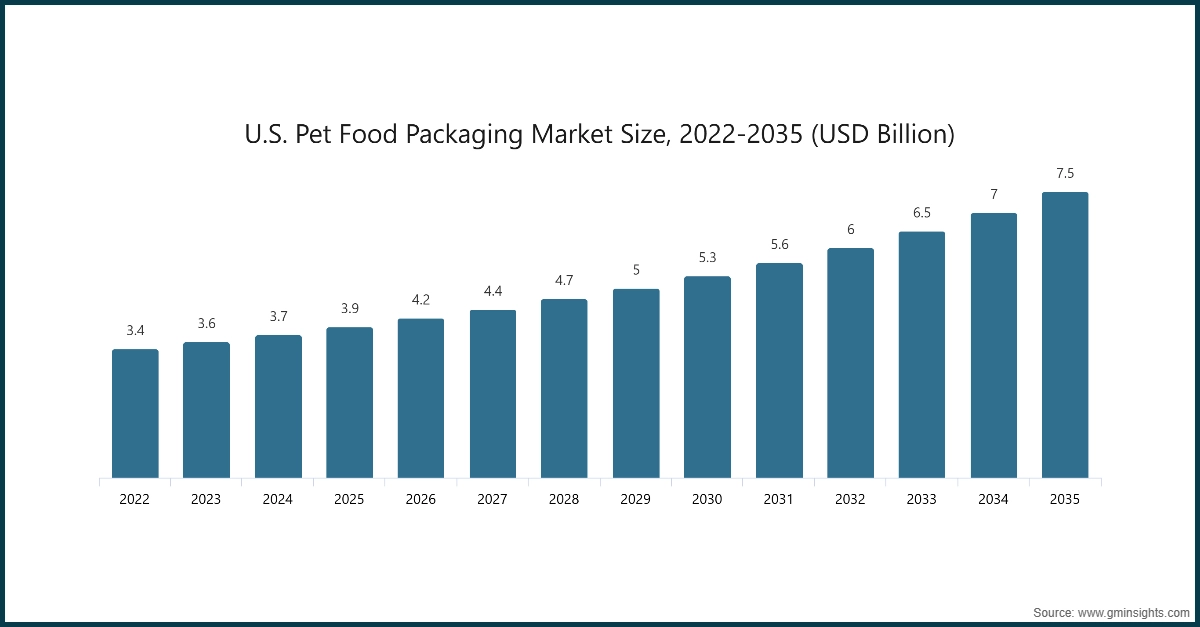
The U.S. pet food packaging market was valued at USD 3.4 billion and USD 3.5 billion in 2022 and 2023, respectively. The market size reached USD 3.9 billion in 2025, growing from USD 3.7 billion in 2024.
- In the US, pet food packaging trends are shaped by regulatory focus on labeling transparency, safety, and potential reform of feed laws.
- For instance, in February 2025, the Association of American Feed Control Officials (AAFCO) raised concerns about the Pet Food Uniform Regulatory Reform Act of 2025 (PURR Act), arguing it could weaken state‑level oversight of pet food labeling and reduce transparency on packaging, potentially affecting consumer trust and safety communications.
- The FDA continues to regulate pet food safety and labeling under federal food laws, while manufacturers monitor evolving proposals that could centralize authority with the FDA and change how pet food packaging communicates ingredient and nutritional information.
- Manufacturers must focus on supplying modular CT and automated screening solutions that integrate seamlessly with TSA infrastructure while meeting rigorous compliance and service‑level expectations.
Europe Pet Food Packaging Market
Europe market accounted for USD 3.23 billion in 2025 and is anticipated to show lucrative growth over the forecast period.
- Europe’s pet food packaging industry is driven by strict environmental regulations, circular economy policies, and consumer demand for sustainability.
- The EU’s Packaging and Packaging Waste Regulation (PPWR) and national acts like Germany’s VerpackG enforce extended producer responsibility and high recycling targets, pushing brands toward recyclable, reusable, and mono‑material packaging.
- Sustainability influences purchasing decisions, with studies showing a majority of European pet owners consider packaging recyclability an important purchase factor. Regulatory momentum and eco‑design principles require manufacturers to innovate while ensuring compliance across multiple jurisdictions within the EU.
- Manufacturers should accelerate development of recyclable and mono‑material packaging certified under EU standards to meet regulatory and consumer sustainability expectations.
Germany dominated the Europe pet food packaging market, showcasing strong growth potential.
- Germany’s pet food packaging trends are strongly shaped by stringent national and EU waste‑management laws that enforce extended producer responsibility and recyclability standards.
- For instance, the German Packaging Act (VerpackG) requires manufacturers to register packaging with the national LUCID register and participate in dual recycling systems, with strict reporting and recycling targets to reduce environmental impact.
- Combined with upcoming EU PPWR rules tying recyclability claims to actual sorting performance, this regulatory emphasis makes sustainability integral to packaging design and compliance.
- Manufacturers should ensure packaging registrations, reporting, and eco‑design criteria compliance under VerpackG and PPWR to sustain market access and reduce EPR costs.
Asia Pacific Pet Food Packaging Market
The Asia Pacific market is the largest and fastest growing market and is anticipated to grow at the CAGR of 6.3% during the analysis timeframe.
- The Asia Pacific pet food packaging industry is the fastest‑growing globally, driven by rising urban pet ownership, e‑commerce expansion, and premiumization.
- Urbanization and rising disposable incomes fuel demand for premium and value‑added packaging formats. Sustainability is gaining traction as governments promote recyclable materials and environmental awareness, prompting brands to adopt eco‑friendly films and paper‑based solutions.
- Diverse markets in Japan and South Korea prefer compact, lightweight designs for small living spaces, while Southeast Asian countries emphasize durability and tamper‑proof packaging for humid climates and doorstep delivery.
- Manufacturers should invest in packaging durability and sustainability innovations tailored to e‑commerce and urban consumer preferences to capture rapid regional growth.
China pet food packaging market is estimated to grow with a CAGR of 6.8% during the forecast period, in the Asia Pacific market.
- China’s pet food packaging industry is booming due to massive urbanization, rising pet ownership, and strong e‑commerce growth. Packaging must balance durability for long‑distance logistics with premium visual appeal to attract online shoppers.
- The Chinese government’s push for sustainability encourages the adoption of recyclable and biodegradable packaging materials, aligning with broader environmental policy goals.
- Local brands are improving quality and investing in R&D to compete with imports, while QR code traceability and digital engagement tools are increasingly integrated into packaging designs.
- Chinese manufacturers Enhance packaging robustness and integrate traceability features while increasing use of recyclable materials to meet government and consumer expectations.
Latin American Pet Food Packaging Market
Brazil leads the Latin American market, exhibiting remarkable growth during the analysis period.
- Brazil’s market reflects growing demand for flexible packaging formats like stand‑up pouches, though supply constraints for components like zippers can limit adoption rates.
- The Brazilian sugarcane industry supports bio‑based materials, encouraging sustainable packaging alternatives such as ethanol‑based bioplastics. Consumer interest in sustainability and functional designs grows alongside pet ownership levels. Packaging formats must balance cost, durability, and ecological considerations.
- The prevalence of flexible bag formats for food products generally influences pet food packaging choices, while local manufacturing partnerships and material availability shape innovation trajectories.
- Manufacturers should develop cost‑effective, bio‑based flexible packaging and secure reliable supply of key components to expand sustainable format adoption.
Middle East and Africa Pet Food Packaging Market
South Africa market to experience substantial growth in the Middle East and Africa pet food packaging industry in 2025.
- South Africa’s market is influenced by growing pet ownership and increasing interest in sustainable solutions, though economic constraints temper premiumization. Durable, cost‑effective flexible plastics and multi‑use packaging remain prevalent.
- Awareness of environmental issues is rising, pushing brands toward recyclable and lightweight formats, while e‑commerce growth supports demand for resealable, transit‑ready designs. Local manufacturers focus on improving material performance and cost efficiency to meet diverse consumer needs across urban and rural markets.
- Collaboration with regional waste management initiatives further boosts interest in recyclable solutions, positioning sustainability as a longer‑term trend rather than immediate regulatory demand.
- Manufacturers should focus on affordable, durable recyclable packaging and strengthen regional recycling partnerships to support sustainability goals and broaden market reach.
Pet Food Packaging Market Share
The global pet food packaging industry shows a moderately consolidated structure, with the leading players such as Amcor, Mondi, Crown Holdings, and Smurfit Kappa, which collectively accounted for around 23.2% of the total market share. This concentration reflects the strong influence of large, multinational packaging companies that benefit from scale, global manufacturing networks, long-term contracts with major pet food brands, and continuous investment in sustainable materials and advanced packaging technologies.
Despite this, a significant portion of the market remains fragmented, with regional and local players serving niche requirements, cost-sensitive customers, and localized regulatory needs. The collective dominance of the top players enables them to shape innovation trends, sustainability standards, and pricing dynamics, while smaller players continue to compete through customization, regional proximity, and flexible production capabilities.
Pet Food Packaging Market Companies
Prominent players operating in the pet food packaging industry are as mentioned below:
- Amcor
- Ball Corporation
- Mondi
- Sealed Air
- Smurfit Kappa
- Sonoco
- Crown Holdings
- Huhtamäki
- ProAmpac
- Constantia Flexibles
- Tetra Pak
- Coveris
- Winpak
- Packaging Corporation of America
- Amcor controlled 8.1% of the pet food packaging market, supported by its strong global presence in flexible and rigid packaging solutions. The company delivered high-barrier, shelf-life-extending formats such as pouches, bags, and containers optimized for dry and wet pet food. Amcor strengthened its position through long-term partnerships with major pet food brands and continuous innovation in recyclable and mono-material packaging aligned with sustainability regulations.
- Mondi held 7.2% of the market, driven by its leadership in paper-based and flexible packaging solutions. The company emphasized sustainable, fiber-based pet food packaging with advanced barrier properties, catering to manufacturers seeking alternatives to conventional plastics. Mondi’s integrated value chain and focus on eco-design enhanced its competitiveness, particularly in Europe.
- Crown Holdings accounted for 5.1% of the market, focusing primarily on metal packaging for wet pet food applications. The company’s portfolio included durable, high-barrier cans that provided long shelf life, strong product protection, and high recyclability across global markets.
- Smurfit Kappa held 2.8% of the market, positioning itself as a key supplier of paperboard and corrugated packaging. The company supported pet food manufacturers with recyclable, transit-ready solutions optimized for bulk distribution, retail display, and e-commerce logistics.
Pet Food Packaging Market Report Attributes
| Key Takeaway | Details |
|---|---|
| Market Size & Growth | |
| Base Year | 2025 |
| Market Size in 2025 | USD 11.36 Billion |
| Market Size in 2026 | USD 11.87 Billion |
| Forecast Period 2026-2035 CAGR | 5.6% |
| Market Size in 2035 | USD 19.4 Billion |
| Key Market Trends | |
| Drivers | Impact |
| Rising pet adoption and ownership | Strengthened demand for pet food packaging as more households acquire pets, driving higher consumption of dry, wet, and specialty foods, increasing the need for diverse packaging formats that ensure freshness and convenience. |
| Increasing demand for premium and organic pet food | Boosted market growth as consumers seek high-quality, health-focused products, prompting manufacturers to adopt innovative packaging that preserves nutrients, displays certifications, and communicates premium value. |
| Growing e-commerce and online retail channels | Expanded packaging requirements for durable, transit-ready formats with resealable features, optimized sizes, and branding appeal to meet the logistics and marketing needs of direct-to-consumer sales. |
| Innovations in sustainable and eco-friendly packaging | Accelerated adoption of recyclable, biodegradable, and mono-material solutions to meet regulatory mandates and consumer preference for environmentally responsible products, strengthening brand differentiation. |
| Expansion of ready-to-eat and convenient pet food products | Increased demand for easy-to-use, portion-controlled packaging such as pouches, single-serve trays, and resealable bags, supporting consumer convenience and market penetration in on-the-go segments. |
| Pitfalls & Challenges | Impact |
| High cost of advanced packaging materials | Limited adoption among smaller manufacturers or cost-sensitive markets, as premium materials like recyclable films, barrier laminates, and compostable boards involve higher upfront and production costs. |
| Stringent regulatory standards and compliance requirements | Increased complexity in packaging design, production, and labeling, as manufacturers must adhere to food safety, recyclability, and environmental regulations across multiple regions. |
| Opportunities: | Impact |
| Adoption of smart and interactive packaging | Enables manufacturers to differentiate products and enhance consumer engagement through QR codes, NFC tags, or digital traceability, improving brand loyalty and transparency in ingredient sourcing and sustainability. |
| Growth of sustainable subscription and direct-to-consumer models | Encourages packaging innovation for portioned, durable, and eco-friendly formats suitable for recurring deliveries, boosting sales volume, customer retention, and reduced environmental footprint. |
| Market Leaders (2025) | |
| Market Leader |
Market Share of Amcor is 8.1% in 2025 |
| Top Players |
Collective market share in 2025 is 24.3% |
| Competitive Edge |
|
| Regional Insights | |
| Largest Market | North America |
| Fastest Growing Market | Asia Pacific |
| Emerging Countries | India, China, Brazil, South Africa, and the United Arab Emirates |
| Future outlook |
|
What are the growth opportunities in this market?
Pet Food Packaging Industry News
- In July 2025, Mars Incorporated introduced new recyclable mono-polypropylene (PP) pouches for WHISKAS in the UK and Germany, replacing, hard-to-recycle, multi-material, plastic-aluminum hybrids. This innovation, launched with the WHISKAS Tasty Mix Country Collection, reduces the packaging's carbon footprint by 46%.
- In December 2025, Cosmo Films launched a new portfolio of advanced BOPP, CPP, and BOPET films in India, targeting the pet food and food packaging markets. These films include high heat-resistant 1850 TR-BOPP and Ultra High Barrier (UHB) films designed to replace traditional aluminum foil. The solutions are engineered for high barrier performance in both wet and dry applications.
- In June 2025, Mondi and French pet food manufacturer Saga Nutrition officially launched a new recyclable mono-material packaging for dry pet food. This partnership replaces non-recyclable multi-material plastics with a high-barrier solution designed for the circular economy.
The pet food packaging market research report includes in-depth coverage of the industry with estimates & forecasts in terms of revenue (USD Million) from 2022 to 2035, for the following segments:
Market, By Material Type
- Flexible plastics
- Rigid plastics
- Metal
- Paper & paperboard
- Others
Market, By Packaging Format
- Pouches & bags
- Cans
- Cartons & boxes
- Bottles & jars
- Trays & tubs
- Others
Market, By Pet Food Type
- Dry food
- Wet food
- Treats & snacks
- Others
Market, By Pet Type
- Dogs
- Cats
- Birds
- Fish
- Others
Market, By Distribution Channel
- Online
- Offline
The above information is provided for the following regions and countries:
- North America
- U.S.
- Canada
- Europe
- Germany
- UK
- France
- Spain
- Italy
- Netherlands
- Asia Pacific
- China
- India
- Japan
- Australia
- South Korea
- Latin America
- Brazil
- Mexico
- Argentina
- Middle East and Africa
- Saudi Arabia
- South Africa
- UAE
Frequently Asked Question(FAQ) :
What is the pet food packaging market size in 2025?
The market size for pet food packaging is valued at USD 11.36 billion in 2025. Rising pet ownership, demand for premium food products, and innovations in sustainable packaging are driving market growth.
What is the market size of the pet food packaging industry in 2026?
The market size for pet food packaging is projected to reach USD 11.87 billion in 2026, reflecting steady growth driven by e-commerce expansion and consumer preference for convenient packaging formats.
What is the projected value of the pet food packaging market by 2035?
The market size for pet food packaging is expected to reach USD 19.4 billion by 2035, growing at a CAGR of 5.6%. This growth is fueled by increasing demand for eco-friendly packaging, premium pet food, and innovative packaging solutions.
How much revenue did the flexible plastics segment generate in 2025?
The flexible plastics segment accounted for USD 4.71 billion in 2025, making it the largest material category. Its growth is driven by rising demand for recyclable flexible plastics due to government mandates and circular economy policies.
What was the valuation of the pouches & bags segment in 2025?
The pouches & bags segment was valued at USD 5.62 billion in 2025, emerging as the largest packaging format. Regulatory emphasis on recyclability and the shift to mono-material formats are key factors driving this segment.
What is the growth outlook for the dog food packaging segment from 2025 to 2035?
The dog food packaging segment is projected to grow significantly, with a valuation of USD 6.1 billion in 2025. Increasing pet ownership and demand for high-quality nutrition products are expected to sustain growth through 2035.
Which region leads the pet food packaging market?
North America led the global pet food packaging industry in 2025, holding a 41.6% share. The region's dominance is attributed to high pet ownership rates, demand for premium pet food, and advancements in sustainable packaging solutions.
What are the upcoming trends in the pet food packaging industry?
Key trends include the adoption of sustainable and eco-friendly packaging, innovations in smart and interactive packaging, growth in e-commerce-driven packaging formats, and increased focus on portion-controlled and convenient packaging solutions.
Who are the key players in the pet food packaging market?
Key players include Amcor, Mondi, Crown Holdings, Smurfit Kappa, Huhtamäki, Ball Corporation, Sealed Air, Sonoco, ProAmpac, Constantia Flexibles, and Tetra Pak.
Pet Food Packaging Market Scope
Related Reports