Summary
Table of Content

Perovskite Solar Cells Market
Get a free sample of this report
Form submitted successfully!
Error submitting form. Please try again.
Thank you!
Your inquiry has been received. Our team will reach out to you with the required details via email. To ensure that you don't miss their response, kindly remember to check your spam folder as well!
Request Sectional Data
Thank you!
Your inquiry has been received. Our team will reach out to you with the required details via email. To ensure that you don't miss their response, kindly remember to check your spam folder as well!
Form submitted successfully!
Error submitting form. Please try again.
Perovskite Solar Cells Market Size
The global perovskite solar cells market size was valued at more than USD 335.5 million in 2024. The market is expected to grow from USD 393.2 million in 2025 to USD 2.74 billion by 2034, at a CAGR of 24.1%, according to Global Market Insights, Inc.
Perovskite Solar Cells Market Key Takeaways
Market Size & Growth
- 2024 Market Size: USD 335.5 Million
- 2025 Market Size: USD 393.2 Million
- 2034 Forecast Market Size: USD 2.74 Billion
- CAGR (2025–2034): 24.1%
Regional Dominance
- Largest Market: Asia Pacific
- Fastest Growing Region: Europe
Key Market Drivers
- High power conversion efficiency and low manufacturing costs.
- Rapid innovation and material tunability.
- Versatility in Applications.
Challenges
- Durability and reliability issues.
- Manufacturing and large scale production.
Opportunity
- Rise of smart technology and IoT.
- Rising efficiency advantages.
- Growing solar PV installation.
Key Players
- Market Leader: Oxford PV led with over 12% market share in 2024.
- Leading Players: Top 5 players in this market include Oxford PV, Saule Technologies, Microquanta Semiconductor, GCl Suzhou Nanotechnology, Hubei Wonder Solar, which collectively held a market share of 49% in 2024.
Get Market Insights & Growth Opportunities
- Perovskite solar cells are a next-generation PV technology that combines high efficiency, low-cost fabrication, and versatility. They use a perovskite-structured compound as light-absorbing layer to convert sunlight into electricity. Further, they can be fabricated using low-temperature solution methods like blade-coating, or inkjet printing, spin-coating, thereby reducing the manufacturing costs.
- Perovskite solar cells are witnessing significant transformation on account of technological achievements in power conversion efficiency. Manufacturing cost advantages indicating perovskite solar cells could be produced at lower costs than conventional silicon photovoltaics, which will enhance the product adoption.
- Key factors including tolerance for material impurities, lower temperature processing requirements, and compatibility with solution-based manufacturing techniques including inkjet printing and roll-to-roll production methods, will drive the business scenario. In addition, higher conversion efficiencies and better integration with existing solar infrastructure coupled with unique application opportunities in building-integrated photovoltaics, transportation, and portable electronics is set to augment the industry landscape.
- For instance, in June 2025, BOE showcased perovskite photovoltaic products at SNEC 2025, including dimmable glass roof with flexible perovskite power generation enabling dynamic color changes and integrated photovoltaic-energy storage-charging management systems.
- Several companies across China and Europe are operating various perovskite solar cells pilot production lines. Most companies, including those currently preparing for production, plan to begin commercial production around 2024 to 2026, after that some of those companies have plans to expand production capacity to GW/year level.
- For instance, in 2021, about 20 companies in China announced plans to produce perovskite solar cells. The Ministry of Industry and Information Technology (MIIT) announced a policy in the Action Plan for Innovation and Development of the Smart Photovoltaic Industry (2021-2025), to promote the smartification of the entire PV industry.
- Advance research and industrialization of new solar cell modules, along with ongoing development and application of Building-integrated Photovoltaics (BIPV) with long service life and higher safety is set to stimulate the technology penetration. Further, many companies have additionally passed the IEC 61215/61730 certification test, leading to market growth.
- For instance, in 2024, UtmoLight announced its commercial-sized perovskite solar cell module had passed the IEC 61215/61730 certification test. The solar cell with an area of 0.72 m2 supported the company obtain its first and only TÜV certification.
- Perovskites can be deposited on flexible substrates, allowing for integration into diverse surfaces, including curved rooftops, glass windows, or lightweight portable devices, expanding their market potential. Additionally, the semi-transparent nature of some perovskite films allows for innovative applications in solar windows, facades, and other building-integrated solutions, further broadening adoption.
- Academic institutions and startups worldwide are developing stable, scalable perovskite formulations and addressing challenges like long-term durability, moisture sensitivity, and lead toxicity. Furthermore, Initiatives including the U.S. Department of Energy Perovskite Solar Program, EU research funding, and corporate R&D collaborations are facilitating pilot lines and early commercial deployments.
- For instance, in November 2024, UtmoLight launched 450 W perovskite panel achieving 16.1% power conversion efficiency, demonstrating commercial module performance approaching conventional photovoltaic technologies.
- Solution-processing techniques allow high-throughput production, potentially enabling roll-to-roll manufacturing at industrial scales. Faster production cycles and lower energy requirements compared with silicon wafers help reduce the levelized cost of electricity (LCOE), leading to market growth.

To get key market trends
Perovskite Solar Cells Market Trends
- Large-scale power generation facilities are increasingly evaluating perovskite technologies for their superior efficiency potential and cost reduction opportunities. Certified tandem efficiencies exceeding 33% will create compelling value propositions for utility-scale deployment, particularly when combined with projected manufacturing cost reductions of 2-4 times compared to conventional silicon technologies, contributing to the market growth.
- For instance, in April 2025, Sekisui Solar Film participated in the Fukuoka City’s initiative to introduce the next-generation solar technology. The initiative further aims to establish a new model for urban energy self-sufficiency and expand the application of the technology in the coming times.
- Increased consumer interest in advanced photovoltaic technologies and distributed energy generation along with growing benefits from the technology's lightweight characteristics, installation flexibility, and potential for building-integrated applications that enhance property aesthetics is set to drive the business scenario.
- Rapidly developing industrial-scale manufacturing capabilities coupled with ongoing establishment of gigawatt-scale production facilities by various companies will complement the industry landscape. Long-term operational stability improvements and advanced encapsulation strategies and materials engineering will extend the operational lifetimes, contributing to the market growth.
- For instance, in September 2025, Advanced Energy Materials published a research demonstrating 60% coverage of sRGB color gamut for bifacial perovskite solar cells with 23.7% front-illumination efficiency, advancing building-integrated photovoltaic applications.
- Multi-junction tandem configurations are emerging as the preferred pathway for achieving ultra-high efficiencies exceeding 30%. Perovskite-silicon tandems have demonstrated certified efficiencies of 33.7%, while all-perovskite tandem cells have reached 28.5% efficiency. These architectures leverage the complementary absorption spectra of different perovskite compositions to capture broader portions of the solar spectrum more effectively than single-junction devices, leading to product adoption.
- For instance, in February 2025, P3C (India) partnered with National Institute of Solar Energy via memorandum of understanding to accelerate perovskite photovoltaic market entry in India, focusing on glass and flexible modules, tandems, and urban/rural deployment.
- Improvements in photovoltaic technology along with introduction of mixed-cation and mixed-halide compositional engineering to enhance both efficiency and stability will stimulate the product penetration. Continuous efficiency improvements through advanced materials engineering will further institute a favorable business scenario.
- For instance, the City Solar project announced 12.3% efficiency for transparent tandem cells combining organic and perovskite layers intended for photovoltaic windows, highlighting transparent BIPV feasibility for large glass facades.
Perovskite Solar Cells Market Analysis
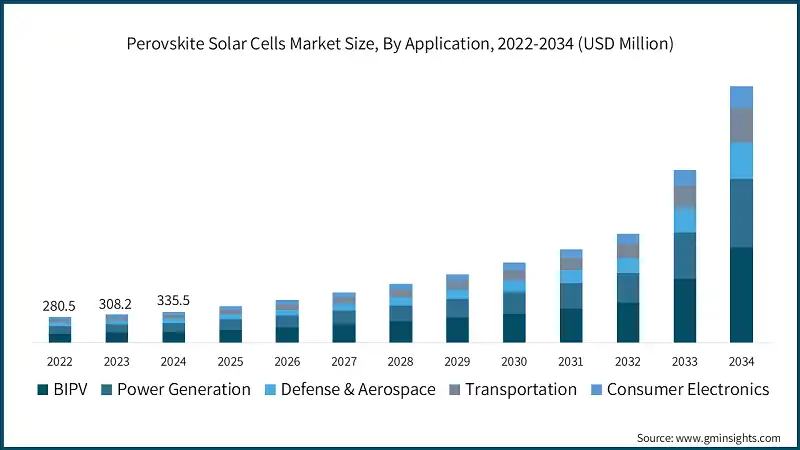
Learn more about the key segments shaping this market
- Based on application, the perovskite solar cells market is segmented into BIPV, power generation, defense & aerospace, transportation and consumer electronics. BIPV applications hold the largest market share at 35.8% in 2024, growing at more than 24.5% CAGR through 2034 on account of rising demand and popularity of energy-efficient systems.
- The product enables architectural integration through transparency control, colour tunability, and lightweight construction, making it a preferred choice contributing to overall market growth. In addition, government demonstration projects, including Fukuoka City's municipal building integration and EU-funded PERSEUS project for decorative facade applications, will lead to widespread architectural adoption.
- Power generation will grow more than CAGR 23.5% by 2034 driven by superior efficiency potential and decreasing manufacturing costs. Moreover, manufacturing scalability has reached commercial viability, with multiple companies establishing gigawatt-scale production facilities, boosting the product adoption.
- Defense and aerospace market hold 58.6% of the perovskite solar cells market share in 2024 owing to increasing popularity of high-voltage perovskite solar cells in utility-scale renewable energy projects, transmission infrastructure upgrades and HVAC systems. The technology's ability to maintain relatively higher power conversion efficiency under diffuse light conditions makes it particularly suitable for challenging operational environments, which is set to augment the industry scenario.
- Transportation will grow more than 24.5% CAGR by 2034 on account of their lightweight, flexible, and high-efficiency characteristics, which make them ideal for integration into vehicles and mobility systems. Additionally, perovskite-based solar modules are being developed for applications in aviation, marine, and rail transport to power onboard electronics and sensors.
- For instance, in January 2025, EneCoat Technologies along with Toyota Motor Corporation announced a 4-terminal tandem cell equipped with a conversion efficiency of over 30%. It consists of crystalline silicon and stacked perovskite solar cells. Further, the two companies are focused on the transmittance of perovskite solar cells and thereby succeeded in improving the infrared transmittance to 81%.
- Consumer electronics is set to grow more than USD 200 million by 2034 owing to their ability to generate electricity efficiently under low-light or indoor conditions makes them ideal for wearables, smartphones, IoT devices, and smart sensors. Moreover, growing flexibility, tunable transparency, and high indoor efficiency makes perovskite solar cells a cornerstone for the future of energy-autonomous consumer devices.

Learn more about the key segments shaping this market
- Based on type, the perovskite solar cells market is segmented into rigid and flexible modules. Rigid module segment dominate with 69.1% market share and is anticipated to reach over 23.5% CAGR till 2034. These modules utilize glass or hard substrate configurations that provide superior mechanical stability and enhanced encapsulation capabilities essential for long-term outdoor deployment.
- Established manufacturing infrastructure compatibility with conventional crystalline silicon production lines will contribute to market growth. Increasing utilization across Major applications include utility-scale power generation, commercial rooftop installations, and building-integrated photovoltaic systems where structural integrity and long-term performance is set to accelerate the product adoption.
- The flexible modules holds 30.9% of the perovskite solar cells market share and is anticipated to grow over 24.5% CAGR, driven by unique application opportunities unavailable to rigid technologies. These modules utilize lightweight plastic or metal foil substrates that enable deployment on curved surfaces, portable applications, and weight-sensitive installations. High power conversion efficiencies exceeding 20% on scalable substrates using roll-to-roll manufacturing processes further drive the product demand.
- Furthermore, companies like Power Roll are developing business models specifically targeting flexible perovskite modules with projected lifetimes of 10-15 years, demonstrating commercial viability despite shorter operational life compared to rigid alternatives.

Looking for region specific data?
- The U.S. perovskite solar cells market recorded a valuation of USD 31 million in 2022, reached USD 33.9 million in 2023 and will reach to USD 36.7 million by 2024. North America accounted for 18% of the global market share in 2024 supported by substantial government funding and strategic research initiatives.
- In the U.S, growing funding aimed to support projects that improve the efficiency, reliability, and durability of perovskite solar cells, reduce manufacturing costs, and enhance performance validation, will lead to business growth. For instance, in March 2021, the DOE selected 22 projects to receive a total of USD 40 million in funding.
- Europe is anticipated to grow over USD 800 million in 2034 driven by leading research institutions, government funding programs, and aggressive renewable energy targets. European companies lead the commercialization efforts, with Oxford PV achieving the milestone of first commercial tandem module shipments to international markets, thereby augmenting the business statistics. Additionally, research excellence across European institutions, including the University of Oxford, Fraunhofer institutes, and various national laboratories, maintains the region's position at the forefront of perovskite science and technology development, contributing to market growth.
- Asia Pacific dominates the global Perovskite solar cells market with 49.65% market share in 2024 and will grow more than 24.5% CAGR through 2034. Substantial manufacturing investments, government policy support, and established photovoltaic industry infrastructure will contribute to the business momentum. Additionally, government initiatives across the region will provide substantial support for perovskite technology development and deployment, thereby strengthening the business scenario.
- In China, majority of the regional market share, is driven by companies including Microquanta Semiconductor, GCL Suzhou Nanotechnology, and UtmoLight establishing gigawatt-scale production facilities. For instance, in February 2025, Microquanta announced the supply of Perovskite a2 modules to the Huaneng Qinghai Perovskite Demonstration Project. Post completion, the project is anticipated to generate more than 1.14 million kWh of electricity annually.
Perovskite Solar Cells Market Share
- The top five players operating in the industry include Oxford PV, Saule Technologies, Microquanta Semiconductor, GCL Suzhou Nanotechnology and Hubei Wonder Solar that have attained major market share in the perovskite solar cells industry. This reflects the early commercialization stage and the diverse approaches being pursued for different applications and market segments.
- The competitive landscape is influenced by substantial government funding and research institution involvement, with public-private partnerships playing critical roles in technology development and risk mitigation. Competitive strategies focus primarily on technological differentiation, with companies pursuing distinct approaches including tandem architectures, flexible substrates, building-integrated applications, and manufacturing process innovations. Patent portfolios and intellectual property positions play increasingly important roles as the technology approaches widespread commercialization.
- Major players operating in the perovskite solar cells market include a diverse ecosystem of established photovoltaic manufacturers, specialized perovskite developers, research institutions, and emerging technology companies. The competitive landscape reflects the technology's transition from laboratory development to commercial deployment, with companies pursuing various strategies for market entry and scaling.
- GCL Suzhou Nanotechnology leverages established photovoltaic industry position to develop perovskite technologies, focusing on manufacturing scalability and integration with existing silicon production infrastructure. In 2024, the company recorded a revenue of USD 2.06 billion. The company's approach emphasizes cost reduction through process optimization and supply chain synergies with conventional photovoltaic manufacturing.
Perovskite Solar Cells Market Companies
Eminent players operating in the perovskite solar cells industry are:
- Alfa Aesar
- Caelux
- CubicPV
- Dyenamo AB
- Energy Materials Corp.
- Fraunhofer ISE
- Frontier Energy Solutions
- FrontMaterials Co. Ltd.
- FUJIFILM Wako Pure Chemical Corporation
- G24 Power Ltd.
- GCL Suzhou Nanotechnology
- Heiking PV Technology
- Hubei Wonder Solar
- Hunt Perovskite Technologies
- Li Yuan New Energy Technology
- Microquanta Semiconductor
- Oxford Photovoltaics
- Saule Technologies
- Sekisui Chemical
- Swift Solar
- Oxford Photovoltaics pioneers the perovskite-silicon tandem technology commercialization. In September 2024, the company achieved the industry milestone of first commercial shipments, delivering 72-cell tandem panels to the U.S. customers. The tandem modules have passed all key IEC reliability tests and demonstrate certified efficiencies approaching 28%, representing significant advantages over conventional single-junction technologies.
- Saule Technologies focuses on flexible perovskite modules and building-integrated photovoltaic applications, with notable commercial deployments including the Skanska Spark building integration project. The company's strategic partnerships with Columbus Energy and Google Cloud demonstrate integration capabilities with smart building systems and energy management platforms. Its roll-to-roll manufacturing approach targets applications where flexibility and aesthetic integration are critical requirements.
- Microquanta established significant market presence through large-scale demonstration projects and manufacturing capabilities. The company has completed the world's largest perovskite BIPV installation at 17.92 kW featuring double-glass modules with 40% light transmittance and further operates the 8.6 MW grid-connected ground-mounted facility, representing the largest perovskite power plant globally.
- Hubei Wonder Solar focuses on perovskite technology development with emphasis on manufacturing process innovation and cost reduction. The company announced a 2 GW annual capacity target project with USD 1 billion investment, demonstrating commitment to large-scale production capabilities.
Perovskite Solar Cells Market Report Attributes
| Key Takeaway | Details |
|---|---|
| Market Size & Growth | |
| Base Year | 2024 |
| Market Size in 2024 | USD 335.5 Million |
| Market Size in 2025 | USD 393.2 Million |
| Forecast Period 2025 - 2034 CAGR | 24.1% |
| Market Size in 2034 | USD 2.74 Billion |
| Key Market Trends | |
| Drivers | Impact |
| High power conversion efficiency and low manufacturing costs | High power conversion efficiency and low manufacturing costs |
| Rapid innovation and material tunability | Advanced compositional engineering and 2D/3D hybrid structures have extended operational lifetimes to over 9,000 hours under controlled conditions, leading to product adoption. |
| Versatility in Applications | Unique properties enable semi-transparent, flexible, and color-tunable modules suitable for BIPV, transportation, and consumer electronics applications, contributing to the business momentum. |
| Pitfalls & Challenges | Impact |
| Durability and reliability issues | Current average lifetimes of 2-3 years versus 25-30 years for silicon modules remain a significant commercialization barrier challenging the business prospects. |
| Manufacturing and large scale production | Scaling from lab-scale devices to large-area modules typically results in 10-15% efficiency reduction and manufacturing uniformity challenges, posing challenges for manufacturers. |
| Opportunities: | Impact |
| Rise of smart technology and IoT | Scaling from lab-scale devices to large-area modules typically results in 10-15% efficiency reduction and manufacturing uniformity challenges, posing challenges for manufacturers. |
| Rising efficiency advantages | Perovskite solar cells have demonstrated rapid efficiency improvements from 3.8% in 2009 to over 26.1% in recent certified tests, with tandem configurations achieving over 33.7% efficiency which is anticipated to open new markets. |
| Growing solar PV installation | Global PV installed capacity exceeding 500 GW creates expanding opportunities for next-generation perovskite technologies, expanding the market. |
| Market Leaders (2024) | |
| Market Leaders |
12% |
| Top Players |
Collective market share in 2024 is 49% |
| Competitive Edge |
|
| Regional Insights | |
| Largest Market | Asia Pacific |
| Fastest Growing Market | Europe |
| Emerging Countries | Japan, China, U.S. and South Korea |
| Future outlook |
|
What are the growth opportunities in this market?
Perovskite Solar Cells Industry News
- In September 2025, Researchers at the Fraunhofer Institute for Solar Energy Systems (Fraunhofer ISE) Germany demonstrated the enhanced performance for perovskite solar cells by applying a solvent treatment to laminated carbon top electrodes in triple-cation, thereby making carbon electrodes a viable alternative to metal electrodes.
- In June 2024, LONGi achieved efficiency of 30.1% for the commercial M6 size wafer-level silicon-perovskite tandem solar cell in Germany. This breaks the previous record of 28.6% wafer-level tandem solar cell efficiency providing an absolute efficiency advantage of 1.5%. In addition, the ongoing research and development will support in company expansion.
- In August 2023, Panasonic developed the prototype of the BIPV perovskite glass. The company started the demonstration project including technical tests at the newly constructed model house Future Co-Creation FINECOURT III in Japan. The company further aims to improve the reliability and energy conversion through the project.
The perovskite solar cells market research report includes an in-depth coverage of the industry with estimates & forecast in terms of revenue in “USD Million” from 2021 to 2034, for the following segments:
Market, By Type
- Rigid
- Flexible
Market, By Application
- BIPV
- Power Generation
- Defense & Aerospace
- Transportation
- Consumer Electronics
Market, By End Use
- Residential
- Commercial & Industrial
- Utility
The above information has been provided for the following regions and countries:
- North America
- U.S.
- Canada
- Mexico
- Europe
- Germany
- UK
- France
- Italy
- Poland
- Asia Pacific
- Japan
- South Korea
- China
- India
- Australia
- Rest of world
Frequently Asked Question(FAQ) :
What is the market size of the perovskite solar cells in 2024?
The market size was valued at over USD 335.5 million in 2024, with a CAGR of 24.1% expected through 2034. The growth is driven by advancements in photovoltaic technology, cost-effective manufacturing methods.
What is the projected value of the perovskite solar cells market by 2034?
The market size was valued at over USD 335.5 million in 2024, with a CAGR of 24.1% expected through 2034. The growth is driven by advancements in photovoltaic technology, cost-effective manufacturing methods.
What is the expected size of the perovskite solar cells industry in 2025?
The market size is expected to reach USD 393.2 million in 2025.
What was the market share of the BIPV segment in 2024?
The BIPV segment held the largest market share at 35.8% in 2024, led by the growing demand for energy-efficient systems and aesthetic building-integrated applications.
What was the market share of the rigid module segment in 2024?
The rigid module segment dominated with a 69.1% market share in 2024 and is anticipated to expand at a CAGR of over 23.5% through 2034.
What is the growth outlook for the U.S. perovskite solar cells sector?
The U.S. market was valued at approximately USD 36.7 million in 2024, with North America accounting for 18% of the global market share.
What are the upcoming trends in the perovskite solar cells market?
Trends include high-efficiency tandem cells, improved stability via compositional engineering, transparent BIPV use, and gigawatt-scale production expansion.
Who are the key players in the perovskite solar cells industry?
Key players include Alfa Aesar, Caelux, CubicPV, Dyenamo AB, Energy Materials Corp., Fraunhofer ISE, Frontier Energy Solutions, FrontMaterials Co. Ltd., G24 Power Ltd., GCL Suzhou Nanotechnology, Heiking PV Technology, and Hubei Wonder Solar.
Perovskite Solar Cells Market Scope
Related Reports