Summary
Table of Content

Perfume Market
Get a free sample of this report
Form submitted successfully!
Error submitting form. Please try again.
Thank you!
Your inquiry has been received. Our team will reach out to you with the required details via email. To ensure that you don't miss their response, kindly remember to check your spam folder as well!
Request Sectional Data
Thank you!
Your inquiry has been received. Our team will reach out to you with the required details via email. To ensure that you don't miss their response, kindly remember to check your spam folder as well!
Form submitted successfully!
Error submitting form. Please try again.
Perfume Market Size
Rise in the demand for specialized perfumes that are natural ingredients-based acts as a driving force for the expansion of the perfume market. Growth in e-commerce sites will also raise demand for perfumes worldwide. Also, the increasing trend of personal grooming services and the increase in the use of social sites have boosted demand for perfumes. This is coupled with the increasing online shopping platforms that have made it easy for consumers to access different products, thereby increasing market growth. Technologies related to product formulation, the use of natural and organic components, have also played a pivotal part in grabbing the attention of consumers who value the environment. In addition, the trend of unisex perfumes is expanding the target market base for manufacturers.
Perfume Market Key Takeaways
Market Size & Growth
- 2025 Market Size: USD 62.1 Billion
- 2026 Market Size: USD 64.1 Billion
- 2035 Forecast Market Size: USD 85.5 Billion
- CAGR (2026–2035): 3.3%
Regional Dominance
- Largest Market: Europe
- Fastest Growing Region: Asia Pacific
Key Market Drivers
- Increasing consumer demand for premium and luxury fragrances.
- Expansion of e-commerce platforms.
Challenges
- High competition among established players.
- Volatility in raw material prices.
Opportunity
- Rising popularity of personalized and niche fragrances.
- Growing demand for natural and organic perfumes.
Key Players
- Market Leader: LVMH led with over 12.5% market share in 2025.
- Leading Players: Top 5 players in this market include LVMH, Chanel, Armani Beauty, Estée Lauder, Kiehl's, which collectively held a market share of 10% in 2025.
Get Market Insights & Growth Opportunities
According to the YouGov survey, 45% of American perfume consumers purchase one to two favorite fragrances, and 36% purchase new ones. Additionally, 88% rank fragrance as the key purchase consideration, and 62% rank price/value, whereas only 26% find brand to be significant. In addition, 57% spent less than $50 on the last perfume purchase, and merely 4% spent $150 and above.
Nearly three-fourths of Americans (74%) report using perfume or fragrance, while 37% do it on a regular basis, and 34% do it occasionally. One in four Americans (26%) do not use perfume at all. This finding is based on a recent online study conducted by YouGov. The growing concern for sustainability and eco-friendly packaging is another consideration for consumer preference, causing manufacturers to incorporate sustainable aspects into their production process.
The global perfume market was estimated at USD 62.1 billion in 2025. The market is expected to grow from USD 64.1 billion in 2026 to USD 85.5 billion in 2035, at a CAGR of 3.3% according to latest report published by Global Market Insights Inc.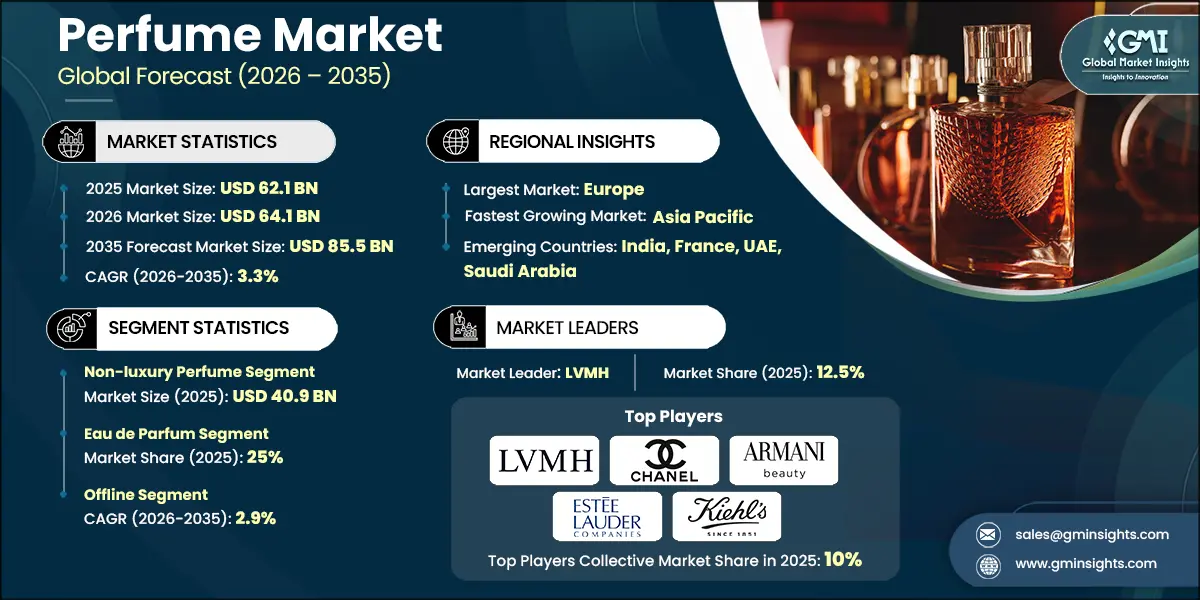
To get key market trends
Perfume Market Trends
- The fragrance industry is undergoing a significant shift due to the changing consumer trends, regulatory issues, and technology breakthroughs.
- Floral patterns are all set to make a comeback, but with a twist that moves away from the conventional way of depicting them. As predicted by designers, rose will dominate floral patterns but with a complete turnaround.
- Young Gen-Z consumers have been responsible for a new wave of new fragrance sales, and the revolutionary impact this has on the industry has become increasingly clear over the course of the last year.
- According to a survey conducted by Circana, 55% of consumers between 18 and 34 years old have changed their so-called “fragrance behavior" over the past year, with a difference in their purchasing behavior in that they buy more body sprays.
- The sales data, which revealed marked growth in the year 2024, reported that the body spray products more than doubled in the European region, registering growth of 107% at USD 286.8 million (265 million Euros), with Sol de Janeiro leading the segment, standing out at number one in its category.
- Sleep has been adopted to a beauty and wellness trend and is a major focus for many brands. Estée Lauder appointed its first ever Global Sleep Science Advisor and some brands have invested in sleep scents due to a reported rise in consumer interest.
- Solid fragrances are one of the important emerging trends that cater to many high-level criteria which play an important role in the purchase decision for Gen Z consumers. Apart from this, solid fragrances provide advantages such as convenience to be carried around. At the same time, they provide good value for money compared to other fragrances coming in packaging such as eau de parfum or toilette.
Perfume Market Analysis
Learn more about the key segments shaping this market
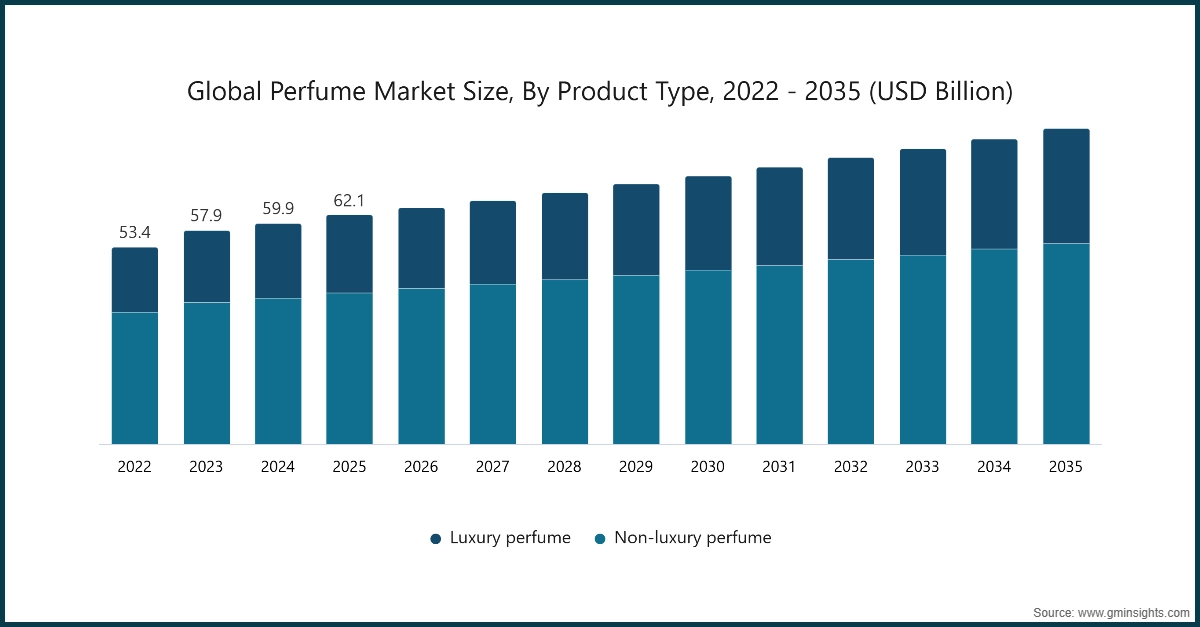
Based on the product type, the perfume market is divided into luxury perfume and non-luxury perfume. In 2025, non-luxury perfume segment dominated the market, generating revenue of USD 40.9 billion and expected to grow at a CAGR of 2.9% during the forecast period.
- The non-luxury segment is expected to exhibit steady growth, due to the affordability of the products. The rising demand for daily use perfumes, along with the availability of different varieties based on different price ranges, will propel the market.
- The category is further assisted by the growth of e-commerce platforms that offer consumers accessibility to a broad array of non-luxury fragrances.
- The luxury perfume segment is projected to grow significantly and is expected to grow at a CAGR of 3.9% from 2026 to 2035. This is due to consumers’ ever-increasing demand for exclusive and luxury fragrances, together with the increased disposable income in emerging countries.
- Also, the trend of gifting upmarket perfumes is contributing to increasing demand. Apart from that, the impact of celebrity endorsements is also adding to the demand in this market. This market is also experiencing advancements in the area of packaging, thereby adding to the consumer delight.
Learn more about the key segments shaping this market
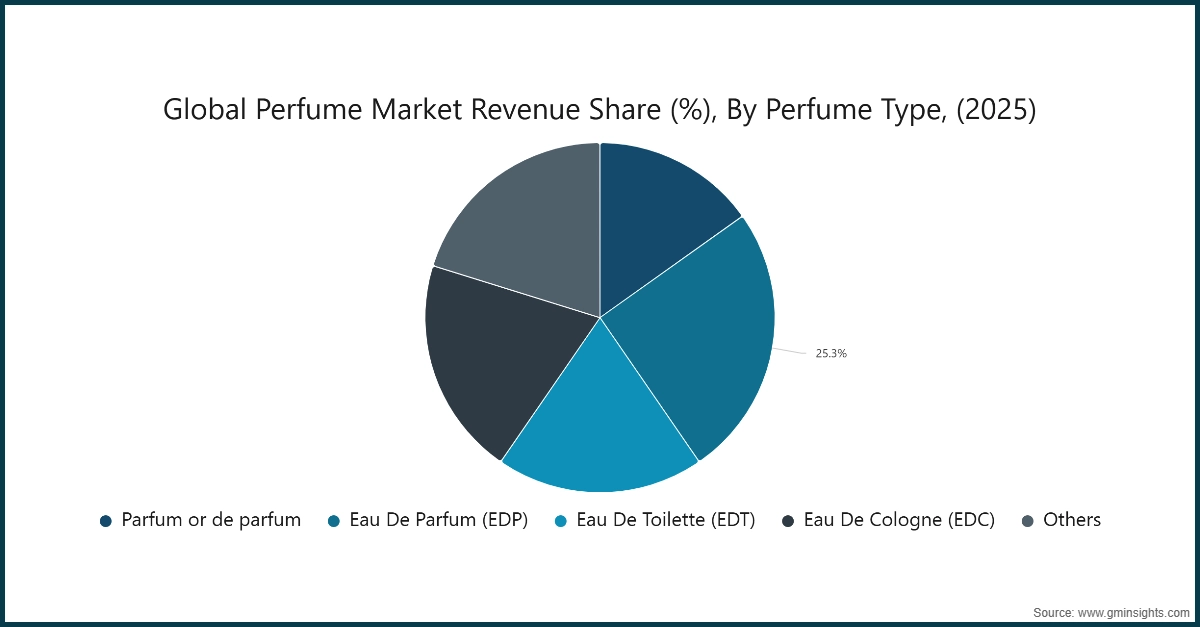
Based on perfume type, the perfume market is segmented into parfum or de parfum, eau de parfum, eau de toilette, eau de cologne, other. In 2025, eau de parfum segment dominates the market with 25% market share and the segment is expected to grow at a CAGR of 3.8% from 2026 to 2035.
- EDP provides a concentration of fragrance oils and is relatively more affordable compared to Parfum, which is a long-lasting fragrance. These qualities have contributed to its popularity among the middle-class group of people.
- The expansion of the category is further fueled by the availability of various choices of fragrances and the trend of personal grooming.
- The Parfum or De Parfum category is likely to experience a steady rise over the forecast period. The demand for fragrance that lasts longer has surged, as Parfum has the maximum concentration of fragrance oils.
- The preference for high-quality and luxury goods is increasing amongst consumers, and this is common amongst developed countries. In addition, the growing disposable income amongst developing countries is fueling the market for luxury goods.
Based on distribution channel, the perfume market is segmented into online and offline. In 2025, the offline segment dominates the market and is expected to grow at a CAGR of 2.9% from 2026 to 2035.
- Offline distribution channel is an emerging force within the perfume industry due to the dominant presence of specialized stores, department stores, as well as exclusive brand stores. Customers favor offline channels to get a tangible feel of the products before buying them.
- In 2025, the online segment is expected to grow at a CAGR of 5.5% from 2026 to 2035. The online-based distribution channel of the perfume industry is registering substantial growth owing to the escalating use of e-commerce platforms.
- Other factors that have contributed to this expansion are the availability of a broad product line, competitive pricing, as well as the ability to assess consumer opinions by viewing reviews and ratings.
Looking for region specific data?
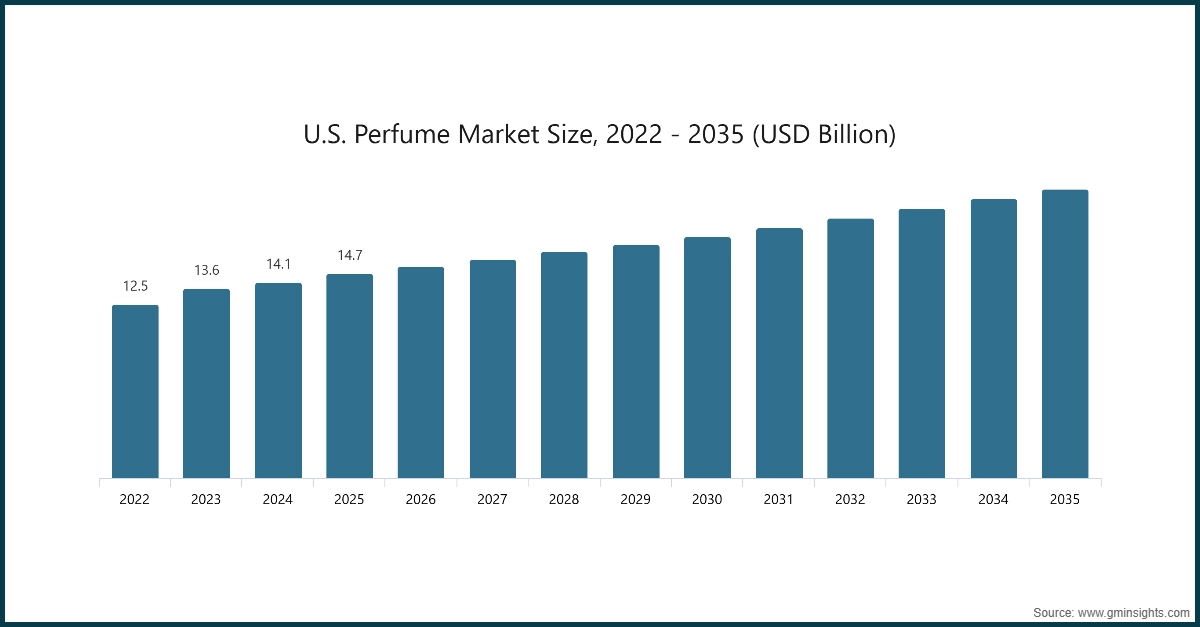
In terms of country, the United States led the perfume market with 80% of the North American market share and estimated USD 14.7 billion in revenue during 2025.
- The growth in the U.S. perfumes market is mainly attributed to changing consumer patterns due to the upsurge in demand for niche perfumes.
- The growth of the market is aided by the growing use of social platforms and celebrity endorsements, thus adding to the visibility of the brand.
- Personalized and eco-friendly fragrances are also emerging as a popular trend among customers. The East Coast segment, with New York being the center for innovations and distribution of fragrances, is an essential contributor to the development of the market.
The Europe perfume market was valued at USD 19.5 billion in 2025 and is projected to grow at a CAGR of 3.1% between 2026 and 2035.
- The market across Europe is likely to grow steadily over the forecast period with the rising demand for luxury and niche perfumery.
- The countries that are major contributors to this market include France, Italy, and Germany, as these countries have an established heritage for perfumes and major market players.
The Asia Pacific perfume market was valued at USD 16.3 billion in 2025 and is projected to grow at a CAGR of 3.7% between 2026 and 2035.
- Increases in disposable income, rising levels of urbanization, and increasing awareness among consumers about the necessity of personal grooming are contributing factors for this market.
- Regions such as China, India, and Japan are at the forefront of the market due to the high population base and lifestyle changes. Premium and niche scents are in high demand, thanks to the growing popularity of e-commerce platforms.
The Middle East and Africa perfume market was valued at USD 3.7 billion in 2025 and is projected to grow at a CAGR of 2.4% between 2026 and 2035.
- Factors such as the cultural trend of personal grooming, as well as the increasing disposable income of the population, are fueling this growth.
- Regions like UAE, Saudi Arabia, and South Africa are turning out to be leaders in the growth of this market. The Increasing Trend of Western Lifestyle and the launch of new and diverse fragrances are further fueling the growth of the market.
Perfume Market Share
The top 5 companies in the market are LVMH, Chanel, Armani Beauty, Estée Lauder, Kiehl's collectively hold a share of 10% in the market. These companies continue to acquire and merge with others, expand facilities, and make various collaborations to increase their product offerings, access customer bases, and secure their market positions. LVMH is increasing its market share through its diverse group of luxury brands, innovative marketing, and its worldwide distribution channels.
The company is focusing on innovations in its products and pursuing sustainable projects to attract a wider customer base without undermining its prestige brands. Chanel performs market consolidation through the exclusive launching of products and by adopting a luxurious brand. The company focuses on experiencing a direct connection with the target market and at the same time retains its luxury aspect. Armani Beauty increases its market share by leveraging its existing brand reputation with its novel fragrance compositions.
The organization adopts various approaches such as collaborations, celebrity influencers, and online marketing campaigns to boost its brand presence. Estée Lauder focuses on its strong product range of offerings and acquisitions. In order to further enhance its position in the perfume segment, it focuses on its online transformation and personal customer services.
Perfume Market Companies
Major players operating in the perfume industry are:
- Armani Beauty
- Burberry
- Bvlgari
- Chanel
- Dior
- Estée Lauder
- Gucci
- Hermès
- Kiehl's
- LVMH
- Michael Kors
- Paris Hilton
- Tom Ford
- Victoria's Secret
- Zara
To improve the product and market share key players are constantly investing in technological activities and are also entering into partnerships to provide improved and better solutions for the customers. These investments are benefiting both companies and customers as they help develop and offer solutions as per the changing technological trends and thus the customer requirements.
Bvlgari is an Italian luxury brand famous for its high-quality perfumes, jewelry, and accessories. The brand combines traditional craftsmanship with innovative technologies that produce distinctive perfumes. In addition, the brand has a wide range of perfumes that appeal to high-end market shoppers who value elegance and sophistication.
Michael Kors is an international luxury fashion brand offering a line of perfumes with its unique style and essence. The company is known for its classic and fashionable designs and has been able to develop its line of perfumes that cater to today’s modern consumers with a desire for both elegance and wearability.
Victoria’s Secret, a prominent American shopping brand, is well-known for its lingerie, cosmetics, and even fragrances. The various perfumes marketed under the brand are created to symbolize femininity. As a brand that focuses on innovation, it is a significant player in the world of perfumes.
Zara, a popular international fast-fashion brand, has recently diversified its product range with affordable but elegant fragrances. The brand provides different scents to appeal to different customers with varying tastes and preferences. The perfumes by Zara are popular due to their quality and affordability.
Perfume Market Report Attributes
| Key Takeaway | Details |
|---|---|
| Market Size & Growth | |
| Base Year | 2025 |
| Market Size in 2025 | USD 62.1 Billion |
| Market Size in 2026 | USD 64.1 Billion |
| Forecast Period 2026-2035 CAGR | 3.3% |
| Market Size in 2035 | USD 85.5 Billion |
| Key Market Trends | |
| Drivers | Impact |
| Increasing consumer demand for premium and luxury fragrances | This trend is driving market growth as consumers prioritize high-quality and exclusive products, leading to increased revenue for premium brands |
| Expansion of e-commerce platforms | The convenience of online shopping is broadening the consumer base, contributing to steady market growth |
| Pitfalls & Challenges | Impact |
| High competition among established players | Intense rivalry is pressuring companies to lower prices, which can reduce profit margins and hinder market growth |
| Volatility in raw material prices | Fluctuating costs of natural ingredients are impacting production budgets, potentially leading to higher product prices and reduced consumer demand |
| Opportunities: | Impact |
| Rising popularity of personalized and niche fragrances | Catering to specific consumer preferences is creating new revenue streams and fostering brand loyalty |
| Growing demand for natural and organic perfumes | Alignment with the clean beauty trend is opening up opportunities for innovation and attracting environmentally conscious consumers |
| Market Leaders (2025) | |
| Market Leader |
12.5% market share |
| Top Players |
The collective market share in 2025 is 10% |
| Competitive Edge |
|
| Regional Insights | |
| Largest Market | Europe |
| Fastest growing market | Asia Pacific |
| Emerging countries | India, France, UAE, Saudi Arabia |
| Future outlook |
|
What are the growth opportunities in this market?
Perfume Industry News
- In January 2026, Tom Ford introduced its new Figue Érotique perfume smells like a bit of a throwaway project. Whilst the profile hits a lot of the right notes in the trending category of salty beachside white floral, it’s packaged in a green top and a particular banana-boat mid that cheapens its impact as a luxury product.
- In January 2026, Emporio Armani unveils power of you Eau de Parfum. It is a new creation that pulses with vibrant, inherent energy. It embodies luminosity itself, crafted for women who are grounded in their truth, who confidently express their own power, and who together form a powerful collective.
- In October 2025, The Estée Lauder Companies announced the opening of its Fragrance Atelier within its new La Maison des Parfums on Rue Volney in Paris. This newly established global innovation hub is fully dedicated to world-class fragrance expertise, advanced technologies and cutting-edge capabilities, and will accelerate the company’s strategic ambitions in luxury and prestige fragrances.
- In April 2025, Chanel Beauty launch Chance Eau de Splendide. Developed by in-house perfumer-creator Olivier Polge, the latest creation is described as a fruity-floral fragrance that holds on to its captivating mystique and intricate notes. It embodies the adventurous trail of life; think chance encounters in a splendid style.
The perfume market research report includes in-depth coverage of the industry with estimates & forecasts in terms of revenue (USD Billion) and volume (Million Units) from 2022 to 2035, for the following segments:
Market, By Product Type
- Luxury perfume
- Non-luxury perfume
Market, By Perfume Type
- Parfum or de parfum
- Eau De Parfum (EDP)
- Eau De Toilette (EDT)
- Eau De Cologne (EDC)
- Other (Eau Fraiche etc.)
Market, By Scent Profile
- Floral
- Oriental
- Woody
- Fresh
- Others (gourmand, fruity etc.)
Market, By Consumer Group
- Men
- Women
- Unisex
Market, By Price
- Up to $49
- $50 to $149
- $150 & above
Market, By Distribution Channel
- Online
- E-commerce
- Company websites
- Offline
- Supermarkets/hypermarket
- Specialty retail stores
- Others (independent retailer etc.)
The above information is provided for the following regions and countries:
- North America
- U.S.
- Canada
- Europe
- UK
- Germany
- France
- Italy
- Spain
- Netherlands
- Asia Pacific
- China
- India
- Japan
- South Korea
- Australia
- Latin America
- Brazil
- Mexico
- Argentina
- MEA
- South Africa
- Saudi Arabia
- UAE
Frequently Asked Question(FAQ) :
What was the market size of the perfume market in 2025?
The perfume industry was valued at USD 62.1 billion in 2025, with a CAGR of 3.3% projected through 2035, driven by evolving consumer preferences and technological advancements in fragrance production.
What is the projected value of the perfume market by 2035?
The market is expected to reach USD 85.5 billion by 2035, fueled by increasing demand for innovative fragrances and the growing influence of younger demographics.
What was the revenue generated by the non-luxury perfume segment in 2025?
The non-luxury perfume segment generated USD 40.9 billion in 2025 and is anticipated to grow at a CAGR of 2.9% during the forecast period.
Which distribution channel dominated the perfume market in 2025?
The offline distribution channel dominated the market in 2025 and is expected to grow at a CAGR of 2.9% from 2026 to 2035.
Which country led the perfume market in 2025?
The United States led the market, accounting for 80% of the North American market share and generating USD 14.7 billion in revenue in 2025.
What are the key trends shaping the global perfume industry?
Key trends include the resurgence of floral patterns with innovative interpretations, the growing influence of Gen-Z consumers on fragrance sales, and a shift in consumer purchasing behavior towards body sprays.
Who are the major players in the perfume industry?
Key players in the market include Armani Beauty, Burberry, Bvlgari, Chanel, Dior, Estée Lauder, Gucci, Hermès, and Kiehl's.
Perfume Market Scope
Related Reports