Summary
Table of Content

Perforating Gun Market
Get a free sample of this report
Form submitted successfully!
Error submitting form. Please try again.
Thank you!
Your inquiry has been received. Our team will reach out to you with the required details via email. To ensure that you don't miss their response, kindly remember to check your spam folder as well!
Request Sectional Data
Thank you!
Your inquiry has been received. Our team will reach out to you with the required details via email. To ensure that you don't miss their response, kindly remember to check your spam folder as well!
Form submitted successfully!
Error submitting form. Please try again.
Perforating Gun Market Size
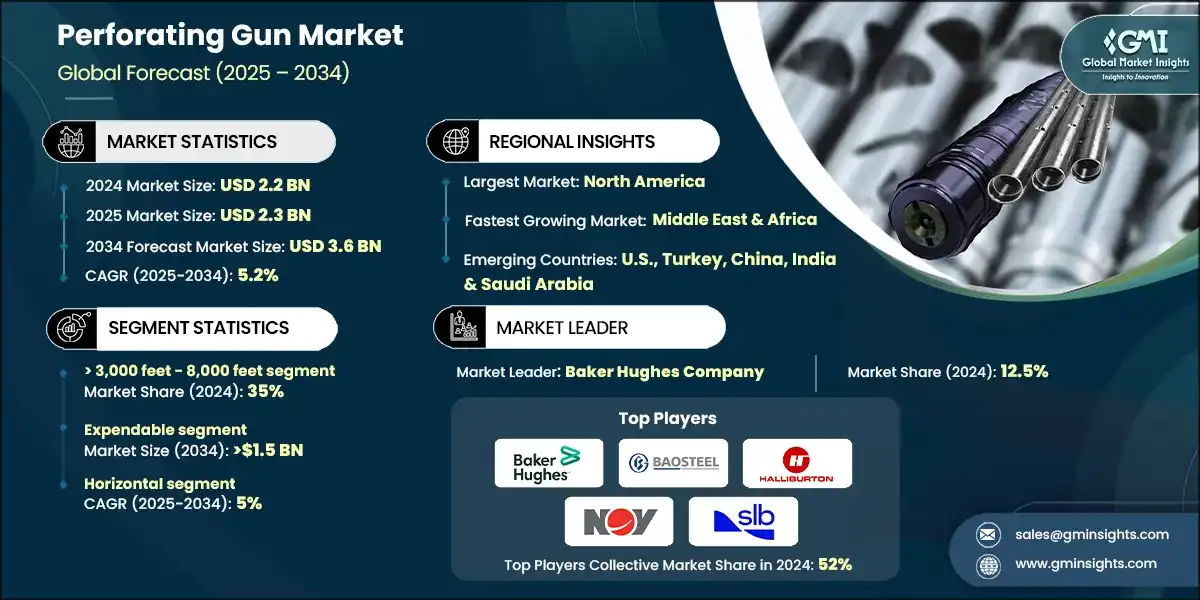
According to a recent study by Global Market Insights Inc., the perforating gun market was estimated at USD 2.2 billion in 2024. The market is expected to grow from USD 2.3 billion in 2025 to USD 3.6 billion by 2034, at a CAGR of 5.2%.
Perforating Gun Market Key Takeaways
Market Size & Growth
- 2024 Market Size: USD 2.2 Billion
- 2025 Market Size: USD 2.3 Billion
- 2034 Forecast Market Size: USD 3.6 Billion
- CAGR (2025–2034): 5.2%
Regional Dominance
- Largest Market: North America
- Fastest Growing Region: Middle East & Africa
Key Market Drivers
- Increasing development of complex wells.
- Shift toward well optimization & higher recovery rates.
- Expansion of re-perforation & well intervention activities.
Challenges
- Operational risks and stringent safety regulations.
Opportunity
- Digitalization & smart perforating systems.
- Development of ultra-compact guns for coiled tubing operations.
- Increasing adoption of autonomous perforation tools in remote operations.
- Environmentally Friendly & Low-Residue Charges.
Key Players
- Market Leader: Baker Hughes Company led with over 12.5% market share in 2024.
- Leading Players: Top 5 players in this market include SLB, Halliburton, Baosteel, Baker Hughes Company, which collectively held a market share of 52% in 2024.
Get Market Insights & Growth Opportunities
- The industry is shaped by the growing need to efficiently connect hydrocarbon-bearing formations to wellbores. Operators focus on tools that deliver cleaner perforations, minimal casing damage, and high penetration. Performance improvements are driven by advancements in shaped charges, stronger carrier materials, and better well-site deployment practices, enabling consistent productivity across conventional & unconventional reservoirs.
- Perforating guns are critical completion tools used in the oil & gas industry to create pathways through well casing, cement, and formation rock, enabling hydrocarbon flow from reservoir to wellbore. These specialized devices contain shaped explosive charges arranged in specific patterns to optimize perforation density, penetration depth, and flow efficiency.
- For illustration, in January 2025, the National Marine Fisheries Service released its final Biological Opinion for oil & gas activities in the Gulf of Mexico, introducing updated operational rules and environmental safeguards for offshore drilling and completion work. The BiOp outlines specific limitations on perforating activities in designated areas and seasons to protect marine life.
- The perforating gun market was valued at USD 1.9 billion in 2021 and grew at a CAGR of approximately 3% through 2024. The modern systems are engineered to withstand high pressures, elevated temperatures, and corrosive fluids. Their design emphasizes predictable detonation, uniform charge performance, and controlled debris generation.
- These tools support multiple completion styles, enabling precise perforation placement. Innovation is shifting toward modular, compact systems that reduce rig time, simplify logistics, and improve operational reliability during both vertical and horizontal completions, which in turn will positively impact the industry landscape.
- Demand for selective perforation capabilities is increasing as well becoming more complex and require stage-by-stage control. The market is influenced by the need to optimize fracture initiation points & maximize connectivity in tight reservoirs, driving the adoption of high-density and oriented shot systems.
- For instance, in December 2024, the U.S. Energy Information Administration issued revised forecasts for domestic oil and natural gas output through 2050, indicating ongoing expansion in unconventional resource production and steady drilling activity across key shale basins. These projections reinforce a favorable outlook for perforating equipment providers, especially those focused on North America’s unconventional development markets.
- Operators are prioritizing perforation strategies that enhance flow efficiency, reduce formation damage, and improve overall productivity. Data from logging tools, geomechanically studies, and reservoir models guide perforation depth & phasing decisions. Rising emphasizes on tools capable of working seamlessly with digital subsurface insights, enabling perforation patterns that match heterogeneous lithologies and variable stress regimes.
To get key market trends
Perforating Gun Market Trends
- The companies invest in robust risk-management frameworks for explosive handling, storage, and transport. As regulations evolve, manufacturers develop tools with improved initiation safety, stronger containment, and better-quality assurance. Training, certification, and strict operational procedures ensure that guns are deployed consistently and safely across diverse drilling environments.
- Real-time telemetry, depth correlation tools, and downhole sensing systems integrate perforating guns to improve accuracy and reduce uncertainty. These digital tools help operators refine perforation placement, optimize firing sequences, and verify effectiveness, producing more predictable well performance, accelerating the industry potential.
- For instance, in November 2024, the International Energy Agency’s World Energy Outlook 2024 examines global energy dynamics and anticipates oil and natural gas remaining significant contributors to the energy mix through mid-century, even as renewables accelerate. The report underscores the need for ongoing investment in oil and gas supply to meet rising demand during the transition, reinforcing long-term requirements for perforating technologies.
- The operators explore new materials that offer higher strength-to-weight ratios, better corrosion resistance, and improved thermal stability. Enhanced diagnostics, such as post-shot imaging and acoustic analysis, help refine tool design. Collaboration among manufacturers, laboratories, and academic institutions accelerates innovation in perforation science and downhole explosive behavior.
- Global regulations governing explosives in line with well integrity, and environmental protection will foster industry dynamics. Companies operating across regions navigate differing standards while maintaining consistent operational quality. Industry associations develop best practices that help standardize testing, certification, and safe usage across international markets.
- For instance, in July 2024, the Society of Petroleum Engineers hosted technical workshops focused on advanced completion technologies such as smart perforating systems and real-time monitoring tools. The sessions emphasized growing industry interest in digital integration and data-driven approaches to optimizing completion performance.
- Integration with digital completions, automation, and advanced reservoir analytics will drive perforation design, while mechanical advancements focus on reducing debris, streamlining assembly, and enhancing performance in extended horizontal sections. As well complexity rises, the need for tools that provide reliable, high-quality perforations with minimal operational risk is expected to grow.
Perforating Gun Market Analysis
Learn more about the key segments shaping this market
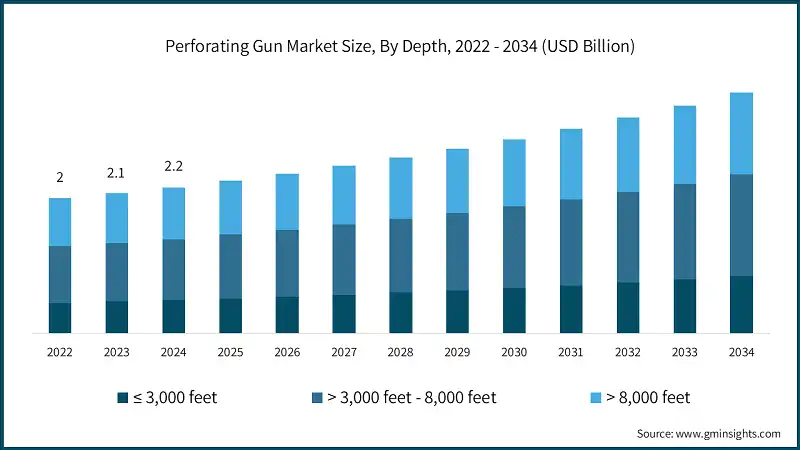
- Based on depth, the industry is segmented into ≤ 3,000 feet, > 3,000 feet - 8,000 feet and > 8,000 feet. The > 3,000 feet - 8,000 feet perforating gun market holds a share of about 35% in 2024 and is projected to grow at a growth rate of over 4.5% through 2034.
- The industry is growing as operators target mid-depth unconventional zones. Growing emphasis on cleaner tunnel geometry, safer plug-and-perf operations, and improved gun shock resistance will propel the business landscape. Increasing integration with digital monitoring tools is enhancing operational efficiency, while innovations aimed at reducing completion time, improving reservoir contact, and boosting overall productivity are shaping industry developments.
- For instance, according to the U.S. Energy Information Administration, hydraulically fractured horizontal wells make up about 69% of all U.S. wells and 83% of total footage drilled, driving strong demand for perforating equipment. Key regions such as the Permian Basin, Eagle Ford, Bakken, Marcellus, and Haynesville see continuous drilling and completions, with roughly 35,000 wells fractured annually, per the American Petroleum Institute.
- The ≤ 3,000 feet segment is set to exceed USD 800 million by 2034. market is expanding as shallow wells, recompletions, and workover programs gain momentum. Emerging trends in the market include the growing demand for compact guns compatible with older wellbores, the adoption of safer low-pressure deployment systems, and the rise of quick-swap modular designs. Additionally, integration with lightweight digital firing heads is enhancing operational control, minimizing downtime, and improving near-wellbore stimulation efficiency.
- The > 8,000 feet perforating gun industry was valued at USD 771.3 million in 2024. The industry is advancing as operators pursue deeper, high-pressure reservoirs. The key features include ultra-high-strength gun bodies, temperature-resilient energetic materials, real-time downhole telemetry, and compact deep-deployment systems that maintain performance under extreme conditions will foster product deployment.
Learn more about the key segments shaping this market
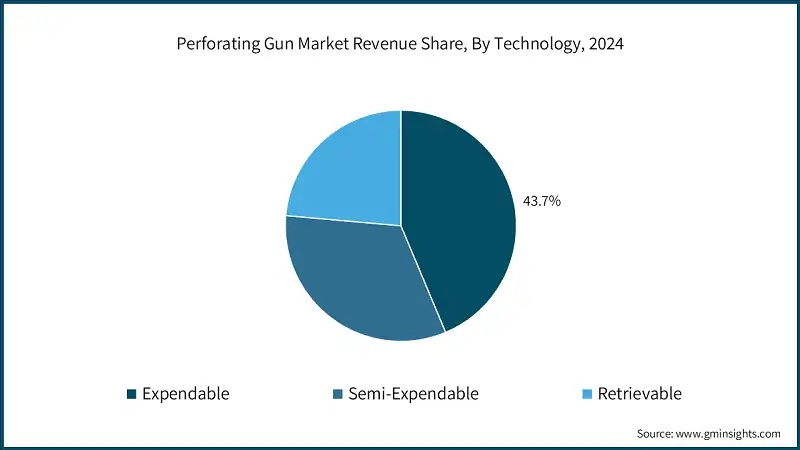
- Based on technology, the industry is divided into expendable, semi-expendable and retrievable. The expendable perforating gun market holds a share of 43.7% in 2024 and is set to reach over USD 1.5 billion by 2034.
- The industry is growing as operators seek faster, cost-efficient completion cycles. Shifting focuses on reducing retrieval risks, incorporating improved debris-management designs, and enhancing charge reliability will augment the industry growth. There is further increasing compatibility with high-shot-density systems, which boost stimulation efficiency and streamline logistics for both unconventional wells and multi-stage plug-and-perf operations.
- Semi-expendable industry was estimated at over USD 1 billion in 2024. The main drivers include hybrid perforating designs that limit debris, strengthened carrier structures for reliable multi-stage use, pressure-balanced firing systems that improve safety, and seamless integration with digital initiation technologies that boost precision and simplify complex, multi-stage completion workflows.
- For instance, in March 2024, the Bureau of Safety and Environmental Enforcement introduced revised offshore safety regulations, reflecting insights from recent operations and technological advancements. These updates directly impact perforating operations conducted in offshore environments, ensuring enhanced safety and compliance standards.
- The retrievable perforating gun market is set to grow at a rate of 5.5% from 2025 to 2034. The market is gaining traction as operators focus on cleaner wellbores and lower operational waste. High-pressure carriers, quicker turnaround for redressing, safer mechanical initiation systems, and greater demand for reusable tools in multi-stage completion programs will fuel the product penetration.
- Based on well type, the industry is bifurcated into horizontal and vertical. The horizontal industry will witness a CAGR of 5% by 2034. The market is evolving with trends such as ultra-compact guns for long laterals, higher shot density for improved reservoir contact, low-debris designs, enhanced compatibility with dissolvable plugs, and increasing adoption of real-time initiation systems that support more efficient multi-stage completion workflows.
- The vertical perforating gun market will gain an appreciable momentum on account of its simplified plug-and-perf setups, compact gun assemblies for mature fields, cleaner-shot technologies that reduce formation damage, rising use of modular systems for quick deployment, and improved initiation tools that enhance precision in conventional reservoir completions.
Looking for region specific data?
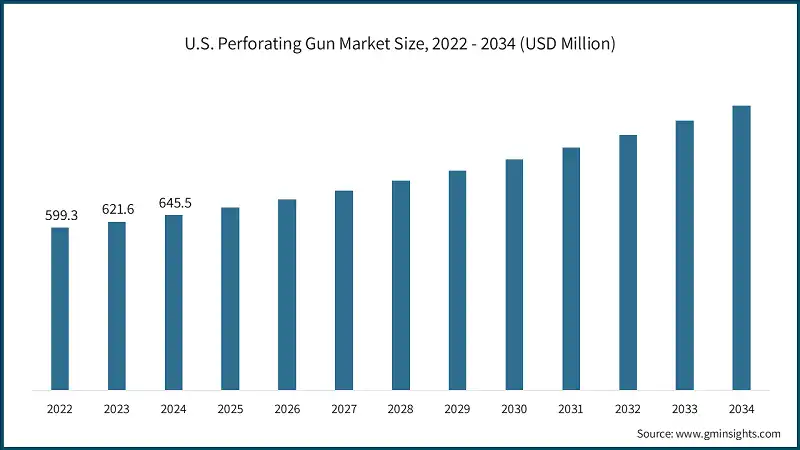
- The U.S. dominated the perforating gun market in North America with around 80% share in 2024 and generated USD 645.5 million in revenue. Growing lateral lengths, deeper stimulation requirements, and pressure to reduce completion time are influencing the industry growth. Operators increasingly prefer compact, high-density systems, safer initiation tools, and low-debris designs that support efficient multi-stage operations in shale and tight reservoir developments.
- The North America perforating gun market is projected to hit USD 1.2 billion by 2034. Rising shale activity coupled with tighter stage spacing, and increased focus on operational safety are shaping the demand. Rising adoption of low-debris designs, the use of digital initiation tools, and the deployment of compact high-density gun systems will fuel the product penetration. Additionally, faster deployment technologies are gaining traction, enabling more efficient multi-stage completions across major unconventional basins.
- For instance, North America represents the largest onshore market, with the United States alone accounting for approximately 35,000 hydraulically fractured wells annually according to the American Petroleum Institute. The Permian Basin, Eagle Ford, Bakken, Marcellus, and other major plays generate substantial perforating equipment demand, with operators conducting intensive completion programs featuring multi-stage hydraulic fracturing and high shot density perforations.
- Evolving offshore projects along with tighter environmental standards, and renewed interest in mature field redevelopment are stimulating the Europe perforating gun market. Operators favor low-debris systems, corrosion-resistant carriers, precise orientation tools, and digital initiation technologies that support safer, high-efficiency completions in both conventional and complex reservoirs.
- For illustration, in May 2024, the Occupational Safety and Health Administration released revised guidance on explosive handling and perforating operation safety, highlighting the importance of risk management and personnel training. This update underscores the continued emphasis on maintaining high safety standards in perforating operations.
- The Asia Pacific perforating gun market is set to grow at a rate of over 5% by 2034. Growing redevelopment of mature fields, expanding unconventional pilots, and rising offshore drilling activity are escalating the industry outlook. Operators are shifting toward compact gun systems, corrosion-resistant designs, improved charge reliability, and safer digital initiation tools to enhance completion efficiency across diverse geological environments.
- The Middle East & Africa accounted for about 25% of the market share. Operators increasingly adopt high-strength carriers, low-debris systems, precise orientation tools, and digital initiation technologies to enhance completion safety, shot accuracy, and productivity in complex formations. Rising high-pressure reservoirs coupled with sustained offshore investments, and ongoing brownfield optimization will favor the business scenario.
- Increasing offshore exploration, shale development, and mature field interventions are driving the Latin America perforating gun. The product offers key benefits including high-reliability, low-debris designs, and modular carriers, that stimulates its deployment. Advanced digital initiation technologies are increasingly adopted to improve safety, enhance accuracy, and boost overall completion efficiency.
- For citation, in September 2024, the Bureau of Ocean Energy Management released the results of its Gulf of Mexico offshore lease sale, showing robust industry participation and continued interest in offshore exploration and development. These lease awards are expected to drive future demand for offshore equipment as operators advance projects on newly acquired acreage.
Perforating Gun Market Share
- The top 5 players in perforating gun industry are Baker Hughes Company, Baosteel, Halliburton, NOV and SLB contribute around 52% of the market share in 2024.
- The industry is highly specialized, serving both onshore and offshore oil and gas operations. It is characterized by a mix of conventional, semi-expendable, and retrievable systems tailored to varying well depths, pressures, and geological conditions. Growth is driven by increasing multi-stage completions, advanced well designs, and the adoption of digital and low-debris technologies that enhance efficiency, safety, and precision in reservoir stimulation.
- In Q1 2025, Halliburton reported total revenue of USD5.4 billion and a GAAP net income of USD 204 million. Its adjusted net income (excluding impairments and other charges) was USD 517 million, or USD 0.6 per diluted share. Operating income came in at USD 431 million, while adjusted operating income was US$ 787 million, resulting in an adjusted operating margin of 14.5%.
- In 2024, SLB (Schlumberger) reported USD 36.3 billion in sales revenue and an estimated EBIT margin of 16%, demonstrating strong operational resilience amid challenging upstream market conditions. The company delivered robust free cash flow of USD 3.9 billion and returned USD 3.3 billion to shareholders through dividends and share repurchases. It remains focused on driving innovation in digital services, optimizing costs, and leveraging its global scale to support long-term, sustainable growth across its oilfield services and technology divisions.
- In 2024, Baosteel Co., Ltd. reported revenues of approximately USD 44.2 billion and a net profit of about USD 1.1 billion, reflecting pressure from weak steel prices and softer demand. The company aims to strengthen its market position by expanding exports, upgrading its product mix toward higher-value specialty steels, and accelerating cost-saving measures, while also returning value to shareholders through dividends, supporting sustainable growth across its steel-making and industrial operations.
Perforating Gun Market Companies
Major players operating in the perforating gun industry are:
- Baker Hughes Company
- Baosteel
- Core Laboratories
- DMC
- DynaEnergetics
- G&H Diversified Manufacturing
- Halliburton
- HUNTING
- ILJIN NTS
- NOV
- Oso Perforating
- Promperforator
- Repeat Precision
- Shaanxi FYPE Rigid Machinery
- SLB
- Tassaroli
- VIGOR
- Weatherford
- XPRO HOLDINGS
- ZAO NTF Perfotech
- Baker Hughes Company provides perforating systems covering applications from shallow conventional wells to ultra-deepwater HPHT environments. Recent innovations include electronically triggered perforating systems with real-time monitoring, oriented perforating technologies to optimize production, and reloadable gun systems designed for high-volume unconventional completions.
- Baosteel participates in the perforating gun market through its specialty steel and manufacturing capabilities, supplying gun bodies and components to perforating system assemblers. The company's metallurgical expertise and manufacturing scale support its position in the supply chain.
- Halliburton represents one of the world's largest oilfield services companies with substantial participation. It's technical expertise in well completion and hydraulic fracturing supports integrated service delivery that optimizes perforation design for specific reservoir conditions and completion strategies.
- NOV participates through its Completion & Production Solutions segment, offering perforating guns, shaped charges, and related equipment. The company's manufacturing capabilities and supply chain integration provide cost advantages in certain product categories. NOV's broader equipment portfolio including wellheads, completion tools, and production equipment facilitates integrated solutions and customer relationship development.
- SLB competes across the full spectrum of perforating technologies with particular strength in premium-positioned products for offshore and HPHT applications. The company's focus on technology differentiation and performance optimization appeals to operators prioritizing productivity over cost minimization. Its perforating systems incorporate advanced features including oriented perforating capabilities, electronic activation with programmable timing, and specialized designs for extreme operating conditions.
Perforating Gun Market Report Attributes
| Key Takeaway | Details |
|---|---|
| Market Size & Growth | |
| Base Year | 2024 |
| Market Size in 2024 | USD 2.2 Billion |
| Market Size in 2025 | USD 2.3 Billion |
| Forecast Period 2025 - 2034 CAGR | 5.2% |
| Market Size in 2034 | USD 3.6 Billion |
| Key Market Trends | |
| Drivers | Impact |
| Increasing development of complex wells | Growing deepwater, HPHT, and multistage drilling requires advanced perforating guns capable of delivering reliable performance under extreme pressure, temperature, and geological conditions. |
| Shift toward well optimization & higher recovery rates | Operators demand precise, high-efficiency perforation systems to improve flow, enhance productivity, and maximize oil recovery while reducing overall completion costs. |
| Expansion of re-perforation & well intervention activities | Maturing wells require re-perforation to restore production, driving demand for through-tubing perforating guns enabling efficient interventions without removing existing tubing. |
| Pitfalls & Challenges | Impact |
| Operational risks and stringent safety regulations | High operational risks and strict safety regulations for handling explosives increase costs and complicate deployment of perforating guns & limit wider adoption. |
| Opportunities: | Impact |
| Digitalization & smart perforating systems | Integration of IoT, real-time monitoring, and data analytics to optimize perforation parameters and improve operational efficiency. |
| Development of ultra-compact guns for coiled tubing operations | Rising demand for rapid interventions and slim-hole re-entry wells offers opportunities for miniaturized perforating guns compatible with coiled tubing in tight wellbores. |
| Increasing adoption of autonomous perforation tools in remote operations | Remote and offshore operations are shifting toward autonomous, pre-programmed perforating tools that reduce manpower, improve safety, and lower intervention costs. |
| Environmentally Friendly & Low-Residue Charges | Development of eco-friendly explosives and low-emission perforating technologies to meet stricter environmental regulations. |
| Market Leaders (2024) | |
| Market Leaders |
12.5% market share |
| Top Players |
Collective market share in 2024 is 52% |
| Competitive Edge |
|
| Regional Insights | |
| Largest Market | North America |
| Fastest Growing Market | Middle East & Africa |
| Emerging Country | U.S., Turkey, China, India & Saudi Arabia |
| Future outlook |
|
What are the growth opportunities in this market?
Perforating Gun Industry News
- In November 2025, Halliburton has secured an integrated drilling services contract for OML 144 offshore Nigeria from Shell Nigeria Exploration and Production Company, in partnership with Sunlink Energies. The contract supports the HI gas field development, supplying feed gas to the Nigeria LNG Train 7 facility. It will utilize LOGIX automation and remote operation technologies to enhance drilling accuracy, efficiency and safety in offshore operations.
- In October 2025, Baker Hughes has been awarded a contract by Aramco to enlarge its incorporated underbalanced coiled tubing drilling actions in Saudi Arabia. The company plans to increase its fleet from four to 10 units to serve re-entry and greenfield drilling projects. It will provide end-to-end solutions, comprising of coiled tubing drilling units, operational management, well construction, geoscience support, underbalanced drilling services, enhancing and accelerating gas access from both new and established fields.
- In May 2025, Core Laboratories has opened its new unconventional core analysis laboratory in Saudi Arabia. Developed in association with long-standing partner Abdulla Fouad Group, this advanced facility reinforces the company’s commitment to enhancing reservoir evaluation technologies in the Middle East.
- In April 2025, Baosteel made its sixth appearance at the Shanghai International Auto Show. With the theme sharing together & growing together, the company displayed over 130 automotive materials and solutions, including steel, aluminum, magnesium, titanium, and carbon fiber, showcasing advanced technology and presenting a SMARTeX grand showcase experience.
The perforating gun market research report includes in-depth coverage of the industry with estimates & forecast in terms of revenue (USD Million) from 2021 to 2034, for the following segments:
Market, By Well Type
- Horizontal
- Vertical
Market, By Depth
- ≤ 3,000 feet
- > 3,000 feet - 8,000 feet
- > 8,000 feet
Market, By Technology
- Expendable
- Semi-expendable
- Retrievable
Market, By Application
- Onshore
- Offshore
Market, By Orientation
- Internal
- External
Market, By Pressure
- High
- Low
Market, By Product
- Through tubing hollow carrier system
- Wireline conveyed casing system
- Through tubing exposed gun system
- Tubing conveyed the perforation system
The above information has been provided for the following regions & countries:
- North America
- U.S.
- Canada
- Europe
- Germany
- Turkey
- Romania
- UK
- Italy
- Russia
- Netherlands
- Norway
- Asia Pacific
- China
- Japan
- Indonesia
- India
- Australia
- Thailand
- Middle East & Africa
- Saudi Arabia
- UAE
- Qatar
- Egypt
- Algeria
- Libya
- Nigeria
- Kuwait
- Oman
- Latin America
- Brazil
- Mexico
- Argentina
Frequently Asked Question(FAQ) :
What is the market size of the perforating gun in 2024?
The market size was USD 2.2 billion in 2024, with a CAGR of 5.2% expected through 2034 driven by rising demand for precise, high-efficiency wellbore connectivity and advanced tools that ensure cleaner perforations with minimal casing damage.
What is the projected value of the perforating gun market by 2034?
The perforating gun market is expected to reach USD 3.6 billion by 2034, propelled by increasing development of complex wells, shift toward well optimization, and expansion of re-perforation and well intervention activities.
What is the current perforating gun market size in 2025?
The market size is projected to reach USD 2.3 billion in 2025.
How much revenue did the expendable perforating gun segment generate in 2024?
The expendable perforating gun segment holds a share of 43.7% in 2024 and is set to reach over USD 1.5 billion by 2034, driven by operators seeking faster, cost-efficient completion cycles.
What was the valuation of the > 8,000 feet depth segment in 2024?
The > 8,000 feet perforating gun segment was valued at USD 771.3 million in 2024, advancing as operators pursue deeper, high-pressure reservoirs with ultra-high-strength gun bodies and temperature-resilient materials.
What is the growth outlook for the retrievable perforating gun segment from 2025 to 2034?
The retrievable perforating gun market is set to grow at a rate of 5.5% from 2025 to 2034, driven by operators' focus on cleaner wellbores, lower operational waste, and reusable tools in multi-stage completion programs.
Which region leads the perforating gun market?
North America leads the perforating gun market, with the U.S. dominating around 80% share in 2024 and generating USD 645.5 million in revenue, supported by strong shale activity and intensive completion programs.
What are the upcoming trends in the perforating gun market?
Key trends include integration of sensors and digital firing heads with real-time analytics, development of ultra-compact guns for coiled tubing operations, increasing adoption of autonomous perforation tools in remote operations, and development of environmentally friendly, low-residue charges.
Who are the key players in the perforating gun market?
Key players include Baker Hughes Company, Baosteel, Halliburton, NOV, SLB, Core Laboratories, DMC, DynaEnergetics, G&H Diversified Manufacturing, HUNTING, ILJIN NTS, Oso Perforating, Promperforator, Repeat Precision, Shaanxi FYPE Rigid Machinery, Tassaroli, VIGOR, Weatherford, XPRO HOLDINGS, and ZAO NTF Perfotech.
Perforating Gun Market Scope
Related Reports