Summary
Table of Content

Peanut Oil Market
Get a free sample of this report
Form submitted successfully!
Error submitting form. Please try again.
Thank you!
Your inquiry has been received. Our team will reach out to you with the required details via email. To ensure that you don't miss their response, kindly remember to check your spam folder as well!
Request Sectional Data
Thank you!
Your inquiry has been received. Our team will reach out to you with the required details via email. To ensure that you don't miss their response, kindly remember to check your spam folder as well!
Form submitted successfully!
Error submitting form. Please try again.
Peanut Oil Market Size
- The market is shaped by rising consumption of edible oils that match daily cooking requirements and traditional food preferences which exist in areas where peanuts have become a major agricultural product. The foodservice and residential markets maintain constant demand because people choose plant-based oils and their household spending on packaged cooking oils has increased. The food industry uses peanut oil for frying and sautéing because of its high smoke point and mild flavor and ability to complement various culinary traditions which keeps it relevant in both restaurants and street food vendors.
- Health-oriented consumption trends also influence market development. Peanut oil contains monounsaturated and polyunsaturated fats which aligns with consumer focus on balanced dietary fat intake. Health-conscious consumers adopt the product because they understand how cholesterol levels affect their health and special cooking oils benefit their heart health. The product receives premium and cold-pressed oil status because natural antioxidants which include vitamin E help protect its presence in urban retail channels.
- The supply-side of peanut production operates through three essential factors which include the amount of peanut crops grown and the methods used in agriculture and the changes in raw peanut prices. The distribution of peanuts in major production areas enables processing facilities to operate within their local area while creating market opportunities for regional trade. Producers who invest in oil extraction technologies and refining efficiency and quality control systems can achieve food safety compliance while they create products that have consistent taste and color. The supply landscape within multiple countries shows a fragmented pattern because small-scale producers and unorganized manufacturers compete against big processors.
- The market faces challenges because price fluctuations and storage problems and edible oil alternatives which include sunflower and soy and mustard and palm oils compete with the existing products. Pricing and product availability in particular regions depends on their import requirements, which become more challenging during times of reduced domestic production. Peanut oil continues to be an essential cooking oil in both developing and developed countries because people use it for cooking and their cultural traditions and the growth of packaged food products.
The global peanut oil market was valued at USD 11.5 billion in 2025. It is projected to grow from USD 11.9 billion in 2026 to USD 16.2 billion by 2035, representing 3.5% CAGR from 2026 to 2035, according to latest report published by Global Market Insights Inc.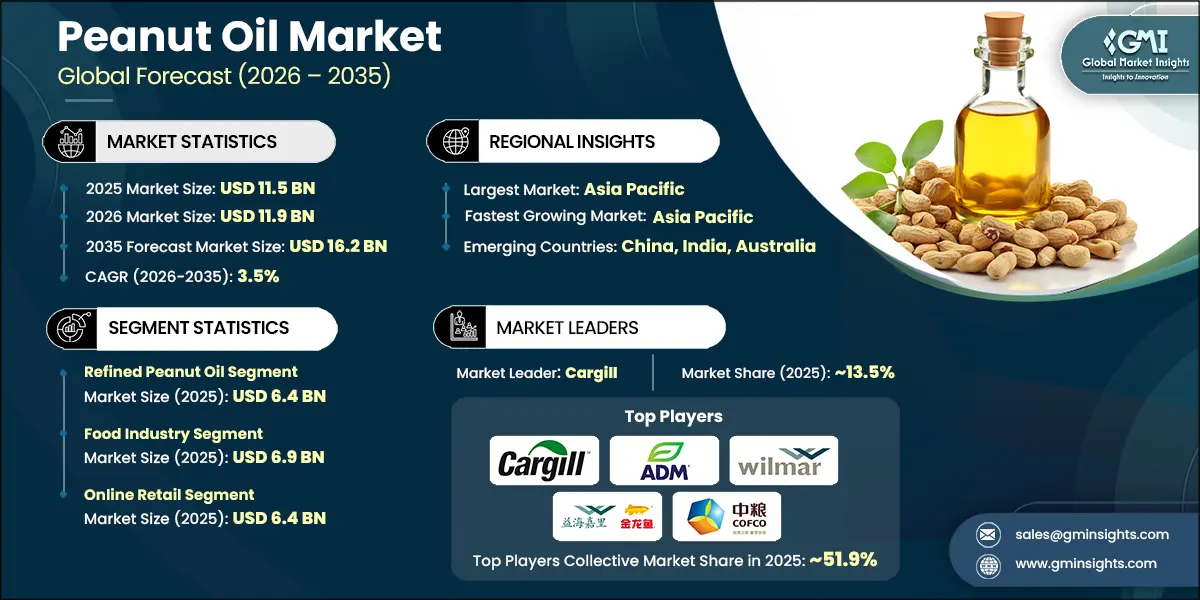
Peanut Oil Market Key Takeaways
Market Size & Growth
- 2025 Market Size: USD 11.5 Billion
- 2026 Market Size: USD 11.9 Billion
- 2035 Forecast Market Size: USD 16.2 Billion
- CAGR (2026–2035): 3.5%
Regional Dominance
- Largest Market: Asia Pacific
- Fastest Growing Region: Asia Pacific
Key Market Drivers
- Widespread culinary use in traditional cooking.
- High smoke point suitability for frying.
- Preference for plant-based edible oils.
- Availability of peanuts in major agricultural economies.
Challenges
- Raw peanut price volatility.
- Competition from alternative edible oils.
- Storage stability and shelf-life concerns.
Opportunity
- Growth of cold-pressed and unrefined oil segments.
- Expansion of packaged food and snack industries.
- Rising urban consumption of branded edible oils.
- Product diversification into blends and fortified oils.
Key Players
- Market Leader: Cargill led with over 13.5% market share in 2025.
- Leading Players: Top 5 players in this market include Cargill, Archer Daniels Midland (ADM), Wilmar International, Yihai Kerry (Arawana), COFCO Corporation, which collectively held a market share of 51.9% in 2025.
Get Market Insights & Growth Opportunities
To get key market trends
Peanut Oil Market Trends
- The peanut oil industry is experiencing a transition towards less processed and cold-pressed products because consumers increasingly prefer natural edible oils. The products are currently finding better market presence in urban retail outlets and specialty stores because people now understand traditional extraction methods and their nutritional benefits. Packaging and labeling and price positioning are all affected by premiumization trends.
- Foodservice operations and snack production facilities have started using peanut oil more than ever before because they need it for their frying work. The product meets commercial cooking needs because it maintains its stability at high temperatures while delivering a flavorless taste. Peanut oil delivers steady cooking results which street food vendors and restaurants and packaged snack makers use to create their dishes.
- Market trends receive formation through branding activities and the development of organized retail market presence. Consumers now prefer buying packaged oils which show product quality and traceability and fixed pricing over purchasing loose unbranded oils. The trend leads to more regional brands and better supply chain practices.
- The market today observes rising product innovation because businesses develop products based on new blends and their functional characteristics. Consumers who follow changing dietary habits prefer peanut oil which food manufacturers combined with other vegetable oils or which they positioned as a nutritional product. This trend enables companies to meet two different consumer requirements by developing products which are both budget-friendly and health-conscious.
Peanut Oil Market Analysis
Learn more about the key segments shaping this market
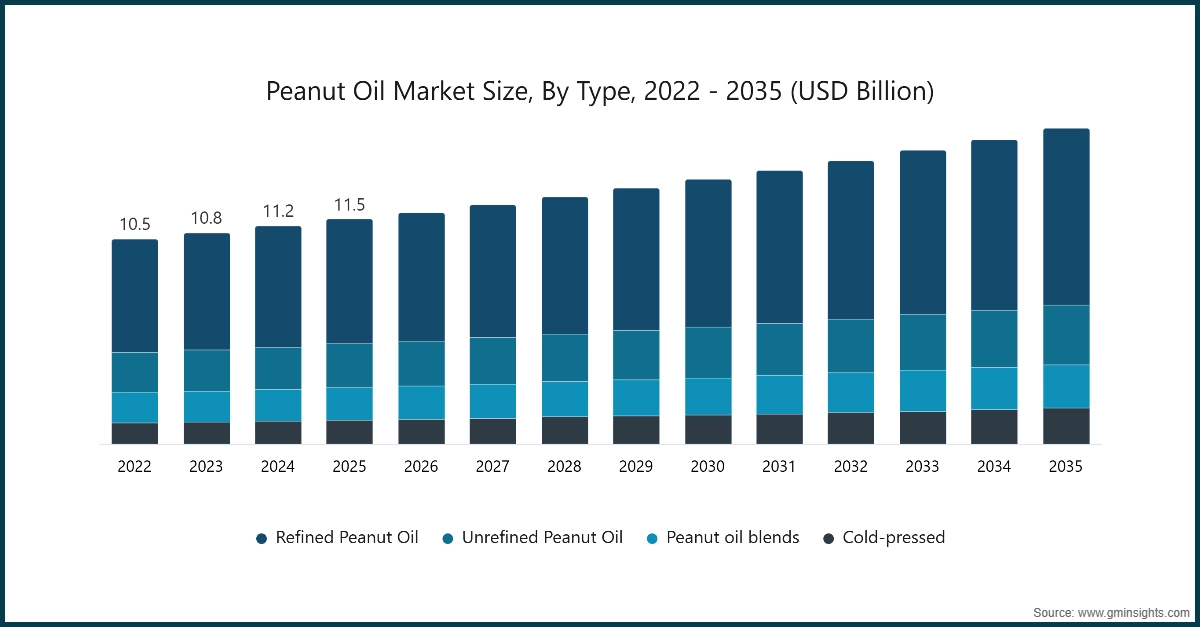
- Refined peanut oil holds broad acceptance due to its neutral taste, clarity, and suitability for high-temperature cooking in both households and foodservice settings. Unrefined peanut oil remains relevant in traditional and regional cuisines where natural aroma and flavor retention are valued. Peanut oil blends address cost sensitivity and functional versatility by combining peanut oil with other vegetable oils. Cold-pressed peanut oil reflects premium consumption trends, supported by growing preference for minimally processed and traditional oil extraction methods.
Peanut oil market based on application is segmented into food industry, cosmetics and personal care, industrial applications, and others. The food industry segment was valued at USD 6.9 billion in 2025, and it is anticipated to expand to 3.6% of CAGR during 2026 to 2035.
- The food industry represents the primary application area, driven by extensive use of peanut oil in household cooking, foodservice frying, and packaged food preparation. Cosmetics and personal care applications utilize peanut oil for its emollient properties in skincare and haircare formulations. Industrial applications include its use as a lubricant base, processing aid, and ingredient in specialty formulations. The others segment covers niche uses such as pharmaceutical preparations and small-scale traditional applications, supporting diversified end-use exposure.
Learn more about the key segments shaping this market
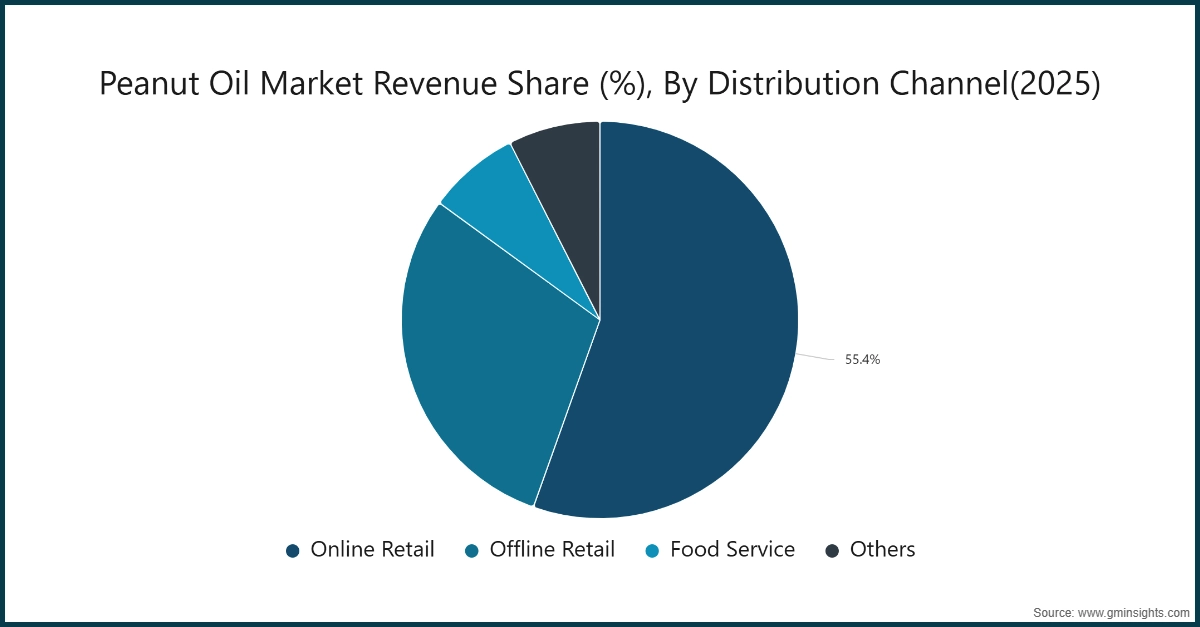
- Online retail continues to gain momentum due to convenience, product variety, and access to branded and specialty oils. Offline retail remains relevant through supermarkets, Kirana stores, and wholesale outlets supporting routine purchases. Food service channels drive bulk demand from restaurants, street food vendors, and catering services. The others segment includes institutional sales and direct procurement, contributing to overall market reach.
Looking for region specific data?
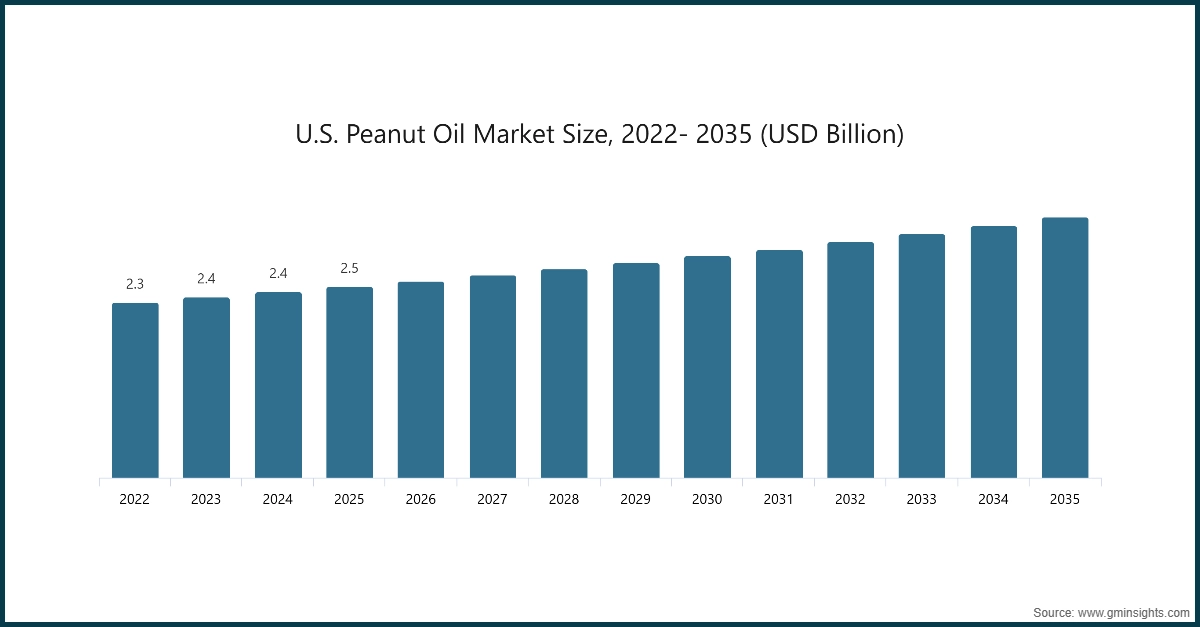
The market in North America shows predictable consumption patterns which stem from three main sources. The United States plays a central role because it maintains established peanut farms and processing facilities which provide restaurants and snack food companies with abundant supplies. The Canadian market relies on imported peanut oil because its retail and foodservice sectors are expanding. The demand patterns in the region arise from two factors which include people who prefer clean-label products and those who want to buy refined and blended oils.
The Europe peanut oil market accounted for USD 2.2 billion in 2025 and is anticipated to show lucrative growth over the forecast period.
The market in Europe exists because chefs use peanut oil for particular cooking purposes while people increasingly want to know where their ingredients come from. France and the United Kingdom represent key consumption centers, where peanut oil is used in ethnic cuisines, gourmet cooking, and certain processed foods. The market demand stems from products which occupy premium retail spaces and meet high quality requirements and attract customers who want to explore different vegetable oil options. Domestic peanut production limits result in a situation where imports supply most of the market demand.
Asia Pacific peanut oil market accounted for 40.5% market share in 2025 and is anticipated to show lucrative growth over the forecast period.
Asia Pacific represents the most consumption-intensive region, supported by widespread use of peanut oil in traditional and everyday cooking. The large peanut farming sites and domestic processing facilities and strong household demand in China and India shape the regional market structure. The oil serves as a frying ingredient for regional recipes used in foodservice operations. The region experiences market development through three factors which include urbanization and the rising demand for packaged foods and the presence of both branded products and loose oil offerings.
Latin America peanut oil market is anticipated to grow at a CAGR of 3.1% during the analysis timeframe.
The peanut oil industry in Latin America experiences changes because agricultural availability and local consumption patterns determine the market. Argentina functions as a major peanut production country which enables oil manufacturing and international distribution operations. Brazil provides foodservice demand and specialized household consumption to the market. The market shows high concentration patterns while growth develops through urban snack manufacturing and the slow development of organized retail distribution.
Middle East & Africa peanut oil market is expected to grow at a CAGR of 5.3% during the analysis timeframe.
The peanut oil industry in Middle East & Africa operates through two systems which involve both imported oil and regional cooking traditions. The foodservice sector and expatriate communities and retail food distribution drive peanut oil demand, which makes Saudi Arabia and South Africa important markets. The restaurant industry uses the product for cooking and frying operations while people at home choose to use it based on the cost and what other oil options they have.
Peanut Oil Market Share
- Cargill, Archer Daniels Midland (ADM), Wilmar International, Yihai Kerry (Arawana), and COFCO Corporation are a significant part of the global peanut oil industry and with further standing of being slightly consolidated with the top five players steadily holding 51.9% market share in the year 2025.
- Manufacturing expenses depend on two main factors which include the availability of raw peanuts and the distance to farming areas. Companies that combine their material sourcing with nearby manufacturing operations achieve better cost management and dependable product delivery.
- The product portfolio contains multiple options which include refined, unrefined, blended, and cold-pressed variants that provide different price ranges and consumer choices across multiple markets.
- Processing efficiency and refining capabilities create product uniqueness through their ability to produce transparent substances which remain stable throughout their shelf life while maintaining flavor neutrality for food service and packaged products.
- Urban consumers who shop at organized retail stores now depend on brand positioning through quality assurance and packaging formats and labeling to choose standardized edible oils.
- The market reach and volume traction of a business depend on its distribution capabilities which include offline retail and foodservice supply networks and new online platforms. The two factors, which include food safety compliance and oil quality consistency determine how competitive a supplier can be when supplying packaged food manufacturers and institutional buyers.
- The company uses its product innovation to create blends and functional positions which enable entry into cost-sensitive and health-oriented markets without requiring a transition to premium pricing.
- The market participants still choose regional focus strategies which lead them to concentrate on domestic markets and nearby export markets for their logistical needs and regulatory controls and profit margin protection.
Peanut Oil Market Companies
The major players operating in peanut oil industry include:
- Cargill
- Archer Daniels Midland (ADM)
- Wilmar International
- Yihai Kerry (Arawana)
- COFCO Corporation
- Adani Wilmar (Fortune)
- Shandong Luhua Group
- Louis Dreyfus Company
- Patanjali Foods
- KS Oils Limited
- Lorenzati Ruetsch
- Oleos Mazola
- SONACOS
- Others
- Cargill built its peanut oil business through its extensive distribution of edible oils and its global network of oil sourcing and its high-capacity oil processing operations. The company enables its customers to receive peanut oil products through its established distribution network which includes both refined and blended oil options.
- Archer Daniels Midland (ADM) operates in the peanut oil market through its complete oilseed processing system and its worldwide ingredient distribution network. The company competes through its refining capabilities and its commitment to quality regulations because these attributes enable it to serve both packaged food producers and institutional customers.
- Wilmar International uses vertical integration to control its operations from agricultural product sourcing through oil processing to the delivery of products to end users. The company achieves a competitive advantage through its cost-effective production methods which enable it to operate multiple facilities throughout Asia while offering a variety of edible oils that meet both household and foodservice requirements.
- Yihai Kerry (Arawana) maintains its competitive strength through its domestic oil distribution network and its development of oil branded products and its location near Asian raw material sources. The company uses its peanut oil product line which includes refined and consumer-ready products to expand its market reach into retail and foodservice businesses.
- COFCO Corporation operates in the market through its agricultural buying activities and its operations in edible oil production. The company achieves its operational strength through its supply chain management system which enables it to serve customers throughout the domestic market while fulfilling high-volume requests from both food manufacturers and institutional clients.
Peanut Oil Market Report Attributes
| Key Takeaway | Details |
|---|---|
| Market Size & Growth | |
| Base Year | 2025 |
| Market Size in 2025 | USD 11.5 Billion |
| Market Size in 2026 | USD 11.9 Billion |
| Forecast Period 2026-2035 CAGR | 3.5% |
| Market Size in 2035 | USD 16.2 Billion |
| Key Market Trends | |
| Drivers | Impact |
| Widespread culinary use in traditional cooking | Supports consistent household and foodservice demand across regions |
| High smoke point suitability for frying | Encourages adoption in commercial kitchens and snack preparation |
| Preference for plant-based edible oils | Strengthens demand amid shifting dietary patterns |
| Availability of peanuts in major agricultural economies | Enables localized production and stable regional supply |
| Pitfalls & Challenges | Impact |
| Raw peanut price volatility | Creates fluctuations in production cost and retail pricing |
| Competition from alternative edible oils | Limits volume growth in price-sensitive consumer segments |
| Storage stability and shelf-life concerns | Increases quality management and packaging requirements |
| Opportunities: | Impact |
| Growth of cold-pressed and unrefined oil segments | Enables value addition and premium product positioning |
| Expansion of packaged food and snack industries | Increases industrial consumption of peanut oil |
| Rising urban consumption of branded edible oils | Supports penetration through organized retail channels |
| Product diversification into blends and fortified oils | Allows manufacturers to address evolving consumer preferences |
| Market Leaders (2025) | |
| Market Leader |
Market Share Approximately 13.5% |
| Top Players |
Collective Market Share Approximately 51.9% |
| Competitive Edge |
|
| Regional Insights | |
| Largest Market | Asia Pacific |
| Fastest growing market | Asia Pacific |
| Emerging countries | China, India, Australia |
| Future outlook |
|
What are the growth opportunities in this market?
Peanut Oil Industry News
- In December 2024, Wilmar International Limited announced that its wholly owned subsidiary, Lence Pte. Ltd., entered into an agreement with Adani Commodities LLP for an option to acquire up to 31.06% equity stake in Adani Wilmar Limited.
- In November 2025, COFCO Corporation announced that its oilseeds division had signed multi-billion-dollar agreements to procure nearly 20 million tons of Brazilian agricultural products, including soybeans, soybean oil, and palm oil. Valued at over USD 10 billion, the contracts were finalized during the China International Import Expo in Shanghai with global traders to strengthen long-term edible oil supply security.
The peanut oil market research report includes in-depth coverage of the industry with estimates & forecasts in terms of revenue (USD Billion) & (Kilo Tons) from 2022 to 2035, for the following segments:
Market, By Type
- Refined Peanut Oil
- Fully refined peanut oil
- Light refined peanut oil
- Deodorized peanut oil
- Unrefined Peanut Oil
- Traditional expeller-pressed oil
- Filtered unrefined oil
- Unfiltered artisan oil
- Peanut Oil Blends
- Peanut–sunflower oil blends
- Peanut–soybean oil blends
- Multi-vegetable oil blends
- Cold-Pressed
- Organic cold-pressed peanut oil
- Conventional cold-pressed peanut oil
- Premium small-batch oils
Market, By Application
- Food Industry
- Household cooking
- Packaged snacks
- Bakery and confectionery
- Cosmetics and Personal Care
- Skin care products
- Hair care formulations
- Massage oils
- Soaps and creams
- Industrial Applications
- Lubricants
- Coatings and resins
- Processing aids
- Others
Market, By Distribution Channel
- Online Retail
- Company-owned websites
- Third-party e-commerce platforms
- Direct-to-consumer sales
- Offline Retail
- Supermarkets and hypermarkets
- Convenience stores
- Specialty food stores
- Food Service
- Restaurants
- Catering services
- Street food vendors
- Cloud kitchens
- Others
The above information is provided for the following regions and countries:
- North America
- U.S.
- Canada
- Europe
- UK
- Germany
- France
- Italy
- Spain
- Rest of Europe
- Asia Pacific
- China
- India
- Japan
- South Korea
- Australia
- Rest of Asia Pacific
- Latin America
- Brazil
- Mexico
- Argentina
- Rest of Latin America
- MEA
- UAE
- Saudi Arabia
- South Africa
- Rest of Middle East and Africa
Frequently Asked Question(FAQ) :
What was the market size of the peanut oil in 2025?
The market size was USD 11.5 billion in 2025, with a CAGR of 3.5% expected from 2026 to 2035. Increasing consumption of edible oils for daily cooking and traditional food preferences is driving market growth.
What is the projected value of the peanut oil market by 2035?
The market is poised to reach USD 16.2 billion by 2035, driven by rising demand in foodservice and residential sectors, along with its high smoke point and mild flavor.
What is the expected size of the peanut oil industry in 2026?
The market size is projected to reach USD 11.9 billion in 2026.
How much revenue did the refined peanut oil segment generate in 2025?
The refined peanut oil segment generated approximately USD 6.4 billion in 2025.
What was the valuation of the food industry segment in 2025?
The food industry segment was valued at USD 6.9 billion in 2025, led by its extensive use in frying and sautéing due to peanut oil's high smoke point and mild flavor.
What is the growth outlook for the online retail segment from 2026 to 2035?
The online retail segment is projected to grow at a CAGR of 3.7% from 2026 to 2035, supported by increasing consumer preference for packaged oils with traceability and fixed pricing.
Which region leads the peanut oil sector?
North America leads the market, with a valuation of USD 2.8 billion in 2025. The U.S. plays a central role due to its established peanut farms and processing facilities, while Canada relies on imports to meet its growing demand.
What are the upcoming trends in the peanut oil market?
Trends include a shift towards less processed and cold-pressed oils, premiumization in packaging and pricing, product innovation with blended oils, and increasing demand for clean-label and traceable products.
Who are the key players in the peanut oil industry?
Key players include Cargill, Archer Daniels Midland (ADM), Wilmar International, Yihai Kerry (Arawana), COFCO Corporation, Adani Wilmar (Fortune), Shandong Luhua Group, Louis Dreyfus Company, Patanjali Foods, and KS Oils Limited.
Peanut Oil Market Scope
Related Reports