Summary
Table of Content

Passenger Car Seat Market
Get a free sample of this report
Form submitted successfully!
Error submitting form. Please try again.
Thank you!
Your inquiry has been received. Our team will reach out to you with the required details via email. To ensure that you don't miss their response, kindly remember to check your spam folder as well!
Request Sectional Data
Thank you!
Your inquiry has been received. Our team will reach out to you with the required details via email. To ensure that you don't miss their response, kindly remember to check your spam folder as well!
Form submitted successfully!
Error submitting form. Please try again.
Passenger Car Seat Market Size
The passenger car seat market volume was estimated at 449.4 million units in 2025. The market is projected to grow from 457.5 million units in 2026 to 600.3 million units by 2035, registering strong double-digit growth over the forecast period.
Passenger Car Seat Market Key Takeaways
Market Size & Growth
- 2025 Market Size: USD 45.8 Billion
- 2026 Market Size: USD 48 Billion
- 2035 Forecast Market Size: USD 77.7 Billion
- CAGR (2026–2035): 5.5%
Regional Dominance
- Largest Market: Asia Pacific
- Fastest Growing Region: Asia Pacific
Key Market Drivers
- Growing global vehicle production and sales.
- Rising consumer demand for comfort and premium features.
- Increasing safety regulations and integrated safety systems.
- Shift toward electric vehicles driving lightweight seat designs.
- Technological advancements in smart and connected seating.
Challenges
- High raw material costs and supply chain volatility.
- Stringent emission and weight reduction mandates.
Opportunity
- Autonomous vehicle development creating new seating configurations.
- Growth in emerging markets with rising vehicle ownership.
- Sustainability trends driving eco-friendly material adoption.
- Aftermarket customization and personalization services.
Key Players
- Market Leader: Adient led with over 17% market share in 2025.
- Leading Players: Top 5 players in this market include Adient, Faurecia (FORVIA), Lear, Magna International, Toyota Boshoku, which collectively held a market share of 63% in 2025.
Get Market Insights & Growth Opportunities
Passenger car seats are essential interior components designed to enhance comfort, safety, and driving posture while integrating advanced features like seatbelt systems and airbags. Modern seats utilize lightweight structures, advanced cushioning, and electronic adjustments to improve durability and interior quality.
The market includes front and rear seats, bucket seats, and advanced seating systems with features like power adjustments, heating, ventilation, and integrated safety technologies. Manufacturers supply complete seat assemblies and components, leveraging lightweight materials and smart technologies to enhance passenger comfort and reduce vehicle weight.
The passenger car seat market is driven by rising global passenger vehicle production, increasing demand for comfort and premium interiors, and stricter safety regulations. The growing popularity of SUVs, luxury vehicles, and EVs has boosted the adoption of advanced, lightweight, and space-optimized seating technologies.
For instance, in August 2025, Adient launched the ModuGo modular seat platform, offering improved customization, lightweight design, and smart features like heating, ventilation, and massage for future passenger vehicles.
Asia Pacific dominates the passenger car seat market due to its strong automotive manufacturing base, cost-efficient production, and increasing domestic vehicle sales. Key countries like China, India, Japan, and South Korea drive demand through their role as major automotive hubs.
Rapid urbanization, rising disposable incomes, and an uptick in passenger car ownership are propelling the Asia Pacific region to the forefront of the passenger car seat market. As automakers ramp up production of SUVs, electric vehicles, and premium cars, there's a notable shift towards integrating advanced seating technologies and smart interior features, bolstering the region's robust growth trajectory.
Global passenger car seat market was estimated at USD 45.8 billion in 2025. The market is expected to grow from USD 48 billion in 2026 to USD 77.7 billion in 2035, at a CAGR of 5.5% according to latest report published by Global Market Insights Inc.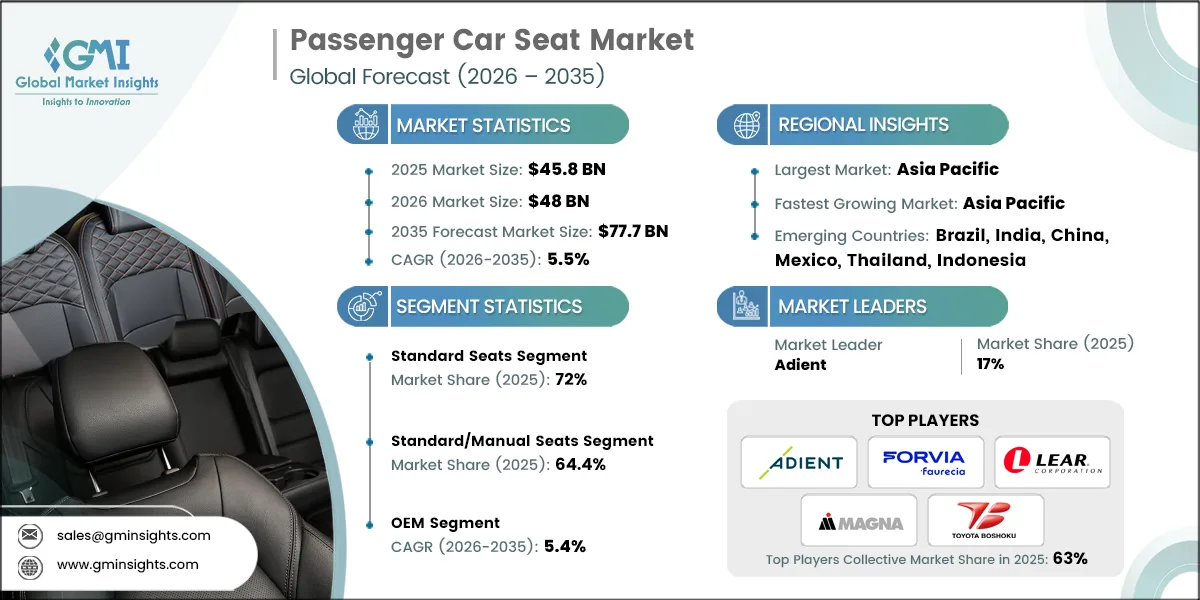
To get key market trends
Passenger Car Seat Market Trends
The passenger car seat industry is steadily evolving as automakers emphasize passenger comfort, safety integration, and lightweight interior designs, driven by advancements in ergonomic engineering, smart seat electronics, and lightweight materials.
Stringent global safety and emission regulations are driving OEMs to optimize seat structures by reducing weight, using recyclable materials, and enhancing occupant protection. This has increased demand for lightweight, precision-engineered seat frames, energy-absorbing foams, and integrated side-thorax airbag systems.
Increasing consumer demand for comfort and premium features in passenger vehicles, especially SUVs and luxury models, is driving the adoption of advanced seating platforms with functionalities like power-adjustable seats, heating, ventilation, and massage systems.
Rising vehicle production in Asia Pacific, particularly in China and India, is boosting regional automotive supply chains and driving demand for locally manufactured seat assemblies and components.
For instance, in January 2025, Adient launched a modular seat platform designed for lightweight vehicle architecture and flexible interiors, addressing the growing demand for comfort, weight optimization, and manufacturing efficiency.
Technological advancements in smart and connected seating systems are further transforming the market. Sensor-enabled seats can monitor passenger posture, adjust seating positions automatically, and integrate with vehicle infotainment and climate control systems to provide a personalized in-cabin experience.
Material innovations like lightweight steel frames, high-resilience polyurethane foams, and sustainable fabrics help reduce seat weight while maintaining durability, supporting automakers' goals for efficiency, comfort, and sustainability in electric and next-gen passenger vehicles.
Passenger Car Seat Market Analysis
Learn more about the key segments shaping this market
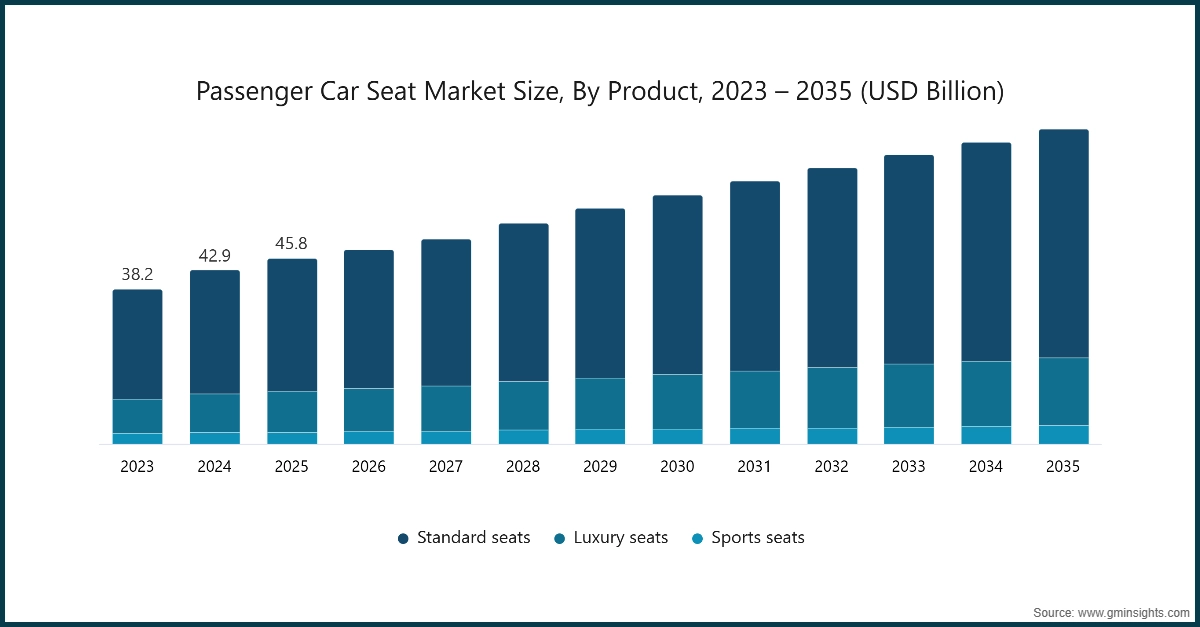
Based on product, the market is segmented into standard seats, luxury seats and sports seats. The standard seats segment dominates the market with 72% share in 2025, and the segment is expected to grow at a CAGR of 5.7% from 2026 to 2035.
- Standard seats dominance is primarily attributed to the high production volumes of mass-market passenger vehicles such as hatchbacks, sedans, and entry-level SUVs, where standard seating systems are widely adopted.
- Standard seats, featuring basic ergonomics and manual adjustments, are designed to balance durability, comfort, and cost for high-volume production in emerging and developing markets.
- For instance, in March 2025, Toyota Motor introduced upgraded seating systems in the 2025 Toyota Camry, focusing on improved comfort, safety integration, and interior quality.
- The segment is growing steadily, driven by rising passenger car production, increasing vehicle ownership in emerging markets, and advancements in seating system materials and design.
- Luxury seats are gaining traction with a CAGR of 5.1% during forecast period in the passenger car seat market, driven by demand for premium features like power adjustments, ventilation, and massage functions.
- The growing demand for premium vehicles is driving the adoption of luxury seats, supported by advanced materials like premium leather, memory foam, and integrated electronics.
- Sports seats, designed for performance and luxury vehicles, enhance driver support, stability, and comfort with bolstered sides, lightweight structures, and ergonomic designs.
- The sports seats segment is growing due to rising demand for sports cars, performance vehicles, and motorsports-inspired designs, driven by consumer interest in sporty aesthetics and better ergonomics.
Learn more about the key segments shaping this market
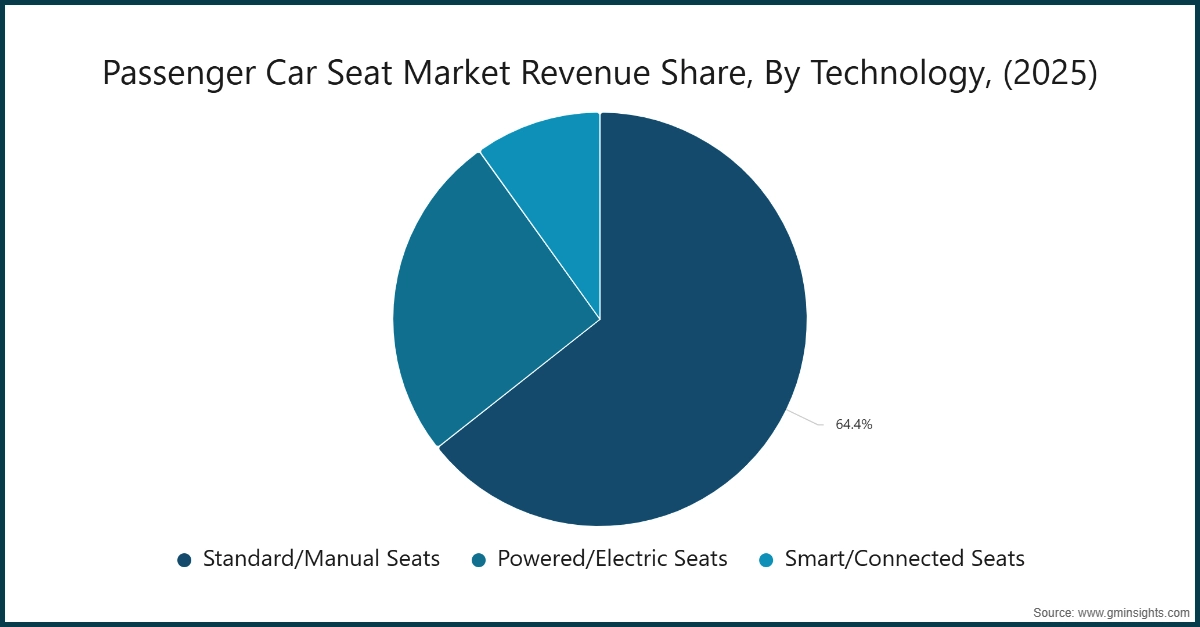
Based on technology, passenger car seat market is divided into standard/manual seats, powered/electric seats, and smart/connected seats. The standard/manual seats segment dominates with 64.4% market share in 2025 and is growing at the rate of 5.3% CAGR.
- Standard/manual seats, with mechanical adjustment mechanisms, offer affordability, durability, and comfort, making them ideal for high-volume vehicle production in developing markets.
- Rising passenger vehicle production and ownership in emerging economies drive demand, while automakers enhance manual seat designs with advanced materials and ergonomic features.
- Manual seat adjustment involves user-operated mechanical systems, such as recliners, slide rails, and height levers, without electric motor assistance.
- Manual seats are cost-effective, mechanically simple, lightweight for better fuel economy and EV range, and suitable for economy vehicles, with engineering focused on durability, smooth adjustments, and compact design.
- In 2025, powered seating systems held a 26% market share and are projected to grow at a 5.5% CAGR by 2035, driven by electric seat adjustments offering multi-directional positioning and premium comfort features.
- Powered seats offer precise adjustments, memory functionality, compatibility with autonomous vehicles, and a premium perception, with leading models providing 12-16 adjustment ways for diverse user needs.
- In 2025, smart and connected seating technology held a 10% market share with a 6.7% CAGR, driven by features like occupant detection, biometric monitoring, and integration with vehicle digital ecosystems.
- Smart seat capabilities as demonstrated in IEEE research include force-sensing resistors, pressure mat arrays, and 60 GHz radar sensors detecting occupancy states and monitoring physiological parameters including respiration and heart rate.
- Smart seat growth is driven by automotive digitalization, rising vehicle electronic content, consumer demand for personalization, regulatory requirements for occupant monitoring, and cost reductions enabling broader adoption.
Based on end use, the passenger car seat market is segmented into OEM and aftermarket. The OEM segment dominates with 87% market share in 2025 with 5.4% CAGR during 2026 to 2035.
- OEM seating refers to products supplied directly to automotive manufacturers, involving engineering collaboration, production scheduling, just-in-time delivery, and integrated quality assurance processes.
- OEM seat supply involves complex commercial relationships characterized by multi-year contracts specifying volume commitments, pricing structures including productivity requirements, global footprint expectations, and technical capability requirements.
- Leading seat suppliers maintain engineering centers co-located with major automotive OEM technical centers, enabling intimate collaboration on vehicle program development, simultaneous engineering of seat systems with vehicle architecture, and rapid response to engineering change requirements during development and production phases.
- OEM seat suppliers strategically locate manufacturing facilities near automotive assembly plants to reduce logistics costs, support just-in-time manufacturing, and meet local content requirements.
- Aftermarket seating encompasses replacement seats for collision repair applications, performance upgrade seats for enthusiast modifications, comfort enhancement products for commercial vehicle applications, and specialty seating for vehicle customization and restoration projects.
- The aftermarket segment is growing fastest at a CAGR of 6% during forecast period, driven by aging vehicle parc and rising demand for premium upholstery, ergonomic cushions, and performance seats in mature automotive markets.
- Suppliers are driving aftermarket growth by offering modular upgrades, smart seat add-ons, and lightweight replacement seats compatible with existing vehicle models.
Looking for region specific data?
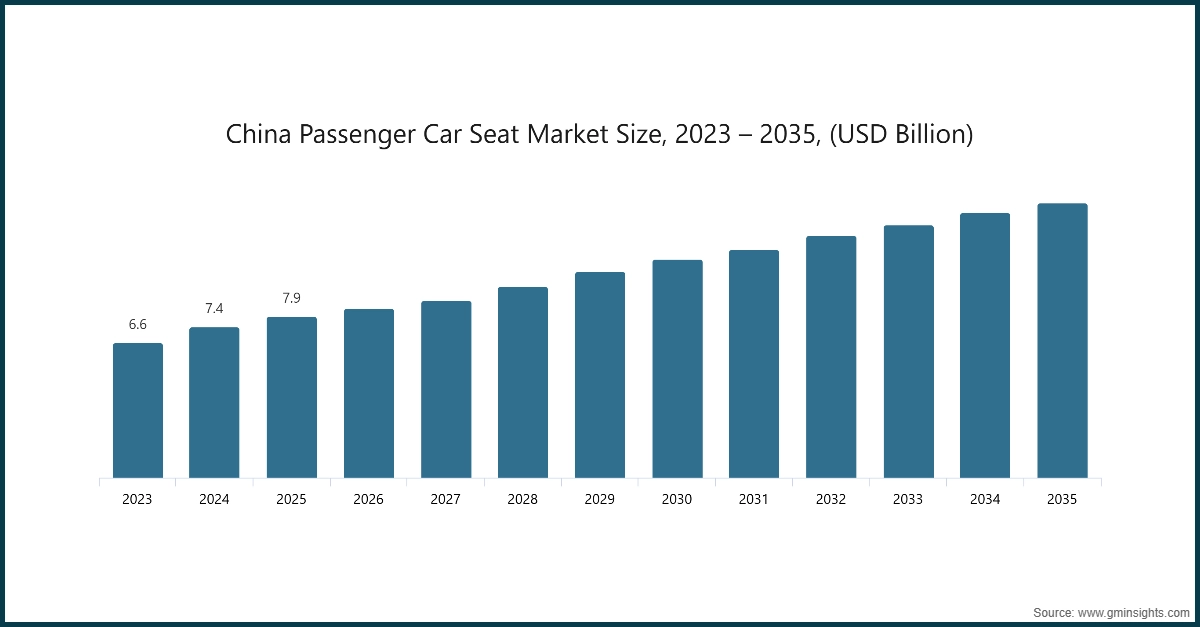
China dominates the Asia Pacific passenger car seat market, showcasing strong growth potential, with a CAGR of 5.5% from 2026 to 2035.
- China, with its strong automotive manufacturing base and integrated supply chain, leads the Asia Pacific passenger car seat industry, driven by high production of passenger cars and SUVs.
- China's annual automotive production of over 30 million units drives demand for standard/manual seats in mass-market vehicles and boosts powered and smart seat adoption in premium and electric vehicles.
- With BEV production exceeding 8 million units in 2024 and projected to hit 18 million by 2030, EV adoption is driving demand for lightweight, modular seats with advanced electronics and comfort features.
- The growth of China's commercial vehicle sector fuels demand for durable, ergonomic seating solutions built for high utilization and long operational cycles.
- Yanfeng Automotive Interiors and regional players have expanded production and advanced technology, securing a significant domestic market share through competitive pricing and OEM partnerships.
- For instance, in May 2025, Yanfeng Automotive Interiors expanded its Shanghai facility to produce advanced seating systems for electric and hybrid passenger vehicles.
Asia Pacific market accounted for USD 21.7 billion in 2025 and is anticipated to show growth of 5.8% CAGR over the forecast period.
- Asia Pacific dominates the passenger car seat market, bolstered by its expansive automotive manufacturing base, seamlessly integrated supply chains, and an escalating demand for sophisticated seating solutions in both passenger and commercial vehicles.
- Rising vehicle production volumes and a growing preference for hybrid and electric powertrains are fueling the demand for lightweight, comfortable, and tech-savvy seating solutions in the region.
- The rest of Asia Pacific, excluding China, is a key growth zone due to rising adoption of premium, powered, and smart seating technologies across diverse automotive markets.
- Rapid urbanization, infrastructure development, and rising vehicle ownership are positioning India as the region's prime expansion hotspot. Demand remains robust for durable, cost-effective seating systems in both mass-market passenger and light commercial vehicles.
- Developed markets like Japan and South Korea feature advanced vehicle interiors and premium seat manufacturing, with companies like Adient and Toyota Boshoku excelling through precision engineering and innovative materials.
- Southeast Asian countries like Indonesia, Thailand, Vietnam, and the Philippines are seeing steady automotive production growth, driven by a growing middle class and investments by global OEMs in regional seat manufacturing.
- For instance, in August 2025, Adient plc expanded its Thailand production line to manufacture advanced powered and smart seating systems for hybrid and electric passenger vehicles.
The passenger car seat market in Germany is expected to experience significant and promising growth with a CAGR of 4.3% from 2026 to 2035.
- Germany leads the European passenger car seat industry, driven by its premium vehicle manufacturing base and integrated interior component supply chain.
- Premium OEMs like BMW, Mercedes-Benz, Audi, and Porsche AG fuel the demand for high-quality seats, meticulously crafted for comfort, safety, and durability, catering to both drivers and passengers.
- In Germany, a push for premium interiors, lightweight materials, and advanced ergonomics is driving OEMs and Tier-1 suppliers to embrace high-performance foams, memory materials, and modular seat structures, enhancing comfort while lightening vehicle weight.
- The country’s export-driven automotive production ecosystem drives consistent demand for standard and advanced seating systems in passenger and premium vehicles for global markets.
- In Germany, the rising popularity of hybrid and electric vehicles is driving the demand for lightweight, electrically adjustable seats. These advanced seats not only need to be lightweight but also must seamlessly integrate with EV architecture and occupant safety systems.
- Germany's stringent safety and emission regulations are driving demand for seats with integrated airbags, seatbelt sensors, and smart connectivity to comply with EU standards.
Europe market is anticipated to grow at a CAGR of 5% during the analysis timeframe.
- In Europe, a robust premium vehicle manufacturing ecosystem fuels the passenger car seat market. Rising consumer demands for comfort and safety, coupled with stringent interior engineering standards, further bolster this market. Additionally, as production ramps up for luxury, performance, and hybrid vehicles, the appetite for advanced seating solutions intensifies.
- Leading automotive manufacturers, such as BMW Group, Stellantis N.V., and Volkswagen AG, are driving demand for ergonomically designed seats to enhance passenger comfort and safety.
- European safety and environmental regulations are driving automakers to adopt integrated airbags, advanced seatbelt sensors, and sustainable materials, fostering innovation in OEM and aftermarket supply chains.
- The region's advanced automotive R&D ecosystem is driving innovations in seating materials, lightweight frames, memory foam, and modular seat designs to enhance comfort and adaptability across vehicle platforms.
- Local vehicle production levels, the maturity of interior manufacturing, and the speed of EV adoption shape market penetration differently across the UK, Germany, France, Italy, Spain, and the Nordic region.
- The demand for advanced seating systems in Nordic countries is driven by hybrid vehicle usage, with a focus on thermal comfort and durability in cold climates.
The passenger car seat market in U.S. is expected to experience significant and promising growth with a CAGR of 5% from 2026 to 2035.
- In North America, the U.S. dominates the passenger car seat industry, fueled by a robust demand for comfort, safety, and cutting-edge interior features in passenger vehicles, SUVs, and electric models.
- U.S. OEMs are enhancing passenger experience and meeting federal safety standards by focusing on ergonomic designs, lightweight seat structures, and advanced electronics integration.
- Michigan, Ohio, Illinois, and Indiana remain key hubs for seat design and assembly, with Tier-1 suppliers like Adient plc and Lear Corporation expanding R&D by 2026 to focus on smart seating systems integrated with advanced technologies.
- Southern states like Tennessee and South Carolina are emerging as manufacturing hubs due to low industrial costs, skilled labor, and proximity to automotive assembly plants.
- For instance, in February 2025, Lear Corporation expanded its Detroit-area facility to produce advanced seating solutions for hybrid and electric vehicles in North America.
North America passenger car seat market accounted for USD 8.2 billion in 2025 and is anticipated to show growth of 5.3% CAGR over the forecast period.
- The North American passenger car seat industry is driven by advanced material science, strict safety standards, and Tier-1 suppliers specializing in innovative seating technologies.
- The U.S. leads demand for advanced seating systems due to high production of SUVs, pickup trucks, and EVs requiring durable, comfortable, and tech-integrated features.
- Canada is emerging as a key hub for premium seating solutions, driven by R&D incentives, precision manufacturing, and partnerships with global OEMs.
- Canadian provincial initiatives in Ontario and Quebec focus on lightweight materials, advanced cushioning technologies, and modular seat designs to reduce vehicle weight while ensuring comfort and safety.
- Pilot programs for autonomous and connected vehicle interiors in North America are boosting demand for smart seating systems with integrated sensors and adaptive comfort features.
- Adient plc and Lear Corporation lead North America's automotive seating sector by developing modular, powered, and connected seat systems for domestic vehicles and global OEM platforms.
Mexico leads the Latin American passenger car seat industry, exhibiting remarkable growth of 5.8% during the forecast period of 2026 to 2035.
- Mexico leads the Latin American passenger car seat market, supported by its role as a major automotive manufacturing hub and growing demand for both standard and advanced seating systems.
- Driven by increasing vehicle production for domestic consumption and export markets, Mexican automakers are prioritizing lightweight, ergonomic, and durable seating solutions, ensuring passenger comfort, interior safety, and compliance with regional and international standards.
- OEMs in Mexico are adopting powered seat mechanisms, modular designs, and high-quality materials to enhance occupant comfort, improve crash safety, and reduce vehicle weight while meeting evolving regulatory and environmental requirements.
- Industrial clusters in Nuevo León, Guanajuato, and Puebla host global and regional suppliers such as Adient, Lear, and Faurecia, which have expanded production and R&D capabilities to meet growing demand for both domestic and export-oriented vehicles.
- Suppliers are increasingly incorporating smart and connected seating technologies, including power adjustments, memory functions, and sensor-enabled safety features, to elevate passenger experience across mid-range and premium vehicles.
- For instance, in August 2025, Adient expanded its production facility in Nuevo León, Mexico, to manufacture next-generation powered and smart seating systems for hybrid and electric passenger vehicles, reflecting the country’s strategic role in regional automotive interior growth.
Saudi Arabia to experience substantial growth in the Middle East and Africa passenger car seat market in 2025.
- Saudi Arabia represents the largest national market within MEA driven by high per-capita income from petroleum resources, large and growing population, and government economic diversification initiatives supporting vehicle ownership growth.
- Saudi Arabia leads the Middle East in the passenger car seat industry, driven by the Vision 2030 mandate to localize automotive manufacturing and diversify the economy beyond oil, creating strong demand for locally produced seating systems.
- Extreme climatic conditions in the Kingdom necessitate durable materials and heat-resistant components in advanced seats to ensure comfort and longevity.
- King Abdullah Economic City (KAEC), hosting the King Salman Automotive Cluster, drives demand for ergonomically designed seats that meet global safety and comfort standards, supporting OEMs like Ceer Motors and Lucid Motors.
- By early 2026, the market is pivoting towards advanced manufacturing and quality validation. Several dedicated interior and seat assembly units are emerging, emphasizing lightweight frames, modular designs, and the integration of powered and ventilated seat features, particularly for SUVs and light commercial vehicles.
Passenger Car Seat Market Share
The top 7 companies in the passenger car seat industry are Adient, Lear, Faurecia (FORVIA), Magna International, Toyota Boshoku, Grupo Antolin and Aisin contributed around 71% of the market in 2025.
- Adient leads the market with a global presence of approximately 200 facilities across 33 countries, supported by engineering expertise and strong relationships with major automotive OEM programs.
- Lear integrates seating systems with electrical and electronic solutions, operating across 250 locations in 38 countries to serve major automotive OEMs with products ranging from economy to luxury.
- Faurecia, part of the FORVIA group post-merger with Hella, focuses on premium seating solutions, European luxury vehicle programs, sustainable materials, and innovative cockpit integration.
- Magna International offers complete vehicle manufacturing and seating systems, supplying components like frames, mechanisms, and trims to major OEMs globally, with a strong presence in North America.
- Toyota Boshoku, a key seat supplier for Toyota Motor Corporation and other Japanese OEMs, leverages Toyota's production philosophies, advanced quality management, and expertise in materials and assembly.
- Grupo Antolin, based in Burgos, Spain, is a family-owned global automotive supplier specializing in seating and interior systems, with a €5 billion annual revenue and a strong presence in premium market segments and sustainable materials innovation.
- Aisin, headquartered in Kariya, Japan, is a Toyota group supplier offering seating, powertrains, chassis, body components, and aftermarket products, while expanding its independent OEM customer base.
Passenger Car Seat Market Companies
Major players operating in passenger car seat industry are:
- Adient
- Aisin Seiki
- Faurecia
- Grammer
- Grupo Antolin
- Johnson Controls
- Lear
- Magna International
- RECARO Automotive
- Toyota Boshoku
- Adient, Aisin Seiki, Faurecia, Grammer, Grupo Antolin, Johnson Controls, Lear, Magna International, RECARO Automotive, and Toyota Boshoku dominate the passenger car seat market. They offer advanced seating systems, integrating ergonomic design, lightweight structures, and smart seat electronics to meet OEM and Tier-1 supplier requirements across mass-market, premium, and electric vehicle segments.
- These companies strengthen their seat offerings by incorporating powered adjustments, ventilated and heated surfaces, modular seat architectures, and connected seat technologies. Their solutions enhance passenger comfort, safety, and interior efficiency, support the adoption of electric and hybrid vehicle platforms, and ensure compliance with stringent global safety and material regulations.
Passenger Car Seat Market Report Attributes
| Key Takeaway | Details |
|---|---|
| Market Size & Growth | |
| Base Year | 2025 |
| Market Size in 2025 | USD 45.8 Billion |
| Market Size in 2026 | USD 48 Billion |
| Forecast Period 2026-2035 CAGR | 5.5% |
| Market Size in 2035 | USD 77.7 Billion |
| Key Market Trends | |
| Drivers | Impact |
| Growing global vehicle production and sales | Expanding passenger car production increases OEM demand for seating systems and interior components across all vehicle segments. |
| Rising consumer demand for comfort and premium features | Drives adoption of advanced seating technologies such as power adjustment, ventilation, heating, and massage functions. |
| Increasing safety regulations and integrated safety systems | Encourages integration of airbags, seatbelt sensors, and occupant detection systems directly into seat structures. |
| Shift toward electric vehicles driving lightweight seat designs | Promotes the use of lightweight frames and advanced materials to improve vehicle efficiency and driving range. |
| Technological advancements in smart and connected seating | Enables features such as memory settings, posture monitoring, and sensor-based seat adjustments to enhance passenger experience. |
| Pitfalls & Challenges | Impact |
| High raw material costs and supply chain volatility | Raises manufacturing costs for seat frames, foams, and electronic components, affecting supplier margins. |
| Stringent emission and weight reduction mandates | Forces manufacturers to redesign seating structures using lightweight materials while maintaining safety and durability. |
| Opportunities: | Impact |
| Autonomous vehicle development creating new seating configurations | Enables flexible seat layouts such as rotating, reclining, and lounge-style seating systems for future mobility. |
| Growth in emerging markets with rising vehicle ownership | Expanding middle-class populations increase demand for passenger cars and associated seating systems. |
| Sustainability trends driving eco-friendly material adoption | Encourages the use of recycled fabrics, bio-based foams, and low-carbon manufacturing processes. |
| Aftermarket customization and personalization services | Creates additional revenue streams through seat upgrades, premium trims, and comfort feature retrofits. |
| Market Leaders (2025) | |
| Market Leader |
17% Market Share |
| Top Players |
Collective Market Share is 63% |
| Competitive Edge |
|
| Regional Insights | |
| Largest Market | Asia Pacific |
| Fastest growing market | Asia Pacific |
| Emerging countries | Brazil, India, China, Mexico, Thailand, Indonesia |
| Future outlook |
|
What are the growth opportunities in this market?
Passenger Car Seat Industry News
- In March 2026, Adient announced a new 500,000-square-foot facility in Georgia to support electric vehicle programs, creating 600 jobs and introducing lightweight seat designs with a 30% mass reduction.
- In February 2026, Lear partnered with a leading sensor technology company to develop advanced occupant monitoring systems, integrating 60 GHz radar sensors, pressure mat arrays, and processing electronics to meet regulatory requirements and enable adaptive comfort features in automated vehicles.
- In January 2026, Faurecia launched its "Seating for Life" pilot program, enabling complete seat refurbishment to like-new condition while supporting sustainability goals and exploring new business models like leasing and subscriptions.
- In December 2025, Magna International unveiled a lightweight sports seat concept with a 40% weight reduction, targeting electric sports cars to enhance acceleration and driving range.
The passenger car seat market research report includes in-depth coverage of the industry with estimates & forecasts in terms of revenue (USD Bn) and shipments (Units) from 2022 to 2035, for the following segments:
Market, By Product
- Standard seats
- Luxury seats
- Sports seats
Market, By Seat
- Front seats
- Rear seats
- Bucket seats
Market, By Material
- Fabric
- Leather
- Synthetic
- Others
Market, By Technology
- Standard/manual seats
- Powered/electric seats
- Smart/connected seats
Market, By Vehicle
- Sedan
- SUV (Sport Utility Vehicle)
- Hatchback
- Luxury
Market, By End Use
- OEM
- Aftermarket
The above information is provided for the following regions and countries:
- North America
- US
- Canada
- Europe
- Germany
- UK
- France
- Italy
- Spain
- Russia
- Netherlands
- Sweden
- Denmark
- Poland
- Asia Pacific
- China
- India
- Japan
- Australia
- South Korea
- Singapore
- Thailand
- Indonesia
- Vietnam
- Latin America
- Brazil
- Mexico
- Argentina
- Colombia
- MEA
- South Africa
- Saudi Arabia
- UAE
- Israel
Frequently Asked Question(FAQ) :
What is the projected value of the passenger car seat industry by 2035?
The passenger car seat market is projected to reach USD 77.7 billion and 600.3 million units by 2035, growing at a CAGR of 5.5% from 2026 to 2035, supported by autonomous vehicle development enabling new seating configurations.
What is the passenger car seat industry size in 2026?
The passenger car seat market size is projected to reach USD 48 billion in 2026, fueled by rising production of electric vehicles requiring lightweight modular seats.
Which product segment dominated the passenger car seat market in 2025?
The standard seats segment dominates with a 72% market share in 2025 and is expected to grow at a CAGR of 5.7% from 2026 to 2035, driven by high production volumes of mass-market passenger vehicles including hatchbacks, sedans.
Which technology segment led the passenger car seat market in 2025?
The standard/manual seats segment dominated with a 64.4% market share in 2025, growing at a CAGR of 5.3% through 2035, driven by affordability, mechanical simplicity, and suitability for high-volume economy vehicle production.
Which end-use segment dominated the passenger car seat market in 2025?
The OEM segment dominates with an 87% market share in 2025 and a CAGR of 5.4% from 2026 to 2035, driven by multi-year contracts with automotive manufacturers, just-in-time delivery requirements, and engineering collaboration on vehicle program development.
Which region leads the passenger car seat market?
Asia Pacific passenger car seat market was valued at USD 21.7 billion in 2025 with a CAGR of 5.8% expected through 2035, driven by high production of passenger cars and SUVs.
What are the upcoming trends in the passenger car seat market?
Key trends include rising demand for power-adjustable seats with heating, ventilation, and massage functions in SUVs and luxury vehicles, and development of flexible lounge-style seating configurations for autonomous vehicle interiors.
Who are the key players in the passenger car seat market?
Key players include Adient, Faurecia (FORVIA), Lear, Magna International, Toyota Boshoku, Grupo Antolin, Aisin Seiki, Grammer, Johnson Controls, and RECARO Automotive.
Passenger Car Seat Market Scope
Related Reports