Summary
Table of Content

Parquet Market
Get a free sample of this report
Form submitted successfully!
Error submitting form. Please try again.
Thank you!
Your inquiry has been received. Our team will reach out to you with the required details via email. To ensure that you don't miss their response, kindly remember to check your spam folder as well!
Request Sectional Data
Thank you!
Your inquiry has been received. Our team will reach out to you with the required details via email. To ensure that you don't miss their response, kindly remember to check your spam folder as well!
Form submitted successfully!
Error submitting form. Please try again.
Parquet Market Size
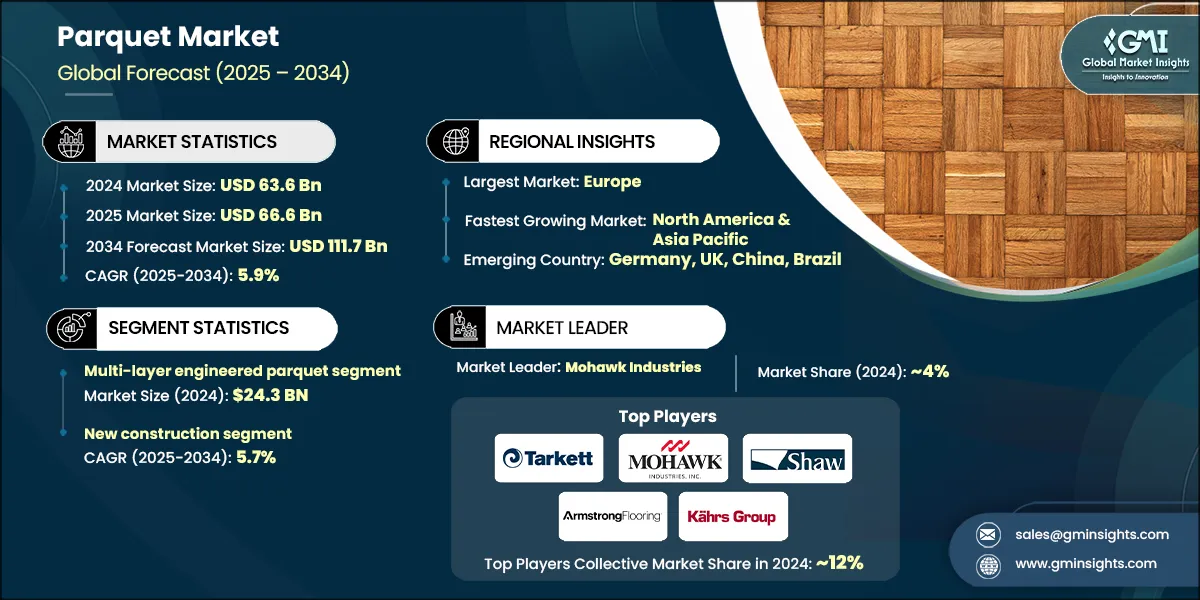
The global parquet market was estimated at USD 63.6 billion in 2024. The market is expected to grow from USD 66.6 billion in 2025 to USD 111.7 billion in 2034, at a CAGR of 5.9%, according to Global Market Insights Inc.
Parquet Market Key Takeaways
Market Size & Growth
- 2024 Market Size: USD 63.6 Billion
- 2025 Market Size: USD 66.6 Billion
- 2034 Forecast Market Size: USD 111.7 Billion
- CAGR (2025–2034): 5.9%
Regional Dominance
- Largest Market: Europe
- Fastest Growing Region: North America & Asia Pacific
Key Market Drivers
- Rising demand for aesthetic and premium flooring solutions.
- Increasing urbanization and residential construction.
- Growing popularity of engineered wood flooring.
Challenges
- High initial installation and material costs.
- Susceptibility to moisture and humidity damage.
Opportunity
- Expansion in luxury residential and hospitality projects.
- Rising demand for sustainable and certified wood products.
- Growth in engineered wood and moisture resistant parquet.
Key Players
- Market Leader: Mohawk Industries led with over 4% market share in 2024.
- Leading Players: Top 5 players in this market include Tarkett Group, Mohawk Industries, Shaw Industries, Armstrong Flooring, Kährs Group, which collectively held a market share of 12% in 2024.
Get Market Insights & Growth Opportunities
The parquet flooring industry is experiencing a boom in demand, driven primarily by the increasing consumer desire for good-looking and high-end flooring solutions. The World Floor Covering Association (WFCA) reports that the global flooring market in 2022 hit USD 457.83 billion, with parquet flooring contributing about 12% of the overall market share.
Parquet, with its complex geometric designs and classic beauty, is favored by homeowners and interior designers to add a touch of luxury to interior spaces. The growing demand for interiors, particularly in urban residents and millennials, made parquet a symbol of sophistication and style. It's ability to mix with old craftsmanship with modern design trends makes it a popular choice in both residential and commercial environments. In addition, the presence of customizable patterns and finishes has become another growth driver, enabling consumers to customize their surroundings without a compromise on high-end looks.
Urbanization and growth in residential development are also growing the demand for parquet. The United Nations Department of Economic and Social Affairs states that 68% of the world population will live in cities by 2050, which will require massive housing construction. As the cities grow and populations swell, the need for new housing units keeps growing, especially in the emerging economies of Asia-Pacific, Africa, and select European markets.
Governments and private builders are developing infrastructure and housing projects with significant investment, forming a strong pipeline for floor materials. Parquet flooring, in its ability to withstand wear and tear and its aesthetic appeal, is now being specified in these developments. Additionally, the trend of refinishing old homes to contemporary standards is also fueling the growth of the market, as homeowners choose parquets to increase value and character in their homes. The European Federation of the Parquet Industry (FEP) cites a 5.8% rise in parquet consumption on the continent during 2022, as a testament to the market's rapid growth path.
Another reason for the growth of the parquet flooring is the increasing demand for engineered wood flooring. Unlike old solid wood, engineered wood provides great stability, moisture resistance, and convenience of installation features which make it ideal for various environments. Engineered parquet combines with the aesthetics of natural wood with the technical benefit of layered design, which is suitable for both heavy traffic and regions with fluctuating climates. With sustainability becoming a priority, engineered wood also supports eco-conscious choices by optimizing wood usage and reducing waste, further aligning with global green building initiatives. According to the Forest Stewardship Council (FSC), engineered wood products consume 25-30% less raw material than solid wood flooring materials, which is in line with sustainable building norms and green building schemes like LEED and BREEAM.
To get key market trends
Parquet Market Trends
The market is evolving rapidly, due to the influence of sustainability, design creativity, and lifestyles in consumers.
- The most notable trend is the shift toward sustainable and responsibly sourced materials. Consumers are increasingly selecting parquets that are made from certified wood like oak and walnut, in support of global sustainability targets and green building practices. This is complemented by increasing demand for engineered wood parquet, which provides durability, moisture resistance, and efficient usage of raw material. The beauty of parquets continues to be in high demand, with sophisticated designs like herringbone and chevron finding increasing usage in residential and commercial spaces.
- Development and technology are also influencing the market. Technology advances in multi-layer construction and simple-to-install forms such as floating parquet are bringing the product within reach of the home improver and renovation market. Urbanization and increased luxury residential and hospitality development are driving premium decorative flooring solutions demand. Moreover, the cross-fertilization between traditional craftsmanship and contemporary design sensibilities is drawing in a wider consumer base, including younger, fashion-aware consumers. As the market continues to expand, parquet flooring is increasingly seen not just as a functional element, but as a statement of elegance and sustainability.
Parquet Market Analysis

Learn more about the key segments shaping this market
Based on product type, the market can be segmented into multi-layer engineered parquet, three-layer engineered parquet, solid wood parquet, FSC-certified parquet, exotic wood parquet and bamboo parquet. The multi-layer engineered parquet segment accounted for revenue of around USD 24.3 billion in the year 2024 and is estimated to grow at a CAGR of 6.4% from 2025 to 2034.
- Multi-layer engineering is growing due to its high structural stability, flexibility, and ability to withstand various climatic conditions. Unlike, conventional solid wood parquet, multi-layer engineered parquets are made of multiple layers of wood veneers assembled in a cross-grain pattern, which largely improves its resistance to warping, moisture, and heat. This renders it a top choice for both domestic and commercial use, such as in rooms with underfloor heating or with high humidity.
- Moreover, the ease of installation, wide range of design, and cost-effectiveness over solid wood options further contributed to its widespread adoption. As buyers and constructors increasingly value durability, performance, and beauty, multi-layer engineered parquet remains the parquet flooring market leader, surpassing other product categories like three-layer engineered, solid wood, FSC-certified, exotic wood, and bamboo parquet.
Learn more about the key segments shaping this market
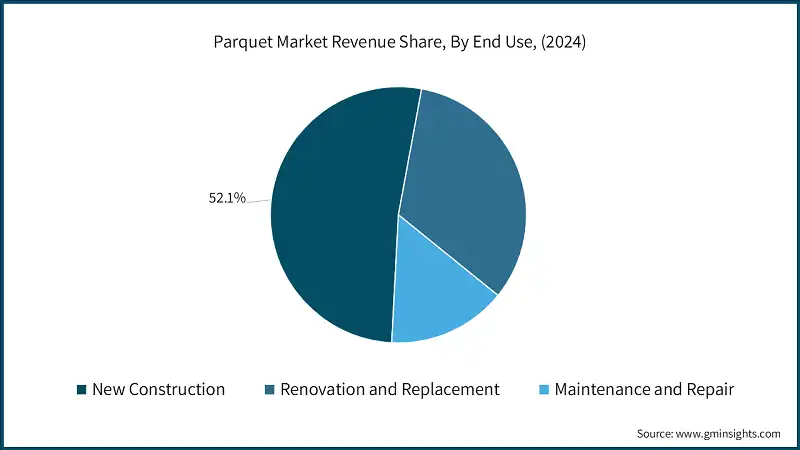
Based on end use, the parquet market is categorized as new construction, renovation and replacement and maintenance and repair. The new construction segment held around 52.1% of the total market share in 2024 and is anticipated to grow at a CAGR of 5.7% during the forecast period.
- The new construction segment had the leading share in 2024, due to the robust demand for parquet flooring within newly constructed residential, commercial, and institutional buildings. This growth is all due to growing urbanization, infrastructure development, and housing construction globally in both developed and emerging economies. Architects and developers now prefer parquet flooring for new developments because it is aesthetically adaptable, long-lasting, and can increase property value.
- Moreover, the inclusion of advanced engineered parquet products, which grant increased efficiency of installation and compatibility with current construction standards, has further driven its use in new constructions. Consequently, the new construction market remains dominant, leading to market share over renovation, replacement, and maintenance purposes.
Looking for region specific data?
North America Parquet Market
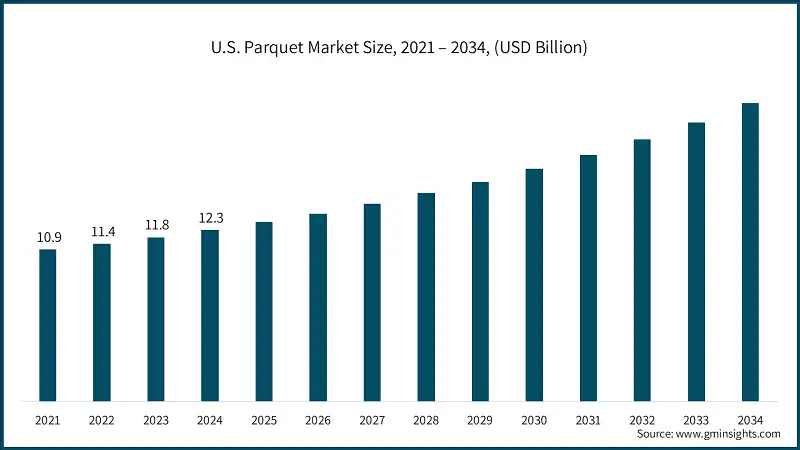
The U.S. dominates an overall North America parquet industry and valued at USD 12.3 billion in 2024 and is expected to grow at a CAGR of 5.8% during the forecast period from 2025 to 2034.
- The expansion of the U.S. is due to the combination of growing residential remodeling, rising demand for high-end interior aesthetics, and technological innovation in engineered wood. Designers and homeowners are looking for floors that provide both beauty and long-lasting performance, parquet has gained popularity as a first-choice option because of its enduring patterns and the ability to take interior spaces to the next level. The increase in urban housing estates and upscale real estate developments also contributes to this demand, with parquet being preferred because of its high-end appearance and durability.
- Furthermore, increasing consciousness about sustainability and environmentally friendly construction materials is also driving consumer demand. Engineered parquet flooring, which minimizes the use of solid wood while retaining the look and integrity of hardwood, is becoming increasingly popular due to its eco-friendliness and affordability.
Europe Parquet Market
The market in Europe, Germany is expected to experience significant and promising growth from 2025 to 2034.
- The growth of Germany is fueled by a mix of high construction activity, increased demand for green building materials, and growing consumer interest in high-end interior designs. Germany has been a major player in the European flooring market, with strong residential and commercial construction projects driving the demand for high-quality flooring products. Parquet floors with their long lifespan and classic design motifs such as herringbone and chevron are gaining popularity in high-end residences, businesses, and hotels throughout Germany. Rising trends and the popularity of engineered wood floors also help fuel the market growth as people look for fashionable yet functional solutions for contemporary living spaces.
Asia Pacific Parquet Market
The Asia Pacific parquet industry, the China held 32.4% market share in 2024 and is expected to grow at a CAGR of 6.9% during the forecast period from 2025 to 2034.
- The country’s growth is fueled by the synergistic effect of fast-paced urbanization, massive infrastructure development, and growing consumer demand for superior-quality interior finishes. The nation's ambitious investment in affordable housing, smart city development, and urban renewal plans has fueled a healthy pipeline of residential and commercial building projects. These advancements are increasingly making use of high-specification flooring solutions such as parquet, which provide both visual attractiveness and durability over time.
Middle East and Africa Parquet Market
In the Middle East and Africa market, Saudi Arabia held 21.6% market share in 2024 and is expected to grow at a CAGR of 4.2% during the forecast period from 2025 to 2034.
- The development of Saudi Arabia in the Middle East and Africa parquet flooring market is being driven by a mix of massive infrastructure projects, growing residential requirements, and the transition toward higher-end interior finishes. The country's Vision 2030 program has spurred construction megaproject wave that includes New Murabba, Diriyah Gate, and King Salman Park, which demand high-quality flooring solutions in commercial, civic, and luxury residential markets. These schemes also propelling demand for parquet flooring because of its good durability, attractiveness, and applicability to high-end settings.
Parquet Market Share
- In 2024, the prominent manufacturers in parquet industry are Tarkett Group, Mohawk Industries, Shaw Industries, Armstrong Flooring, and Kährs Group together these companies hold the market share of ~12%. These companies have established themselves as key players through extensive product portfolios, strong distribution networks, and a consistent focus on innovation and quality. Their market presence is bolstered by a combination of advanced manufacturing capabilities, strategic acquisitions, and investments in sustainable practices, which align with the growing consumer demand for eco-friendly and high-performance flooring solutions.
- Tarkett implements its comprehensive "Impact 2027" strategic framework, emphasizing customer experience optimization, product innovation, environmental sustainability, and workforce development. The company allocates significant resources to eco-design principles and circular economic implementation, encompassing advanced recycling programs and low-carbon product development initiatives. Their technological advancements include non-PVC flooring solutions, manufacturing processes enhanced by artificial intelligence, and innovative hybrid carpets incorporating mushroom-derived biomaterials.
- Mohawk Industries reinforces its market dominance through extensive global operations, strategic product portfolio diversification, and systematic innovation processes. The company's product development encompasses advanced manufacturing technologies, including 3D-printed porcelain surfaces, renewable polymer core flooring systems, and high-performance waterproof laminates with enhanced visual characteristics. These innovations address specific requirements across residential and commercial market segments.
Parquet Market Companies
Major players operating in the market include:
- Armstrong Flooring
- Barlinek SA
- Bauwerk Group
- Beaulieu International Group
- Boral
- Egger Group
- Haro (Hamberger Flooring)
- Kahrs Group
- Kronospan
- Mannington Mills
- MeisterWerke
- Mohawk Industries
- Shaw Industries
- Swiss Krono Group
- Tarkett
Shaw Industries implements a data-driven innovation framework centered on customer requirements and market intelligence. The company's product development process integrates comprehensive market analysis with anticipated consumer demands. Their diversified portfolio encompasses established brands such as COREtec and Anderson Tuftex, complemented by technological innovations including EcoWorx resilient flooring and LifeGuard carpet protection systems. Shaw maintains Environmental Product Declarations and implements sustainable manufacturing protocols, while fostering systematic innovation processes. This integrated approach strengthens their market position across residential and commercial segments.
Armstrong Flooring executes a flexible market strategy characterized by digital transformation initiatives and customer-centric innovation processes. The company maintains a comprehensive product portfolio spanning hardwood, vinyl, and laminate categories, supported by integrated installation and maintenance services. Armstrong's strategic framework encompasses brand repositioning and distribution channel optimization to enhance market penetration. Their environmental management strategy focuses on sustainable product development and operational efficiency optimization, demonstrating commitment to environmental stewardship while maintaining market competitiveness.
Parquet Market Report Attributes
| Key Takeaway | Details |
|---|---|
| Market Size & Growth | |
| Base Year | 2024 |
| Market Size in 2024 | USD 63.6 Billion |
| Market Size in 2025 | USD 66.6 Billion |
| Forecast Period 2025 - 2034 CAGR | 5.9% |
| Market Size in 2034 | USD 111.7 Billion |
| Key Market Trends | |
| Drivers | Impact |
| Rising demand for aesthetic and premium flooring solutions | Boosts adoption in luxury residential and commercial interiors, enhancing market value. |
| Increasing urbanization and residential construction | Expands the customer base and drives volume sales across new housing projects. |
| Growing popularity of engineered wood flooring | Encourages innovation and wider usage due to improved durability and cost-efficiency. |
| Pitfalls & Challenges | Impact |
| High initial installation and material costs | Limits adoption in budget-sensitive markets and slows penetration in developing regions. |
| Susceptibility to moisture and humidity damage | Reduces suitability in tropical or poorly ventilated environments, affecting long-term performance. |
| Opportunities: | Impact |
| Expansion in luxury residential and hospitality projects | Opens high-margin segments and increases demand for premium parquet designs. |
| Rising demand for sustainable and certified wood products | Drives innovation in eco-friendly materials and strengthens brand positioning. |
| Growth in engineered wood and moisture resistant parquet | Enhances product versatility and supports expansion into climate-sensitive markets. |
| Market Leaders (2024) | |
| Market Leaders |
Market share of ~4% |
| Top Players |
Collective market share in 2024 ~12% |
| Competitive Edge |
|
| Regional Insights | |
| Largest Market | Europe |
| Fastest growing market | North America & Asia Pacific |
| Emerging countries | Germany, UK, China, Brazil |
| Future outlook |
|
What are the growth opportunities in this market?
Parquet Industry News
- In 2025, Bauwerk Group expanded its premium flooring portfolio with the introduction of "Formpark Nova" parquet collection, incorporating advanced modular capabilities and sophisticated geometric patterns to address the requirements of professional interior designers and architects.
- In 2024, Barlinek Corporation unveiled its innovative "Barlinek NextGen" parquet product line, featuring advanced click-lock installation technology and environmentally certified finishes, specifically designed for both residential DIY applications and sustainable construction projects.
- In 2024, Tarkett strengthened its market position in sustainable flooring solutions through a strategic minority investment in a European bio-based flooring materials startup, further advancing its circular economy objectives.
- In 2024, Mohawk Industries enhanced its European market presence through the strategic acquisition of a specialized luxury vinyl tile (LVT) manufacturer, strategically diversifying its product portfolio alongside existing engineered wood and parquet offerings.
The parquet market research report includes in-depth coverage of the industry, with estimates & forecasts in terms of revenue (USD Billion) and volume (Million sq. ft.) from 2021 to 2034, for the following segments:
Market, By Product Type
- Multi-layer engineered parquet
- Three-layer engineered parquet
- Solid wood parquet
- FSC-certified parquet
- Exotic wood parquet
- Bamboo parquet
Market, By Wood Species
- Oak parquet
- Maple parquet
- Walnut parquet
- Cherry parquet
- Exotic species
- Engineered species combinations
Market, By Application
- Residential
- Commercial
- Industrial
- Institutional
Market, Installation Method
- Glue-down installation
- Floating installation
- Nail-down installation
- Hybrid installation methods
Market, End Use
- New construction
- Renovation and replacement
- Maintenance and repair
Market, Distribution Channel
- Direct
- Indirect
The above information is provided for the following regions and countries:
- North America
- U.S.
- Canada
- Europe
- Germany
- UK
- France
- Italy
- Spain
- Asia Pacific
- China
- Japan
- India
- South Korea
- Australia
- Indonesia
- Malaysia
- Latin America
- Brazil
- Mexico
- Argentina
- MEA
- Saudi Arabia
- UAE
- South Africa
Frequently Asked Question(FAQ) :
What is the market size of the parquet industry in 2024?
The market size was USD 63.6 billion in 2024, with a CAGR of 5.9% expected through 2034 driven by rising demand for aesthetic and premium flooring solutions.
What is the current parquet market size in 2025?
The market size is projected to reach USD 66.6 billion in 2025.
What is the projected value of the parquet market by 2034?
The market size for parquet is expected to reach USD 111.7 billion by 2034, supported by urbanization, luxury housing projects, and the popularity of engineered wood flooring.
How much revenue did the multi-layer engineered parquet segment generate in 2024?
The multi-layer engineered parquet segment generated USD 24.3 billion in 2024, dominating the market due to its durability, cost-effectiveness, and suitability for diverse climates.
What was the valuation of the new construction segment in 2024?
The new construction segment held 52.1% share and generated the largest revenue in 2024, driven by global housing demand and large-scale infrastructure projects.
Which region leads the parquet market?
The U.S. industry was valued at USD 12.3 billion in 2024, making it the largest regional market. Growth is driven by rising home remodeling, demand for luxury interiors, and increasing adoption of engineered wood for sustainable flooring solutions
What are the upcoming trends in the parquet industry?
Key trends include the rise of engineered wood parquet, demand for sustainable FSC-certified flooring, growth of luxury residential and hospitality projects, and adoption of modern installation technologies like floating systems.
Who are the key players in the parquet market?
Key players include Tarkett Group, Mohawk Industries, Shaw Industries, Armstrong Flooring, Kährs Group, Barlinek SA, Bauwerk Group, Egger Group, Haro, Kronospan, Mannington Mills, MeisterWerke, Swiss Krono Group, and Beaulieu International Group.