Summary
Table of Content

Pallet Truck Market
Get a free sample of this report
Form submitted successfully!
Error submitting form. Please try again.
Thank you!
Your inquiry has been received. Our team will reach out to you with the required details via email. To ensure that you don't miss their response, kindly remember to check your spam folder as well!
Request Sectional Data
Thank you!
Your inquiry has been received. Our team will reach out to you with the required details via email. To ensure that you don't miss their response, kindly remember to check your spam folder as well!
Form submitted successfully!
Error submitting form. Please try again.
Pallet Truck Market Size
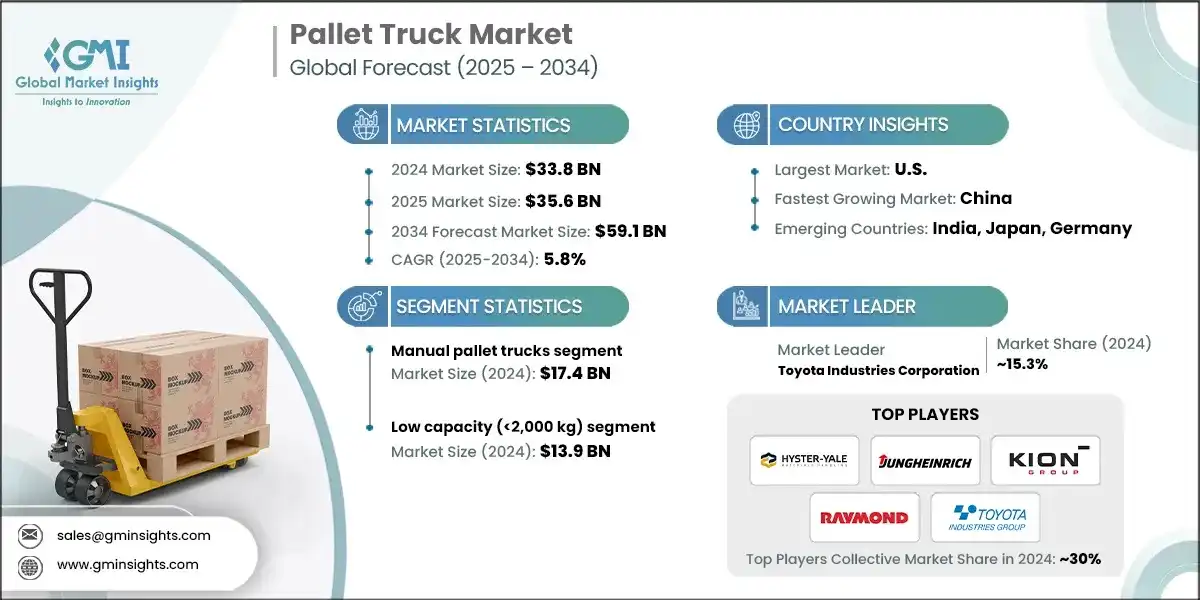
The global pallet truck market was estimated at USD 33.8 billion in 2024. The market is expected to grow from USD 35.6 billion in 2025 to USD 59.1 billion in 2034, at a CAGR of 5.8%, according to latest report published by Global Market Insights Inc.
To get key market trends
The global pallet truck market is experiencing a fundamental transformation driven by the convergence of warehouse automation, labor market pressures, and technological advancement across material handling operations. The sector encompasses manual pallet jacks, electric pallet trucks, and increasingly sophisticated automated guided vehicles (AGVs) that serve as the backbone of modern logistics infrastructure. Labor shortages have emerged as a critical catalyst, with 76% of supply chain and logistics operations experiencing notable workforce shortages, compelling organizations to accelerate automation adoption. This operational imperative has coincided with significant technological breakthroughs in battery technology, particularly the widespread adoption of lithium-ion systems that offer superior energy density, faster charging capabilities, and reduced maintenance requirements compared to traditional lead-acid alternatives. The Industrial Truck Association's economic impact analysis reveals that the broader industrial truck sector, which includes pallet trucks, generates $36.6 billion in total GDP impact annually in the United States alone, supporting over 257,000 jobs across manufacturing and distribution networks. Simultaneously, safety regulations have intensified operational requirements, with OSHA standards mandating enhanced workplace safety protocols that favor automated and semi-automated material handling solutions over manual alternatives. The integration of Internet of Things (IoT) technologies and telematics systems has enabled real-time fleet management, predictive maintenance capabilities, and operational analytics that optimize equipment utilization and reduce total cost of ownership across warehouse and distribution center operations.
The competitive landscape features concentrated market structure dominated by Toyota Material Handling, Crown Equipment Corporation, and Jungheinrich AG, who maintain leadership through comprehensive product portfolios and global distribution networks. Strategic acquisitions include ABB's acquisition of B&R Industrial Automation and Coesia Group's acquisition of FlexLink AB, demonstrating the importance of automation integration. Manufacturing operations have diversified geographically, with regional production facilities reducing supply chain vulnerabilities. Competition intensifies around technological differentiation, particularly autonomous navigation systems, advanced battery management, and warehouse management system integration. European manufacturers emphasize sustainability and energy efficiency as key differentiators, aligning with environmental regulations. Robotics specialists like KUKA, Fanuc, and ABB introduce competitive pressures through integrated automation solutions complementing traditional pallet truck operations.
Regional dynamics reveal distinct demand patterns reflecting economic and industrial development trends. Asia-Pacific emerges as fastest-growing region, driven by rapid industrialization in China, India, and Southeast Asia, where manufacturing expansion creates substantial material handling equipment demand. China dominates as the world's largest machinery exporter with $1.72 trillion annually, while the United States represents the largest import market at $916 billion, reflecting strong domestic e-commerce and warehouse modernization demand. European markets lead sustainability-focused innovations, with the EU's Manufacturing-X initiative promoting digital transformation across manufacturing sectors. The U.S. Material Handling Equipment Manufacturing sector generates over $30 billion annually, representing 15-20% of total material handling consumption. Supply chain regionalization accelerates following global disruptions, with manufacturers establishing closer-to-market production facilities. Trade patterns indicate growing South-South commerce, with emerging economies in Latin America, Southeast Asia, and Africa representing new growth frontiers.
The future growth trajectory is shaped by sustainability imperatives, regulatory evolution, and Industry 4.0 technology adoption across global manufacturing and logistics operations. Environmental regulations drive demand for energy-efficient electric pallet trucks with optimized battery management and regenerative braking technologies. China's Guidelines for Digital Transformation exemplify policy support for digitalization initiatives encompassing material handling equipment integration. Workplace safety standards favor automated solutions reducing manual lifting injuries. The Material Handling Industry Association's ANSI MH30 series specifications provide regulatory frameworks shaping product development. Equipment-as-a-service business models transform procurement approaches, favoring operational expenditure models with maintenance and performance guarantees. UNIDO data shows regional manufacturing variations, with China (+1.3%), India (+1.3%), and Malaysia (+2.7%) demonstrating stronger growth supporting material handling equipment demand. The convergence of AI, robotics, and sustainable manufacturing positions the industry toward intelligent, connected, environmentally responsible material handling solutions.
Pallet Truck Market Report Attributes
| Key Takeaway | Details |
|---|---|
| Market Size & Growth | |
| Base Year | 2024 |
| Market Size in 2024 | USD 33.8 Billion |
| Market Size in 2025 | USD 35.6 Billion |
| Forecast Period 2025 - 2034 CAGR | 5.8% |
| Market Size in 2034 | USD 59.1 Billion |
| Key Market Trends | |
| Drivers | Impact |
| Increasing demand for material handling equipment | Boosts global adoption of pallet trucks across manufacturing, logistics, and retail sectors to improve operational efficiency and reduce manual labor. |
| Expansion of the warehouses and distribution centers | Drives sustained demand for pallet trucks as essential tools for inventory movement and space optimization in large-scale storage facilities worldwide. |
| Pitfalls & Challenges | Impact |
| High initial costs associated with advanced electric and automated pallet trucks | Limits adoption among small and mid-sized enterprises, slowing market penetration of next-generation pallet handling technologies. |
| Availability of alternative material handling equipment | Intensifies competition and reduces demand for pallet trucks in sectors opting for forklifts, conveyors, or AGVs based on operational needs. |
| Opportunities: | Impact |
| Electrification and Automation Integration | Accelerates market growth by enabling safer, more efficient, and labor-saving operations, especially in high-throughput logistics and manufacturing environments. |
| Expansion in Emerging Economies | Opens new revenue streams as industrialization and infrastructure development in regions like Asia, Africa, and Latin America increase demand for affordable and scalable pallet handling solutions. |
| Market Leaders (2024) | |
| Market Leaders |
Market share of ~15.3% |
| Top Players |
Collective market share in 2024 ~30% |
| Competitive Edge |
|
| Regional Insights | |
| Largest Market | U.S. |
| Fastest Growing Market | China |
| Emerging Country | India, Japan, Germany |
| Future Outlook |
|
What are the growth opportunities in this market?
Pallet Truck Market Trends
- The transition from lead-acid to lithium-ion battery technology represents a fundamental shift driven by operational efficiency demands and total cost of ownership optimization across the entire pallet truck value chain. Raw material suppliers face unprecedented demand volatility, with lithium carbonate prices experiencing extreme fluctuations from $5,000 per ton in early 2020 to peaks exceeding $70,000 per ton in 2022, before stabilizing around $15,000-20,000 per ton, while cobalt and nickel markets similarly experience supply chain constraints and price volatility that directly impact battery cost structures. Manufacturers are responding by redesigning equipment architectures to accommodate lithium-ion systems, with companies like Crown and Toyota Material Handling investing heavily in battery management systems and charging infrastructure, while simultaneously securing long-term supply agreements with battery manufacturers to mitigate raw material price volatility. Distributors are transforming their service capabilities, requiring significant investments in technician training for lithium-ion maintenance, establishing charging infrastructure at customer sites, and developing new financing models that account for higher upfront costs but lower lifetime maintenance requirements. End-users are driving this transition through demands for reduced maintenance costs, faster charging cycles, and improved productivity, with lithium-ion systems offering up to 3,000 charge cycles compared to 1,500 for lead-acid, while providing consistent power output throughout the discharge cycle that maintains equipment performance. Final beneficiaries experience improved operational reliability, reduced workplace emissions, and enhanced safety through elimination of battery watering requirements and acid spill risks, while achieving energy cost reductions of 20-30% through improved charging efficiency and reduced HVAC requirements for battery charging areas.
- The integration of autonomous and semi-autonomous capabilities into pallet truck systems is fundamentally reshaping the value chain, driven by acute labor shortages affecting 76% of supply chain operations and the need for consistent operational performance. Raw material suppliers are adapting to increased demand for specialized components including LiDAR sensors, advanced microprocessors, and high-precision actuators, with semiconductor demand for industrial automation applications growing significantly, while suppliers invest in cleanroom facilities and precision manufacturing capabilities to meet automotive-grade quality requirements for autonomous systems. Manufacturers are fundamentally restructuring their product development processes, with companies like KUKA, Fanuc, and ABB investing billions in R&D for autonomous material handling systems, while traditional pallet truck manufacturers like Jungheinrich and Crown are forming strategic partnerships with robotics companies to integrate autonomous navigation, obstacle avoidance, and fleet coordination capabilities into their product lines. Distributors are evolving from equipment sellers to solution integrators, requiring substantial investments in systems integration capabilities, software expertise, and ongoing technical support infrastructure, while developing new service models that include system commissioning, software updates, and performance optimization services that generate recurring revenue streams. End-users are experiencing operational transformation through predictable labor costs, 24/7 operational capability, and productivity improvements of 20-40% in material handling operations, while achieving safety improvements through elimination of human error in repetitive tasks and consistent adherence to safety protocols. Final beneficiaries realize improved service levels through more consistent and reliable material handling operations, reduced product damage from human error, and enhanced workplace safety that reduces insurance costs and regulatory compliance risks, while achieving improved inventory accuracy through integrated tracking systems.
Pallet Truck Market Analysis
Learn more about the key segments shaping this market
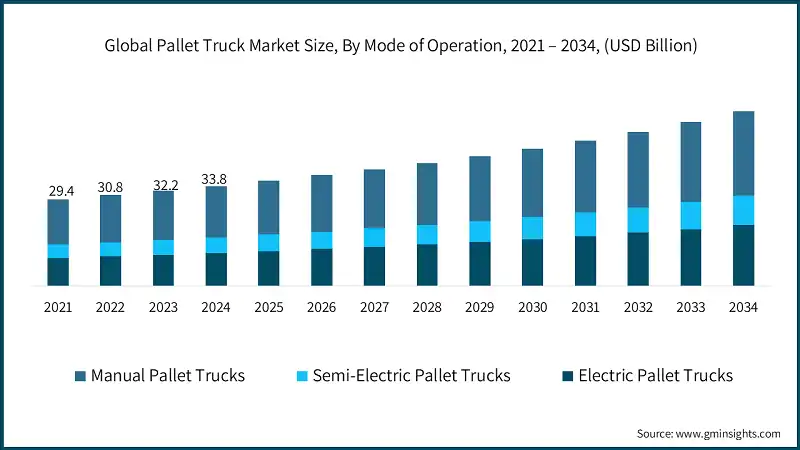
Based on mode of operation, the market is segmented into manual pallet trucks, semi-electric pallet trucks and electric pallet trucks. The manual pallet trucks segment generated USD 17.4 billion revenue in 2024 and is expected to grow at a CAGR of around 5.1% during 2025 to 2034.
- The dominance of manual pallet trucks in the market by mode of operation can be attributed primarily to their cost-effectiveness and simplicity. Manual pallet trucks are significantly cheaper than electric or semi-electric variants, making them an attractive option for small and medium-sized enterprises (SMEs) and operations with limited budgets. Their straightforward design requires minimal maintenance and no complex training, which further reduces operational costs. In regions where labor costs are relatively low, manual pallet trucks offer a practical and economical solution for material handling.
- Another key factor is their versatility and ease of use in diverse environments. Manual pallet trucks are compact and maneuverable, making them ideal for tight warehouse spaces, retail backrooms, and small-scale distribution centers. Unlike electric models that may require charging infrastructure or specific operating conditions, manual pallet trucks can be used immediately and in virtually any setting. This flexibility makes them especially popular in developing markets and industries with variable operational needs, such as food retail, logistics, and manufacturing.
- Lastly, low maintenance and durability contribute to their sustained market preference. Manual pallet trucks have fewer mechanical and electronic components, which translates to lower chances of breakdown and longer service life. Their rugged construction allows them to withstand rough handling and harsh conditions, making them a reliable choice for businesses seeking long-term value. Even in larger operations that use automated systems, manual pallet trucks often serve as essential backup or supplementary tools, reinforcing their widespread adoption across the market.
Learn more about the key segments shaping this market
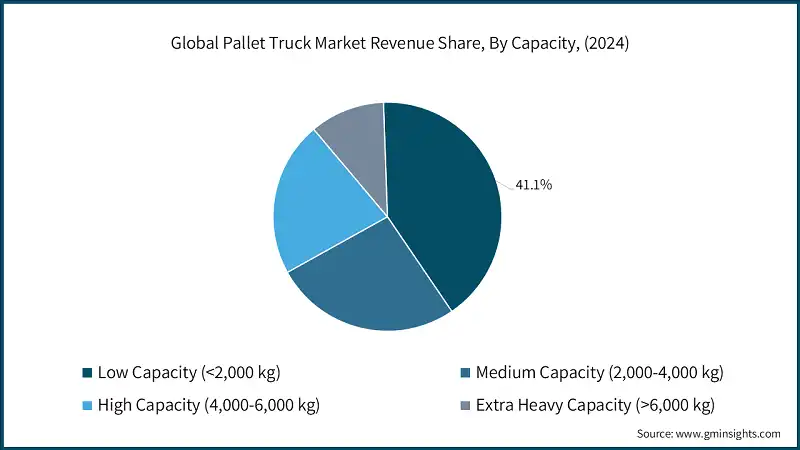
The pallet truck market by capacity is segmented into low capacity (<2,000 kg), medium capacity (2,000-4,000 kg), high capacity (4,000-6,000 kg), and extra heavy capacity (>6,000 kg). The low capacity (<2,000 kg) segment was the leading segment in 2024 with a revenue of USD 13.9 billion and has a market share of around 41.1%.
- The dominance of the low capacity segment is primarily due to its widespread use in retail, small warehouses, and light industrial settings where heavy-duty handling is not required. These pallet trucks are cost-effective, easy to operate, and ideal for short-distance transport of lighter goods, making them highly accessible for small and medium enterprises (SMEs) and businesses with limited space or budget constraints.
- Additionally, the surge in e-commerce and last-mile delivery operations has increased demand for compact and maneuverable pallet trucks that can operate efficiently in tight spaces. Low capacity models are particularly suited for these environments, offering flexibility and speed without the need for complex infrastructure or high maintenance, which further boosts their adoption across urban logistics and distribution centers.
- Manufacturers have also focused on enhancing the ergonomics and energy efficiency of low capacity pallet trucks, including electric variants with lithium-ion batteries and smart control systems. These innovations have made them more attractive to businesses seeking affordable automation solutions, reinforcing their market leadership amid growing competition and evolving operational needs.
Looking for region specific data?
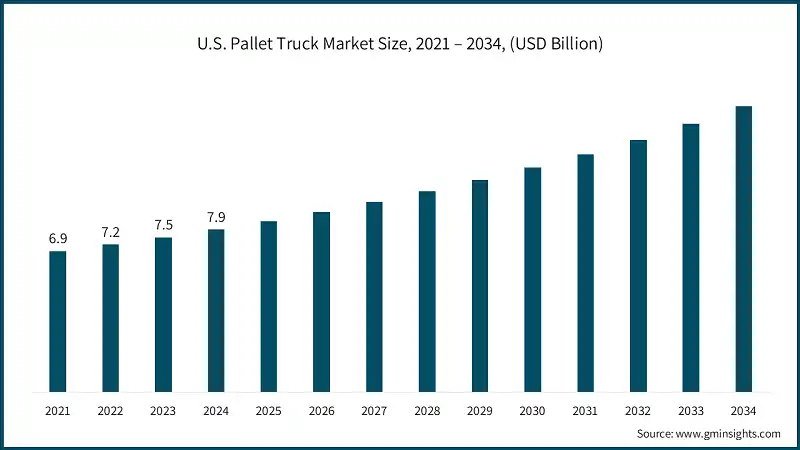
The U.S. pallet truck market was valued at around USD 7.9 billion in 2024 and is anticipated to register a CAGR of 5.9% between 2025 and 2034.
- The U.S. market is demonstrating strong demand, primarily driven by the rapid expansion of the warehousing and storage sector. According to the U.S. Bureau of Labor Statistics, employment in warehousing reached 1.83 million workers in August 2025, with over 322,000 industrial truck and tractor operators actively engaged in material handling operations. This surge reflects the growing need for efficient pallet movement solutions in logistics hubs, retail distribution centers, and e-commerce fulfillment facilities. The rise in labor-intensive operations has made pallet trucks essential for streamlining workflows and reducing manual strain, especially in high-volume environments.
- Additionally, the U.S. machinery and equipment industry, particularly material handling equipment has seen robust growth, supported by over 1.1 million jobs in mid-2024. The integration of automation and electrification in pallet trucks aligns with broader industrial trends toward productivity enhancement and workplace safety. With the U.S. continuing to lead in e-commerce and freight movement, as highlighted by the Bureau of Transportation Statistics, the demand for pallet trucks is expected to remain strong, especially as businesses invest in scalable and sustainable logistics infrastructure.
Europe witnessed promising demand in the pallet truck market, with a share of around 25.7% in 2024 and is expected to grow at a robust CAGR of 5.5% during the forecast period.
- Europe is demonstrating strong demand in the pallet truck industry, primarily driven by the expansion of warehousing and logistics infrastructure across key economies. According to Eurostat, road freight transport in the EU reached over 13.1 billion tons in 2024, with Germany, Poland, and Spain leading in volume. This surge in freight movement has intensified the need for efficient material handling solutions, including pallet trucks, to support high-throughput operations in distribution centers and retail hubs. Additionally, countries like Poland and France are experiencing significant warehouse development, with nearly 2 million sqm and 1.8 million sqm of space under construction respectively, indicating robust demand for handling equipment.
- Moreover, the EU’s push toward digitalization and sustainability in logistics is encouraging the adoption of electric and automated pallet trucks. The European Commission’s logistics sector analysis highlights megatrends such as process automation, nearshoring, and data-driven operations as key drivers of transformation. These trends are reshaping supply chain strategies and increasing the need for agile, low-emission material handling equipment. With rising freight volumes and evolving operational requirements, Europe is positioned as a high-potential market for pallet truck manufacturers focused on innovation and compliance with EU sustainability standards.
Asia Pacific is fastest growing as well as leading the market at a growth rate of 6.3% during the forecast period.
- Asia Pacific is demonstrating the fastest-growing demand in the pallet truck market, driven by rapid e-commerce expansion, industrialization, and infrastructure development across key economies. According to the International Trade Administration, the region’s e-commerce market is projected to exceed USD 28.9 trillion by 2026, growing at an average annual rate of 15%, outpacing global averages. This surge is fueling demand for efficient material handling solutions, including pallet trucks, to support high-volume logistics operations in countries like China, India, Indonesia, and Vietnam. Additionally, Southeast Asia’s internet economy is forecast to grow from USD 194 billion to over USD 330 billion by 2025, with Indonesia alone contributing over USD 82 billion, further accelerating warehouse and distribution center expansion.
- The region also dominates the global pallet truck market due to its manufacturing capacity, labor force scale, and increasing automation adoption. For instance, Japan’s material handling equipment market reached USD 4.5 billion in 2023, with consistent growth projected due to automation needs and labor shortages. Regulatory changes, such as Japan’s 2024 labor reforms limiting fleet driver working hours, have further boosted demand for automated pallet handling systems. Asia Pacific’s strategic role in global supply chains, combined with its investment in smart logistics and warehouse technologies, positions it as both the fastest-growing and most influential region in shaping the future of the pallet truck industry.
Pallet Truck Market Share
- The top 5 companies in the pallet truck industry, such as Hyster-Yale, Jungheinrich AG, KION Group, The Raymond Corporation, and Toyota Industries Corporation, collectively hold a market share of 30%.
- Hyster-Yale is undergoing a strategic transformation by realigning its Nuvera fuel cell business to focus on battery-powered solutions and modular charging platforms. This pivot reflects a pragmatic response to slow fuel cell adoption and rising demand for electrified material handling equipment. The company is investing in lithium-ion battery modules, mobile charging systems (HydroCharge), and scalable energy platforms to support electric forklift growth. By consolidating operations and leveraging technical synergies, Hyster-Yale expects to achieve USD 25-35 million in annual cost savings and accelerate product development, positioning itself as a key player in warehouse electrification and off-grid logistics solutions.
- Jungheinrich is executing its Strategy 2030+, aiming to become a €10 billion revenue company with 10% EBIT ROS by 2030. The strategy focuses on global expansion, especially in North America and APAC, and deep investment in automation, AI, and mid-tech industrial trucks. Strategic acquisitions like Magazino and EP Equipment are enhancing its robotics and lithium-ion capabilities, while its DEEP (Digital End-to-End Processes) initiative is streamlining operations. Jungheinrich’s multi-channel sales model and sustainability leadership (top 1% globally) enable it to outperform competitors in both high-tech and cost-sensitive markets.
- KION Group is leveraging its multi-brand strategy and global footprint to dominate both the forklift and warehouse automation segments. Its “Playing to Win” strategy emphasizes automation, sustainability, and regional production expansion, particularly in APAC and the Americas. Strategic alliances with NVIDIA and Accenture are driving AI-powered supply chain optimization, including digital twins and smart robotics. With over USD 11 billion in revenue and a goal to exceed 10% EBIT margin by 2027, KION is investing in AGVs, AMRs, and AI control towers to stay ahead of market shifts and labor shortages.
Pallet Truck Market Companies
Major players operating in the pallet truck industry are:
- Anhui Heli
- CLARK
- Crown Equipment Corporation
- CUBLIFT
- Hangcha
- Howard Handling
- HU-LIFT
- Hyster-Yale
- Jungheinrich AG
- KION Group
- Nantong Allman Industry
- Noblelift
- The Raymond Corporation
- Toyota Industries Corporation
- Vestil Manufacturing Corp.
Raymond, a Toyota Industries subsidiary, is leading innovation through its iWAREHOUSE ObjectSense system, which won the 2025 “Material Handling Innovation of the Year” award. This technology enhances operator safety and warehouse efficiency via real-time object detection, dynamic alerts, and actionable data insights. Raymond’s scalable solutions, including VR training, lithium-ion batteries, and telematics, are tailored for modern logistics challenges. Its integration with Toyota Material Handling North America (TMHNA) creates USD 150 million in synergy potential, expanding reach across 120+ locations and reinforcing its position in intelligent, connected pallet truck systems.
Toyota Industries maintains its global leadership in lift truck unit sales by offering a comprehensive value chain from in-house development of electric, fuel cell, and autonomous trucks to integrated logistics solutions. Its strategy emphasizes electrification, automation, and sustainability, with recent launches of lithium-ion powered forklifts and AGVs tailored for high-efficiency operations. Toyota’s global production and service network, combined with its brands like BT, Raymond, and CESAB, enables it to meet diverse customer needs while driving innovation in carbon-neutral and autonomous logistics systems.
Pallet Truck Market News
- In October 2025, Toyota Material Handling UK highlighted the growing demand for its Toyota Lifter hand pallet trucks, emphasizing their role in supporting efficient, safe, and cost-effective material handling across retail and industrial sectors. The company’s focus on ergonomic design, durability, and ease of maintenance has positioned its hand pallet trucks as a preferred choice for businesses seeking reliable solutions for short-distance load movement. With increasing pressure on operational efficiency and workplace safety, Toyota’s continued investment in product quality and nationwide support services reinforces its competitive edge in the UK pallet truck market.
- In September 2025, Jungheinrich launched its new AME series of pallet trucks in Australia, designed to meet the growing demand for compact, efficient, and ergonomic material handling solutions. The AME models feature enhanced maneuverability, low maintenance requirements, and energy-efficient performance, making them ideal for retail, warehousing, and light industrial applications. This product launch reflects Jungheinrich’s commitment to expanding its footprint in the Asia-Pacific region and addressing evolving customer needs with innovative, user-friendly equipment.
- In August 2025, Chinese material handling equipment manufacturer Noblelift signed an exclusive dealership agreement with Bakheet Company for Machinery in Saudi Arabia, marking a strategic move to expand its footprint in the Kingdom’s pallet truck and forklift market. While the deal excludes Noblelift’s aerial work platforms, it covers most of its other product lines, including lithium-powered solutions and internal combustion forklifts. This partnership supports Saudi Vision 2030 by promoting industrial development, supply chain efficiency, and environmental sustainability, and is expected to drive innovation and growth in the region’s logistics and warehousing sectors.
- In July 2025, Crown launched its new WJ 50 Series electric pedestrian pallet truck, designed to enhance efficiency and maneuverability in confined warehouse spaces. Weighing just 159.5kg for the 1.2-tonne model and 162.5kg for the 1.5-tonne version, the compact truck features a 370mm head length and a 1,319mm turning radius. Equipped with a V-Force 48V lithium-ion battery system offering up to 39% lower energy consumption than market averages, the WJ 50 Series includes four battery options and an ergonomic control handle for precise, one-handed operation. The model has received positive feedback for its robust design, intuitive controls, and suitability for demanding material handling applications.
The pallet truck market research report includes in-depth coverage of the industry, with estimates & forecasts in terms of revenue (USD Billion) and volume (Thousand Units) from 2021 to 2034, for the following segments:
Market, By Product Type
- Hand Pallet Trucks
- Walkie Pallet Trucks
- Rider Pallet Trucks
- High-Lift Pallet Trucks
- Scissor Lift Pallet Trucks
- Others (Straddle Pallet Trucks, etc.)
Market, By Mode of Operation
- Manual Pallet Trucks
- Semi-Electric Pallet Trucks
- Electric Pallet Trucks
Market, By Capacity
- Low Capacity (<2,000 kg)
- Medium Capacity (2,000-4,000 kg)
- High Capacity (4,000-6,000 kg)
- Extra Heavy Capacity (>6,000 kg)
Market, By Application
- Warehousing and Distribution Centers
- Manufacturing Facilities
- Retail and E-commerce Operations
- Transportation and Logistics
- Others (Construction, Agriculture, etc.)
Market, By Distribution Channel
- Direct sales
- Indirect sales
The above information is provided for the following regions and countries:
- North America
- U.S.
- Canada
- Europe
- Germany
- U.K.
- France
- Italy
- Spain
- Netherlands
- Asia Pacific
- China
- Japan
- India
- South Korea
- Australia
- Latin America
- Brazil
- Mexico
- Argentina
- MEA
- UAE
- Saudi Arabia
- South Africa
Frequently Asked Question(FAQ) :
What is the market size of the pallet truck in 2024?
The market size was USD 33.8 billion in 2024, with a CAGR of 5.8% expected through 2034 driven by warehouse automation, labor shortages, and advancing material handling technologies.
What is the projected value of the pallet truck market by 2034?
The pallet truck market is expected to reach USD 59.1 billion by 2034, propelled by electrification trends, automation integration, and expanding warehousing infrastructure across developed and emerging economies.
What is the current pallet truck market size in 2025?
The market size is projected to reach USD 35.6 billion in 2025.
How much revenue did the manual pallet trucks segment generate in 2024?
Manual pallet trucks generated USD 17.4 billion in 2024, led by cost-effectiveness, simplicity, and versatility across diverse environments.
What was the valuation of low capacity (<2,000 kg) segment in 2024?
Low capacity segment held around 41.1% market share and generated USD 13.9 billion in 2024, fueled by widespread use in retail, small warehouses, and e-commerce operations.
What is the growth outlook for Asia Pacific region from 2025 to 2034?
Asia Pacific is the fastest-growing region, projected to grow at a CAGR of 6.3% till 2034, supported by rapid e-commerce expansion, industrialization, and infrastructure development across China, India, and Southeast Asia.
Which region leads the pallet truck market?
The U.S. held the largest market position with USD 7.9 billion in 2024 and is anticipated to grow at a CAGR of 5.9%. Strong warehousing expansion and e-commerce growth fuel the region's dominance.
What are the upcoming trends in the pallet truck market?
Key trends include transition from lead-acid to lithium-ion battery technology, integration of autonomous and semi-autonomous capabilities, IoT and telematics for fleet management, and equipment-as-a-service business models.
Who are the key players in the pallet truck market?
Key players include Anhui Heli, CLARK, Crown Equipment Corporation, CUBLIFT, Hangcha, Howard Handling, HU-LIFT, Hyster-Yale, Jungheinrich AG, KION Group, Nantong Allman Industry, Noblelift, The Raymond Corporation, Toyota Industries Corporation, and Vestil Manufacturing Corp.
Pallet Truck Market Scope
Related Reports