Summary
Table of Content

Packaging Equipment for Agricultural Products Market
Get a free sample of this report
Form submitted successfully!
Error submitting form. Please try again.
Thank you!
Your inquiry has been received. Our team will reach out to you with the required details via email. To ensure that you don't miss their response, kindly remember to check your spam folder as well!
Request Sectional Data
Thank you!
Your inquiry has been received. Our team will reach out to you with the required details via email. To ensure that you don't miss their response, kindly remember to check your spam folder as well!
Form submitted successfully!
Error submitting form. Please try again.
Packaging Equipment for Agricultural Products Market Size
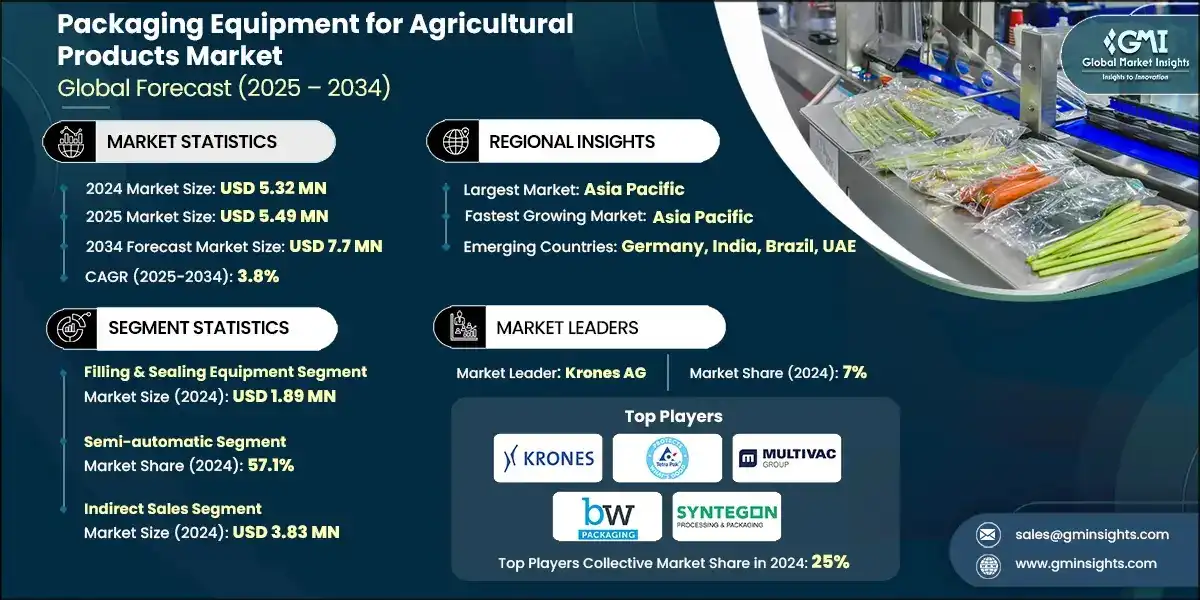
The global packaging equipment for agricultural products market was estimated at USD 5.32 million in 2024. The market is expected to grow from USD 5.49 million in 2025 to USD 7.7 million in 2034, at a CAGR of 3.8%, according to latest report published by Global Market Insights Inc.
Packaging Equipment for Agricultural Products Market Key Takeaways
Market Size & Growth
- 2024 Market Size: USD 5.32 Million
- 2025 Market Size: USD 5.49 Million
- 2034 Forecast Market Size: USD 7.7 Million
- CAGR (2025–2034): 3.8 %
Regional Dominance
- Largest Market: Asia Pacific
- Fastest Growing Region: Asia Pacific
Key Market Drivers
- Automation & smart packaging integration.
- Diversification into agrochemicals & specialty products.
- Sustainability-driven equipment demand.
Challenges
- High capital costs & ROI pressure.
- Supply chain volatility.
Opportunity
- Smart packaging equipment.
- Eco-friendly packaging lines.
Key Players
- Market Leader: Krones AG led with over 7% market share in 2024.
- Leading Players: Top 5 players in this market include Krones AG, Tetra Pak, MULTIVAC Group, BW Packaging, Syntegon Technology, which collectively held a market share of 25% in 2024.
Get Market Insights & Growth Opportunities
The packaging equipment for agriculture is becoming more efficient and consistent with automated systems in place. These systems aid in filling, sealing, or labeling with automated functions that reduce labor reliance, decrease human error, and increase throughput for larger scale operations. The addition of smart packaging adds further value to the process with features like QR codes, RFID tags, and freshness indicators. These technologies allow for increased traceability, help with improved food safety compliance, and provide real-time data for inventory control, making them appeal to exporters and suppliers of premium produce.
Growing consumer demand for transparency and quality assurance is also contributing to the influence of automation and smart packaging. As food safety regulations become stricter across the world, food producers are investing in machinery that can enable both digital monitoring, as well as predictive maintenance. This trend not only enhances operational reliability, but it allows for the possibilities of data-informed insights, thereby allowing farms and food processors to streamline packaging efficiency and reduce waste levels. Firms that provide modular solutions built on IoT will gain competitive advantages in this changing environment.
The market for agricultural packaging equipment is growing beyond foodstuffs and into specialized and agrochemical goods, such as fertilizers, pesticides, and soil conditioning materials. These products require specific packaging solutions ensuring leak-proof containment, tamper evidence, and compliance with hazardous materials regulations. Equipment for intermediate bulk containers (IBCs), flexible bulk bags, and high-barrier packaging formats has increased in-demand and presents a profitable niche for manufacturers that meet the imposed regulations.
The diversification into specialty products also coincides with the increasing mechanization of agriculture and the growing global use of crop protection chemicals. As sustainability and safety concerns grow, producers demand packaging systems that minimize the impact on the environment while maintaining the integrity of the product and limiting spillage. This information indicates that equipment suppliers can innovate new advanced sealing technology, automatic dosing, and compatible sustainability materials to position themselves as a partner in the agriculture supply chain.
To get key market trends
Packaging Equipment for Agricultural Products Market Trends
The agricultural product packaging equipment market is evolving in the face of changing technology, sustainability requirements and consumer preferences. Companies are emphasizing automation, sustainable materials and smart or intelligent packaging solutions in all aspects of the market to meet global food safety and supply chain efficiency standards. Complementing the movement of agrochemicals and specialty products, the demand for flexible and modular systems will form the future competitive landscape, especially in developing markets.
- Automation is changing agricultural packaging by getting rid of manual processes with speed and precision. Robotic arms can sort, fill and palletize consistently and remove the reliance on seasonal labor, which can be difficult to depend on. Automated lines provide ag producers with the ability to scale and manage large quantities of products depending on the season. Automation continues to be the biggest shift in agricultural packaging.
- With environmental issues and regulatory requirements driving the market toward sustainable packaging materials, including biodegradable films, compostable trays, and recyclable mono-materials, it offers no surprise that these eco-materials have different properties of sealing and barrier than traditional plastics, requiring special machines. Those who have developed a machine that can process a variety of eco-materials will become a real contender in the market.
- Smart packaging technologies, including QR code labels, RFID tags and freshness indicators are on the rise as consumers and regulators are pushing for more transparency and traceability. Internet of Things (IoT) packaging equipment can monitor conditions products are subjected to in real time to comply safety guidelines and reduce spoilage. Market diversification creates new revenue pathways for packaging machine manufacturers, particularly for that capable and knowledgeable workforce that can design and build automation and sustainable features into specialized equipment that will package hazardous or sensitive materials.
- The market has extended beyond food packaging into agrochemicals such as fertilizers, pesticides, and soil conditioners, and all these materials require sturdy, leak-proof, and tamper-evident packaging in line with safety and regulatory requirements. There is increasing demand for equipment that can package products and ingredients in intermediate bulk containers (IBCs), flexible bulk bags or for other high-barrier formats.
Packaging Equipment for Agricultural Products Market Analysis

Learn more about the key segments shaping this market
Based on equipment type, the market is divided into filling & sealing equipment, sorting & grading equipment, bagging & packaging lines, weighing and portioning systems, and palletizing and wrapping equipment. In 2024, filling & sealing equipment held the major market share, generating a revenue of USD 1.89 million.
- Modern filling and sealing machinery are built for accurate and precise product dosing of grains, seeds, powders, and liquids with minimal waste and high-quality packaging. Heightened systems utilize servo-driven technology and weight-based controls to maintain accuracy at some of the highest speeds possible. Accuracy is crucial for regulatory compliance and material loss avoidance, especially in bulk agricultural operations.
- Filling and sealing machinery intended for agricultural products typically features stainless-steel frames, smooth surfaces, and easy sanitation for food safety compliance. A hygienic design prevents contamination and allows for rapid sanitation during product changeover. These features are most crucial for packaging fresh produce, seeds, and organic products wherein sanitary conditions are a matter of compliance.
- Current machinery can flexibly run a variety of packaging configurations, including bags, pouches, or sacks, on a single unit. The addition of weighing devices, labeling equipment, and palletizing devices creates a fully integrated packaging line that minimizes human handling and increases efficiency. This flexibility enables producers to process a multitude of agricultural products and respond to varying market behavior.

Learn more about the key segments shaping this market
Based on operation, the packaging equipment for agricultural products market is segmented into manual, semi-automatic, and automatic. The semi-automatic segment held the largest share, accounting for 57.1% of the global market in 2024.
- Semi-automatic packaging machinery also offers producers a more cost-effective option. The semi-automatic packaging configurations offer a middle ground for small and medium sized agricultural businesses that need an option more affordable than fully automated machinery system. The semi-automatic packaging machinery allows producers to reduce their labor demand but allows for flexibility in their production, allowing significant increases in production volume without significant capital investment. The semi-automatic machinery configuration balances manual handling within the agricultural business with production automation while providing better return on investment for businesses with limited budgets.
- The semi-automatic systems are adaptable and can fill multiple products grains, seeds, fertilizers, and powders without long changeover time. The operator simply adjusts product specifications or bag sizes accordingly. As a result, semi-automatic machines easily cater to farms and cooperatives that sell various agricultural products. Furthermore, semi-automatic systems can handle changes in customer order volume or seasonal demand with minimal downtime.
- Semi-automated equipment often has easier interfaces with fewer moving parts and therefore requires less technical skill to operate than fully automated lines or conveyors. Preventative maintenance is easier and less expensive and can even remain active without completely shutting down an entire facility. Semi-automated systems can be especially compelling in areas where access to skilled labor in limited.
Based on distribution channel, the packaging equipment for agricultural products market is segmented into direct sales and indirect sales. In 2024, indirect sales held a major market share, generating a revenue of USD 3.83 million.
- Indirect sales channels enable manufacturers to tap into regional distributors and dealers to reach markets that are difficult to directly reach. This is particularly useful in emerging economies where distributors have established relationships with agricultural companies and are familiar with regional market conditions. Therefore, it allows companies to expand into regions without having to create a network or duplicate infrastructure.
- Using indirect channels enables manufacturers to reduce the challenges associated with logistics, after-sales service, and compliance across regions. The burden of logistics, installation, training, and maintenance often falls to the distributor, giving the manufacturer the freedom to focus on product innovation and core business functions. Local distributors can also provide local solutions for customers and respond to their needs more rapidly, with an overall improvement in service quality. Local distributors can also modify levels of marketing, pricing, and technical support to local conditions, which can enhance customer satisfaction and build trust.
Looking for region specific data?
North America Packaging Equipment for Agricultural Products Market
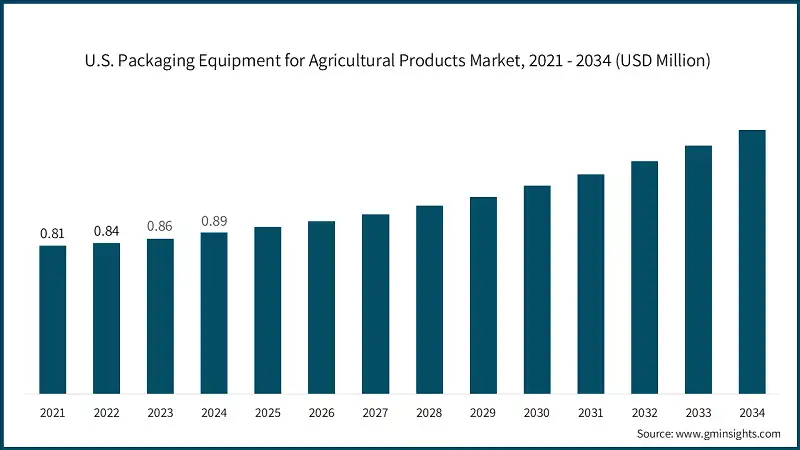
In 2024, the U.S. dominated the North America market, accounting for around 78.2% and generating around USD 0.89 million revenue in the same year.
- The agricultural packaging equipment market in the U.S. is experiencing significant sophistication, mostly driven by extensive agribusinesses and robust government policies governing food safety and sustainability. Automation is pervasive, and both farms and processors are investing into high-speed filling and sealing machines along with palletizing equipment, all of which offer the necessary speed and compliance. There is a rapid growth of interest in smart packaging technologies related to farm produce, including incremental costs attributed to RFIDs for traceability or other related freshness indicators, especially among exporters or high-end producers of produce products.
- The North American region consists of the U.S., and Canada which are technologically advanced and produce a variety of agricultural commodities. The U.S. is the leader in automation, using smart packaging, but Canada tries to capitalize on sustainability and strict environmental laws. The North American region has good infrastructure, a strong supply chain, and large investments in digital technologies, contributing to its status as a center of innovation in packaging equipment.
Europe Packaging Equipment for Agricultural Products Market
Europe market, France leads the market with 17.3% share in 2024 and is expected to grow at 4% during the forecast period.
- Europe is one of the most advanced and established markets for agricultural packaging machinery, driven by food safety regulations and sustainability requirements. The agricultural sector in Europe prioritizes quality packaging for grains, seeds, fresh fruits and vegetables, and processed foods. As a result, the sectors are looking for automated processes and sustainable solutions to fulfill those demands. Germany, Italy, and France are frontrunners in incorporating machinery that is enabled with Industry 4.0 capabilities that allow for use of robotics, IoT, and smart labeling systems to improve traceability and meet EU standards.
- The European agricultural packaging equipment market is characterized by its advanced technological capability and well-developed regulatory framework. The region has well-established food processing and packaging infrastructure supported by some of the world's largest manufacturers in countries such as Germany and Italy. Equipment in this market often focuses on accuracy, hygiene, and adherence to strict EU requirements, with advanced automation and digital monitoring being commonplace. Furthermore, sustainability is an integral aspect of the market, with many companies adopting sustainable components and energy-efficient machines.
Asia Pacific Packaging Equipment for Agricultural Products Market
The Asia Pacific leads the packaging equipment for agricultural products industry, China leads with market share of around 29.6% in 2024 and is anticipated to grow with a CAGR of around 4.4% from 2025 to 2034.
- The agricultural packaging equipment industry worldwide is chiefly represented by the Asia-Pacific region, where demand for these products is fueled by significant agricultural output and quickening industrialization. A variety of Asian countries, including China, India, Japan, among others, spend significantly to implement new packaging technology into their existing large-scale agricultural production and food production for onward exports. Government agencies across the region promote both food safety and mechanization through active participation in the food packaging industry. Urban markets move toward increasing consumer purchasing of packaged and processed agricultural products, while the increasingly favorable productivity and cost-competitive manufacturing give APAC the edge as the fastest growing area for the packaging equipment industry.
- The APAC Market includes both developed economies with high-tech packaging lines and developing economies that rely primarily on semi-automatic systems. As infrastructure develops and foreign investments increase in this region, technology continues to advance. Environmental sustainability is becoming increasingly important for manufacturers, and equipment is being developed to run on biodegradable films and recyclable substrates to meet the environmental regulations found throughout industry. Additionally, due to the diversity of agriculture in the region, from grains and seeds to fresh produce, there will be a demand for modular, flexible packaging capable of adapting to each product's unique needs.
Latin America Packaging Equipment for Agricultural Products Market
Latin America market is growing at a CAGR of 3.3% during the forecast period.
- An emerging market for agricultural packaging equipment is present within Latin America due in part to its strong agricultural base and growing international demand for products such as grains, coffee, fruits, vegetables, etc. Modernizing packaging equipment is an investment in Brazil, Argentina, and Mexico to enhance food safety, and increase shelf-life for export. While smaller farms may largely utilize manual or semi-automatic packing systems, the growing needs for efficiency and global trade compliance are increasingly promoting more automated systems. Government initiatives for agri-business modernization, as well as foreign investment into food processing, are increasingly adopted of packaging technology.
- The market landscape for the region consists of large-scale agribusinesses and smallholder farms, leading to varied and diverse needs for packaging equipment ranging from high-volume automated lines to lower-volume modular or manual lines. While infrastructure constraints exist as challenges, and outright penetration of capital equipment will be slow, there will be opportunities to leverage existing technology to provide flexible, robust and easy to maintain equipment. Sustainability of manufacturing and packaging is increasingly important, as is the perceived benefit of sourcing eco-friendly packaging materials or equipment used in packaging formats that support recyclability or biodegradability. Regionally, Latin America’s role as an important exporter of agricultural products will guarantee demand for packaging equipment that improves quality, traceability and compliance.
Packaging Equipment for Agricultural Products Market Share
Krones AG are leading with 7% market share. Krones AG, Tetra Pak, MULTIVAC Group, BW Packaging, and Syntegon Technology collectively hold around 25%, indicating moderately fragmented market concentration. These prominent players are proactively involved in strategic endeavors, such as mergers & acquisitions, facility expansions & collaborations, to expand their product portfolios, extend their reach to a broad customer base, and strengthen their market position.
Krones is a worldwide leader in packaging and bottling system manufacturer, with its headquarters in Neutraubling, Germany. Krones AG provides integrated lines for the beverage and food industries specializing in custom packaging. Founded in 1951, Krones has complete lines that address each stage, including container making, filling, labeling, packaging, and intralogistics. Krones AG is known for its advanced process technology, sustainability practices, and digital services that improve productivity and reduce operating costs.
BW Packaging, a subdivision and part of Barry-Wehmiller Companies, is a global supplier of integrated solutions/packaging machinery for markets ranging from food to beverage, agriculture to chemicals, and more. It brings together several divisions, including BW Flexible Systems and BW Integrated Systems, under one umbrella to deliver end-to-end packaging solutions across all categories and functionality, filling, sealing, labeling, and end-of-line automated packaging.
Packaging Equipment for Agricultural Products Market Companies
Major players operating in the packaging equipment for agricultural products industry are:
- BW Packaging
- Combi Packaging Systems
- Concetti Group
- General Packer
- Haver & Boecker
- IMA Group
- Krones AG
- Landpack
- MULTIVAC Group
- Paglierani
- Premier Tech Systems & Automation
- STATEC BINDER
- Syntegon Technology
- Tetra Pak
- WOLF Packaging
Combi Packaging Systems is a major North American manufacturer of custom end-of-line packaging equipment. Combi was established in 1979 and is now a part of the SIAT Group. Combi's focus is on becoming the preferred supplier of end-of-line packaging equipment, including case erectors, tray formers, case packers, sealers, and robotic packaging systems. For industries such as food, beverage, agriculture, and e-commerce, Combi has gained recognition for the modular design of its equipment and its ability to provide tailored solutions. The company focuses on flexibility and integration while working with its customers to achieve speed, productivity, and cost efficiency through innovative automation and ergonomic hand-pack stations.
IMA Group, based in Bologna, Italy, is the world's leading designer and manufacturer of automatic machines for processing and packaging for pharmaceuticals, food, cosmetics, tea and coffee. Established in 1961, IMA has developed a reputation for technology, sustainability and active digital transformation though such initiatives as IMA Digital, and IMA ZERO. The company's range of products includes specialized machines for filling, sealing, wrapping, and end-of-line automation for sectors ranging from pharmaceutical to e-commerce.
Packaging Equipment for Agricultural Products Market Report Attributes
| Key Takeaway | Details |
|---|---|
| Market Size & Growth | |
| Base Year | 2024 |
| Market Size in 2024 | USD 5.32 Million |
| Market Size in 2025 | USD 5.49 Million |
| Forecast Period 2025 – 2034 CAGR | 3.8 % |
| Market Size in 2034 | USD 7.7 Million |
| Key Market Trends | |
| Drivers | Impact |
| Automation & smart packaging integration | By decreasing manual labor and lowering mistake incidence, Automating and integrating smart packaging is an important means to significantly increase operational performance. Traceability and compliance will also improve, resulting in packaging lines being faster and more reliable. |
| Diversification into agrochemicals & specialty products | Diversification into a broader range of agrochemicals and specialized products is a new revenue generator for equipment manufacturers. This diversification also fits the growing need for safe, leak-proof, and tamper-evident packaging for fertilizers, pesticides, and other specialized agricultural products. |
| Sustainability-driven equipment demand | The rise in sustainability also drives the equipment innovation needed to successfully manage biodegradable and recyclable materials which ultimately helps provide manufacturers with tools to meet regulatory compliance pursuant of consumer demand. |
| Pitfalls & Challenges | Impact |
| High capital costs & ROI pressure | The demand for high capital investments restricts advanced automated systems adoption among small and medium-sized producers, which has dampened the overall market penetration. |
| Supply chain volatility | Changes in the cost of raw materials and energy cause equipment prices to fluctuate, and continue to create uncertainty for manufacturers, ultimately affecting profitability. |
| Opportunities: | Impact |
| Smart packaging equipment | Smart packaging equipment offers traceability, freshness control and consumer interaction. These value-added features pertain to premium agricultural products, as well as traceability/compliance with export markets. |
| Eco-friendly packaging lines | Sustainability-compliant packaging lines provide manufacturers competitive advantages by aligning with global sustainability requirements and offering compliance benefits for years to come. |
| Market Leaders (2024) | |
| Market Leaders |
7% market share |
| Top Players |
The collective market share in 2024 is 25% |
| Competitive Edge |
|
| Regional Insights | |
| Largest market | Asia Pacific |
| Fastest growing market | Asia Pacific |
| Emerging countries | Germany, India, Brazil, UAE |
| Future outlook |
|
What are the growth opportunities in this market?
Packaging Equipment for Agricultural Products Industry News
- In November 2025, Combi Packaging Systems launched the BeeWrap+ Robotic Stretch Wrapper, created for large or heavy agricultural use to wrap products in size or weight, including fertilizer bags, bulk soil packs, and cartons of produce. The automation of the wrapping process with these devices increases the load containment of the wrapped loads and minimizes hand loading. By combining strong design with precise automation in applying the wrap to the load, BeeWrap+ also simplifies the efficiency and safety processes in agriculture supply chain handling and transport measures.
- In October 2025, BW Packaging exhibited various advanced packaging solutions at PACK EXPO Las Vegas 2025 including the Hayssen R300 Flow Wrapper and the OpView Human Machine Interface. The Hayssen R300 is designed for greater flexibility and flow-wrapping flexibility to meet the needs of numerous flexible packaging applications and products. The OpView HMI is an easy-to-use interface like a smartphone, with no traditional controls, to facilitate machine use and productivity. These products highlight BW Packaging’s core competence in creating new solutions at the intersection of advanced technology and simple, easy-to-use design.
- In September 2025, Combi Packaging Systems introduced its 2EZ-A Series Case Erectors as part of its EZ-Advantage program, to bring next-generation end-of-line packaging automation to market. The next generation of case erectors are built with a focus on speed, configurability, and reliability, making them a great fit for agricultural packing lines handling bulk produce and similar products.
- In April 2025, IMA Group launched The Vegatronic 6000 DZ vertical-form fill-seal (VFFS) machine. It is designed to run a variety of bag styles for grains, seeds and powders. It operates at speed and automatically changes-over from one bag style to another, allowing manufacturers to improve their flexibility and efficiency in agricultural packaging lines. IMA Group is clearly focused on sophisticated automation and functionality for the growing demand for increased efficiency in packaging lines for the grocery and agricultural markets.
- In March 2025, Concetti Group also launched the IPF25 Automated Seed Packaging System, a high-performance system explicitly designed for packages of seeds from 100 g to 5 kg. The system supports resealable pouches and sacks, has enhanced features supporting traceability and labelling, and has a phenomenal throughput of up to 600 bags per hour. The launch speaks to Concetti's guarantee of precision, flexibility, and capabilities for compliance within agricultural packaging to satiate the continued demand for quicker and secure seed packaging systems.
The packaging equipment for agricultural products market research report includes in-depth coverage of the industry with estimates & forecasts in terms of revenue (USD Million) and volume (Thousand Units) from 2021 to 2034, for the following segments:
Market, By Equipment Type
- Filling & sealing equipment
- Vertical form-fill-seal (VFFS)
- Horizontal form-fill-seal (HFFS) systems
- Others
- Sorting & grading equipment
- Bagging & packaging lines
- Weighing and portioning systems
- Palletizing and wrapping equipment
Market, By Operation
- Manual
- Semi-automatic
- Automatic
Market, By Application
- Fresh produce packaging
- Grain & seed processing
- Animal feed & agricultural inputs
- Others (eggs, dairy pack, etc.)
Market, By End Use
- Primary agricultural producers
- Agro & food processing facilities
- Others (agricultural cooperatives & associations, farmer-owned processing facilities, etc.)
Market, By Distribution Channel
- Direct sales
- Indirect sales
The above information is provided for the following regions and countries:
- North America
- U.S.
- Canada
- Europe
- Germany
- UK
- France
- Italy
- Spain
- Asia Pacific
- China
- India
- Japan
- Australia
- South Korea
- Latin America
- Brazil
- Mexico
- Argentina
- Middle East and Africa
- South Africa
- Saudi Arabia
- UAE
Frequently Asked Question(FAQ) :
What is the market size of the packaging equipment for agricultural products industry in 2024?
The market size was USD 5.32 million in 2024, with a CAGR of 3.8% expected through 2034 driven by automation and smart packaging integration.
What is the current packaging equipment for agricultural products market size in 2025?
The market size is projected to reach USD 5.49 million in 2025.
What is the projected value of the packaging equipment for agricultural products market by 2034?
The packaging equipment for agricultural products market is expected to reach USD 7.7 million by 2034, driven by increased automation, sustainability initiatives, and integration of IoT and AI technologies.
How much revenue did the filling & sealing equipment segment generate in 2024?
The filling & sealing equipment segment generated USD 1.89 million in 2024, leading the market due to high demand for accuracy, hygiene, and speed in packaging grains, seeds, and produce.
Which operation segment held the largest market share in 2024?
The semi-automatic segment accounted for 57.1% of the global market in 2024. It remains dominant due to affordability, flexibility, and suitability for small and medium-sized producers seeking automation benefits at lower capital investment.
What was the revenue share of the indirect sales distribution channel in 2024?
The indirect sales segment generated USD 3.83 million in 2024. This growth is driven by the extensive reach of distributors and dealers in emerging economies, enabling efficient access to remote agricultural markets.
Which region leads the packaging equipment for agricultural products market?
The U.S. dominated the North America market, accounting for 78.2% share and generating around USD 0.89 million in 2024. Strong agribusiness infrastructure and government policies focused on automation and sustainability are driving regional growth.
What are the major trends shaping the packaging equipment for agricultural products market?
Key trends include automation and smart packaging integration, diversification into agrochemicals and specialty products, and sustainability-driven equipment demand. The industry is also witnessing innovation in modular, energy-efficient, and AI-enabled systems supporting circular economy goals.
Who are the key players in the packaging equipment for agricultural products industry?
Key players include Krones AG, Tetra Pak, MULTIVAC Group, BW Packaging, Syntegon Technology, IMA Group, Combi Packaging Systems, Concetti Group, and STATEC BINDER. These companies focus on automation, sustainability, and digital transformation to strengthen their market position.
Packaging Equipment for Agricultural Products Market Scope
Related Reports