Summary
Table of Content

Oyster and Clam Market
Get a free sample of this report
Form submitted successfully!
Error submitting form. Please try again.
Thank you!
Your inquiry has been received. Our team will reach out to you with the required details via email. To ensure that you don't miss their response, kindly remember to check your spam folder as well!
Request Sectional Data
Thank you!
Your inquiry has been received. Our team will reach out to you with the required details via email. To ensure that you don't miss their response, kindly remember to check your spam folder as well!
Form submitted successfully!
Error submitting form. Please try again.
Oyster and Clam Market Size
- Oysters and clams belong to the bivalve mollusk category which describes creatures that possess two shell structures to safeguard their internal organs. Oysters attach themselves to various surfaces in marine waters and brackish environments while clams prefer to hide themselves in sandy or muddy areas that exist near coastlines and freshwater bodies. The two species function as filter feeders because they filter water to capture plankton and nutrients which results in improved water quality. Oysters produce pearls which create their market value while clams possess culinary versatility because their soft meat can be cooked in various ways.
- Oysters and clams bring essential elements to their natural environments. Oysters create reefs that serve as protective habitats for fish and crabs and other ocean species while their filtering process cleans the water by removing contaminants that lead to better ocean health. Clams create soil aeration by their burrowing behavior while they recycle nutrients through their movement which helps plants grow and enables other benthic organisms to thrive. The presence of these shellfish serves as a reliable indicator of aquatic environments that remain healthy and balanced.
- Oysters and clams hold both economic and cultural significance for society. People around the globe enjoy oysters and clams through various raw and baked dishes as well as clam chowder and pasta sauces. Aquaculture operations results in rising market needs which has led to job creation in coastal regions while creating benefits for seafood businesses and enabling tourism through oyster festivals and culinary events. The world values these foods because they provide essential nutrients to people who require protein and vitamins and minerals for their dietary needs.
- Technological progress has changed the methods used to cultivate oysters and clams. Advancement in aquaculture operations results in using water quality monitoring systems and shellfish sorting equipment which functions automatically and thus selective breeding method helps achieve better growth results and disease defense mechanisms. Farmers use biotechnology which includes genomic studies to achieve better shell quality and higher yield production while they reduce their negative effects on the environment. Sustainable practices such as reef restoration and sediment management allow for responsible oyster and clam harvesting while protecting aquatic ecosystems which will benefit future generations.
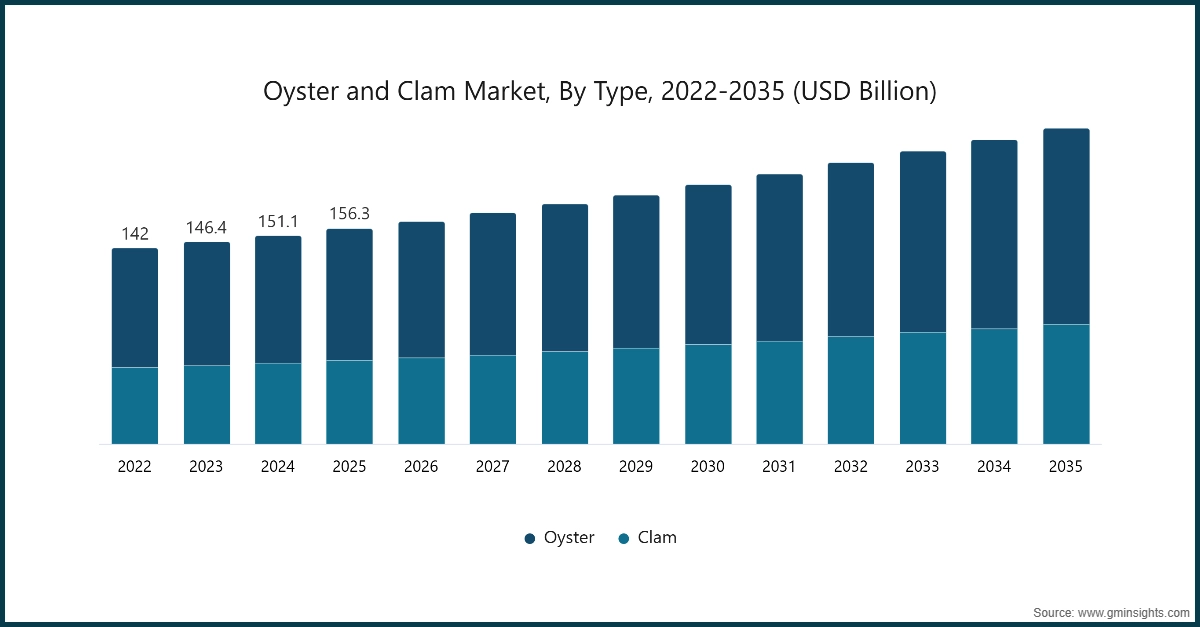
The global oyster and clam market was valued at USD 156.3 billion in 2025. The market is expected to grow from USD 161.7 billion in 2026 to USD 228.9 billion in 2035, at a CAGR of 3.9% according to the latest report published by Global Market Insights Inc.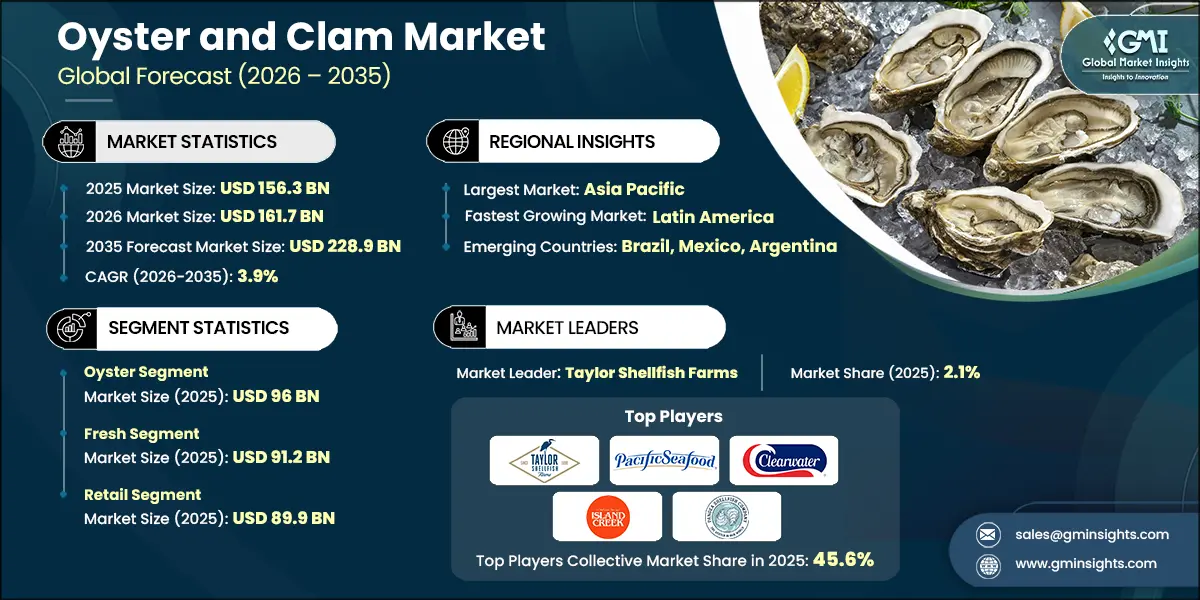
Oyster and Clam Market Key Takeaways
Market Size & Growth
- 2025 Market Size: USD 156.3 Billion
- 2026 Market Size: USD 161.7 Billion
- 2035 Forecast Market Size: USD 228.9 Billion
- CAGR (2026–2035): 3.9%
Regional Dominance
- Largest Market: Asia Pacific
- Fastest Growing Region: Latin America
Key Market Drivers
- Rising demand for seafood boosts oyster and clam consumption.
- Modern aquaculture improves growth and disease resistance.
- Sustainable farming supports long-term production.
Challenges
- Water pollution harms shellfish health.
- Overharvesting reduces wild populations.
Opportunity
- Eco-tourism and shellfish festivals.
- Biotechnology enhances yield and quality.
Key Players
- Market Leader: Taylor Shellfish Farms led with over 2.1% market share in 2025.
- Leading Players: Top 5 players in this market include Taylor Shellfish Farms, Pacific Seafood, Clearwater Seafoods, Island Creek Oysters, Pangea Shellfish Company, which collectively held a market share of 45.6% in 2025.
Get Market Insights & Growth Opportunities
To get key market trends
Oyster and Clam Market Trends
- The demand for oysters and clams is rising because people want to eat seafood which provides both nutritional value and sustainable protein sources. The growth in worldwide consumption of food from restaurants and retail stores results from people becoming more aware of healthy eating and existing food trends.
- People choose to eat oysters and clams because these shellfish contain low fat content and high protein value while also being environmentally friendly. The market demand for shellfish products drives producers to implement sustainable farming practices which help manage their environmental impact while establishing shellfish as a healthy and sustainable seafood option.
- The efficiency and productivity of oyster and clam farming operations improve through the application of modern aquaculture techniques which involve selective breeding and disease management and water quality control. The developments guarantee shellfish producers with all-year product availability plus enhanced product quality and stronger shellfish populations.
- The market is changing to match new consumer behavior patterns which results in retail stores and restaurants and online seafood delivery services increasing their distribution options. The global purchasing and consumption patterns of oysters and clams now depend on three factors which include product availability and the freshness of products and their dependable nature.
- The different regions of the market create expansion opportunities through their local production and consumption activities and their ability to export products. The sustainable practices show progress in particular regions of the world because trade and market diversification create new opportunities for oyster and clam products to enter international markets.
Oyster and Clam Market Analysis
Learn more about the key segments shaping this market
The oyster and clam market by type is segmented into oyster and clam. Oyster holds the largest market value of USD 96 billion in 2025.
- Oysters can be eaten as both raw and cooked and is due to its distinct flavor and texture, it has more value. Oysters production process involves two distinct methods, which are harvesting from natural populations and raising them through aquaculture, to achieve year-round supply consistency. Clams are used in a variety of culinary preparations, including soups, pastas, and ready-to-eat meals, and their mild taste makes them suitable for diverse dishes.
- The storage and transportation advancements have enabled people to access oysters and clams from regions that extend beyond coastal areas. Seasonal changes still influence supply, but farming practices and aquaculture techniques contribute to steadier production. Due to their nutritional value and culinary applications consumers generally choose these shellfish.
The oyster and clam market by form is segmented into fresh, frozen and canned. Fresh holds the largest market value of USD 91.2 billion in 2025.
- The natural flavor and texture of fresh oysters and clams lead to their purchase by customers. The products gain access to inland markets because restaurants and seafood counters and direct-to-consumer outlets receive better cold-chain logistics for their distribution. As people view fresh shellfish to be healthier, they frequently use it in their home cooking and dining at restaurants.
- The two types of products enable customers to store items for extended periods while offering convenient access to food. Frozen shellfish enables consumers to access off-season seafood products which they can use for preparing frozen meals, while canned shellfish provides users with straightforward storage options to prepare multiple dishes. The two product formats enable customers to obtain oyster and clam products in areas where fresh seafood availability may pose difficulties.
Learn more about the key segments shaping this market
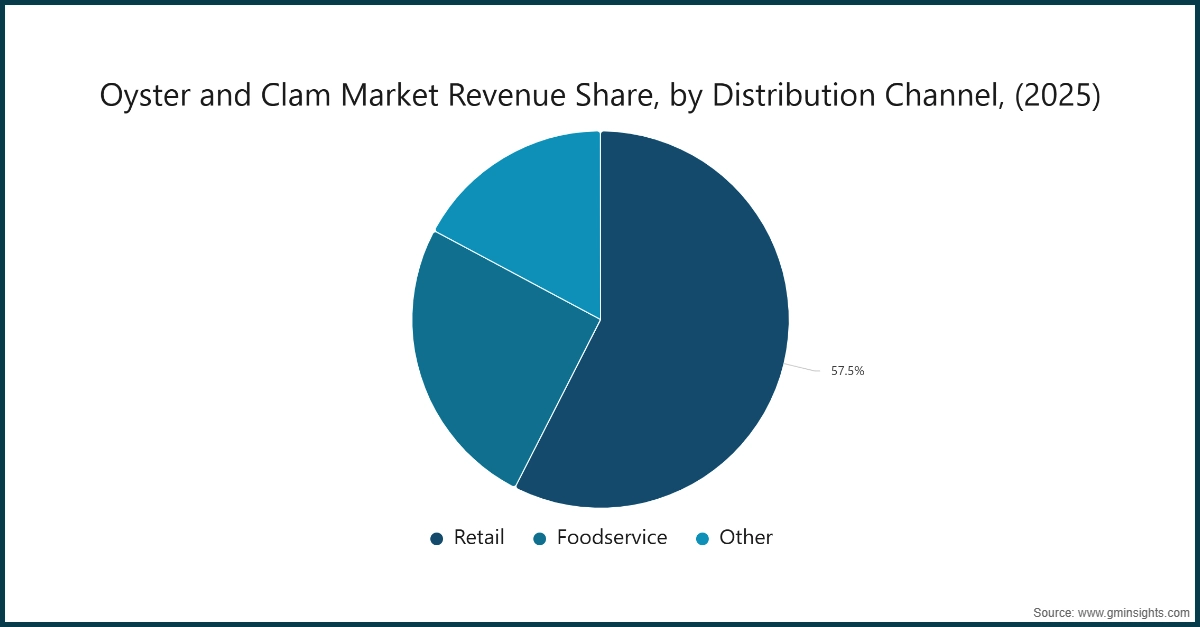
The oyster and clam market by distribution channel is segmented into retail, foodservice and other. Retail holds the largest market value of USD 89.9 billion in 2025.
- Retail stores which include supermarkets, seafood shops and online platforms serve as the main locations where customers buy oysters and clams. The shellfish products available through these channels enable urban and inland consumers to select from various product options which come in different packaging formats. The retail environment uses packaging, labeling and storage techniques to determine how products should be displayed and maintained until customers make their purchase.
- Foodservice channels which include restaurants and hotels and catering services provide customers with prepared meals that feature oysters and clams as menu items throughout different seasons. Smaller producers together with their selected product range can use direct-to-consumer sales and farmers' markets and specialty distributors as additional sales channels. The various distribution channels enable consumers to access oysters and clams in different situations while promoting various ways of eating the products.
Looking for region specific data?
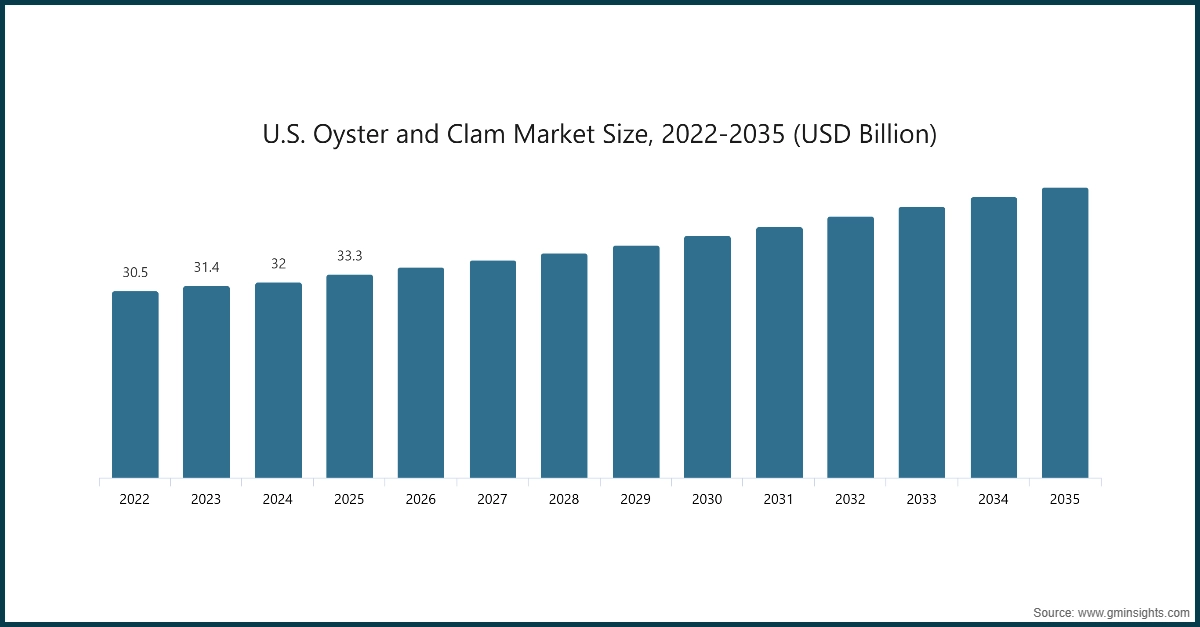
The market in the North America is expected to experience significant and promising growth from USD 41.1 billion in 2025 to USD 58.7 billion in 2035. The U.S. oyster and clam market accounted for USD 33.3 billion in 2025.
- The production of oysters and clams in North America has shown continuous growth because of two main factors which are rising seafood consumption and increasing public knowledge about sustainable fishing methods and better aquafarming methods. Producers need to deliver their products with constant availability because retail and restaurant and local market demand requires them to use sustainable production methods.
- The United States shows continuous growth in oyster and clam production which meets rising urban and regional market demand for fresh shellfish. Oysters and clams will be available to consumers through the combined efforts of farmers and suppliers who work to improve product availability and quality while using sustainable farming methods to control their production capacity.
The market in the Europe is expected to experience significant and promising growth from USD 36.4 billion in 2025 to USD 50.9 billion in 2035.
- In Europe shellfish industry is developing through continuous output and sustainable aquaculture methods and increasing consumer demand for high-quality seafood products. Producers are working to protect the environment through their production methods which they use to supply both local and regional market needs. French oyster and clam farms exist to produce reliable domestic supply for French markets.
- Investment in production efficiency and careful management allows for reliable availability throughout the year. Restaurants and retailers experience rising demand for fresh shellfish which leads producers to sustain their production pace. The cultivation process follows sustainability and quality standards which ensure both environmental protection and continual consumer access to oysters and clams.
The oyster and clam market in Asia Pacific is expected to experience increasing growth from USD 58.7 billion in 2025 to USD 89 billion in 2035.
- The Asia Pacific region operates oyster and clam production which grows because of suitable coastal areas and increasing seafood consumption. The industry now uses aquaculture together with management programs to maintain steady product availability while satisfying expanding market requirements.
- China experiences fast-growing oyster and clam production because producers now work to create stable supply chains while enhancing product quality. Farmers have begun to structure their production systems because domestic consumption levels have risen. Shellfish consumption remains throughout the year because urban and regional markets receive constant shellfish supply. Environmental factors help determine production techniques which aim to sustain perennial oyster and clam farming operations.
Middle East & Africa oyster and clam market is expected to experience significant and promising growth from USD 8.7 billion in 2025 to USD 12.7 billion in 2035.
- The Middle East and Africa regions experience slow growth in oyster and clam production because these areas focus on three priorities which include environmental protection, meeting urban population demand and delivering reliable product supply. Natural harvesting receives support from aquaculture which provides additional resources to maintain market product availability.
- The United Arab Emirates uses oyster and clam farming to create products which are continuously available for domestic markets. Producers work to deliver consistent supply while they enhance product quality and protect the environment. Urban markets now demonstrate increased shellfish demand which leads to steady production rates. The sector responds to rising seafood demand through responsible management practices which permit increased oyster and clam availability across the entire region.
Latin America is expected to experience significant and increasing growth from USD 11.4 billion to USD 17.6 billion in 2035.
- Latin America's shellfish production shows gradual improvement because aquaculture development, consumer demand and dependable supply efforts are growing. Producers need to increase their output while maintaining their environmental protection efforts because product demand continues to rise. Brazil now produces oysters and clams to meet the needs of its domestic market.
- Farmers have established two main goals which require them to produce their products at a constant level while maintaining product quality. Local markets have better seafood access which leads to increased seafood consumption in urban areas. The shellfish industry has expanded its operations which now make shellfish products more widely available through reliable production processes and environmentally sustainable farming methods.
Oyster and Clam Market Share
- Oyster and Clam indusries are moderately consolidated with players like Taylor Shellfish Farms, Pacific Seafood, Clearwater Seafoods, Island Creek Oysters, Pangea Shellfish Company holding 5.8% market share and Taylor Shellfish Farms being the market leader holding the market share of 2.1% in 2025.
- Competitive companies achieve success by delivering products which maintain high standards of quality throughout their entire production process. Buyers and consumers develop trust in the company when it delivers oysters and clams which meet their expectations for freshness and size and hygiene requirements. By high-quality products businesses establish their market position which leads to customers making additional purchases in both retail and foodservice settings.
- Farming and processing innovation provides businesses with operational advantages. Modern aquaculture methods together with selective breeding and automated harvesting or sorting processes enable companies to accomplish better operational results while simultaneously decreasing product waste and enhancing product safety and quality control which gives them an advantage over businesses that lack such advanced technology.
- Sustainable methods help companies to establish their competitive edge through environmental management practices. Companies that adopt eco-friendly practices, such as reef restoration, careful water management, and responsible harvesting, appeal to consumers and retailers who value environmental stewardship. The practice protects resources while it enhances the reputation of the brand.
- Companies achieve differentiation through their market reach and their capacity to distribute products efficiently. The efficient logistics system together with cold-chain management and the establishment of strategic partnerships with retailers and restaurants and online suppliers enables oysters and clams to be delivered to customers in a fast and dependable manner while maintaining product freshness and availability throughout different regions.
- The companies use their brand reputation and consumer engagement methods as their primary strategy for achieving competitive advantage. The combination of marketing activities and certification labels and festival participation and public quality and sustainability practice disclosure creates customer trust, which results in customer loyalty and brand recognition, leading customers to choose their oysters and clams instead of competitor products.
Oyster and Clam Market Companies
Major players operating in the oyster and clam industry are:
- Clearwater Seafoods
- Colville Bay Oyster Co. Ltd
- Five Star Shellfish Inc
- Island Creek Oysters
- Pacific Seafood
- Pangea Shellfish Company
- Royal Hawaiian Seafood
- Taylor Shellfish Farms
- Ward Oyster Company
- Woodstown Bay Shellfish Ltd
Taylor Shellfish Farms operates as the shellfish producer in America because it applies sustainable aquaculture methods to create superior oysters. The company has operated its oyster farming business in the Pacific Northwest since its establishment as it now produces clams and mussels. Taylor Shellfish provides its distribution services to both restaurants and retail markets by using traditional farming methods together with contemporary hatchery techniques.
Pacific Seafood stands as the main seafood enterprise in North America which emphasizes product freshness and quality across all its offerings including oysters and clams and other shellfish products. The company has integrated its operations by combining harvesting with processing and distribution which helps local fisheries while it upholds its rigorous food safety and sustainability standards.
Clearwater Seafoods is a seafood company in Canada which receives recognition for its top-quality shellfish products that include clams and oysters. The company operates its business through a system that connects harvesting with processing and worldwide distribution. The company applies its traditional seafood knowledge together with environmental conservation practices while building partnerships with local communities.
Island Creek Oysters is a highly regarded oyster farm on the East Coast which produces oysters through sustainable farming practices. The company has developed its U.S. shellfish brand through dedicated shellfish cultivation and environmental conservation and chef connection development.
Pangea Shellfish Company operates as a specialized shellfish supplier that focuses on providing oysters and clams. The company prioritizes shellfish quality through responsible sourcing while providing education to customers about shellfish products. Pangea has established a strong reputation in the market because it selects products carefully which it obtains from growers to distribute in North American restaurants and retail stores.
Oyster and Clam Market Report Attributes
| Key Takeaway | Details |
|---|---|
| Market Size & Growth | |
| Base Year | 2025 |
| Market Size in 2025 | USD 156.3 Billion |
| Market Size in 2026 | USD 161.7 Billion |
| Forecast Period 2026-2035 CAGR | 3.9% |
| Market Size in 2035 | USD 228.9 Billion |
| Key Market Trends | |
| Drivers | Impact |
| Rising demand for seafood boosts oyster and clam consumption | Increasing global awareness of healthy diets and protein-rich foods drives higher consumption of oysters and clams, creating strong market demand and encouraging both wild harvesting and aquaculture production worldwide. |
| Modern aquaculture improves growth and disease resistance | Advances in aquaculture technology, including water quality monitoring, automated sorting, and selective breeding, enhance oyster and clam growth, improve disease resistance, and make farming more efficient and productive. |
| Sustainable farming supports long-term production | Sustainable practices like reef restoration, sediment management, and responsible harvesting ensure long-term oyster and clam production while protecting ecosystems, maintaining biodiversity, and supporting environmental health. |
| Pitfalls & Challenges | Impact |
| Water pollution harms shellfish health | Contaminated water from industrial waste, chemicals, or sewage harms oysters and clams by reducing their growth, weakening immunity, and sometimes causing mass die-offs, threatening both aquaculture and natural populations. |
| Overharvesting reduces wild populations | Excessive collection of wild oysters and clams depletes natural populations, disrupts ecosystems, and reduces breeding stock, making recovery slow and threatening long-term sustainability of shellfish resources. |
| Opportunities: | Impact |
| Eco-tourism and shellfish festivals | Oyster and clam farms can attract tourists through eco-tourism and local shellfish festivals, promoting awareness, generating income for coastal communities, and creating cultural and educational experiences. |
| Biotechnology enhances yield and quality | Biotechnology, including selective breeding and genomic research, improves oyster and clam growth rates, disease resistance, and shell quality, increasing productivity while supporting sustainable aquaculture practices. |
| Market Leaders (2025) | |
| Market Leader |
Market share 2.1% |
| Top Players |
Collective market share of 45.6 % in 2025 |
| Competitive Edge |
|
| Regional Insights | |
| Largest Market | Asia Pacific |
| Fastest growing market | Latin America |
| Emerging countries | Brazil, Mexico, Argentina |
| Future outlook |
|
What are the growth opportunities in this market?
Oyster and Clam Industry News
- In March 2026, Mericq acquired Maison Blanc to operate Gillardeau oyster production which Mericq runs in France and Ireland. The merger helps Mericq by providing better premium seafood products, enhanced logistics and customer service capabilities while expanding their ability to sell oysters and clams and other seafood products in both domestic and international markets.
- In March 2026, Spanish seafood company Congalsa acquired a Vietnamese clam processing company, strengthening its supply chain and raw material control in Asia.
The oyster and clam market research report includes an in-depth coverage of the industry with estimates and forecast in terms of revenue in USD Billion and volume in terms of kilo tons from 2022–2035 for the following segments:
Market, By Type
- Oyster
- Clam
Market, By Form
- Fresh
- Frozen
- Canned
Market, By Distribution Channel
- Retail
- Foodservice
- Other
- Others
The above information is provided for the following regions and countries:
- North America
- U.S.
- Canada
- Europe
- Germany
- UK
- France
- Spain
- Italy
- Rest of Europe
- Asia Pacific
- China
- India
- Japan
- Australia
- South Korea
- Rest of Asia Pacific
- Latin America
- Brazil
- Mexico
- Argentina
- Rest of Latin America
- Middle East and Africa
- Saudi Arabia
- South Africa
- UAE
- Rest of Middle East & Africa
Frequently Asked Question(FAQ) :
What was the market size of the oyster and clam in 2025?
The market size was USD 156.3 billion in 2025, with a CAGR of 3.9% expected through 2035. Increasing demand for sustainable seafood and nutritional benefits is driving market growth.
What is the projected value of the oyster and clam market by 2035?
The market is poised to reach USD 228.9 billion by 2035, driven by advancements in aquaculture, rising global seafood consumption, and sustainable farming practices.
What is the expected market size of the oyster and clam industry in 2026?
The market size is projected to reach USD 161.7 billion in 2026.
What was the valuation of the oyster segment in 2025?
The oyster segment generated USD 96 billion in 2025, due to its distinct flavor, texture, and consistent year-round supply through aquaculture and natural harvesting.
What was the valuation of the fresh segment in 2025?
The fresh segment accounted for USD 91.2 billion in 2025, led by consumer preference for natural flavor and texture, supported by improved cold-chain logistics and inland market accessibility.
What is the growth outlook for the North American oyster and clam sector from 2025 to 2035?
The North American market is expected to grow significantly, increasing from USD 41.1 billion in 2025 to USD 58.7 billion by 2035. Growth is fueled by rising seafood consumption, sustainable aquafarming practices, and increasing public awareness of sustainable fishing methods.
What are the key trends in the oyster and clam market?
Sustainable farming, advanced aquaculture, wider distribution, and demand for healthy, eco-friendly seafood are key trends.
Who are the major players in the oyster and clam industry?
Key players include Clearwater Seafoods, Colville Bay Oyster Co. Ltd, Five Star Shellfish Inc, Island Creek Oysters, Pacific Seafood, Pangea Shellfish Company, and Royal Hawaiian Seafood.
Oyster and Clam Market Scope
Related Reports