Summary
Table of Content

Outboard Boats Engine Market
Get a free sample of this report
Thank you!
Your inquiry has been received. Our team will reach out to you with the required details via email. To ensure that you don't miss their response, kindly remember to check your spam folder as well!
Form submitted successfully!
Error submitting form. Please try again.
Request Sectional Data
Thank you!
Your inquiry has been received. Our team will reach out to you with the required details via email. To ensure that you don't miss their response, kindly remember to check your spam folder as well!
Form submitted successfully!
Error submitting form. Please try again.
Outboard Boats Engine Market Size
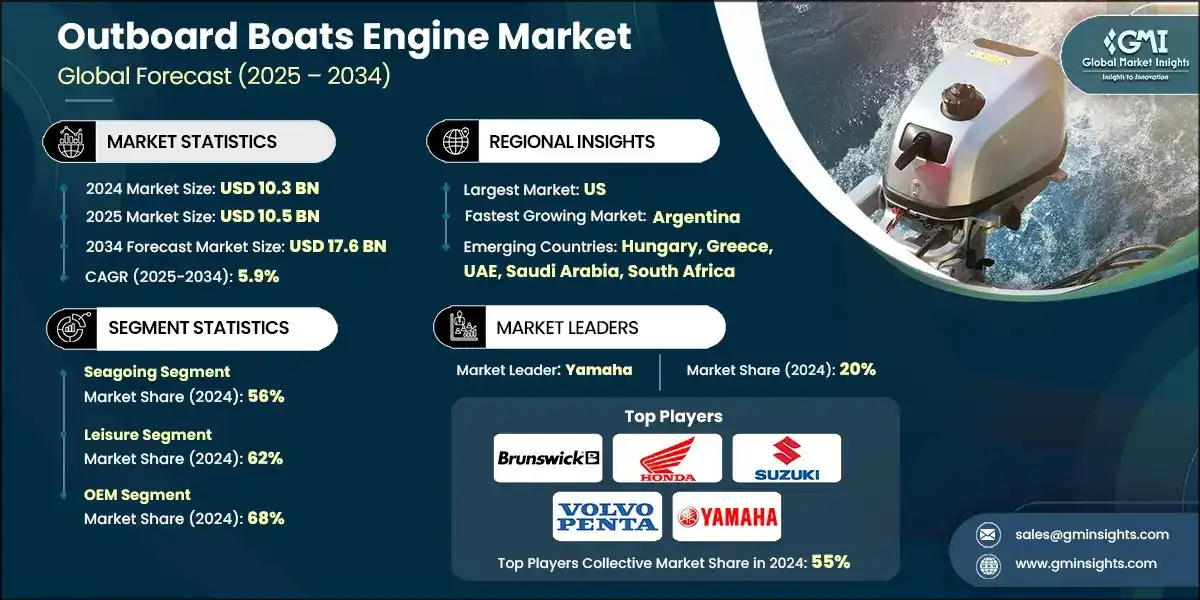
The global outboard boats engine market size was estimated at USD 10.3 billion in 2024. The market is expected to grow from USD 10.5 billion in 2025 to USD 17.6 billion in 2034, at a CAGR of 5.9% according to latest report published by Global Market Insights Inc.
To get key market trends
The increased use of leisure boating and water sport activities in the coastal and inland areas will create a huge demand for power engines. The growth of the market will be driven by rising consumer expenditure on leisure products, the growth of marina facilities and tourism offers tremendous opportunities throughout the period of the forecast.
The use of fuel-efficient, lightweight, and low-emission engine technologies is going to be advanced, and its use will gain popularity in both commercial and recreational applications. The increased demand towards four-stroke and direct fuel injection engines caused by strict emission requirements and sustained growth will be a great market opportunity and reinforcement of the growth trend of the global outboard engine market.
Small scale marine transportation, coastal logistics and commercial fishing will increase the demand of high performance outboard engines that are reliable. The rise in investment in coastal infrastructure as well as the development of the artisanal and aquaculture fishery will further drive the growth of the market and provide firm growth opportunities to manufacturers over the forecast timeframe.
The current rapid transition into the electric and hybrid outboard propulsion systems will offer great market potential during the forecast period. The adoption will be sustained by continuous innovations in battery efficiency, lightweight design, and charging infrastructure, which will propel the uptake among the eco-conscious consumers and the fleet operators to ensure the sustainable growth of the marine markets across developed and emerging markets.
Companies operating in outboard boats engine market are raising funds to launch electric motors. For instance, Zparq raised around USD 6.6 million for development and large scale industrial production of its Z10 electric outboard motor. The Zparq drive is designed with innovative battery management, control and safety control, which are developed and designed internally. All the components are developed in modular scalable shapes that may be integrated to suit most propeller driven vessels.
The market of the outboard engines in Latin America will experience a high rate of growth due to the growth of coastal tourism, increased recreational boating involvement, and the growing use of low-cost small and mid-speed engines. The support to marine infrastructure alongside the high demand in Brazil, Mexico, and Chile of fishing and transport vessels will drive high growth of the market throughout the forecast period.
Europe carries a market dominance since this region has developed boating culture, large coastline infrastructure and other high market share boat manufacturers. Consumer spending on the leisure boating segment will remain high due to the presence of tight emission regulations which encourage the adoption of high technologies in engines and will ensure steady growth to maintain the leading position of the Europe market with regard to the outboard engines.
Outboard Boats Engine Market Report Attributes
| Key Takeaway | Details |
|---|---|
| Market Size & Growth | |
| Base Year | 2024 |
| Market Size in 2024 | USD 10.3 Billion |
| Market Size in 2025 | USD 10.5 Billion |
| Forecast Period 2025 – 2034 CAGR | 5.9% |
| Market Size in 2034 | USD 17.6 Billion |
| Key Market Trends | |
| Drivers | Impact |
| Rising recreational boating and tourism | Increased participation in water sports and leisure boating across coastal regions will drive higher sales of outboard engines, especially in North America and Latin America. |
| Shift toward fuel-efficient and cleaner engines | Growing environmental regulations are propelling the adoption of four-stroke, direct fuel injection, and hybrid-electric engines. |
| Growth in fishing and marine transport | Expanding artisanal and small-scale fishing, coupled with coastal transport applications, is boosting outboard engine demand. |
| Technological advancements | Integration of electronic fuel injection, smart controls, and digital throttle systems is enhancing performance and reliability. |
| Expanding boating infrastructure | Investments in marinas, boat clubs, and marine tourism hubs are supporting long-term outboard engine demand. |
| Pitfalls & Challenges | Impact |
| High maintenance and operating costs | Routine servicing, fuel expenses, and wear-related costs can limit adoption in low-income markets. |
| Environmental regulations | Stringent emission standards, especially in Europe and North America, pose challenges for traditional two-stroke engine manufacturers. |
| Raw material price fluctuations | Rising prices of aluminum and other components impact production costs and profit margins. |
| Opportunities: | Impact |
| Electrification of marine propulsion | Growing R&D in electric and hybrid outboard systems will open significant new market opportunities. |
| Growth in emerging markets | Expanding middle-class spending and tourism in Southeast Asia, Latin America, and Africa will drive future sales. |
| OEM and aftermarket integration | Collaborations between engine manufacturers and boat OEMs to offer factory-fitted propulsion systems will boost revenues. |
| Market Leaders (2024) | |
| Market Leaders |
20% market share |
| Top Players |
Collective Market Share is 55% |
| Competitive Edge |
|
| Regional Insights | |
| Largest Market | US |
| Fastest growing market | Argentina |
| Emerging countries | Hungary, Greece, UAE, Saudi Arabia, South Africa |
| Future outlook |
|
What are the growth opportunities in this market?
Outboard Boats Engine Market Trends
The increasing consumer needs in leisure boats, fishing, and water sports will be an impetus to the high demand of outboard engines. Due to increased networks in the marina sector, the growth in disposable income, and tourism in the coastline, sales are going to drive a lot, and there will be great potential growth to manufacturers in the forecast period.
Marine propulsion efficiency is changing with continuous inventions including electronic fuel injection, digital throttle control and real-time monitoring systems. These new technologies improve fuel consumption, performance and reliability that is fueling the use of modern outboard engines by all recreational and commercial consumers around the world.
The world is moving towards greener energy is driving the demand to electric and hybrid outboard engines. The enhancements in battery operation, charging and greener design will provide a tremendous chance of sustainable propulsion systems in leisure boats, fishing boats and coastal transport fleets.
Emerging outboard engines in small, durable and fuel efficient are in high demand by emerging economies due to the presence of rising fishing activities conducted by small and artisans. Governments that will contribute to sustainable fishing and local transport networks will continue to boost the expansion of markets in Latin America, Southeast Asia, and Africa.
The replacement demand of the advanced outboard engines is being caused by aging marine fleets and increasing concern over the efficiency of maintenance. The growing number of aftermarkets, spare parts, and electronic diagnostic systems will enhance the recurring revenue lines and enhance sustainable expansion prospects of the market.
Outboard engines are gaining acceptance in global investments in waterfront tourism, cruise marinas, and recreational boating systems. The nations that advance blue economy plans and recreation in coastal areas will offer new chances to manufacturers, which will drive the continuous development of the high-end and middle-range engines.
Outboard Boats Engine Market Analysis
Learn more about the key segments shaping this market
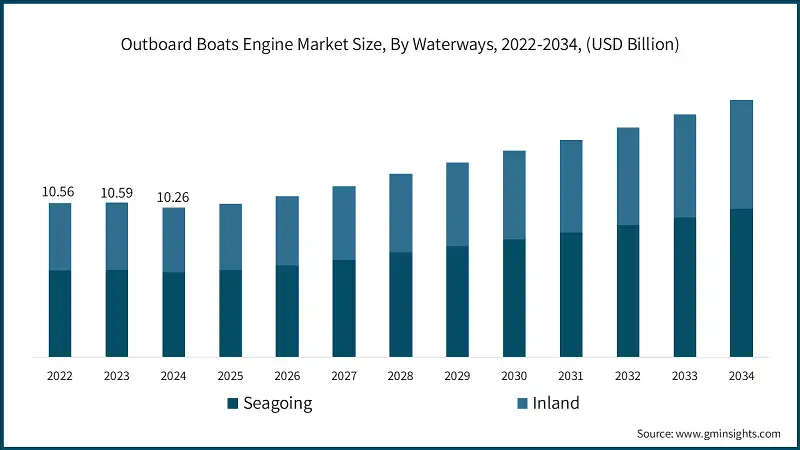
Based on waterways, the outboard boats engine market is divided into seagoing and inland. The seagoing segment dominated the market accounting for around 56% in 2024 and is expected to grow at a CAGR of over 5.9% from 2025 to 2034.
- The increasing fame of seashore tourism, island trips, and water sports is pushing the high inquiry of seagoing outboard boats. More spending in resorts, charters and coastal marinas will drive the use of more powerful and dependable outboard engines that are meant to use in offshore navigation and where traveling long distances is required.
- The use of seagoing outboard engines is also becoming popular in the business transport, coast guard and patrol activities because it has high reliability and responsiveness. Multi-engine designs are becoming more popular among governments and private operators due to the reasons of safety, speed, and endurance, with market growth steadily developing over the forecast period.
- The seagoing vessels are taking a new direction due to technological advancement in high horsepower outboard engines (300 HP or above). To achieve better fuel economy and increased durability, the manufacturers are targeting lightweight material, computerized throttle, and better cooling systems, which is increasing in use in the luxury boats, rescue boats, and commercial fleets.
- The offshore fishing and charter tourism activities are increasing, which is driving the adoption of high-performance outboard engines that can withstand the harsh sea conditions. The growing demand by consumers towards large, fast and fuel-efficient offshore boats will push the market to grow strongly, especially in North America, Europe and Asia-Pacific coasts.
- The increasing environmental awareness and tightening emission regulations are driving the adoption of more environmentally friendly seagoing propulsion systems. The modernization of four-stroke engines, hybrid engines, and electric outboard engines will offer huge potentials of sustainable operations in the marine business, cutting carbon footprints and increasing the fuel efficiency of the offshore business.
- A cabinet initiative that is driving up the demand of seagoing outboard engines is investment by the government in ports, docking stations, and coastal transport systems. Improved access to marine services, fueling stations, and maintenance centers will help in enhancing the deployment of vessels and long-term outboard development in seagoing activities in the world maritime economies.
Learn more about the key segments shaping this market
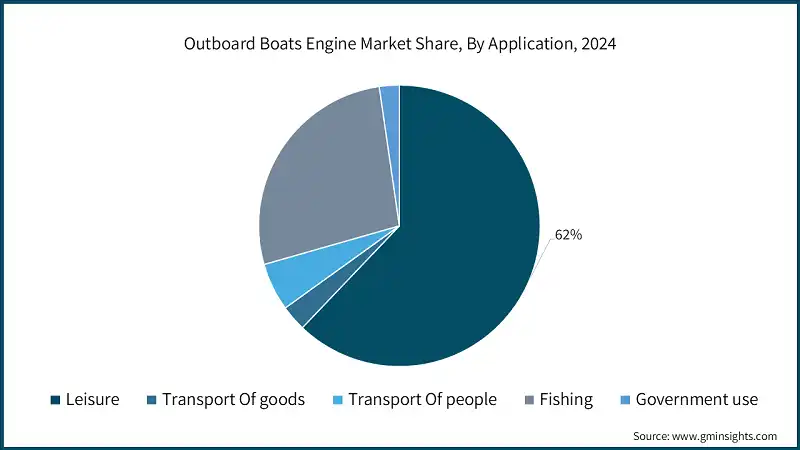
Based on application, the outboard boats engine market is segmented into leisure, transport of goods, transport of people, fishing, and government use. The leisure segment dominates the market with 62% share in 2024, and the segment is expected to grow at a CAGR of over 5% from 2025 to 2034.
- The surge in consumer demand for leisure boating, family trips as well as weekend water sports is causing high demand of outboard engines. Increased disposable income, urbanized lifestyles and increased popularity of marine recreational activities are driving the sales of small and mid-powered boats in the coastal and inland waterways.
- Marina networks, waterfront resorts and boating clubs are being expanded by governments and individual investors to facilitate leisure marine activities. Better docking, storage, and maintenance services are adding to its accessibility to recreational boat owners which is accelerating the shift to the use of outboard engines in the leisure boating market.
- Convenience and cost-effectiveness Leisure boaters are turning to lightweight, portable, and low-maintenance outboard engines increasingly. The development of small four stroke engines, electronic starting systems, and anticorrosive materials are driving their usage by hobbyists, rental operators, and seasonal boating professionals around the globe.
- Demand and environmental concern in the sense of the need to have noise on their boat is increasing the use of less noisy, less polluting and more efficient engines. The shift to electric and hybrid outboards in the leisure markets offers sustainable and enjoyable boating experiences, and this is in line with the tougher environment and tourism policies.
- Access to recreational boating is growing through the introduction of boat rentals, boat sharing, and fractional ownership platforms. To maintain uptime and user satisfaction, these services need dependable, robust, and easily serviceable outboard engines to earn more replacement and fleet demand in key recreational centers.
- Performance monitoring systems, GPS tracking and digital controls are emerging as a major point of distinction among leisure boats. Added internet of things and mobile connectivity to outboard engines increases the convenience of the user, engine navigation, and engine control, and is propelling the use of the technology among the technologic leisure boat users across the world.
Based on propulsion, the outboard boats engine market is segmented into gasoline, diesel, and electric. Gasoline outboard engines are still in the lead because they are reliable, easy to maintain, and have a high number of service centers. Their performance in the recreational and commercial boats is uniform, and that is why people use them when they want a reliable propulsion in diverse marine conditions.
- The increased activity of leisure boaters and small-scale fishing operators is driving the demand for gasoline-powered outboards. The engines provide a fair balance of being cost-effective, powerful and performing to be used in coastal tourism, inland waterways and light commercial marine in both developed and emerging markets.
- The current four stroke gasoline outboards have enhanced fuel injection, variable valve timing and ideal combustion systems. Such innovations make delivery of power more effective, less emissions and more fuel efficiency and more users are adopting the innovations in pursuit of greater power with less operation cost and standards that meet the changing environmental demands.
- The ease of availability of gasoline and the established refueling system at the global level still make it dominate in the outboard engine market. The availability of fuel both inland and offshore is a benefit to the person boating since it is a convenient resource to support large recreational, transport and fisheries use without range or compatibility constraints.
- Gasoline outboard engines are cheaper to buy initially and maintain than diesel or electric ones. This reasonableness attracts end-user boat owners, rental operators, small fleet operators, as well as favoring consistent sales and replacement businesses, especially in price-sensitive and emerging markets.
- Multi-engine, offshore boats have been fitted with gasoline outboards because they have great power-to-weight ratio and good acceleration. The fact that they have the capability of providing seamless synchronization and redundancy in the sea increases performance, safety, and control, which leads to a sustained growth in premium and sport boating segments.
Based on sales channel, the outboard boats engine market is segmented into OEM, and aftermarket. OEM segment is leading the market with 68% share in 2024.
- The manufacturers of boats are increasingly engaging engine manufacturers to provide outboard propulsion systems in factories. This integration will support the next level of performance compatibility, reliability and design productivity, which will also offer a new source of revenue to the OEMs and lead to increased usage of advanced, pre-aboard engines with commercial and recreational boat markets.
- Consumers remain loyal to those boats that have ideal propulsion systems to meet particular performance, efficiency and handling requirements. OEM alliances allow smooth combination of the hull design, weight distribution, and calibration of engines, which leads to innovation and enhances the demand of OEM-equipped outboard engines in the high-end and middle-range vessels.
- The movement to electric and hybrid propulsion is encouraging boat OEMs and engine vendors to have strategic alliances. The ability to co-develop integrated systems with common battery platforms, control units and power management technologies will lead forces on the OEM side and speed up the integration of next-generation outboard engines.
- The integration of OEM offers buyers a single network of services and warranty, which makes it easy to maintain the product, and the customer gains confidence. The operational costs are lower in centralized production and distribution models, and this has helped the OEMs to produce outboard boats, which are competitively priced, and of high quality alongside high after sales and performance guarantees.
Looking for region specific data?
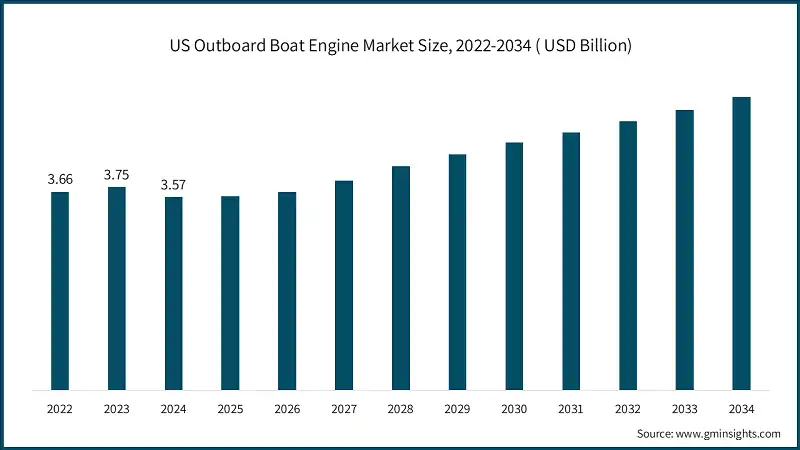
US dominated the outboard boats engine market in North America with around 86% share and generated USD 3.57 billion in revenue in 2024.
- Recreational boating is still on a booming trend in the US due to high consumerism and a growing marina system. The increased demand of personal watercraft, fishing boats, and recreation water vessels will stimulate the constant increase in outboard engines sales in the coastal, inland, and freshwater areas.
- The major US manufacturers are launching more sophisticated four-stroke and digitally controlled outboard engines that have a better fuel efficiency, reduced emissions and smoother performances. Electric propulsion, intelligent monitoring, and IoT applications advancements are revolutionizing the boating experiences and driving constant adoption in the recreational and a commercial sector.
- The strong system of dealerships, services, and spare parts vendors throughout the US is increasing revenues in aftermarket. The expanding replacement demand of older engines and upgrade due to maintenance will offer the outboard engines producers and distributors in the country a constant growth avenue.
- The increasing popularity of recreational and sport fishing and other outdoor leisure activities are driving the demand towards small and mid-powered outboard engines. Increasing the number of people engaged in freshwater and saltwater fishing tournaments is also a further boost to engine improvements and more sales in all horsepower lines.
- Sustainability objectives at both federal and state levels are hastening the use of cleaner propulsion technologies. The electric and hybrid outboard engines are on the rise, which is supported by the emission reduction policies, the electrification of marinas, and growing popularity of the consumers in quiet and environmentally friendly boating experiences in the waters of the U.S. waters.
- The US is home to large marine companies like Brunswick (Mercury Marine), Honda and Yamaha with great potential of domestic supply. The U.S. outboard engine market will remain on the strong track in the forecast period due to OEM relationships, extensive research and development, and the broad array of products in the power segments.
The outboard boat engine market in Germany is expected to experience robust growth between 2025 and 2034.
- The rising demand of the outboard engines is due to the growing inland waterway tourism in Germany and increasing involvement in the leisure boating. Rivers and lakes like Rhine, Elbe and Mecklenburg Lake District are increasing the sale of engines in small recreational and rental boats.
- The strict emission standards and emissions policies in Germany are increasing the pace at which the country is moving towards fuel-efficient four-stroke and electric outboard engines. The manufacturers that specialize on low-noise, low-emissions propulsion systems are in a good position to gain when sustainability forms a major buying criterion of the German boat owners.
- The current attention of Germany to green mobility and integration of renewable energy is facilitating the fast growth in the use of electric and hybrid outboard engines. The rise of environmentally friendly marine propulsion is being fueled by government subsidies, technological development in battery technologies and the creation of more charging networks.
- The boom of boats rental and shared leisure mobility business in Germany is increasing the use of durable and easy to maintain outboard engines. The emerging market is boosted by the trend of increased fleet utilization and a high number of engine replacements, which are confirmed by the growth in the popularity of flexible and short-term boat rentals in the urban lakes and rivers.
- Germany is seeing an improvement in boating safety and performance due to technological innovation in digital controls, GPS navigation and IoT connectivity. Real-time diagnostics and smart monitoring systems integration of outboard engines are appealing to tech-oriented consumers and help in the development of premium segments.
- Germany is having a well-established marine supply chain and the availability of well-established European OEMs and distributors that maintain stable product supply. The manufacturers of outboard engines are experiencing long term growth in the German market due to the local partnerships, good service backing and association with the regional boat builders.
The outboard boat engine market in China is expected to experience rapid growth between 2025 and 2034.
- The outboard-powered boats are being demanded by the emerging marine tourism sector in China that is enabled by government programs to build the coastal recreational areas and water sports. The growth of infrastructure in the process of developing such destinations as Hainan, Guangdong, and Zhejiang is responsible for the favorable uptake of mid- and high-powered outboard engines in tourism and leisure.
- The strategy of China in the form of Blue Economy is aimed at sustainable development of the marine sector, which encourages investment in transport, aquaculture, and maritime tourism on the coast. This national orientation provides the outboard engine manufacturers with great opportunities in serving the small commercial, patrol and passenger transport vessels both in the coastal areas and in the inland ones.
- China is quickly converting to electric and hybrid outboard propulsion systems with the policy in favor of clean energy transition. On-going improvements in production of domestic batteries, as well as infrastructure investment in charging networks, will result in massive introduction of low-emission marine engines in leisure and transport shipments.
- The growing local boatbuilding industry is increasing the demand of locally manufactured outboard engines by OEM. New propulsion systems are also being introduced into new Chinese-made vessels by Chinese manufacturers, including joint ventures and technology partnerships with internationally respected marine engine brands to increase performance, efficiency, and compliance.
- The popularity of recreational boating is increasing rapidly due to increased disposable income and lifestyle shift among the upper-middle-class population in China. High performance outboard engines are being purchased more and more by the growing population of private marinas and yacht clubs, particularly in luxury and sport boating markets.
- The growing investments by China in the coastal surveillance, boundary patrol and in the inland water enforcement are creating a demand of using the strong and dependable outboard engines. Multi-engine patrol boats with high output propulsion systems are becoming more and more common in government agencies and maritime authorities due to increased speed, control and endurance.
The outboard boat engine market in Argentina is expected to experience significant and promising growth from 2025 to 2034.
- Argentina's growing interest in leisure boating, sailing, and water-based tourism along its vast river networks and coastal areas is fueling strong demand for outboard engines. Locations like the Paraná Delta and Patagonia's waterways are seeing more boat ownership and rental activity, which is driving market growth.
- The country's large fishing industry, especially artisanal and small-scale coastal fisheries, relies heavily on boats powered by outboard engines. Increasing fishery exports and the expansion of aquaculture are raising the need for reliable, fuel-efficient outboard engines that can handle long working hours and perform well in different water conditions.
- Both public and private investments in marina construction, river ports, and boating facilities are making waterways more accessible across Argentina. These efforts are improving recreational and commercial boating environments, creating long-term growth opportunities for outboard engine manufacturers and distributors.
- Growing awareness of environmental sustainability and fuel efficiency is promoting the use of modern four-stroke and direct fuel injection outboards. This shift in technology is lowering operating expenses and emissions, helping boat owners comply with stricter environmental standards in Argentina's coastal and inland waterways.
The outboard boat engine market in UAE is expected to experience significant and promising growth from 2025 to 2034.
- The rapidly growing marine tourism and luxury yachting industry in UAE will provide significant market opportunities. High disposable incomes, coupled with waterfront developments and government-backed maritime tourism initiatives in Dubai and Abu Dhabi, have driven up sales of premium outboard engines for leisure and charter vessels.
- Large-scale investments in marinas, waterfront resorts, and port facilities are adding to the UAE's marine ecosystem. Projects at Dubai Harbour and Yas Marina are leading to an excellent demand base for modern, high-performance outboard engines for recreational and transport boats in private and commercial fleets.
- The trend of offshore fishing, diving, and water adventure sports is increasing, thereby fueling demand for mid- and high-horsepower outboard engines. Local enthusiasts and charter operators are incorporating technologically advanced propulsion systems that offer better speed, fuel efficiency, and reliability for longer marine activities.
- The UAE's strategic focus on expanding its blue economy is encouraging sustainable marine operations. Policies and regulations in support of marine innovation, eco-tourism, and electric mobility are driving the adoption of fuel-efficient and low-emission outboard engines, particularly within the leisure and light commercial boating categories.
Outboard Boats Engine Market Share
- The top 7 companies in the outboard boats engine industry are Honda, Brunswick, Yamaha, Volvo Penta, Cox Powertrain, Suzuki Motor, Oxe Marine, contributing around 55% of the market in 2024.
- Honda Motor uses its years of experience and expertise in the area of advanced four-stroke technology, Honda Marine produces outboard motors that are quiet, economical, and low-emission.
Attention is given to specific automotive innovations adapted for performance, like VTEC and Lean Burn Control. Its strong brand reputation, global dealer network, and environmentally friendly designs continue to drive competitiveness across premium boating segments. - Brunswick (Mercury Marine) via the subsidiary of Mercury Marine, is the leading company in the global outboard market, with a diversified portfolio of products for recreational and commercial purposes. It invests heavily in propulsion integration, smart digital controls, and sustainability. A broad marine ecosystem of engines, parts, and digital services creates a strong competitive advantage and enhances customer loyalty worldwide.
- Yamaha Motor has the broadest product portfolio, ranging from portable to high-horsepower outboard models. Continuous innovation in areas such as digital throttle systems, electronic steering, and improved fuel efficiency secures Yamaha's position as one of the leaders in modern marine propulsion. Global brand strength, reliability, and aftersales service networks ensure long-term competitiveness in leisure and commercial boating.
- Volvo Penta has its focus on premium and professional marine applications, with well-developed propulsion systems combining performance, efficiency, and environmental compliance. Hybrid and alternative-fuel solutions are the focus of the company's sustainability aspirations. With a solid engineering heritage behind it and high-torque, long-lasting engines, Volvo Penta remains one of the leading manufacturers in the luxury yacht and commercial marine segments.
- Cox Marine differentiates itself with high-performance diesel outboard engines designed for endurance, safety, and fuel economy. Its flagship CXO300 engine targets military, commercial, and government operators seeking lower total cost of ownership and greater reliability. Engineering innovation and a focus on heavy-duty applications give it a strong foothold in specialized marine propulsion markets.
- Suzuki Motor continues with its competitive edge in innovation in four-stroke engine design, offering smooth, fuel-efficient, and durable outboards. Its standard Lean Burn control, offset driveshafts, and precision electronic controls improve performance and sustainability. With a wide global footprint, extensive model range, and reliable aftersales network, Suzuki maintains a leading position among trusted choices for both recreational and fishing sectors.
- OXE Marine is a pioneer in diesel outboard technology, focusing on high-torque, fuel-efficient engines for commercial and defense markets. Its various developments of a diesel-electric hybrid support cleaner, longer-range operations with lower emissions. By combining rugged design with cutting-edge innovation, OXE Marine fills a niche demand for sustainable heavy-duty marine propulsion, fortifying its position in the highly specialized global market
Outboard Boats Engine Market Companies
Major players operating in the outboard boats engine industry are:
- Brunswick
- Cox Powertrain
- Hidea Power
- Honda
- Oxe Marine
- Parsun Power Machine
- Suzuki Motor
- Tohatsu
- Volvo Penta
- Yamaha
- The outboard boat engine market is very competitive. It includes well-known global companies and new regional manufacturers. Leading brands like Yamaha, Mercury (Brunswick), Honda, and Suzuki focus on improving four-stroke efficiency, digital control systems, and lightweight designs. These companies rely on their extensive dealer networks and aftersales services.
- Tohatsu, Parsun, and Hidea are advancing in cost-sensitive markets by prioritizing affordability and expanding their export reach. The shift toward electric outboards, stricter emission rules, and smart connectivity solutions is driving more investment in research and development. This trend is also fostering partnerships that are reshaping the competitive landscape of the industry over the next decade.
Outboard Boats Engine Industry News
- In October 2025, Yamaha Motor Europe announced the new agreement with globally recognized boat manufacturer Salpa Nautica. A collaboration that will see the manufacturer provide outboard engines to Salpa Nautica for a number of the shipyard's popular boats in the coming five years.
- In September 2025, Mercury Marine, announced the release of its new 6HP EFI outboard engine. Based on Mercury’s proved 209cc 8/9.9HP EFI platform, this high-displacement model offers superior torque and quick, reliable starting for small boats use. The 6HP EFI engine features a special calibration that provides reliable starting at all times, in all weather conditions, along with excellent fuel economy.
- In September 2025, Honda Marine Europe announced the arrival of the new generation of 4-cylinder and V6 outboard engines, all-new for design, technology, and performance. The new models come in the BF115, BF135 and BF150 for the 4-cylinder products, BF200, BF225, and B250 for the V6.
- In December 2024, McLaren Engineering announced an alliance with Honda Marine, a division of Honda Power Sports & Products. This dynamic engineering collaboration has at its heart a heritage of technical engineering excellence between two formidable technology partners. Under the terms of an Official Licensed Product agreement, Honda Marine and McLaren Engineering will work together on the manufacture of the all-new McLaren Performance M300, a performance-inspired marine outboard offering improved top-end power, high quality, and exceptional reliability and durability.
The outboard boats engine market research report includes in-depth coverage of the industry with estimates & forecasts in terms of revenue ($ Mn/Bn) and shipment (units) from 2021 to 2034, for the following segments:
Market, By Waterways
- Seagoing
- Leisure
- Transport Of goods
- Transport Of people
- Fishing
- Government use
- Inland
- Leisure
- Transport Of goods
- Transport Of people
- Fishing
- Government use
Market, By Propulsion
- Gasoline
- Diesel
- Electric
Market, By Application
- Leisure
- Transport Of goods
- Transport Of people
- Fishing
- Government use
Market, By Engine
- 2-stroke
- 4-stroke
- Electric
Market, By Power
- Low
- Mid
- High
Market, By Ignition
- Electric
- Manual
Market, By Sales Channel
- OEM
- Aftermarket
The above information is provided for the following regions and countries:
- North America
- US
- Canada
- Europe
- UK
- Germany
- France
- Italy
- Spain
- Russia
- Nordics
- Hungary
- Greece
- Asia Pacific
- China
- India
- Japan
- South Korea
- ANZ
- Southeast Asia
- Latin America
- Brazil
- Mexico
- Argentina
- MEA
- South Africa
- Saudi Arabia
- UAE
Frequently Asked Question(FAQ) :
Who are the key players in the outboard boat engine industry?
Key players include Brunswick, Cox Powertrain, Hidea Power, Honda, Oxe Marine, Parsun Power Machine, Suzuki Motor, Tohatsu, Volvo Penta, and Yamaha.
Which region leads the outboard boat engine sector?
The United States leads the North American market with an 86% share, generating USD 3.57 billion in revenue in 2024. This growth is fueled by high consumerism, a growing marina network, and increasing demand for recreational boating.
What are the upcoming trends in the outboard boat engine market?
Key trends include electric and hybrid propulsion, improved fuel efficiency, real-time monitoring, and rising demand from waterfront tourism and blue economy initiatives.
How much revenue did the seagoing segment generate in 2024?
The seagoing segment accounted for approximately 56% of the market in 2024 and is expected to witness over 5.9% CAGR till 2034.
What was the market share of the leisure segment in 2024?
The leisure segment dominated the market with a 62% share in 2024 and is set to expand at a CAGR exceeding 5% through 2034.
What is the growth outlook for the OEM segment?
The OEM segment, which held a 68% market share in 2024, as manufacturers increasingly integrate advanced propulsion systems directly into boats during production.
What is the market size of the outboard boat engine in 2024?
The market size was estimated at USD 10.3 billion in 2024, with a CAGR of 5.9% expected through 2034. The rising popularity of leisure boating and water sports is driving market growth.
What is the expected size of the outboard boat engine industry in 2025?
The market size is projected to reach USD 10.5 billion in 2025.
What is the projected value of the outboard boat engine market by 2034?
The market is poised to reach USD 17.6 billion by 2034, driven by advancements in propulsion technologies, increasing disposable incomes, and growing tourism activities.
Outboard Boats Engine Market Scope
Related Reports