Summary
Table of Content

Organoids and Spheroids Market
Get a free sample of this report
Form submitted successfully!
Error submitting form. Please try again.
Thank you!
Your inquiry has been received. Our team will reach out to you with the required details via email. To ensure that you don't miss their response, kindly remember to check your spam folder as well!
Request Sectional Data
Thank you!
Your inquiry has been received. Our team will reach out to you with the required details via email. To ensure that you don't miss their response, kindly remember to check your spam folder as well!
Form submitted successfully!
Error submitting form. Please try again.
Organoids and Spheroids Market Size
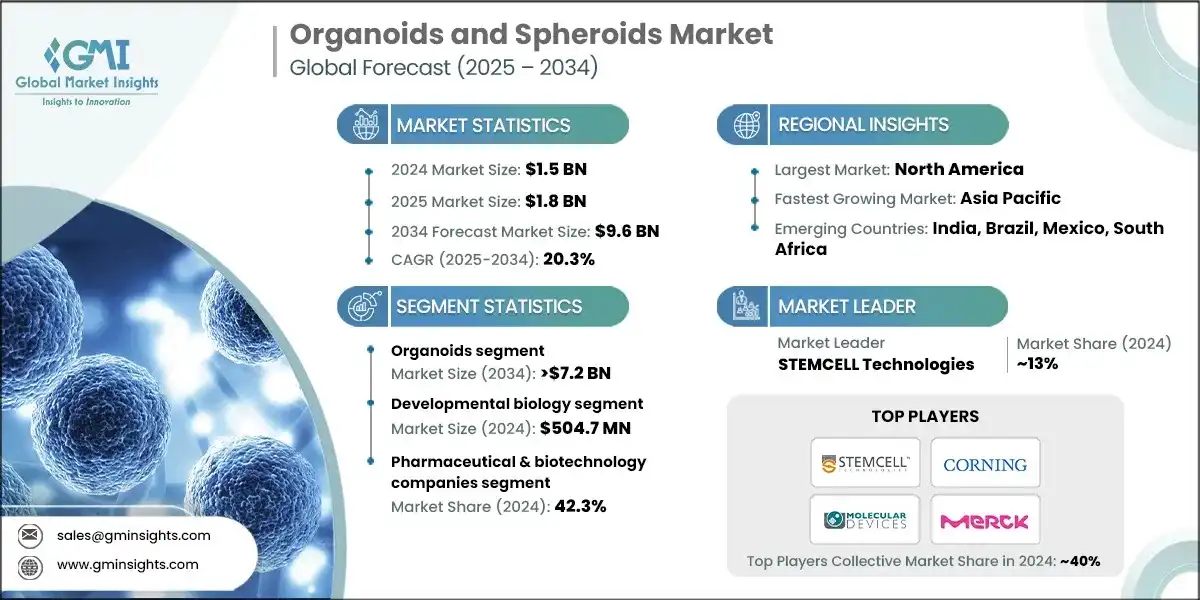
The global organoids and spheroids market was estimated at USD 1.5 billion in 2024. The market is expected to grow from USD 1.8 billion in 2025 to USD 9.6 billion in 2034, at a CAGR of 20.3%, according to the latest report published by Global Market Insights Inc. The market is experiencing rapid growth primarily due to the increasing demand for physiologically relevant 3D cell culture models that better replicate human biology compared to traditional 2D cultures.
Organoids and Spheroids Market Key Takeaways
Market Size & Growth
- 2024 Market Size: USD 1.5 Billion
- 2025 Market Size: USD 1.8 Billion
- 2034 Forecast Market Size: USD 9.6 Billion
- CAGR (2025–2034): 20.3%
Regional Dominance
- Largest Market: North America
- Fastest Growing Region: Asia Pacific
Key Market Drivers
- Advancement in cell culture technologies.
- Increase in demand for personalized medicine.
- Rise in prevalence of chronic diseases.
- Technological advancement in 3D spheroid systems.
Challenges
- Lack of robust disease models.
- High cost of development and maintenance.
Opportunity
- Expansion of organoid biobanks and rare disease modelling.
- Integration of AI and digital platforms.
Key Players
- Market Leader: STEMCELL Technologies led with over 13% market share in 2024.
- Leading Players: Top 5 players in this market include STEMCELL Technologies, Corning, Molecular Devices, Merck KGaA, which collectively held a market share of 40% in 2024.
Get Market Insights & Growth Opportunities
This increasing shift towards the 3D models is stimulated by the high need for accuracy, predictive, scalable, and ethically viable alternatives to animal testing, especially in oncology, neurology, and regenerative medicine, thereby driving the growth of the organoids and spheroids market.
In addition, the increasing adoption of patient-derived organoids and spheroids, which allow for personalized treatment strategies and biomarker discovery, is further contributing to the market growth. These models are particularly valuable in oncology, where genetic mutations can be studied in real-time using tumour-derived organoids. Immunotherapy and targeted therapy development are benefiting significantly from these platforms, as they enable the testing of drug responses in a patient-specific context, improving treatment outcomes and reducing trial-and-error approaches.
The organoids and spheroids market refers to the industry focused on the development, production, and commercialization of three-dimensional (3D) cell culture models, including organoids and spheroids, used for research, drug discovery, toxicity testing, disease modelling, and regenerative medicine applications. The market is dominated by key players, such as STEMCELL Technologies, Corning, Molecular Devices, and Merck KGaA. These companies are actively contributing to market growth by offering specialized organoids and spheroids products.
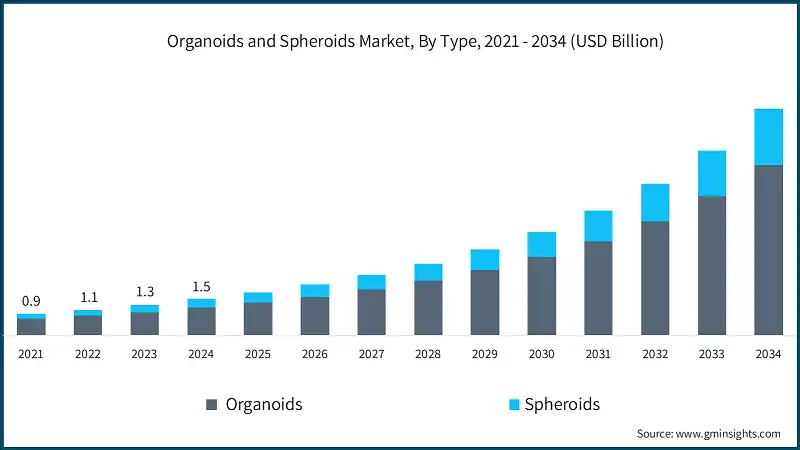
The market has witnessed steady growth, increasing from USD 907.3 million in 2021 to USD 1.3 billion in 2023. Factors such as the rising prevalence of chronic diseases, such as cancer, neurodegenerative disorders, and gastrointestinal conditions, that require advanced preclinical models for drug development and personalized therapy, have significantly contributed to the market growth during this period.
For instance, as per the WHO, over 20 million new cancer cases were reported worldwide in 2022, and according to NIH, 537 million adults were experiencing diabetes in the age group of 20 to 79 years old. These trends are pushing healthcare systems to adopt 3D models that offer high accuracy in mimicking tissue-specific responses, enabling researchers to study disease progression, drug efficacy, and toxicity with greater accuracy.
To get key market trends
Organoids and Spheroids Market Trends
- The market is undergoing a significant transformation as researchers increasingly shift away from traditional animal models toward human-relevant systems. Organoids and spheroids offer superior predictability, scalability, and ethical viability, making them ideal for drug testing and disease modelling.
- Moreover, the integration of AI-powered image analysis and digital platforms is accelerating the use of organoid-based diagnostics. These technologies enable real-time monitoring and personalized treatment strategies, particularly in oncology and rare disease applications.
- Further, the rising costs and limitations of conventional preclinical models are encouraging the adoption of organoids and spheroids. These models provide faster, more accurate results with reduced systemic variability, aligning with the growing demand for precision medicine.
- Additionally, there is a surge in interest in patient-derived organoids (PDOs), which replicate individual disease profiles. This is driving innovation in personalized medicine and expanding the scope of therapeutic research, especially for rare and heterogeneous conditions.
- Also, the emergence of multi-organoid systems and organ-on-chip platforms is enhancing the simulation of complex tissue interactions. These advanced models are improving outcomes in drug screening, toxicity testing, and disease progression studies.
- The growing adoption of tumour spheroids and organoids in oncology is enabling localized drug testing and reducing reliance on animal models. This approach is improving response prediction and supporting biomarker-driven screening strategies.
- In addition, rising awareness of disease heterogeneity and treatment resistance is prompting researchers to explore diverse organoid libraries. These libraries allow for more nuanced therapeutic evaluations across genetic backgrounds and disease subtypes.
- The development of scalable manufacturing platforms and standardized protocols is further expanding access to organoid technologies. This is facilitating broader adoption in both academic and industrial environments.
- Moreover, the expansion of organoid biobanks with genetic diversity is bridging the gap between population-level research and individualized therapy development. These biobanks are becoming vital resources for clinical trials and translational research.
- The rising popularity of co-culture models and immune-organoid systems is transforming immunotherapy research. These models offer valuable insights into tumor-immune interactions and are being used to evaluate checkpoint inhibitors and other immune-modulating therapies.
- Additionally, growing interest in post-treatment modeling, including recurrence and resistance studies, is stimulating growth in adjunctive organoid applications. These models help researchers understand long-term treatment outcomes and refine therapeutic strategies.
Organoids and Spheroids Market Analysis
Learn more about the key segments shaping this market
Based on type, the organoids and spheroids market is categorized into organoids and spheroids. The organoids segment accounted for 76.2% of the market in 2024 which is stimulated due to ability to replicate organ-specific architecture and function, enabling more accurate drug screening and predictive modelling. The segment is expected to exceed USD 7.2 billion by 2034, growing at a CAGR of 20.2% during the forecast period.
- The organoids segment dominates due to its ability to replicate organ-specific architecture and function, making it highly valuable for disease modelling and drug screening. Also, there is a rising trend in the use of organoids for personalized medicine, especially in oncology, where patient-derived models are enabling targeted therapy selection. Moreover, increasing integration of organoids in regenerative medicine is stimulating demand, particularly for liver, intestinal, and neural tissue repair applications.
- The segment is benefiting from growing adoption in infectious disease research, with organoids being used to study host-pathogen interactions in lung, gut, and brain tissues.
- The segment is also supported by expanding organoid biobanks, which offer standardized, genetically diverse models for large-scale research and clinical validation.
- On the other hand, the spheroids segment is projected to grow steadily, supported by its widespread use in cancer research, toxicology testing, and high-throughput screening for their simplicity, cost-effectiveness, and ability to mimic tumour microenvironments, making them ideal for early-stage drug evaluation.
Based on application, the organoids and spheroids market is segmented into developmental biology, personalized medicine, regenerative medicine, disease pathology studies and drug toxicity & efficacy testing. The developmental biology segment dominated the market in 2024 with USD 504.7 million market size, driven due to the increasing use of organoid models to study early-stage organ formation, cellular differentiation, and tissue morphogenesis under controlled laboratory conditions.
- The segment is witnessing a strong upward trend due to the rising demand for physiologically relevant models that can mimic embryonic and fetal development.
- Moreover, advancements in stem cell reprogramming, 3D culture systems, and microfluidic platforms are further advancing the adoption of organoids in developmental biology.
- Also, the ability to generate organoids that retain age-specific molecular signatures and self-organize into tissue-like structures is transforming how researchers study organ maturation and aging. Additionally, the integration of AI-powered analytics and real-time imaging tools is enhancing the precision and scalability of developmental studies.
- In contrast, the personalized medicine segment is gaining traction as researchers increasingly utilize patient-derived organoids to simulate individual disease profiles and predict therapeutic responses.
- Simultaneously, the regenerative medicine segment is expanding as organoids demonstrate strong potential in tissue repair and organ regeneration. Applications in liver, intestinal, and neural restoration are advancing rapidly, supported by innovations in stem cell engineering and scaffold-based culture systems.
Learn more about the key segments shaping this market
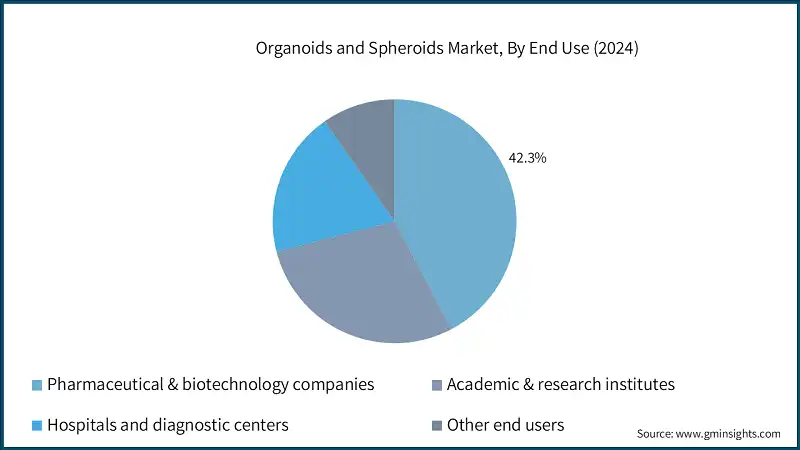
Based on end use, the organoids and spheroids market is segmented into pharmaceutical & biotechnology companies, academic & research institutes, hospitals and diagnostic centers and other end users. The pharmaceutical & biotechnology companies segment dominated the market in 2024 with a market share of 42.3%, stimulated by the rising adoption of organoids and spheroids in drug discovery, toxicity testing, and personalized therapy development.
- Pharmaceutical and biotech companies are increasingly integrating organoids and spheroids into early-stage drug discovery to improve predictive accuracy and reduce attrition rates in clinical trials.
- Moreover, these companies are leveraging 3D models to simulate human tissue responses, enabling faster identification of lead compounds and toxicity profiles. The segment is seeing rising investment in screening platforms that utilize organoids for testing multiple drug candidates simultaneously.
- Additionally, organoids are being used to validate biomarkers and optimize targeted therapies, particularly in oncology and rare disease pipelines. Biotechnology firms are collaborating with academic institutions and CROs to co-develop organoid-based assays and expand therapeutic applications.
- Meanwhile, academic and research institutes represent a rapidly growing segment, driven by expanding applications in developmental biology, disease modelling, and stem cell research. These institutions are at the forefront of innovation, leveraging organoids and spheroids to explore genetic pathways, simulate organogenesis, and validate therapeutic targets.
- Likewise, hospitals and diagnostic centers are gradually adopting organoid technologies for clinical applications such as personalized oncology, infectious disease modelling, and molecular diagnostics.
Looking for region specific data?
North America Organoids and Spheroids Market
The North America market dominated the market with a market share of 42.7% in 2024. The market is escalated by the advanced biomedical research infrastructure, early adoption of innovative technologies, and strong presence of leading pharmaceutical and biotechnology companies.
- The market is further stimulated due to the rising prevalence of chronic diseases that includes cancer, various neurological disorders, and gastrointestinal conditions, which are constantly increasing demand for predictive and human-relevant preclinical models.
- The countries in North America such as U.S. and Canada are experiencing a surge in organoid-based research and commercial activity, escalated by high research and investments, availability of patient-derived biobanks, and integration of organoids into precision medicine workflows.
- The region leads in clinical trial activity involving organoids and spheroids, reflecting a favourable regulatory environment and growing acceptance of non-animal testing models.
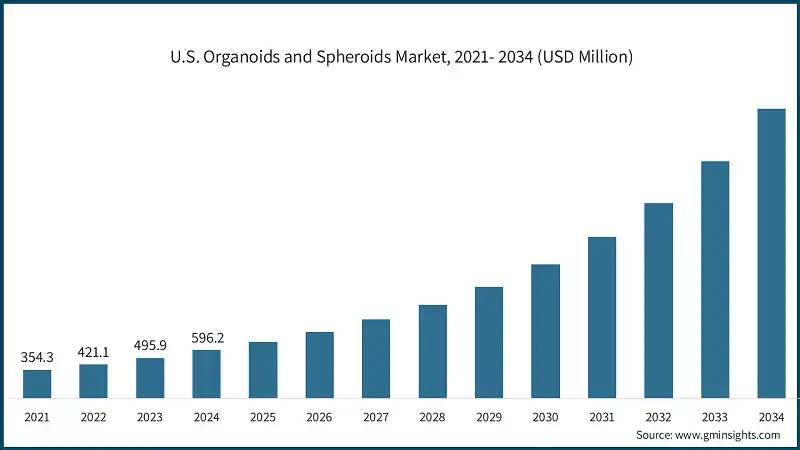
The U.S. organoids and spheroids market was valued at USD 354.3 million and USD 421.1 million in 2021 and 2022, respectively. The market size reached USD 596.2 million in 2024, growing from USD 495.9 million in 2023.
- The increasing prevalence of chronic diseases in the U.S. is escalating demand for advanced biomedical research tools such as organoids and spheroids. As healthcare systems seek more predictive and cost-effective solutions, the adoption of organoids and spheroids is accelerating across research institutions and biotech companies.
- Moreover, an estimated 129 million people in the U.S. are living with at least one major chronic disease such as heart disease, cancer, diabetes, obesity, or hypertension as mentioned by the CDC. This massive patient population creates an urgent need for innovative platforms that can replicate human tissue responses more accurately.
- Therefore, the surge in chronic disease cases is not only amplifying the demand for more effective treatment strategies but also reinforcing the role of organoids and spheroids as essential tools in biomedical innovation.
Europe Organoids and Spheroids Market
Europe market accounted for USD 404 million in 2024 and is anticipated to show lucrative growth over the forecast period.
- European countries such as Germany and France are witnessing a steady rise in chronic and complex conditions escalating demand for organoids and spheroids, offering more physiologically relevant platforms for drug discovery, and personalized medicine. According to WHO, over 74 million adults in the region are affected by diabetes alone, further emphasizing the need for innovative preclinical models.
- Countries such as the UK, Italy, and Spain are strengthening national biomedical research and healthcare innovation programs by improving access to cutting-edge technologies such as organoid-based platforms.
Germany organoids and spheroids market is anticipated to witness considerable growth over the analysis period.
- Germany’s healthcare and research ecosystem is actively integrating advanced cell culture technologies into national biomedical strategies, supported by structured health technology assessments and funding mechanisms that prioritize innovation and translational potential.
- The presence of leading academic research hubs and translational medicine centers is stimulating the development of organoid-based models for personalized oncology, and infectious disease research.
- Germany’s market is also benefiting from its leadership in clinical and preclinical research, with a high volume of organoid and spheroid-based studies being conducted across university hospitals, biotech incubators, and private research institutions.
Asia Pacific Organoids and Spheroids Market
The Asia Pacific market is anticipated to grow at the highest CAGR of 20.7% during the analysis timeframe.
- The region consists of key markets including China, India, Japan, South Korea, and Australia, is witnessing rapid growth in biomedical research infrastructure, supported by advancements in cell culture technologies as research institutions and biotech firms across countries.
- Additionally, healthcare system and high disposable income levels enhance access to professional biomedical innovation, attracting global collaborations and investments.
- In addition, technological advancements in 3D spheroid systems such as microfluidic platforms, improved biomaterials, and automation are enhancing the precision and reproducibility of cell-based models.
China organoids and spheroids market is predicted to grow significantly over the forecast period.
- The growing prevalence of chronic diseases in China is intensifying the need for advanced biomedical research tools such as organoids and spheroids. As healthcare systems shift toward precision medicine, the adoption of these technologies is accelerating across research and clinical settings.
- In the country NIH mentions, chronic diseases account for 87% of total deaths, and represent approximately 70% of the overall disease burden, posing a major challenge for prevention and treatment. This high impact is stimulating demand for innovative platforms that can support personalized drug testing and disease modeling.
- Therefore, the dual pressures of managing widespread chronic illnesses and advancing personalized healthcare are propelling the growth of the market in China.
Latin America Organoids and Spheroids Market
Brazil is experiencing significant growth in the market due to rising chronic disease prevalence.
- Technological advancements in 3D spheroid systems are opening new possibilities for biomedical research across Brazil. Innovations such as improved scaffold designs, automated culture platforms, and enhanced imaging techniques are enabling more accurate and scalable human tissues.
- As the country experiences increase in investment in biotechnology and academic research, the adoption of advanced 3D spheroid technologies is changing momentum. These tools are supporting the country’s growing interest in personalized medicine and regenerative therapies, while also reducing reliance on animal testing and improving translational research outcomes.
Middle East and Africa Organoids and Spheroids Market
Saudi Arabia market is poised to witness substantial growth in Middle East and Africa market during the forecast period.
- The country is investing heavily in biomedical research infrastructure, with national initiatives aimed at integrating organoid and spheroid technologies into translational research, precision medicine, and drug development pipelines.
- Collaborations between academic institutions, government research bodies, and international biotech firms are accelerating the adoption of 3D cell culture platforms for toxicity screening, and regenerative medicine applications.
Organoids and Spheroids Market Share
The market is moderately consolidated, with leading life sciences and biotechnology companies holding a significant share, while innovation continues to flourish among emerging players. Top companies STEMCELL Technologies, Corning, Molecular Devices, and Merck KGaA collectively account for approximately 40% of the global market. These players maintain their leadership through comprehensive product portfolios, proprietary 3D cell culture technologies, strategic collaborations, and robust global distribution networks.
Additionally, niche players such as ACROBiosystems, AMSBIO, Lonza, Prellis Biologics, and ATCC are gaining momentum by advancing organoid expansion techniques, microfluidic systems, and tissue engineering platforms. These companies are driving market growth by offering enabling technologies for personalized medicine, CDMO services, and high-content screening solutions. This dynamic environment fosters rapid technological advancements and competitive differentiation, accelerating the evolution of 3D cell culture into a scalable, precision-driven domain for drug development and disease modelling.
Organoids and Spheroids Market Companies
Few prominent players operating in the organoids and spheroids industry includes:
- ACROBiosystems
- AMSBIO
- ATCC
- Corning
- DefiniGEN
- Lonza
- Merck KGaA
- Molecular Devices
- Prellis Biologics
- STEMCELL Technologies
- STEMCELL Technologies
STEMCELL Technologies leads the organoids and spheroids market with 13% in the market, a strong global footprint and an extensive portfolio of specialized reagents, media, and protocols tailored for organoid culture. STEMCELL’s innovations in gastrointestinal, neural, and cancer organoid systems, combined with its support for standardized workflows and training resources, reinforce its leadership in enabling scalable and physiologically relevant 3D cell culture models.
Corning holds a significant share of the market through its pioneering contributions in extracellular matrices and 3D culture platforms. Its flagship product, Matrigel, remains a cornerstone for organoid formation and maintenance, widely adopted across pharmaceutical and academic labs. Corning’s integration of material science with life sciences has enabled the development of high-throughput compatible microplates and scaffolds, supporting drug screening, disease modelling, and regenerative medicine applications.
Molecular Devices acquired Cellesce in December 2022, integrating proprietary patient-derived organoid (PDO) manufacturing capabilities into its portfolio. The company offers 3D Ready Organoids and Organoid Expansion Services with bioprocess technology that significantly increases productivity, enabling reproducible organoid production for drug screening and disease modeling. Supported by automation solutions and the Organoid Innovation Center, Molecular Devices provides an integrated workflow for scaling organoid programs in drug discovery.
Organoids and Spheroids Market Report Attributes
| Key Takeaway | Details |
|---|---|
| Market Size & Growth | |
| Base Year | 2024 |
| Market Size in 2024 | USD 1.5 Billion |
| Market Size in 2025 | USD 1.8 Billion |
| Forecast Period 2025 – 2034 CAGR | 20.3% |
| Market Size in 2034 | USD 9.6 Billion |
| Key Market Trends | |
| Drivers | Impact |
| Advancement in cell culture technologies | Innovations in stem cell culture, scaffolds, and bioreactors are improving the reliability and scalability. |
| Increase in demand for personalized medicine | Growing use of patient-derived models is enabling more accurate and individualized drug testing and therapy development. |
| Rise in prevalence of chronic diseases | The increasing burden of cancer, neurological, and gastrointestinal disorders is driving the need for better disease modelling tools. |
| Technological advancement in 3D spheroid systems | Integration of bioprinting and automated platforms is enhancing drug screening efficiency and expanding research applications. |
| Pitfalls & Challenges | Impact |
| Lack of robust disease models | Limited availability of validated organoid models for complex and rare diseases restricts broader clinical and research use. |
| High cost of development and maintenance | Specialized reagents, equipment, and skilled labour make these systems expensive and less accessible in low-resource settings. |
| Opportunities: | Impact |
| Expansion of organoid biobanks and rare disease modelling | Building standardized organoid libraries can support research into rare conditions and improve drug development pipelines. |
| Integration of AI and digital platforms | AI-powered analysis and digital diagnostics are enhancing precision, scalability, and predictive capabilities of 3D models. |
| Market Leaders (2024) | |
| Market Leaders |
13% market share |
| Top Players |
Collective market share in 2024 is ~40% |
| Competitive Edge |
|
| Regional Insights | |
| Largest Market | North America |
| Fastest growing market | Asia Pacific |
| Emerging countries | India, Brazil, Mexico, South Africa |
| Future outlook |
|
What are the growth opportunities in this market?
Organoids and Spheroids Industry News
- In October 2025, Precision Cell Systems (PCS), a cell analysis tools company, announced its acquisition of BennuBio. This strategic move allows PCS to enter the 3D cell culture market and continue its consolidation strategy of acquiring complementary technologies for sample preparation and cellular analysis. This strengthened Precision Cell Systems presence in the market.
- In September 2025, The National Institutes of Health allocated USD 87 million to establish the Standardized Organoid Modeling (SOM) Center at the Frederick National Laboratory for Cancer Research. The initiative aimed to develop reproducible organoid models for preclinical drug testing and reduce reliance on animal models. This move positioned NIH as a key driver in advancing organoid-based research and regulatory adoption.
- In December 2024, Merck announced the acquisition of HUB Organoids, a pioneer in the field of organoid technology. The deal expands Merck's next-generation biology portfolio, incorporating HUB's foundational patent portfolio and expertise in developing patient-derived organoids for drug development.
The organoids and spheroids market research report includes in-depth coverage of the industry with estimates and forecast in terms of revenue in USD Million from 2021 - 2034 for the following segments:
Market, By Type
- Organoids
- By Type
- Neural organoids
- Hepatic organoids
- Intestinal organoids
- Other organoid types
- By Method
- General submerged method for organoid culture
- Crypt organoid culture techniques
- Air Liquid Interface (ALI) method
- Other organoid culture methods
- By Source
- Primary tissues
- Stem cells
- By Type
- Spheroids
- By Type
- Multicellular tumor spheroids
- Neurospheres
- Mammospheres
- Hepatospheres
- By Method
- Micropatterned plates
- Low cell attachment plates
- Hanging drop method
- Other spheroid culture methods
- By Source
- Cell line
- iPSCs derived cells
- By Type
Market, By Application
- Developmental biology
- Personalized medicine
- Regenerative medicine
- Disease pathology studies
- Drug toxicity & efficacy testing
Market, By End Use
- Pharmaceutical & biotechnology companies
- Academic & research institutes
- Hospitals and diagnostic centers
- Other End Use
The above information is provided for the following regions and countries:
- North America
- U.S.
- Canada
- Europe
- Germany
- UK
- France
- Italy
- Spain
- Netherlands
- Asia Pacific
- China
- Japan
- India
- Australia
- South Korea
- Latin America
- Brazil
- Mexico
- Argentina
- Middle East and Africa
- South Africa
- Saudi Arabia
- UAE
Frequently Asked Question(FAQ) :
What is the market size of the organoids and spheroids market in 2024?
The market size was USD 1.5 billion in 2024, with a CAGR of 20.3% expected through 2034, driven by the increasing demand for physiologically relevant 3D cell culture models that replicate human biology more effectively than traditional 2D cultures.
What is the projected value of the organoids and spheroids market by 2034?
The market is expected to reach USD 9.6 billion by 2034, fueled by advancements in personalized medicine, AI-powered diagnostics, and the growing adoption of patient-derived organoids (PDOs).
What is the projected size of the organoids and spheroids market in 2025?
The market is expected to reach USD 1.8 billion in 2025.
What was the market share of the organoids segment in 2024?
The organoids segment accounted for 76.2% of the market in 2024, driven by its ability to replicate organ-specific architecture and function, enabling accurate drug screening and predictive modeling.
What was the valuation of the developmental biology segment in 2024?
The developmental biology segment held a market size of USD 504.7 million in 2024, driven by the use of organoid models to study early-stage organ formation, cellular differentiation, and tissue morphogenesis under controlled laboratory conditions.
Which end-use segment dominated the organoids and spheroids market in 2024?
The pharmaceutical and biotechnology companies segment dominated the market in 2024 with a 42.3% share, driven by the adoption of organoids and spheroids in drug discovery, toxicity testing, and personalized therapy development.
Which region leads the organoids and spheroids market?
North America led the market with a 42.7% share in 2024, supported by advanced biomedical research infrastructure, early adoption of innovative technologies, and the strong presence of leading pharmaceutical and biotechnology companies.
What are the upcoming trends in the organoids and spheroids industry?
Key trends include the shift from animal models to human-relevant systems, integration of AI-powered image analysis for diagnostics, rising interest in patient-derived organoids (PDOs) for personalized medicine, and the growing demand for precision medicine.
Who are the key players in the organoids and spheroids market?
Key players include ACROBiosystems, AMSBIO, ATCC, Corning, DefiniGEN, Lonza, Merck KGaA, Molecular Devices, Prellis Biologics, and STEMCELL Technologies.
Organoids and Spheroids Market Scope
Related Reports