Summary
Table of Content

Organic Peroxide Market
Get a free sample of this report
Form submitted successfully!
Error submitting form. Please try again.
Thank you!
Your inquiry has been received. Our team will reach out to you with the required details via email. To ensure that you don't miss their response, kindly remember to check your spam folder as well!
Request Sectional Data
Thank you!
Your inquiry has been received. Our team will reach out to you with the required details via email. To ensure that you don't miss their response, kindly remember to check your spam folder as well!
Form submitted successfully!
Error submitting form. Please try again.
Organic Peroxide Market Size
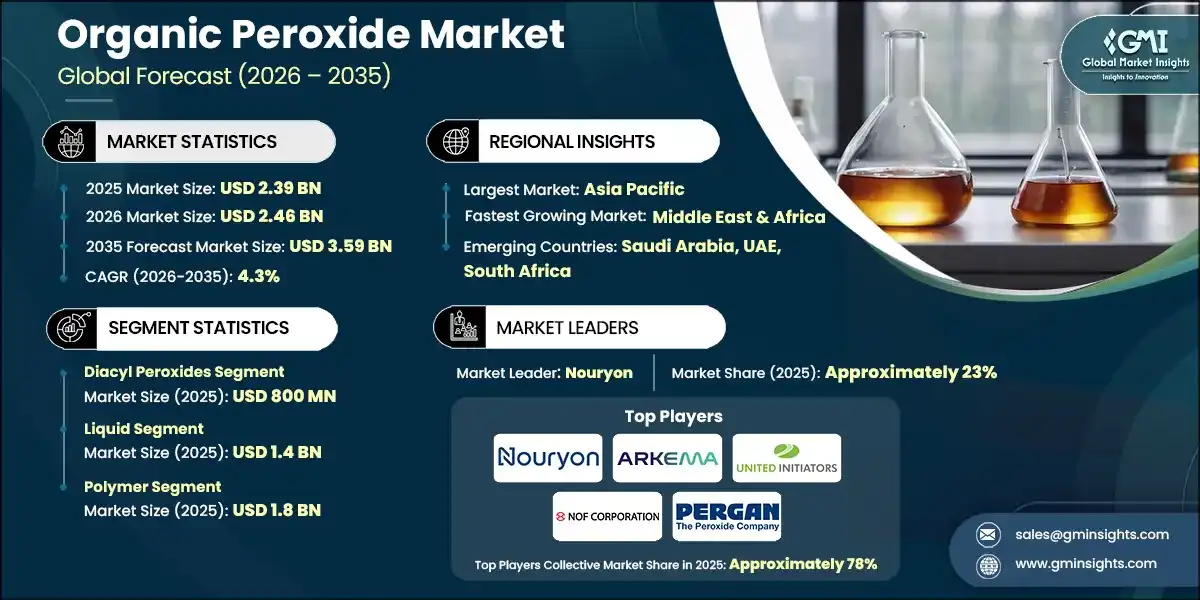
The global organic peroxide market was valued at USD 2.39 billion in 2025. It is projected to grow from USD 2.46 billion in 2026 to USD 3.59 billion by 2035, representing 4.3% CAGR from 2026 to 2035, according to latest report published by Global Market Insights Inc.
To get key market trends
- Organic peroxide industry is experiencing a stable growth owing to the increased demand in the polymerization process applied in plastics and elastomers. Organic peroxides are important as catalysts and curing agents, and they are therefore essential in the manufacture of polyethylene, polypropylene, PVC, and rubber products. The consumption of these polymers in the packaging, construction and consumer goods industries is indeed helping to drive the growth of the market. Demand further is boosted by continuous capacity increases in the production of polymers.
- The other important growth drive is the widening application of high-performance composites and cross-linked polymer in the automotive, aerospace, and wind energy applications. Organic peroxides are vital in the cure of thermoset resins as well as reinforcing composite materials which are rapidly being used to save weight in enhancing strength and durability. Consumption is increasing at a faster rate due to growth in electric vehicles, lightweight automotive parts, and wind turbine blades. This is a stronger market trend that is reinforcing the presence of the market in high value industrial applications.
- The behavior towards light and green materials is also playing a role in growth of the market. The use of polymer-based and composite materials is also becoming popular among manufacturers in the process of substituting traditional materials to enhance energy efficiency and minimize emissions. Such structures of polymers that satisfy such performance and sustainability requirements are possible using organic peroxides. This long-term movement in the end-use industries is also generating long-term demand stability in the organic peroxide products.
- Moreover, injection into the market is being facilitated by increasing use in coatings, adhesives and specialty elastomers. These formulations increase the efficiency of curing, thermal resistance and performance of mechanical performance of organic peroxides. Due to increasing demand for high performance coatings and adhesives in construction, automotive and industrial maintenance is enhancing their application base. With the growth in the specialty applications, they are not only driving up the volumes but also adding value to the market.
Organic Peroxide Market Report Attributes
| Key Takeaway | Details |
|---|---|
| Market Size & Growth | |
| Base Year | 2025 |
| Market Size in 2025 | USD 2.39 Billion |
| Market Size in 2026 | USD 2.46 Billion |
| Forecast Period 2026 - 2035 CAGR | 4.3% |
| Market Size in 2035 | USD 3.59 Billion |
| Key Market Trends | |
| Drivers | Impact |
| Rising demand from polymerization processes in plastics and elastomers | Boosts consumption of organic peroxides as key initiators |
| Expansion of high-performance composites in automotive, aerospace, and wind energy | Accelerates peroxide use for curing and crosslinking in composites |
| Increasing focus on lightweight and sustainable materials | Drives innovation in peroxide-based formulations for eco-friendly solutions |
| Growing applications in coatings, adhesives, and specialty elastomers | Expands market reach into diverse industrial segments |
| Pitfalls & Challenges | Impact |
| Stringent safety, handling, and storage regulations | Increases compliance costs and limits operational flexibility |
| Volatility in raw material prices | Creates pricing pressure and margin instability for manufacturers |
| Opportunities: | Impact |
| Emerging applications in healthcare and medical device manufacturing | Opens high-value niche markets for peroxide-based polymers |
| Rapid industrialization in Asia-Pacific creating new consumption hubs | Spurs regional demand and capacity expansion opportunities |
| Increased investment in specialty chemicals for high-value end-use sectors | Strengthens peroxide adoption in advanced material applications |
| Market Leaders (2025) | |
| Market Leaders |
Market Share Approximately 23% |
| Top Players |
|
| Competitive Edge |
|
| Regional Insights | |
| Largest Market | Asia Pacific |
| Fastest growing market | Middle East & Africa |
| Emerging countries | Saudi Arabia, UAE, South Africa |
| Future outlook |
|
What are the growth opportunities in this market?
Organic Peroxide Market Trends
- There is a clear trend in changing the product formulations in the organic peroxide industry to safer and more stable products. Gearing towards increasing shock sensitivity, thermal stability and introducing diluted or controlled release peroxide systems are additional objectives of the manufacturers. This action is transforming the method of transportation, storage, and utilization of organic peroxides in downstream industries. It is also facilitating the broader acceptance by end users who have stringent safety and compliance needs.
- Another trend that is currently influencing the market is sustainability redesign of products. Organizations are also balancing the production of organic peroxide with the concepts of green chemistry by cutting down on emissions, minimizing risky by-products and enhancing the efficiency of the process. There is an increase in efforts to reduce the carbon footprint of peroxide production and adopt cleaner intermediates. This is a trend that is shaping the procurement of large polymer and composite manufacturers.
- The tendency of digitalization and process automation is becoming a determining factor in the process of organic peroxide production. To improve the efficiency of plants and minimize the risks of the operations, manufacturers are implementing superior process controls, real-time monitoring systems, and predictive safety analytics. This change is enhancing the uniformity in quality of products and reinforcing regulatory conformance. Digital manufacturing is turning out to be a differentiating capability in the market over time.
- There is also a change in production and supply chain to regionalization in the market. Localization or expansion of chemical companies to closer proximity with major polymer and composite consumers is to provide improvement to supply security and decrease logistical risks. This is changing the dynamics of world trade and promoting capacity growth that is not confined to the conventional centers of production. Consequently, there is a balance in market structure in the regions.
Organic Peroxide Market Analysis
Learn more about the key segments shaping this market
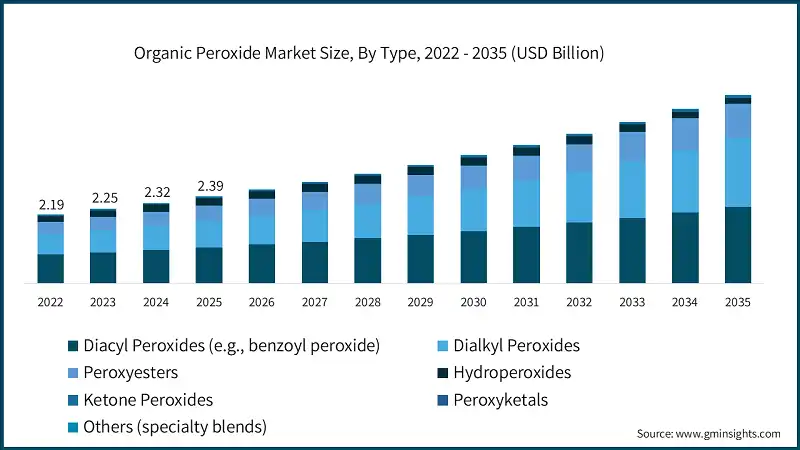
Organic peroxide industry based on type is segmented into diacyl peroxides (e.g., benzoyl peroxide), dialkyl peroxides, peroxyesters, hydroperoxides, ketone peroxides, peroxyketals, and others (specialty blends). The diacyl peroxides segment was valued at USD 800 million in 2025, and it is anticipated to expand to 4.4% of CAGR during 2026-2035.
- Diacyl peroxides, including benzoyl peroxide, still have application in processes where initiation is required to be controlled, and the reaction is expected to be predictable. Dialkyl peroxides are becoming more a preferred choice in the process when higher temperatures are involved as they are more stable and predictable to decompose. Such processing difference is favoring consistent growth around various types of peroxide.
- The use of peroxyesters and hydroperoxides is gaining momentum as manufacturers need to be flexible in the reaction speed and processing efficiency. Such types allow one to control polymer characteristics of a wide variety of resin systems. The use of ketone peroxides and peroxyketals in composite and reinforced plastics with curing precision directly affecting mechanical performance is on the increase. Their application is associated with the increased sophistication of the manufacturing of composite materials.
- The growth in the market is driven by specialty blends and other tailored peroxide formulations that are tailored to meet the application requirements with regard to performance and safety. End users are placing more and more demands on custom-made solutions that are optimized to be compatible, stable in storage and processing environment. This is the trend towards personalized peroxide systems that are both affecting product development strategy and more intimate supplier-processor partnership. In general, the performance customization and alignment of applications are driving growth between the types instead of the volume based demand.
Organic peroxide market based on form is segmented into liquid, paste, powder, and granules. The liquid segment was valued at USD 1.4 billion in 2025, and it is anticipated to expand to 4.4% of CAGR during 2026-2035.
- Liquid organic peroxides find more and more applications in processes when the exact dosing, even dispersion, and the automated feeding system is needed. Processes which focus on controlled release and enhanced handling safety are being adopted using paste and powder forms. This type of segmentation in the form is based on the flexibility necessary in a variety of polymer and composite manufacturing settings.
- The granular and paste organic peroxides are being featured in areas where the formation of the dust is minimized, the storage stability is enhanced, and the transportation is safer. Powder forms are still utilized in some formulations wherein quick activation and easy blending is needed. Formulations of specialty in all forms are being formulated to strike a balance between performance and safety and regulatory compliance. Altogether, operational comfort and streamlining processes cause expansion by form instead of chemical functionality transformation.
Learn more about the key segments shaping this market
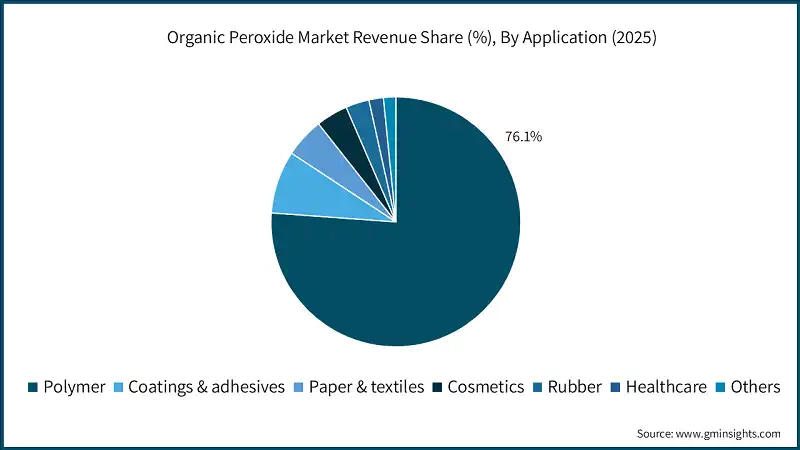
Organic peroxide market based on application is segmented into polymer, coatings & adhesives, paper & textiles, cosmetics, rubber, healthcare, and others. The polymer segment was valued at USD 1.8 billion with a market share of with a market share of 76.1% in 2025, and it is anticipated to expand to 4.1% of CAGR during 2026-2035.
- Organic peroxides are also finding increasing application in polymer and rubber processes to obtain controlled polymerization and high mechanical properties. Coatings and adhesives usage is also advancing with organic peroxides being used to allow quicker curing and better thermal resistance. The applications are producing reliable demand in the industrial and specialty material segments.
- Organic peroxides are being used in paper, textile, cosmetics and healthcare where they are used in bleaching, surface treatment and controlled chemical reactions. Growing attention to product quality, process efficiency, and compliance with the regulations is an issue that drives demand in these segments. Other niche applications are coming forth whereby special functional results are needed on a case-by-case basis using specific peroxide formulations. All in all, end-use industry diversification is through application-based growth as opposed to that of reliance on a single industry.
Looking for region specific data?
The North America organic peroxide market accounted for USD 660 million in 2025 and is anticipated to show lucrative growth over the forecast period.
North America is experiencing steady growth in the market due to the presence of robust polymer production, usage of composites and the presence of steady demand in the automotive, construction and industrial markets. The region enjoys the use of high-technology chemical infrastructure, high level of safety, and constant enhancement of process efficiency. Demand is being supported in several types of peroxide by increasing use of cross-linked polymers and thermoset composites. Growth is now more influenced by tailored formula and less hazardous handling approaches as opposed to pure volume growth.
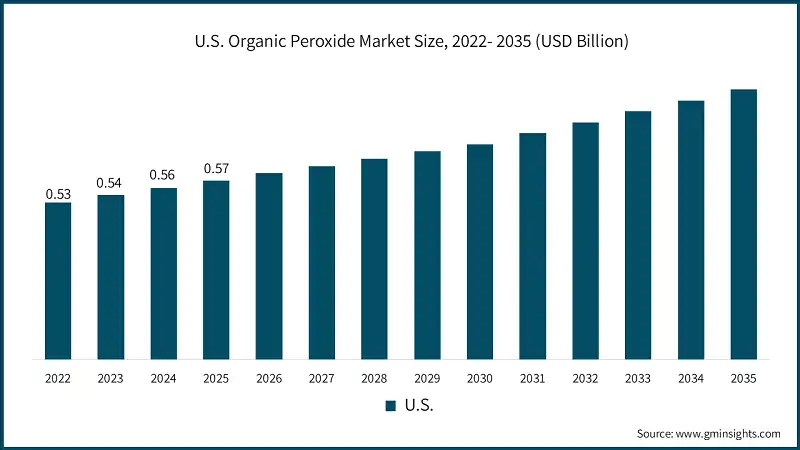
U.S. dominates the North America market, showcasing strong growth potential.
U.S. is in the quickest develop into the country in North America due to the increased consumption of composites in electric vehicles, renewable energy, and infrastructure upgrading. The growing localization of organic peroxides is being supported by growing domestic manufacturing of polymer and emphasis on supply chain localization. The manufacturing companies are switching towards application-specific peroxide grades to address performance and safety needs. The technology- and application-based market development is huge.
The Europe organic peroxide market accounted for USD 620 million in 2025 and is anticipated to show lucrative growth over the forecast period.
The market of organic peroxides is expanding in Europe due to automotive lightweighting, industrial coating, and advanced polymer. The high emphasis on safety, sustainability and regulatory compliance in the region is also affecting the product design and formulation strategies. The trend towards greater use of composite materials in the transportation and renewable energy sector still augers well with market expansion. The cooperation between the chemical manufacturers and the final consumers is intensifying usage-based demand.
Germany dominates the Europe market, showcasing strong growth potential.
Germany is the most growing economy in Europe with the help of a good automotive and industrial manufacturing base. The need to have precision in curing and material performance consistency in polymers and composites is the driving force of demand. The development is associated with sophisticated engineering uses and rising the application of high performance materials. Its market is growing by quality-driven adoption as opposed to quick expansion.
Asia Pacific organic peroxide market accounted for 38.2% market share in 2025 and is anticipated to show lucrative growth over the forecast period.
The market of Asia-Pacific organic peroxides is increasing because of the high production of polymer and increased manufacturing activities and increased consumption of plastic and rubber products. The growth of infrastructure and industrialization is in favor of the use of peroxide in polymerization and cross-linking. The region has been enjoying economic production and growing chemical capacities. Both an extensive application and a slow progression toward quality formulations help in growth.
China organic peroxide industry is estimated to grow with a significant CAGR, in the Asia Pacific market.
China has been the most rapidly developing state in the region with a comprehensive polymer and chemical production system. Growing production of plastics, rubber and composite is another aspect that is driving the need to use organic peroxides. The growing attention to the specialty chemical production within the country is enhancing supply. The development of the market is moving towards better quality and application-specific use.
Latin America organic peroxide market is anticipated to grow at a CAGR of 5.1% during the analysis timeframe.
The market of organic peroxide in Latin America is still developing with the growth of plastics, rubber and construction markets, which require this organic peroxide. Demand of polymer-based materials is rising due to rising urbanization and construction of infrastructure. The use of peroxide as a process in manufacturing is gradually gaining acceptance by the manufacturers to enhance efficiency and consistency in products. The growth is still selective and concentrated in the major industrial areas.
Brazil leads the Latin America market, exhibiting remarkable growth during the analysis period.
Brazil is increasing at a faster rate as compared to other nations in Latin America, because of expansion in packaging, automobile parts, and factory production. The demand for organic peroxide is being supported by increasing polymer processing capacity. Peroxide systems are being employed in companies to improve material performance and reliability of the process. The growth is gradual and associated with modernization and recovery of industries.
Middle East & Africa organic peroxide market is expected to grow at a CAGR of 5.4% during the analysis timeframe.
The Middle East and African market of organic peroxide is growing with the investments in petrochemicals, building and industrial diversification. There is growing interest in downstream production of polymers, which generates the need in curing and cross-linking agents. Slow market growth is being aided by infrastructure initiatives and industrialization. There is an increase in adoption as local production capacity increases.
Saudi Arabia market to experience substantial growth in the Middle East and Africa market in 2025.
Saudi Arabia is also the rapidly developing state in the region, as investments are made in petrochemicals and downstream chemical industries. The growth of mixed polymer and specialty chemical complexes is growing organic peroxide applications. Construction, industrial material, and polymer processing applications are associated with demand. Expansion is fueled by capacity building and long term industrial development strategies.
Organic Peroxide Market Share
- Nouryon, Arkema, United Initiators, NOF Corporation, and Pergan GmbH are a significant part of the global organic peroxide industry and with further standing of being highly consolidated with the top five players steadily holding 78% market share in the year 2025.
- Some of the ways that compete with companies have a wide and diversified organic peroxide portfolio that incorporates various types and forms of peroxides and application requirements. This enables them to offer polymers, composites, rubber as well as specialty uses and avoid overreliance on any single end-use market.
- One of the main competitive strategies is constant investment in product innovation and optimization of its formulation. To address tougher regulatory and customer demands, players are interested in enhancing safety, thermal stability, shelf life and handling properties.
- High emphasis is on application specific customization with the suppliers collaborating with polymer processors to ensure that the peroxide systems are specifically customized to achieve the correct level of curing and performance results. This consolidates customer relationships in the long run and switching costs.
- The presence of global manufacturing bases and local production facilities helps companies to maintain their position. Presence in region will assist in providing supply reliability, regulatory compliance and quicker response to demand over the prime industrial hubs.
- There is a common use of operational excellence and process automation to ensure the efficiency of production and increase the consistency of quality and decrease the risks of safety. The use of advanced process control and monitoring systems helps to optimize costs and comply with all regulations.
- There is strategic emphasis in safety leadership that affects the market where businesses invest a lot in safer formulations, controlled reactivity products and better packaging solutions. This creates confidence in the end users that deal with the risky materials.
- The development of downstream polymer and composite value chains is integrated with the companies to affect the trends of material innovation and processing. They define the trends in the demand of organic peroxide by following the changing polymer technologies.
Organic Peroxide Market Companies
The major players operating in organic peroxide industry include:
- Nouryon
- Arkema
- United Initiators
- NOF Corporation
- Pergan GmbH
- Others
- Nouryon maintains a presence in the peroxide market of the organic peroxide industry by having a broad range of peroxide initiators and cross-linking agents that are polymer, rubber, and composite specific. The company aims at application-based innovation, good technical service and presence of manufacturing around the globe so that supply can always be maintained and customers can be retained.
- Arkema is retaining its position in the market through the incorporation of organic peroxides in its expanded specialty materials and improved polymer solutions portfolio. The company underlines on high-performance formulations, product design about safety and strong association with downstream polymer and composite manufacturers.
- United Initiators places importance on the continuation of its position by specializing in organic peroxide solutions that are utilized in polymerization, elastomers and cross-linking. The company employs the ability to formulate its regional production plants and, good customer relationships to continue competing in the industrial and specialty business.
- NOF Corporation’s precision-engineered organic products based on R&D as well as its leading position is maintained through its organic peroxide products. The company focuses on stable quality and application specific performance and integration with viable polymer and materials technologies.
- Pergan GmbH enforces its position in the market through the provision of customized organic peroxide formulations with significant attention to safety and handling efficiency. The company justifies its standby adopting flexible production, niche applications focusing, and niche technical collaboration with polymer processors.
Organic Peroxide Industry News
- In September 2025, Solvay doubled production capacity of electronic grade hydrogen peroxide at its Zhenjiang, China facility targeting semiconductor and advanced material demand. While focused on H2O2, this expansion is relevant to the broader peroxide ecosystem supporting high-purity and specialty applications connected to polymer and electronics end markets.
- In November 2024, Nouryon completed a major organic peroxide capacity expansion at its Ningbo, China facility. The company doubled production capacity for key peroxide products Perkadox 14 and Trigonox 101 to meet rising demand in polymers and recycled polypropylene applications. This expansion strengthens supply to Asia Pacific polymer and rubber markets and supports performance requirements of recycled plastics.
- In December 2023, Evonik completed the full acquisition of Thai Peroxide Co., Ltd. taking full ownership of the former joint venture to strengthen its specialty peroxide offerings in Asia Pacific. This strategic acquisition enhances Evonik’s peroxide portfolio and regional footprint in peroxides used across polymers, microchips, and other industrial sectors.
- In September 2023, Arkema announced a 2.5-fold expansion of its organic peroxide production capacity at the Changshu, China site backed by approximately Euro 50 million investment to increase Luperox production. This expansion is significant for meeting growing demand from polymer, renewable energy, and specialty materials sectors in Asia.
The organic peroxide market research report includes in-depth coverage of the industry with estimates & forecast in terms of revenue (USD Billion) & (Kilo Tons) from 2022 to 2035, for the following segments:
Market, By Type
- Diacyl Peroxides (e.g., benzoyl peroxide)
- Dialkyl Peroxides
- Peroxyesters
- Hydroperoxides
- Ketone Peroxides
- Peroxyketals
- Others (specialty blends)
Market, By Form
- Liquid
- Paste
- Powder
- Granules
Market, By Application
- Polymer
- Polyethylene
- Polypropylene
- PVC
- Other thermoplastics
- Coatings & adhesives
- Industrial coatings
- Automotive coatings
- Construction adhesives
- Sealants
- Paper & textiles
- Bleaching agents
- Textile finishing
- Paper brightening
- Cosmetics
- Hair care products
- Skin care formulations
- Oral care products
- Rubber
- Crosslinking of elastomers
- Vulcanization processes
- Healthcare
- Pharmaceutical intermediates
- Medical device manufacturing
- Others
The above information is provided for the following regions and countries:
- North America
- U.S.
- Canada
- Europe
- UK
- Germany
- France
- Italy
- Spain
- Rest of Europe
- Asia Pacific
- China
- India
- Japan
- South Korea
- Australia
- Rest of Asia Pacific
- Latin America
- Brazil
- Mexico
- Argentina
- Rest of Latin America
- MEA
- UAE
- Saudi Arabia
- South Africa
- Rest of Middle East and Africa
Frequently Asked Question(FAQ) :
What was the valuation of the liquid form segment in 2025?
The liquid organic peroxide segment was valued at USD 1.4 billion in 2025, driven by precise dosing, improved dispersion, and compatibility with automated polymer processing systems.
Which country leads the organic peroxide market in North America?
The U.S. organic peroxide industry generated a significant share of North America’s USD 0.66 billion valuation in 2025. Growth is driven by rising consumption of composites in electric vehicles, renewable energy, and infrastructure modernization.
What is the growth outlook for the diacyl peroxide type segment through 2035?
The diacyl peroxide segment was valued at USD 0.80 billion in 2025 and is expected to grow at a CAGR of 4.4% through 2035, supported by controlled polymerization demand in plastics and elastomers.
Which region dominates the global organic peroxide market?
Asia Pacific held a 38.2% market share in 2025, supported by large-scale polymer production, expanding manufacturing capacity, and strong demand from plastics and rubber industries.
Who are the key players in the organic peroxide industry?
Key companies operating in the market include Nouryon, Arkema, United Initiators, NOF Corporation, Pergan GmbH, BASF, Solvay, Evonik Industries, DOW, and Huntsman Corporation.
What is the market size of the organic peroxide industry in 2025?
The market size was valued at USD 2.39 billion in 2025 and is expected to grow at a CAGR of 4.3% during 2026–2035, driven by rising demand from polymerization processes in plastics, elastomers, and specialty materials.
What is the current organic peroxide market size in 2026?
The organic peroxide industry is projected to reach USD 2.46 billion in 2026, supported by increasing adoption across polymer, rubber, and composite manufacturing applications.
What is the projected value of the organic peroxide market by 2035?
The organic peroxide industry is expected to reach USD 3.59 billion by 2035, expanding at a CAGR of 4.3% from 2026 to 2035 due to growth in high-performance composites, lightweight materials, and sustainable polymer solutions.
How much revenue did the polymer application segment generate in 2025?
The polymer application segment generated USD 1.8 billion in 2025, accounting for 76.1% market share due to extensive use of organic peroxides as initiators and cross-linking agents.
Organic Peroxide Market Scope
Related Reports