Summary
Table of Content

Optical Sensors Market
Get a free sample of this report
Form submitted successfully!
Error submitting form. Please try again.
Thank you!
Your inquiry has been received. Our team will reach out to you with the required details via email. To ensure that you don't miss their response, kindly remember to check your spam folder as well!
Request Sectional Data
Thank you!
Your inquiry has been received. Our team will reach out to you with the required details via email. To ensure that you don't miss their response, kindly remember to check your spam folder as well!
Form submitted successfully!
Error submitting form. Please try again.
Optical Sensors Market Size
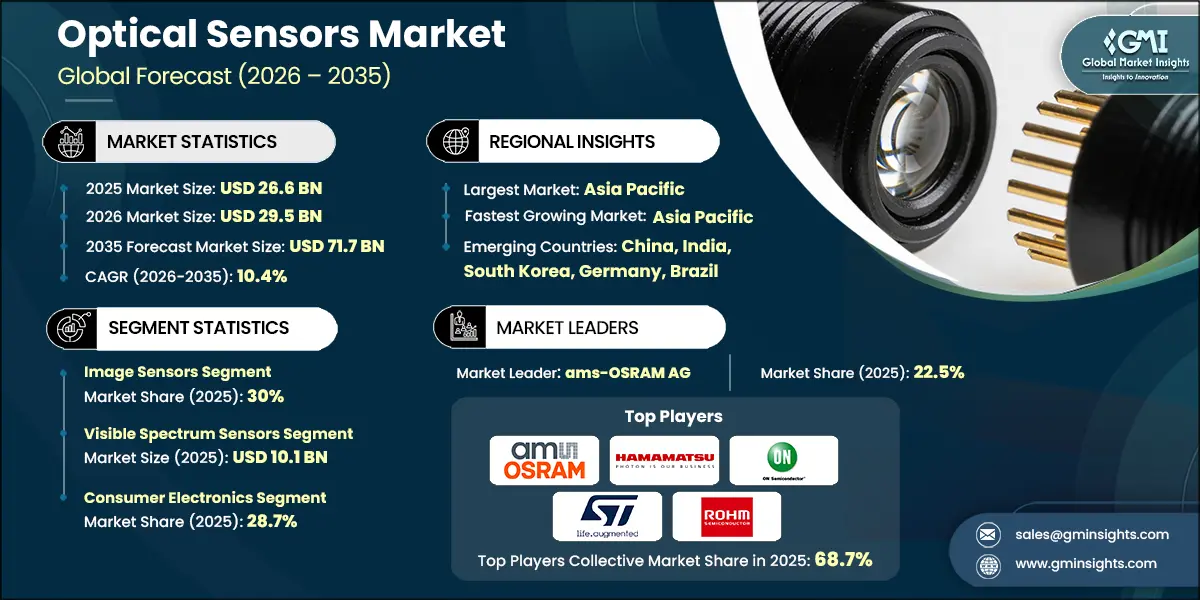
The global optical sensors market was valued at USD 26.6 billion in 2025. The market is expected to grow from USD 29.5 billion in 2026 to USD 47.3 billion in 2031 & USD 71.7 billion in 2035, at a CAGR of 10.4% during the forecast period according to the latest report published by Global Market Insights Inc.
Optical Sensors Market Key Takeaways
Market Size & Growth
- 2025 Market Size: USD 26.6 Billion
- 2026 Market Size: USD 29.5 Billion
- 2035 Forecast Market Size: USD 71.7 Billion
- CAGR (2026–2035): 10.4%
Regional Dominance
- Largest Market: Asia Pacific
- Fastest Growing Region: Asia Pacific
Key Market Drivers
- Rising ADAS and LiDAR integration in passenger vehicles.
- Expanding use in wearable health monitoring devices.
- Optical sensing adoption in medical diagnostics and imaging.
- Demand for precise environmental and gas monitoring systems.
- Growth of smart factories using photoelectric sensing.
Challenges
- High calibration and alignment costs for precision applications.
- Competition from low-cost MEMS and capacitive sensors.
Opportunity
- Optical biosensors for non-invasive disease diagnostics.
- Industrial safety compliance driving machine-vision sensors.
Key Players
- Market Leader: ams-OSRAM AG led with over 22.5% market share in 2025.
- Leading Players: Top 5 players in this market include ams-OSRAM AG, Hamamatsu Photonics K.K., ON Semiconductor Corp., STMicroelectronics N.V., ROHM Co., Ltd., which collectively held a market share of 68.7% in 2025.
Get Market Insights & Growth Opportunities
The optical sensors market is primarily driven by the growing utilization of optical sensors in wearable health monitoring devices, along with the rise in application of optical sensors in imaging and medical diagnostics. The market is further fueled by the increasing demand for accurate environmental and gas monitoring in industrial and commercial applications, as well as the increasing adoption of smart factories that adopt photoelectric sensing for automation, inspection, and safety purposes.
The optical sensors market is primarily driven by the increasing adoption of ADAS and LiDAR technology in passenger vehicles. According to the U.S. Department of Transportation’s NHTSA and PARTS collaboration report, by the 2023 model year 10 out of 14 ADAS features surpassed 50% penetration in U.S. passenger vehicles, with several exceeding over 90 % adoption. This rapid uptake of optical-based safety sensing is accelerating the deployment of optical sensors to improve collision avoidance, enhance situational awareness, and meet evolving safety requirements in automotive manufacturing, like AEB and lane-keeping systems. This factor is likely to propel the demand for optical detection technologies, thereby contributing to market growth.
Growth in the optical sensors market is supported by increasing adoption in medical diagnostics and imaging, where non-invasive accuracy is critical. According to the U.S. Centers for Disease Control and Prevention (CDC), pulse oximetry screening using optical sensors is now implemented in over 98% of U.S. newborn screenings to detect critical congenital heart disease. This government-supported use underscores trust in optical sensing and is driving its adoption in imaging, early diagnosis, and minimally invasive monitoring in global healthcare systems.
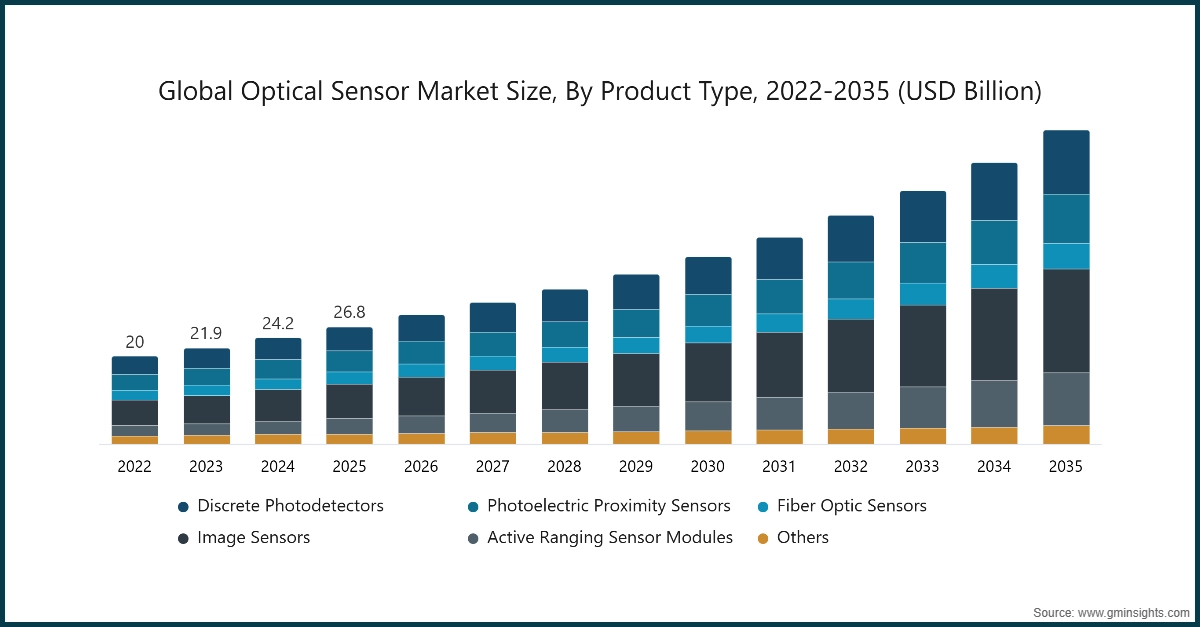
Between 2022 and 2024, the market witnessed considerable growth, increasing from USD 20 billion in 2022 to USD 24.1 billion in 2024 supported by rising vehicle safety requirements, growing penetration of health monitoring wearables, and increased investment in advanced medical imaging technologies. Market adoption during this period was further strengthened by accelerated industrial automation, wider use of optical sensors in gas and emission monitoring, and the gradual transition of manufacturing facilities toward smart factory and Industry 4.0 frameworks.
To get key market trends
Optical Sensors Market Trends
- In optical sensors market, edge-level AI processing is emerging technology to reduce data loads and latency by analyzing signals locally. This trend grows in 2022, driven by the growing need for real-time decisions and bandwidth limitations in industrial and mobility systems. It is expected to continue through 2029 as low-power AI chips improve reliability, response speed, and independent decision-making.
- The growing use of fiber-optic sensing in energy and infrastructure monitoring is transforming long-distance, high-sensitivity measurement applications. Adoption began to gain momentum around 2020 with grid modernization and the expansion of renewable energy sources. This trend will continue through 2030 as utilities concentrate on real-time fault detection and structural health monitoring, improving asset availability and minimizing downtime and maintenance risks.
- Increasing emphasis on standardizing and ensuring safety in optical sensors is shaping procurement and deployment strategies in regulated industries. This trend started to gain traction after 2021 as compliance complexity grew in transportation, healthcare, and industrial systems. Momentum will continue until 2028 as global standards align, improving interoperability and speeding up approvals, while also building long-term trust in optical sensing technologies.
Optical Sensors Market Analysis
Learn more about the key segments shaping this market
Based on product type, the optical sensors market is segmented into discrete photodetectors, photoelectric proximity sensors, fiber optic sensors, image sensors, active ranging sensor modules, and others.
- The image sensors segment made up 30% of the market share in 2025. Image sensors lead the market due to their widespread use in consumer electronics, automotive camera systems, industrial machine vision, and medical imaging. They capture high-resolution visual data, support AI-based analytics, and integrate with digital processing platforms, making them essential for applications that need precision, scalability, and real-time visual intelligence.
- The active ranging sensor modules segment is anticipated to grow at a CAGR of 13.2% over the forecast period. Growth is driven by rising adoption of time-of-flight and LiDAR-based modules in automotive ADAS, robotics, and smart infrastructure. These sensors enable precise depth and distance measurement, supporting collision avoidance, spatial mapping, and autonomous navigation, accelerating adoption in safety-critical and automation-focused applications.
Based on the spectral range, the global optical sensors market is segmented into ultraviolet (UV) sensors, visible spectrum sensors, infrared (IR) sensors, and broadband & multi-spectral sensors.
- The visible spectrum sensors segment dominated the market in 2025 and valued at USD 10.1 billion supported by widespread use in image sensing, machine vision, display calibration, and consumer electronics. Their compatibility with standard imaging systems, cost-effective manufacturing, and suitability for high-volume applications such as smartphones, cameras, and industrial inspection systems sustain strong demand across multiple end-use sectors.
- The infrared (IR) sensors segment is expected to witness growth at a CAGR of 11.9% during the forecast period. Growth is driven by increasing use in low-light imaging, biometric authentication, automotive night vision, gas detection, and thermal monitoring. Improvements in near-infrared and short-wave infrared technologies are boosting IR sensor adoption in automotive safety, healthcare diagnostics, and industrial monitoring applications.
Learn more about the key segments shaping this market
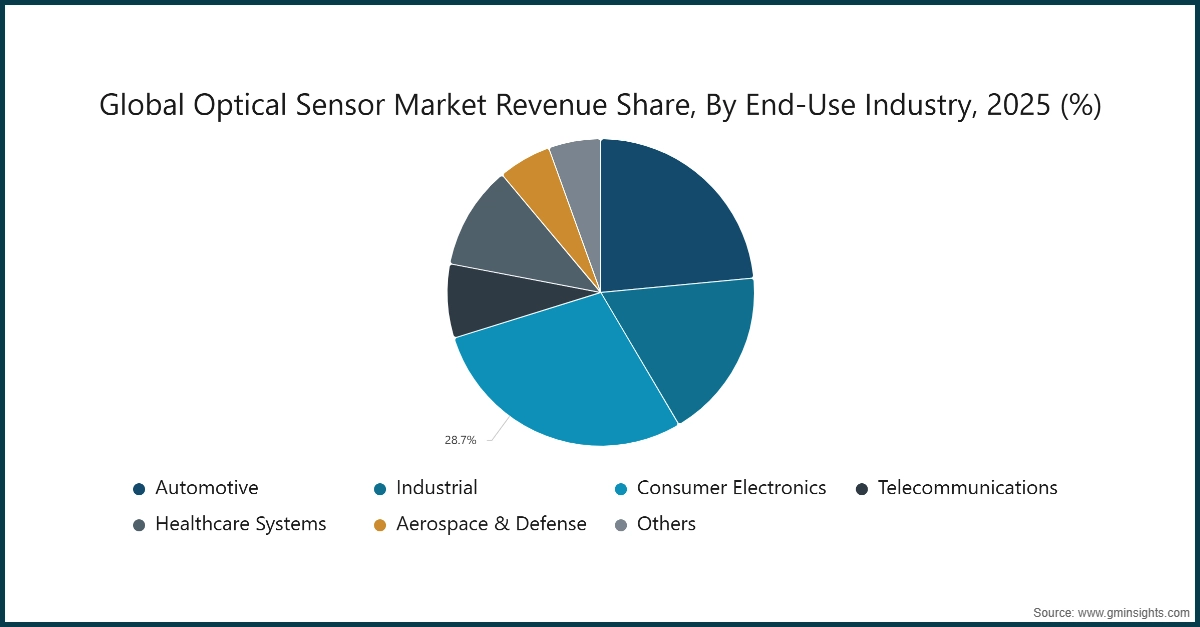
Based on end-use industry, the optical sensors market is segmented into automotive, industrial, consumer electronics, telecommunications, healthcare systems, aerospace & defense, and others.
- The consumer electronics segment led the market in 2025 with a market share of 28.7% driven by high-volume integration of image sensors, proximity sensors, and biometric optical sensors in smartphones, wearables, tablets, smart home devices. Ongoing product updates, improving camera technology, and increasing demand for biometric authentication help maintain this segment's dominant position.
- The automotive segment is expected to grow at a CAGR of 12.5% during the forecast period. This growth is driven by the rising use of optical sensors in ADAS, LiDAR, in-cabin monitoring, and driver assistance systems. Regulatory safety requirements, electrification trends, and progress toward autonomous driving are accelerating adoption, making automotive the highest-growth industry for optical sensors.
North America Optical Sensors Market
Looking for region specific data?
North America held a market share of 27% of optical sensors industry in 2025.
- The optical sensors market in North America is growing due to more adoption of advanced driver assistance systems, increased use of optical sensing in healthcare diagnostics, and rising automation in industrial manufacturing. Strong demand from the automotive, medical device, and semiconductor industries is driving the deployment of high-precision image sensors, LiDAR, and photoelectric sensors.
- Governments and private companies are investing in smart mobility, digital health, and Industry 4.0 projects that depend on optical sensing for real-time data and control. The region is expected to stay a technology leader, with ongoing growth driven by automotive safety requirements, healthcare innovations, and advanced manufacturing efforts through 2035.
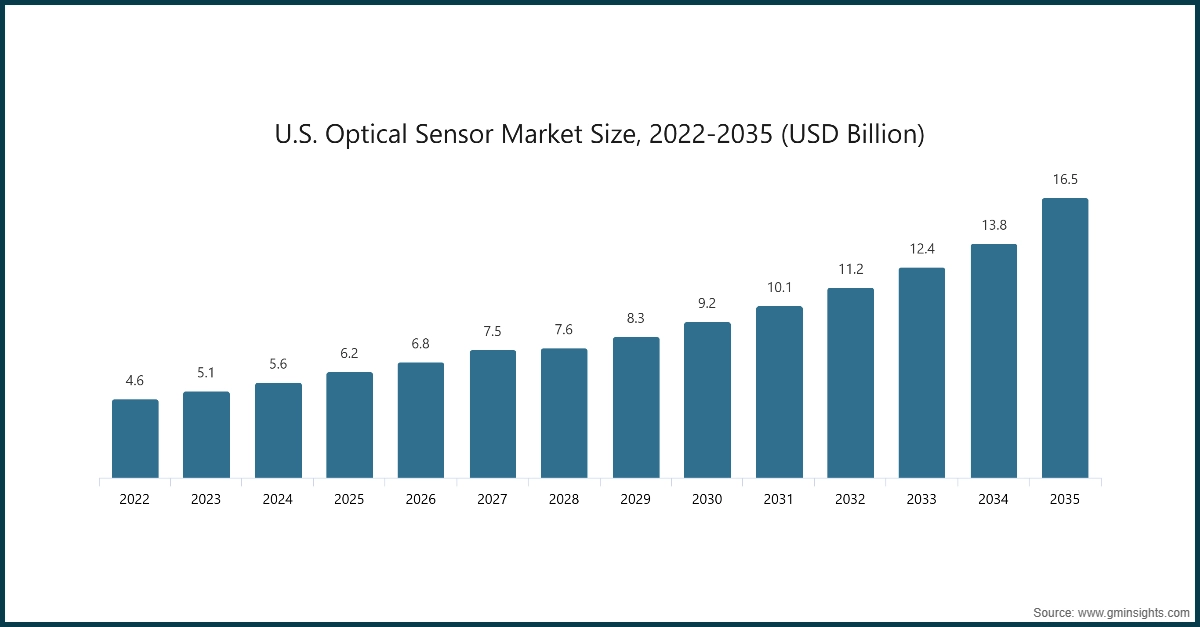
The U.S. optical sensors market was valued at USD 4.6 billion and USD 5.1 billion in 2022 and 2023, respectively. The market size reached USD 6.2 billion in 2025, growing from USD 5.6 billion in 2024.
- In U.S., the optical sensors industry is growing at a robust pace due to federal regulations for vehicle safety systems, the adoption of digital health, and the promotion of semiconductor manufacturing within the country. The U.S. Department of Transportation's NHTSA has finalized a rule that makes automatic emergency braking (AEB) systems mandatory in all new passenger cars by 2029. This regulatory requirement is fueling the widespread use of optical image sensors, cameras, and LiDAR technology in automotive platforms.
- Furthermore, the increasing number of regulations and guidelines by the FDA regarding pulse oximeters and digital health products is accelerating the adoption of optical sensors in medical diagnostics and remote patient monitoring. These regulations are also making the U.S. the leading market for optical sensors in North America.
Europe Optical Sensors Market
Europe optical sensors industry accounted for USD 5.4 billion in 2025 and is anticipated to show lucrative growth over the forecast period.
- The optical sensors industry in Europe is expanding due to the increasing emphasis on precision engineering, safety, and regulations in industrial automation. The adoption of optical sensors is especially high in factory automation, machine vision, and metrology, bolstered by Europe's leadership in automotive manufacturing and advanced machinery. The European Union's emphasis on worker safety standards, product traceability, and zero-defect manufacturing is increasing the use of photoelectric sensors, image sensors, and optical inspection systems.
- Countries such as Germany, France, and the UK are continuing to invest in smart manufacturing, rail and infrastructure monitoring, and medical imaging innovation. This ensures a steady demand for accurate optical sensing solutions in the industrial and medical sectors.
Germany dominates the Europe optical sensors market, showcasing strong growth potential.
- Germany leads the optical sensors industry in Europe due to its deep integration of optical sensing technologies across automotive manufacturing, industrial automation, and precision engineering. German automotive OEMs and Tier-1 suppliers extensively deploy image sensors, LiDAR, and optical inspection systems to support vehicle safety, autonomous driving development, and quality assurance.
- The country’s strong Industry 4.0 ecosystem drives widespread use of photoelectric and machine-vision sensors in smart factories, robotics, and inline inspection. Moreover, Germany’s focus on high-resolution medical imaging, metrology, and semiconductor equipment backs sustained use of advanced optical sensors, positioning the country as a major growth and innovation center in the European market.
Asia Pacific Optical Sensors Market
The Asia Pacific optical sensors industry is expected to grow at the highest CAGR of 11.4% during the forecast period.
- The Asia Pacific optical sensors industry is expanding rapidly because of large-scale electronics production, increasing semiconductor fabrication capabilities, and consumer electronics production. The region serves as a global hub for manufacturing image sensors, photodetectors, and optoelectronic components, supported by strong supply chains in Japan, South Korea, Taiwan, and China.
- The greater use of optical sensors in smart factories, robotics, display manufacturing, and quality inspection systems is boosting demand. In addition, the increasing development of telecommunication infrastructure, data centers, and smart devices in China, India, and Southeast Asia is fueling the adoption of optical sensing technology.
India optical sensors market is estimated to grow with a significant CAGR, in the Asia Pacific market.
- India is emerging as a key market for optical sensors due to the rapid deployment of advanced driver-assistance systems in passenger vehicles and the local production of electronics driven by national incentive programs. The growing use of optical sensing in biometric identification systems, healthcare diagnostics, and smart surveillance is further advancing market growth.
- Industrial corridors and electronics increasingly use photoelectric sensors and for quality inspection and automation. Furthermore, India’s rising focus on wearable health devices, telemedicine, and improving traffic safety supports ongoing demand, making the country an important growth market in the Asia-Pacific optical sensors landscape.
Middle East and Africa Optical Sensors Market
South Africa optical sensors industry to experience substantial growth in the Middle East and Africa market.
- The UAE is experiencing increased use of optical sensors due to large smart mobility projects, autonomous transport trials, and upgraded surveillance systems in cities like Dubai and Abu Dhabi. Optical sensing is becoming a part of traffic management systems, LiDAR-based road mapping, and smart toll platforms to improve safety and reduce congestion.
- Strong demand is also emerging from healthcare digitization initiatives, where optical sensors support imaging diagnostics, patient monitoring, and non-contact measurement systems. Additionally, the UAE’s focus on high-precision manufacturing, airport automation, and intelligent energy facilities accelerates the deployment of photoelectric, image, and ranging sensors, positioning the country as a key optical sensing hub within the Middle East and Africa region.
Optical Sensors Market Share
The optical sensors industry is led by players such as ams-OSRAM AG, Hamamatsu Photonics K.K., ON Semiconductor Corp., STMicroelectronics N.V., and ROHM Co., Ltd., which together account for a 68.7% share of the market. These companies benefit from strong technological depth, integrated manufacturing, and a broad geographic presence across automotive, industrial automation, consumer electronics, and healthcare imaging.
Their product range includes image sensors, photo detectors, optical modules, and active ranging solutions, allowing them to lead in ADAS, LiDAR, machine vision, and medical diagnostics. Ongoing investments in research and development, advancements in CMOS and compound semiconductors, AI-enabled sensing, and system-level integration enhance their ability to meet the increasing demand for high-performance and safety-driven optical sensing worldwide.
Optical Sensors Market Companies
Prominent players operating in the optical sensors industry are as mentioned below:
- ams-OSRAM AG
- Broadcom Inc.
- Hamamatsu Photonics K.K.
- Honeywell International Inc.
- Jenoptik AG
- Keyence Corporation
- ON Semiconductor Corp.
- Panasonic Corporation
- Rockley Photonics Holdings Ltd.
- ROHM Co., Ltd.
- SICK AG
- SiLC Technologies, Inc.
- Sony Group Corporation
- STMicroelectronics N.V.
- TE Connectivity Ltd.
- Texas Instruments Incorporated
- Vishay Intertechnology, Inc.
ams-OSRAM offers an extensive range of optical sensors, including ambient light, spectral, proximity, and active optical sensing solutions. The company integrates emitters, detectors, and signal processing to support automotive ADAS, mobile devices, industrial automation, and medical systems requiring precision and reliability.
Hamamatsu Photonics is a global leader in photodetectors, photomultiplier tubes, image sensors, and optical modules. Its technologies are widely used in medical imaging, analytical instruments, semiconductor inspection, and scientific research, where ultra-high sensitivity and accuracy are critical.
ON Semiconductor specializes in CMOS image sensors and optical sensing solutions optimized for automotive, industrial vision, and intelligent power applications. Its strength lies in high dynamic range imaging, functional safety compliance, and energy-efficient designs for ADAS, factory automation, and smart infrastructure.
STMicroelectronics provides advanced optical sensors such as time-of-flight, image sensors, and proximity sensing solutions. The company focuses on scalable, low-power designs that support consumer electronics, automotive in-cabin sensing, industrial automation, and IoT-enabled vision systems.
ROHM delivers photo sensors, infrared devices, and optical components designed for industrial equipment, automotive electronics, and consumer products. Its emphasis on miniaturization, signal stability, and long-term reliability supports high-performance optical sensing in demanding operating environments.
Optical Sensors Market Report Attributes
| Key Takeaway | Details |
|---|---|
| Market Size & Growth | |
| Base Year | 2025 |
| Market Size in 2025 | USD 26.6 Billion |
| Market Size in 2026 | USD 29.5 Billion |
| Forecast Period 2026-2035 CAGR | 10.4% |
| Market Size in 2035 | USD 71.7 Billion |
| Key Market Trends | |
| Drivers | Impact |
| Rising ADAS and LiDAR integration in passenger vehicles | Drives 26% growth by providing functions such as adaptive cruise control, lane-keeping assistance, collision avoidance, and autonomous navigation in automotive industry. |
| Expanding use in wearable health monitoring devices | Supports 19% growth through rising adoption of optical sensors in smartwatches, fitness bands, and medical-grade wearables for heart rate, SpO₂, and blood flow monitoring. |
| Optical sensing adoption in medical diagnostics and imaging | Contributes 18% growth as hospitals and diagnostic centers deploy optical sensors in endoscopy, pulse oximetry, optical coherence tomography, and fluorescence imaging. |
| Demand for precise environmental and gas monitoring systems | Adds 17% growth as optical gas sensors gain adoption in industrial emissions monitoring, indoor air quality systems, and hazardous gas detection. |
| Growth of smart factories using photoelectric sensing | Accounts for 20% growth by enabling high-speed object detection, position sensing, and quality inspection in automated production lines. |
| Pitfalls & Challenges | Impact |
| High calibration and alignment costs for precision applications | Restrains market growth as high-accuracy optical sensors require precise alignment, frequent recalibration, and controlled installation environments. These requirements increase setup time, maintenance costs, and downtime, particularly in medical imaging, semiconductor manufacturing, and high-speed industrial automation, limiting adoption among cost-sensitive users. |
| Competition from low-cost MEMS and capacitive sensors | Limits growth as MEMS and capacitive sensors offer acceptable performance at significantly lower costs for proximity, motion, and basic detection applications. Their smaller form factors, lower power consumption, and mature manufacturing ecosystems reduce optical sensor penetration in consumer electronics and price-driven industrial applications. |
| Opportunities: | Impact |
| Optical biosensors for non-invasive disease diagnostics | Presents strong growth potential by enabling non-invasive, real-time detection of biomarkers through optical techniques such as spectroscopy and fluorescence sensing. Rising demand for early disease detection, chronic disease monitoring, and home-based diagnostics is accelerating adoption in glucose monitoring, cancer screening, and cardiovascular diagnostics. |
| Industrial safety compliance driving machine-vision sensors | Offers opportunity as stricter workplace safety regulations require continuous monitoring of hazardous zones, operator presence, and machine guarding. Optical machine-vision sensors enable automated inspection, intrusion detection, and compliance reporting, supporting adoption across automotive manufacturing, heavy machinery, logistics, and process industries. |
| Market Leaders (2025) | |
| Market Leader |
22.5% market share in 2025 |
| Top Players |
Collective market share is 68.7% in 2025 |
| Competitive Edge |
|
| Regional Insights | |
| Largest Market | Asia Pacific |
| Fastest growing market | Asia Pacific |
| Emerging countries | China, India, South Korea, Germany, Brazil |
| Future outlook |
|
What are the growth opportunities in this market?
Optical Sensors Industry News
- In November 2025, Sony Group Corporation launched a stacked CMOS image sensor with on-chip AI and enhanced near-infrared sensitivity, improving low-light performance and enabling real-time object recognition for automotive ADAS and industrial vision systems.
- In September 2025, STMicroelectronics N.V. partnered with a European automotive OEM to co-develop integrated time-of-flight and LiDAR sensor modules, supporting scalable ADAS and in-cabin monitoring with improved accuracy and faster mass-market deployment.
- In August 2025, Hamamatsu Photonics K.K. expanded its Japanese photodetector manufacturing facility, increasing capacity by about 25% to support growing demand from medical imaging, analytical instrumentation, and semiconductor inspection applications.
The optical sensors market research report includes in-depth coverage of the industry with estimates and forecast in terms of revenue (USD Million) from 2022 – 2035 for the following segments:
Market, By Product Type
- Discrete photodetectors
- Photoelectric proximity sensors
- Fiber optic sensors
- Image sensors
- Active ranging sensor modules
- Others
Market, By Output Signal Type
- Analog output sensors
- Digital output sensors
- Hybrid & configurable output sensors
Market, By Spectral Range
- Ultraviolet (UV) sensors
- Visible spectrum sensors
- Infrared (IR) sensors
- Broadband & multi-spectral sensors
Market, By End-Use Industry
- Automotive
- Industrial
- Consumer Electronics
- Telecommunications
- Healthcare Systems
- Aerospace & Defense
- Others
The above information is provided for the following regions and countries:
- North America
- U.S.
- Canada
- Europe
- Germany
- UK
- France
- Spain
- Italy
- Russia
- Asia Pacific
- China
- India
- Japan
- Australia
- South Korea
- Latin America
- Brazil
- Mexico
- Argentina
- Middle East and Africa
- South Africa
- Saudi Arabia
- UAE
Frequently Asked Question(FAQ) :
What was the market size of the optical sensors in 2025?
The optical sensors market was valued at USD 26.6 billion in 2025, growing at a CAGR of 10.4% through 2035. The market is driven by the increasing use of optical sensors in wearable health monitoring devices and medical diagnostics.
What is the projected value of the optical sensors market by 2035?
The market is poised to reach USD 71.7 billion by 2035, fueled by advancements in automation, imaging, and environmental monitoring technologies.
What is the expected size of the optical sensors industry in 2026?
The market size is projected to reach USD 29.5 billion in 2026.
What was the market share of the image sensors segment in 2025?
The image sensors segment accounted for 30% of the market share in 2025, led by applications in consumer electronics, automotive camera systems, industrial machine vision, and medical imaging.
What was the valuation of the visible spectrum sensors segment in 2025?
The visible spectrum sensors segment was valued at USD 10.1 billion in 2025, supported by their widespread use in image sensing, machine vision, display calibration, and consumer electronics.
What is the growth outlook for the consumer electronics segment?
The consumer electronics segment held a 28.7% market share in 2025.
Which region led the optical sensors sector in 2025?
North America led the market with a 27% share in 2025, propelled by the adoption of advanced driver assistance systems, increased use of optical sensing in healthcare diagnostics, and rising automation in industrial manufacturing.
What are the upcoming trends in the optical sensors market?
Key trends include edge AI adoption for real-time processing, growing use of fiber-optic sensing for monitoring, stronger safety and standardization focus, and advances in low-power AI chips for reliable decision-making.
Who are the key players in the optical sensors industry?
Key players include ams-OSRAM AG, Broadcom Inc., Hamamatsu Photonics K.K., Honeywell International Inc., Jenoptik AG, Keyence Corporation, ON Semiconductor Corp., Panasonic Corporation, Rockley Photonics Holdings Ltd., ROHM Co., Ltd., and SICK AG.
Optical Sensors Market Scope
Related Reports