Summary
Table of Content

Optical Communication and Networking Market
Get a free sample of this report
Form submitted successfully!
Error submitting form. Please try again.
Thank you!
Your inquiry has been received. Our team will reach out to you with the required details via email. To ensure that you don't miss their response, kindly remember to check your spam folder as well!
Request Sectional Data
Thank you!
Your inquiry has been received. Our team will reach out to you with the required details via email. To ensure that you don't miss their response, kindly remember to check your spam folder as well!
Form submitted successfully!
Error submitting form. Please try again.
Optical Communication and Networking Market Size
The global market for optical communications and networks is expanding rapidly due to the acceleration of digitalization around the world, along with the widespread rollout of 5G technology. As a result, telecommunications operators are expanding their fiber optic networks to provide backhaul and fronthaul connectivity that features high bandwidth and low latency, along with the deployment of Dense Wavelength Division Multiplexing (DWDM) and Coherent Optical technologies. This will therefore enable reliable connections in smart cities, industrial automation, and connected devices by establishing a robust optical network as a key component of the digital infrastructure.
The growth of hyperscale data centers and the increasing demand for cloud services are also driving demand for optical networks. Optical transport solutions and high-speed transceivers provide connectivity between computers and storage devices that carry large amounts of data. New innovations such as optical coherent technologies that are being developed now (e.g., 800G coherent optics) use less power than traditional solutions and can carry more data, thereby fulfilling the needs of all applications, including artificial intelligence (AI), cloud services, and enterprises. Therefore, major players continue to invest in routed optical networks to enable increased scale and performance.
Optical Communication and Networking Market Key Takeaways
Market Size & Growth
- 2025 Market Size: USD 35.6 Billion
- 2026 Market Size: USD 37.8 Billion
- 2035 Forecast Market Size: USD 77.5 Billion
- CAGR (2026–2035): 8.3%
Regional Dominance
- Largest Market: Asia Pacific
- Fastest Growing Region: Asia Pacific
Key Market Drivers
- Expansion and rollout of 5G and future mobile networks.
- Rapid growth of hyperscale data centers.
- Rising global internet usage and data traffic volumes.
- Rising adoption of cloud based services and virtualization.
- Growth of IoT and digital transformation across sectors.
Challenges
- High initial capital expenditure on deployment and upgrades.
- Complexity in integrating optical technology with legacy systems.
Opportunity
- Growth in edge computing and hybrid networks.
- Adoption of advanced optical technologies in enterprise/data center networks.
Key Players
- Market Leader: Huawei Technologies Co., Ltd. led with over 5% market share in 2025.
- Leading Players: Top 5 players in this market include Arista Networks, Inc., Huawei Technologies Co., Ltd., Juniper Networks, Inc., ZTE Corporation, Ciena Corporation., which collectively held a market share of 13.2% in 2025.
Get Market Insights & Growth Opportunities
With the ever-increasing number of Internet of Things (IoT) devices, AI workloads, and streaming applications, there will be a growing demand for high-speed and reliable optical links. The development of pluggable coherent optical solutions and silicon photonics will allow for high levels of data transmission while using significantly lower amounts of energy. In addition, when Pluggable coherent optics and silicon photonics are paired with switches through the use of co-packaged optics, energy losses are minimized, and support is provided for real-time analytics and AI clusters used by enterprises and financial service providers.
The market growth is further strengthened by standardization, open interfaces, and energy-efficient optical solutions. Disaggregated networks allow multi-vendor deployments, reducing costs and accelerating innovation.
The global optical communication and networking market was valued at USD 35.6 billion in 2025. The market is expected to grow from USD 37.8 billion in 2026 to USD 77.5 billion in 2035, at a CAGR of 8.3%, according to the latest report published by Global Market Insights Inc.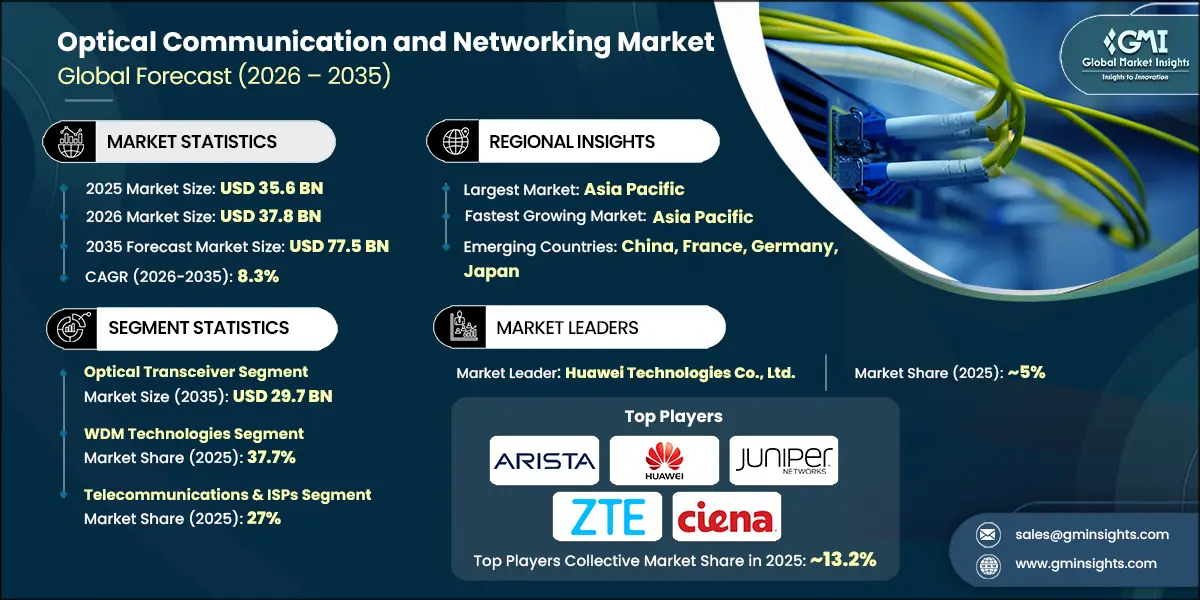
To get key market trends
Optical Communication and Networking Market Trends
- The optical communication and networking industry is witnessing significant transformation driven by technological convergence and innovation. A key trend is the integration of IP and optical layers, which streamlines network operations, reduces total cost of ownership, and enhances traffic forwarding efficiency by combining routing intelligence with optical transport systems.
- Standardization and open networking initiatives, supported by organizations such as the Optical Internetworking Forum (OIF), are fostering multi-vendor interoperability and accelerating deployment of disaggregated optical systems.
- The adoption of high-speed pluggable coherent optics, including 400G modules, is expanding optical connectivity across long-haul, metro, and data center applications.
- Meanwhile, enterprises and telecom operators are increasingly deploying Fiber-to-the-Office (FTTO) solutions and higher-speed Passive Optical Networks (PON) to deliver gigabit-class connectivity.
- Looking ahead, next-generation photonics and all-optical network concepts, championed by initiatives like the IOWN Global Forum, are shaping ultra-low latency, high-capacity, and energy-efficient optical infrastructures.
Optical Communication and Networking Market Analysis
Learn more about the key segments shaping this market
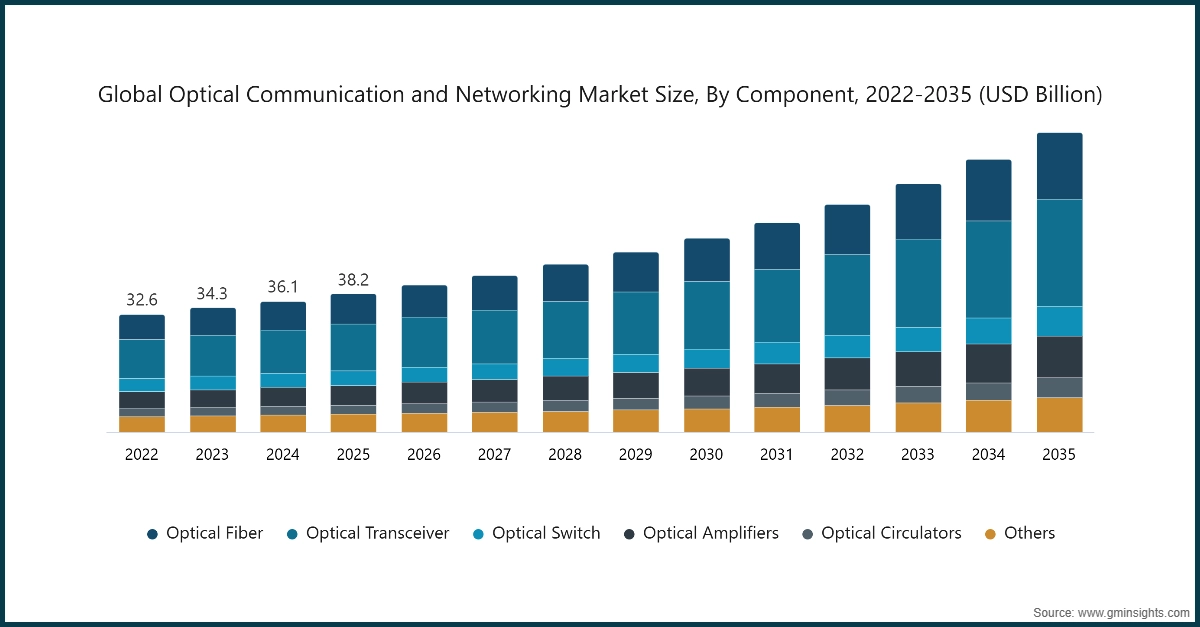
On the basis of component, the market is segmented into optical fiber, optical transceiver, optical switch, optical amplifiers, optical circulators, and others.
- The optical transceiver segment is anticipated to reach USD 29.7 billion by 2035, as hyperscale data centers and cloud providers deploy 400G+ and 800G optics to support AI, edge, and high‑bandwidth services. Innovations such as Credo’s ZeroFlap 400G‑1.6T transceivers and Coherent’s quad‑channel ICs for 800G silicon photonics enhance performance, telemetry, and power efficiency. Thermal‑management advancements further improve reliability in dense network environments.
- The optical amplifiers segment was valued at USD 5.5 billion in 2025 and is anticipated to grow at a CAGR of 8.1% over the forecast years. The growth is being driven by global network expansion and rising data traffic, requiring signal boosting across long‑haul, metro, and data center links. Multi‑core amplifier breakthroughs by NTT significantly reduce power consumption while expanding capacity, and emerging low‑power, chip‑scale amplifiers promise efficient integration in next‑generation photonic networks.
Learn more about the key segments shaping this market
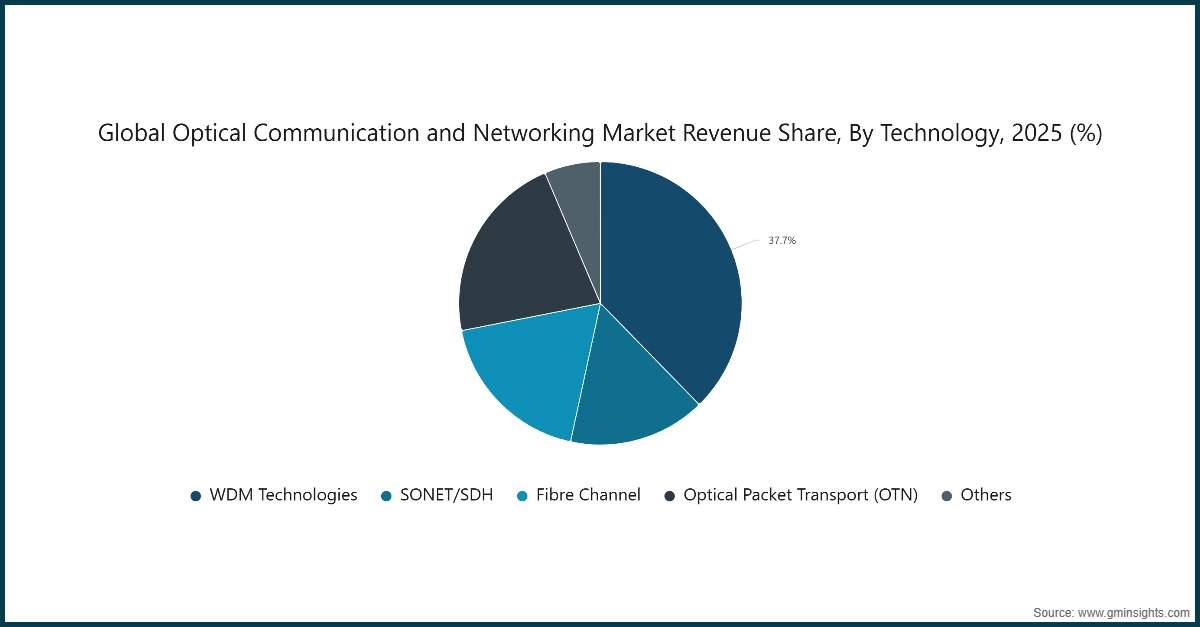
On the basis of technology, the optical communication and networking market is divided into WDM technologies, SONET/SDH, fiber channel, optical packet transport (OTN), and others.
- The WDM technologies segment held a market share of 37.7% in 2025, continues to dominate optical networks by enabling multiple high‑capacity data channels over a single fiber, significantly increasing bandwidth efficiency and spectral utilization. Operators are deploying advanced Dense WDM (DWDM) and ROADMs to support scalable 400G+ backhaul and metro transport. WDM upgrades are integral for long‑haul and metro 5G and cloud interconnects, driving network capacity and performance.
- The optical packet transport (OTN) segment is anticipated to grow at a CAGR of 9.5% during the forecast period 2026–2035. The segment is poised for steady growth as service providers adopt robust, standardized transport solutions that encapsulate and manage diverse client traffic over optical backbones. OTN’s ability to support multiplexing, routing, and management functions makes it essential for 5G backhaul, cloud interconnect, and secure enterprise transport, reinforcing reliable, high‑capacity networks globally.
On the basis of product type, the optical communication and networking market is segmented into telecommunications & ISPs, data centers & cloud providers, government & public sector, defense & aerospace, energy & utilities, industrial & manufacturing, BFSI (banking, financial services & insurance), healthcare & life sciences, media, broadcasting & entertainment, retail & commercial enterprises, and others.
- The telecommunications & ISPs segment held a market share of 27% in 2025, due to the rapid deployment of 5G networks, fiber-to-the-home (FTTH) initiatives, and expanding mobile broadband services. Network operators increasingly adopt high-capacity optical transport, DWDM systems, and coherent optics to handle surging data traffic and improve latency. Leading providers, such as AT&T and Verizon, are upgrading backbone networks with 400G and 800G optical links to support cloud, IoT, and edge computing applications.
- The BFSI (Banking, Financial Services & Insurance) segment is anticipated to grow at a CAGR of 9.9% during the forecast period 2026–2035. Leading providers, such as AT&T and Verizon, are upgrading backbone networks with 400G and 800G optical links to support cloud, IoT, and edge computing applications.
North America Optical Communication and Networking Market
Looking for region specific data?
North America dominated about 32.7% share of the global optical communication and networking industry in 2025.
- North America’s growth is driven due to rapid 5G rollout, expansion of hyperscale data centers, and high broadband penetration. Advanced network infrastructure and investments in fiber optics, coherent transport, and programmable optical solutions enhance connectivity and operational efficiency. Telecom operators and cloud providers, including AT&T, Verizon, and Microsoft, are deploying high-capacity DWDM and 400G/800G optical networks, supporting edge computing, IoT, and low-latency enterprise applications across the U.S., Canada, and Mexico.
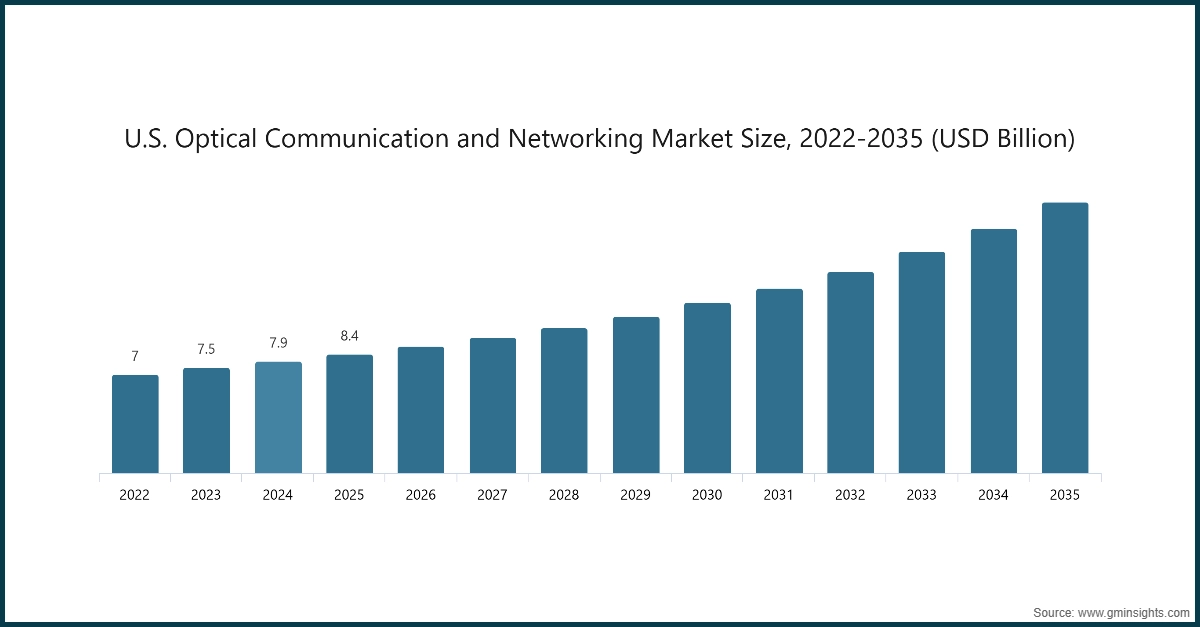
The U.S. optical communication and networking market was valued at USD 7 billion and USD 7.5 billion in 2022 and 2023, respectively. The market size reached USD 8.4 billion in 2025, growing from USD 7.9 billion in 2024.
- The U.S. market is expanding rapidly as operators scale high‑capacity fiber and optical backhaul to support 5G, cloud, and AI‑driven data traffic. Major carriers such as AT&T are investing heavily in fiber network expansion and backbone upgrades, including acquisitions to enhance broadband reach and support integrated 5G services. Suppliers like Corning are securing multi‑billion‑dollar fiber contracts to meet demand from data centers and AI infrastructure deployments, reflecting robust infrastructure growth across telecommunications and enterprise ecosystems.
Europe Optical Communication and Networking Market
Europe market accounted for USD 7.5 billion in 2025 and is anticipated to show lucrative growth over the forecast period.
- Europe’s optical communication and networking industry growth is increasingly shaped by widespread fiber and gigabit broadband expansion under the EU’s Digital Decade initiative, which aims for universal ultra‑high‑capacity networks by 2030. As of 2023, fixed very high-capacity networks covered approximately 79% of EU households, and fiber‑to‑the‑home coverage reached around 64%, illustrating solid infrastructure progress that propels optical network adoption across telecom and enterprise segments.
- Germany dominates the Europe optical communication and networking industry, owing to its robust digital infrastructure and extensive fiber deployments, representing about 24.1% share of the regional fiber optics market. Strong public‑private collaboration and national digitization efforts accelerate fiber‑to‑the‑premises expansion and Industry 4.0 integration, reinforcing demand for high‑capacity optical solutions across telecom and industrial verticals.
Asia Pacific Optical Communication and Networking Market
The Asia Pacific market holds significant share of 36.4% in 2025 and is expected to grow at the highest CAGR of 7.8% during the forecast period.
- The Asia-Pacific market is experiencing rapid growth due to massive investments in digital infrastructure and 5G rollout across key economies. Countries like India are adding hundreds of thousands of kilometers of optical cable annually, and Japan and South Korea are upgrading metro networks with coherent optical technologies to support next‑generation services.
- Optical network deployments are further buoyed by rising internet usage and government efforts to bridge digital divides, with regional carriers expanding fiber backhaul and dense wavelength division multiplexing systems to meet soaring data traffic and connectivity demands.
- China optical communication and networking market is estimated to grow with a CAGR of 9.9% in the Asia Pacific region. The country remains a key growth engine in the Asia‑Pacific region, underpinned by extensive optical fiber infrastructure and national broadband strategies that support 5G expansion and digital transformation. Optical fiber production and consumption are growing steadily, with significant volumes produced and increasing annual deployment, reflecting strong domestic demand for high‑speed networks and broadband connectivity.
Latin American Optical Communication and Networking Market
- The Latin America market was valued at USD 1.4 billion in 2025, driven by expanding fiber‑to‑the‑home (FTTH) deployments and broadband upgrades across the region. By mid‑2025, Latin America had nearly 88 million fiber optic connections, reflecting robust fixed broadband growth as countries replace legacy infrastructure and prioritize high‑speed optical networks for digital services and enterprise connectivity.
Middle East and Africa Optical Communication and Networking Market
Saudi Arabia market to experience substantial growth in the Middle East and Africa in 2025.
- The Saudi Arabia market is expected to experience substantial growth as Vision 2030 accelerates digital infrastructure transformation. Nationwide fiber and 5G rollouts, including over 125,000 new FTTH connections and 1,100 km of fiber optic deployments, are expanding high‑capacity networks, enhancing broadband services for consumers, businesses, and smart city initiatives across the Kingdom.
Optical Communication and Networking Market Share
The global optical communication and networking industry is moderately consolidated, with key players such as Arista Networks, Inc., Huawei Technologies Co., Ltd., Juniper Networks, Inc., ZTE Corporation, and Ciena Corporation collectively accounting for a significant share of the market. These companies leverage deep expertise in high-speed optical transmission, packet-optical integration, and advanced network architectures, delivering scalable, high-capacity solutions for applications across data centers, telecom service providers, cloud infrastructure, and metro and long-haul networks.
While these leading vendors maintain strong market positions, the market remains partially fragmented, with several regional and niche players addressing specialized requirements such as 5G transport networks, hyperscale data centers, edge computing, and software-defined optical networking. Smaller and emerging providers differentiate themselves through cost-optimized systems, flexible open networking platforms, AI-driven network automation, and rapid deployment capabilities. These competitive dynamics continue to drive innovation in coherent optics, ultra-high-bandwidth transmission, energy-efficient designs, and seamless integration with SDN and NFV frameworks, supporting sustained growth in the global optical communication and networking industry.
Optical Communication and Networking Market Companies
Prominent players operating in the optical communication and networking industry are as mentioned below:
- Adtran
- Arista Networks, Inc.
- Ciena Corporation.
- Cisco Systems, Inc.
- FiberHome
- FUJITSU
- General Atomics
- Huawei Technologies Co., Ltd.
- Juniper Networks, Inc.
- Mitsubishi Electric Corporation
- NEC Corporation
- Nokia
- Space Photonics Inc.
- Telefonaktiebolaget LM Ericsson
- ZTE Corporation
- Huawei Technologies Co., Ltd.
Huawei Technologies Co., Ltd. is a global leader in optical communication and networking solutions, offering a comprehensive portfolio spanning optical transmission, access networks, and intelligent network management. Drawing on strong capabilities in photonic integration and coherent optical technologies, Huawei delivers high-capacity, energy-efficient systems for telecom operators, data centers, and enterprise networks. Ongoing R&D investments in AI-enabled network optimization, 5G transport, and all-optical network architecture enabled bandwidth, reliability, and end-to-end network automation.
Arista Networks, Inc. is a leading provider of high-performance optical networking and cloud networking solutions, specializing in ultra-low-latency switching, routing, and software-driven network architecture. Leveraging its expertise in scalable data center and cloud-grade networks, Arista delivers advanced optical interconnects and Ethernet-based platforms optimized for hyperscale, AI, and high-performance computing environments. The companies continued investments in EOS software, automation, and open networking standards support seamless integration with software-defined networking (SDN) and next-generation optical transport systems.
Juniper Networks, Inc. is a prominent provider of optical communication and networking technologies, focusing on high-speed routing, packet-optical convergence, and software-driven network solutions. Utilizing its strengths in AI-powered networking and secure, scalable architecture, Juniper supports service providers and enterprises with optical platforms designed for metro, core, and data center interconnect applications. The companies continued innovation in automation, open standards, and integrated optical IP solutions enhances network performance, agility, and operational efficiency.
Optical Communication and Networking Market Report Attributes
| Key Takeaway | Details |
|---|---|
| Market Size & Growth | |
| Base Year | 2025 |
| Market Size in 2025 | USD 35.6 Billion |
| Market Size in 2026 | USD 37.8 Billion |
| Forecast Period 2026-2035 CAGR | 8.3% |
| Market Size in 2035 | USD 77.5 Billion |
| Key Market Trends | |
| Drivers | Impact |
| Expansion and rollout of 5G and future mobile networks | The global deployment of 5G networks drives substantial demand for high-capacity, low-latency optical communication infrastructure. Optical networks form the backbone of 5G backhaul and core connectivity, enabling operators to meet growing data throughput requirements and support next-generation mobile services. |
| Rapid growth of hyperscale data centers | Hyperscale data center expansion is a key catalyst for optical networking adoption. Increasing inter-data center traffic and high-bandwidth storage needs necessitate advanced optical interconnect solutions, driving investments in high-speed fiber-optic infrastructure and scalable network architectures. |
| Rising global internet usage and data traffic volumes | Surging internet penetration and escalating digital consumption intensify demand for optical networks. High-definition streaming, online gaming, and real-time applications require ultra-fast, reliable, and scalable optical communication systems, accelerating market growth and infrastructure deployment globally. |
| Rising adoption of cloud based services and virtualization | The proliferation of cloud computing and virtualization increases dependency on high-performance optical networks. Efficient data transport, low latency, and seamless connectivity between cloud environments necessitate upgraded optical infrastructures, fueling market expansion and technological innovation. |
| Growth of IoT and digital transformation across sectors | IoT proliferation and sector-wide digital transformation generate massive, continuous data streams. Industries require robust optical networks to support real-time analytics, smart infrastructure, and connected devices, creating opportunities for optical communication solutions with high bandwidth, reliability, and scalability. |
| Pitfalls & Challenges | Impact |
| High initial capital expenditure on deployment and upgrades | Significant upfront costs for optical infrastructure, equipment, and network upgrades can limit adoption, particularly in developing regions. High CAPEX requirements may delay deployment, constrain ROI timelines, and create budgetary challenges for service providers and enterprises. |
| Complexity in integrating optical technology with legacy systems | Integrating advanced optical solutions into existing legacy networks poses technical and operational challenges. Compatibility issues, system redesigns, and training requirements increase deployment time and cost, potentially slowing market growth and hindering seamless adoption across enterprises and service providers. |
| Opportunities: | Impact |
| Growth in edge computing and hybrid networks | The rise of edge computing and hybrid network architectures drives demand for low-latency, high-capacity optical connectivity. Enterprises and service providers increasingly require robust optical solutions to support distributed computing, seamless data exchange, and enhanced performance across decentralized infrastructures. |
| Adoption of advanced optical technologies in enterprise/data center networks | Deployment of cutting-edge optical technologies, such as coherent optics, photonic integrated circuits, and all-optical switching, enhances network efficiency and scalability. Enterprises and data centers leverage these innovations to improve bandwidth, reduce latency, and optimize overall network performance, creating significant market growth opportunities. |
| Market Leaders (2025) | |
| Market Leader |
~5% Market Share |
| Top Players |
Collective Market Share is ~13.2% |
| Competitive Edge |
|
| Regional Insights | |
| Largest Market | Asia Pacific |
| Fastest growing market | Asia Pacific |
| Emerging countries | China, France, Germany, Japan |
| Future outlook |
|
What are the growth opportunities in this market?
Optical Communication and Networking Industry News
In April 2024, Huawei held its first Global Optical Summit (GOS) in Bangkok under the theme “F5G-A: The Foundation for Industrial Intelligence.” The event was attended by more than 300 customers and partners from several Asia-Pacific countries, including Singapore, Thailand, the Philippines, and Malaysia. During the summit, Huawei introduced a range of F5G-Advanced optical products and solutions targeted at the Asia-Pacific market. The company also launched a global OptiX Club membership initiative, aimed at supporting the adoption of optical technologies and enabling industrial intelligence across the region.
In March 2024, Nokia announced enhancements to its WaveSuite optical network automation platform to address growing customer requirements for higher bandwidth, improved reliability, and low-latency network performance. The upgraded platform offers enhanced network visibility and control, supported by an expanding set of applications designed for specific use cases. These capabilities enable network operators to optimize operations, scale network capacity, and improve utilization of network assets.
In January 2024, General Atomics Electromagnetic Systems (GA-EMS) has received a contract from the Space Development Agency (SDA) to demonstrate the performance of its Optical Communication Terminals (OCTs) in Low Earth Orbit (LEO). The demonstration will be conducted using GA-EMS’ GA-75 spacecraft platform, which belongs to the 75-kilogram class. The project aims to validate the company’s optical communication capabilities for space-based networking applications.
The optical communication and networking market research report includes in-depth coverage of the industry with estimates and forecast in terms of revenue in USD Billion from 2022 – 2035 for the following segments:
Market, By Component
- Optical Fiber
- Optical Transceiver
- Optical Switch
- Optical Amplifiers
- Optical Circulators
- Others
Market, By Technology
- WDM Technologies
- SONET/SDH
- Fibre Channel
- Optical Packet Transport (OTN)
- Others
Market, By Data Rate
- ≤ 10 Gbps
- 10–40 Gbps
- 40–100 Gbps
- above 100 Gbps
Market, By Vertical
- Telecommunications & ISPs
- Data Centers & Cloud Providers
- Government & Public Sector
- Defense & Aerospace
- Energy & Utilities
- Industrial & Manufacturing
- BFSI (Banking, Financial Services & Insurance)
- Healthcare & Life Sciences
- Media, Broadcasting & Entertainment
- Retail & Commercial Enterprises
- Others
The above information is provided for the following regions and countries:
- North America
- U.S.
- Canada
- Europe
- Germany
- UK
- France
- Spain
- Italy
- Netherlands
- Asia Pacific
- China
- India
- Japan
- Australia
- South Korea
- Latin America
- Brazil
- Mexico
- Argentina
- Middle East and Africa
- South Africa
- Saudi Arabia
- UAE
Frequently Asked Question(FAQ) :
What is the market size of the optical communication and networking in 2025?
The market size was USD 35.6 billion in 2025, with a CAGR of 8.3% expected through 2035 driven by 5G rollout, hyperscale data center growth, and rising global internet usage.
What is the projected value of the optical communication and networking market by 2035?
The optical communication and networking market is expected to reach USD 77.5 billion by 2035, propelled by coherent optics, DWDM, photonic integrated circuits, and software-defined networking advancements.
What is the current optical communication and networking market size in 2026?
The market size is projected to reach USD 37.8 billion in 2026.
What is the projected value of optical transceiver segment by 2035?
Optical transceiver segment is anticipated to reach USD 29.7 billion by 2035, driven by hyperscale data centers deploying 400G+ and 800G optics for AI and high-bandwidth services.
What was the valuation of optical amplifiers segment in 2025?
Optical amplifiers segment was valued at USD 5.5 billion in 2025 and is anticipated to grow at a CAGR of 8.1%, driven by global network expansion requiring signal boosting.
What is the growth outlook for the optical packet transport segment from 2026 to 2035?
Optical packet transport (OTN) segment is anticipated to grow at a CAGR of 9.5% till 2035, driven by adoption of standardized transport solutions for 5G backhaul and cloud interconnect.
Which region leads the optical communication and networking market?
Asia Pacific holds 36.4% market share in 2025 and is expected to grow at highest CAGR of 7.8%, driven by massive digital infrastructure investments and 5G rollout.
What are the upcoming trends in the optical communication and networking market?
Key trends include integration of IP and optical layers for streamlined operations, adoption of 400G pluggable coherent optics, deployment of FTTO solutions and higher-speed PON, and development of next-generation photonics through IOWN Global Forum initiatives.
Who are the key players in the optical communication and networking market?
Key players include Huawei Technologies, Arista Networks, Juniper Networks, ZTE Corporation, Ciena Corporation, Adtran, Cisco Systems, FiberHome, FUJITSU, General Atomics, Mitsubishi Electric, NEC Corporation, Nokia, Space Photonics, and Telefonaktiebolaget LM Ericsson.
Optical Communication and Networking Market Scope
Related Reports