Summary
Table of Content

Optical Coherence Tomography Market
Get a free sample of this report
Form submitted successfully!
Error submitting form. Please try again.
Thank you!
Your inquiry has been received. Our team will reach out to you with the required details via email. To ensure that you don't miss their response, kindly remember to check your spam folder as well!
Request Sectional Data
Thank you!
Your inquiry has been received. Our team will reach out to you with the required details via email. To ensure that you don't miss their response, kindly remember to check your spam folder as well!
Form submitted successfully!
Error submitting form. Please try again.
Optical Coherence Tomography Market Size
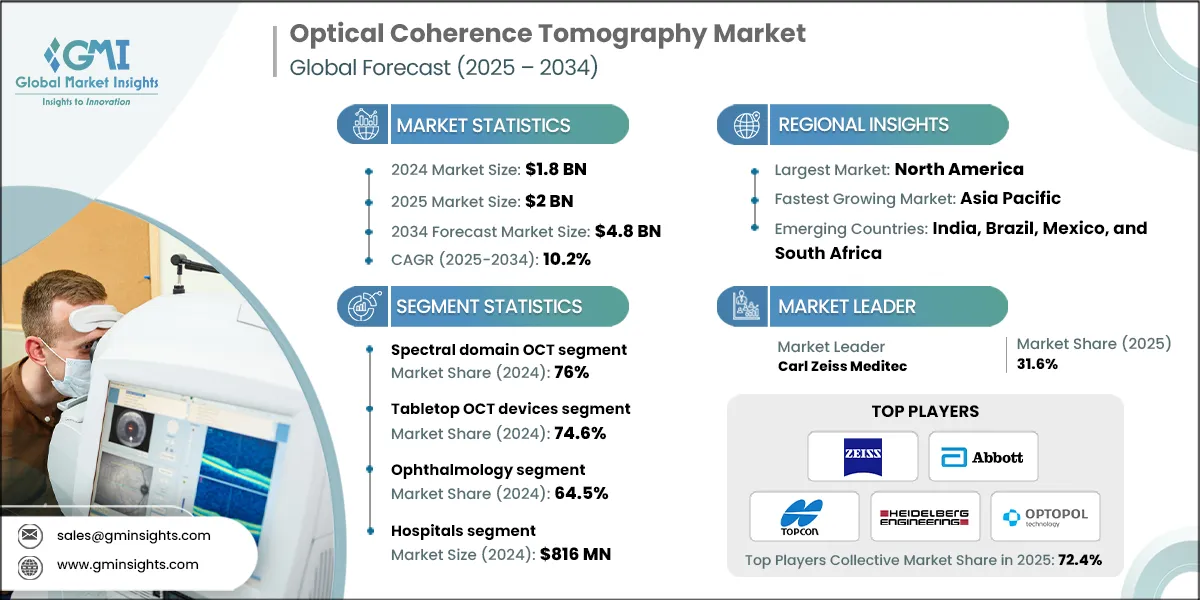
The global optical coherence tomography market size was valued at USD 1.8 billion in 2024. The market is expected to grow from USD 2 billion in 2025 to USD 4.8 billion in 2034, growing at a CAGR of 10.2%, according to the latest report published by Global Market Insights Inc. Optical coherence tomography employs low-coherence light waves and is a non-invasive imaging technique that extracts high-resolution cross-sectioned images of biological tissues. Major players in the optical coherence tomography industry include Carl Zeiss Meditec, Abbott Laboratories, Topcon Corporation, Heidelberg Engineering, and OPTOPOL Technology.
To get key market trends
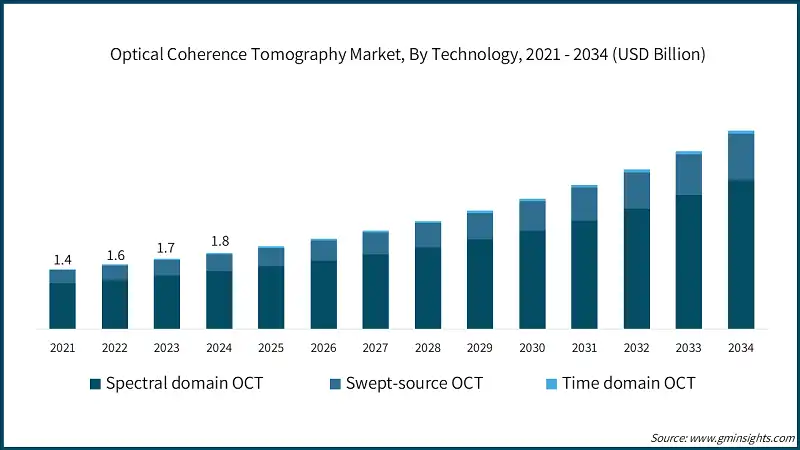
The market increased from USD 1.4 billion in 2021 to USD 1.7 billion in 2023. The increasing number of ophthalmic disease cases, including age-related macular degeneration (AMD), which is estimated to reach USD 20 billion by 2034, diabetic neuropathy, and glaucoma, is driving the demand for optical coherence tomography (OCT) diagnostics. For instance, the International Agency for the Prevention of Blindness (IAPB) states that approximately 5% of all blindness cases globally are caused by AMD. Further, as per a 2022 study published by Cureus Journal of Medical Science, about 200 million individuals are expected to be affected by AMD by 2040 across the world, which is expected to increase to 300 million by 2050. Such ophthalmic conditions necessitate high-quality imaging for effective treatment planning, ongoing monitoring, and early detection, highlighting the crucial role of OCT as a critical tool for ophthalmology.
Optical Coherence Tomography Market Report Attributes
| Key Takeaway | Details |
|---|---|
| Market Size & Growth | |
| Base Year | 2024 |
| Market Size in 2024 | USD 1.8 Billion |
| Market Size in 2025 | USD 2 Billion |
| Forecast Period 2025 - 2034 CAGR | 10.2% |
| Market Size in 2034 | USD 4.8 Billion |
| Key Market Trends | |
| Drivers | Impact |
| Growing prevalence of eye disorders | Increases demand for OCT systems for early diagnosis and monitoring of retinal diseases, boosting market growth. |
| Advancements in OCT technology | Enhances imaging speed and resolution, making OCT more accurate and appealing for clinical and research applications. |
| Rising adoption of non-invasive diagnostic techniques | Encourages preference for OCT over invasive methods, improving patient comfort and accelerating adoption. |
| Increasing healthcare investments and awareness in emerging economies | Expands access to advanced diagnostic tools, creating new revenue streams in developing regions. |
| Pitfalls & Challenges | Impact |
| High cost of therapies | Limits affordability and adoption, especially in low-income regions, slowing market penetration. |
| Shortage of skilled professionals trained to operate and interpret OCT systems | Creates operational bottlenecks and reduces efficiency in healthcare facilities, impacting utilization rates. |
| Opportunities: | Impact |
| AI-powered diagnostic algorithms and automated analysis | Improves diagnostic accuracy and speeds up interpretation, reducing dependency on specialists. |
| Increasing applications of OTC in pediatric and critical care | Opens new segments for growth, expanding OCT usage beyond ophthalmology into broader healthcare areas. |
| Market Leaders (2024) | |
| Market Leaders |
31.6% market share |
| Top Players |
|
| Competitive Edge |
|
| Regional Insights | |
| Largest Market | North America |
| Fastest Growing Market | Asia Pacific |
| Emerging Countries | India, Brazil, Mexico, and South Africa |
| Future outlook |
|
What are the growth opportunities in this market?
Furthermore, the rapidly increasing global aging population, especially in developed countries, has resulted in the growing burden for chronic eye-related conditions. As per the World Health Organization (WHO), the number of individuals aged 60 and above will reach 1.4 billion by the year 2030. Hence, the growing population of elderly patients is likely to increase the need for efficient diagnostic tools such as OCT, which will propel the market growth.
Furthermore, due to the significant investments in research and development of novel technologies which are designed to provide end users with precise diagnostic results, deeper tissue access, and rapid image capture, new and advanced therapies are being introduced. For instance, Abbott Laboratories received the U.S. Food and Drug Administration (FDA) approval of its novel OCT imaging platform integrated with its innovative Ultreon software. The advanced software utilizes artificial intelligence (AI) for advanced diagnostics. Therefore, advancements such as these provide significant market growth potential, supplementing the increasing demand for advanced ophthalmic diagnostic tools.
Optical Coherence Tomography Market Trends
- An increasing preference for handheld, compact, and portable OCT systems due to the increasing demand for point-of-care diagnostics and improved accessibility in rural areas, mobile clinics, homecare, and outpatient settings is prompting manufacturers to develop and introduce such compact OCT devices.
- The development of technologies such as visible light OCT (Vis-OCT), which use visible light for OCT illumination rather than near-infrared light to obtain high-resolution images with better resolution of retinal features, has spurred significant research and development activities in the market.
- Several recent technological advancements in OCTs, such as swept-source OCT and depth imaging OCT, have improved comprehensive investigation of the choroid. As well as improvement of new OCT angiography (OCTA) technology in producing high-definition retinal imagery.
- Additionally, the use of AI and machine learning algorithms on OCT platforms is revolutionizing diagnostic efficiency and accuracy. The technologies assist in predictive analytics, automated image segmentation, and disease detection.
- Moreover, the market is also witnessing a massive trend towards swept-source OCT (SS-OCT) machines as it offers greater resolution, speed, and image clarity than traditional OCT machines, thereby fostering the market growth.
Optical Coherence Tomography Market Analysis
Learn more about the key segments shaping this market
The global market was valued at USD 1.4 billion in 2021. The market size reached USD 1.7 billion in 2023, from USD 1.6 billion in 2022. Based on technology, the global market is segmented into time domain OCT, spectral domain OCT, and swept-source OCT. The spectral domain OCT segment dominated the market with the largest revenue share of 76% in 2024.
- The growing cases of age-related macular degeneration, diabetic retinopathy, glaucoma, and other eye diseases that affect the retina are progressively triggering ophthalmological demand for spectral domain OCT equipment. For instance, in the year 2020 an estimated 80 million individuals across the globe had glaucoma, according to the Glaucoma Research Foundation.
- SD-OCT devices are applied widely not just for retinal imaging but also for the examination of the optic nerve, anterior segment, and corneal disease. Their capacity to accommodate such an enormous array of clinical applications from glaucoma staging to post-operative examination adds value in comprehensive eye care.
- Furthermore, continued innovation in image analysis software such as AI-driven retinal layer segmentation, computerized disease detection, and longitudinal change analysis is improving the clinical value of SD-OCT, thereby facilitating the segment growth.
Based on products and services, the global optical coherence tomography market is segmented into instruments, component replacement services and software licensing and upgrade, and other services. The instrument system is further bifurcated into tabletop OCT devices, catheter-based OCT devices, handheld OCT devices, and doppler OCT devices. The tabletop OCT devices segment dominated the instrument segment within the market, with a share of 74.6% in 2024.
- Tabletop OCT devices are the preferred option for ophthalmic disease diagnostics due to their compatibility with several scanning modalities, high precision imaging, and stability. These machines are largely used in specialty clinics, ophthalmic centers, and hospitals for anterior segment evaluation, glaucoma assessment and retinal imaging.
- Moreover, contemporary tabletop systems are usually followed by sophisticated technologies such as scanning laser ophthalmoscopy, fluorescein angiography, and fundus camera, leading to an integrated workstation.
- For example, in September 2024, Topcon got the U.S. FDA clearance of its OCTA OCT color fundus camera system. It was the very first and sole of its kind, fundus camera in the U.S.
- Therefore, such continuous innovation and regulatory approvals will further strengthen tabletop OCT devices position as the preferred choice for ophthalmic diagnostics, fostering market growth.
Based on application, the global optical coherence tomography market is segmented into ophthalmology, cardiology, dermatology, oncology, and other applications. The ophthalmology segment dominated the market with a share of 64.5% in 2024.
- The growing incidence of age-related macular degeneration, diabetic retinopathy, glaucoma, and other retinal diseases drives the demand for OCT systems in ophthalmology. According to the World Health Organization (WHO), approximately 2.2 billion people globally had vision impairment in 2022.
- Additionally, according to BMC Ophthalmology, in the year 2024 about 30% were influenced by diabetic retinopathy. These conditions necessitate repeated and accurate imaging of retinal layers and optic nerve structures, which are reconstructed by OCT devices using non-invasive, high-resolution imaging.
- Modern ophthalmic OCT scanners apply enhanced depth imaging, swept-source imaging, and OCTA to image structures more posterior and the retinal vascular bed without the need for staining, driving the need for devices.
Learn more about the key segments shaping this market
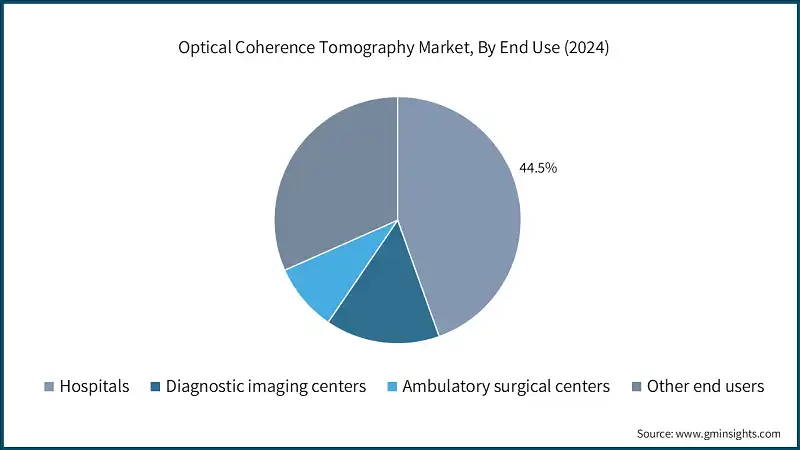
Based on end use, the global optical coherence tomography market is segmented into hospitals, diagnostic imaging centers, ambulatory surgical centers, and other end users. The hospitals segment dominated the market with the largest revenue of USD 816 million in 2024.
- Hospitals, especially tertiary and quaternary care hospitals, need sophisticated imaging technology to facilitate advanced diagnostics and specialty care. OCT systems offer high-resolution visualization of ocular and cardiovascular tissues, facilitating early detection of disease and planning for treatment.
- Hospitals developing specialty services in ophthalmology, cardiology, and oncology employ OCT for high-resolution, non-invasive imaging to enhance clinical outcomes, minimize diagnostic uncertainty, and facilitate multidisciplinary care.
- OCT systems are compatible with hospital networks, including electronic medical records (EMRs) and picture archiving and communication systems (PACS). This enables data sharing, facilitates telemedicine programs, and improves patient monitoring for chronic disease management.
- Hospitals select OCT solutions with data automation and connectivity capabilities to reduce administrative work, improve accuracy, and implement clinical decision support tools for patient management, thereby fostering the segment’s growth.
Looking for region specific data?
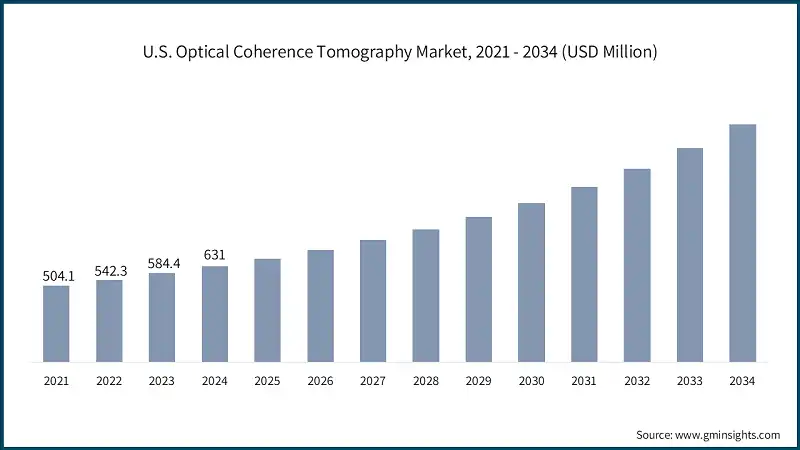
North America Optical Coherence Tomography Market The North America dominated the market with a market share of 38.2% in 2024. The U.S. market is projected to grow significantly, from USD 631 million in 2024 to USD 1.6 billion by 2034. Europe market accounted for USD 536.8 million in 2024 and is anticipated to show lucrative growth over the forecast period. The optical coherence tomography market in the UK is expected to experience significant and promising growth from 2025 to 2034. The Asia Pacific market is anticipated to grow at the CAGR of 10.9% during the analysis timeframe. Japan optical coherence tomography market is anticipated to witness lucrative growth between 2025 – 2034. The Latin America market is expected to experience significant and promising growth from 2025 to 2034. The Saudi Arabia market is expected to experience significant and promising growth from 2025 to 2034. The global market is segmented and controlled by a dynamic mix of international and domestic players providing innovative solutions to meet the growing demand for advanced diagnostic tools with enhance accuracy and faster diagnosis rates. Top 5 companies such as Carl Zeiss Meditec, Abbott Laboratories, Topcon Corporation, Heidelberg Engineering, and OPTOPOL Technology are some of the dominant competitors in the market accounting for a combined market share of approximately 72.4%. Competition in this area arises from continuous technological developments and the ability to offer customized solutions for various diagnostic applications. In developing nations, due to the priority given to cost, multinational companies are squeezed to offer optical coherence tomography that are both affordable and of quality. Domestic manufacturers take advantage of this demand by providing cost effective alternatives, which make multinationals alter their price strategy while maintaining the safety, ruggedness, and regulatory acceptability of the products. Some of the eminent market participants operating in the global optical coherence tomography industry include: Carl Zeiss is a leading player with its Cirrus HD-OCT and AngioPlex systems, which offer high-resolution imaging and structural-angiographic functionality for retinal diagnostics. Zeiss's OCT platforms are able to integrate with surgical platforms such as cataract and refractive lasers, making them more beneficial in ophthalmic clinics and hospitals. Topcon's 3D OCT-1 Maestro and Triton platforms offer ultra-widefield imaging of anterior and posterior ocular segments. The company's swept-source OCT technology delivers rapid, clean scanning that is useful in high-volume clinical settings. Topcon couples several imaging modalities by pairing OCT with fundus photography and fluorescein angiography in the same devices. Abbott Laboratories' ILUMIEN OPTIS system is one of the leading intravascular OCT technology applied for high-resolution coronary artery imaging in percutaneous coronary intervention (PCI) cases. The stent optimization capabilities of the system enable cardiologists to assess vessel morphology, plaque, and stent position.Europe Optical Coherence Tomography Market
Asia Pacific Optical Coherence Tomography Market
Latin America Optical Coherence Tomography Market
Middle East and Africa Optical Coherence Tomography Market
Optical Coherence Tomography Market Share
Optical Coherence Tomography Market Companies
Optical Coherence Tomography Industry News:
The global optical coherence tomography market research report includes an in-depth coverage of the industry with estimates and forecast in terms of revenue in USD Million from 2021 - 2034 for the following segments:
By Technology
- Spectral domain OCT
- Swept-source OCT
- Time domain OCT
By Product and Services
- Instruments
- Tabletop OCT devices
- Catheter based OCT devices
- Handheld OCT devices
- Doppler OCT devices
- Component replacement services and software licensing and upgrade
- Other services
By Application
- Ophthalmology
- Cardiology
- Dermatology
- Oncology
- Other applications
By End Use
- Hospitals
- Diagnostic imaging centers
- Ambulatory surgical centers
- Other end use
The above information is provided for the following regions and countries:
- North America
- U.S.
- Canada
- Europe
- Germany
- UK
- France
- Italy
- Spain
- Netherlands
- Asia Pacific
- Japan
- China
- India
- Australia
- South Korea
- Latin America
- Brazil
- Mexico
- Argentina
- Middle East and Africa
- South Africa
- Saudi Arabia
- UAE
Frequently Asked Question(FAQ) :
What is the expected market size of the OCT market in 2025?
The optical coherence tomography market is expected to reach USD 2 billion in 2025, supported by strong diagnostic adoption and continued integration of AI and multimodal imaging.
Who are the key players in the OCT market?
Key players include Carl Zeiss Meditec, Abbott Laboratories, Topcon Corporation, Heidelberg Engineering, OPTOPOL Technology, Canon, NIDEK, Gentuity, Novacam, and Haag-Streit (Metall Zug AG).
Which region leads the global OCT market?
North America led the market with a 38.2% share in 2024, reaching USD 631 million in the U.S., supported by advanced healthcare systems, reimbursement coverage, and rising age-related eye disease incidence.
What is the growth outlook for the Asia Pacific OCT market from 2025 to 2034?
Asia Pacific is projected to grow at a CAGR of 10.9% through 2034 due to improved healthcare infrastructure, aging populations, and rising early-diagnosis awareness across China, India, and Japan.
What was the valuation of tabletop OCT devices in 2024?
Tabletop OCT devices accounted for 74.6% of the instruments segment in 2024, driven by their precision, modality compatibility, and preference in ophthalmic centers.
How much revenue did the spectral domain OCT (SD-OCT) segment generate in 2024?
The spectral domain OCT segment dominated the technology category with a 76% revenue share in 2024, making it the leading contributor among OCT modalities.
What is the projected value of the OCT market by 2034?
The OCT market is expected to reach USD 4.8 billion by 2034, growing at a CAGR of 10.2% driven by AI-enabled diagnostics, deep-tissue visualization technologies, and portable OCT demand.
What is the market size of the optical coherence tomography market in 2024?
The market size was USD 1.8 billion in 2024, supported by rising ophthalmic disease prevalence and adoption of non-invasive diagnostic imaging.
Optical Coherence Tomography Market Scope
Related Reports