Summary
Table of Content

Olive & Olive Derivatives Market
Get a free sample of this report
Form submitted successfully!
Error submitting form. Please try again.
Thank you!
Your inquiry has been received. Our team will reach out to you with the required details via email. To ensure that you don't miss their response, kindly remember to check your spam folder as well!
Request Sectional Data
Thank you!
Your inquiry has been received. Our team will reach out to you with the required details via email. To ensure that you don't miss their response, kindly remember to check your spam folder as well!
Form submitted successfully!
Error submitting form. Please try again.
Olive & Olive Derivatives Market Size
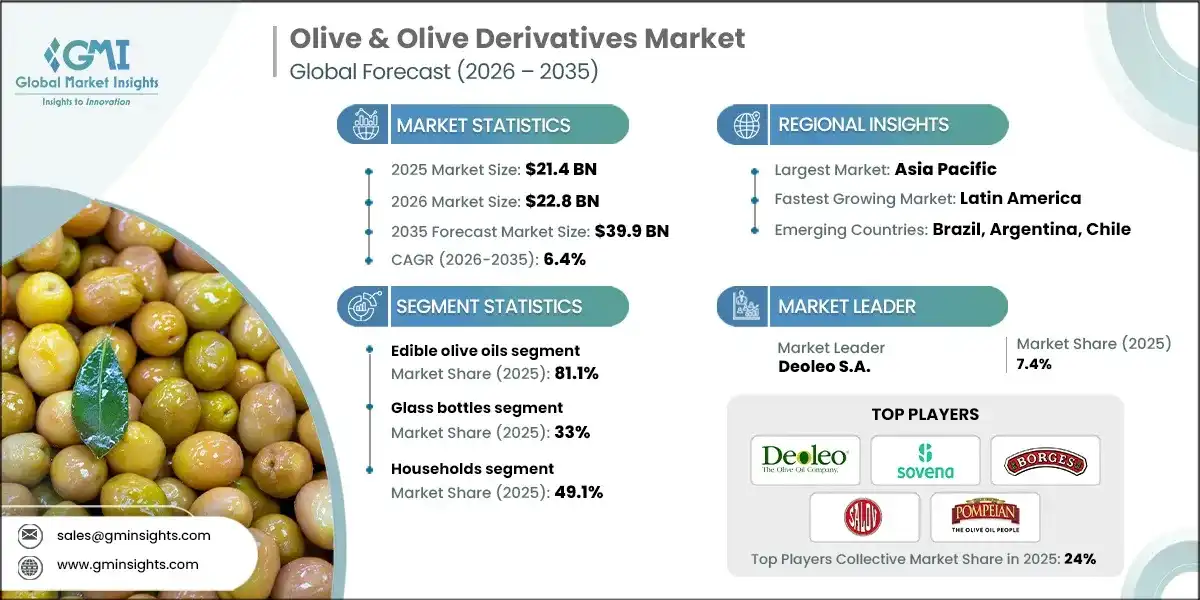
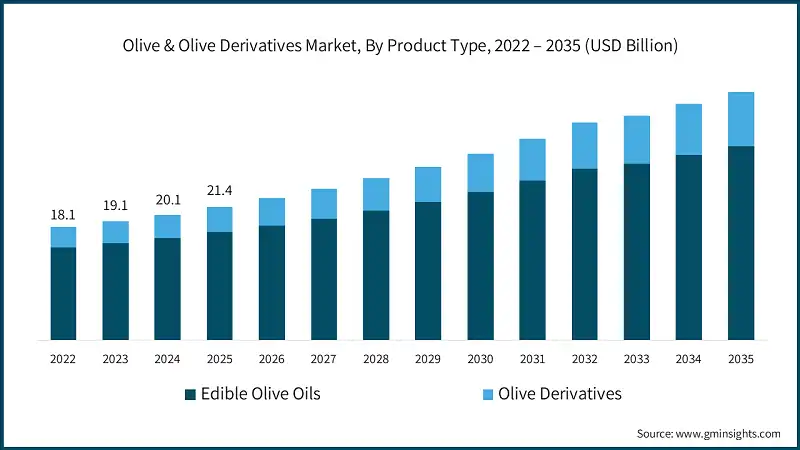
The global olive & olive derivatives market size was valued at USD 21.4 billion in 2025. The market is expected to grow from USD 22.8 billion in 2026 to USD 39.9 billion in 2035, at a CAGR of 6.4% according to latest report published by Global Market Insights Inc.
Olive & Olive Derivatives Market Key Takeaways
Market Size & Growth
- 2025 Market Size: USD 21.4 Billion
- 2026 Market Size: USD 22.8 Billion
- 2035 Forecast Market Size: USD 39.9 Billion
- CAGR (2026–2035): 6.4%
Key Market Drivers
- Rise in Global Health & Wellness Awareness.
- Innovation in Processing Technologies.
- Expansion of E-commerce & Gourmet Retailing.
Challenges
- Climate Change & Water Scarcity.
- Price Volatility & Supply Chain Disruptions.
Opportunity
- Growth of Clean Label & Functional Nutraceuticals.
- Circular Economy & By-Product Utilization.
Key Players
- Market Leader: Deoleo S.A. led with over 7.4% market share in 2025.
- Leading Players: Top 5 players in this market include Deoleo S.A., Sovena Group, Borges International, Salov Group, Pompeian, Inc., which collectively held a market share of 24% in 2025.
Get Market Insights & Growth Opportunities
- Increasing awareness about health, increasing popularity of mediterranean diets and innovations in food processing have driven the growth of the global olive oil and associated oils market over the last decade.
- Olive oil is now more widely recognized for its health benefits, particularly extra-virgin olive oil (EVOO), because of its high levels of polyphenols (antioxidants) and fatty acids that are fundamental to good nutrition. Increasingly, due to scientific research supporting the health benefits of eating olives and their oil, consumers all over the world are preferring to consume EVOO as a major part of their diet.
- As consumers become more aware of plant-based products with "clean label" attributes and product fortifications, business opportunities have emerged for companies producing derivative products from olives. Innovation in food manufacturing and preparing goods for commercial sale is another factor that is helping to fuel growth in the olive oil and olive oil derivative markets, as advanced extraction techniques, solid-liquid separation techniques and cold pressing have enabled companies to extract more oil from the same volume of olives, increase the quality of the resulting oil, and reduce waste associated with the production of olive oil.
- Also enhancing growth in these markets is the growing interest in reducing waste and, in some cases, creating zero-waste pipelines. The result has been the creation of commercial avenues to add value to the by-products produced from the cultivation of olives, including uses in the production of bioplastics and biofuels and incorporate as animal feed. This new trend toward changing how the by-products of olive oil production are valued is also in accordance with the environmental, social and governance (ESG) goals of many companies in this space.
- Recent changes in the global marketplace indicate that there is a shift in the focus of leading producers (Spain, Italy, Turkey, and Greece) from both backward integration and geographic expansion of their product lines to developing modern agricultural practices (e.g., super high-density [SHD] olive farming; precision irrigation; artificial intelligence for harvest forecasting), which will increase the efficiency of production and reduce input costs, while minimizing the impact of climate-related disruptions on the stability of supply chain systems.
- In addition, consumer behavior is undergoing a fundamental transformation, creating an environment where premium brands and product diversity will increasingly drive the growth of the industry's leading segments. In growing segment markets, boutique olive oil manufacturers have seen some of their niche products see year-over-year increases of 12% to 15% through their e-commerce sales channels. Direct-to-consumer (DTC) platforms for olive oil producers allow them access to international sales, to maintain their margins, and to develop an international brand image.
To get key market trends
Olive & Olive Derivatives Market Trends
- In recent years, traditional regions that produce olive oil (such as Spain, Italy and Greece) are experiencing greater numbers of farmers switching over to precision agriculture and smart farming due to increased desire to improve production efficiency (productivity) as well as to deal with the effects of climate change on their farms. More specifically, this move to greater efficiency of production is due to the use of modern technologies including drones (Unmanned aerial vehicles [UAVs]), Internet of Things (IoT) and sensor technologies, AI-based irrigation systems, satellite maps and other remote sensing technologies.
- The use of olive oil by-products is becoming more significant for the modern producer as part of their overall sustainability strategy. In addition to olives, growers are using other by-products of the olive oil extraction process including leaves, pomace, and pits, and converting them into a variety of value-added products, including biofuels, composts, animal feeds, cosmetics and antioxidant-rich extracts.
- Regulatory agencies and legislatures have implemented even tighter quality standards and protected designation of origin (PDO) certifying systems to help prevent tampering with food products and protect agricultural heritage. For example, the EU enacted tougher standards concerning how olive oils are labeled in 2024; as a result, consumers have greater confidence in purchasing these oils, and premium quality brands are receiving a higher price for their oil on the foreign market.
- In addition to being used in cooking, olive oil derivatives are increasingly being utilized in the health and beauty industry. Due to the many clinical studies supporting the positive health effects of oleuropein and hydroxytyrosol, many companies are now marketing anti-inflammatory dietary supplements and anti-aging skin care products containing these ingredients. This trend is part of a wider cultural shift toward the purchase of functional wellness oriented products across many markets worldwide.
Olive & Olive Derivatives Market Analysis
Learn more about the key segments shaping this market
Based on product type, the olive & olive derivatives market is segmented into edible olive oils, and olive derivatives. Edible olive oils dominated the market with an approximate market share of 81.1% in 2025 and is expected to grow with a CAGR of 6% till 2035.
- Extra virgin olive oil continues to be recognized as one of the highest quality olive oils due to its health benefits, unique flavor, and antioxidant properties, which leads many 'health-conscious' consumers to use an EVOO repeatedly.
- Edible Olive Oil's popularity is growing due in part to the introduction of a wide variety of product innovations, such as organic, cold-pressed, and flavored varieties of olive oils. Manufacturers are creating new "infused" oils (garlic, rosemary, truffle) for more gourmet users, and utilizing innovative packaging, such as ultraviolet protective bottles and spray dispensers, to enhance the storage life of their oils and provide additional value-added functionality for the consumer.
- Through culinary use, many types of edible olive oils are available to consumers for dressings, marinades, sautéing, and frying, making them more versatile than specialty products or niche products. Edible olive oils are also shelf-stable, so they are essential to both home cooks and food service providers in the household and HoReCa sectors of the economy.
- Although true premium olive oils may be priced higher than other types of edible oils, the overall health and wellness benefits, along with increasing disposable incomes and acceptance of the Mediterranean diet worldwide, will help ensure continued resilience for the olive oil category.
Based on packaging type, the olive & olive derivatives market is segmented into glass bottles, plastic, bottles/containers, metal cans/tins, bag-in-box, and bulk containers. Glass bottles dominated the market with an approximate market share of 33% in 2025 and is expected to grow with a CAGR of 5.2% up to 2035.
- Olive oil and derivative products mostly use glass bottles for packaging as it is considered the one packaging material that is best at preserving the sensory qualities and stability of extra virgin oil and premium derivative products.
- Premium and organic brands currently use glass packaging to indicate their authenticity, purity and origin. Glass is a popular type of packaging among brands with PDO/PGI positioning and brands sold in gourmet retail settings. Heavier glass formats support higher price realization among brands sold through Specialty Manufacturers and Hospitality & Restaurant Channels (HoReCa).
- In addition, sustainability trends will only increase the need for using glass because of the high recycling rates, introduction of returnable bottle pilots and lightweight glass innovations reducing carbon footprint and logistics costs associated with using glass.
Learn more about the key segments shaping this market
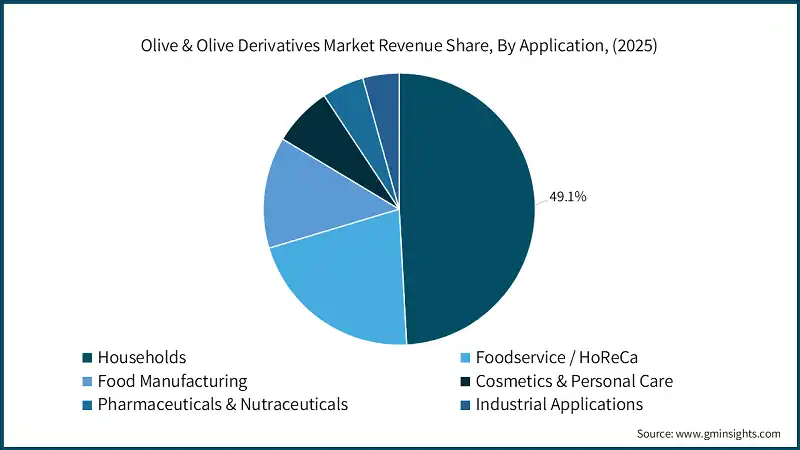
Based on application, the olive & olive derivatives market is segmented into households, foodservice / HoReCa, food manufacturing, cosmetics & personal care, pharmaceuticals & nutraceuticals, and industrial applications. Households held the largest market share of 49.1% in 2025 and is expected to grow at a CAGR of 5% during 2026 to 2035.
- The largest share of the global olive and olive derivative market is accounted for by the household sector, which is primarily driven by the trend toward increased consumption of healthier home-cooked meals and the increased awareness of the health benefits associated with consuming olives and cooking with olive oil. Olive oil as both an extra virgin and refined product has become a staple kitchen item, replacing other forms of fats, such as butter or vegetable oils, due to the heart-healthy properties of olive oil and its high levels of antioxidants.
- As mediterranean diets continue to gain popularity with continued increased awareness of clean label products, urbanization among middle-class consumers will continue to fuel the increasing consumption of olive oil by households. Increased popularity of cold-pressed and organic varieties of olive oil is also evident, with more consumers incorporating olive oil into cooking, dressing, and flavoring as they view olive oil products as both culinary and functional health products.
Looking for region specific data?
The North America olive & olive derivatives market is growing rapidly on the global level with a market share of 14.2% in 2025.
- In North America, there are positive indicators that olive oils and their products are becoming increasingly popular due to the rising levels of consumer knowledge regarding the numerous health benefits of cooking with extra virgin olive oil, as well as the trend toward using this type of product daily within a person's daily diet. Both Canadians and Americans are beginning to prefer premium-quality and cold-pressed olive oils, as evidenced by organic or non-GMO certifications on products offered in retail stores.
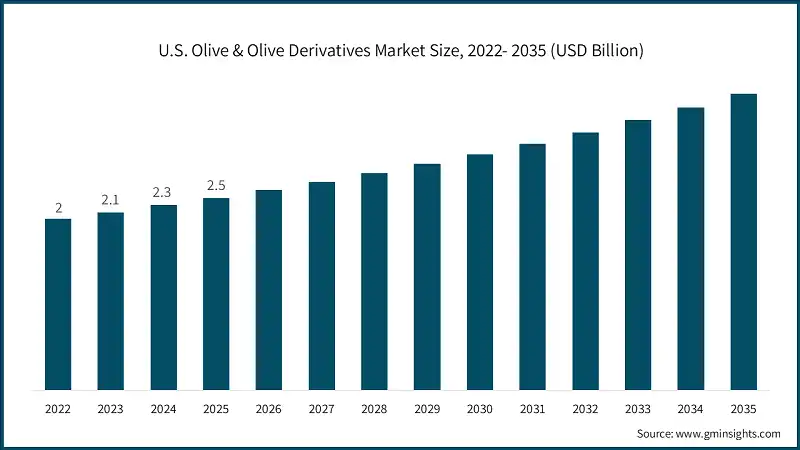
U.S. dominates the North America olive & olive derivatives market, showcasing strong growth potential.
- The U.S. is currently the largest individual consumer of olive oil globally, outside of Europe. The large-scale growth of the gourmet food and health supplement industries have contributed to this phenomenon; however, California's olive oil industry continues to grow due to its extensive and well-established domestic production base. Organizations such as the California Olive Oil Council (COOC) play an important role in California's success by developing strict quality standards, creating an improved labeling system, and implementing a program for identifying traceability within their supply chains, thereby establishing greater consumer confidence in American-produced olive oils.
Europe olive & olive derivatives market held substantial position in the industry with revenue of USD 12.8 billion in 2025 and is anticipated to show lucrative growth over the forecast period.
- The leading region for both production and consumption of olive oils is Europe. Countries such as Italy, Greece, and Spain play a major role in the supply chain of olives and olive oil globally. Throughout the EU, agricultural policies like the EU's Common Agricultural Policy (CAP) provide olive growers with considerable subsidies for the development of their businesses. The European Commission also markets and promotes the benefits of the Mediterranean diet through educational campaigns and the promotion of exports of mediterranean-style food.
- Europe also has the highest level of innovation in olive oil and olive oils, with a greater emphasis being put on high-polyphenol oils, flavored olive oils, and sustainable methods of producing olive oil. European consumers are becoming more aware of locally produced products and seek PDO (Protected Designation of Origin) labelled products that have been certified by traceability programs. This trend is particularly strong in western and southern European countries.
The Asia Pacific olive & olive derivatives market is anticipated to grow at a CAGR of 9.8% during the analysis timeframe.
- Asia Pacific is a rapidly developing market for olive oil and olive products, driven by the increasing exposure of consumers to these products through western dining styles, changes in dietary habits due to health awareness, and the potential for growth. In Japan and Korea, there is increasing use of olive oil in cosmetics and supplements; these products are gaining high acceptance in the marketplace. In addition, urban areas in both India and China are experiencing growth in the demand for edible olive oils, which are consumed largely by middle- to upper-middle class consumers.
Latin America olive & olive derivatives accounted for 8.6% market share in 2025 and is anticipated to show highest growth over the forecast period.
- The olive industry is presently experiencing substantial growth and development in Latin America for both the production and consumption aspects. Specifically, Argentinian, Chilean, and Peruvian producers have increased the number of olive trees that are being cultivated through favorable climatic conditions, as well as increased funding for developing the technology required to produce olive oil by cold-press extraction.
Middle East & Africa olive & olive derivatives accounted for 6.5% market share in 2025 and is anticipated to show lucrative growth over the forecast period.
- The Middle East has long-established culinary traditions that utilize olives and olive oil. However, in recent years, there has been a shift toward the consumption of high-quality extra virgin olive oil (EVOO) and health-focused products based on EVOO, such as olive leaf extract. Countries in the Middle East include Saudi Arabia and the United Arab Emirates, which are currently making investments to encourage the production of olives domestically and at the same time serve as major distribution points for exporting to other markets.
Olive & Olive Derivatives Market Share
The olive & olive derivative industry is globally fragmented, consisting of a mix of vertically integrated and traditional producers. The top 5 companies (Deoleo S.A., Borges International Group, Sovena Group, Luque Ecological, Pompeian, Inc.) collectively represent approximately 24% of the global market share, due to their strong sourcing, brand awareness, and distribution capabilities.
The competition between these companies revolves around product quality, origin traceability, certifications (organic), health innovation, etc. For example, Deoleo has invested significant resources into developing premium extra virgin and quality assurance categories, whereas Luque Ecological has developed a strong niche in organic cold press olive oil. Sovena and Borges have also aggressively expanded into private label manufacturing and global foodservice distribution.
The competition is further impacted by strategic alliances, joint ventures, acquisitions, R&D investment in polyphenol extraction, and formulation development for clean label products. The pricing of olive oil products continues to be under pressure from low-cost producers in Turkey and Tunisia, which will continue to put pressure on pricing strategies for all types of users of olive oil.
Olive & Olive Derivatives Market Companies
Major players operating in the olive & olive derivatives industry include:
- Deoleo S.A.: Deoleo, the owner of the brands Carbonell, Carapelli and Bertolli, is changing its emphasis from volume to value. Specifically, it focuses on the extra-virgin quality of its product, greater transparency in the origin of the product and consistency of sensory characteristics. This change will support Deoleo's commitment to rebuilding trust in both their products and the shelf space for their products worldwide. Deoleo is achieving this by investing in agronomic partnerships, conducting stricter supplier audits, and promoting consumer education to help inform the consumer about what they are buying.
- Borges International Group: Borges' strategy for growth is to develop a broadly diversified Mediterranean range of products, including olive oils, nuts, vinegars and sauces, which they will sell to both retail and foodservice outlets in more than one hundred countries. Borges focuses on growing the company through exports, sourcing only from Spain and Tunisia, and developing innovative new products including organic, spray and flavored olive oils that will appeal to health and convenience minded consumers.
- Sovena Group: Sovena has a fully integrated model from the production of oil olives from Iberia and North Africa through large-scale oil refining and bottling. By operating this way, Sovena has positioned itself as a cost-effective supplier to retailers worldwide for private label products. To achieve a stable yield and margin regardless of the weather or the price of its product, Sovena invests in agritech, precision irrigation, and sustainable agriculture with certification to support their claims.
- Luque Ecological: Luque is a manufacturer of only organic and generally biodynamic Extra Virgin Olive Oils that distribute through premium/specialty distribution methods. Small batch, high polyphenol oil, strict traceability, and ecologically sustainable packaging gives Luque the opportunity to attract customers who value the origin of their oil product, sustainability of the environment, and artisanal production techniques more than they do low cost oils.
- Pompeian, Inc.: Pompeian, Inc. has become one of the most recognizable brands in the United States for Olive Oil as it blends and bottles Oil from overseas in accordance with the taste profile and pricing expectations of American consumers. Positioning itself as a "Farmer Owned" company with the support of the North American Olive Oil Association seal certification for quality and through facilities in Maryland to conduct its own testing on products gives Pompeian assurance of the authenticity of its products and meets retailer needs for national brands that have reliability.
Olive & Olive Derivatives Market Report Attributes
| Key Takeaway | Details |
|---|---|
| Market Size & Growth | |
| Base Year | 2025 |
| Market Size in 2025 | USD 21.4 Billion |
| Market Size in 2026 | USD 22.8 Billion |
| Forecast Period 2026-2035 CAGR | 6.4% |
| Market Size in 2035 | USD 39.9 Billion |
| Key Market Trends | |
| Drivers | Impact |
| Rise in Global Health & Wellness Awareness | Drives increased consumption of olive oils and extracts as functional health foods. |
| Innovation in Processing Technologies | Enhances product yield, quality, and diversification of olive-based derivatives. |
| Expansion of E-commerce & Gourmet Retailing | Broadens consumer access, fueling premium and artisanal olive product sales. |
| Pitfalls & Challenges | Impact |
| Climate Change & Water Scarcity | Threatens olive crop yield consistency in traditional Mediterranean regions. |
| Price Volatility & Supply Chain Disruptions | Affects market stability and profit margins for producers and exporters. |
| Opportunities: | Impact |
| Growth of Clean Label & Functional Nutraceuticals | Creates new avenues for olive leaf extract and polyphenol-based health products. |
| Circular Economy & By-Product Utilization | Enables new revenue streams through sustainable use of pomace, pits, and leaves. |
| Market Leaders (2025) | |
| Market Leaders |
Approximate Market Share of 7.4% in 2025 |
| Top Players |
|
| Competitive Edge |
|
| Regional Insights | |
| Largest Market | Asia Pacific |
| Fastest Growing Market | Latin America |
| Emerging Country | Brazil, Argentina, Chile |
| Future Outlook |
|
What are the growth opportunities in this market?
Olive & Olive Derivatives Industry News
- In October 2025, Deoleo unveiled “EVOO-lution,” its new 2025–2028 roadmap, aiming to generate an additional USD 32 million in EBITDA.
- In September 2024, Borges, a renowned name in the Mediterranean space, unveiled its latest innovation, Borges Olive Leaf Infusion.
- In November 2023, the Rovensa Group, an Iberian agricultural input specialist, launched its Rovensa Next business unit in the MENA region, including Morocco and Tunisia, to provide sustainable agricultural solutions and leverage local insights.
- In March 2023, Capricho Andaluz, a company belonging to the Borges International Group, received the RETRAY distinction granted by the Plastic Sense Foundation.
This olive & olive derivatives market research report includes in-depth coverage of the industry, with estimates & forecasts in terms of revenue (USD Billion) and volume (Kilo Tons) from 2022 to 2035, for the following segments:
Market, By Product Type
- Edible Olive Oils
- Extra Virgin Olive Oil
- Virgin Olive Oil
- Refined Olive Oil
- Olive Oil (Pure/Blended)
- Olive Pomace Oil
- Olive Derivatives
- Oleochemicals
- Bioactive Compounds
- Olive By-Product Extracts
Market, By Packaging Type
- Glass Bottles
- Plastic Bottles/Containers
- Metal Cans/Tins
- Bag-in-Box
- Bulk Containers
Market, By Application
- Households
- Salad Dressings & Cold Dishes
- Cooking & Frying
- Baking Applications
- Home Wellness & Personal Care
- Foodservice / HoReCa
- Full-Service Restaurants
- Quick Service Restaurants (QSR)
- Hotels & Resorts
- Catering Services
- Food Manufacturing
- Sauces, Dressings & Condiments
- Ready-to-Eat & Convenience Foods
- Bakery & Confectionery Products
- Canned Fish & Preserved Foods
- Cosmetics & Personal Care
- Skin Care Products
- Hair Care Products
- Soap & Bath Products
- Natural & Organic Cosmetics
- Pharmaceuticals & Nutraceuticals
- Dietary Supplements
- Cardiovascular Health Products
- Anti-Inflammatory & Antioxidant Supplements
- Pharmaceutical Excipients
- Industrial Applications
- Oleochemicals & Surfactants
- Soap & Detergent Manufacturing
- Bio-Based Lubricants
- Biofuel & Energy Production
The above information is provided for the following regions and countries:
- North America
- U.S.
- Canada
- Europe
- Germany
- UK
- France
- Spain
- Italy
- Rest of Europe
- Asia Pacific
- China
- India
- Japan
- Australia
- South Korea
- Rest of Asia Pacific
- Latin America
- Brazil
- Mexico
- Argentina
- Rest of Latin America
- Middle East and Africa
- Saudi Arabia
- South Africa
- UAE
- Rest of Middle East and Africa
Frequently Asked Question(FAQ) :
What was the market size of the olive and olive derivatives in 2025?
The market size was valued at USD 21.4 billion in 2025, with a CAGR of 6.4% expected through 2035. Growth is driven by increasing health awareness, the popularity of Mediterranean diets, and advancements in food processing.
What is the projected value of the olive and olive derivatives market by 2035?
The market is poised to reach USD 39.9 billion by 2035, fueled by innovations in agriculture, sustainability initiatives, and rising demand for premium olive oil products.
What is the expected size of the olive and olive derivatives industry in 2026?
The market size is projected to reach USD 22.8 billion in 2026.
What was the market share of edible olive oils in 2025?
Edible olive oils dominated the market with an approximate share of 81.1% in 2025 and is expected to grow at a CAGR of 6% through 2035.
What was the valuation of the glass bottles segment in 2025?
Glass bottles accounted for approximately 33% of the market share in 2025 and is set to expand at a CAGR of 5.2% up to 2035.
What is the growth outlook for the household segment from 2026 to 2035?
The household segment, which held the largest market share of 49.1% in 2025, is anticipated to observe around 5% CAGR during the forecast period.
Which region leads the olive and olive derivatives sector?
North America leads with a market share of 14.2% in 2025. The region's growth is driven by increasing consumer awareness of the health benefits of extra virgin olive oil and a preference for premium, organic, and non-GMO products.
What are the upcoming trends in the olive and olive derivatives market?
Adoption of precision agriculture and smart farming, sustainable use of olive by-products, stricter quality/labeling standards, and rising use of olive oil derivatives in health and beauty products.
Who are the key players in the olive and olive derivatives industry?
Key players include Borges International Group, Boundary Bend, Brightland, Cargill, Incorporated, Cobram Estate, Colavita S.p.A., Deoleo S.A., Gallo Worldwide, Graza, HSH-Chemie, Kalichem, Minerva S.A., and Monini S.p.A.
Olive & Olive Derivatives Market Scope
Related Reports