Summary
Table of Content

Oil Based Biofuel Market
Get a free sample of this report
Form submitted successfully!
Error submitting form. Please try again.
Thank you!
Your inquiry has been received. Our team will reach out to you with the required details via email. To ensure that you don't miss their response, kindly remember to check your spam folder as well!
Request Sectional Data
Thank you!
Your inquiry has been received. Our team will reach out to you with the required details via email. To ensure that you don't miss their response, kindly remember to check your spam folder as well!
Form submitted successfully!
Error submitting form. Please try again.
Oil Based Biofuel Market Size
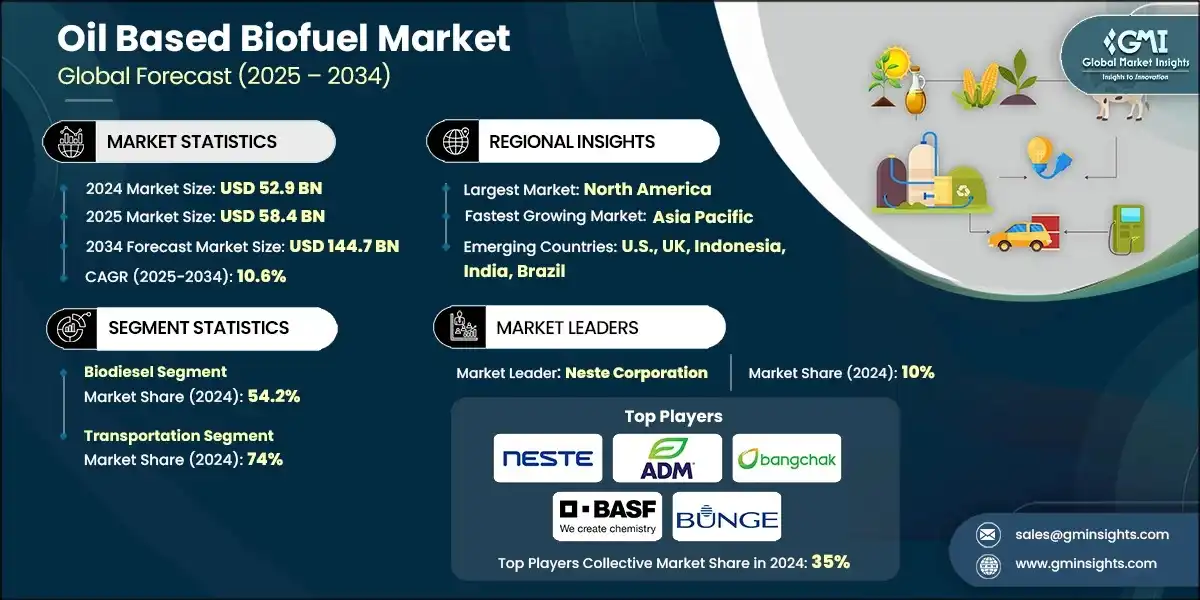
The global oil based biofuel market was estimated at USD 52.9 billion in 2024. The market is expected to grow from USD 58.4 billion in 2025 to USD 144.7 billion in 2034, at a CAGR of 10.6%, according to a recent study by Global Market Insights Inc.
Oil Based Biofuel Market Key Takeaways
Market Size & Growth
- 2024 Market Size: USD 52.9 billion
- 2025 Market Size: USD 58.4 billion
- 2034 Forecast Market Size: USD 144.7 billion
- CAGR (2025–2034): 10.6%
Key Market Drivers
- Shift Toward Renewable Diesel (HVO).
- Decarbonization of transport and aviation.
Challenges
- Competition from alternative biofuels and electrification.
Opportunity
- Expansion of SAF production in Asia-Pacific.
- Strategic partnerships between agribusiness and energy majors.
Key Players
- Market Leader: Neste Corporation led with over 10% market share in 2024.
- Leading Players: Top 5 players in this market include Neste Corporation, ADM, Bangchak Corporation Public Company Limited, BASF, Bunge Limited, which collectively held a market share of 35% in 2024.
Get Market Insights & Growth Opportunities
- Binding transport decarbonization targets are locking in long-term demand for biofuels especially across heavy roads, aviation, and marine segments. Policymakers have responded with binding renewable energy and low carbon fuel targets that explicitly include biofuels.
- The EU’s revised Renewable Energy Directive (RED) now requires either 29% renewables in transport or a 14.5% emissions-intensity reduction by 2030, with a 5.5% combined sub-target for advanced biofuels and RFNBOs. These targets create durable demand signals that justify investments in vegetable-oil conversion (FAME/HVO) and HEFA-SAF capacity, blending infrastructure, and traceability systems.
- For instance, the European Commission details the revised RED (Directive (EU) 2018/2001 as amended in 2023), including the transport targets and guidance for Member States; it also notes progress toward the 42.5% economy wide renewables target by 2030. Because targets are statutory, fuel suppliers must plan for compliance, creating reliable pull through for certified, deforestation free lipid feedstocks such as used cooking oil (UCO), tallow, and sustainably sourced vegetable oils.
- Aviation’s net-zero ambition is forcing rapid scale-up of SAF, with HEFA (derived from vegetable oils, UCO, and animal fats) as today’s most commercially mature route. Governments are now mandating SAF blends, creating guaranteed markets. This is materially boosting demand for hydro processed lipid feedstocks and HVO/HEFA conversion capacity.
- The policy momentum also de risks long term offtake contracts and supports refinery reconfiguration toward jet and diesel cuts from renewable lipids. For suppliers and airlines, early compliance via HEFA provides near term emissions reductions while next gen pathways mature, keeping fleets operational and avoiding stranded assets.
- For illustration, in December 2024, the UK Department for Transport launched the SAF Mandate, that obligated 2% SAF in 2025, rising to 10% by 2030 and 22% by 2040, with tradable certificates and compliance guidance, directly stimulating demand for HEFA-SAF. This in turn will create results in the production of oil-based biofuel, thus benefiting market growth.
- The RFS remains a cornerstone demand driver for lipid-based biofuels in the U.S., setting annual volume requirements for biomass-based diesel, advanced biofuel, and total renewable fuel. EPA’s finalized volumes for 2023–2025 show steady growth, underpinning investments in feedstock logistics (soy oil, UCO, distillers corn oil) and hydrotreating capacity that produces HVO and HEFA-SAF.
- RFS pathway approvals and lifecycle GHG thresholds formalize eligibility, guiding buildouts and ensuring environmental performance. Importantly, predictable RIN generation and compliance markets help finance projects and stabilize producer margins despite feedstock price volatility.
- For reference, in June 2023, EPA’s Final Renewable Fuel Standards Rule for 2023–2025 fixed biomass-based diesel targets of 2.82, 3.04, and 3.35 billion gallons respectively, and specifies advanced biofuel and total renewable fuel volumes, reinforcing market certainty. This signified the government’s commitment to strengthen the nation’s energy independence, advance low-carbon fuels, and support agricultural communities.
To get key market trends
Oil Based Biofuel Market Trends
- Emerging economies continue to raise biodiesel blend mandates to enhance energy security, reduce import bills, and support domestic oilseed sectors. Indonesia’s program, fueled by palm-based FAME but increasingly complemented by waste/lipid streams, has moved from B35 nationwide to preparing B40, which in turn is fueling the industry growth.
- These mandates command sizeable volumes and incentivize plant upgrades, feedstock diversification, and distribution infrastructure. They also trigger parallel testing in off road sectors and rail, expanding biodiesel’s application envelope and normalizing higher blends.
- For instance, in September 2025, Indonesia rolled out B40 biodiesel program, a blend of 40% palm-based Fatty Acid Methyl Ester (FAME) with petroleum diesel, as part of its strategy to cut fossil fuel imports, boost palm oil demand, and lower transport emissions.
- Strict due-diligence regimes are making deforestation-free, traceable lipid feedstocks a prerequisite raising quality standards and enabling premium pricing for certified inputs like UCO and sustainably grown vegetable oils. The EU’s Deforestation-free Regulation (EUDR) requires geolocation, and legality checks for listed commodities, pushing supply chains toward certification and digital traceability.
- In parallel, the Union Database for Biofuels (UDB) increases transparency and prevents double counting across liquid and gaseous fuels, further professionalizing the market and mitigating fraud risk. Producers that invest early in robust traceability and certification (ISCC EU/PLUS) gain compliance readiness and preferential access.
- In June 2023, the European Commission’s EUDR page confirms the regulation entered into force, with phased application beginning December 2025, while the Commission’s Union Database became functional in Nov 2024 and is being extended upstream for raw-material traceability.
- Oil majors and refiners are converting fossil refineries into biorefineries capable of hydrotreating vegetable oils, UCO, and animal fats into renewable diesel and HEFA-SAF. These sites leverage existing logistics, hydrogen units, and hydro processing knowhow, bringing scale and reliability to renewable diesel supplies.
- For instance, in June 2023, TotalEnergies announced an investment of over USD 70 million with the aim of ramping up the biorefinery's transformation from 2024. The La Mède biorefinery in France, commissioned in 2019 targets 500,000 t/y of renewable diesel and is being re-tooled to run on 100% UCO and animal fats, with palm oil excluded.
- With flexible feedstock slates and jet/diesel optimization, biorefineries switch between road fuel and aviation products as economics and mandates evolve. This “brownfield decarbonization” trend lowers capex compared to greenfield builds and accelerates market availability of drop in fuels that meet ASTM specifications and OEM requirements.
Oil Based Biofuel Market Analysis
Learn more about the key segments shaping this market
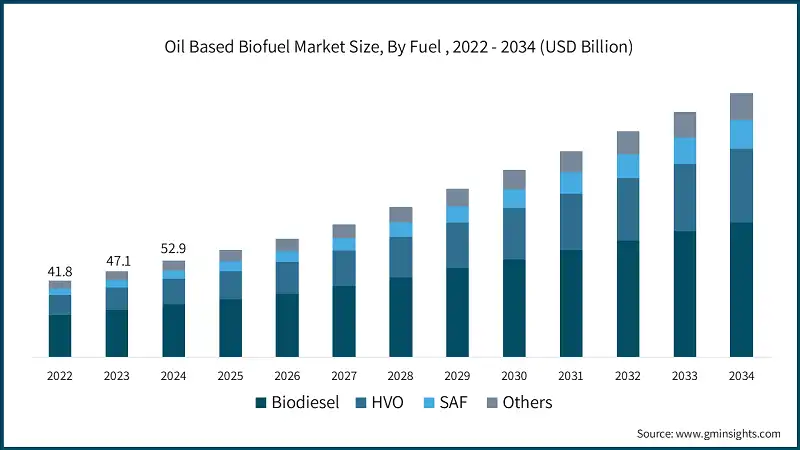
- Based on fuel, the market is segmented into biodiesel, HVO, SAF, and others. Biodiesel based biofuel industry dominated by 54.2% of the market share in 2024 and is set to grow at a CAGR of 9.9% by 2034. Rising statutory blend mandates in large domestic markets sustain baseline demand, which in turn will influence the market dynamics.
- Biodiesel’s most durable growth dynamic is the steady tightening of national blend mandates, which convert policy ambition into guaranteed offtake across road transport. This is especially visible in Latin America, where biodiesel is intertwined with energy security and rural value chains.
- Brazil’s regulator and energy council have progressively lifted the legal blend, moving to B14 in March 2024 and setting B15 from August 1, 2025, providing a multi-year, rules-based trajectory for producers and blenders. These steps stabilize utilization rates for ester plants, guide logistics upgrades, and allow engine producers to complete durability validations for higher blends.
- Policymakers are pairing field trials with refinery and terminal readiness plans to ensure fuel quality at higher blend levels, while integrating hydrotreating drops (HVO / DPME) where needed to meet cold flow and stability constraints. The rollout cadence and communications from the energy ministry and state fuel suppliers signal a pragmatic phase in, alleviating supply chain frictions and offering clearer demand signals to feedstock and logistics providers.
- For instance, Neste revised 2024 guidance citing margin pressure but still targeted ~3.9 Mt renewable product sales with 0.35–0.55 Mt SAF, and signaled ongoing capacity optimization, demonstrating continued supply commitment amid volatile market conditions.
- HVO industry will grow at a CAGR of 11.1% by 2034. A central HVO trend is the conversion of legacy refineries into biorefineries that leverage existing hydroprocessing, hydrogen, and logistics to produce drop-in renewable diesel at commercial scale. These sites increasingly prioritize waste and residue lipids (UCO, animal fats) to meet stringent sustainability criteria and reduce dependency on food-grade oils.
- Strategic investments announced by major energy companies demonstrate confidence in long term demand for drop in molecules that meet ASTM/DIN specs and OEM approvals. Conversions reduce build time and capex versus greenfield plants and let operators tune jet/diesel cut splits, creating optionality between road and aviation products as mandates evolve.
- For illustration, TotalEnergies confirms La Mède’s ~500,000 t/y renewable diesel capacity and states that palm oil has been excluded since Jan 1, 2023; a €70 million (2024) modernization enables processing up to 100% UCO/animal fats, pivoting the site toward circular feedstocks.
- HVO growth increasingly relies on robust traceability and sustainability assurance to meet RED III and national implementing rules. The EU Union Database for Biofuels (UDB) became operational for registration in January 2024 and has since expanded toward full functionality, including plans to extend traceability upstream to raw materials.
Learn more about the key segments shaping this market
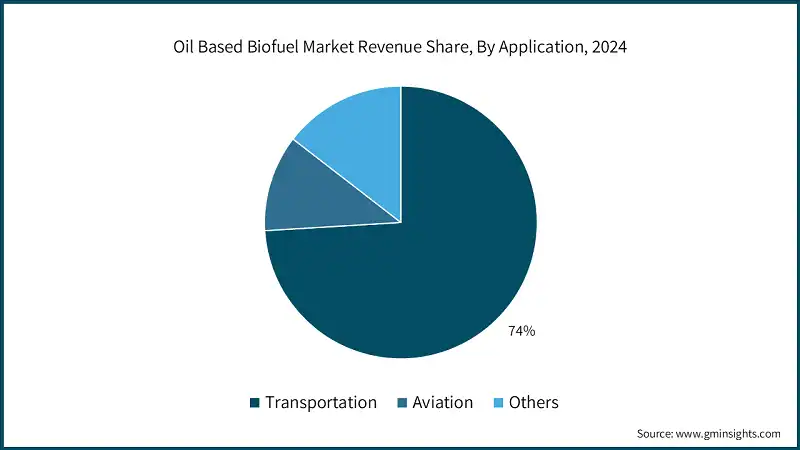
- Based on application, the oil based biofuel market is segmented into transportation, aviation, & others. Transportation application industry held a market share of 74% in 2024 and will grow at a CAGR of 10% by 2034. Governments worldwide continue to enforce biodiesel blending mandates in diesel pools to decarbonize road transport and reduce reliance on imported fossil fuels. These mandates create predictable demand for Fatty Acid Methyl Ester (FAME) and hydrotreated vegetable oil (HVO) blends, ensuring compliance across freight, public transport, and municipal fleets.
- USDA’s Foreign Agricultural Service reports around 13 billion liters of biodiesel in 2024 under B35, with trials toward B40 and HDRD integration, this establishes durable offtake for FAME/HVO in road and mining segments. In parallel, the EU’s RED III compels higher transport renewable shares by 2030, with advanced biofuels multipliers and caps on conventional crops.
- These frameworks reduce demand volatility for biodiesel/HVO and encourage logistics investments (terminals, blending hubs), reinforcing transport biofuel growth even when feedstock prices swing. This in turn is anticipated to increase the product adoption across application segment.
- The aviation application industry will grow at rate of 15.2% by 2034. The EU’s ReFuelEU Aviation Regulation (EU 2023/2405) imposes rising SAF blend shares at EU airports starting mid-decade, with sub-targets for synthetic fuels from 2030 creating guaranteed demand and backbone for airport-side logistics.
- For instance, in Japan, the Ministry of Economy, Trade and Industry (METI) convened an SAF public-private council and set a working target for Japanese airlines to replace around 10% of jet fuel with SAF by 2030, with explicit emphasis on scaling domestic HEFA/ATJ capacities and aligning feedstock supply chains.
- Similarly, Singapore is operationalizing an airport-level SAF levy and centralized procurement, signaling a demand-assurance instrument that lowers transaction complexity for airlines at a major Asian hub. CAAS’ communications highlight the setup of SAFCo and a planned levy start in 2026, embedding SAF cost recovery and pooled procurement to increase availability at Changi.
Looking for region specific data?
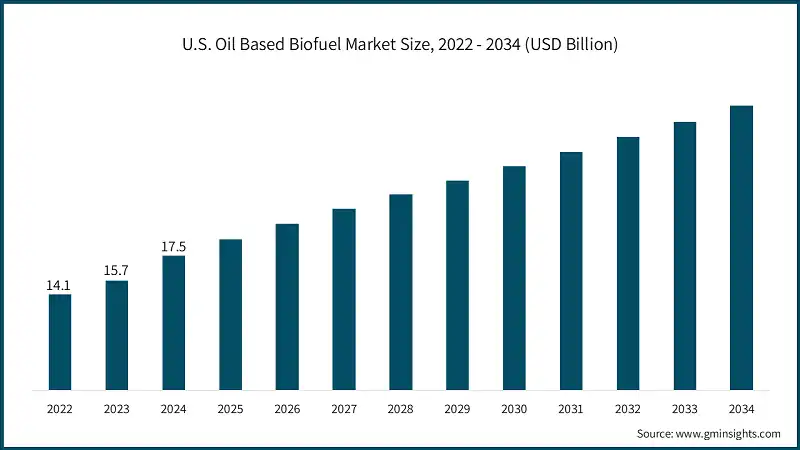
- The U.S. dominated the oil based biofuel market in North America with around 93% share in 2024 and generated USD 17.5 billion in revenue. Multi-instrument policy “stack” (RFS set-rule + LCFS) is increasing the floor and boosting premiums for waste-oil biodiesel/HVO, anchoring investment beyond simple blend mandates.
- At the state level, California’s LCFS continues to reward fuels with the lowest lifecycle carbon intensity, typically renewable diesel/HVO from used cooking oil (UCO) and animal fats, via tradable credits, an approach that has steadily raised credit bank balances and demonstrated robust over-compliance.
- Europe oil based biofuel industry will grow at a CAGR of 10.8% by 2034. Member States must reach either a ≥29% renewable share in transport or ≥14.5% GHG intensity reduction by 2030, with advanced biofuels and RFNBOs sub-targets. For oil-derived biofuels, this framework channels demand toward sustainable feedstocks, UCO, tallow, and other residues, by restricting food/feed crop routes and applying stringent sustainability/land-use rules.
- In addition, ReFuelEU Aviation (Regulation 2023/2405) mandates rising SAF shares supplied at EU airports, creating guaranteed demand signals for HEFA SAF in the near term and synthetic sub-shares from 2030. This dual policy spine (RED-III + ReFuelEU) is catalyzing refinery conversions to HVO/HEFA across the bloc, refining certification systems (ISCC EU), and expanding port/airport logistics for bio-blends, all of which favor waste-oil pathways in the 2025–2030 window.
- Asia Pacific oil based biofuel market will reach USD 34.6 billion by 2034 driven by surge in green refinery investments to produce Hydrotreated Vegetable Oil (HVO) and Sustainable Aviation Fuel (SAF). Various strategy leverages abundant palm-based feedstocks and waste oils, creating a competitive edge for exports to Europe and North America where strict sustainability criteria apply.
- For instance, Indonesia’s Pertamina is leading this transition with projects like the Balikpapan Refinery Development Master Plan (RDMP) and the Cilacap Green Refinery, which integrate advanced hydrotreating units and sulfur recovery systems to meet Euro V standards and produce renewable diesel and SAF. These projects align with national energy transition goals and international sustainability certifications (ISCC), positioning Indonesia as a regional hub for low-carbon fuels.
- Middle East & Africa region will grow at a CAGR of 10.7% by 2034. Gulf states are formalizing national SAF policies and hubs, positioning oil derived HEFA supply chains through regulatory roadmaps, airport integration and airline partnerships. In addition, the region is witnessing a shift in policies from voluntary initiatives to structured national programs, which in turn is further complementing the industry.
- For reference, the UAE approved a general policy for SAF, targeting local production of 700 million liters annually and aiming to supply 1% SAF to national airlines by 2031, with accompanying plans to establish a regulatory framework and investment facilitation. This is complemented by airline-energy partnerships that integrate SAF into hub infrastructure and run 100% SAF demonstration flights, creating operational confidence and demand signals.
- Latin America oil based biofuel market will grow at a CAGR of 11.1% by 2034. Brazil is reinforcing its leadership in biodiesel through the Fuel of the Future Law, which accelerates blending targets to B15 by 2025 and explores E30 ethanol blends. This policy framework, combined with RenovaBio’s carbon credit system (CBIO), is stimulating investment in soybean crushing and logistics.
- Argentina remains a top biodiesel exporter, primarily from soybean oil, but recent regulatory updates under Law 27.640 aim to stabilize domestic pricing and blending obligations while supporting export competitiveness. The government introduced new pricing mechanisms for biodiesel destined for mandatory gasoil blends, ensuring cost alignment amid inflationary pressures.
Oil Based Biofuel Market Share
- The top 5 companies in the oil based biofuel industry Neste Corporation, ADM, Bangchak Corporation Public Company Limited, BASF, Bunge Limited. held over 35% market share in the year 2024. Wilmar operates biodiesel plants in Asia using corn oil and palm derivatives. Its integrated agribusiness model supports feedstock security and cost efficiency. In 2025, Wilmar expanded its SAF feedstock partnerships and reported strong growth in renewable fuel exports to Europe.
- Neste Corporation holds approximately 10% of the global oil-based biofuel market share in 2024, positioning itself as the world's leading producer of sustainable aviation fuel and renewable diesel. Bunge advanced its biofuel strategy in 2024 through feedstock expansion and strategic partnerships, including collaborations with Chevron and Repsol to develop low-carbon intensity oils for renewable diesel and SAF.
- The company completed the sale of its stake in BP Bunge Bioenergia, refocusing on oilseed processing and refining as core growth drivers. Bunge’s global footprint and access to soybean, canola, and UCO supply chains position it as a leading feedstock provider for bioenergy producers.
Oil Based Biofuel Market Companies
Major players operating in the oil based biofuel industry are:
- ADM
- Bangchak Corporation Public Company Limited
- BASF
- Bunge Limited
- Chevron Renewable Energy Group
- Cargill Incorporated
- Eni S.p.A.
- ExxonMobil Corporation
- Greenergy International Ltd.
- Gushan Environmental Energy
- Louis Dreyfus Company (LDC)
- Marathon Petroleum Corporation
- POET LLC
- Shell plc
- Targray
- TotalEnergies
- Valero Energy Corporation
- Verbio Vereinigte BioEnergie AG
- Wilmar International Limited
- Zilor
- ADM maintains a dominant position in the oil-based biofuel sector through its extensive corn ethanol operations, running 18 bioethanol plants with a combined annual capacity of 1.8 billion gallons. In Q2 2025, ADM reported USD 452 million in adjusted earnings, reflecting strong operational resilience and strategic portfolio optimization.
- Chevron Corporation, following its acquisition of Renewable Energy Group (REG), has significantly broadened its presence in oil-based biofuels by leveraging corn oil and waste-derived feedstocks for biodiesel and renewable diesel production. In 2024, Chevron posted USD 17.7 billion in net income and invested USD 7.7 billion in low-carbon initiatives.
- Bunge Limited has strengthened its role in the oil-based biofuel value chain by expanding feedstock origination and forming strategic alliances with energy majors. The company’s partnerships with Chevron and Repsol focus on developing low-carbon intensity oils for renewable diesel and SAF production, leveraging Bunge’s global network in soybean, canola, and waste oil supply chains.
Oil Based Biofuel Market Report Attributes
| Key Takeaway | Details |
|---|---|
| Market Size & Growth | |
| Base Year | 2024 |
| Market Size in 2024 | USD 52.9 billion |
| Market Size in 2025 | USD 58.4 billion |
| Forecast Period 2025 - 2034 CAGR | 10.6% |
| Market Size in 2034 | USD 144.7 billion |
| Key Market Trends | |
| Drivers | Impact |
| Shift Toward Renewable Diesel (HVO) | The market is experiencing a significant transition from traditional biodiesel (FAME) to hydrotreated vegetable oil (HVO), also known as renewable diesel. |
| Decarbonization of transport and aviation | Urgent climate commitments and net-zero targets are accelerating the transition from fossil fuels to oil-based biofuels across transportation and aviation sectors. |
| Pitfalls & Challenges | Impact |
| Competition from alternative biofuels and electrification | Oil-based biofuels face intensifying competition from alternative decarbonization pathways |
| Opportunities: | Impact |
| Expansion of SAF production in Asia-Pacific | It driven by airport-level levies and national mandates creates a lucrative market for HEFA-based fuels. |
| Strategic partnerships between agribusiness and energy majors | Strategic partnerships between agribusiness and energy majors to secure low-carbon feedstocks for renewable diesel and biodiesel production. |
| Market Leaders (2024) | |
| Market Leaders |
10% |
| Top Players |
Collective market share in 2024 is 35% |
| Competitive Edge |
|
| Regional Insights | |
| Largest Market | North America |
| Fastest Growing Market | Asia Pacific |
| Emerging Country | U.S., UK, Indonesia, India, Brazil |
| Future Outlook |
|
What are the growth opportunities in this market?
Oil Based Biofuel Industry News
- In October 2025, Advanced Biofuels Canada (ABFC) through its annual report stated that biofuels produced made from Canadian crops and other renewable sources, are one of the most effective methods for reducing greenhouse gas emissions from vehicles.
- In September 2025, the Australian government unveiled plans to invest approximately USD 735 million to accelerate the development of a low-carbon fuels industry. This strategic move is expected to significantly increase demand for biofuel feedstocks such as canola, thereby strengthening the growth prospects of the oil-based biofuel sector and supporting the country’s broader energy transition objectives.
- In March 2024, Bunge Limited and Repsol have entered into a strategic partnership aimed at developing new opportunities to supply lower-carbon intensity feedstocks for renewable fuel production. This collaboration is expected to accelerate the scale-up of renewable fuel output required under European Union mandates, supporting the region’s transition toward cleaner energy solutions.
This oil based biofuel market research report includes in-depth coverage of the industry with estimates & forecast in terms of revenue (USD Million) and volume (Mtoe) from 2025 to 2034, for the following segments:
Market, By Fuel
- Biodiesel
- HVO
- SAF
- Others
Market, By Application
- Transportation
- Aviation
- Others
The above information has been provided for the following regions and countries:
- North America
- U.S.
- Canada
- Mexico
- Europe
- Germany
- UK
- Italy
- France
- Spain
- Asia Pacific
- China
- India
- Indonesia
- Australia
- South Korea
- Middle East & Africa
- Saudi Arabia
- South Africa
- Latin America
- Brazil
- Argentina
Frequently Asked Question(FAQ) :
What is the market size of the oil-based biofuel industry in 2024?
The market size was USD 52.9 billion in 2024, with a CAGR of 10.6% expected through 2034 driven by the shift toward renewable diesel (HVO).
What is the current oil-based biofuel market size in 2025?
The market size is projected to reach USD 58.4 billion in 2025. Policy-driven demand for biodiesel and renewable diesel continues to expand across transport and aviation industries.
What is the projected value of the oil-based biofuel market by 2034?
The oil-based biofuel industry is expected to reach USD 144.7 billion by 2034. Growth is driven by diesel decarbonization, HVO refinery conversions, and rising SAF mandates globally.
How much revenue did the biodiesel segment generate in 2024?
The biodiesel-based biofuel segment held 54.2% market share in 2024. Its growth is supported by tightening national blend mandates and strong transport-sector demand.
What was the valuation of the transportation application segment in 2024?
The transportation application segment accounted for 74% of the market share in 2024. Governments enforcing biodiesel and HVO blending mandates are ensuring steady offtake across commercial fleets.
What is the growth outlook for the HVO (renewable diesel) segment from 2025 to 2034?
The HVO segment is projected to grow at a CAGR of 11.1% through 2034. Refinery conversions, waste-oil feedstock availability, and compliance with RED III and global sustainability rules drive adoption.
Which region leads the oil-based biofuel market?
The U.S. dominated the North America market with USD 17.5 billion and a 93% share in 2024. Growth is driven by the RFS, LCFS credits, and strong state-level incentives that prioritize low-carbon biodiesel and renewable diesel.
What are the upcoming trends in the oil-based biofuel industry?
Key trends include refinery conversions to HVO/HEFA, expansion of SAF capacity, and rising airport-level mandates in Asia and Europe. Traceability systems, sustainability certification, and waste-oil feedstock optimization are reshaping the industry.
Who are the key players in the oil-based biofuel market?
Key players include Neste Corporation, ADM, Bangchak Corporation Public Company Limited, BASF, Bunge Limited, and others. These companies expand capacity through refinery upgrades, feedstock partnerships, and investments in renewable diesel and SAF production.
Oil Based Biofuel Market Scope
Related Reports