Summary
Table of Content

Offshore Wind Energy Market
Get a free sample of this report
Form submitted successfully!
Error submitting form. Please try again.
Thank you!
Your inquiry has been received. Our team will reach out to you with the required details via email. To ensure that you don't miss their response, kindly remember to check your spam folder as well!
Request Sectional Data
Thank you!
Your inquiry has been received. Our team will reach out to you with the required details via email. To ensure that you don't miss their response, kindly remember to check your spam folder as well!
Form submitted successfully!
Error submitting form. Please try again.
Offshore Wind Energy Market Size
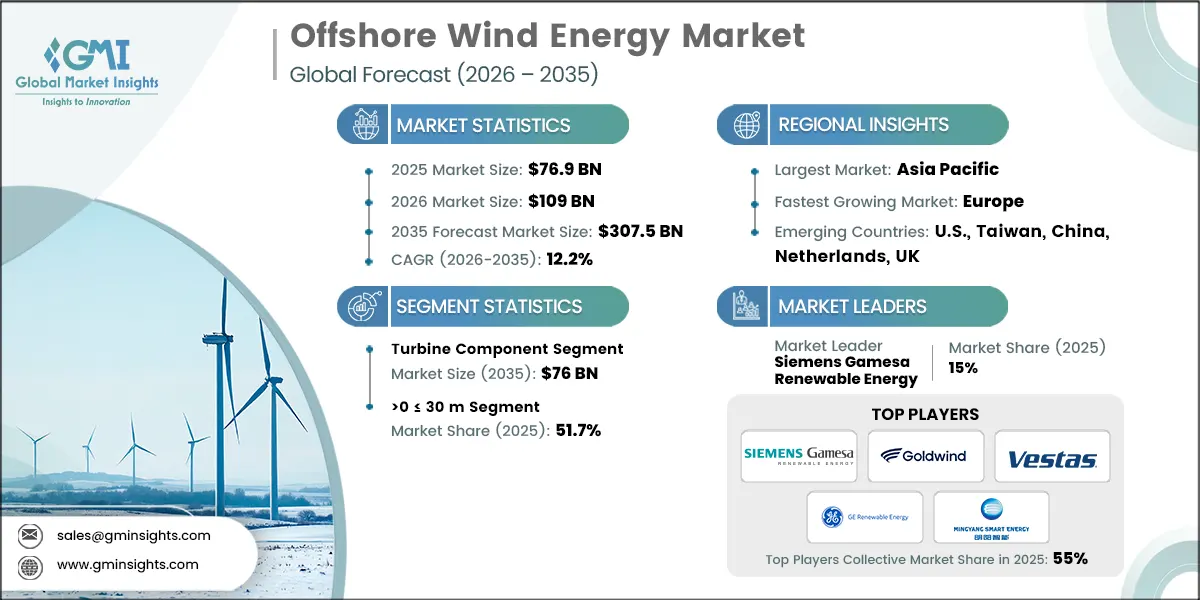
According to a recent study by Global Market Insights Inc., the offshore wind energy market size was valued at USD 76.9 billion in 2025. The market is anticipated to grow from USD 109 billion in 2026 to USD 307.5 billion in 2035, at a CAGR of 12.2%.
Offshore Wind Energy Market Key Takeaways
Market Size & Growth
- 2025 Market Size: USD 76.9 Billion
- 2026 Market Size: USD 109 Billion
- 2035 Forecast Market Size: USD 307.5 Billion
- CAGR (2026–2035): 12.2%
Regional Dominance
- Largest Market: Asia Pacific
- Fastest Growing Region: Europe
Key Market Drivers
- Favorable regulatory policies.
- Huge untapped & unexplored energy potential.
- Growing adoption of clean energy sources.
- Increasing demand for electricity.
Challenges
- High capital cost and installation complexity.
- Availability of auxiliary electricity generation sources.
Opportunity
- Ongoing implementation of FiTs.
- Increased offshore wind capacity installation primarily across Europe.
Key Players
- Leading Players: Top 5 players in this market include Siemens Gamesa Renewable Energy, Vestas Wind Systems, GE Renewable Energy, MingYang Smart Energy, Goldwind with a collective market share of 55%.
Get Market Insights & Growth Opportunities
- The steady increase in electricity consumption combined with growing concerns regarding carbon emissions has encouraged policymakers to introduce supportive regulatory frameworks, thereby boosting investments in renewable energy technologies. The offshore wind sector is largely supported by policy mechanisms such as fixed tariff structures, technology-based deployment targets, and competitive bidding processes. Several nations, including China, Denmark, France, Germany, Japan, the Netherlands, and the United Kingdom, have implemented offshore wind auction programs to accelerate project development.
- The expanding supply chain supporting offshore wind development, combined with progress in vessel capabilities, grid integration, and installation methods, is helping shorten project timelines and lower overall costs, thereby accelerating deployment. Additionally, advancements in foundation technologies that enable installations in deeper waters, along with improvements in jacket and monopile structures, are facilitating project execution in harsher marine conditions and broadening the range of viable offshore locations.
- The continued rollout of Feed-in Tariffs (FiTs), which offer predictable revenue streams and lower financial uncertainty, along with the introduction of Contracts for Difference (CfD) mechanisms that enhance income stability for project developers, is expected to strengthen competitive dynamics within the industry. In addition, government-led competitive auctions, evolving financing mechanisms such as green bonds and long-term Power Purchase Agreements (PPAs) and increasing investments in offshore transmission infrastructure to facilitate grid integration are anticipated to support market expansion.
- The rising deployment of offshore wind capacity across Europe, supported by long coastlines, strong wind resources, and well-established regulatory structures, is further driving sector growth. Expanding wind power capabilities in key markets such as the United States and China, backed by extensive project pipelines, are also contributing to industry momentum. Furthermore, the growing emphasis on developing large-scale offshore wind projects exceeding 1 GW, combined with the clustering of wind farm developments, is expected to strengthen overall market growth.
- Ongoing technological progress and innovation, such as the development of higher-capacity turbines, improved construction expertise, and emerging solutions including floating platform technologies, along with continuous enhancements in foundation engineering and installation processes, are expected to boost product demand. Additionally, advancements in site access, operational efficiency, and system integration are enabling projects to be deployed in deeper waters and farther offshore, allowing operators to capture stronger and more consistent wind resources, thereby improving capacity utilization and supporting industry growth.
- Continued government support in the form of subsidies, tax benefits, and other incentive programs aimed at promoting offshore wind energy is expected to impact market growth positively. For example, initiatives such as the European Green Deal and various national renewable energy targets are fueling sector expansion. Rising investments from private companies and financial institutions further reinforces the market outlook. Moreover, international partnerships and regional cooperation can accelerate offshore wind development by enabling the sharing of resources, knowledge, and best practices, thereby driving stronger demand for the technology.
To get key market trends
Offshore Wind Energy Market Trends
- Digitalization and operations and maintenance (O&M) innovation are driving significant cost reductions in the offshore wind sector. Advanced digital technologies including artificial intelligence, machine learning, and Internet of Things (IoT) sensors are transforming offshore wind O&M practices, thereby leading to market growth. Improvements including reduced unplanned downtime by 30-40% and extended component lifespans by 10-15% to increase energy production and reduce LCOE, will complement the market growth.
- For instance, in December 2025, Sumitomo Corporation announced government approval for the Five Estuaries offshore wind project in the UK, advancing its European renewable portfolio.
- Development of innovative transmission concepts to optimize offshore wind integration and networked transmission infrastructure will contribute to the business scenario. Further, introduction of pilot projects integrating offshore wind with hydrogen production in several markets will enable energy storage and utilization of curtailed generation, complementing the industry landscape.
- Substantial investment in localized manufacturing capabilities and specialized port infrastructure driven by economic and strategic considerations along with supply chain localization, reducing logistics expenses and carbon footprint will drive the market outlook. Leading manufacturers are establishing regional manufacturing hubs to serve multiple markets coupled with Chinese manufacturers consisting of Goldwind among others will expand internationally, thereby establishing their manufacturing presence in Southeast Asian markets.
- For instance, in June 2025, Siemens Gamesa is engaging with Chinese suppliers of rare-earth permanent magnets to explore the option of establishing production in Europe, aiming to reduce the region’s dependence on imports, following supply restrictions from China.
- Government policy frameworks and competitive auction mechanisms replacing feed-in tariff and power purchase agreement structures and increasingly ambitious national targets will drive the business landscape. Further, development of ambitious floating offshore wind targets owing to accelerated cost reduction potential will lead to business expansion.
- For instance, in June 2025, Global Offshore Wind Alliance (GOWA) along with twenty-seven countries established specific offshore wind capacity targets comprising over 30 member countries committed to the 2,000 GW by 2050.
Offshore Wind Energy Market Analysis
 Learn more about the key segments shaping this market
Learn more about the key segments shaping this market
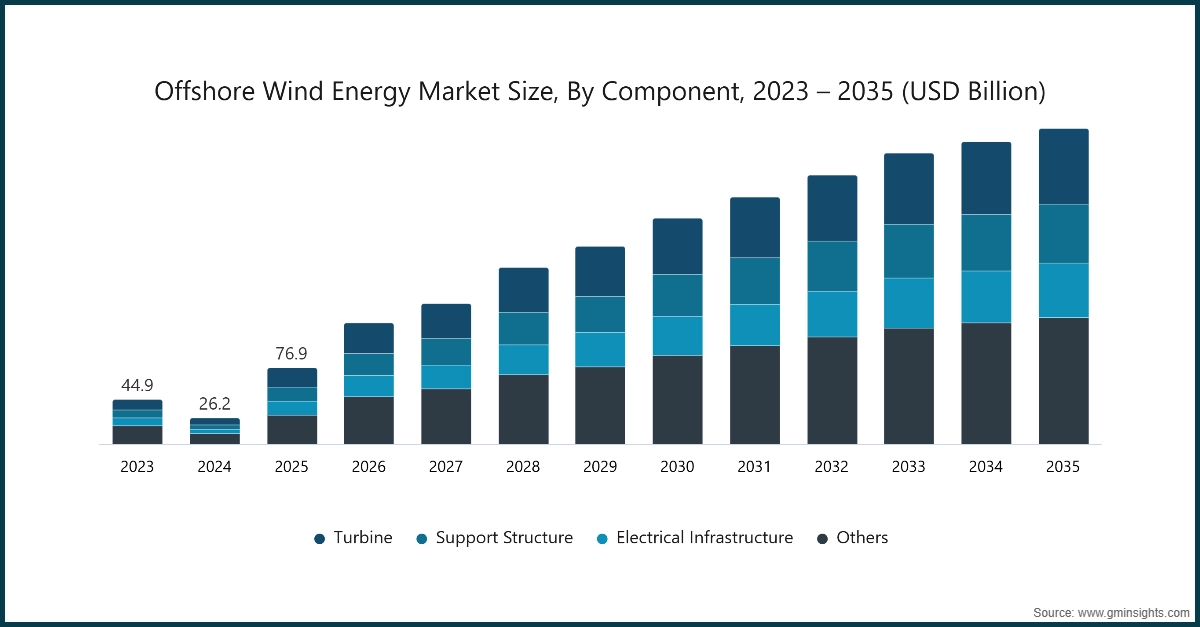
Based on component, the offshore wind energy market is segmented into turbine, support structure, electrical infrastructure and Others. The others segment accounted for over 38.2% market share in 2025 and is expected to grow at a CAGR of 11.7% through 2035.
- Others, including offshore substations, will drive market growth due to the increasing adoption of HVDC systems, especially in large-scale projects. This segment's large market share reflects the capital-intensive and complex nature of offshore wind development. Offshore substations are increasingly being incorporated into hybrid setups that integrate wind power with other renewable energy sources, enhancing grid stability by delivering a more consistent and reliable energy output. Moreover, innovation in installation methods, including floating turbine assembly and tow-out installation, is reducing installation costs and weather dependencies, leading to product adoption.
- The turbine component will grow to more than USD 76 billion by 2035 on account of the worldwide transition toward renewable energy, where larger wind turbines are able to harness more wind power and operate more efficiently, lowering the cost per MWh of electricity produced. Leading turbine manufacturers including Siemens Gamesa Renewable Energy, Vestas Wind Systems, and GE Renewable Energy dominate this segment, with Chinese manufacturers MingYang and Goldwind rapidly gaining market share. Additionally, extended blade lengths and taller towers enable turbines to access stronger and more consistent winds at higher altitudes, further enhancing energy capture and shaping the overall industry landscape.
- Electrical infrastructure captured 17.6% of the market share in 2025, driven by technological advancements, the expansion of project sizes, and the demand for efficient and dependable energy transmission. It is a key area of innovation, with High Voltage Direct Current (HVDC) transmission systems enabling connection of large offshore wind farms located far from shore. Rising deployment of floating wind turbines, which necessitates innovative electrical infrastructure solutions such as dynamic (flexible) cabling, will support market development.
- Support structure market is anticipated to expand with the increasing deployment of offshore wind in deeper waters requiring more sophisticated and expensive foundation solutions. Emerging hybrid support structures, which integrate features from multiple foundation types, are being used to optimize both cost and performance for specific site conditions. These solutions also provide greater flexibility in adapting to varying seabed and environmental conditions, effectively combining the advantages of both monopile and jacket foundations. The development of standardized foundation designs that enable economies of scale in fabrication and installation, will enhance the business statistics.
Learn more about the key segments shaping this market
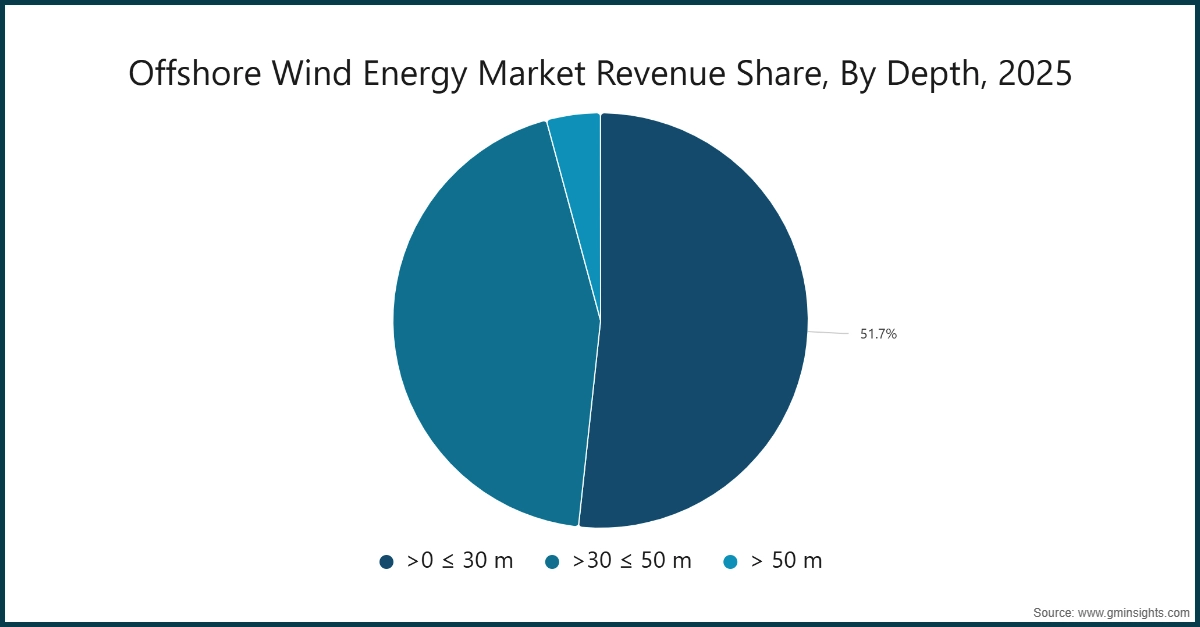
Based on depth, the offshore wind energy market is segmented into >0 ≤ 30 m, >30 ≤ 50 m, and > 50 m. The >0 ≤ 30 m accounts for the major share with 51.7% in 2025 and is expected to grow at a CAGR of 10.5% up to 2035, owing to the technical maturity and cost-effectiveness of fixed-bottom foundation technologies in shallow waters.
- Further, the depth due to their relative ease of development and lower costs compared to deep-water projects, will gain traction. Their foundations involve less complex installation processes, while the growing deployment of smaller turbines and the increasing use of hybrid substation designs combining alternating current (AC) and direct current (DC) systems help enhance energy transmission efficiency. Additionally, emerging markets including the United States East Coast, Taiwan, and Southeast Asian countries will augment the market landscape.
- The segment of >30 m to ≤50 m water depths is anticipated to expand steadily, driven by the rising adoption of jacket foundations that provide a stable yet economical solution. Jacket foundations are increasingly preferred in this depth range due to their superior performance in challenging seabed conditions and ability to support larger turbines. They further enable the development of offshore wind projects in deeper waters than conventional shallow-water methods. Additionally, technological advances in foundation design and installation methods that are reducing costs and improving project economics will drive the market outlook.
- Depths of >50 m are projected to grow at a CAGR of over 28.5%, fueled by the advancement of floating wind turbine technology. Various floating designs, including spar-buoy, semi-submersible, and tension-leg platforms, are being developed to enhance both stability and operational efficiency. Enhanced policy support with Japan's EEZ Bill and South Korea's OSS Bill will specifically enable floating offshore wind in the deep waters.
- For instance, in November 2025, GB Energy announced its first investment in an offshore wind project, the Pentland Floating Wind Project, being developed by Copenhagen Infrastructure Partners (CIP) and its partners. GB Energy, together with the National Wealth Fund and the Scottish National Investment Bank, will each contribute USD 65.5 million to support the deployment of 100 MW of offshore wind capacity in the United Kingdom.
Looking for region specific data?
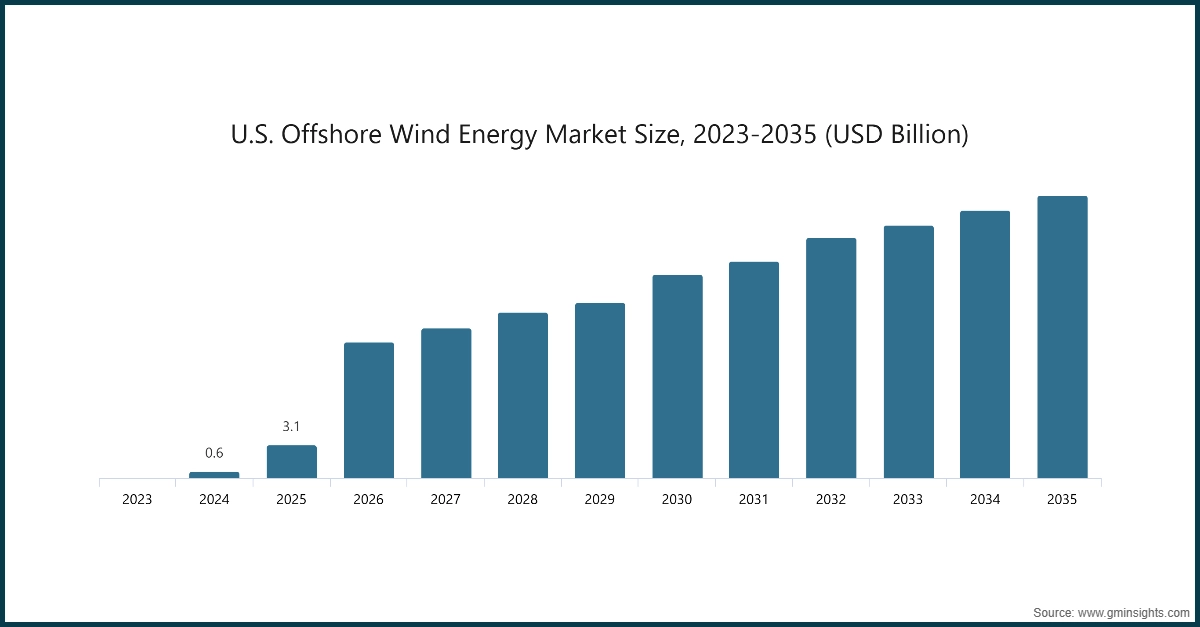
The U.S. offshore wind energy market was valued at USD 3.1 billion in 2025 and is projected to grow at a CAGR of 8.5% for the forecast period of 2026-2035.
- North America amounted to 4% market share in 2025 owing to technological advancements, growing environmental concerns and supportive policies, thereby strengthening the market landscape. Established offshore wind targets across eight including New York, New Jersey, Massachusetts, Connecticut, Rhode Island, Maryland, Virginia, and North Carolina will contribute to the business momentum. Ongoing investments to develop manufacturing facilities for turbines, blades, towers, foundations, and cables coupled with development of specialized offshore wind ports are under development on the East Coast, Gulf Coast, and West Coast will contribute to the market growth.
- Substantial investment in offshore wind projects and related infrastructure is anticipated to boost product adoption. While offshore wind remains in its early stages in Canada, with the majority of activity concentrated on onshore projects, provinces such as Nova Scotia and Newfoundland and Labrador along with presence of substantial resources on the Atlantic Coast are actively assessing offshore wind potential, supporting the sector’s growth.
The offshore wind energy market in Europe, Germany is anticipated to grow by more than USD 21.5 billion by 2035.
- Europe market is driven from strong policy frameworks including REPowerEU, ambitious renewable energy goals, technological progress, and growing energy security concerns. The offshore wind industry in the region is increasingly focused on deeper waters and floating technologies, shaping a positive business outlook. Key emerging European markets include Poland, which targets 11 GW of offshore wind by 2040, and Baltic Sea countries including Sweden and Finland will further contribute to the business momentum.
- Netherlands will grow owing to favorable North Sea conditions, including consistent high wind speeds and relatively shallow waters along the coast. Ongoing implementation for structured permitting processes, competitive auctions, and long-term Contracts for Difference (CfDs), will provide financial certainty and attract significant domestic and international investment in the country.
- For instance, in December 2025, XOCEAN was awarded a series of five-year contracts in the Netherlands, under which the company will deliver bathymetric survey services for six offshore wind farms.
The offshore wind energy market in Asia Pacific, China is expected to grow at a CAGR of 13% from 2026 to 2035.
- Asia Pacific market will grow on account of supportive policies, increasing electricity demands, strong government commitments to decarbonization, substantial untapped offshore wind resources and favorable wind conditions. Rising adoption of floating wind energy projects across countries comprising of Taiwan and Japan will contribute to the market growth.
- China dominates the regional market and benefits from strong government support, with the Energy Law adopted in November 2024 prioritizing renewable energy development. Further, the Chinese manufacturers including MingYang and Goldwind are developing the world's largest offshore wind turbines, with ratings exceeding 16 MW, thereby gaining international market share and leading to offshore wind deployment.
- Other Asia Pacific markets including Taiwan, Japan and South Korea demonstrate exceptional growth potential. Successfully deployment of competitive auctions with strong local content requirements in Taiwan, enactment of the Offshore Wind Power Promotion Act (OSS Bill) in South Korea and introduction of the EEZ Bill passed in June 2025, in Japan which enables floating offshore wind development in deep waters beyond territorial seas, will augment the business growth.
Emergence of new offshore wind markets in Latin America, Africa, and the Middle East along with growing potential of these markets with suitable resources and rising electricity demand will complement the business landscape. Middle Eastern countries including Saudi Arabia and the United Arab Emirates are investigating offshore wind as part of economic diversification strategies.
Offshore Wind Energy Market Share
- The top five players operating in the offshore wind energy industry are Siemens Gamesa Renewable Energy, Vestas Wind Systems, GE Renewable Energy, MingYang Smart Energy, Goldwind. Market participants are consistently investing in research and development to create advanced reactor technologies, strengthen safety measures, and boost operational performance.
- These companies are collectively driving the offshore wind industry forward through technological innovation, capacity expansion, and market development. Key strategic initiatives include turbine upscaling to 15+ MW class, floating offshore wind technology development, supply chain localization, digitalization of operations, and expansion into emerging markets. Growing collaboration among turbine manufacturers, project developers, component suppliers, and other stakeholders will support to achieve the offshore wind sector's ambitious growth targets.
- Another important strategy is the diversification of product portfolios, enabling companies to provide a variety of offshore wind energy solutions customized for different market segments and client requirements. Leading players are also pursuing expansion and market penetration strategies to access emerging markets with increasing energy demand and engage in international projects to widen their customer reach.
- Project developers such as Ørsted, Equinor, RWE Renewables, and others hold pivotal roles within the offshore wind value chain. They bring specialized expertise in areas like site selection, permitting, financing, and project execution. This underscores the importance of experienced developers in ensuring the successful deployment of offshore wind projects, especially in emerging markets.
Offshore Wind Energy Market Companies
Eminent players operating in the offshore wind energy industry are:
China Longyuan Power Group
- Enessere
- Equinor ASA
- Furukawa Electric
- General Electric
- Global Energy (Group) Limited
- Goldwind
- IMPSA
- LS Cable & System
- Nexans
- Nordex SE
- Ørsted A/S
- Prysmian Group
- RWE Renewables
- Siemens Gamesa Renewable Energy
- Sumitomo Electric Industries
- Southwire Company
- Suzlon Energy Limited
- Vestas
- WEG
- Siemens Gamesa Renewable Energy is the market leader in offshore wind turbine manufacturing, with the most extensive portfolio of offshore wind turbines and the largest installed base globally. The company's offshore wind turbines range from 8 MW to 15 MW class, while its technological leadership includes direct-drive turbine technology, which eliminates gearboxes and reduces maintenance requirements.
- Ørsted A/S is the world's largest offshore wind developer and operator, with over 9 GW of installed offshore wind capacity globally. The Danish company has pioneered offshore wind development and operates major offshore wind farms in Europe, the United States, and Asia. The company, in 2026, signed an agreement with Copenhagen Infrastructure Partners (CIP), to divest its entire European onshore business. This will further support in its strategic priority to refocus on offshore wind in its core European markets.
- Vestas Wind Systems is a Danish wind turbine manufacturer and one of the world's largest wind energy companies. It has strengthened its offshore wind position through its V236-15.0 MW turbine, securing major offshore wind contracts in Europe and Asia Pacific. Further, in December 2025, the company received a 390 MW order for the Shinan-Ui offshore wind project in South Korea, including 26 V236-15.0 MW offshore wind turbines as well as a 20-year service agreement.
- Goldwind is one of China's largest wind turbine manufacturers and has expanded significantly into offshore wind. It supplies turbines for major Chinese offshore wind projects and is expanding internationally, particularly in Southeast Asian markets. The company’s competitive advantages include cost-effective manufacturing and strong support from China's domestic market.
Offshore Wind Energy Market Report Attributes
| Key Takeaway | Details |
|---|---|
| Market Size & Growth | |
| Base Year | 2025 |
| Market Size in 2025 | USD 76.9 Billion |
| Market Size in 2026 | USD 109 Billion |
| Forecast Period 2026-2035 CAGR | 12.2% |
| Market Size in 2035 | USD 307.5 Billion |
| Key Market Trends | |
| Drivers | Impact |
| Favorable regulatory policies | Supportive regulatory frameworks and policy certainty are the most significant drivers of offshore wind deployment. Countries with well-established policy mechanisms, including the United Kingdom, Germany, and China along with increasing investment and reduced project risks will complement the business landscape. |
| Huge untapped & unexplored energy potential | Offshore wind energy holds vast untapped and largely unexplored potential due to the abundance of strong and consistent wind resources available over oceans and large water bodies. Many coastal regions worldwide, particularly in Asia-Pacific, North America, and parts of Africa and Latin America, still have significant undeveloped offshore wind resources due to high initial investment costs, technological limitations, and regulatory challenges. |
| Growing adoption of clean energy sources | Governments across the world are implementing stringent environmental regulations, carbon reduction targets, and renewable energy mandates, encouraging utilities and corporations to transition from fossil fuel-based power generation to sustainable alternatives. Rising electricity demand, coupled with concerns over energy security and fuel price volatility, is further accelerating investments in clean energy infrastructure. |
| Increasing demand for electricity | Increasing electrification across sectors such as transportation, heating, and manufacturing is significantly boosting power requirements, while the expansion of digital infrastructure, data centers, and smart technologies is further elevating electricity consumption. Many countries are witnessing growing pressure on existing power generation systems, prompting governments and utilities to invest in large-scale, reliable, and sustainable energy sources to ensure grid stability and long-term energy security. |
| Pitfalls & Challenges | Impact |
| High capital cost and installation complexity | Offshore wind projects involve substantial upfront investments for turbine manufacturing, foundation construction, subsea cabling, offshore substations, and grid connection systems. In addition, the deployment of turbines in marine environments requires specialized installation vessels, skilled labor, and complex transportation and assembly processes, which further increase project costs. |
| Availability of auxiliary electricity generation sources | Offshore wind power is inherently intermittent and dependent on wind availability, which can fluctuate due to changing weather conditions. As a result, grid operators frequently require backup or complementary power sources such as natural gas plants, hydropower, energy storage systems, or other dispatchable generation technologies to balance supply and demand. |
| Opportunities: | Impact |
| Ongoing implementation of FiTs | FiTs guarantee a fixed price for electricity generated from renewable sources over a predetermined period, making investment in capital-intensive offshore wind projects more predictable and attractive. Additionally, FiTs can stimulate competition among developers to deliver cost-effective solutions, drive technological innovation, and expand local supply chains for turbines, foundations, and transmission infrastructure. |
| Increased offshore wind capacity installation primarily across Europe | Countries such as the UK, Germany, the Netherlands, Denmark, and France are implementing ambitious renewable energy targets and competitive auction systems, which encourage investment in large-scale offshore wind projects. Additionally, the ongoing expansion of turbine sizes, floating wind technologies, and clustered project development enables developers to maximize energy capture and reduce the levelized cost of energy. |
| Market Leaders (2025) | |
| Market Leader |
15% market share |
| Top Players |
Collective market share in 2025 is 55% |
| Competitive Edge |
|
| Regional Insights | |
| Largest Market | Asia Pacific |
| Fastest growing market | Europe |
| Emerging countries | U.S., Taiwan, China, Netherlands, UK |
| Future outlook |
|
What are the growth opportunities in this market?
Offshore Wind Energy Industry News
- In January 2026, Envision Energy along with Vietnam’s REE Group, signed for supply of turbines to 128 MW of nearshore wind projects in Vinh Long Province, encompassing V1-3 Phase II and V1-5&6 Phase II. The developments will further utilize sixteen EN-226/8.X MW turbines, representing the largest single-turbine capacity for nearshore wind in both Vietnam and Southeast Asia, thereby supporting the country’s net-zero energy goals.
- In June 2025, Japan passed the Exclusive Economic Zone (EEZ) Bill, allowing the development of floating offshore wind projects in deep waters beyond its territorial seas. The legislation opens extensive areas for offshore wind deployment and positions Japan as a significant future market for floating wind technology. It also sets out permitting procedures and revenue-sharing arrangements for projects within the EEZ.
- In February 2025, Mitsubishi Corporation announced that it is reassessing the direction of its offshore wind projects in Japan. This notable change in the business landscape suggests that the country may also be affected by the rising costs impacting offshore wind projects worldwide.
- In January 2025, Brazil passed Law No. 15.097/2025, creating the nation’s first comprehensive regulatory framework for offshore wind development. The law outlines permitting procedures, environmental standards, and revenue-sharing arrangements for offshore wind projects within Brazilian waters. This increased regulatory clarity is anticipated to unlock the country’s significant offshore wind potential and draw international investment.
The offshore wind energy market research report includes an in-depth coverage of the industry with estimates & forecast in terms of volume and revenue in “MW & USD Billion” from 2022 to 2035, for the following segments:
Market, By Component
- Turbine
- Support Structure
- Electrical Infrastructure
- Others
Market, By Depth
- >0 ≤ 30 m
- >30 ≤ 50 m
- >50 m
The above information has been provided for the following regions and countries:
- North America
- U.S.
- Canada
- Europe
- Germany
- Spain
- UK
- France
- Italy
- Sweden
- Poland
- Denmark
- Portugal
- Netherlands
- Ireland
- Belgium
- Asia Pacific
- China
- India
- Australia
- Japan
- South Korea
- Vietnam
- Philippines
- Taiwan
- Rest of World
Frequently Asked Question(FAQ) :
What is the market size of the offshore wind energy in 2025?
The market size was USD 76.9 billion in 2025, with a CAGR of 12.2% expected through 2035 driven by favorable regulatory policies, untapped energy potential, and growing adoption of clean energy sources.
What is the projected value of the offshore wind energy market by 2035?
The offshore wind energy market is expected to reach USD 307.5 billion by 2035, propelled by large-capacity projects exceeding 1 GW, floating wind installations, and supportive policies including FiTs and CfDs.
What is the current offshore wind energy market size in 2026?
The market size is projected to reach USD 109 billion in 2026.
What was the market share of the 'others' component segment in 2025?
The 'others' component segment (including offshore substations) accounted for 38.2% market share in 2025 and is expected to grow at a CAGR of 11.7%, driven by HVDC systems adoption.
What is the projected value of turbine component by 2035?
Turbine component will grow to more than USD 76 billion by 2035, driven by worldwide renewable energy transition and larger turbines that harness more wind power efficiently.
What is the growth outlook for depths >50 m segment from 2026 to 2035?
Depths >50 m are projected to grow at a CAGR of over 28.5% till 2035, fueled by advancement of floating wind turbine technology including spar-buoy, semi-submersible, and tension-leg platforms.
Which region leads the offshore wind energy market?
The U.S. market was valued at USD 3.1 billion in 2025 and is expected to grow at a CAGR of 8.5% from 2026 to 2035.
What are the upcoming trends in the offshore wind energy market?
Key trends include development of networked transmission infrastructure and hydrogen production integration, supply chain localization with regional manufacturing hubs, and government policy frameworks with floating offshore wind targets aiming for 2,000 GW by 2050.
Who are the key players in the offshore wind energy market?
Key players include Siemens Gamesa Renewable Energy, Vestas Wind Systems, GE Renewable Energy, MingYang Smart Energy, Goldwind, Ørsted A/S, Equinor ASA, RWE Renewables, China Longyuan Power, Enessere, Furukawa Electric, Global Energy, IMPSA, LS Cable & System, Nexans, Nordex, Prysmian Group, Sumitomo Electric, Southwire Company, Suzlon Energy, and WEG.
Offshore Wind Energy Market Scope
Related Reports