Summary
Table of Content

Off Grid Battery Storage Market
Get a free sample of this report
Form submitted successfully!
Error submitting form. Please try again.
Thank you!
Your inquiry has been received. Our team will reach out to you with the required details via email. To ensure that you don't miss their response, kindly remember to check your spam folder as well!
Request Sectional Data
Thank you!
Your inquiry has been received. Our team will reach out to you with the required details via email. To ensure that you don't miss their response, kindly remember to check your spam folder as well!
Form submitted successfully!
Error submitting form. Please try again.
Off Grid Battery Storage Market Size
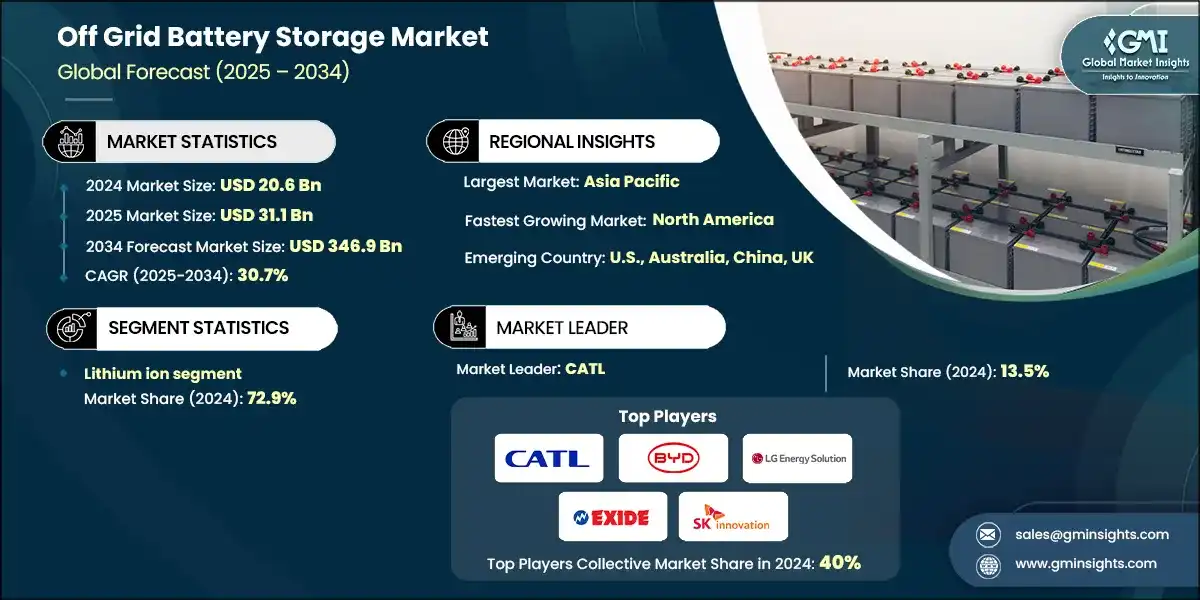
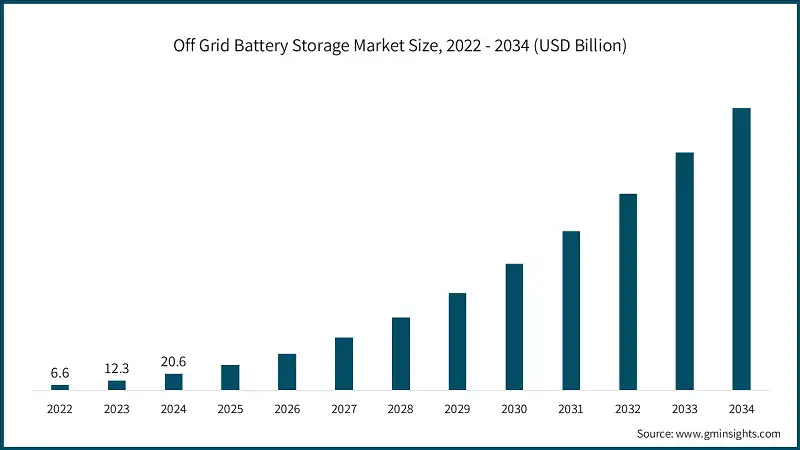
The global off grid battery storage market size was valued at USD 20.6 billion in 2024. The market is expected to grow from USD 31.1 billion in 2025 to USD 346.9 billion by 2034, at a CAGR of 30.7%, according to Global Market Insights Inc.
Off Grid Battery Storage Market Key Takeaways
Market Size & Growth
- 2024 Market Size: USD 20.6 Billion
- 2025 Market Size: USD 31.1 Billion
- 2034 Forecast Market Size: USD 346.9 Billion
- CAGR (2025–2034): 30.7%
Regional Dominance
- Largest Market: Asia Pacific
- Fastest Growing Region: North America
Key Market Drivers
- Growth in the renewable energy sector.
- Favorable regulatory framework.
Challenges
- Safety concerns.
Opportunity
- Increasing demand for autonomous energy systems.
- Technological advancements in manufacturing & recycling.
Key Players
- Market Leader: CATL led with over 13.5% market share in 2024.
- Leading Players: Top 5 players in this market include CATL, BYD, LG Energy Solution, Exide, SK Innovation, which collectively held a market share of 40% in 2024.
Get Market Insights & Growth Opportunities
- Off-grid battery storage systems are increasingly deployed in remote and rural regions where grid connectivity is either unavailable or unreliable. These areas often face frequent power outages or lack access to centralized electricity infrastructure. Off-grid solutions provide a dependable source of energy, especially for critical applications like healthcare, education, and telecommunications.
- In August 2025, BLUETTI Inc. expanded its eco-friendly off-grid battery solutions across Southeast Asia, targeting rural electrification. Their lithium-ion systems offer zero-emission backup power for healthcare and education facilities in underserved regions. The initiative supports decentralized energy access and aligns with global sustainability goals. BLUETTI’s modular systems are now deployed in over 300 villages, enhancing energy reliability and reducing diesel dependency.
- The intermittent nature of renewable energy sources like solar and wind necessitates efficient energy storage solutions. Off-grid battery systems store excess energy generated during peak production periods and release it when generation is low, ensuring a consistent power supply. This capability makes them essential for standalone renewable installations. As governments and private entities push for decarbonization and clean energy adoption, off-grid storage becomes a key enabler of sustainable energy systems.
- Technological advancements and economies of scale have significantly reduced the cost of lithium-ion and other battery chemistries. Lower prices make off-grid battery storage systems more accessible to consumers and businesses, especially in price-sensitive markets. This affordability is encouraging adoption across various sectors, including agriculture, telecom, and small-scale industries.
- Many governments are offering subsidies, tax credits, and grants to promote off-grid energy storage systems. These incentives aim to accelerate the transition to clean energy and improve energy access in underserved regions. Policies supporting net-zero emissions, rural electrification, and energy independence are creating a favorable regulatory environment for market growth.
- Innovations in battery technologies—such as lithium iron phosphate (LFP), flow batteries, and sodium-ion—are enhancing the performance, safety, and lifespan of off-grid storage systems. These advancements allow for greater energy density, faster charging, and improved thermal stability, making systems more efficient and reliable. Flow batteries, for instance, offer scalable energy storage with minimal degradation, ideal for long-duration applications.
- For reference, in October 2025, Alsym Energy launched its Na-Series sodium-ion battery, offering non-toxic, non-flammable, and cost-effective off-grid storage. Designed for 10,000 cycles and 20-year lifespan, the system supports data centers, industrial sites, and remote communities. Its wide temperature tolerance and safety profile make it ideal for off-grid deployment in extreme climates.
- The expansion of telecom towers, mining operations, and military bases in remote areas is driving demand for off-grid battery storage. These infrastructures require uninterrupted power for critical operations, and off-grid systems offer a clean and reliable solution. Telecom operators, in particular, are replacing diesel generators with battery storage to reduce operational costs and carbon emissions. The growth of remote infrastructure projects globally is expected to remain a strong driver for off-grid energy storage adoption.
- For instance, in December 2024, Elektros highlighted a USD 14.3 billion total addressable market for off-grid storage across telecom towers, data centers, and emergency infrastructure. Their lithium-based systems support uninterrupted power for critical operations, with federal contracts and CAGE certification planned for 2025 to expand deployment in remote U.S. regions.
To get key market trends
Off Grid Battery Storage Market Trends
Learn more about the key segments shaping this market
- Off-grid battery storage systems contribute to reducing greenhouse gas emissions by replacing fossil fuel-based generators. As climate change awareness grows, individuals and organizations are seeking cleaner energy alternatives. Off-grid solutions powered by renewables align with global sustainability goals and corporate ESG commitments. Their adoption helps mitigate environmental impact, especially in ecologically sensitive regions.
- Off-grid systems offer users complete autonomy from centralized grids, ensuring energy security and resilience against outages or grid failures. This independence is particularly valuable in disaster-prone areas or regions with unstable grids. Households, businesses, and institutions are increasingly investing in off-grid storage to safeguard against energy disruptions.
- Modern off-grid battery storage systems are designed to be modular and scalable, allowing users to expand capacity as needed. This flexibility makes them suitable for a wide range of applications—from small homes to large industrial facilities. Modular systems reduce upfront costs and allow for phased investments, which is attractive to budget-conscious consumers.
- For illustration, Panel Built Inc. launched modular Battery Energy Storage System (BESS) facilities in October 2025. Their containerized, skid-mounted, and mobile units offer scalable off-grid solutions for utilities and municipalities. Built off-site and delivered turnkey, these systems reduce installation time and support flexible energy deployment.
- Rapid urbanization and infrastructure expansion in emerging economies are increasing energy demand, especially in peri-urban and newly developed areas. Off-grid battery storage systems are being deployed to meet this demand where grid extension is delayed or impractical. Construction sites, temporary settlements, and new industrial zones benefit from portable and reliable energy solutions.
- For example, the U.S. Energy Information Administration reported in February 2025 that 63 GW of new generating capacity will be added in 2025, with 18.2 GW from battery storage. This surge supports urban infrastructure expansion, especially in states like Texas and California, where off-grid systems are deployed to meet rising energy demand.
- Off-grid battery storage is gaining traction among homeowners and businesses seeking sustainable and cost-effective energy solutions. Residential users benefit from reduced electricity bills and backup power during outages, while commercial entities use storage to manage peak loads and improve energy efficiency. The rise of smart homes and energy management systems is further enhancing the appeal of off-grid solutions.
- Microgrids powered by off-grid battery storage are emerging as a solution for community-level energy access. These systems serve multiple users with shared infrastructure, reducing costs and improving reliability. Microgrids are particularly effective in rural and island communities, where centralized grids are absent. They support local economic development, education, and healthcare by ensuring consistent power supply.
- Private companies and investors are recognizing the potential of off-grid battery storage and are pouring capital into technology development, manufacturing, and deployment. Venture capital, impact funds, and corporate investments are fueling innovation and market expansion. Strategic partnerships between battery manufacturers, renewable energy firms, and infrastructure developers are accelerating project execution.
- For reference, in October 2025, Honeywell and LS ELECTRIC announced a global partnership to develop modular BESS for commercial and industrial buildings. Their AI-driven systems support predictive maintenance and grid-aware microgrids, enabling scalable off-grid solutions for data centers and large facilities.
Off Grid Battery Storage Market Analysis
Learn more about the key segments shaping this market
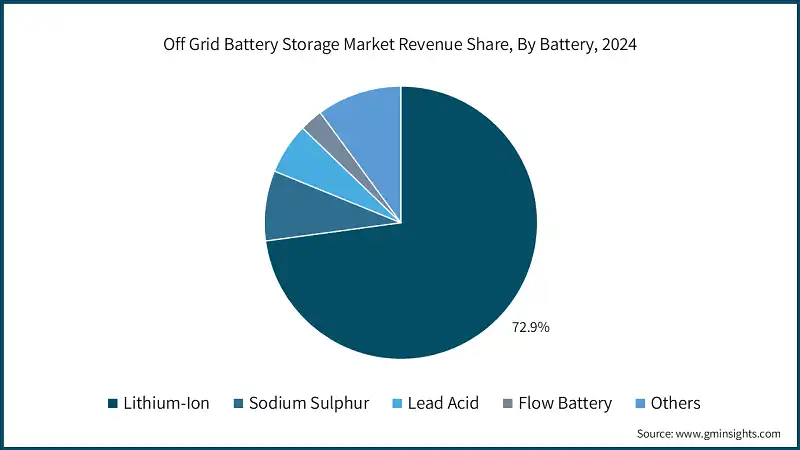
- Based on battery, the industry is segmented into lithium ion, lead acid, sodium sulphur, flow battery, and others. The lithium ion segment dominated the off-grid battery storage market accounting for 72.9% in 2024 and is expected to grow at a CAGR of 29.3% through 2034.
- Lithium-ion batteries are the dominant technology in off-grid storage due to their high energy density, lightweight design, and superior charge-discharge efficiency. These attributes make them ideal for residential, commercial, and mobile off-grid applications. Their compact form factor allows for easy integration into modular systems, while fast charging capabilities support dynamic energy needs. As renewable energy installations grow, lithium-ion batteries are increasingly paired with solar and wind systems to ensure consistent power supply.
- The rapid decline in lithium-ion battery costs, driven by economies of scale and technological innovation, is accelerating off-grid storage adoption. Mass production for electric vehicles and consumer electronics has spilled over into the energy storage sector, making lithium-ion systems more affordable and accessible. This cost reduction enables broader deployment in rural electrification, disaster relief, and mobile infrastructure. Additionally, advancements in battery recycling and second-life applications are improving sustainability and reducing lifecycle costs.
- Lead-acid batteries remain a popular choice for off-grid storage due to their low upfront cost and well-established technology. They are widely used in small-scale systems, backup power applications, and rural electrification projects. Despite lower energy density and shorter lifespan compared to lithium-ion, lead-acid batteries offer reliable performance and are easy to maintain. Their recyclability and global availability make them suitable for budget-conscious deployments.
- Lead-acid batteries are known for their resilience in extreme conditions, making them suitable for off-grid installations in remote or harsh environments. Their ability to tolerate wide temperature ranges and deep discharge cycles supports applications in telecom towers, agricultural sites, and off-grid cabins. Unlike more sensitive chemistries, lead-acid systems can operate reliably with minimal technical oversight. This robustness, combined with low cost and ease of recycling, makes them a practical choice for off-grid users seeking dependable energy storage.
- Sodium-sulfur (NaS) batteries are gaining traction in off-grid storage due to their long-duration capabilities and high operating temperatures. These batteries can store large amounts of energy for extended periods, making them ideal for industrial and utility-scale off-grid applications. Their high energy density and thermal stability support continuous power delivery in remote areas with fluctuating energy demand. NaS batteries are particularly useful in regions with extreme climates, where conventional batteries may fail.
- NaS batteries are increasingly used to support renewable energy integration in off-grid systems. Their ability to deliver consistent power over long durations complements intermittent sources like solar and wind. These batteries help balance supply and demand, reduce curtailment, and enhance grid-forming capabilities in isolated networks. Their high-temperature operation and sealed design reduce environmental risks, making them suitable for remote installations.
- Flow batteries offer unique advantages for off-grid storage, including scalability, long cycle life, and minimal degradation. Unlike conventional batteries, energy and power in flow systems are decoupled, allowing users to scale capacity independently. This flexibility is ideal for community microgrids, industrial sites, and remote infrastructure. Flow batteries can operate for thousands of cycles without significant loss of performance, reducing maintenance and replacement costs. Their water-based electrolytes and low fire risk enhance safety, especially in sensitive environments.
- The environmental and safety profile of flow batteries makes them attractive for off-grid applications in ecologically sensitive areas. These systems use non-toxic, non-flammable electrolytes and operate at ambient temperatures, minimizing risks associated with thermal runaway or hazardous leaks. Their modular design supports easy installation and expansion, while low maintenance requirements reduce operational complexity. Flow batteries are particularly suited for off-grid schools, clinics, and community centers where safety and reliability are paramount.
- The growing trend of hybrid energy systems is driving demand for diverse battery chemistries in off-grid applications. Integrating lithium-ion with flow or lead-acid batteries allows users to optimize performance across different load profiles and durations. For example, lithium-ion can handle short bursts of high power, while flow batteries manage long-duration storage. This multi-chemistry approach enhances system flexibility, reliability, and cost-effectiveness. It also supports tailored solutions for varied off-grid needs—from residential backup to industrial microgrids.
- Advanced Battery Management Systems (BMS) are significantly improving the performance and safety of off-grid storage across all battery types. These systems monitor voltage, temperature, and charge cycles in real time, ensuring optimal operation and preventing failures. For lithium-ion and sodium-sulfur batteries, BMS enhances thermal management and extends lifespan. In flow and lead-acid systems, it supports predictive maintenance and load balancing. The integration of AI and IoT into BMS is enabling smarter energy management, remote diagnostics, and adaptive control.
Looking for region specific data?
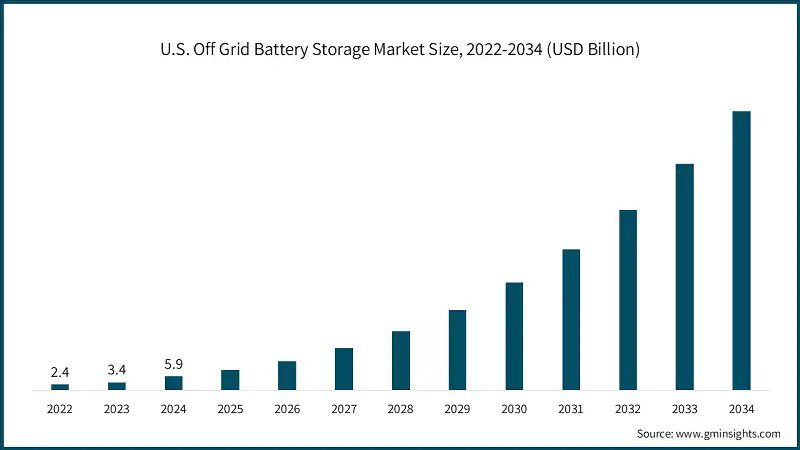
- The U.S. off grid battery storage market is set to reach a value of USD 10.1 billion by 2034. The U.S. market is expanding rapidly due to strong federal support, including tax credits, grants, and resilience-focused programs like the DOE’s Long Duration Storage Shot. These initiatives encourage deployment in disaster-prone and underserved regions. Rising demand for backup power in homes, data centers, and military bases is also driving adoption. Additionally, the push for electrification of transportation and rural infrastructure is creating new opportunities for off-grid systems.
- For reference, in October 2025, U.S. battery manufacturers began shifting focus from electric vehicles to off-grid and grid storage markets due to slowing EV sales and surplus production capacity. Companies like LG converted major facilities to produce stationary batteries for data centers and renewable energy storage. This pivot supports growing demand for long-duration storage in off-grid applications, especially in rural and disaster-prone areas. The same production lines used for EV batteries are now supplying scalable lithium-ion systems for backup power and microgrids.
- Europe’s off-grid battery storage market is driven by aggressive climate policies, high renewable penetration, and sustainability mandates. Countries like Germany, France, and the Nordics are deploying off-grid systems to support solar and wind integration in remote and island regions. The EU’s Green Deal and REPowerEU initiatives promote decentralized energy and long-duration storage. Flow batteries and sodium-ion technologies are gaining traction due to their eco-friendly profiles. Additionally, energy security concerns and rising electricity prices are prompting businesses and households to invest in off-grid solutions.
- European island territories such as the Canary Islands, Corsica, and Greek archipelagos are adopting off-grid battery storage to reduce dependence on imported fuels and improve energy resilience. These regions face unique challenges due to geographic isolation and climate vulnerability. Off-grid systems paired with renewables offer sustainable and cost-effective alternatives to diesel generators. EU funding and regional development programs are supporting microgrid installations and battery innovation. As climate adaptation becomes a priority, off-grid storage is emerging as a critical tool for disaster preparedness and energy autonomy in Europe’s peripheral and island communities.
- For illustration, in May 2025, SolarPower Europe reported that Europe installed 21.9 GWh of battery energy storage systems (BESS) in 2024, marking the eleventh consecutive year of record growth. Despite a slowdown in annual growth to 15%, the total battery fleet reached 61.1 GWh. The report emphasized the urgent need for an EU Energy Storage Action Plan to support grid flexibility and renewable integration.
- Asia Pacific is witnessing robust growth in off-grid battery storage, driven by rural electrification efforts and rising industrial energy needs. Countries like India, Indonesia, and the Philippines are deploying solar-plus-storage systems in remote villages, schools, and clinics. China leads in manufacturing and innovation, with companies like CATL and BYD offering scalable lithium-ion and sodium-ion solutions. Australia is investing in off-grid systems for mining and agricultural operations. Government subsidies, falling battery costs, and regional climate goals are fueling adoption. Asia Pacific’s diverse energy landscape and large off-grid population make it a major growth engine for battery storage.
- China, South Korea, and Japan are driving Asia Pacific’s leadership in off-grid battery technology through R&D, manufacturing scale, and export expansion. Chinese firms dominate lithium-ion production, while Japan and Korea are advancing flow and sodium-sulfur technologies. These countries are exporting off-grid systems to Africa, Southeast Asia, and Latin America, supporting global electrification. Strategic partnerships and Belt and Road energy projects are enabling large-scale deployments.
- In Africa and Latin America, off-grid battery storage is essential for expanding energy access in underserved regions. Governments and NGOs are deploying solar-plus-storage systems in schools, clinics, and agricultural sites. Lithium-ion and lead-acid batteries are commonly used due to affordability and availability. International funding from organizations like the World Bank and USAID is supporting infrastructure development. Local startups are also emerging with innovative, low-cost solutions.
- Off-grid battery storage is increasingly used in humanitarian and climate resilience efforts across the rest of the world. In regions affected by conflict, displacement, or natural disasters, portable and modular battery systems provide critical power for relief operations. Flow and sodium-ion batteries are favored for their safety and long-duration capabilities. International agencies are investing in off-grid solutions to support refugee camps, mobile clinics, and emergency shelters.
Off Grid Battery Storage Market Share
- The top 5 companies in the Off Grid battery storage industry are CATL, BYD, Exide, LG Energy Solution, and SK Innovation contributing around 40% of the market in 2024.
- SK Innovation, through its subsidiary Key Capture Energy, is actively shaping the U.S. off-grid battery storage landscape by deploying large-scale Battery Energy Storage Systems (BESS). With over 620 MW of operational capacity and a development pipeline exceeding 10,000 MW, the company supports grid resilience and renewable integration. These systems are crucial for managing peak demand and ensuring energy reliability in remote and high-load areas, including AI data centers. SK Innovation’s focus on advanced lithium-ion technologies and strategic infrastructure investments positions it as a key player in expanding off-grid energy access across North America.
- BYD is a global leader in battery and renewable energy technologies, offering innovative off-grid storage solutions through its Haohan battery system. Engineered for extreme environments, Haohan delivers 51% higher energy density than market averages and supports over 10,000 cycles. It integrates solar and wind energy with advanced power conversion and energy management systems, making it ideal for rural electrification and commercial backup. BYD’s modular, containerized systems reduce land use and installation costs by up to 30%, while lowering lifetime energy costs to under USD 0.014/kWh. These innovations position BYD as a transformative force in global off-grid energy storage.
Off Grid Battery Storage Market Companies
Major players operating in the off grid battery storage industry are:
- BYD
- CATL
- Exide
- GS Yuasa
- Hitachi
- Johnson Controls
- Leclanche
- LG
- Panasonic
- Samsung
- Siemens
- SK Innovation
- Tesla
- Toshiba
- Varta
- CATL, headquartered in Ningde, China, is a global leader in lithium-ion battery manufacturing with a 38% market share in EV and stationary storage. In 2025, CATL raised USD 4.6 billion through a Hong Kong IPO to fund innovations in grid-scale and off-grid storage, including hybrid lithium-sodium chemistries and five-minute fast-charge batteries. The company’s second-generation sodium-ion cells are expected to reach commercial scale ahead of schedule, supporting long-duration off-grid applications. CATL’s technology is deployed in microgrids, telecom towers, and rural electrification projects across Asia, Africa, and Latin America, reinforcing its role in global energy transition.
- LG Energy Solution, based in South Korea, is expanding its footprint in the U.S. off-grid battery storage market through its system integrator arm, LG ES Vertech. In 2025, LG converted major EV battery production lines to supply stationary lithium-ion systems for data centers, microgrids, and renewable integration. The company secured a USD 4.3 billion deal with Tesla for ESS batteries and is actively deploying containerized BESS units across North America. LG’s vertically integrated model and advanced LFP modules support scalable off-grid solutions for residential, commercial, and industrial use, enhancing energy independence and grid resilience.
- Exide, a legacy battery manufacturer headquartered in India, is leveraging its expertise in lead-acid and lithium-ion technologies to serve the off-grid storage market. The company supplies modular energy systems for telecom, defense, and rural electrification, particularly in South Asia and Africa. Exide’s sealed lead-acid batteries remain popular for cost-effective backup power, while its lithium-ion offerings are gaining traction in hybrid solar installations. With a focus on durability and affordability, Exide is expanding its product line to include smart energy management and inverter-integrated solutions, supporting decentralized energy access in remote and underserved regions.
Off Grid Battery Storage Market Report Attributes
| Key Takeaway | Details |
|---|---|
| Market Size & Growth | |
| Base Year | 2024 |
| Market Size in 2024 | USD 20.6 Billion |
| Market Size in 2025 | USD 31.1 Billion |
| Forecast Period 2025 - 2034 CAGR | 30.7% |
| Market Size in 2034 | USD 346.9 Billion |
| Key Market Trends | |
| Drivers | Impact |
| Growth in the renewable energy sector | The off-grid battery storage market is experiencing rapid growth, largely driven by the increasing integration of renewable energy sources such as solar and wind. These batteries provide scalable and long-duration energy storage solutions, making them ideal for managing the intermittent nature of renewable power generation and ensuring a stable energy supply in off-grid environments |
| Favorable regulatory framework | Supportive policies across North America—such as the U.S. Department of Energy’s Long Duration Storage Shot and the adoption of UL and IEEE standards—are accelerating the deployment of off-grid battery storage systems. These regulatory frameworks emphasize safety, performance, and seamless integration with renewable energy sources and microgrids |
| Pitfalls & Challenges | Impact |
| Safety concerns | Although off-grid batteries offer notable safety benefits, they still face several challenges that can impact their performance and scalability. Issues such as electrolyte leakage, complex system maintenance requirements, and relatively low energy density can lead to operational inefficiencies and environmental risks, particularly in large-scale deployments |
| Opportunities: | Impact |
| Increasing demand for autonomous energy systems | As global efforts to improve rural electrification intensify, the demand for autonomous energy systems continues to grow. This trend is particularly strong in developing countries and island nations, where off-grid storage ensures energy access and supports socio-economic development. |
| Technological advancements in manufacturing & recycling | Innovations in manufacturing and recycling are further driving down costs, making off-grid solutions a financially viable alternative to traditional diesel generators and grid extensions. |
| Market Leaders (2024) | |
| Market Leaders |
13.5%market share |
| Top Players |
Collective market share in 2024 is 40% |
| Competitive Edge |
|
| Regional Insights | |
| Largest Market | Asia Pacific |
| Fastest Growing Market | North America |
| Emerging Countries | U.S., Australia, China, UK |
| Future outlook |
|
What are the growth opportunities in this market?
Off Grid Battery Storage Industry News
- In June 2024, BASF Stationary Energy Storage a subsidiary of BASF and NGK a Japanese ceramic manufacturer in partnership launched next generation sodium sulfur batteries “NAS Model L24”. The new battery has longer shelf life and better management towards higher temperature.
- In October 2024, VRB Energy commenced construction of a new industrial facility dedicated to vanadium flow battery production, aiming to achieve a manufacturing capacity of 3 GWh. This large-scale initiative marks a significant milestone in the company’s expansion into grid-scale and off-grid energy storage markets. The facility will focus on producing vanadium redox flow batteries (VRFBs), known for their long-duration capabilities and safety features. Designed to support renewable integration and grid stability, the project reinforces VRB Energy’s commitment to advancing sustainable energy solutions and scaling its presence across global markets, including Asia, Europe, and emerging regions.
- In July 2024, Exide announced the launch of its advanced AGM battery in its lead-acid battery line for starting, light, and ignition (SLI) applications. The new product is designed to offer optimal performance for automotive services.
- In January 2022, QuantumScape Corporation collaborated with Fluence Energy Inc. to introduce solid state lithium battery technology in stationary battery storage applications. The agreement will help to achieve both parties’ objectives to reform energy storage industry and reduce carbon footprint. The QuantumScape had entered into partnership with automakers including Volkswagen.
The off grid battery storage market research report includes in-depth coverage of the industry with estimates & forecast in terms of volume (MW) & revenue (USD Million) from 2021 to 2034, for the following segments:
Market, By Battery
- Lithium Ion
- Sodium Sulphur
- Lead Acid
- Flow Battery
- Others
The above information has been provided for the following regions and countries:
- North America
- U.S.
- Canada
- Mexico
- Europe
- UK
- France
- Germany
- Italy
- Russia
- Spain
- Asia Pacific
- China
- Australia
- India
- Japan
- South Korea
- Rest of World
Frequently Asked Question(FAQ) :
What was the market size of the off-grid battery storage in 2024?
The market size was valued at USD 20.6 billion in 2024, with a CAGR of 30.7% expected through 2034. Increasing demand for reliable energy solutions in remote and rural areas is driving market growth.
What is the projected value of the off-grid battery storage market by 2034?
The market is poised to reach USD 346.9 billion by 2034, driven by advancements in modular and scalable battery systems, renewable energy integration, and rising energy demand in emerging economies.
What is the expected size of the off-grid battery storage industry in 2025?
The market size is projected to reach USD 31.1 billion in 2025.
What was the market share of the lithium-ion segment in 2024?
The lithium-ion segment dominated the market with a 72.9% share in 2024 and is expected to witness over 29.3% CAGR through 2034.
Which regions are driving the demand for off-grid battery storage sector?
The U.S. market is expected to reach USD 10.1 billion by 2034, led by federal support, tax credits, and resilience-focused programs like the DOE’s Long Duration Storage Shot.
What are the key trends driving the off-grid battery storage market?
Trends include renewable-powered off-grid systems, modular batteries, microgrid expansion, and rising investments in energy innovation.
Who are the major players in the off-grid battery storage industry?
Key players include BYD, CATL, Exide, GS Yuasa, Hitachi, Johnson Controls, Leclanche, LG, Panasonic, Samsung, and Siemens.
Off Grid Battery Storage Market Scope
Related Reports