Summary
Table of Content

North America Underfloor Heating Market
Get a free sample of this report
Form submitted successfully!
Error submitting form. Please try again.
Thank you!
Your inquiry has been received. Our team will reach out to you with the required details via email. To ensure that you don't miss their response, kindly remember to check your spam folder as well!
Request Sectional Data
Thank you!
Your inquiry has been received. Our team will reach out to you with the required details via email. To ensure that you don't miss their response, kindly remember to check your spam folder as well!
Form submitted successfully!
Error submitting form. Please try again.
North America Underfloor Heating Market Size
Increasing need for energy efficient floor heating systems driven by the implementation of policies to reduce carbon emissions along with favorable policies toward enhancing building performance is shaping business dynamics. Growing construction of building infrastructure, rising demand for advanced technological and environmentally friendly floor heating systems will augment business landscape.
North America Underfloor Heating Market Key Takeaways
Market Size & Growth
- 2025 Market Size: USD 2 Billion
- 2026 Market Size: USD 2.1 Billion
- 2035 Forecast Market Size: USD 3.3 Billion
- CAGR (2026–2035): 5.2%
Regional Dominance
- Largest Market: U.S.
- Fastest Growing Country: Canada
Key Market Drivers
- Stringent standards by respective authorities to curb carbon emissions.
- Flourishing investments for development of green building infrastructure.
- Growing adoption of energy efficient space heating technologies.
Challenges
- Significant initial deployment cost.
Opportunity
- Growing expansion and electrification of building retrofits.
- Growth in high‑end residential construction.
- Integration with renewable-powered buildings.
- Expansion of property technology partnerships.
Key Players
- Market Leader: Uponor Corporation led with over 9% market share in 2025.
- Leading Players: Top 5 players in this market include REHAU, Watts, Uponor Corporation, Schluter Systems, Danfoss, which collectively held a market share of 30% in 2025.
Get Market Insights & Growth OpportunitiesFor instance, in January 2025, the New York State Assembly Bill 2025-A2101A established a green affordable pre-electrification program. It will assist property owners and renters in dealing with the structural and code issues they currently face in accessing support for energy efficiency, emission reduction, and climate resilience measures. It also establishes an interagency coordination group that will oversee the coordination of the state’s energy efficiency and electrification programs to facilitate the provision of support and resources from the concerned agencies.
Growing inclination toward advanced floor-heating solutions including electric radiant floor systems and hydronic technologies driven by governments and international agencies are aiming for electrification of building infrastructure further shaping business dynamics. Consumers are opting for energy-saving heating systems that can help reducing utility bills and providing uniform heating distribution will continue to accelerate the adoption.
For example, in March 2024, JVIS has introduced its MicroHeat Series 6 Hydronic Underfloor Heating System in March 2024. This is a smart and energy-savvy solution for replacing old heating elements with new technology. The system can be used in any space, from a small space to a larger space or venue, for heating while speeding up adoption in both residential and commercial spaces. Furthermore, this technology also has prospects for development in the electric vehicle segment, thereby increasing the scope for use in other applications.
Increasing occurrence of extreme weather events have accelerated the demand for efficient underfloor heating, coupled with shifting focus to reduce carbon emissions, will accelerate product demand.
For instance, California implemented a new Energy Code in January 2026, which will require greater efficiency in new constructions and major renovations of buildings for residential and commercial use. The 2025 code supports California’s overall decarbonization objectives, strengthens heat pump adoption, and reduces energy use during peak hours. These provisions are expected to provide significant long-term economic benefits and greenhouse gas reductions, as supported by CALGreen’s optional high-performance standards.
Stringent mandates that encourage energy conservation, along with consumers' increasing inclination to adopt low energy-consumption solutions, will boost product penetration. Additionally, the expansion of residential and commercial infrastructure and the quick development of emerging markets will have a positive impact on the business outlook.
For example, in U.S., California, the West Hollywood City Council approved the Equitable Building Performance Standards in December 2025, which accelerate the climate goals and improves the health, comfort, and sustainability of existing buildings. By becoming the first jurisdiction in Los Angeles County to adopt these standards, the city is setting a regional benchmark and is also exploring other reach codes to take building performance to the next level.
The North America underfloor heating market was estimated at USD 2 billion in 2025. The market is expected to grow from USD 2.1 billion in 2026 to USD 3.3 billion in 2035, at a CAGR of 5.2% according to a recent study by Global Market Insights Inc.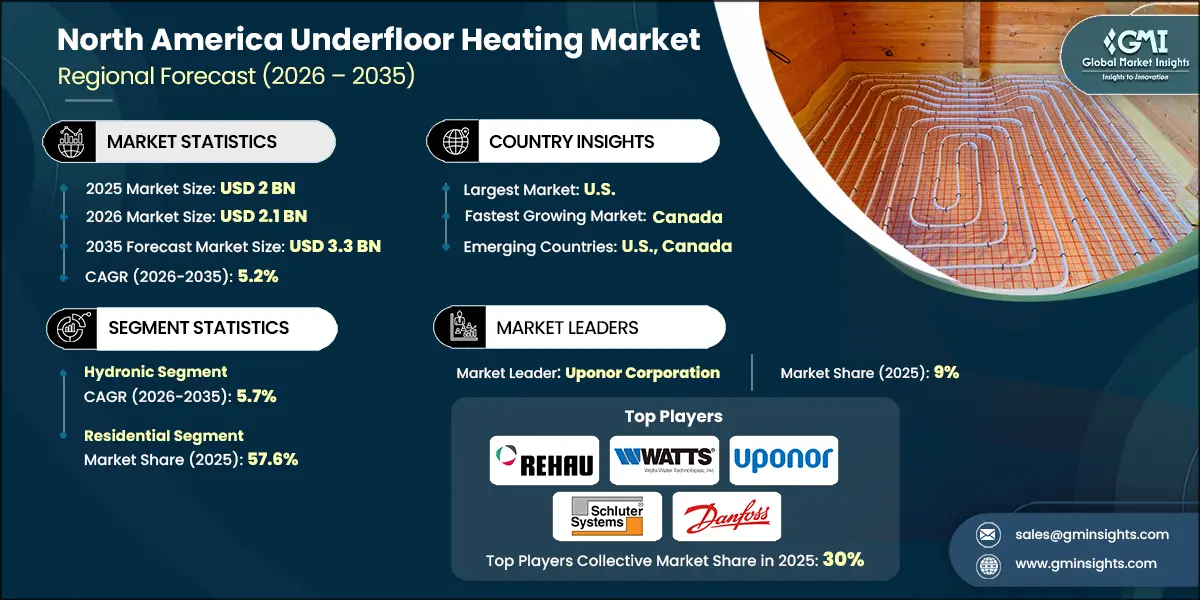
To get key market trends
North America Underfloor Heating Market Trends
The North America underfloor heating market is anticipated to witness significant growth, driven by rising demand for space heating, and shifting focus to replace the conventional systems, and construction of building infrastructure. Stringent regulatory mandates, which focus on increasing energy efficiency in buildings, and the increasing trend of using advanced technology will complement the industry dynamics.
For example, in April 2024, the Department of Energy announced a Clean Energy Rule, focusing on new constructions and renovations in the country. This rule aims to reduce building emissions significantly and channelize the building infrastructure towards net-zero carbon emissions by 2045. Moreover, as the number of people migrating to urban centers increases, the need for additional building infrastructures is expected to influence the green building investment outlook.
The increasing need for energy-saving technology is enhancing the adoption of underfloor heating systems in modern climate control systems. Growing urbanization rate, rapidly increasing population and construction both residential and commercial buildings, along with more efficient infrastructure, accelerated the need for space-saving, efficient, and eco-friendly heating systems, which is augmenting long-term growth of the North American market for underfloor heating systems industry.
North America Underfloor Heating Market Analysis
Learn more about the key segments shaping this market
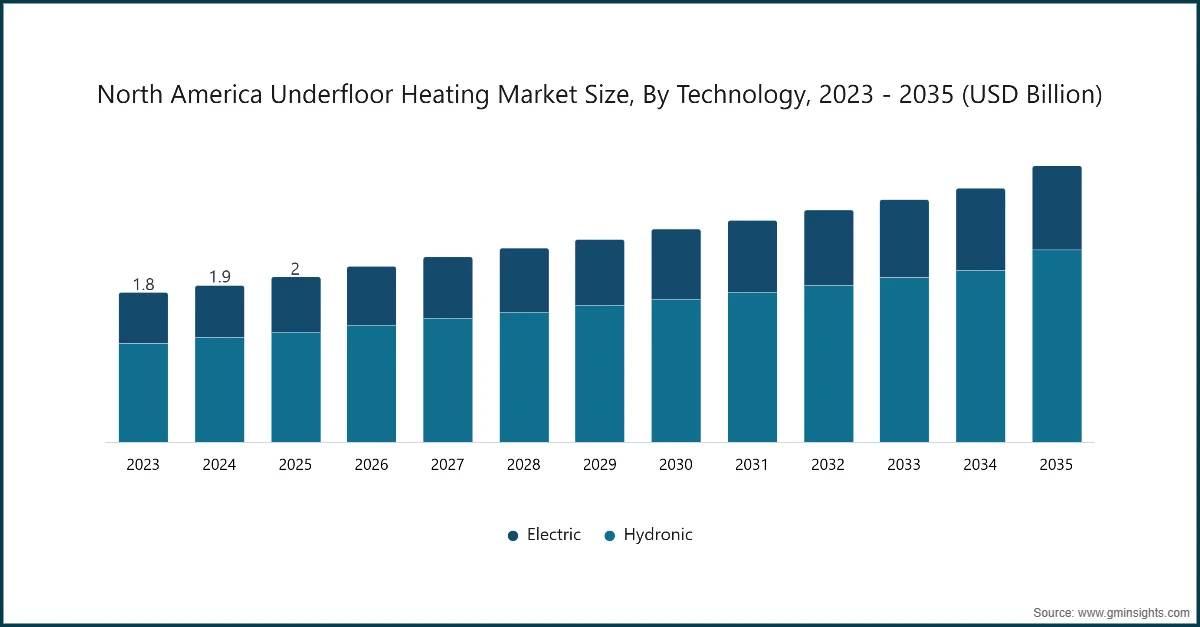
Based on technology, the underfloor heating market is segmented into electric and hydronic. The hydronic segment dominated North America market, accounted for around 66.4% market share in 2025 and is anticipated to grow at a CAGR of 5.7% from 2026 to 2035.
Increasing demand for advanced technology and efficient underfloor heating systems in various applications, driven by initiatives for cleaner buildings and greener solutions. In addition, the development of residential and commercial infrastructure, led by an increase in smart city development in emerging countries, will positively influence hydronic underfloor heating industry outlook.
Electric underfloor heating segment in North America underfloor heating industry is expected to grow significantly owing to shifting inclination from traditional and outdated heating solutions towards more efficient solutions and focus on reducing energy consumption. Increasing adoption of green energy solutions and compliance with stringent environmental regulations will further accelerate adoption of energy efficient solutions, further contributing to industry growth.
For instance, in January 2025, WarmlyYours launched the nJoy WiFi LED Touch Programmable Thermostat, designed specifically for use with electric floor heating and radiant panels. It is equipped with the technology currently available, such as remote diagnostics, scheduling, energy tracking, and vacation features. It is designed to be easy to use and customer-focused, with a modern, simple design, perfect for residential heating systems.
Learn more about the key segments shaping this market
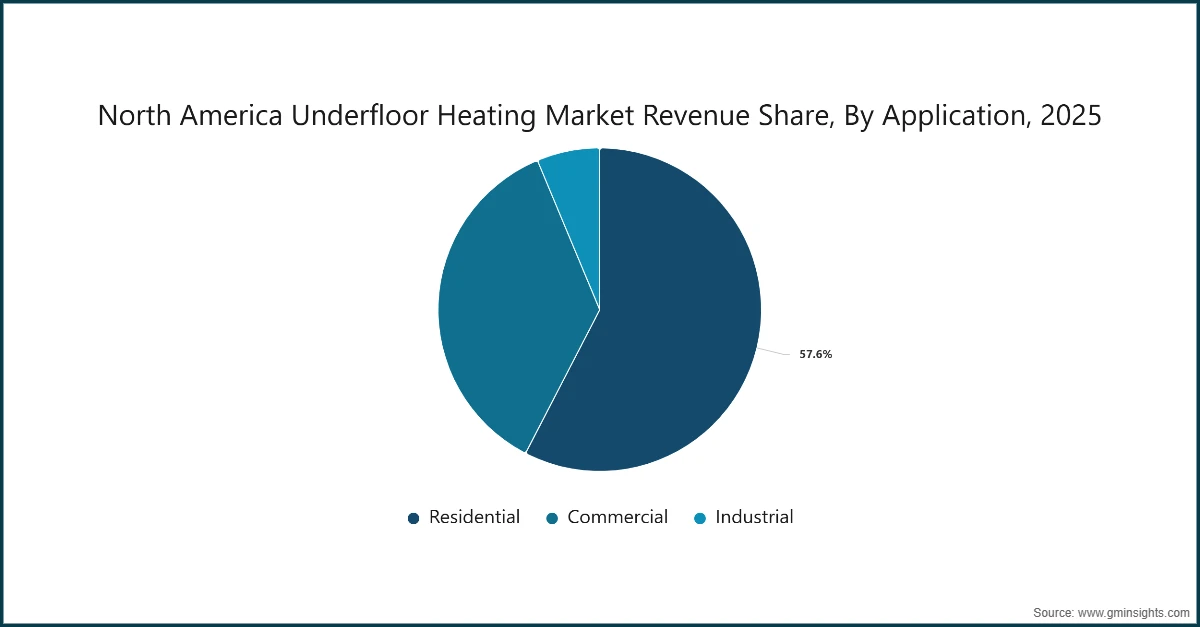
Based on the application, the underfloor heating market is segmented into residential, commercial and industrial. The residential segment holds 57.6% market share in 2025 with a 5.2% CAGR from 2026 to 2035.
The increasing construction of building infrastructures, driven by the rising population, robust urbanization and growing inclination toward enhancing the efficiency of building infrastructure and sustainable buildings, is complementing the industry landscape. Continuous developments in space heating systems and rising demand for clean energy technologies will positively influence industry’s dynamics.
The ongoing adoption of effective and efficient space heating systems, backed by the increasing green building initiatives and growing residential infrastructure is complementing industry landscape. Moreover, the partnership between governments and other players in the private sector is providing efficient space heating in cold climates, which is positively influencing the residential underfloor heating market.
For instance, in May 2025, sixteen local governments were selected by the U.S. Green Building Council to be part of the 2025 LEED for Cities Certification Cohort. The purpose is to enhance sustainability, resilience, and community well-being. Through this program, the local governments develop strategic plans, collect performance data and measure progress using LEED for Cities’ standardized measures to achieve environmental targets.
Commercial market in North America is set to grow at a CAGR of over 5.4% by 2035. Commercial application of underfloor heating is gaining significant momentum driven by the rising demand for energy-saving systems, climate control, rising number of offices, hotels, and shops, and the increased standardization of building performance. Favorable programs, accelerating investments in retrofit and high-performance infrastructure, and increased focus of builders on energy-saving systems, and reducing costs will positively influence commercial underfloor heating industry dynamics.
Looking for region specific data?
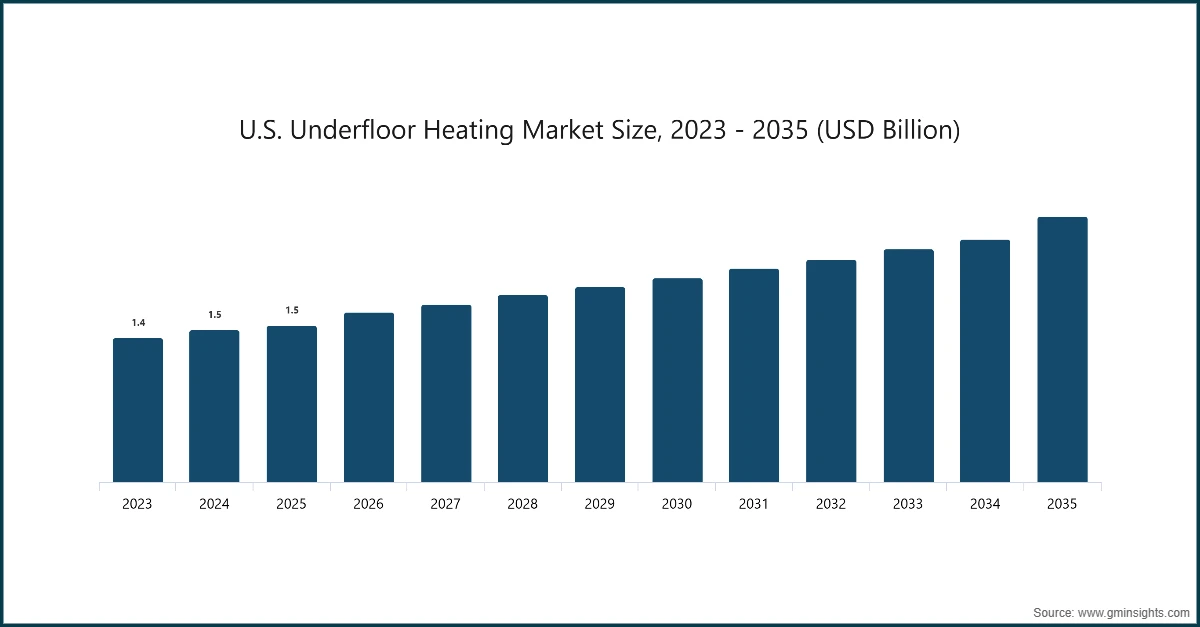
U.S. dominated the North America underfloor heating market in North America with around 77.8% share in 2025 and generated USD 1.5 billion in revenue. Increasing demand for more advanced floor heating systems, and the implementation of stricter energy efficiency and low emission regulations will shape the industry dynamics. Beneficial policies and financial incentives for the improvement of homes and the use of low emission and energy-efficient systems will augment business outlook.
For instance, in April 2024, the U.S. Department of Energy has finalized its Clean Energy Rule for new and renovated federal buildings, as Congress has ordered it to reduce emissions in the federal building portfolio. The rule will reduce pollution, improve air quality, and save money with the latest energy-saving technology, all in support of the federal goal of net-zero emissions in buildings by 2045.
North America Underfloor Heating Market Share
Major 5 players operating across the North America market include Uponor, Danfoss, REHAU, Watts and Schluter Systems contributed around 30% of the market share in 2025.
Major players in the North America underfloor heating industry are actively introducing new products and technologies, mergers & acquisitions, pursuing strategic collaborations, partnerships, and entering joint ventures to bolster their competitive market share. Major players, including Danfoss, REHAU, Uponor Corporation, Schluter Systems and Watts hold the majority of the market share.
Key companies operating in the North America market are characterized by intense competition attributed by product diversification, consolidating their market presence through strategic partnerships, and mergers & acquisitions, as they actively seek to enhance their competitive position.
North America Underfloor Heating Market Companies
Major players operating in the North America underfloor heating industry are:
Arkon Heating
Danfoss
Emerson Electric
FloorHeat
Gold Heat
Infloor Heating Systems
MAPEI
MP Global Products
Nuheat
Ouellet
ProLux Materials
REHAU
Schluter Systems
STEP HEAT
SunTouch
ThermaRay
Uponor Corporation
Warmboard
Warmup
Watts
North America Underfloor Heating Market Report Attributes
| Key Takeaway | Details |
|---|---|
| Market Size & Growth | |
| Base Year | 2025 |
| Market Size in 2025 | USD 2 Billion |
| Market Size in 2026 | USD 2.1 Billion |
| Forecast Period 2026-2035 CAGR | 5.2% |
| Market Size in 2035 | USD 3.3 Billion |
| Key Market Trends | |
| Drivers | Impact |
| Stringent standards by respective authorities to curb carbon emissions | Stringent emission regulations across the region is accelerating demand for underfloor heating systems, as builders and developers prioritize low carbon, high efficiency solutions that support compliance, enhance building performance, and align with long term sustainability objectives. |
| Flourishing investments for development of green building infrastructure | Growing capital allocation toward sustainable construction is boosting adoption of underfloor heating, as developers integrate advanced heating solutions to meet green certification requirements and improve energy performance in residential, commercial, and industrial projects. |
| Growing adoption of energy efficient space heating technologies | Increasing preference for energy efficient heating systems is strengthening underfloor heating demand, driven by consumers seeking uniform warmth, lower operating costs, and compatibility with heat pumps and other emerging low carbon building technologies. |
| Pitfalls & Challenges | Impact |
| Significant initial deployment cost | High upfront installation expenses may impact adoption of underfloor heating in cost sensitive projects, prompting many developers and homeowners to favor conventional heating systems despite long term efficiency and comfort advantages. |
| Opportunities: | Impact |
| Growing expansion and electrification of building retrofits | Growing retrofit programs prioritizing electrified heating create substantial demand for underfloor systems, enabling suppliers to access aging building stock and secure long‑term modernization opportunities. |
| Growth in high‑end residential construction | Rising investment in premium housing supports broader adoption of comfort‑focused heating solutions, allowing underfloor system providers to target higher‑margin segments with differentiated product offerings. |
| Integration with renewable-powered buildings | Increasing adoption of solar‑powered technologies and net‑zero buildings strengthens industry potential for underfloor heating, as homeowners seek efficient, low‑temperature systems aligned with sustainable energy strategies. |
| Expansion of property technology partnerships | Collaborations with PropTech firms enhance building‑automation compatibility, improving system performance and creating recurring revenue streams through advanced monitoring, optimization, and remote‑control solutions. |
| Market Leaders (2025) | |
| Market Leader |
Market Share of: 9% |
| Top Players |
Collective Market Share of: 30% |
| Competitive Edge |
|
| Regional Insights | |
| Largest Market | U.S. |
| Fastest growing market | Canada |
| Emerging countries | U.S., Canada |
| Future outlook |
|
What are the growth opportunities in this market?
North America Underfloor Heating Industry News
In March 2026, Uponor’s multilayer pipe technology provide efficient solutions at the Panorama 2962 restaurant, by providing efficient underfloor heating, with composite pipes used to connect heating systems and drinking water systems in harsh weather conditions. These systems show Uponor’s ability to provide efficient heating and drinking water systems to meet different requirements in residential and commercial buildings.
In March 2026, h2x announced the launch of next-level AI-powered tools that can make radiant and underfloor heating design easier than ever. Engineers can now make changes on the fly, generate professional documents, and enjoy the benefits of 3D images, automation, and alerts. These tools are part of the larger mechanical and plumbing family offered by h2x and can perform real-time calculations that adhere to industry standards without any manual design effort required.
In May 2025, Schluter Systems launched DITRA PS, a peel and stick membrane that facilitates tile installation, provides rapid electric heating and flexible heating control for floors and parts of the walls. It ensures long-term performance, even in complex flooring situations, in conjunction with modern underfloor heating solutions. Its repositioning capability ensures faster installation, minimizes adhesive mess, and provides reliable uncoupling, vapor management, and load distribution, suitable for tile installers, builders, and fit-out professionals who want to incorporate underfloor heating solutions.
In March 2024, WarmlyYours introduced ThermalSheet, which is a thin synthetic cork underlayment designed to improve the performance of underfloor heating systems. It reduces heat loss in concrete slabs for increased energy efficiency, reduces sound, and isolates cracks. Placed under the heating systems, ThermalSheet increases heat transfer to living spaces, eliminates floor height increase, resolves supply issues, and provides consistent performance.
The North America underfloor heating market research report includes in-depth coverage of the industry with estimates & forecast in terms of revenue (USD Million) from 2026 to 2035, for the following segments:
Market, By Technology
Electric
Hydronic
Market, By Facility
New buildings
Retrofit
Market, By Application
Residential
Single family
Multi family
Commercial
Education
Healthcare
Retail
Logistics & transportation
Offices
Hospitality
Others
Industrial
The above information has been provided for the following countries:
U.S.
Canada
Frequently Asked Question(FAQ) :
What is the market size of the North America underfloor heating market in 2025?
The North America underfloor heating market was valued at USD 2 billion in 2025, driven by increasing demand for energy-efficient heating systems and sustainable building solutions.
What is the expected market size of the North America underfloor heating market in 2026?
The market is projected to reach USD 2.1 billion in 2026, supported by growing adoption of advanced radiant floor heating technologies.
What is the projected value of the North America underfloor heating market by 2035?
The market is expected to reach USD 3.3 billion by 2035, expanding at a CAGR of 5.2% from 2026 to 2035, driven by increasing investments in sustainable building technologies and smart home solutions.
Which technology segment dominates the North America underfloor heating market?
The hydronic segment dominated the market with a 66.4% share in 2025, owing to its higher energy efficiency and suitability for heating large spaces such as residential complexes and commercial buildings.
What is driving the growth of electric underfloor heating systems in North America?
Electric underfloor heating systems are gaining traction due to ease of installation, compatibility with smart thermostats, reduced energy consumption, and increasing adoption of green energy solutions.
What is the growth outlook for the commercial underfloor heating segment?
The commercial segment is projected to grow at a CAGR of over 5.4% by 2035, driven by rising demand for energy-efficient climate control systems in offices, hotels, retail spaces, and other commercial buildings.
Which country dominates the North America underfloor heating market?
The United States dominated the regional market with a 77.8% share in 2025, generating approximately USD 1.5 billion in revenue, supported by strict energy efficiency regulations and increasing adoption of green building standards.
Who are the key players operating in the North America underfloor heating market?
Major companies in the market include Uponor Corporation, Danfoss, REHAU, Watts, Schluter Systems, Emerson Electric, Nuheat, Warmboard, Warmup, SunTouch, Ouellet, and ProLux Materials.
North America Underfloor Heating Market Scope
Related Reports