Summary
Table of Content

North America Turbocharger Market
Get a free sample of this report
Form submitted successfully!
Error submitting form. Please try again.
Thank you!
Your inquiry has been received. Our team will reach out to you with the required details via email. To ensure that you don't miss their response, kindly remember to check your spam folder as well!
Request Sectional Data
Thank you!
Your inquiry has been received. Our team will reach out to you with the required details via email. To ensure that you don't miss their response, kindly remember to check your spam folder as well!
Form submitted successfully!
Error submitting form. Please try again.
North America Turbocharger Market Size
In terms of units, the year 2025 is accounting for around 5.3 million turbocharger units sold. The turbocharger units are projected to surpass around 8.5 million units by 2035 at a CAGR of around 4.8% between 2026 and 2035.
North America Turbocharger Market Key Takeaways
Market Size & Growth
- 2025 Market Size: USD 5.8 Billion
- 2026 Market Size: USD 6 Billion
- 2035 Forecast Market Size: USD 9.5 Billion
- CAGR (2026–2035): 5.1%
Regional Dominance
- Largest Market: US
- Fastest Growing Country: US
Key Market Drivers
- Stringent emission regulations driving engine downsizing.
- Rising fuel efficiency demands.
- Performance enhancement in passenger vehicles.
- Heavy-duty commercial vehicle turbo adoption.
Challenges
- Electric vehicle displacement of ICE demand.
- Oil leakage and maintenance challenges.
Opportunity
- Electric turbocharger commercialization.
- Aftermarket growth in aging vehicle fleet.
- Off-highway and marine application expansion.
Key Players
- Market Leader: Garrett Motion led with over 15.8% market share in 2025.
- Leading Players: Top 5 players in this market include BorgWarner, Cummins, Garrett Motion, IHI, Mitsubishi Heavy Industries, which collectively held a market share of 57.2% in 2025.
Get Market Insights & Growth Opportunities
Stricter fuel-efficiency and emission rules in the U.S. and Canada support the adoption of turbochargers in North America. There are organizations like the U.S. Department of Energy and the U.S. Environmental Protection Agency that support technologies that make engines more efficient and reduce pollution. Turbochargers help make engines smaller while keeping their power, making them important for car makers. The US DOE reported that in 2000, only 1% of passenger cars had turbochargers, but their use increased a lot over the next 20 years as companies worked to improve fuel efficiency.
It is estimated that at present the penetration for passenger cars has reached around 41% in 2025, showing a big change in engine technology. Car makers now use smaller engines with turbochargers to meet fuel-efficiency rules without losing power. This is common in gasoline direct-injection engines used by many big carmakers. Turbocharged engines are also popular in pickup trucks and SUVs, which are the best-selling vehicles in the U.S. and Canada.
Medium and heavy commercial vehicles with high power requirements are prominent in the region. Heavy-duty trucks are provided with turbocharging technology for enhanced performance, efficiency, and reduced negative impacts on the environment. Volvo Trucks North America has introduced its Volvo D13 VGT engine with variable geometry turbocharging technology in March 2025, along with its Volvo VNR truck. It is another advancement of the previous engines, as turbocharging technology is gaining popularity in freight vehicles.
The manufacturers of turbochargers are also contributing to the growth of the market by developing new technologies. In July 2025, BorgWarner secured a major contract to provide turbochargers for a global automotive manufacturer’s new vehicles in North America. This includes a high-performance turbocharger for a 3.0-liter gasoline-powered hybrid engine, which will start in September 2028. This indicates the role of turbochargers in the development of hybrid vehicles.
North America has a good turbocharger supply chain, with plants and engineering centers in the US and Canada. Many global suppliers also have operations in North America to support local automotive production. These plants manufacture various parts of a turbocharger, including the turbine housing, compressor wheel, and electronic actuators. Manufacturers and suppliers cooperate to make the parts more durable, efficient, and effective in working with the engine systems of a car.
The North America turbocharger market was valued at USD 5.8 billion in 2025. The market is expected to grow from USD 6 billion in 2026 to USD 9.5 billion in 2035 at a CAGR of 5.1%, according to latest report published by Global Market Insights Inc.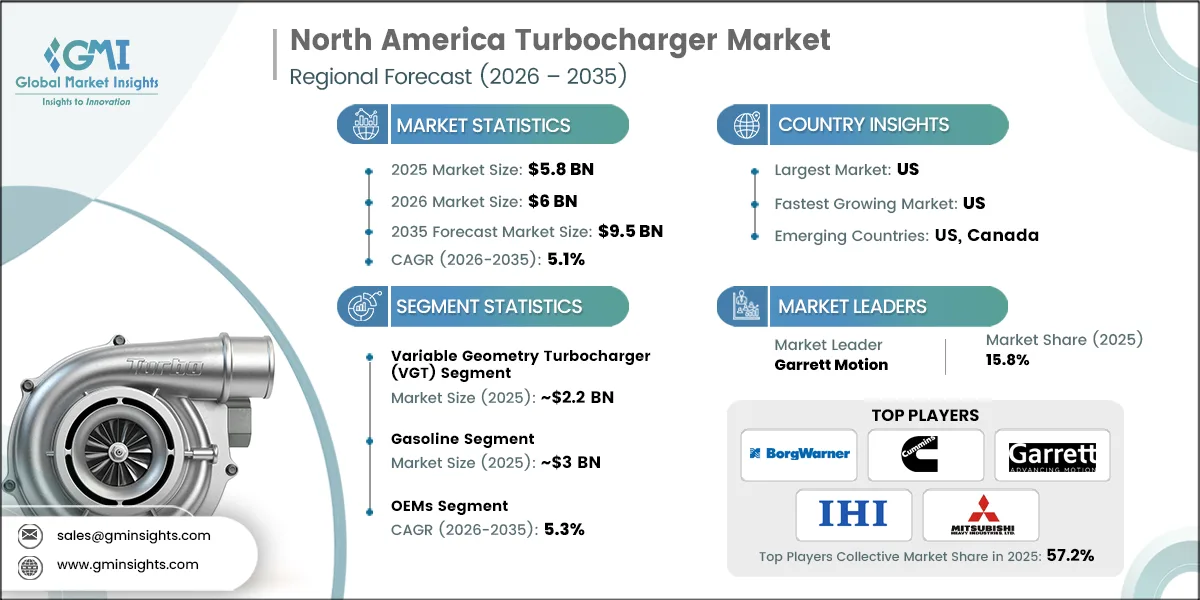
To get key market trends
North America Turbocharger Market Trends
The US Environmental Protection Agency and the National Highway Traffic Safety Administration have imposed stricter standards which set a new example that the market for turbochargers will grow in the country. Car makers are using turbochargers to comply with the rules while ensuring their cars are both powerful and fuel-efficient. Turbochargers are being used to reduce the engine size without compromising on performance, making them suitable for use in cars and light trucks.
High performance vehicles such as SUVs and trucks which have gasoline engines need turbochargers to generate more power. SUVs and trucks are extremely popular in America and Canada, and these vehicles need more power for towing heavy loads. The automakers are replacing V8 engines in these vehicles with smaller V6 engines for more power while burning less fuel.
In March 2025, Volvo Trucks North America introduced the Volvo D13 VGT engine with variable geometry turbocharging. This engine improves performance and fuel efficiency for regional haul trucks. At the same time, these companies are also working on designs like variable geometry turbochargers and twin-scroll systems. These make engines respond faster, burn fuel better, and reduce delays in power delivery.
Another trend is seen with hybrid vehicles, which are using turbochargers. Car manufacturers are increasingly using hybrid vehicles to improve their performance. BorgWarner entered into an agreement in July 2025 to provide turbochargers for a global automotive manufacturer’s new vehicles in North America. These vehicles include a high-performance turbocharger for a 3.0-liter gasoline engine hybrid, which will begin production in September 2028.
North America Turbocharger Market Analysis
Learn more about the key segments shaping this market
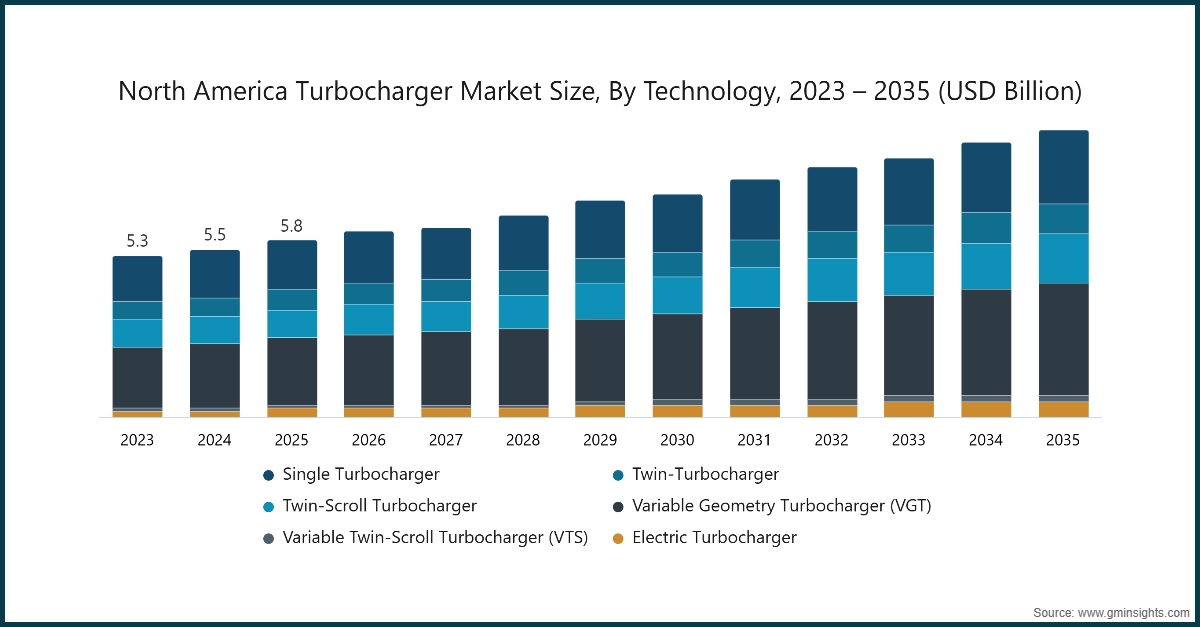
Based on technology, the North America turbocharger market is divided into single turbocharger, twin-turbocharger, twin-scroll turbocharger, variable geometry turbocharger (VGT), variable twin-scroll turbocharger (VTS) and electric turbocharger. The variable geometry turbocharger (VGT) segment dominated the market with market share of around 37.6% and generating revenue of around USD 2.2 billion in 2025.
- Variable geometry turbochargers have been designed to have adjustable vanes that can optimize the exhaust gases at varying speeds. This has enabled the engines to attain higher combustion efficiency, power output, and reduced turbo lag compared to the conventional single or double turbocharged engines. This has made the VGTs extremely popular in passenger as well as commercial vehicles, contributing to the overall sales and revenue generation.
- Tightened regulations on the level of emissions can be seen in governments across the region, with particular focus on the reduction of nitrogen oxides and particulate matter. VGTs can be used to regulate the level of air intake into the engine, which improves the air-fuel mix and minimizes the level of harmful emissions into the environment.
- Recently, Volvo Trucks North America introduced the new Volvo D13 VGT engine during the launch of the all-new Volvo VNR. The engine incorporates variable geometry turbocharging technology to enhance performance, fuel efficiency, and operational reliability in regional haul applications.
- The capacity of VGTs to pass the tests on the level of emissions without compromising the performance has seen the technology gain traction in diesel and gasoline engines, making it the market leader.
Learn more about the key segments shaping this market
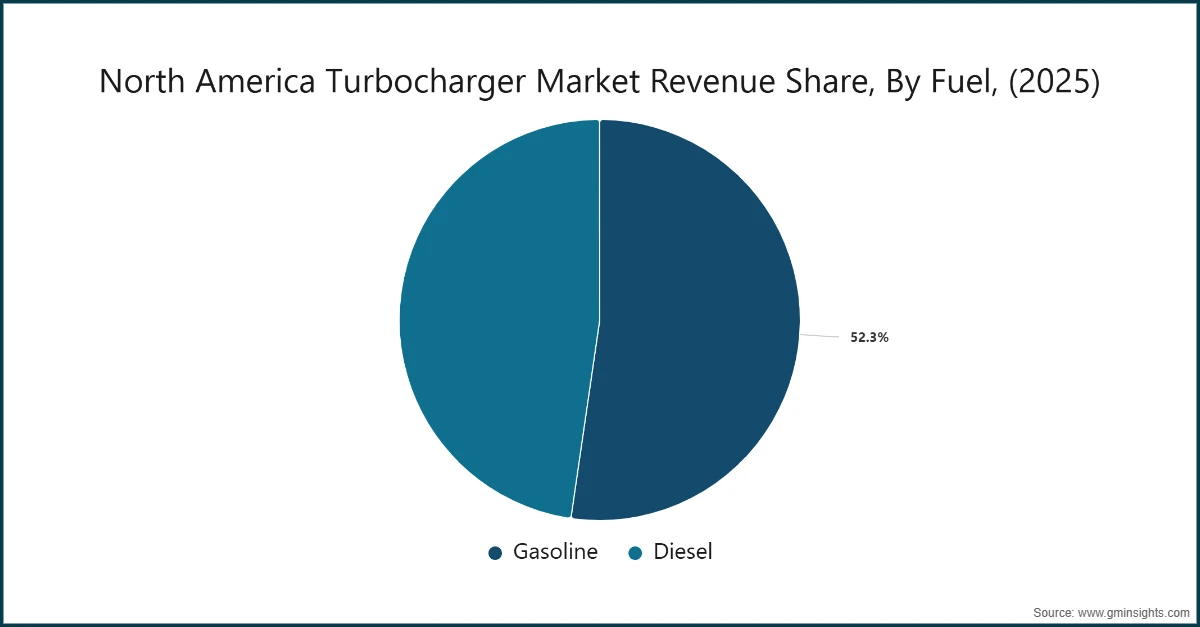
Based on fuel, the market is divided into gasoline and diesel. The gasoline segment accounts for 52.3% in 2025, valued around USD 3 billion.
- The majority of passenger vehicles are fueled by gasoline engines. With the increase in the number of vehicles being manufactured and replaced, turbocharged gasoline engines are now commonly found in modern cars for better fuel efficiency and performance. This has helped the gasoline segment dominate the turbocharger industry.
- The North American market has witnessed significant growth in the sale of SUVs, crossovers, and performance-oriented passenger cars, most of which are fueled by gasoline engines. Major brands like GM reported growth in this segment. The trend towards turbocharging these gasoline engines is helping the gasoline segment grow, as it is able to provide increased performance without compromising on fuel efficiency.
- At the same time, stringent fuel economy regulations, such as those implemented by the US Environmental Protection Agency, have prompted automakers in North America to use smaller, turbocharged gasoline engines. Turbochargers are required to achieve the required torque and power from downsized engines.
Based on sales channel, the North America turbocharger market is divided into OEMs and the aftermarket. The OEMs segment is dominant with a market share of around 93.1% in 2025 and is expected to grow at the fastest CAGR of 5.3% between 2026 and 2035.
- OEMs install turbochargers during the production of new vehicles, which helps in achieving optimal performance, efficiency, and reliability. OEMs prefer purchasing turbochargers through this route because it helps in achieving consistency in performance and warranty compliance. The installation of turbochargers during production has enabled OEMs to dominate this market in terms of revenue generation.
- Regulatory bodies in North America, such as the U.S. EPA and California Air Resources Board (CARB), impose stringent regulations on fuel efficiency and emissions. OEMs install turbochargers in vehicles in a way that helps in achieving optimal performance while complying with these regulations. Installing turbochargers during production helps in achieving optimal performance while complying with these regulations, which has enabled OEMs to dominate this market.
- The lifespan of a turbocharger is as long as the lifespan of a vehicle. A turbocharger in a diesel-powered vehicle lasts for around 150,000 to 200,000 miles or more. The lifespan of a turbocharger is long enough for a vehicle, which decreases the need for aftermarket turbochargers.
Based on application, the turbocharger market is divided into automotive and non-automotive. The automotive segment is dominant with a market share of around 97.1% in 2025.
- SUVs have emerged as the dominant form of vehicles in the US, with 58% of all vehicles sold in 2025 being SUVs. General Motors emerged as the leader in the US automotive industry in 2025, with its sales increasing by 6%. This is because of the growth in different segments of its business.
- The majority of these vehicles are gasoline-fueled, and turbocharging plays a significant role in increasing the performance of the vehicles with high fuel efficiency. Thus, the dominance of gasoline-fueled vehicles is further enhanced in the turbocharger market in North America.
- The trend in smaller engines in vehicles in North America has led to a higher dependency on turbochargers. The smaller engines can provide similar power output as larger engines while at the same time reducing fuel consumption. As car makers continue to produce fuel-efficient cars with powerful engines, turbochargers will be essential in these cars.
Looking for region specific data?
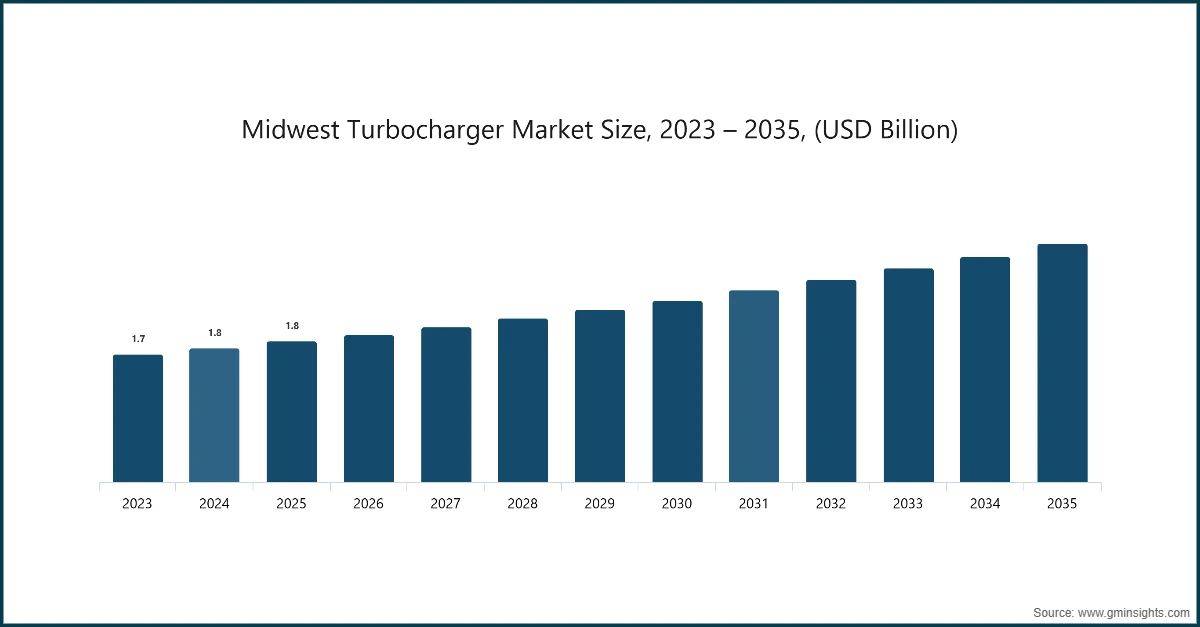
The Midwest turbocharger market reached USD 1.8 billion in 2025 and growing at a CAGR of 5.4% between 2026-2035.
- The Midwest, which includes automotive centers such as Michigan, Ohio, and Indiana, is arguably one of the most strategically significant areas for the turbocharger market, driven by the presence of key OEM powertrain design centers, tier 1 automotive component suppliers, and component production facilities.
- The grouping of automotive expertise in engine design and turbocharger prototyping is directly beneficial to regional R&D and innovation in advanced turbo technologies, such as variable geometry turbochargers and electric assist turbos.
- Manufacturing and testing facilities in the Midwest also provide strength to the supply chains and investments in engine optimization technologies that aid in meeting EPA CAFE regulations and tough requirements for greenhouse-gas reductions. Turbochargers, which are vital for downsizing engines to meet performance requirements and reduce carbon footprint, are critical for OEM manufacturing facilities in the Midwest for SUVs, trucks, and passenger vehicles for local and export markets.
The Southeast region is valued at USD 1.6 billion in 2025. It is expected to grow at the CAGR of 4.9% between 2026 and 2035.
- The Southeast region of the United States, which includes states such as Florida, Georgia, and the Carolinas, is an important market segment in the North America automotive turbocharger market that is witnessing significant growth. The expansion of the market in the Southeast region is fueled by the significant footprint of the auto assembly industry and the rising demand for light commercial vehicles such as pickup trucks and SUVs that incorporate internal combustion engine technologies with the benefits of turbocharging.
- Environmental regulations also influence the regional markets in the North America automotive turbocharger industry. Although the Corporate Average Fuel Economy (CAFE) and Environmental Protection Agency (EPA) regulations directly influence the adoption and expansion of the market, states in the Southern region collaborate with other states to reduce greenhouse gas emissions and introduce low-carbon fuels into the regional markets.
- It could encourage the adoption and expansion of the market with the benefits offered by the application of advanced turbocharger technologies that can help the states achieve the set environmental goals and objectives, such as the Low-Carbon Fuel Standard (LCFS) collaboration between several states in and around the Southeast region.
The West region holds 19.5% of the U.S. turbocharger market in 2025 and is expected to grow at the fastest CAGR of 6.8% between 2026 and 2035.
- The Western United States, California, Oregon, and Washington represent a unique turbocharger environment that is heavily impacted by the environmental regulations and the complex automotive environment. California is the leader in emission control regulations, including fuel efficiency and vehicle pollutant emission regulations.
- This has resulted in turbocharger applications being critical for original equipment manufacturers seeking to minimize NOx, CO2, and particulate emissions from internal combustion engines while maintaining performance characteristics for gasoline and diesel-powered vehicles.
- With that this region has some of the biggest ports on the West Coast, as well as a high number of Class 8 trucks, there is still considerable demand for efficient turbocharged diesel engines, particularly in balancing emissions requirements with cost savings. There is also some interest from the local motorsports culture for performance tuners.
The Canada is expected to grow at a CAGR of 4.6% between 2026 and 2035 in the North America turbocharger market.
- Canada’s turbocharger industry is affected not only by the automotive industry within the country but also by its integration with the US automotive industry. Canada has automotive manufacturing units in Ontario and Quebec provinces, where turbocharged engines are manufactured for light and heavy vehicles.
- Market forces can be influenced by the government policies implemented. In the case of Canada, the government has put in place policies targeting the adoption of zero-emission vehicles and emission reduction strategies as part of the 2030 Emissions Reduction Plan. This is to reduce greenhouse gases by 40-45%. Government strategies have been put in place to support the adoption of purchase incentives and clean transportation.
- Turbocharging will assist the OEMs in achieving the emission and fuel economy regulations set by the Canadian and US governments. This is because the supply chain is already integrated in the North American region through the USMCA. Turbochargers are not only used in passenger vehicles but also in heavy equipment, off-road machines, and agricultural equipment, which is still a key contributor to the Canadian economy.
North America Turbocharger Market Share
The top 7 companies in the turbocharger market are BorgWarner, Cummins, Garrett Motion, IHI, Mitsubishi Heavy Industries, Toyota Industries and Schaeffler contributing 63.6% of the market in 2025.
- BorgWarner makes turbochargers for gasoline and diesel engines. These products use turbines and compressors to improve engine airflow, pressure, and efficiency for cars and industrial machines.
- Cummins makes turbochargers mainly for diesel engines used in trucks and industrial machines. Their turbochargers handle high exhaust temperatures and pressures, helping engines work reliably.
- Garrett Motion provides turbochargers for gasoline and diesel engines used in cars, commercial vehicles, and industrial machines. Their products control air pressure and flow to improve engine performance.
- IHI makes turbochargers for cars and industrial engines. Their designs use turbines and compressors to improve engine airflow and combustion without changing the engine's structure.
- Mitsubishi Heavy Industries makes turbochargers for cars and industrial engines. Their products use turbines and compressors to manage airflow and improve engine combustion.
- Toyota Industries makes turbochargers for gasoline and diesel engines used in vehicles and industrial machines. Their products control air intake to improve engine combustion and meet specific design standards.
- Schaeffler Technologies, with the merger of Vitesco, makes turbochargers for modern gasoline and diesel engines. Their products use turbines and compressors to improve air intake, engine efficiency, and pressure control.
North America Turbocharger Market Companies
Major players operating in the turbocharger industry are:
- BorgWarner
- Continental
- Cummins
- Eaton
- Garrett Motion
- IHI
- Mitsubishi Heavy Industries
- Precision Turbo and Engine
- Toyota Industries
- Schaeffler (Vitesco)
- BorgWarner works with strong OEM partners and offers a wide range of turbochargers, including wastegate, variable geometry, and e-turbos. Its North American manufacturing helps deliver reliable and fuel-efficient solutions for smaller and hybrid engines.
- Cummins focuses on combining turbocharging with its diesel engines. Using Holset turbo technology and its experience in heavy-duty vehicles, it ensures better performance, durability, and emissions control for commercial vehicles.
- Garrett Motion stays competitive with advanced engineering, variable-geometry and dual-stage turbo technologies, and strong relationships with major automakers. It serves passenger, commercial, and performance vehicle markets.
- IHI strengthens its position with large-scale turbocharger production and a variety of uses in passenger, commercial, and marine vehicles. It is also developing electric turbochargers and fuel-cell air systems.
- Mitsubishi Heavy Industries uses its long experience in engine and turbo systems to offer a wide range of products. Its global development and after-sales networks support high-efficiency turbochargers.
- Toyota Industries benefits from being part of Toyota’s automotive system. It uses advanced manufacturing to make turbochargers that improve fuel efficiency for gasoline and diesel engines used by automakers.
- Vitesco Technologies uses its expertise in powertrain electronics and electrification to develop electric boosting technologies. These support new turbocharging solutions for hybrid and low-emission engines.
North America Turbocharger Market Report Attributes
| Key Takeaway | Details |
|---|---|
| Market Size & Growth | |
| Base Year | 2025 |
| Market Size in 2025 | USD 5.8 Billion |
| Market Size in 2026 | USD 6 Billion |
| Forecast Period 2026-2035 CAGR | 5.1% |
| Market Size in 2035 | USD 9.5 Billion |
| Key Market Trends | |
| Drivers | Impact |
| Stringent emission regulations driving engine downsizing | Stricter North American emission standards push automakers toward smaller engines requiring turbochargers to maintain power output while reducing fuel consumption and lowering greenhouse gas emissions. |
| Rising fuel efficiency demands | Growing consumer and regulatory focus on fuel economy encourages adoption of turbochargers, enabling engines to deliver higher efficiency and power density without increasing engine displacement. |
| Performance enhancement in passenger vehicles | Increasing consumer preference for responsive acceleration and higher horsepower in passenger vehicles drives turbocharger integration, helping manufacturers enhance performance while maintaining acceptable fuel efficiency levels. |
| Heavy-duty commercial vehicle turbo adoption | Expanding freight transportation and logistics activities in North America encourage turbocharger adoption in heavy-duty trucks, improving torque, engine efficiency, and compliance with strict emission regulations. |
| Pitfalls & Challenges | Impact |
| Electric vehicle displacement of ICE demand | Rapid growth of battery electric vehicles gradually reduces demand for internal combustion engines, limiting long-term turbocharger market expansion as OEMs shift investments toward electrified powertrains. |
| Oil leakage and maintenance challenges | Turbocharger systems require proper lubrication and maintenance; issues such as oil leakage, overheating, and component wear can increase maintenance costs and discourage adoption among cost-sensitive vehicle owners. |
| Opportunities: | Impact |
| Electric turbocharger commercialization | Advancements in electric turbocharger technology enable improved boost response and efficiency, creating opportunities for automakers to enhance hybrid and downsized engines while meeting tightening emission standards. |
| Aftermarket growth in aging vehicle fleet | A large and aging vehicle fleet across North America drives replacement demand for turbocharger components, supporting steady aftermarket sales through repairs, upgrades, and performance enhancement installations. |
| Off-highway and marine application expansion | Increasing mechanization in construction, agriculture, mining, and marine sectors creates opportunities for turbocharger deployment in off-highway engines requiring higher power output and improved fuel efficiency. |
| Market Leaders (2025) | |
| Market Leader |
15.8% market share |
| Top Players |
Collective market share in 2025 is 57.2% |
| Competitive Edge |
|
| Regional Insights | |
| Largest Market | US |
| Fastest growing market | US |
| Emerging countries | US, Canada |
| Future outlook |
|
What are the growth opportunities in this market?
North America Turbocharger Industry News
- In February 2026, Garrett Motion announced that its largest MEG turbocharger platform would be used in Weichai's new large-bore engine programs. This is a big step for Garrett as it brings its advanced turbocharging technology to marine propulsion and power generation systems.
- In July 2025, BorgWarner won a major contract to supply turbochargers for a global OEM's new vehicles in North America. The deal includes a high-performance turbocharger for a 3.0-liter gasoline hybrid engine. Production is planned to start in September 2028.
- In March 2025, Volvo Trucks North America introduced the new Volvo D13 VGT (Variable Geometry Turbo) engine for the launch of the all-new Volvo VNR. This engine builds on the improvements of the D13 Turbo Compound engine, which is now standard in the new Volvo VNL.
- In February 2025, BorgWarner extended its partnership with a North American OEM by renewing contracts for wastegate turbocharger programs. These turbochargers will be used in midsized gasoline engines for SUVs and trucks. Production will continue through 2028 and beyond.
The North America turbocharger market research report includes in-depth coverage of the industry with estimates & forecasts in terms of revenue ($ Mn/Bn) and volume (thousand units) from 2022 to 2035, for the following segments:
Market, By Technology
- Single Turbocharger
- Small Frame Turbochargers
- Large Frame Turbochargers
- Twin-Turbocharger
- Twin-Scroll Turbocharger
- Variable Geometry Turbocharger (VGT)
- Variable Twin-Scroll Turbocharger (VTS)
- Electric Turbocharger
Market, By Fuel
- Gasoline
- Diesel
Market, By Application
- Automotive
- Passenger cars
- Hatchback
- Sedan
- SUV
- Commercial vehicles
- LCV
- MCV
- HCV
- Off-Highway Vehicle
- Agricultural Equipment
- Construction Equipment
- Mining Equipment
- Passenger cars
- Non-automotive
- Aerospace & defense
- Aircraft Engine Turbochargers
- Military Vehicle Turbochargers
- Marine
- Commercial ship
- Naval vessel
- Recreational boat
- Others
- Aerospace & defense
Market, By Material
- Cast iron
- Aluminum
- Others
Market, By Sales Channel
- OEM
- Aftermarket
The above information is provided for the following regions and countries:
- US
- Canada
Frequently Asked Question(FAQ) :
What is the market size of the North America turbocharger in 2025?
The North America turbocharger market was valued at USD 5.8 billion in 2025, driven by stringent fuel-efficiency and emission regulations.
What is the projected value of the North America turbocharger industry by 2035?
The North America turbocharger market is projected to reach USD 9.5 billion and surpass 8.5 million units by 2035, growing at a CAGR of 5.1%, supported by engine downsizing trends, hybrid vehicle integration, expanding aftermarket demand, and growing adoption in heavy-duty commercial and off-highway applications.
What is the North America turbocharger industry size in 2026?
The North America turbocharger market size is projected to reach USD 6 billion in 2026, driven by continued OEM adoption of turbocharged engines in passenger vehicles, SUVs, pickup trucks, and commercial vehicles to meet EPA and CAFE fuel economy standards.
Which technology segment dominated the North America turbocharger market in 2025?
The variable geometry turbocharger (VGT) segment dominated the market with a 37.6% share, generating revenue of approximately USD 2.2 billion in 2025.
What was the market share of the gasoline fuel segment in 2025?
The gasoline segment accounted for 52.3% of the North America turbocharger market in 2025, valued at approximately USD 3 billion, driven by the dominance of gasoline-fueled passenger vehicles.
What was the market share of the OEM sales channel segment in 2025?
The OEM segment dominated with a 93.1% market share in 2025 and is expected to grow at the fastest CAGR of 5.3% from 2026 to 2035.
Which region leads the turbocharger market?
The Midwest turbocharger market reached USD 1.8 billion in 2025 and growing at a CAGR of 5.4% between 2026 and 2035.
What are the upcoming trends in the North America turbocharger market?
Key trends include rising use of turbochargers in hybrid vehicles, commercialization of electric turbochargers, adoption of variable geometry and twin-scroll systems to reduce lag, and growing aftermarket demand driven by North America’s aging vehicle fleet.
Who are the key players in the North America turbocharger market?
Key players include Garrett Motion, BorgWarner, Cummins, IHI, Mitsubishi Heavy Industries, Toyota Industries, Schaeffler (Vitesco), Continental, Eaton, and Precision Turbo and Engine.
North America Turbocharger Market Scope
Related Reports