Summary
Table of Content

North America Tank Truck Market
Get a free sample of this report
Form submitted successfully!
Error submitting form. Please try again.
Thank you!
Your inquiry has been received. Our team will reach out to you with the required details via email. To ensure that you don't miss their response, kindly remember to check your spam folder as well!
Request Sectional Data
Thank you!
Your inquiry has been received. Our team will reach out to you with the required details via email. To ensure that you don't miss their response, kindly remember to check your spam folder as well!
Form submitted successfully!
Error submitting form. Please try again.
North America Tank Truck Market Size
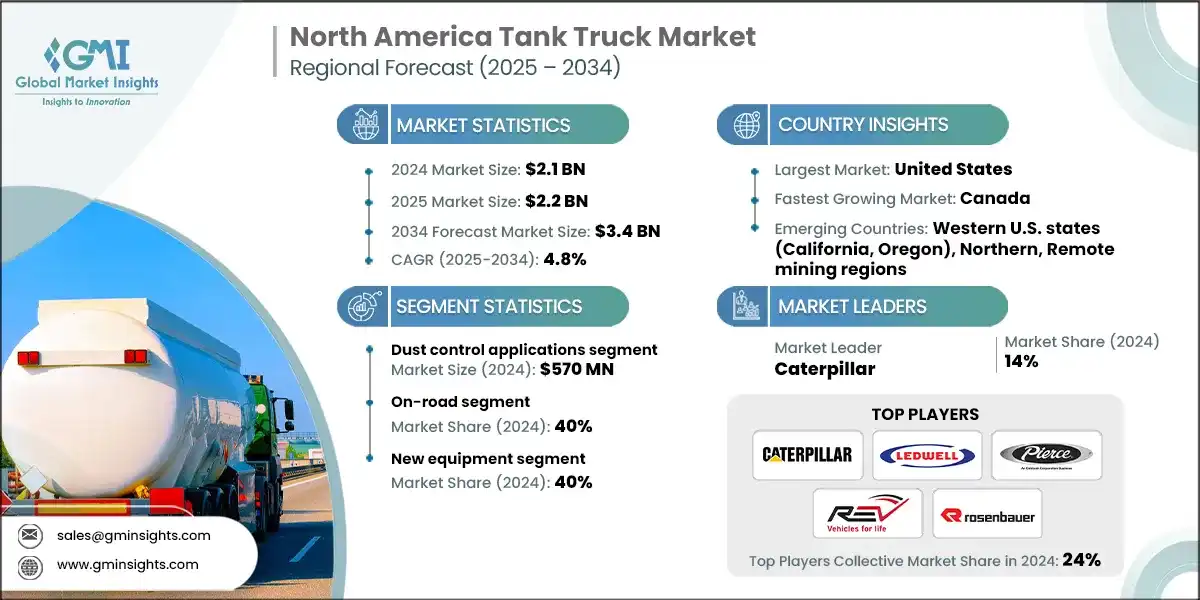
The North America tank truck market size was estimated at USD 2.1 billion in 2024. The market is expected to grow from USD 2.2 billion in 2025 to USD 3.4 billion in 2034, at a CAGR of 4.8%, according to latest report published by Global Market Insights Inc.
North America Tank Truck Market Key Takeaways
Market Size & Growth
- 2024 Market Size: USD 2.1 Billion
- 2025 Market Size: USD 2.2 Billion
- 2034 Forecast Market Size: USD 3.4 Billion
- CAGR (2025–2034): 4.8%
Regional Dominance
- Largest Market: United States
- Fastest Growing Country: Canada
Key Market Drivers
- Growth in wildfire suppression initiatives.
- Expansion of construction and mining projects.
- Rising rental and secondary market adoption.
- Adoption of advanced water truck technology.
Challenges
- Environmental and emission regulations.
- Seasonal and project-based demand fluctuations.
Opportunity
- Smart fleet and telematics integration.
- Alternative fuel and hybrid water trucks.
- Expansion in remote Canadian and U.S. regions.
- Retrofitting and customized tank solutions.
Key Players
- Market Leader: Caterpillar led with over 14% market share in 2024.
- Leading Players: Top 5 players in this market include Caterpillar, Ledwell Enterprises, Oshkosh / Pierce, rev group, Rosenbauer, which collectively held a market share of 24% in 2024.
Get Market Insights & Growth Opportunities
- North America the tank truck market has been integrated for infrastructure development and emergency services. These trucks are used for drinking water distribution, dust suppression and fire management of forests, ensuring stable demand in industries. Their multi-use role, especially in areas of water stress or high construction activity, makes them inevitable for public and private operators.
- The United States is leading the market due to extensive urbanization and large projects. In Canada, the demand is resource-controlled industries and remote societies to be more concentrated, where water tank trucks act as reliable supply channels. Both countries depend on these vehicles for fire extinguishing, municipal distribution and building assistance.
- Wildfire demand emerges as a great demand driver. The federal government spends around $4.74 billion annually on suppression work with an increase of 42–81% to 2100 due to climate change and long-term fire season. It emphasizes water trucks with an important role in emergency preparedness and disaster flexibility.
- Production of fire equipment shows the extent of this market opportunity. Pierce Manufacturing, which produces $1.2–1.3 billion annually in Oshkosh's Fire and Emergency segment, has invested heavily in expanding the ability and technology innovation to accommodate the needs of fire suppression for tanker trucks and related equipment.
To get key market trends
North America Tank Truck Market Trends
- An increase in the frequency and severity of wildfire in US and Canada, the demand for wildfire suppression increases rapidly. Water tank trucks play an important role in fire campaign operations, providing water delivery on site for control and prevention. Manufacturers are innovative to meet these needs, with special trucks capable of high flow rates and expanded access, ensuring rapid response in areas with distant or high risk. This trend emphasizes emergency preparation as a long-term driver for market development.
- Construction dust control is a large growth driver. Entrepreneurs and municipalities rely on water trucks to meet the compliance of OSHA-Silica and reduce air particles in large works. Companies such as United Rentals have captured the opportunity with technology integration with the tier-1 500+ rental housing and 20.6 billion fleet OEC, giving them the benefit of costs and efficiency on small rivals and strengthens the importance of water trucks in building safety and environmental compliance.
- Mining and heavy construction are expanded, which is inspired by the need for high capacity, water trucks with high damping. Caterpillar’s Cat 777 Water Solutions Trucks, with 20,000-gallon wagons, integrated delivery systems (1,800 gallons per minute), and spray cannon, versatile, high-capacity trucks capable of reaching more than 200 feet. Such tools are important for large mines and infrastructure projects required for the suppression of dust, maintenance of haul roads and environmental compliance, and highlight industrial applications as an important development block.
- Rental and leasing market growth strengthens as the contractor and municipalities prefer flexible procurement options for temporary or seasonal needs. Premium monthly prices for large capacity units range from $5,000 to $19,000, while the authorities' cooperative purchase programs provide high-volume contracts with a discount of 3–15%. These models provide cost-effective access to operators, support short-term projects and increase the use of the fleet and make the sale of new trucks as well as a strategic development block.
- Technical integration and fleet management are becoming increasingly important. Water trucks now include monitoring of telematics, GPS tracking and real-time water use, allowing operators to adapt the routes, reduce fuel and water waste and improve operating efficiency. Use of technology increases cost efficiency, especially with several distributions for large projects and municipalities, making advanced systems a competitive differentiator in the North America market.
North America Tank Truck Market Analysis
Learn more about the key segments shaping this market
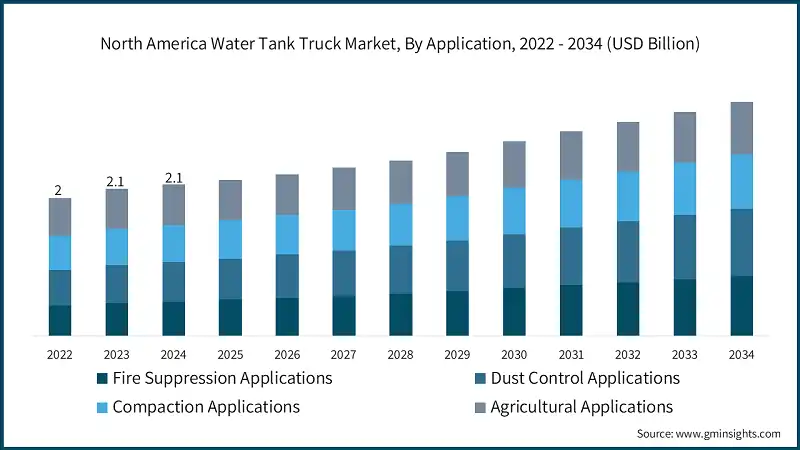
Based on application, the North America tank truck market is divided into fire suppression applications, dust control applications, compaction applications, and agricultural applications. The dust control applications segment held over 32% of the market share and generated revenue of USD 570 million in 2024.
- Fire suppression applications are a major development driver, which is fueled by increasing the incidents of wildfire in the United States and Canada. Trucks for this application use advanced technologies such as electric propulsion, telematics and high-capacity modular pumping systems to increase the reaction time and reduce shutdown. Municipal and emergency services prioritize NFPA-compliant equipment. For example, Pierce Manufacturing produces $1.2–1.3 billion annually in the fire system, highlighting the revenue capacity in specialized water trucks for fire suppression.
- Dust control applications are continuously increasing, especially in design and mining areas, where OSHA-Silica and environmental rules require efficient, environmentally friendly solutions. Autonomous water distribution systems and advanced spray technologies are integrated to adapt water use and reduce operating costs. United Rental, with 1500+ rented places and $20.6+ Fleet OEC, reflects the importance of the market scale and rental model to meet the market scale and season -based and project -based demand.
- Demand for compaction applications is driven by the need to operate high-capacity, rugged water tankers. Attributes such as expansive tank capacities, strengthened frames, and resilient parts guarantee that these vehicles can manage demanding operations like roadway development and land clearing. Manufacturers supply adaptation options to meet specific website requirements, increase operating efficiency and safety. This section benefits from infrastructure investments and increasing urban development projects in North America.
- Applications in the farming sector emphasize maneuverability, user-friendliness, and compatibility with existing agricultural machinery. Seasonal watering of crops, application of liquid treatments, and livestock hydration lead to variable demand, necessitating adaptable financial and maintenance plans. Medium-sized water tank vehicles, with capacities ranging from 2,000 to 5,000 gallons, are frequently employed, while larger units support irrigation for commercial farming enterprises. This sector is further supported by governmental initiatives and financial assistance designed to promote modern farming technologies and effective water resource management strategies.
Learn more about the key segments shaping this market
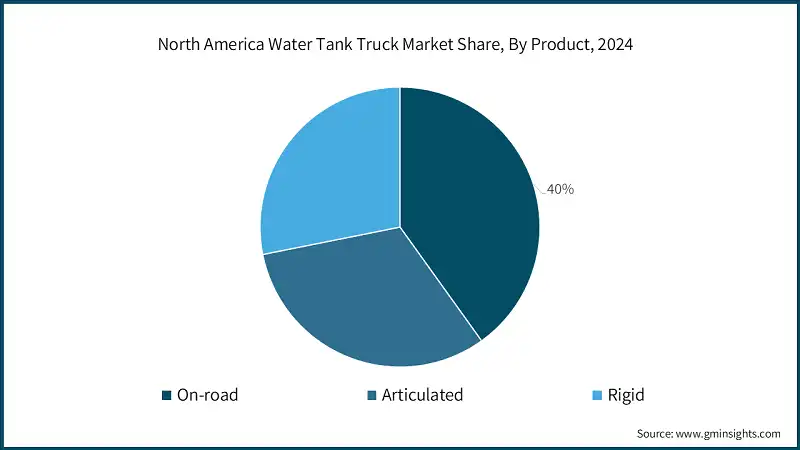
Based on product, the North America tank truck market is segmented into on-road, articulated, and rigid frame. The on-road segment held a market share of 40% in 2024 and is expected to grow at CAGR of 4.8% from 2025 to 2034.
- On-road trucks are predominantly employed in urban and highway applications. Their design adheres to stringent environmental and emission standards. Automotive producers are expeditiously incorporating electric and hybrid powertrain technologies, aiming to enhance fuel economy while maintaining optimal operational capabilities. These trucks are indispensable for various civic functions, including potable water delivery, particulate matter abatement on municipal roadways, and smaller-scale construction endeavors. Consequently, they represent a significant area of expansion, contributing to enhanced operational resilience and decreased expenditure.
- Articulated trucks are gaining traction due to their superior mobility in mining, construction, and off-road sites, as well as their ability to navigate rough terrain. Enhanced suspension systems and robust chassis designs improve stability and durability, allowing operators to handle challenging environments safely. This product segment is preferred for large construction projects, remote resource extraction, and uneven terrains, highlighting its importance in industrial and infrastructure development in North America.
- Rigid trucks dominate the municipal and industrial markets because of their strong construction, high payload capacity, and reliability for heavy-duty operations. Innovations such as modular tank designs and advanced high-capacity pumping systems allow users to customize trucks for multiple applications, including firefighting, dust control, and compaction. Their versatility and operational flexibility make rigid trucks the backbone of the water tank truck fleet in North America.
Based on business model, the North America tank truck market is segmented into new equipment, used equipment and rental. The new equipment segment held a market share of 40% in 2024 and the segment is expected to grow at CAGR of 4.3% from 2025 to 2034.
- Demand for new water tank cars increases as buyers prioritize the latest techniques, including electric propulsion, telematics and autonomous functions. Manufacturers emphasize adaptable alternatives to meet the specific requirements for municipal, industrial and construction applications. This innovation increases operational efficiency, reduces downturn and supports regulatory compliance, making new equipment a favorite option for buyers seeking long -term performance and reliability in fleet operations.
- The used tank truck market is still strong, driven by budget-conscious buyers seeking reliable trucks for low acquisition costs. Certified pre-owned programs and extended warranty are quickly introduced to build the buyer's trust of manufacturers and dealers, reduce operating risk and provide long-term values. This segment is especially important for small contractors, municipal agencies and emerging markets where the lack of capital expenses makes used trucks a practical solution.
- Rental water tankers experience rapid growth when they meet seasonal or project -based requirements in construction, municipal and emergency areas. Flexible price conditions, low lead time and access to specialized equipment allow customers to manage ups and downs without heavy pre-investment. Premium prices for trucks with large capacities can range from $5,000 to $19,000 per month, highlighting the profitability and importance of this segment in the market.
Looking for region specific data?
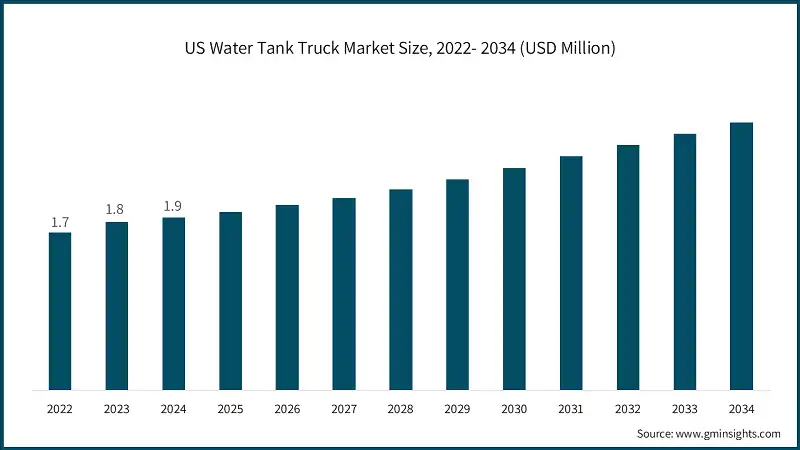
The US accounted for over 86% share in the North America tank truck market, generating revenue of USD 1.9 billion in 2024.
- US is the largest market for water tank trucks in North America, operated by various applications in agriculture, construction, mining and municipal activities. In 2023, US farms irrigated 53.1 million acres, down from 55.9 million acres in 2018, reflecting irrigation efficiency and improvement in drought-related obstacles. Despite this decline, agricultural requirements for water trucks are still significant, especially for flexible watering in remote or resource-constrained areas.
- Construction and field sites continue to rely on water tank trucks for dust suppression, soil compaction and other operating requirements. Depending on the size of the routine application report in 2023, the use of water ranged from 10,000 to 36,000 gallons per mile, depending on the intensity of activity. This continuous demand emphasizes the importance of water tank trucks in both urban and rural projects, preferred for efficiency and operational reliability with high-capacity and specialized trucks.
- Regional development is supported by infrastructure investments, wildfire preparedness programs and municipal water supply projects. Western U.S. states, which are constantly facing the risk of drought and fire, are especially seeing strong adoption, while expansion of construction activity in the Southeast and Midwest contributes to the regular demand for both rental and new equipment. Technical integration, such as telematics and modular pumping systems, is increasingly used in regions to optimize usage and increase fleet efficiency.
The market in Canada is expected to experience significant and promising growth from 2025 to 2034.
- Canadian Water Tank Truck Transport is operated under a comprehensive regulatory structure controlled by Canada, which ensures the protection of commercial vehicles and the transport of dangerous goods. Compliance is an important idea for operators, especially in areas such as energy and natural resources, which contributes 10.3% to Canada's GDP and generates frequent demand for specialized water tank trucks to operate these industries.
- Market growth is supported by regulatory harmony with US standards, although Canada Highway Tank maintains its requirements for specifications and transport of dangerous goods. This adjustment allows cross-border operations, increases operating flexibility for the fleet serving several areas, ensuring compliance with local safety rules.
- Canadian clean technology sector also increases the demand for water tank trucks. Between 2018 and 2023, GDP extended from $65.0 billion to $80.2 billion in the region, leading to more than 327,000 jobs. This development promotes the use of environmentally friendly water transport solutions, including trucks that reduce emissions when transporting water to industrial and municipal needs.
- Canadian waterways, topography and resource-based economies create stable demand for water transport beyond environmental or construction applications. Remote locations, mining operations and industrial projects depend on high-capacity water tankers, highlighting the strategic importance of these vehicles in many areas.
North America Tank Truck Market Share
- The top 7 companies in the North America tank truck industry are Caterpillar, Oshkosh / Pierce, REV Group, Rosenbauer, Ledwell & Son, Knapheide, and Curry Supply, contributing over 47% of the market in 2024.
- Caterpillar Inc., a global leader in off-highway and mining water truck application provides advanced solutions such as Cat 777 Water Solutions and Autonomous Cat 789D. Its integrated water distribution, telemetry and predictive maintenance system improve operating efficiency, while a large dealer network ensures the accessibility and support of parts for high-capacity, premium applications.
- Oshkosh Corporation, along with its subsidiary Pierce Manufacturing, commands the premier position within the North American fire engine sector, possessing a substantial market share ranging from 70 to 80 percent. The company presents a wide array of highly adaptable water tankers, including the BX™, Commercial, and PUC™ series. Their employment of modular construction, pioneering endeavors in electric-powered firefighting vehicles, and collaborative procurement arrangements solidify their prominence in emergency response, municipal services, and industrial water-related contexts.
- REV runs several brands including E-ONE, Ferrara, KME, Spartan and Smeal, which serves municipal and industrial customers. Vector provides flexibility and responsiveness despite electrification efforts such as electric fire trucks, as well as modular and semi-custom product lines, delivery challenges and consolidation pressure in the industry.
- Rosenbauer International, through its North American branch, distributes premium water tenders and fire apparatus. With a South Dakota production plant, advanced pumping systems, extruded aluminum construction and 24/7 OEM support, Rosenbauer targets high-end customers looking for innovative, reliable and technology-centered water transport solutions.
- Ledwell & Son Enterprises specialize in custom water tank trailers, offering high-capacity, flexible hauling solutions for construction, agriculture and emergency response. The Texas-based production ecosystem supports cost-effective production and tailored design and fills the niche applications that are not efficiently served by standard truck-mounted systems.
- Knapheide Manufacturing Company integrates water tanks into municipal, industrial and versatile truck platforms for industrial and construction operations. Extensive dealer networks, multifunctional platforms and long-term expertise ensure reliable, cost-efficient solutions and maintain strong customer relationships that create market barriers.
- The Curry Supply Company focuses on custom water tenders for fire departments and emergency services, and emphasizes engineering solutions for NFPA-compliant, rural, wildland and industrial applications. Its lifecycle support, flexible production and operational expertise make it a reliable partner in the specialized mid-market water transport segments.
North America Tank Truck Market Companies
Major players operating in the North America tank truck industry are:
- Amthor International
- Caterpillar
- Curry Supply Company
- Klein Products
- Knapheide Manufacturing Company
- Ledwell & Son Enterprises
- Load King
- Niece Equipment
- Tiger Manufacturing
- Valew
- The North American marketplace is dominated by leading water tank truck producers such as Caterpillar Inc., Oshkosh/Pierce Manufacturing, and REV Group. Their prominence is attributable to their integration of cutting-edge technologies, modular architectures, and comprehensive lifecycle support. These firms, operating within the United States and Canada, propel market growth through the provision of high-capacity and autonomous trucks, alongside adaptable emergency response solutions, catering to the mining, construction, and municipal sectors.
- In addition, corporations such as Rosenbauer, Ledwell & Son, and Knapheide provide sophisticated water conveyance and conflagration abatement systems, principally targeting industrial, agricultural, and emergency response sectors. These entities are acknowledged for their tank trucks, versatile transport solutions, and bespoke apparatus. Their offerings are extensively deployed, esteemed for their reliability, operational efficiency, and compliance with applicable codes and standards, particularly in isolated locations, building sites, and municipal automotive divisions.
- Finally, entities such as Curry Supply Company and Ledwell, functioning as mid-sized and specialized providers, deliver highly bespoke water tenders and trailers tailored for wildland and industrial applications. Their dedication to engineering adaptability, NFPA conformance, and lifecycle sustainment bolsters their standing within specific market niches. Comprehensive after-sales assistance and custom-designed solutions enhance their competitive edge in regional and specialized operations.
North America Tank Truck Market Report Attributes
| Key Takeaway | Details |
|---|---|
| Market Size & Growth | |
| Base Year | 2024 |
| Market Size in 2024 | USD 2.1 Billion |
| Market Size in 2025 | USD 2.2 Billion |
| Forecast Period 2025 - 2034 CAGR | 4.8% |
| Market Size in 2034 | USD 3.4 Billion |
| Key Market Trends | |
| Drivers | Impact |
| Growth in wildfire suppression initiatives | Rising frequency and severity of wildfires in the U.S. and Canada is driving demand for water tank trucks for firefighting and emergency response |
| Expansion of construction and mining projects | Urban development, road construction, and mining activities are driving higher demand for dust suppression and potable water delivery |
| Rising rental and secondary market adoption | Municipalities and contractors prefer flexible acquisition models, encouraging growth in used and rental truck segments |
| Adoption of advanced water truck technology | Fuel-efficient pumps, telematics, and water-saving systems improve operational efficiency, creating differentiation for manufacturers |
| Pitfalls & Challenges | Impact |
| Environmental and emission regulations | Stricter EPA and state-level emission standards require fleet upgrades, increasing procurement costs for operators |
| Seasonal and project-based demand fluctuations | Uneven demand can impact manufacturer production planning and fleet utilization, particularly in smaller markets or rural regions |
| Opportunities: | Impact |
| Smart fleet and telematics integration | Predictive monitoring, route optimization, and water usage tracking enhance efficiency and appeal to large contractors and municipal fleets |
| Alternative fuel and hybrid water trucks | Growing interest in sustainable solutions aligns with broader North American decarbonization initiatives |
| Expansion in remote Canadian and U.S. regions | Demand in resource-rich, remote, or drought-prone areas presents opportunities for specialized trucks and modular designs |
| Retrofitting and customized tank solutions | Upgrading older trucks with advanced pump systems and custom tanks generates new revenue streams for manufacturers and service providers |
| Market Leaders (2024) | |
| Market Leaders |
14% market share |
| Top Players |
Collective market share in 2024 is 24% |
| Competitive Edge |
|
| Regional Insights | |
| Largest Market | United States |
| Fastest Growing Market | Canada |
| Emerging Market | Western U.S. states (California, Oregon), Northern, Remote mining regions |
| Future outlook |
|
What are the growth opportunities in this market?
North America Tank Truck Industry News
- In June 2025, Klein Products partnered with All Roads Trucks and Kenworth of South Florida to expand its footprint in Florida, customizing Kenworth chassis with Klein’s TRAP-Tank technology to deliver turnkey, high-performance water trucks tailored for contractors, quarries, mining, and public works projects.
- In March 2025, Caterpillar launched the Cat 789D Autonomous Water Truck, the market’s first commercially available AWT, fully integrating Cat Water Delivery System with MineStar technology to optimize haul road watering, reduce water waste, and enhance safety while seamlessly operating within autonomous haulage fleets.
- In March 2025, Custom Truck One Source unveiled the Load King Turbo Loader at WWETT 2025, featuring a Peterbilt 567 8×4 chassis, 3,500-gallon D.O.T. 412 tank, Jurop Helix 1500 Blower, and Cummins X15 engine, delivering high-capacity vacuum performance for demanding environmental and wastewater applications.
- In October 2024, Klein Products, in collaboration with Kenworth and Papé Kenworth, launched the K400SS-TD water truck, a stainless steel 4,000-gallon, dual-purpose model engineered for severe off-road utility work, transformer cleaning, and dust control with advanced hydraulic and SmartSpray systems for optimized performance.
- In February 2024, Amthor International introduced a new 33,000 sq. ft. facility in Gretna Industrial Park, investing over $4 million and creating 75 new jobs, as part of a $30 million capital plan to expand production capacity and meet growing demand for truck-mounted tanks across multiple industries.
The North America tank truck market research report includes in depth coverage of the industry with estimates & forecasts in terms of revenue (USD Mn/Bn) and Volume (Units) from 2021 to 2034, for the following segments:
Market, By Application
- Fire Suppression Applications
- Municipal fire departments
- Wildfire suppression operations
- Industrial fire protection systems
- Dust Control Applications
- Construction site dust suppression
- Mining operations dust control
- Road construction and maintenance
- Compaction Applications
- Agricultural Applications
Market, By Product
- On-road
- Articulated
- Rigid frame
Market, By Business Model
- New equipment
- Used equipment
- Rental
The above information is provided for the following regions and countries:
- US
- Alabama
- Alaska
- Arizona
- Arkansas
- California
- Colorado
- Connecticut
- Delaware
- Florida
- Georgia
- Hawaii
- Idaho
- Illinois
- Indiana
- Iowa
- Kansas
- Kentucky
- Louisiana
- Maine
- Maryland
- Massachusetts
- Michigan
- Minnesota
- Mississippi
- Missouri
- Montana
- Nebraska
- Nevada
- New Hampshire
- New Jersey
- New Mexico
- New York
- North Carolina
- North Dakota
- Ohio
- Oklahoma
- Oregon
- Pennsylvania
- Rhode Island
- South Carolina
- South Dakota
- Tennessee
- Texas
- Utah
- Vermont
- Virginia
- Washington
- West Virginia
- Wisconsin
- Wyoming
- Canada
- Alberta
- British Columbia
- Manitoba
- New Brunswick
- Newfoundland and Labrador
- Nova Scotia
- Ontario
- Prince Edward Island
- Quebec
- Saskatchewan
- Northwest Territories
- Nunavut
- Yukon
Frequently Asked Question(FAQ) :
What is the market size of the North America tank truck in 2024?
The market size was estimated at USD 2.1 billion in 2024, with a CAGR of 4.8% expected through 2034. The market is driven by infrastructure development, emergency services, and increasing demand for water distribution and dust suppression.
What is the projected value of the North America tank truck market by 2034?
The market is poised to reach USD 3.4 billion by 2034, fueled by advancements in technology, growing construction activities, and the rising need for emergency preparedness.
What is the expected size of the North America tank truck market in 2025?
The market size is projected to reach USD 2.2 billion in 2025.
How much revenue did the dust control applications segment generate in 2024?
The dust control applications segment generated approximately USD 570 million in 2024, accounting for over 32% of the market share.
What was the market share of the on-road segment in 2024?
The on-road segment held a 40% market share in 2024 and is expected to witness over 4.8% CAGR till 2034.
What is the growth outlook for the new equipment segment from 2025 to 2034?
The new equipment segment, which held a 40% market share in 2024, is set to expand at a CAGR of 4.3% up to 2034.
Which country leads the North America tank truck sector?
The United States leads the market, accounting for over 86% of the regional revenue, generating USD 1.9 billion in 2024. This dominance is driven by widespread infrastructure projects and emergency service requirements.
What are the upcoming trends in the North America tank truck market?
Trends include rising use of water tank trucks for wildfire control, construction dust, and mining, plus telematics, GPS, and real-time water tracking to boost efficiency and growth.
Who are the key players in the North America tank truck industry?
Key players include Amthor International, Caterpillar, Curry Supply Company, Klein Products, Knapheide Manufacturing Company, Ledwell & Son Enterprises, Load King, Niece Equipment, Tiger Manufacturing, and Valew.
North America Tank Truck Market Scope
Related Reports