Summary
Table of Content

North America Smart Greenhouse Market
Get a free sample of this report
Form submitted successfully!
Error submitting form. Please try again.
Thank you!
Your inquiry has been received. Our team will reach out to you with the required details via email. To ensure that you don't miss their response, kindly remember to check your spam folder as well!
Request Sectional Data
Thank you!
Your inquiry has been received. Our team will reach out to you with the required details via email. To ensure that you don't miss their response, kindly remember to check your spam folder as well!
Form submitted successfully!
Error submitting form. Please try again.
North America Smart Greenhouse Market Size
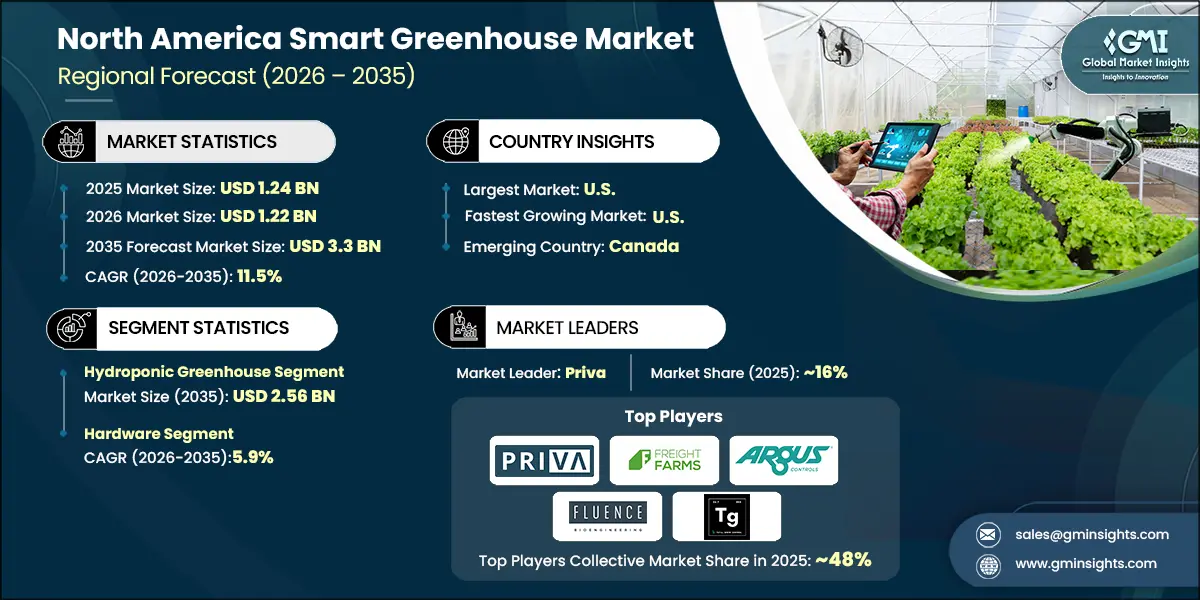
The North America smart greenhouse market was estimated at USD 1.24 billion in 2025. The market is expected to grow from USD 1.22 billion in 2026 to USD 3.3 billion in 2035, at a CAGR of 11.5% according to latest report published by Global Market Insights Inc.
North America Smart Greenhouse Market Key Takeaways
Market Size & Growth
- 2025 Market Size: USD 1.24 Billion
- 2026 Market Size: USD 1.22 Billion
- 2035 Forecast Market Size: USD 3.3 Billion
- CAGR (2026–2035): 11.5%
Regional Dominance
- Largest Market: U.S.
- Fastest Growing Country: U.S.
Key Market Drivers
- Increasing demand for food security and year-round crop production.
- Growing scarcity of water and arable land.
- Advancements in IoT, AI, and automation technologies.
Challenges
- High initial capital investment and operational costs.
- Need for a skilled workforce and technical expertise.
Opportunity
- Development of energy-efficient and renewable energy-integrated systems.
- Expansion into urban and vertical farming.
Key Players
- Market Leader: Priva led with over ~16% market share in 2025.
- Leading Players: Top 5 players in this market include Priva, Freight Farms, Argus Control Systems, Fluence Bioengineering, Total Grow Control, which collectively held a market share of 48% in 2025.
Get Market Insights & Growth Opportunities
The market for smart greenhouses in North America is growing at a rapid pace owing to a number of factors that are currently converging, including an increasing demand for food production, resource scarcity, and a strong need for sustainable models of agriculture. The agricultural sector in North America is undergoing a transformation due to the adoption of technologies that improve climate control, automate processes, and optimize resource utilization, making smart greenhouses a necessity in order to fulfill future food security requirements.
The North American market has experienced rapid growth over the past few years due to an increasing awareness of the environmental impacts associated with traditional farming methods. More stringent regulations on water and pesticide use, as well as a general move towards sustainability, have compelled farmers and agricultural businesses to adopt controlled environment agriculture (CEA). Rapid urbanization in major American and Canadian cities has also increased demand for locally grown produce throughout the year, further justifying the need for smart greenhouses in the commercial and urban farming sectors.
At present, North America accounts for more than 49% of the overall smart greenhouse market share, primarily because of its strong adoption of agricultural technology and its continued investment in Agri-tech innovation. However, with the increasing concerns about food security and resilience, especially in the context of climate volatility, there is a growing need for farmers to adopt climate-independent food systems. Moreover, the urban and peri-urban markets are increasingly turning to smart greenhouses to make their carbon footprint smaller and to ensure a steady supply of high-quality, pesticide-free food. Although there has been progress in this area, the region is still challenged by factors such as high capital costs and a lack of qualified personnel who can handle sophisticated automated systems.
From the technology segmentation perspective, hydroponics-based smart greenhouses currently lead the North American market because of their resource efficiency and high output capacity. The growing interest in soilless agriculture, along with innovations in automated nutrient delivery, water recycling, and precision feeding, has made hydroponic systems particularly appealing to large commercial farmers as well as urban farmers. Their compatibility with sustainability agendas such as water conservation and decreased chemical use further cements their leading position in the North American market. Regulatory pressure in North America is another key factor that is fueling the growth of the market.
Tightening environmental regulations, particularly in arid regions like California and the Southwest, are encouraging farmers to adopt more efficient and scalable models of farming. Water and certain chemical pesticides restrictions are directly leading to increased adoption of smart greenhouse technology. As the need to comply becomes an imperative for most farmers, smart greenhouses are turning out to be one of the most feasible, productive, and compliant agricultural technologies.
The overall scenario is also supporting the North American transition to technology-driven food production. According to the Food and Agriculture Organization of the United Nations, the world will require a 56% increase in food production by 2050, with the same amount of arable land being reduced due to urbanization and climate change. At the same time, research from the World Bank suggests that agriculture accounts for 70% of global freshwater use—furthering the need for water conservation through controlled environment agriculture.
Advances in CEA technology, such as automated climate control, IoT sensing, real-time analytics, and AI-driven decision support tools, are significantly improving productivity, reducing labor intensity, and optimizing overall operational efficiency. Overall, the North American smart greenhouse market is positioned for strong continuous growth as regulatory requirements, sustainability goals, and food security concerns push the region toward advanced, high‑yield, and climate‑independent modes of agriculture.
To get key market trends
North America Smart Greenhouse Market Trends
In North America, the demand for smart greenhouse technology has increased substantially because of the efforts of government agencies and agricultural organizations to adopt sustainable, resilient, and technology-based food security solutions. The region is also under similar pressures in the global market, including the reduction of freshwater resources, the reduction of arable land due to urbanization, and the increase in food requirements due to population growth. U.S. and Canadian agricultural organizations are increasingly advocating for sustainable agricultural practices, supporting technologies that are less resource-dependent. Climate-resilient, lower chemical, and water-conserving policies continue to drive the adoption of controlled environment agriculture (CEA) in the region.
- The increasing policy support has emerged as one of the most driving factors for the integration of smart greenhouse technology among commercial growers, research institutions, and urban farms in North America. Since the late 2010s, the United States and Canada have both invested in the modernization of their horticultural industries and the development of stronger and more localized food chains. The U.S. has focused on agricultural automation and indoor farming innovation to enhance long-term food security, while Canada continues to support the expansion of greenhouses in climate-challenging provinces to decrease dependence on imported produce.
- The innovation comes with a great change in the market. Most of the effects include reduced water usage, increment in crop cycles, and yield. As an example, certain complex smart greenhouse capabilities can cultivate high value produces on only 5 percent or less of the water that would otherwise be used in traditional field farms. All in all, the smart greenhouse sector is going to grow expansively in the near future since it is driven by this intense technological integration.
- Technological advancements, especially in the areas of climate control systems, high-efficiency LED lighting, and hydroponic/aeroponic growing methods, have significantly enhanced the efficiency of greenhouses in the region. These technologies enable farmers to address issues such as labor, weather, and resource availability. By the early 2020s, North American greenhouse growers started adopting these new technologies rapidly, and their impact is likely to accelerate as the technologies become more accessible, scalable, and fully integrated with agricultural practices.
- One of the most disruptive forces driving the industry is the increased adoption of IoT sensors, AI-driven analytics, and autonomous control systems in North American greenhouses. These technologies enable real-time environmental monitoring, autonomous nutrient and water management, predictive crop disease identification, and overall crop cycle optimization. Apart from the technological advantage, the development of the North American market is also aided by the increasing rate of urbanization, increased consumer demand for pesticide-free and locally sourced produce, and the need for climate-resilient food production solutions.
- This technological revolution is creating immense operational efficiencies within the North American smart greenhouse industry. The key outcomes include dramatically lower water usage, shorter crop cycles, increased yields, and improved produce quality.
North America Smart Greenhouse Market Analysis
Learn more about the key segments shaping this market
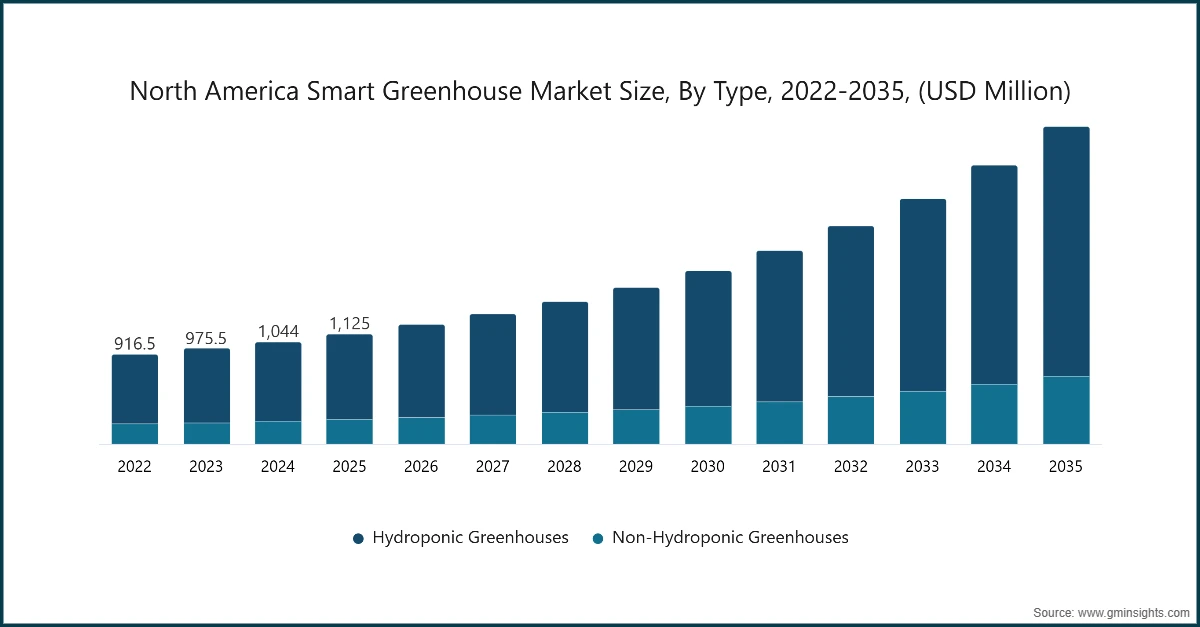
Based on the type of segment, the market is further segmented into hydroponic greenhouse and non-hydroponic greenhouse. The hydroponic greenhouse segment was valued at USD 877.6 million in 2025 and is projected to reach USD 2.56 billion by 2035.
- Smart greenhouses Hydroponic systems, positioned on the market globally, enjoy a leading position primarily due to their absolute resource saving, increased production, and unprecedented control of the cultivation environment. To fulfill the growing demand on productivity as well as sustainability, hydroponic systems allow high density planting with regulated nutrient feeding and minimal human interference.
- The competitive conditions in the sector of hydroponic greenhouses have been changing very fast due to the dynamics in technology. Modern smart hydroponic solutions come with a series of functions deploying high quality technology; smart IoT-based pH and electrical-conductivity (EC) sensing and Artificial Intelligence (AI)-powered nutrient formulas optimize productivity and reduce total production expenses.
- To illustrate, within the commercial hydroponic greenhouse domicile, over the past five years, there has been a rise in water-use efficiency in systems, and advanced systems use up to 95% less water amounts than conventional soil farming.
- Though the hydroponic segment has the dominant position related to the market growth and technological orientation, it exists in the market with non-hydroponic smart greenhouses, known as a crucial and significant piece. This is a widely utilized segment where most of the crops with protrusive roots including tomatoes, peppers and cucumbers are commonly grown but also by the old time farmers who are interested in modernizing their production without losing all the soil and substrate-based production techniques.
- The advanced functionality in this segment is realised through the incorporation of precision drip irrigation and fertigation systems that apply water and nutrients straight to the root zone of the plant on the basis of up to date information that arises when soil moisture and nutrient monitor is installed. The benefits of this technological overlay are water saving and fertilizer conservation relative to conventional farming, improving the quality of the crops, and giving the growers better control over the growth process.
The requirement to advance the effectiveness and sustainability of the division of the high-value, soil-friendly crops administration thusly drives the consummation of the non-hydroponic clever systems that can act as a significant transitional step amid the ordinary farming and the non-soil based flora development.
 Learn more about the key segments shaping this market
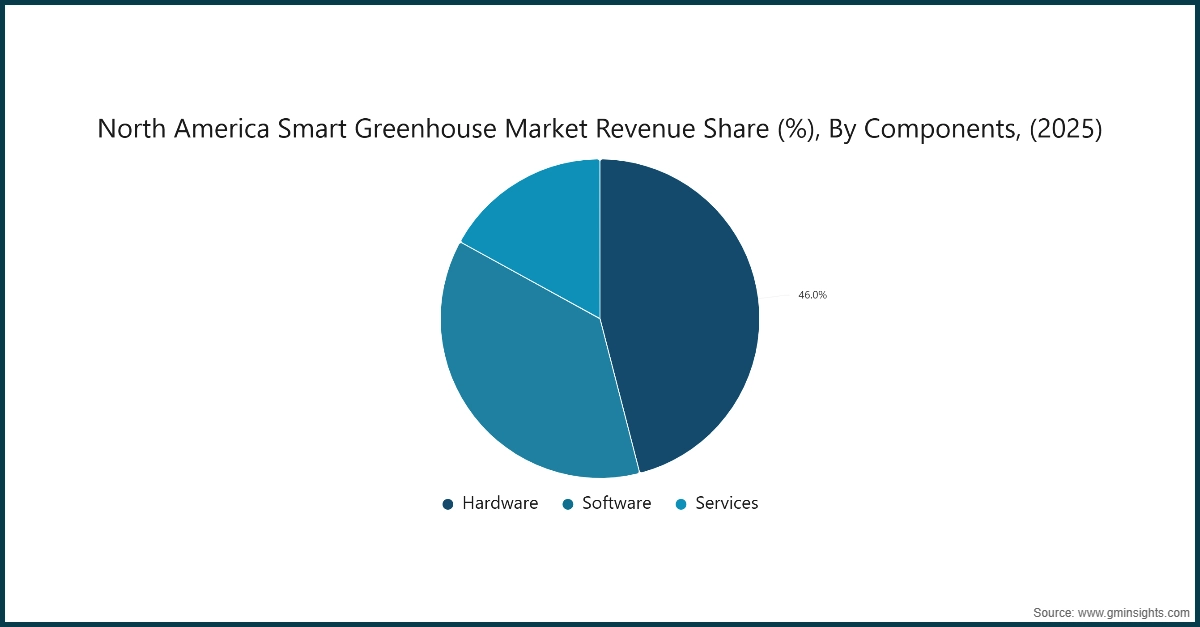
Based on components, the smart greenhouse market is segmented into hardware, software, and services. The hardware segment was valued at USD 519.2 million in 2025 and is anticipated to grow with a CAGR of 5.9% during the forecast period.
- The most prominent component in the smart greenhouse market across the world is hardware, primarily because it is the basic and the most capital-intensive level of any controlled environment agriculture (CEA) complex. Part of this includes everything that is physical, like having climate control systems, top-quality LED lighting, irrigation and fertigation systems, and a vast variety of sensors, which measure both environmental and plant-health factors, etc.
- The nature and quality of this hardware spells out directly the potential yield, the efficient utilization of the resources and the overall profitability of the greenhouse operation. Constant advances in hardware technology, like the birth of highly efficient, spectrum-variable LED grow lights, and more rugged, finely resolved environmental sensors have been instrumental towards improvement of productivity and operational expenses.
- The market for smart greenhouse hardware has changed drastically. Although the initial installation constitutes a huge investment, the price of key components of an installation such as LED light and sensors has reduced over the last five years. Coupled with the increase in energy efficiency, this trend is improving the return on investment for growers.
- Next to the hardware, software plays the role of a central nervous system of the smart greenhouse and its market share is expanding very fast. This part comprises the control platforms, data analytics dashboards, and advanced algorithms that analyze sensor data and automatically run the hardware.
- Lastly, the services segment offers the necessary support line, which guarantees the successful introduction and functioning of such complex systems. This encompasses system design and integration, installation, continual maintenance and technical support, and specialized agronomic and data consulting.
Based on technology, the smart greenhouse market is segmented into HVAC systems, LED grow lights, sensors and control systems, irrigation System, pumps and valves, and material handling. The HVAC system dominates the market and shows potential growth in the upcoming future.
- The most important technology segments to be represented in the smart greenhouse market are HVAC (Heating, Ventilation, and Air Conditioning) systems that play a crucial role and control the creation of the required climate conditions in the greenhouse as well as form a great share of the initial capital investment. This part includes an extensive hardware part such as heaters, cooling systems, dehumidifiers, air circulation fans, and automated vents.
- LED Grow Light is a very fast-developing niche, as it is needed to complement sunlight in vertical farms, or even be the only source of lighting. New developments in this technology can enable the provision of particular light spectrums to suit different growing crops and their development, which means a high increase in yield, quality and energy efficiency over traditional lighting.
- Smart greenhouse intelligence revolves around the sensors and Control Systems. This section is the network of sensors that collect real time data on all of the environmental variables and the software platforms that analyze this data and automate and optimize the functions of the other hardware components.
- Irrigation systems are important when it comes to the accuracy in provision of water and nutrients. In an intelligent greenhouse, these are automated systems that include drip irrigation or Nutrient Film Technique (NFT), which allows customized hydration and fertigation using sensor feedback and, thus, saves enormous volumes of water and fertilizer.
- Pumps and valves act as the necessary sub-components that allow moving water and fertilizing solutions inside the irrigation and fertigation systems, and material handling is a new technological trend aimed to automate labor-intensive procedures. This is also robotic seeding, transplanting, monitoring, and harvesting which will be taken up to save operational expenses, higher level of precision and common labor shortage in the agricultural sector.
Looking for region specific data?
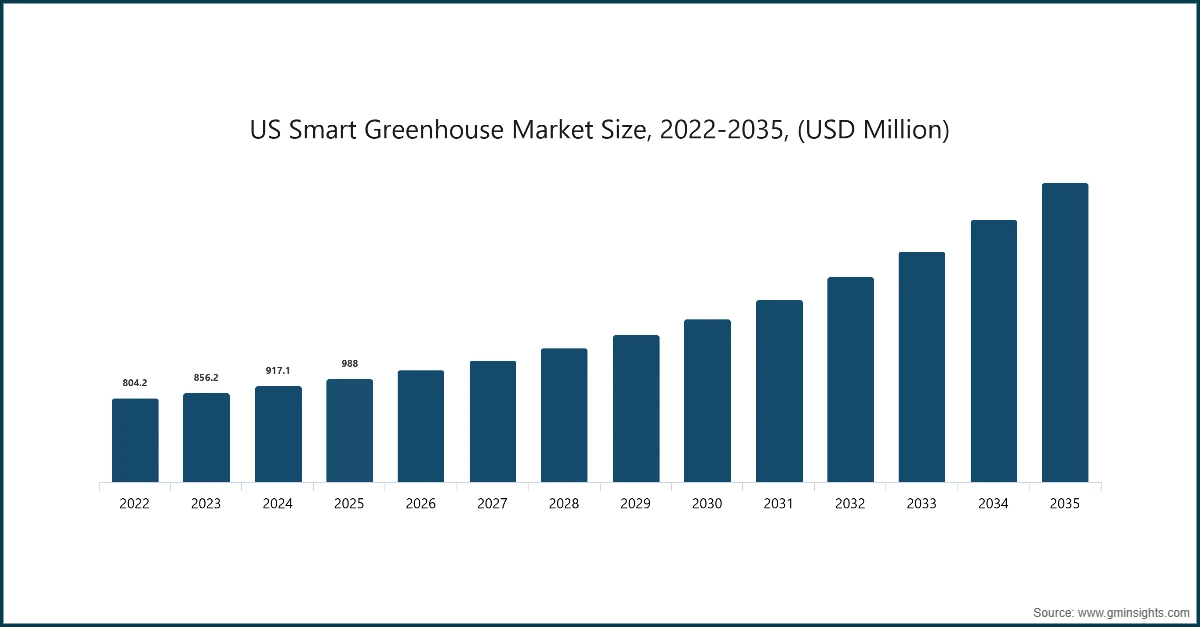
The U.S. dominated the North America smart greenhouse market, which was valued at USD 988 million in 2025 and is estimated to grow at a CAGR of 11.6% from 2026 to 2035.
- The most successful market in the smart greenhouse industry of North America is the U.S., and there are a number of interdependent drivers of growth that it would take to ascend. The growth into controlled environment agriculture (CEA) has been fueled by an increased inflow of venture capital into Agri-Tech along with a high demand in consumerism of both local and sustainably grown produce.
- The agricultural growers of the U.S. are feeling the squeeze of considerable local conditions, such as extreme water scarcity in the West, including California and Arizona, and extreme conditions in the northeast, which contributed to the creation of large-scale greenhouse complex in the Southwest and the propagation of vertical farms in the indoors across major metropolitan areas of the nation, like New York and Chicago, fostering the popularity of intelligent greenhouse technology in the expansive mass production setting or the innovative urban farming system.
North America Smart Greenhouse Market Share
- The leading 5 players of global smart greenhouse market include Priva, Argus Control System, Freight Farms, Fluence Bioengineering, Total Grow Control which will hold approximately 48% of the market in 2025.
- Priva specializes in the production and delivery of process control and automation systems in horticulture and buildings. Using its high-tech software systems, the company has become a leader in the development of complete environmental control systems that reach out to customers, research facilities, and even bulk commercial growers. It uses data-driven expanding, open architectures that connect with third-party equipment, and energy efficiency as its growth strategies.
- Ridder has been keen on giving a full suite of integrated technology in the greenhouse sector. It offers everything that is required by commercial growers, including drive systems and climate screens, through climate computers and water treatment with a range of products that makes it a single point of reliable product supply. Its strategy involves creating synergistic applications in both the hardware application and its software thus making different divisions of the greenhouse performance integrated. The focus on durability and full-service have also aided in the distinction of its products.
- Through high efficiency LED grow lights coupled with evidenced-based solutions, Fluence OSRAM continues to lead the horticultural lighting industry. The company is working in a way that constitutes intense research into photobiology of crops in an effort to come up with crop-specific lighting plans to make commercial growers and vertical farms generate maximum yield and quality. Their plan is not only limited to selling the hardware, but also it offers professional horticultural services to gain its foothold among high-value crop producers.
- Argus Control Systems has area of highly customized and strong environmental control systems provided. The strategic goal is to offer scalable solutions to complex growing environments, including research chamber to large-scale operation commercial greenhouse by merging the boundary between sophisticated automation and data recording. Such a strategy will make Argus stand out in the North American market and create successful collaboration with universities and commercial growers specializing in certain products.
- Netafim has already claimed the top spot in the worldwide marketplace of precision irrigation and fertigation systems, which is an essential part of every smart greenhouse. Through specialized drip irrigation systems of high efficiency, Netafim helps growers to send the water and nutrients within the boundaries of the root zone of the plant with minimum wastage. It employs the strategy of offering ultra-reliable and consistent water control frameworks putting it at the center of hydroponics as well as substrate-based development.
North America Smart Greenhouse Market Companies
Major players operating in the smart greenhouse industry are:
- American Coolair Corp
- Argus Control Systems
- BioTherm, Inc.
- California LightWorks
- Climate Control Systems (CCS)
- Fluence Bioengineering
- Freight Farms
- Industries Harnois Inc.
- Priva
- Spagnol S.r.l.
- Surna Cultivation Technologies
- Swarm Technologies
- Total Grow Control
- Wadsworth Control Systems, Inc.
- Westbrook Greenhouse Systems, Ltd.
- Hoogendoorn Growth Management specializes in novel automation systems of the horticultural industry offering sustainable solutions to efficient greenhouse management. Their advanced technology helps the growers to conserve more resources and produce more and better crops. Main aspects are their next generation IIVO climate computer, sophisticated data analysis, and climate, irrigation and energy predictive controls, which makes them appropriate to high-tech commercial growers who are seeking precise cultivation.
- Heliospectra has a strategic interest in manufacturing smart solutions to light, which provide control to a grower in his cultivation environment at a very specific level. Their lights also aid in maximizing plant growth, speeding up harvest time and enhancing crop traits by means of precise light approaches. Their spectrum-tunable range of LED fixtures and helioCORE 8 control system that enables dynamic, automated changes in light, make the brand a reliable producer in the field of technical lighting solutions to be used by the researcher or light-specific commercial producers.
- Autogrow has created new automation and information platforms for controlled environment agriculture. They provide the most recent technology to convert farm data into viable actions; their options are known for their Multi Grow control boards, the FarmRoad information system, and open API connection. Autogrow is developing profitable and sustainable agricultural solutions that minimize dependency on manual effort and intuition, and that introduce straightforward, data-driven growing systems to small and large-scale growers.
- Hoogendoorn Growth Management specializes in novel automation systems of the horticultural industry offering sustainable solutions to efficient greenhouse management. Their advanced technology helps the growers to conserve more resources and produce more and better crops. Main aspects are their next generation IIVO climate computer, sophisticated data analysis, and climate, irrigation and energy predictive controls, which makes them appropriate to high-tech commercial growers who are seeking precise cultivation.
North America Smart Greenhouse Market Report Attributes
| Key Takeaway | Details |
|---|---|
| Market Size & Growth | |
| Base Year | 2025 |
| Market Size in 2025 | USD 1.24 Billion |
| Market Size in 2026 | USD 1.22 Billion |
| Forecast Period 2026-2035 CAGR | 11.5% |
| Market Size in 2035 | USD 3.3 Billion |
| Key Market Trends | |
| Drivers | Impact |
| Increasing demand for food security and year-round crop production | Rising population and climate variability pressure traditional agriculture, driving the adoption of smart greenhouses for consistent, high-yield, and local food production |
| Growing scarcity of water and arable land | Depleting freshwater sources and limited availability of fertile land compel the agricultural sector to invest in resource-efficient technologies like smart greenhouses. |
| Advancements in IoT, AI, and automation technologies | Integration of advanced sensors, AI-driven analytics, and robotic automation enhances operational efficiency, optimizes resource use, and maximizes crop yields in smart greenhouses. |
| Pitfalls & Challenges | Impact |
| High initial capital investment and operational costs | The substantial upfront cost for technology integration and energy-intensive climate control systems can deter adoption, particularly for small and medium-sized agricultural enterprises |
| Need for a skilled workforce and technical expertise | Operating and maintaining sophisticated control systems, data platforms, and automation equipment requires specialized knowledge, creating a skills gap in the agricultural labor market. |
| Opportunities: | Impact |
| Development of energy-efficient and renewable energy-integrated systems | Innovations in energy-saving materials, LED lighting, and integration with on-site renewable energy sources like solar power can significantly reduce operational costs and enhance the sustainability credentials of smart greenhouses. |
| Expansion into urban and vertical farming | The rising trend of local food movements in densely populated urban centres creates significant opportunities for compact, highly productive smart vertical farms and rooftop greenhouses. |
| Market Leaders (2025) | |
| Market Leader |
~16% market share |
| Top Players |
Collective Market Share in 2024 is ~48% |
| Competitive Edge |
|
| Regional Insights | |
| Largest Market | U.S. |
| Fastest growing market | U.S. |
| Emerging countries | Canada |
What are the growth opportunities in this market?
North America Smart Greenhouse Industry News
- In March 2025, Ridder premiered its new high end "Synapse AI" platform, the fully autonomous climate and irrigation control unit. To resolve the ultimate challenge of resource optimization and lack of labor in large-scale farming, this technology presents a forecasted, self-classifying management of sophisticated greenhouse conditions. Its implementation would greatly reduce its energy and water usage, crop yield optimization, and the use of human knowledge, which would boost the transition to full autonomy in farming in the world.
- In January 2025, John Deere announced a collaboration with foremost vertical farming developer Plenty to jointly develop a new generation of robotic automation tools. It is proposing the synergy between John Deere, a giant in agricultural equipment, and Plenty, a designer of indoor vertically stacked farms, to produce a suite of robots to cover seeding, transplanting and harvesting. This cooperation is an industrial-level engineering and high-tech CEA combination, which provides a ready-made scalable model that may transform food production within cities and eliminate labor issues in the field.
- In October 2024, a material science start-up Bio Optima Films raised 50 million dollars in a Series B Funding led by Climate Growth Partners to manufacture its smart glazing greenhouse in large quantities. The Bio Optima film can be dynamically changed in light diffusion ability, thermal ability and controlled directly by the central climate computer. The innovation transforms green house energy control and provides more efficient, alternative, non-mechanical opportunities to more traditional shading and insulating mechanisms and indicates a potential decrease in heating and cooling expenses.
- In June 2024, Priva announced the release of upgraded Digital Twin, to horticultural process control platforms. The new version of the system provides a real-time virtual model of the greenhouse and greenhouse crop so that the grower can run predictive, what-if scenarios on various climate or irrigation treatment plans. The various benefits of this innovation lie in its extensive use provided by the high level of modeling de-risking decisions as well as enhancing yield forecasting thus making the Digital Twin a very valuable asset in strategic planning and training activities in the newest horticulture practices.
The smart greenhouse market research report includes in-depth coverage of the industry, with estimates & forecasts in terms of revenue ($ Bn) from 2026 to 2035 for the following segments:
Market, By Type
- Hydroponic greenhouses
- Non-Hydroponic greenhouses
Market, By Component
- Hardware
- Software
- Services
Market, By Application
- Fruits
- Vegetables
Market, By Technology
- HVAC systems
- LED grow lights
- Sensors and control systems
- Irrigation system
- Pumps and valves
- Material handling
Market, By End-user
- Commercial smart greenhouses
- Large-scale commercial greenhouses
- Small and medium-scale commercial greenhouses
- Residential smart greenhouses
- Research and educational institutes
The above information is provided for the following countries:
- U.S.
- Canada
Frequently Asked Question(FAQ) :
What are the upcoming trends in the North America smart greenhouse market?
Key trends include increasing adoption of IoT sensors and AI-driven analytics for real-time environmental monitoring, integration of autonomous control systems for nutrient and water management.
Who are the key players in the North America smart greenhouse market?
Key players include Priva, Freight Farms, Argus Control Systems, Fluence Bioengineering, Total Grow Control, American Coolair Corp, BioTherm Inc., California LightWorks, Climate Control Systems (CCS), Industries Harnois Inc., Spagnol S.r.l., Surna Cultivation Technologies, Swarm Technologies.
Which country leads the North America smart greenhouse market?
The U.S. dominated the North America market with a value of USD 1 billion in 2025 and is estimated to grow at a CAGR of 11.6% from 2026 to 2035.
What was the market value of the hardware component segment in 2025?
The hardware component segment was valued at USD 500 million in 2025 and is anticipated to grow at a CAGR of 5.9% during the forecast period, representing the most capital-intensive level of controlled environment agriculture.
What was the market value of the hydroponic greenhouse segment in 2025?
The hydroponic greenhouse segment was valued at USD 800 million in 2025 and is projected to reach USD 3.2 billion by 2035, leading the market due to resource efficiency and high output capacity.
What is the market size of the North America smart greenhouse in 2025?
The market size was USD 1.12 billion in 2025, with a CAGR of 11.5% expected through 2035 driven by increasing demand for food security and year-round crop production.
What is the current North America smart greenhouse market size in 2026?
The market size is projected to reach USD 1.22 billion in 2026.
What is the projected value of the North America smart greenhouse market by 2035?
The North America smart greenhouse market is expected to reach USD 3.3 billion by 2035, propelled by development of energy-efficient and renewable energy-integrated systems.
North America Smart Greenhouse Market Scope
Related Reports