Summary
Table of Content

North America Point-of-Care CT Imaging Systems Market
Get a free sample of this report
Form submitted successfully!
Error submitting form. Please try again.
Thank you!
Your inquiry has been received. Our team will reach out to you with the required details via email. To ensure that you don't miss their response, kindly remember to check your spam folder as well!
Request Sectional Data
Thank you!
Your inquiry has been received. Our team will reach out to you with the required details via email. To ensure that you don't miss their response, kindly remember to check your spam folder as well!
Form submitted successfully!
Error submitting form. Please try again.
North America Point-of-Care CT Imaging Systems Market Size
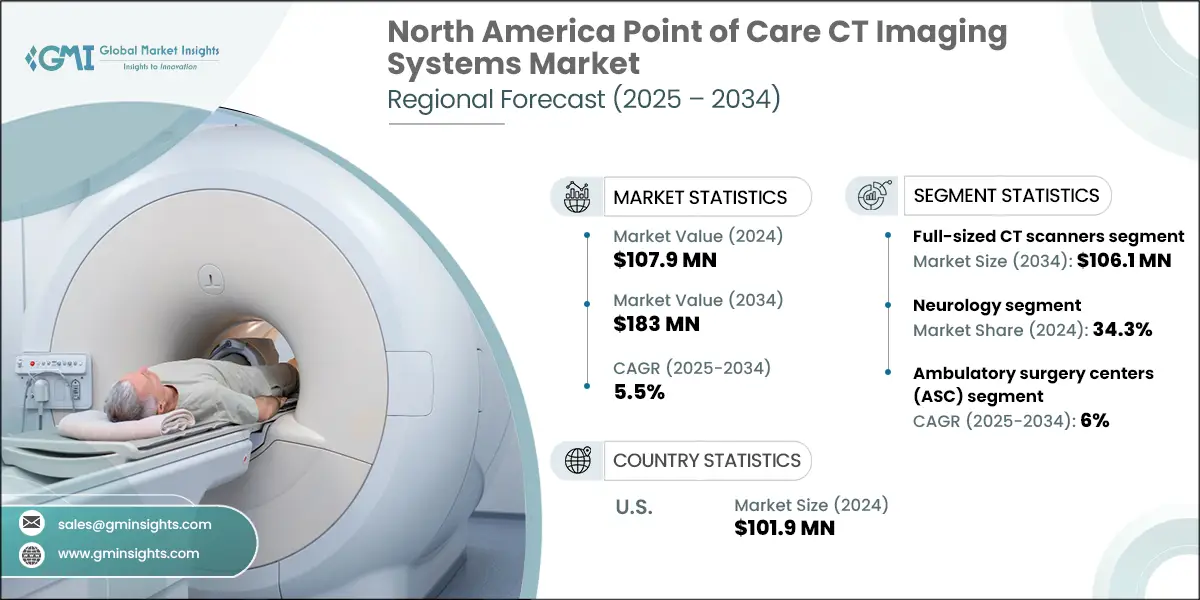
The North America point-of-care CT imaging systems market was valued at USD 107.9 million in 2024 and is projected to grow from USD 112.6 million in 2025 to USD 183 million by 2034, expanding at a CAGR of 5.5%, according to Global Market Insights Inc.
To get key market trends
This consistent growth in North America is propelled by the widening incidence of chronic conditions and the expanding aging population, which are both fueling demand for faster and more convenient diagnostic imaging. Point-of-care CT systems are a valuable asset in emergency and critical care environments due to the urgent imaging needed to diagnose and monitor chronic diseases such as stroke, cardiovascular disease, and respiratory disease. A point-of-care CT imaging platform is a small, mobile diagnostic station created to provide quick, near-patient computed tomography scans in emergency, critical care, and outpatient environments. Key players in the field in North America are NeuroLogica, Siemens Healthineers, Xoran Technologies, CurveBeam, and Stryker.
North America Point-of-Care CT Imaging Systems Market Report Attributes
| Key Takeaway | Details |
|---|---|
| Market Size & Growth | |
| Base Year | 2024 |
| Market Size in 2024 | USD 107.9 Million |
| Forecast Period 2025 - 2034 CAGR | 5.5% |
| Market Size in 2034 | USD 183 Million |
| Key Market Trends | |
| Drivers | Impact |
| Increasing prevalence of chronic disorders | Drives demand for rapid diagnostic imaging in emergency and outpatient settings across the U.S. and Canada, where chronic conditions such as cardiovascular disease, diabetes, and cancer are leading causes of mortality and healthcare burden. |
| Growing aging population | In the U.S., the number of individuals aged 65 and older is projected to increase by 47%. This demographic is more prone to fractures, neurological conditions, and respiratory illnesses, increasing the need for accessible CT imaging solutions. |
| Rising emphasis on early diagnosis and treatment | Encourages deployment of point-of-care CT systems in mobile units, ICUs, and outpatient clinics to enable faster triage and intervention, especially in underserved and remote regions of North America. |
| Technological advancements in imaging systems | Enhances image quality, portability, and integration with AI, making point-of-care CT systems more efficient, user-friendly, and suitable for decentralized care models increasingly adopted in North American healthcare systems. |
| Pitfalls & Challenges | Impact |
| High cost of imaging systems | Limits adoption in small clinics and low-resource settings across North America due to budget constraints, especially in rural and community healthcare facilities. |
| Regulatory and reimbursement barriers | Slows market penetration in certain U.S. and Canadian regions due to complex FDA and Health Canada approval processes, as well as inconsistent reimbursement policies across provinces and states. |
| Opportunities: | Impact |
| Expansion into rural and remote areas | Enables access to advanced imaging in underserved regions through mobile screening units and compact systems, addressing healthcare disparities in parts of Canada and rural U.S. communities. |
| Integration with AI and telemedicine | Improves diagnostic accuracy, supports remote consultations, and streamlines workflows in decentralized care models increasingly adopted across North America, especially in post-pandemic healthcare strategies. |
| Market Leaders (2024) | |
| Market Leaders |
20.5% Market share |
| Top Players |
Collective market share in 2024 is 61% |
| Competitive Edge |
|
| Regional Insights | |
| Largest market | U.S. |
| Fastest growing market | Canada |
| Future outlook |
|
What are the growth opportunities in this market?
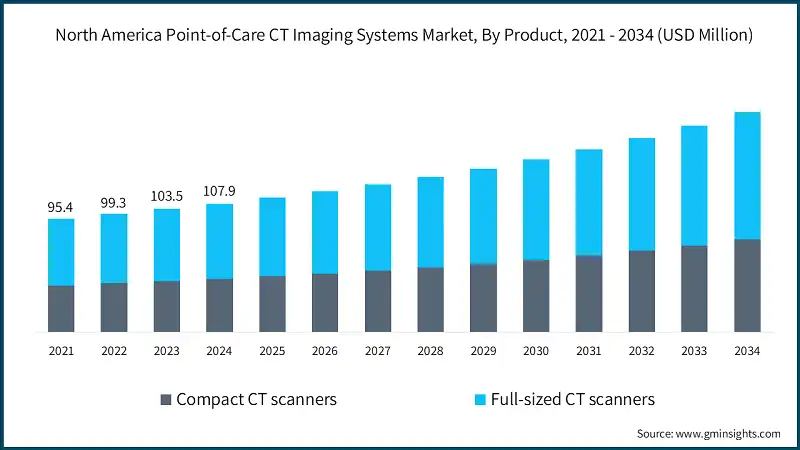
The market increased from USD 95.4 million in 2021 to USD 103.5 million in 2023. This expansion in North America can largely be traced to the increasing incidence of chronic diseases and growing awareness regarding early detection. Thus, the use of small and AI-powered point-of-care CT systems has gained momentum, facilitated by on-the-move screening programs and advancements in imaging technology. Furthermore, healthcare practices in North America are evolving toward patient-focused diagnostics, and thus, portable CT imaging has become an attractive option for evaluation, especially in outpatient centers and telemedicine environments. This solution enhances access and minimizes dependency on conventional hospital-based imaging assets.
The increased incidence of chronic diseases is one of the primary drivers for the growth of the North American point-of-care CT imaging systems market since timely diagnosis is highly important to enhance the prognosis. Chronic diseases such as heart disease, cancer, diabetes, and chronic respiratory diseases are the top causes of death and disability in Canada, and about 44% of adults have been diagnosed with these conditions and are responsible for 67% of total deaths, according to the Public Health Agency of Canada, as of 2024. These diseases also put an enormous strain on the healthcare system, which is leading to a greater focus on preventive health strategies. The national government has a crucial role to provide and finance national policies that focus on early diagnosis and minimize the effects of chronic diseases among Canadians.
Additionally, there has been a significant increase in the geriatric population base, which further drives demand for accessible and rapid diagnostic solutions. In the U.S., the number of individuals aged 65 and older is projected to grow from 58 million in 2022 to 82 million by 2050, a 47% increase. This age group’s share of the total population is expected to rise from 17% to 23%, reported in 2024. As older adults are more susceptible to chronic conditions and acute health events, the need for timely imaging becomes even more critical.
Point-of-care CT imaging systems are small and portable diagnostic platforms integrated into contemporary clinical workflows to provide immediate, near-patient computed tomography scans. These systems are intended for deployment in emergency departments, ICUs, outpatient clinics, and mobile screening units, facilitating prompt diagnosis of conditions such as stroke, trauma, and respiratory diseases. Equipped with advanced imaging software and increasingly powered by artificial intelligence, point-of-care CT machines provide high-resolution images and real-time insights, making them a critical component in decentralized and patient-directed care.
North America Point-of-Care CT Imaging Systems Market Trends
- The North American point-of-care CT imaging systems market is undergoing rapid evolution, driven by the region’s push toward decentralized, fast, and patient-accessible diagnostic solutions. With a strong healthcare infrastructure and high adoption of advanced technologies, the market is poised for significant growth.
- At the micro level, manufacturers are focusing on integrating AI-powered imaging software, real-time data processing, and seamless compatibility with hospital IT systems. For instance, NeuroLogica’s BodyTom has gained traction across North American hospitals for its full-body portable imaging capabilities, supporting trauma and surgical workflows with real-time diagnostics.
- Moreover, the rising emphasis on early diagnosis and intervention is further accelerating adoption, particularly in outpatient and emergency environments. These systems enable bedside detection of trauma, stroke, and respiratory conditions, allowing clinicians to act swiftly and reduce reliance on centralized imaging departments.
- Furthermore, the market is also seeing a shift toward user-friendly interfaces, compact designs, and compatibility with PACS and Electronic Health Records (EHR) (the market size of which was valued at USD 34 billion in 2023). These features support faster image review, automated alignment, and improved patient data management. Portable and self-contained CT systems are enabling flexible deployment across diverse clinical environments, including mobile screening units and rural health centers.
North America Point-of-Care CT Imaging Systems Market Analysis
Learn more about the key segments shaping this market
The market was valued at USD 95.4 million in 2021. The market size reached USD 103.5 million in 2023, from USD 99.3 million in 2022.
Based on the product, the market is segmented into compact CT scanners and full-sized CT scanners. The full-sized CT scanners segment led this market in 2024, accounting for the highest market share due to their superior imaging capabilities, which are critical for complex diagnostic needs in emergency departments and intensive care units. Full-sized systems offer higher resolution and broader anatomical coverage, making them indispensable in trauma cases, stroke management, and surgical planning.
This segment was valued at USD 63.3 million in 2024 and is projected to reach USD 106.1 million by 2034, growing at a CAGR of 5.4%. This growth is because these scanners are widely used in hospitals and emergency departments, where rapid and accurate imaging is essential for timely diagnosis and treatment decisions. In comparison, the compact CT scanners segment, valued at USD 44.5 million in 2024, is expected to grow to USD 76.9 million by 2034, with a slightly higher CAGR of 5.7%, supported by its clinical viability and suitability for smaller facilities.
- Full-sized CT scanners continue to dominate the point-of-care CT imaging systems market due to their advanced imaging capabilities, broad clinical applications, and integration with hospital workflows. These systems are particularly favored in emergency departments, operating rooms, and intensive care units where high-resolution, full-body imaging is critical for rapid diagnosis and treatment planning.
- One of the key drivers for this segment is the ability of full-sized systems to deliver comprehensive anatomical visualization with high spatial and temporal resolution. These scanners support a wide range of clinical procedures, from trauma and stroke assessment to cardiac and orthopedic imaging, making them indispensable in critical care workflows. Their seamless integration with PACS, EMR systems, and surgical navigation platforms further enhances operational efficiency and clinical decision-making.
- For instance, NeuroLogica’s BodyTom CT scanner is widely adopted across U.S. hospitals for its versatility and portability. The BodyTom transforms any standard room into a full-body imaging suite, supporting applications in trauma, neurosurgery, radiation oncology, and interventional radiology. With features such as internal lead shielding, battery-powered mobility, and compatibility with PACS and robotic navigation systems, it offers a robust solution for multi-departmental imaging needs.
- The North American market is also seeing increased investment in full-sized systems due to their ability to support multi-specialty imaging, reduce patient transfer times, and enhance care delivery in both urban and rural settings. As healthcare providers prioritize workflow optimization and real-time diagnostics, full-sized point-of-care CT scanners are expected to remain a cornerstone of innovation and clinical excellence in the region.
Based on the application, the North America point-of-care CT imaging systems market is segmented into neurology, respiratory, musculoskeletal, ENT, and other applications. The neurology segment accounted for the highest market share of 34.3% in 2024.
- This dominance is closely tied to the increasing burden of neurological disorders across the U.S. and Canada. According to a systematic analysis published in JAMA Neurology in 2020, the three most burdensome neurological conditions in the U.S. were stroke, Alzheimer’s disease and other dementias, and migraine. The study also highlighted a five-fold variation in neurological disease burden across U.S. states, underscoring the need for accessible and timely diagnostic tools.
- The rising prevalence of stroke, traumatic brain injuries, and neurodegenerative conditions, especially among aging populations, has intensified the demand for point-of-care CT systems that can deliver immediate, high-resolution imaging at the patient’s bedside. These systems are increasingly deployed in neurocritical care units, emergency departments, and mobile stroke units, where rapid assessment is crucial for clinical decision-making.
- Full-sized point-of-care CT scanners are particularly valuable in this context, offering detailed imaging of the brain and spine to detect hemorrhages, ischemic changes, and structural abnormalities. Their integration with surgical navigation platforms, PACS, and hospital IT systems enhances workflow efficiency and supports timely intervention in acute neurological emergencies.
- Conversely, the respiratory segment is expected to expand to the highest CAGR of 6%, driven by the increasing burden of respiratory illnesses. Conditions such as pneumonia, chronic obstructive pulmonary disease (COPD), and lung cancer are becoming more prevalent, placing significant pressure on healthcare systems to adopt faster and more accessible diagnostic tools.
Learn more about the key segments shaping this market
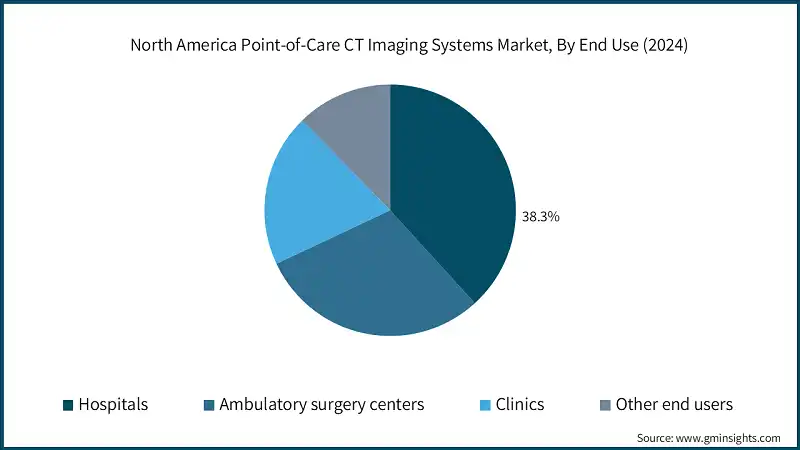
Based on end use, the North America point-of-care CT imaging systems market is segmented into hospitals,ambulatory surgery centers, clinics, and other end users. The ambulatory surgery centers (ASC) segment is expected to show a significant growth rate of about 6% through 2034.
- A key factor contributing to this growth is the rising prevalence of chronic conditions such as cancer, cardiovascular disease, and diabetes. According to the National Diabetes Statistics Report by the CDC, over 11.6% of the U.S. population is living with diabetes, underscoring the need for accessible diagnostic services in outpatient settings. ASCs are increasingly equipped with advanced imaging technologies, including compact point-of-care CT systems, to support early diagnosis and treatment planning for these conditions.
- The segment’s expansion is also supported by favorable reimbursement policies, specialized care delivery, and the growing preference for preventive checkups. Patients are opting for ASCs not only for surgical procedures but also for diagnostic imaging, especially in cases where rapid assessment is needed without hospital admission.
- Point-of-care CT systems in ASCs offer high-resolution imaging with compact designs that fit seamlessly into outpatient workflows. These systems enable quick triage and diagnosis for musculoskeletal injuries, ENT conditions, and neurological assessments, making them ideal for high-throughput environments. Their integration with PACS and EHR platforms ensures efficient data management and continuity of care across clinical settings.
- Additionally, the hospital segment accounted for 38.3% market share in 2024, primarily due to the widespread availability of advanced imaging infrastructure and the presence of skilled radiology professionals. Hospitals remain the central hubs for diagnosing and managing a wide range of conditions, including neurological, respiratory, and trauma-related cases, making them key adopters of point-of-care CT scanners.
Looking for region specific data?
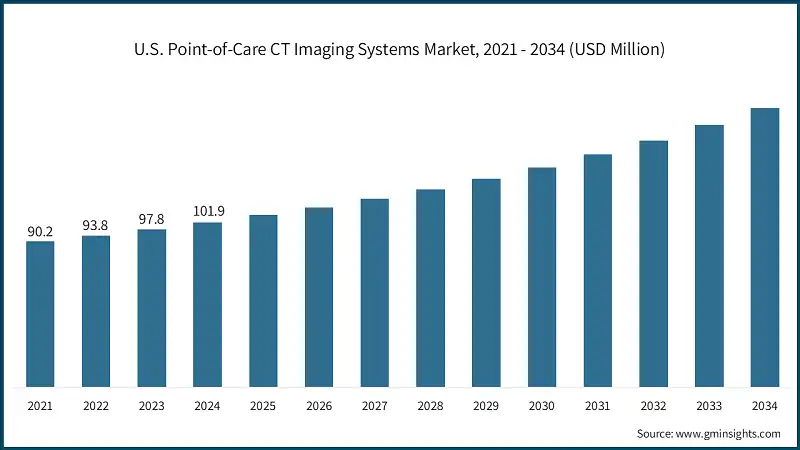
U.S. dominated the point-of-care CT imaging systems market with the highest market share in 2024. The region has advanced healthcare infrastructure, and the rate of adoption of innovative medical technologies is also high. Further, there is an increasing prevalence of chronic disorders in the region, thus propelling the growth of this market.
- The U.S. point-of-care CT imaging systems market was valued at USD 90.2 million and USD 93.8 million in 2021 and 2022, respectively. In 2024, the market size reached USD 101.9 million from USD 97.8 million in 2023.
- Substantial healthcare infrastructure and the high prevalence of chronic diseases in the U.S. remains a major driver of growth in the North American point-of-care CT imaging systems market. According to the Centers for Disease Control and Prevention (CDC), as of 2024, approximately 60% of Americans live with at least one chronic condition, such as heart disease, cancer, or diabetes, while 40% manage two or more. These chronic illnesses are not only the leading causes of mortality and disability but also contribute significantly to the nation’s healthcare spending, which has reached USD 4.9 trillion annually.
- In addition, the country continues to experience a steady increase in cancer incidence. Data from the Global Cancer Observatory indicates that in 2022, the United States accounted for 89.1% of all cancer cases in North America, underscoring the scale of its oncological burden.
- The U.S. market also benefits from a favorable environment for innovation, characterized by streamlined regulatory pathways, high public awareness, and strong investment in research and development. These factors collectively support the rapid adoption of advanced imaging technologies, including point-of-care CT systems, across a wide range of clinical settings.
Canada point-of-care CT imaging systems market accounted for USD 6 million in 2024 and is anticipated to show lucrative growth over the forecast period.
- Canada’s point-of-care CT imaging systems market is witnessing steady growth, supported by the country’s commitment to improving diagnostic access, rising chronic disease burden, and increasing investment in decentralized healthcare infrastructure. A key factor driving market expansion is the growing incidence of cancer and neurological disorders, particularly among aging populations.
- According to Canadian Cancer Statistics (2025), an estimated 44% of women and 45% of men in Canada will develop cancer during their lifetime. The number of new cancer cases continues to rise steadily as the population grows and ages, with risk increasing significantly in older age groups. To address this challenge, the Government of Canada actively supports initiatives through organizations such as the Canadian Partnership Against Cancer (CPAC), which promote early detection and equitable access to diagnostic services.
- Neurological conditions are also a growing concern. While dementia is typically associated with older adults, approximately 3% of Canadians living with dementia are under the age of 65, a condition known as young onset dementia. Because it is less common in younger individuals, it often goes undiagnosed, highlighting the need for accessible and timely neuroimaging solutions.
- Canada’s healthcare system also benefits from universal coverage, strong public health infrastructure, and a growing emphasis on preventive care and early diagnosis. These factors are accelerating the deployment of compact and full-sized point-of-care CT systems across diverse clinical environments, making Canada a key contributor to the overall growth of the North America point-of-care CT imaging systems industry.
North America Point-of-Care CT Imaging Systems Market Share
- The North American market is led by five key players, NeuroLogica, Siemens Healthineers, Xoran Technologies, CurveBeam, and Stryker, who collectively account for 61% of the total market share. These companies maintain their leadership through a strategic mix of technological innovation, AI integration, regulatory compliance, and strong partnerships with hospitals, outpatient centers, and diagnostic networks across the region.
- NeuroLogica, a subsidiary of Samsung, continues to lead with its BodyTom CT systems, which are widely adopted in neurology, trauma care, and critical care environments. Known for their full-body imaging capabilities and mobility, these systems integrate seamlessly with surgical navigation platforms, making them highly effective in emergencies and neurocritical settings.
- Siemens Healthineers, Xoran Technologies, CurveBeam, and Stryker have strengthened their positions by offering specialized imaging solutions tailored to various clinical applications, including orthopedic, ENT, and cardiovascular diagnostics. Their systems are designed to support decentralized care models, with compact formats and AI-enhanced features that improve diagnostic speed and accuracy.
- To expand market share, both established and emerging players are focusing on AI-driven automation, interoperability with PACS and EMR systems, and mobile deployment models that support flexible use across outpatient clinics, rural health centers, and mobile screening units.
North America Point-of-Care CT Imaging Systems Market Companies
Few of the prominent players operating in the North America point-of-care CT imaging systems industry include:
- Carestream Dental
- CurveBeam
- Epica International
- NeuroLogica
- Siemens Healthineers
- SOREDEX
- Stryker
- Xoran Technologies
- CurveBeam
CurveBeam is recognized for its compact, weight-bearing cone beam CT (CBCT) systems, which are widely used in orthopedic and podiatric practices across North America. These systems provide detailed 3D imaging of extremities such as knees, feet, and hands directly at the point-of-care. Designed for outpatient clinics, they are self-shielded and require minimal infrastructure, making them ideal for small practices and mobile diagnostic setups. CurveBeam’s emphasis on biomechanical imaging and low-dose scanning protocols supports precise diagnosis and treatment planning in musculoskeletal care.
- Stryker
Stryker offers point-of-care CT imaging solutions tailored for intraoperative and emergency use. Their systems are engineered to deliver high-resolution imaging of complex anatomical areas and integrate seamlessly with platforms such as Q Guidance for surgical navigation. With battery-powered mobility and dual-mode operation, these scanners are well-suited for deployment in operating rooms, trauma centers, and intensive care units throughout North America.
- Carestream Dental
Carestream Dental provides cone beam CT systems designed specifically for ENT and dental applications. These systems deliver high-quality imaging of sinus and cranial structures with reduced radiation exposure compared to traditional CT. Features such as automated positioning, smart scanning technology, and ergonomic design enhance both diagnostic accuracy and patient comfort. Their compatibility with image-guided surgical tools and suitability for outpatient environments make them an asset for specialty clinics across the region.
North America Point-of-Care CT Imaging Systems Industry News:
- In January 2024, Varian, a Siemens Healthineers company, and Nova Scotia Health launched a 10-year, USD 175 million CAD multi-disciplinary oncology partnership aimed at transforming cancer care across Nova Scotia. The initiative includes the deployment of Varian’s advanced software suite to unify oncology patient data. This collaboration is expected to accelerate the patient journey from screening to survivorship, enhance treatment precision through AI-powered technologies, and foster economic growth and innovation in the region.
- In September 2022, CurveBeam and StraxCorp entered into a definitive merger agreement to form CurveBeam AI, a new entity focused on advancing orthopedic imaging through artificial intelligence. The merger combines CurveBeam’s expertise in weight-bearing CT imaging with StraxCorp’s AI-driven bone health analytics. CurveBeam AI expands CurveBeam’s financially viable point-of-care imaging solutions into the bone health space and also springboards AI-driven applications for weight-bearing CT (WBCT) imaging. This strategic move is expected to accelerate innovation in musculoskeletal diagnostics and broaden access to precision imaging technologies in clinical and research environments.
The North America point-of-care CT imaging systems market research report includes an in-depth coverage of the industry with estimates and forecast in terms of revenue in USD Million and from 2021 – 2034 for the following segments:
Market, By Product
- Compact CT scanners
- Full-sized CT scanners
Market, By Application
- Neurology
- Respiratory
- Musculoskeletal
- ENT
- Other applications
Market, By End Use
- Hospitals
- Ambulatory surgery centers
- Clinics
- Other end use
The above information is provided for the following countries:
- U.S.
- Canada
Frequently Asked Question(FAQ) :
What are the upcoming trends in the North America point-of-care CT imaging systems market?
Trends include the integration of AI-driven imaging software, real-time diagnostics, seamless compatibility with hospital IT systems, and the growing adoption of portable full-body imaging solutions like NeuroLogica’s BodyTom.
Who are the key players in the North America point-of-care CT imaging systems market?
Key players include Carestream Dental, CurveBeam, Epica International, NeuroLogica, Siemens Healthineers, SOREDEX, Stryker, and Xoran Technologies.
What was the valuation of the Canada point-of-care CT imaging systems market in 2024?
The Canada market was valued at USD 6 million in 2024 and is anticipated to experience lucrative growth over the forecast period.
What is the growth outlook for the ambulatory surgery centers (ASC) segment through 2034?
The ASC segment is expected to grow at a significant rate of approximately 6% through 2034, supported by the increasing adoption of portable imaging systems in outpatient settings.
What was the market share of the neurology segment in 2024?
The neurology segment accounted for the highest market share of 34.3% in 2024, driven by its critical role in diagnosing neurological conditions.
What is the projected value of the North America point-of-care CT imaging systems market by 2034?
The market is projected to reach USD 183 million by 2034, fueled by the integration of AI-powered imaging software and real-time data processing capabilities.
What was the market size of the North America point-of-care CT imaging systems in 2024?
The market size was USD 107.9 million in 2024, with a CAGR of 5.5% expected through 2034. The growth is driven by advancements in decentralized diagnostic solutions and the adoption of advanced technologies.
North America Point-of-Care CT Imaging Systems Market Scope
Related Reports