Summary
Table of Content

North America Percutaneous Nephrolithotomy Market
Get a free sample of this report
Form submitted successfully!
Error submitting form. Please try again.
Thank you!
Your inquiry has been received. Our team will reach out to you with the required details via email. To ensure that you don't miss their response, kindly remember to check your spam folder as well!
Request Sectional Data
Thank you!
Your inquiry has been received. Our team will reach out to you with the required details via email. To ensure that you don't miss their response, kindly remember to check your spam folder as well!
Form submitted successfully!
Error submitting form. Please try again.
North America Percutaneous Nephrolithotomy Market Size
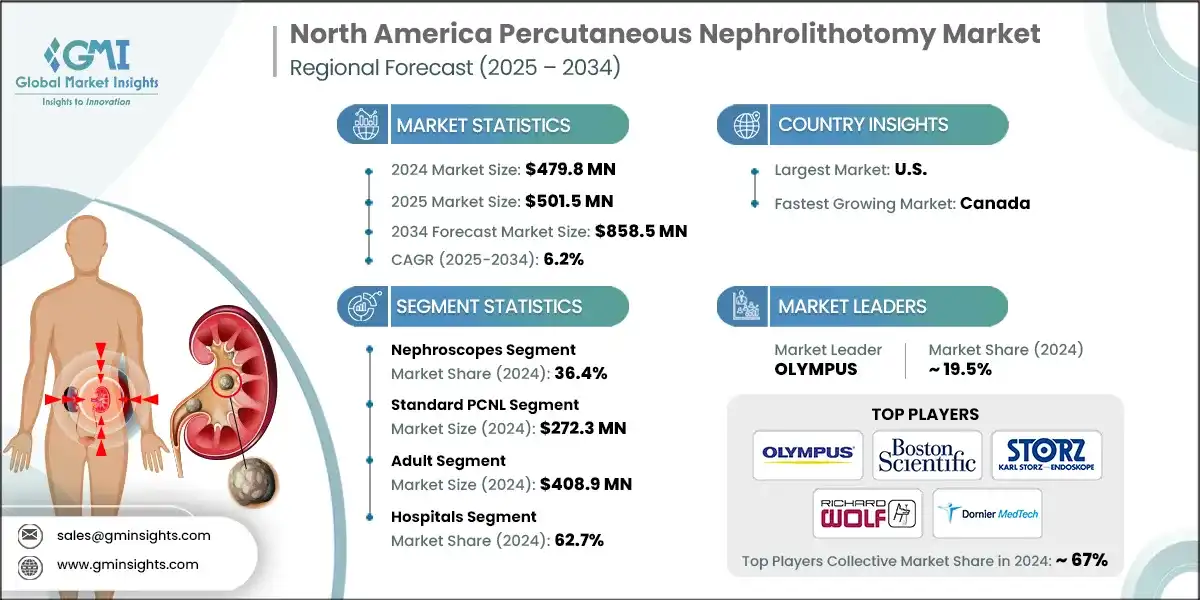
The North America percutaneous nephrolithotomy market was valued at USD 479.8 million in 2024. The market is expected to reach from USD 501.5 million in 2025 to USD 858.5 million in 2034, growing at a CAGR of 6.2% during the forecast period, according to the latest report published by Global Market Insights Inc. The high market growth is attributed to the ongoing advancements in minimally invasive urology, strong healthcare infrastructure, rising prevalence of kidney stones, and favourable reimbursement policies, among other contributing factors.
To get key market trends
Percutaneous nephrolithotomy (PCNL) is a minimally invasive surgical operation that helps in the removal of large or complicated kidney stones which are not amenable to extracorporeal shockwave lithotripsy or ureteroscopy. The method comprises making a small cut in the patient’s back to obtain direct access to the kidney with a nephroscope. In this way, any part can be broken down and removed with a very high success rate and the least possible damage to the tissue and a short recovery time.
The leading players in the percutaneous nephrolithotomy market are OLYMPUS, Boston Scientific, KARL STORZ, Richard Wolf, and Dornier MedTech. These firms maintain their competitive advantage through constant product innovation, regional market presence, and considerable investments in research and development.
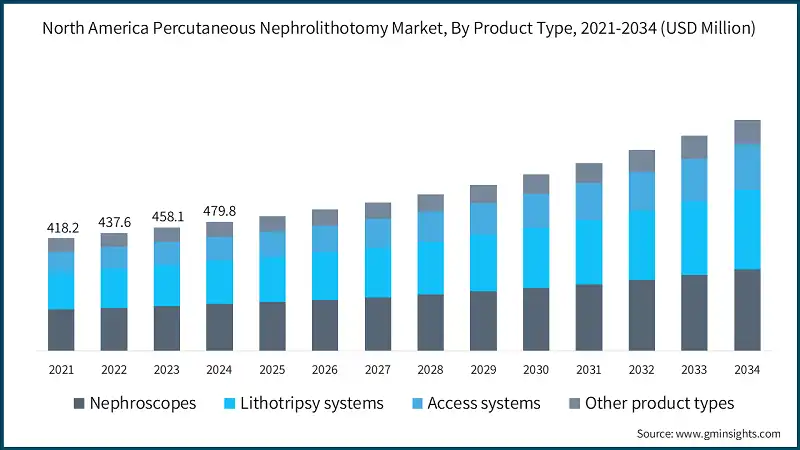
The market has increased from USD 418.2 million in 2021 and reached USD 458.1 million in 2023, with the historic growth rate of 4.7%. The market growth was driven by increasing procedural volume in high-acuity hospitals, rising burden of recurrent nephrolithiasis cases, growing surgeon preference for PCNL in complex and large renal stones, and advancements in imaging guidance and perioperative management.
Moreover, the growing incidence of nephrolithiasis in the U.S. and Canada is a major driver of PCNL demand. Lifestyle factors such as high sodium intake, obesity, diabetes, and dehydration contribute significantly to stone formation. According to urology associations, nearly 1 in 10 Americans will develop kidney stones during their lifetime. This rising burden boosts surgical interventions like PCNL, especially for large and complex stones.
Furthermore, technological innovation in urological surgery, including mini-PCNL, ultra-mini PCNL, and micro-PCNL, has improved stone removal efficiency with less tissue trauma. Enhanced visualization tools, image-guided systems, and advanced nephroscopes support precise stone fragmentation. These improvements reduce complications, shorten recovery time, and drive adoption across hospitals and ambulatory surgical centers.
North America Percutaneous Nephrolithotomy Market Report Attributes
| Key Takeaway | Details |
|---|---|
| Market Size & Growth | |
| Base Year | 2024 |
| Market Size in 2024 | USD 479.8 Million |
| Market Size in 2025 | USD 501.5 Million |
| Forecast Period 2025 - 2034 CAGR | 6.2% |
| Market Size in 2034 | USD 858.5 Million |
| Key Market Trends | |
| Drivers | Impact |
| Technological advancements in PCNL instruments | The introduction of mini-PCNL systems, advanced laser lithotripsy, and disposable nephroscopes has improved surgical precision and reduced complication rates, driving higher adoption of PCNL procedures across hospitals and ASCs in North America. |
| Rising healthcare expenditure and hospital investments | Increased funding for urological infrastructure, operating room upgrades, and procurement of advanced PCNL equipment is supporting procedural growth and expanding the treatment capacity of high-volume medical centers. |
| Increasing prevalence of kidney stone disease | Growing incidence due to lifestyle factors such as obesity, dehydration, and dietary habits has resulted in a higher number of symptomatic stone cases requiring surgical intervention, boosting the demand for PCNL procedures. |
| Growing number of trained endourologists and centers of excellence | Expansion of urology specialization programs and training initiatives has improved procedural accessibility, with more facilities offering complex stone management using PCNL. |
| Pitfalls & Challenges | Impact |
| Shortage of skilled surgeons in some regions | Despite overall growth, rural and underserved areas in the U.S. and Canada face a lack of trained urologists capable of performing PCNL, which limits market penetration and restricts procedure volumes. |
| Stringent regulatory and quality compliance requirements | FDA and Health Canada compliance adds delays to product approvals and increases manufacturing costs, slowing the entry of innovative PCNL devices and restraining smaller players from expanding. |
| Opportunities: | Impact |
| Market penetration in underserved U.S. and Canadian regions | Expanding PCNL services into rural hospitals and secondary care centers will unlock new patient pools, significantly increasing procedure volumes and revenue opportunities for device manufacturers in the coming years. |
| Expansion into ambulatory surgical centers and outpatient settings | The shift toward cost-efficient healthcare delivery and minimally invasive PCNL techniques will enable higher adoption in ASCs, driving faster procedural turnaround and boosting overall market growth in North America. |
| Market Leaders (2024) | |
| Market Leaders |
~ 19.5% market share |
| Top Players |
Collective market share in 2024 is ~ 67% |
| Competitive Edge |
|
| Regional Insights | |
| Largest Market | U.S. |
| Fastest growing market | Canada |
| Future outlook |
|
What are the growth opportunities in this market?
North America Percutaneous Nephrolithotomy Market Trends
The North America percutaneous nephrolithotomy industry is growing considerably with the shift towards miniaturized PCNL techniques, integration of digital and 3D imaging in PCNL, rise in ambulatory surgical centers performing PCNL, and increasing use of laser lithotripsy devices, among other factors collectively driving industry growth.
- A major trend is the increasing adoption of mini-PCNL, ultra-mini PCNL, and micro-PCNL techniques due to lower bleeding risk and reduced postoperative pain. These techniques use smaller tract sizes and are preferred in paediatric and obese patients. This trend is reshaping procedural standards across urology centers in the U.S. and Canada.
- PCNL procedures are increasingly using 3D imaging, augmented fluoroscopy, and intraoperative ultrasound for improved surgical navigation. These technologies enhance precision during percutaneous renal access and reduce complications. Image-guided PCNL is becoming standard in high-volume hospitals across North America.
- Further, there is a growing shift of PCNL procedures from hospitals to ambulatory surgical centers (ASCs) due to cost efficiency and faster patient turnover. Advancements in anesthesia and instrument design have shortened recovery times, enabling same-day discharge for PCNL patients. This trend also benefits device manufacturers targeting mid-sized urology centers, thereby sustaining market growth.
North America Percutaneous Nephrolithotomy Market Analysis
Learn more about the key segments shaping this market
The market was valued at USD 418.2 million in 2021. The market size reached USD 458.1 million in 2023, from USD 437.6 million in 2022.
Based on the product type, the North America percutaneous nephrolithotomy market is segmented into nephroscopes, lithotripsy systems, access systems, and other product types. The nephroscopes segment has asserted its dominance in the market by securing a significant market share of 36.4% in 2024 owing to the growing adoption of high-definition and digital flexible nephroscopes that enhance procedural accuracy, reduce operative time, and improve clinical outcomes in complex kidney stone surgeries. The segment is expected to exceed USD 302.5 million by 2034, growing at a CAGR of 5.8% during the forecast period.
On the other hand, the access systems segment is expected to grow with a CAGR of 6.7%. The growth of this segment is driven by advancements in balloon and telescopic dilators, hydrophilic guidewires, and safety access sheaths that reduce procedure time and minimize tissue trauma.
- The nephroscopes segment continues to dominate the market. The growing prevalence of renal calculi, particularly large and complex stones, is increasing the number of PCNL procedures in the U.S. and Canada. Nephroscopes are essential visualization tools in these surgeries, making them a critical component of the procedure workflow. As hospital surgical volumes rise, demand for advanced nephroscopes increases proportionally.
- In addition, manufacturers are introducing high-definition nephroscopes, fibre-optic scopes, and digital video nephroscopes with superior image clarity and durability. Innovations like narrower shafts, enhanced irrigation systems, and modular designs improve maneuverability inside the kidney. These performance improvements drive adoption in both adult and pediatric urology.
- The lithotripsy systems segment held a revenue of USD 160.1 million in 2024, with projections indicating a steady expansion at 6.5% CAGR from 2025 to 2034. The segmental growth is driven by the rising prevalence of complex renal calculi requiring fragmentation during minimally invasive procedures, along with technological advancements such as high-power laser lithotripsy and mobile C-arm integration that enhance stone clearance efficiency.
- The access systems segment accounted for significant revenue in 2024, with projections indicating a steady expansion at 6.7% CAGR from 2025 to 2034. The segment is driven by the increasing adoption of image-guided percutaneous entry techniques supported by advanced fluoroscopy and ultrasound navigation, along with growing use of disposable access kits and hydrophilic guidewires that improve procedural safety and reduce cross-contamination risks.
Based on procedure type, the North America percutaneous nephrolithotomy market is segmented into standard PCNL, mini-PCNL, and micro-PCNL. The standard PCNL segment dominated the market in 2024, accounting for USD 272.3 million and is anticipated to grow at a CAGR of 6.1% during the forecast period.
- Standard PCNL is preferred in patients with anatomical abnormalities such as horseshoe kidney, calyceal diverticulum, or ureteropelvic junction obstruction. These complex conditions are challenging for flexible ureteroscopes and SWL, reinforcing the clinical dependence on standard tract size PCNL procedures.
- Standard PCNL is supported by well-equipped operating rooms in both large hospitals and regional surgical centers. Established supply chains for dilators, sheaths, nephroscopes, and access kits support procedural continuity. Proven clinical workflows and availability of surgical teams ensure widespread procedural readiness.
- The mini-PCNL segment accounted for significant revenue in 2024 and is anticipated to grow at a CAGR of 6.5% over the forecast period. The growth of the segment is driven by rising preference for minimally invasive stone removal with reduced bleeding and shorter hospital stays, supported by increasing adoption of miniaturized endoscopic instruments for high-risk and pediatric patients.
- The micro-PCNL segment held a revenue of USD 57.1 million in 2024, with projections indicating a steady expansion at 5.5% CAGR from 2025 to 2034. The segment is driven by its expanding use in patients with small renal calculi and anatomically challenging cases, supported by ultra-miniaturized access tracts that minimize renal trauma and postoperative complications.
Based on patient, the North America percutaneous nephrolithotomy market is segmented into adult and pediatric. The adult segment dominated the market in 2024, accounting for USD 408.9 million and is anticipated to grow at a CAGR of 6% during the forecast period.
- The adult working population prefers PCNL due to faster recovery times and shorter hospital stays compared to open surgery. Modern anaesthesia techniques and enhanced post-operative care improve procedure safety in adults. This preference supports continued adoption in hospitals and ambulatory surgical centers.
- Public and private insurers in the region are willing to reimburse most readily for adult PCNL procedures, as they are considered a medical necessity in complex stone disease. As a result, adults are frequently treated with PCNL as the first step for a high stone burden, thus making reimbursement more straightforward. This improves hospital procedural volume and device utilization.
- The pediatric segment accounted for significant revenue in 2024 and is anticipated to grow at a CAGR of 7.2% over the forecast period. The growth of the segment is driven by the rising incidence of pediatric urolithiasis linked to metabolic disorders and dietary shifts, along with increasing availability of child-specific endourology instruments and specialized pediatric urology centers.
Learn more about the key segments shaping this market
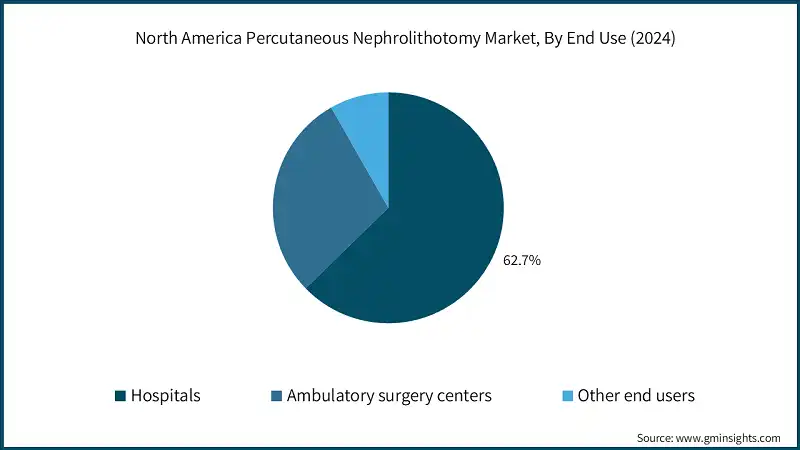
Based on end use, the North America percutaneous nephrolithotomy market is classified into hospitals, ambulatory surgical centers, and other end users. The hospitals segment dominated the market with a revenue share of 62.7% in 2024 and is expected to reach USD 533 million within the forecast period.
- Hospitals are the primary treatment centers for patients with large or complicated kidney stones requiring PCNL. They handle emergency admissions for obstructive uropathy, renal infections, and recurrent stone disease. This steady patient flow drives a higher volume of PCNL procedures in hospital settings.
- Moreover, hospitals in the U.S. and Canada have well-equipped operating rooms, fluoroscopy units, ultrasound guidance systems, and powerful lithotripters. This makes them more capable of performing PCNL than small clinics. Their access to multidisciplinary support enhances procedure safety and efficiency.
- The ambulatory surgical centers segment accounted for significant revenue in 2024 and is anticipated to grow at a CAGR of 6.7% over the forecast period. The segment is driven by increasing patient preference for faster recovery and shorter waiting times, along with expanding investments by private healthcare providers in urology-focused ASCs equipped with advanced imaging and endourology suites.
Looking for region specific data?
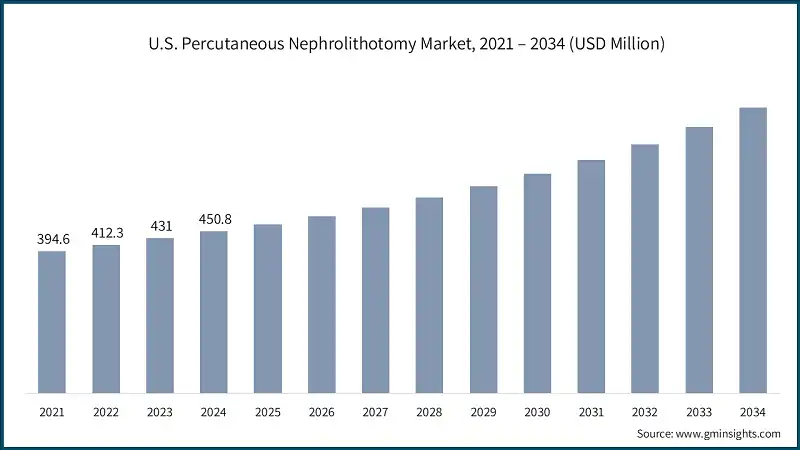
U.S. Percutaneous Nephrolithotomy Market The U.S. percutaneous nephrolithotomy market was valued at USD 394.6 million and USD 412.3 million in 2021 and 2022, respectively. The market size reached USD 450.8 million in 2024, growing from USD 431 million in 2023, and is anticipated to grow at a CAGR of 6% between 2025 to 2034. The Canada percutaneous nephrolithotomy market is anticipated to grow at the highest CAGR of 8.3% during the analysis timeframe. The North America percutaneous nephrolithotomy industry is moderately competitive, characterized by strong product portfolios, continuous R&D investments, and expanding clinical partnerships with urology centers. Key players include OLYMPUS, Boston Scientific, KARL STORZ, Richard Wolf, and Dornier MedTech, collectively accounting for ~67% of the total market share. These companies dominate through broad offerings in nephroscopes, lithotripsy systems, dilators, and access kits. Strategic initiatives such as product launches in mini and micro PCNL systems, advancements in laser lithotripsy, and surgeon training programs strengthen their competitive position. Meanwhile, emerging players and regional manufacturers compete through cost-effective devices and distribution partnerships, especially in niche and outpatient settings. A few of the prominent players operating in the North America percutaneous nephrolithotomy industry include: Olympus differentiates itself with a comprehensive endourology portfolio, including advanced rigid and flexible nephroscopes that deliver superior visualization and ergonomic handling. Its strong clinical training programs and partnerships with top urology centers in the U.S. enhance procedural adoption and brand loyalty. KARL STORZ is known for precision-engineered nephroscopes and modular PCNL systems that offer durability and compatibility with a wide range of accessories. Its innovations in miniaturized instrumentation for Mini-PCNL and Micro-PCNL support minimally invasive surgical advancements across the region. Boston Scientific stands out with cutting-edge laser lithotripsy systems such as the LithoVue and Holmium laser solutions that significantly improve stone fragmentation efficiency. Its strong distribution network and hospital procurement relationships ensure deep market penetration across U.S. surgical centers and ASCs.Canada Percutaneous Nephrolithotomy Market
North America Percutaneous Nephrolithotomy Market Share
North America Percutaneous Nephrolithotomy Market Companies
North America Percutaneous Nephrolithotomy Industry News
The North America percutaneous nephrolithotomy market research report includes an in-depth coverage of the industry with estimates and forecast in terms of revenue in USD Million from 2021 – 2034 for the following segments:
Market, By Product Type
- Nephroscopes
- Rigid
- Flexible
- Lithotripsy systems
- Access systems
- Other product types
Market, By Procedure Type
- Standard PCNL
- Mini-PCNL
- Micro-PCNL
Market, By Patient
- Adult
- Pediatric
Market, By End Use
- Hospitals
- Ambulatory surgery centers
- Other end use
The above information is provided for the following countries:
- U.S.
- Canada
Frequently Asked Question(FAQ) :
What is the current North America percutaneous nephrolithotomy market size in 2025?
The market size is projected to reach USD 501.5 million in 2025.
Who are the key players in the North America percutaneous nephrolithotomy market?
Key players include OLYMPUS, Boston Scientific, KARL STORZ, Richard Wolf, Dornier MedTech, Teleflex, B. Braun, Cook Medical, EMS Electro Medical Systems, and Becton, Dickinson and Company.
What are the upcoming trends in the North America percutaneous nephrolithotomy industry?
Key trends include the increasing use of mini-PCNL and micro-PCNL techniques, 3D and image-guided surgical navigation, and a growing shift toward ambulatory surgical centers (ASCs) for cost-efficient and faster recovery procedures.
What is the growth outlook for access systems from 2025 to 2034?
The access systems segment is projected to grow at a 6.7% CAGR through 2034.
Which region leads the North America percutaneous nephrolithotomy market?
The U.S. led the market with USD 450.8 million in 2024, accounting for the majority share. Growth is fueled by high kidney stone recurrence rates, early AI adoption in surgical navigation, and robust presence of medical device manufacturers.
What was the valuation of the lithotripsy systems segment in 2024?
The lithotripsy systems segment held USD 160.1 million in 2024, supported by demand for laser-based stone fragmentation and integration of mobile C-arm imaging systems enhancing surgical accuracy.
What is the projected value of the North America percutaneous nephrolithotomy market by 2034?
The market is expected to reach USD 858.5 million by 2034, supported by the growing adoption of miniaturized PCNL systems, AI-enabled imaging, and increasing healthcare expenditure in the U.S. and Canada.
How much revenue did the nephroscopes segment generate in 2024?
The nephroscopes segment accounting for 36.4% share of the market, driven by widespread adoption of high-definition and digital flexible nephroscopes for precision stone management.
What is the market size of the North America percutaneous nephrolithotomy industry in 2024?
The market size was USD 479.8 million in 2024, with a CAGR of 6.2% expected through 2034 driven by technological advancements in minimally invasive urology and the rising prevalence of kidney stone disease.
North America Percutaneous Nephrolithotomy Market Scope
Related Reports