Summary
Table of Content

North America Passenger Electric Vehicle Market
Get a free sample of this report
Form submitted successfully!
Error submitting form. Please try again.
Thank you!
Your inquiry has been received. Our team will reach out to you with the required details via email. To ensure that you don't miss their response, kindly remember to check your spam folder as well!
Request Sectional Data
Thank you!
Your inquiry has been received. Our team will reach out to you with the required details via email. To ensure that you don't miss their response, kindly remember to check your spam folder as well!
Form submitted successfully!
Error submitting form. Please try again.
North America Passenger Electric Vehicle Market Size
North America passenger electric vehicle market was estimated at USD 108.3 billion in 2025. The market is expected to grow from USD 116.1 billion in 2026 to USD 263.7 billion in 2035, at a CAGR of 9.5% according to latest report published by Global Market Insights Inc.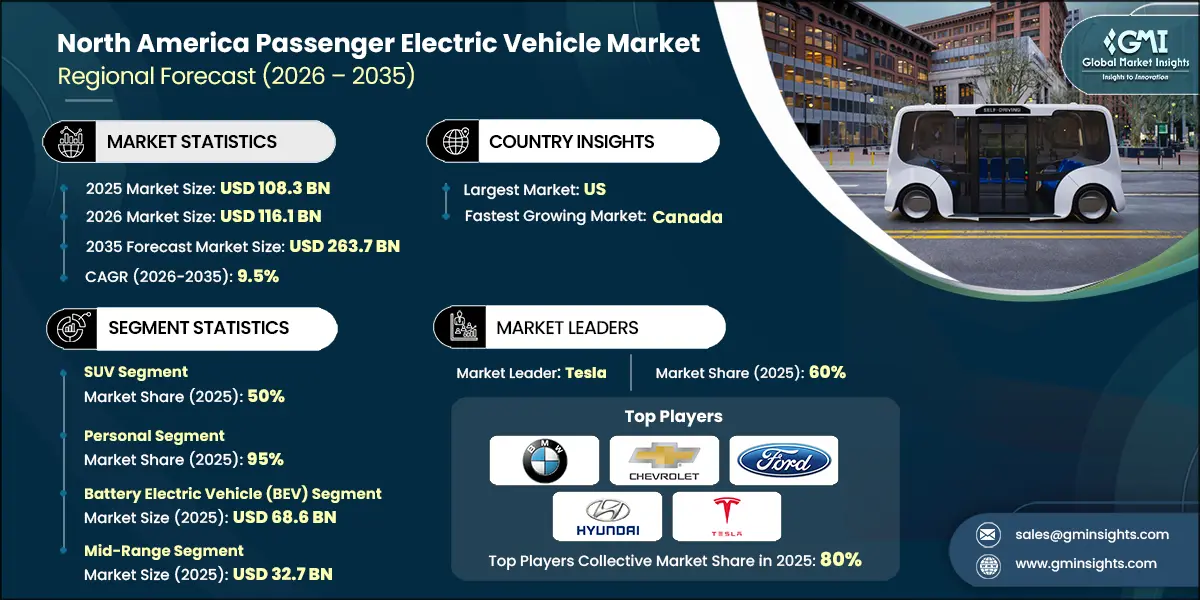
North America Passenger Electric Vehicle Market Key Takeaways
Market Size & Growth
- 2025 Market Size: USD 108.3 Billion
- 2026 Market Size: USD 116.1 Billion
- 2035 Forecast Market Size: USD 263.7 Billion
- CAGR (2026–2035): 9.5%
Regional Dominance
- Largest Market: US
- Fastest Growing Country: Canada
Key Market Drivers
- Strict emission regulations enforcement.
- Growing consumer preference for sustainable mobility.
- Expansion of EV model availability.
- Urban air quality improvement initiatives.
Challenges
- High vehicle costs and battery supply constraints.
- Consumer range anxiety.
Opportunity
- High-power fast charging deployment.
- Battery cost reductions and technological advances.
Key Players
- Market Leader: Tesla led with over 60% market share in 2025.
- Leading Players: Top 5 players in this market include BMW, Chevrolet, Ford Motor, Hyundai, Tesla, which collectively held a market share of 80% in 2025.
Get Market Insights & Growth Opportunities
To get key market trends
The Electric Vehicle (EV) market within the U.S. consists of all types of vehicles that use both electric and partially electric sources, such as battery electric vehicles and plug-in hybrid electric vehicle, along with the infrastructure that supports them, such as charging stations, battery production, and software integration. SUVs and crossovers dominate the EV marketplace, but the EV marketplace will experience long term growth due to the growing prevalence of charging networks, including Tesla's Supercharger Network becoming available to everyone.
Electric Vehicles (EVs) generate the least amount of pollution compared to all other forms of transportation because they do not contribute to the emission of hazardous greenhouse gas emissions of nitrogen oxides (NOx) that are harmful to human health and the natural environment. EVs are also quiet and easier to use than conventional vehicles. For instance, as reported by UNICEF, according to the International Panel on Climate Change (IPCC), atmospheric CO2 levels must decrease by 45% by 2030 to avoid global temperatures rising above 1.5oC and/or prevent the occurrence of the worst impacts of climate changes.
The COVID-19 pandemic of 2020 hit the U.S. automobile industry hard; overall, passenger vehicle sales dropped by about 23-24% as lockdowns across the country and economic disruptions reduced demand for cars and stopped dealerships from being able to sell them. However, electric vehicles (EVs) fared much better than the rest of the market. While the overall market declined, registrations of electric vehicles dropped less than registrations for all types of passenger vehicles and increased their share of total light vehicle sales from about 2% in 2020.
According to the International Council on Clean Transportation, the EV market in the United States continues to grow rapidly. The number of EVs sold in the United States reached 1.56 million units in 2024 or 10% of light-duty vehicle sales. This growth has come from greater awareness on the part of consumers, greater availability of different model types at different price points and continued federal and state incentives for purchasing EVs. In the United States, electric vehicles are becoming an increasingly important part of the total automotive marketplace.
In Canada, the adoption of electric vehicles also grew significantly, with plug-in hybrid electric vehicles (PHEVs) and battery electric vehicles (BEVs) together making up 15% of new registrations for all types of motor vehicles in 2024, according to the Canada Energy Regulator. The growth of the EV market in Canada can be attributed to supportive government policy, increased charging infrastructure, and strong consumer interest.
North America Passenger Electric Vehicle Market Trends
In the United States, the recent policy changes have dramatically impacted electric vehicle, or EV, demand. The ending of the federal EV tax credit at the end of 2024 led to a reported 0.4% decrease in electric vehicle registrations in 2025, even though overall new vehicle registration numbers continued to rise. This indicates just how dependent consumer adoption of electric vehicles still is on purchase incentives and supportive policy frameworks.
In Canada, the recent change in government strategy illustrates how significant policy reversals can affect market dynamics. In early February 2026, the federal government canceled its national EV sales mandate that required 20% of light-duty vehicle sales to be zero-emission vehicles in 2026. Instead, the federal government put in place a set of broader emissions standards with long-term targets of achieving EV sales of 75% by 2035 and 90% by 2040.
In the United States, automakers have responded to EV demand and pressure from competitors by committing to invest significantly in electric vehicle(s). Ford's announcement in mid-2025 of a nearly $2 billion remake of its Louisville assembly plant, located in Kentucky, to manufacture a new midsize electric pickup truck and other electric vehicles, shows how Ford is shifting its production and product line toward electric vehicles.
Similarly, in Canada, automotive manufacturers have begun to respond to a changing market. According to the EV Sales Leader of General Motors Canada, GM Canada had over 21.2% of the national EV market in January 2026 and is in a leadership position. Non‑Tesla brands collectively grew their EV volumes by approximately 20% in 2024, narrowing the gap with the traditional market leader and signifying a diversification of consumer options.
North America Passenger Electric Vehicle Market Analysis
Learn more about the key segments shaping this market
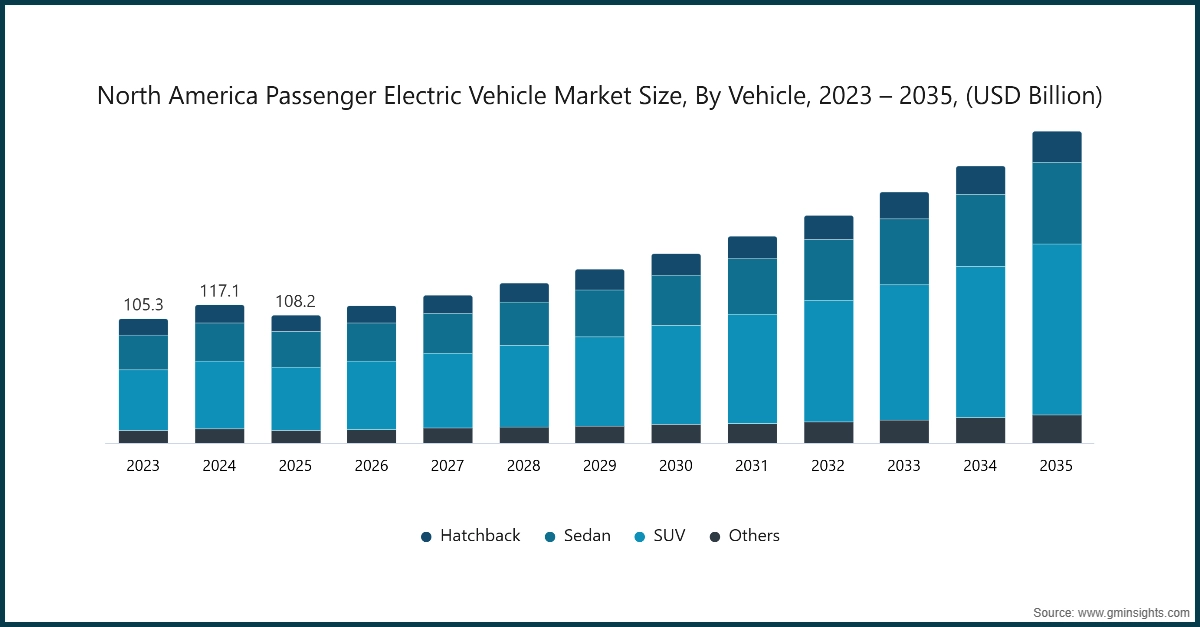
Based on vehicle, the North America passenger electric vehicle market is divided into hatchback, sedan, SUV, and others. SUV segment dominated the market accounting by 50% in 2025 and is expected to grow at a CAGR of 10.7% from 2026 to 2035.
- The SUV sector is the largest growing category in the North American EV market. Consumers have been shifting towards larger, more versatile electric vehicles, as has been the case with Honda's new Prologue, a mid-size electric SUV that Honda developed with General Motors (GM), which just began producing and shipping to customers in the United States starting in January 2024. This is also the first electric SUV for Honda in North America. Similarly, GM is continuing to grow its electric SUV portfolio with the Cadillac Escalade IQ, a full-size luxury electric SUV that will debut in the 2025 model year and utilizes GM's Ultium platform. This is an example of how traditional SUV nameplates have begun the process of being electrified to meet evolving customer demand.
- Electric sedan sales in North America are in transition with record breaking sales in 2024 and the beginning of 2025, with increased volatility and a temporary slowing down of sales in late 2025 due to the expiration of Federal tax credits. The SUV segment currently dominates the North American EV market, however there is still strong demand for electric sedans, which remain a significant segment in terms of sales volume led primarily by Tesla with increasing competition from both European luxury automakers and legacy manufacturers in the United States.
Learn more about the key segments shaping this market
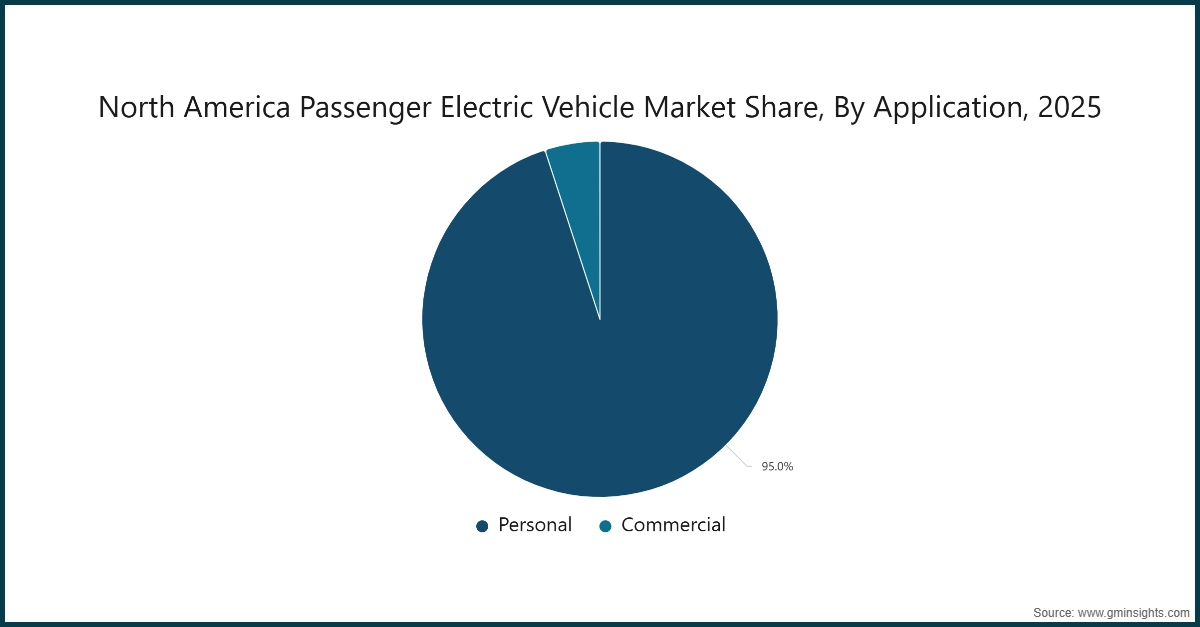
Based on the application, the North America passenger electric vehicle market is divided into personal and commercial. Personal segment dominated the market with 95% share in 2025, and the segment is expected to grow at a CAGR of 9.2% between 2026 to 2035.
- The personal electric vehicle (EV) segment in North America has continued to expand in recent years, thanks to growing consumer interest and the availability of a wider range of EV models. The federal government also provides consumers with financial incentives to purchase EVs, such as the Federal Tax Credit for EVs, which also affects the affordability of purchasing an EV.
- The commercial EV segment has also been experiencing significant growth, primarily due to the ongoing electrification of fleets and a move toward greater sustainability in the corporate sector. For instance, in September 2025, over 1,000 electric delivery vans manufactured by Rivian were delivered to Amazon for use in multiple U.S. cities. This represents the beginning of large-scale corporate investment in commercially based, zero-emission fleets.
Based on propulsion, the North America passenger electric vehicle market is divided into Battery Electric Vehicle (BEV), Fuel Cell Electric Vehicle (FCEV), and Plug-in Hybrid Electric Vehicle (PHEV). Battery Electric Vehicle (BEV) dominate the market and were valued at USD 68.6 billion in 2025.
- Battery electric vehicles (BEV) make up most of the North American EV market and have experienced rapid expansion due to the increased number of models available for purchase, as well as the increasing amount of infrastructure support available. Additionally, traditional automotive manufacturers have begun launching more BEVs, such as the F-150 Lightning Pro, which launched in June 2022 and has become one of North America’s leading electric pickup trucks, largely due to demand from both commercial fleets as well as individual consumers.
- FCEVs remain niche in North America, focused on regions with hydrogen infrastructure and early-adopter fleets. For instance, Toyota Mirai XLE continued to target limited urban markets with hydrogen refueling stations, illustrating the slow but strategic adoption of hydrogen technology. Similarly, PHEVs act as a bridge for consumers hesitant to go full BEV, offering flexibility and partial electrification. BMW 330e sedan offers electric-only capability for daily commutes while retaining an ICE backup for longer trips, maintaining appeal in urban North American markets.
Based on price, the North America passenger electric vehicle market is divided into Entry, Mid-Range and Luxury. Mid-Range EV dominate the market and were valued at USD 32.7 billion in 2025.
- Mid-Range EV segment continues to expand as manufacturers elect to electrify their mid-range vehicle lines and target mid-income buyers who are looking for performance, comfort and exclusivity. A great example of a mid-range EV is the Cadillac Lyriq, which is an all-electric SUV that offers advanced features and futuristic styling. This vehicle will also be used by GM to capture some of the early mid-margin EV customer segments within the luxury automotive market.
- Entry-level EVs are fuelling mass-market development as manufacturers develop and sell to this price-sensitive market segment in order to expand the number of entry-level models. A good example is the Chevrolet Bolt EV, which offers potential customers a driving range. Similarly, Luxury EVs continue to grow as automakers electrify high-end models, catering to affluent buyers seeking performance, comfort, and exclusivity.
Looking for region specific data?
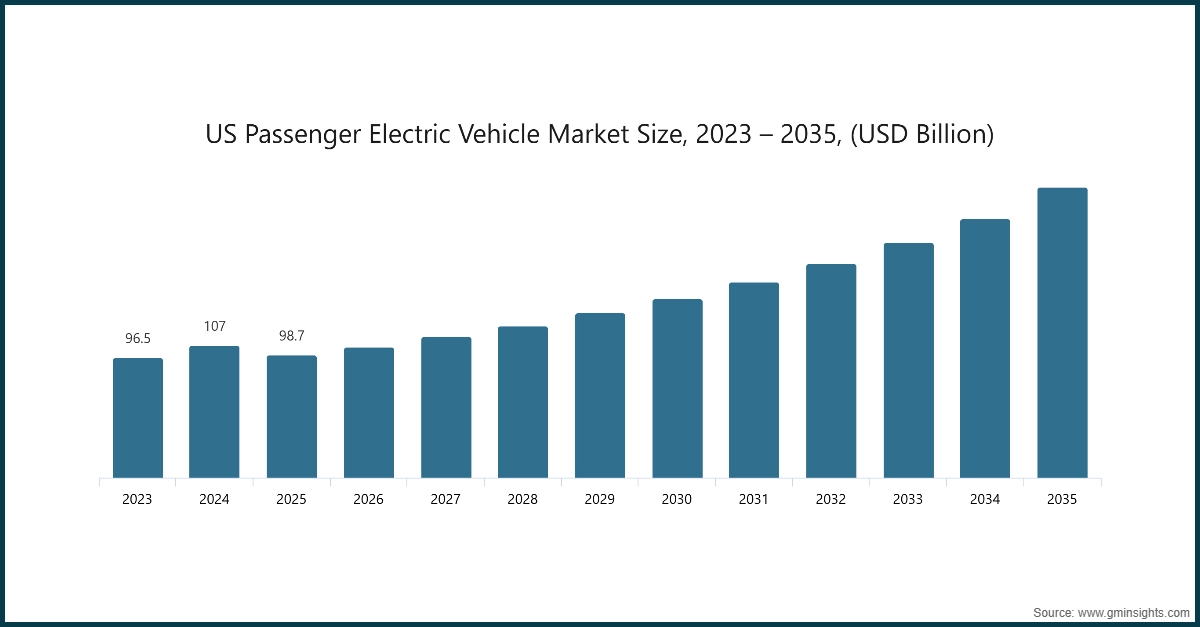
The US dominated North America passenger electric vehicle market with revenue of USD 98.7 billion in 2025.
- The U.S. electric vehicle (EV) market is rapidly growing, driven by strong customer demand, legal assistance, and aggressive OEM strategies. A major trend is developing EV platforms to be efficient and productively used to make many models. An example is Ford’s Universal EV Platform, which was introduced in September 2025, allowing Ford to produce a line of affordable digitally advanced vehicles from one platform on a scale. The vehicles are intended to be enjoyable to drive and continually improved with over-the-air updates, highlighting increasing emphasis on software integration and modular vehicle designs in driving consumer experiences and speeding adoption across multiple vehicle segments from compacts to SUVs.
- The U.S. market will also see OEMs repositioning and realigning their strategies to capture market share as competitive dynamics are shifting. For example, Toyota altered its U.S. EV strategy in May 2025, introducing more models and implementing a different name-scheme. This change occurred partly due to the temporary inventory issues with Tesla, allowing OEMs an opportunity to grow their respective footprints in the market. Similarly, Toyota’s efforts reflect a broader industry transition, where established manufacturers no longer consider EVs experimental and now view them as an integral part of their growth, by leveraging brand equity and trust.
North America passenger electric vehicle market in Canada sold more than 25,500 units in 2025.
- The rapid development of the North American passenger electric vehicle (EV) market continues as manufacturers increasingly rely on partnerships and shared platforms to optimize product launches. For example, Mitsubishi has announced plans to introduce a new battery electric vehicle (BEV) for the U.S. and Canadian markets in the summer of 2026, based on the next-generation Nissan Leaf and created in conjunction with alliance member Nissan Motor Company. This is part of an overall trend towards OEM alliances and sharing platforms with other manufacturers, helping to reduce costs associated with development, decrease the time it takes to reach market and give automotive manufacturers the ability to bring technologically advanced and competitive EVs to multiple regions simultaneously.
- Infrastructure development is a key component for supporting widespread EV adoption in Canada and will play an integral role in supporting sustainable EV usage. In December 2025, ABB E-mobility launched its Terra AC Wallbox product line in Canada, offering scalable residential and commercial charging options that can support the increased number of battery electric vehicles on the road. The expansion of this infrastructure reflects the growing trend toward improved charging accessibility, which helps to alleviate range anxiety, create more convenience for consumers living in urban and suburban areas, and provide the necessary infrastructure to support mass adoption of EVs. An adequate amount of infrastructure investment in conjunction with vehicle launches and OEM partnerships will allow for future growth of the market when new EV models are introduced to the area.
North America Passenger Electric Vehicle Market Share
The top 7 companies in the market are BYD Company, Mercedes-Benz, Volvo, Tesla, Ford Motor, YUTONG BUS, and Scania. These companies hold around 44% of the market share in 2025.
Tesla is a leading company in the North American electric vehicle market with several full-battery electric vehicles like the Model 3, Model Y, and several upcoming updates across their portfolio. Tesla is known for having the best in range, performance, and software capabilities such as over-the-air software updates, while utilizing their own charging network to maintain a strong foothold in this space.
- Ford Motor Company quickly expanded its electric offerings in North America by rolling out new vehicles such as Mustang Mach-E and F-150 Lightning. By utilizing the Ford Universal Electric Vehicle Platform (launched September 2025), Ford has committed to delivering affordable, flexible, and digitally advanced electric vehicles to a mass market.
- Hyundai has made significant strides in North America with its Ioniq and Kona full-battery electric offerings. Both vehicles target the compact and crossover EV segments. Hyundai offers affordable price points, attractive designs, and super-efficient batteries to customers while developing next-generation platforms and partnerships to get too larger-scale production.
- Chevrolet is part of GM and has been a major player in the North American electric vehicle market with its best-selling models such as Chevy Bolt and Bolt EV. Chevrolet focuses on producing affordable, mass-market-priced electric vehicles and take advantage of GM's Ultium platform to produce goods with very competitive ranges, performance levels and advanced technology features.
- Honda Motor extend its reach across the North American market for electric vehicles (EVs). continues to establish additional partnerships and develop next-generation EV platforms. This includes new battery electric vehicle offerings such as the Honda Prologue's battery-powered vehicle. The focus here will be on producing vehicles that are affordable, reliable, and incorporate advanced digital technologies.
- BMW aims to compete with other luxury car manufacturers in North America by electrifying its lineup, including its i4 sedan and iX SUV. It does so by placing an emphasis on premium design and performance, while also providing high-tech features for customers, who BE typically regarded as being able to purchase luxury clothing.
- Volkswagen offers buyers the opportunity to purchase electric vehicles (EVs) via several different brand divisions, including Volkswagen, Audi, and Porsche, and has recently introduced some popular new EVs through its ID family, such as the ID.4 and the Audi e-tron. Volkswagen can reach buyers in all segments of the North American EV market.
North America Electric Vehicle Market Companies
Major players operating in the North America passenger electric vehicle Industry include:
- BMW
- BYD Company
- Ford Motor Company
- Geely Automobile
- General Motors Company
- Hyundai Motor Company
- Kia
- Stellantis
- Tesla
- Volkswagen
- In North America, the electric vehicle (EV) market faces stiff competition among traditional automobile manufacturers, companies dedicated to manufacturing EVs, and new market entrants all competing to capture a portion of the available market. The established manufacturers of EVs, such as Ford, General Motors (GM), Toyota and Honda, have been able to quickly increase their share of the EV segment through the strength of each of their respective brands, their dealer networks and by leveraging shared platforms through partnerships or collaborations.
- The formation of strategic partnerships, alliances and collaborations has greatly influenced the competitive dynamics within the EV marketplace. By cooperating on shared platforms, battery innovations and manufacturing facilities, the original equipment manufacturers (OEM) can achieve cost reductions while also accelerating their launch of new EVs into the marketplace. In addition, joint ventures and alliances enable manufacturers an opportunity to bring new battery electric vehicles (BEVs) to market more quickly, at lower manufacturing costs and at a higher level of compliance with new government regulations.
- The EV marketplace is also characterized by significant investments into new technologies and supporting infrastructure. These investments into new technology represent an important competitive advantage for manufacturers. Manufacturers continue to invest in the following areas: battery technology development; fast-charging infrastructure; and over-the-air (OTA) capabilities to enhance customer/user ease-of-use and overall satisfaction with their EVs. OEMs offering competitively priced vehicles equipped with advanced technical features and excellent charging systems coupled with strategic marketing initiatives will capture the majority of the North American EV market in the future.
North America Passenger Electric Vehicle Market Report Attributes
| Key Takeaway | Details |
|---|---|
| Market Size & Growth | |
| Base Year | 2025 |
| Market Size in 2025 | USD 108.3 Billion |
| Market Size in 2026 | USD 116.1 Billion |
| Forecast Period 2026-2035 CAGR | 9.5% |
| Market Size in 2035 | USD 263.7 Billion |
| Key Market Trends | |
| Drivers | Impact |
| Strict emission regulations enforcement | Federal and state CO₂ targets, including California’s zero-emission vehicle mandates, push OEMs to expand EV offerings, accelerating passenger EV adoption. |
| Growing consumer preference for sustainable mobility | Increasing awareness of climate change and government incentives (tax credits, rebates) drive higher adoption of BEVs and PHEVs among personal vehicle buyers. |
| Expansion of EV model availability | More diverse EV launches across hatchbacks, sedans, SUVs, and luxury segments broaden consumer choice, increasing market penetration and accelerating adoption. |
| Urban air quality improvement initiatives | City-level initiatives promoting cleaner air increase passenger EV demand in metropolitan areas. |
| Pitfalls & Challenges | Impact |
| High vehicle costs and battery supply constraints | Price premiums and intermittent lithium-ion supply delays limit affordability and can slow market growth. |
| Consumer range anxiety | Concerns about battery range and long recharge times reduce willingness to adopt EVs among mainstream buyers. |
| Opportunities: | Impact |
| High-power fast charging deployment | Expansion of DC fast-charging networks enables long-distance travel and increases EV adoption confidence. |
| Battery cost reductions and technological advances | Lower lithium-ion costs, higher energy density, and longer battery life spans improve vehicle affordability and driving range. |
| Market Leaders (2025) | |
| Market Leader |
60% market share |
| Top Players |
Collective market share in 2025 is 80% |
| Competitive Edge |
|
| Regional Insights | |
| Largest Market | US |
| Fastest growing market | Canada |
| Future outlook |
|
What are the growth opportunities in this market?
North America Passenger Electric Vehicle Industry News
In January 2026, the Netherlands launched several grant programs to encourage the adoption of electric trucks and charging infrastructure to reach a carbon-free commercial transport sector. The four programs are called SPriLa, AanZET, SPuLa, and SWiM.
In December 2025, DSV increased its European electric fleet by adding three new Volvo FM 4x2 8-ton electric trucks to its air and sea operations and five additional Volvo electric tractors to its road transport division. This is part of DSV's continued commitment to the global agreement with Volvo to purchase 300 electric trucks by 2024, bringing DSV's total fleet of EVs to approximately 500 units.
- In November 2025 in Australia, Toll has partnered with Coca-Cola Europacific Partners (CCEP) to replace diesel vehicles in CCEP’s delivery network with twelve Volvo FE Electric trucks; this is a major milestone in creating decarbonized last-mile logistics in Australia.
- January 2025: Workhorse announced that its E-GEN electric vehicle platform surpassed 10 million cumulative miles driven, demonstrating real-world reliability and performance, reinforcing the company’s commitment to emission-free commercial transport solutions.
The North America passenger electric vehicle market research report includes in-depth coverage of the industry with estimates & forecasts in terms of revenue ($ Bn) and Volume (Units) from 2022 to 2035, for the following segments:
Market, By Vehicle
- Hatchback
- Sedan
- SUV
- Others
Market, By Drive
- Front-wheel drive
- Rear-wheel drive
- All-wheel drive
Market, By Propulsion
- Battery Electric Vehicle (BEV)
- Fuel Cell Electric Vehicle (FCEV)
- Plug-in Hybrid Electric Vehicle (PHEV)
Market, By Application
- Personal
- Commercial
Market, By Price
- Entry
- Mid-Range
- Luxury
The above information is provided for the following regions and countries:
- US
- Northeast
- Maine
- New Hampshire
- Vermont
- Massachusetts
- Rhode Island
- Connecticut
- New York
- New Jersey
- Pennsylvania
- Delaware
- Maryland
- Southeast
- Virginia
- West Virginia
- North Carolina
- South Carolina
- Georgia
- Florida
- Alabama
- Mississippi
- Tennessee
- Kentucky
- Arkansas
- Louisiana
- Midwest
- Ohio
- Indiana
- Illinois
- Michigan
- Wisconsin
- Minnesota
- Iowa
- Missouri
- North Dakota
- South Dakota
- Nebraska
- Kansas
- West
- Montana
- Idaho
- Wyoming
- Colorado
- New Mexico
- Arizona
- Utah
- Nevada
- Washington
- Oregon
- California
- Alaska
- Hawaii
- Oklahoma
- Texas
- Northeast
- Canada
- British Columbia
- Alberta
- Saskatchewan
- Manitoba
- Ontario
- Quebec
- New Brunswick
- Nova Scotia
- Yukon
- Nunavut
Frequently Asked Question(FAQ) :
What was the market size of the North America passenger electric vehicle market in 2025?
The market size was USD 108.3 billion in 2025, with a CAGR of 9.5% expected through 2035, driven by rising EV adoption, expanding charging networks, and increasing model availability.
What is the projected value of the North America passenger electric vehicle market by 2035?
The market is poised to reach USD 263.7 billion by 2035, driven by advancements in EV technology, supportive policies, and strong consumer demand.
What is the expected size of the North America passenger electric vehicle industry in 2026?
The market size is projected to reach USD 116.1 billion in 2026.
What was the market share of the SUV segment in 2025?
The SUV segment accounted for 50% of the market in 2025 and is expected to grow at a CAGR of 10.7% till 2035, due to increasing consumer preference for larger and versatile electric vehicles.
What was the market share of the personal segment in 2025?
The personal segment held a 95% market share in 2025 and is set to expand at a CAGR of 9.2% up to 2035, supported by growing consumer interest and financial incentives for EV purchases.
What was the valuation of the battery electric vehicle (BEV) segment in 2025?
The battery electric vehicle (BEV) segment was valued at USD 68.6 billion in 2025, driven by increasing infrastructure support and rising launches of new electric models.
Which country led the North America passenger electric vehicle sector in 2025?
The U.S. led the market with revenue of USD 98.7 billion in 2025, supported by strong customer demand, policy support, and aggressive OEM electrification strategies.
What are the upcoming trends in the North America passenger electric vehicle market?
Trends include expansion of charging infrastructure, electrification of traditional SUV models, development of scalable EV platforms, and increasing availability of BEVs and plug-in hybrid vehicles.
Who are the key players in the North America passenger electric vehicle industry?
Key players include BMW, BYD Company, Ford Motor Company, Geely Automobile, General Motors Company, Hyundai Motor Company, Kia, Stellantis, Tesla, and Volkswagen.
North America Passenger Electric Vehicle Market Scope
Related Reports