Summary
Table of Content

North America Oil Based Biofuel Market
Get a free sample of this report
Form submitted successfully!
Error submitting form. Please try again.
Thank you!
Your inquiry has been received. Our team will reach out to you with the required details via email. To ensure that you don't miss their response, kindly remember to check your spam folder as well!
Request Sectional Data
Thank you!
Your inquiry has been received. Our team will reach out to you with the required details via email. To ensure that you don't miss their response, kindly remember to check your spam folder as well!
Form submitted successfully!
Error submitting form. Please try again.
North America Oil Based Biofuel Market Size
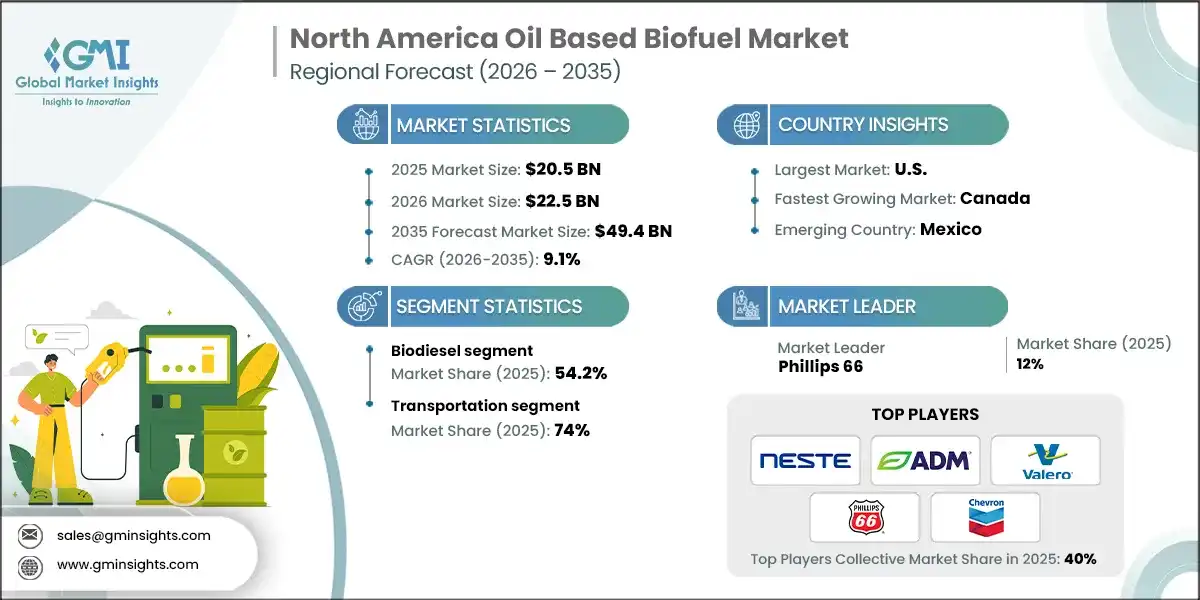
According to a recent study by Global Market Insights Inc., the global North America oil based biofuel market was estimated at USD 20.5 billion in 2025. The market is expected to grow from USD 22.5 billion in 2026 to USD 49.4 billion in 2035, at a CAGR of 9.1%.
North America Oil Based Biofuel Market Key Takeaways
Market Size & Growth
- 2025 Market Size: USD 20.5 Billion
- 2026 Market Size: USD 22.5 Billion
- 2035 Forecast Market Size: USD 49.4 Billion
- CAGR (2026–2035): 9.1%
Regional Dominance
- Largest Market: U.S.
- Fastest Growing Country: Canada
Key Market Drivers
- Stringent carbon-reduction mandates.
- Strong government support through tax credits.
Challenges
- Feedstock availability constraints.
Opportunity
- Rapid expansion of sustainable aviation fuel (SAF).
- Advancements in feedstock diversification.
Key Players
- Market Leader: Phillips 66 led with over 12% market share in 2025.
- Leading Players: Top 5 players in this market include Neste Corporation, ADM, Valero, Phillips 66, Chevron Corporation, which collectively held a market share of 40% in 2025.
Get Market Insights & Growth Opportunities
- Stable, multi-year federal volume standards under the U.S. Renewable Fuel Standard (RFS) sustain demand for oil based biofuels. Consistent standards assists planning for feedstock procurement (e.g., waste oils and animal fats), optimize refinery co-processing decisions, and justify investments in pretreatment capacity.
- The nested nature of the standards enables renewable diesel and biodiesel to backfill broader advanced fuel targets, supporting utilization. While the rule is technology neutral, it has been accompanied by ongoing compliance and implementation updates, signaling program continuity and oversight.
- For instance, EPA’s final RFS rule sets volumes for 2023 - 2025, including biomass based diesel (3.04 in 2024; 3.35 in 2025), and affirms program stability via notices and annual standards tables updated through late 2025. This in turn is augmenting the industry landscape across the region.
- California, the LCFS remains a primary driver for deploying pretreatment, feedstock diversification, and SAF upgrade units, while encouraging long term supply contracts tied to CI performance. In addition, LCFS continues to increase down carbon intensity (CI) targets, directly improving the credit economics for low CI fuels like hydrotreated vegetable oil (HVO) renewable diesel and SAF derived from waste fats and used cooking oil.
- The 2024 board action to update LCFS, followed by the 2025 resubmittal and approval process, signals the state’s commitment to deeper CI cuts and expanded credit generation opportunities (including end use and infrastructure provisions). These technical revisions, with final rulemaking milestones posted and program pages reflect tightened targets and implementation update.
- Canada’s Clean Fuel Regulations (CFR) deepen regional demand for low carbon diesel and co-processing. CFR requires primary suppliers to reduce the life cycle CI of gasoline and diesel, creating tradable credits across three compliance categories, including the supply of low-carbon-intensity fuels such as biodiesel and renewable diesel.
- With reporting commencing and credit market data released, oil-based biofuels have a clearer compliance role in meeting reduction trajectories. Ongoing targeted amendments announced in 2025 aim to strengthen resiliency and support sector development without diluting the program’s emissions focus.
- For instance, in June 2024, Environment and Climate Change Canada published Credit Market Report and, in late 2025, issued a discussion paper outlining targeted CFR amendments to bolster Canada’s low-carbon fuel sector. In addition, for cross border producers, CFR credits and provincial programs expand the addressable market for renewable diesel and SAF blends across Western and Eastern Canada.
- Furthermore, the U.S. clean fuel production tax credit under Section 45Z represents a meaningful shift in how oil-based biofuels are valued at the federal level. Unlike earlier volume-based incentives, the credit is tied directly to lifecycle emissions performance, encouraging producers to minimize carbon intensity through feedstock choice, energy integration, and process efficiency.
To get key market trends
North America Oil Based Biofuel Market Trends
- The regional government’s coordinated push to scale sustainable aviation fuel has created new momentum for oil-based biofuel producers with SAF compatible assets. Federal agencies have aligned policy, tracking mechanisms, and funding frameworks to accelerate commercialization while leveraging existing refinery infrastructure.
- Oil-based processes offer an advantage due to their readiness for hydro processed esters and fatty acids pathways, which integrate effectively with refinery systems. Public reporting of milestones and capacity development has improved visibility across the aviation value chain, supporting airline offtake engagement and long-term supply planning.
- For instance, in May 2025, the U.S. Department of Energy’s Bioenergy Technologies Office took steps to ease constraints on domestic bioenergy development by revising the 45ZCF GREET modeling tool to include new feedstocks and production routes, notably corn wet-milling ethanol and coal-mine methane derived natural gas.
- Investments in storage tanks, blending equipment, and dispensing systems increase the availability of biodiesel blends and renewable diesel across retail and fleet locations. Federal grant programs have reduced financial barriers for operators, particularly in rural and multi-state fueling networks.
- As infrastructure bottlenecks ease, biofuels can achieve higher throughput and stronger price competitiveness relative to fossil diesel. These developments directly improve demand visibility for producers by strengthening downstream readiness rather than relying solely on mandates.
- For instance, in May 2025, the U.S. government updated higher blends infrastructure incentive program to increase significantly the sales and use of higher blends of ethanol and biodiesel by expanding the infrastructure for renewable fuels derived from U.S. agricultural products.
- The program is also intended to encourage a more comprehensive approach to market higher blends by sharing the costs related to building out biofuel-related infrastructure. In addition, the region has entered a phase where full scale refinery conversions to renewable diesel are demonstrating operational reliability rather than pilot level feasibility.
- Converted sites benefit from existing logistics, hydrogen systems, and marine access, enabling high utilization rates and regional supply security. These facilities reinforce the competitiveness of oil based pathways by achieving industrial scale while maintaining compliance with stringent carbon-intensity programs.
- For illustration, in May 2025, Phillips 66 in collaboration with NextEra Energy Resources, commenced commercial operations of the on-site solar facility at the Rodeo Renewable Energy Complex. The facility supports the production of renewable diesel and sustainable aviation fuel using waste oils, fats, greases, and vegetable oil feedstocks.
- Biofuel producers are investing in pretreatment units, aggregation hubs, and joint ventures that secure access to diverse lipid sources. This integration improves yield consistency, protects catalysts, and lowers operating disruptions. A more resilient feedstock system enhances the competitiveness of oil-based biofuels compared to alternative renewable pathways that rely on less mature supply chains.
North America Oil Based Biofuel Market Analysis
Learn more about the key segments shaping this market
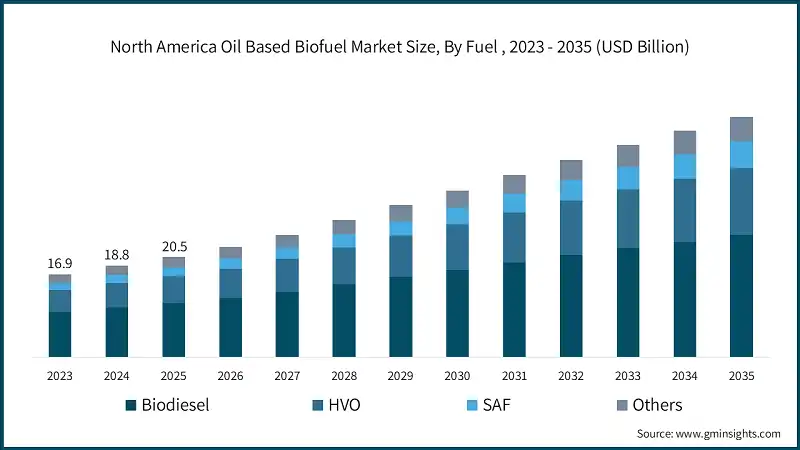
- Based on fuel, the market is segmented into biodiesel, HVO, SAF, and others. The biodiesel segment dominated by 54.2% of the market share in 2025 and is set to grow at a CAGR of 8.4% by 2035. State blending mandates and quality standardization sustain all round demand in core markets of the U.S. in recent times.
- In addition, industry quality programs and ASTM updates have improved compatibility with modern engines and after-treatment systems, reducing operator concerns over metals content, cold-flow, and injector deposits. This combination of policy enforcement and technical assurance translates into durable local demand that supports rail, truck, and agricultural logistics, and keeps biodiesel competitive against both fossil diesel and paraffinic renewable diesel.
- For instance, Minnesota statute and agency guidance continue to enforce the biodiesel content mandate, B20 from April 15 to September 30 and B5 in winter, backed by annual reporting and weights & measures compliance notices. This demand planning for distributors and terminals, ensures throughput for soybean derived methyl esters and other fat and grease-based inputs.
- HVO market will grow at a CAGR of 11% by 2035. The region’s renewable diesel landscape is defined by large refinery conversions that have reached sustained, full rate operations. By leveraging existing hydrotreaters, hydrogen systems, and marine/rail access, these complexes process waste oils, animal fats, and vegetable oils into dropping paraffinic diesel with very low carbon intensity.
- For instance, Oregon DEQ updated its Clean Fuels Program in 2024–2025, adopting OR GREET 4.0, adding CCS crediting mechanisms, and enhancing verification. For HVO suppliers, better CI performance enhances credit generation and strengthens economics under CI based systems, while structured verification builds market trust.
- SAF market will grow a rate of 13% by 2035, propelled by coordinated U.S. federal actions including targeted grants for production and infrastructure, interagency roadmaps, and progress dashboards that quantify capacity and uptake.
- This “whole of government” approach reduces uncertainty for airlines and producers, aligns R&D with certification pathways, and highlights the viability of HEFA/HVO based SAF derived from waste lipids. As airports and carriers pursue decarbonization targets, visibility into funding timelines and metrics helps underpin offtake MOUs and project finance.
- For instance, in August 2024, The FAA’s Fueling Aviation’s Sustainable Transition (FAST) program awarded over USD 291 million for SAF production, logistics, and low-emission aviation technologies. In addition, DOE/USDA/FAA published the SAF Grand Challenge progress report and implementation framework.
- The addition of SAF upgrade trains that convert paraffinic diesel intermediates into jet range products meeting ASTM D7566 annexes will augment the industry growth. This flexibility allows plants to “swing” output between road diesel and SAF based on policy signals and airline demand.
- For instance, Valero’s Diamond Green Diesel project at Port Arthur achieved large scale SAF capability in Q4 2024, allowing up to 50% of renewable diesel output to be upgraded to neat SAF, reinforcing multi-product flexibility for U.S. supply.
Learn more about the key segments shaping this market
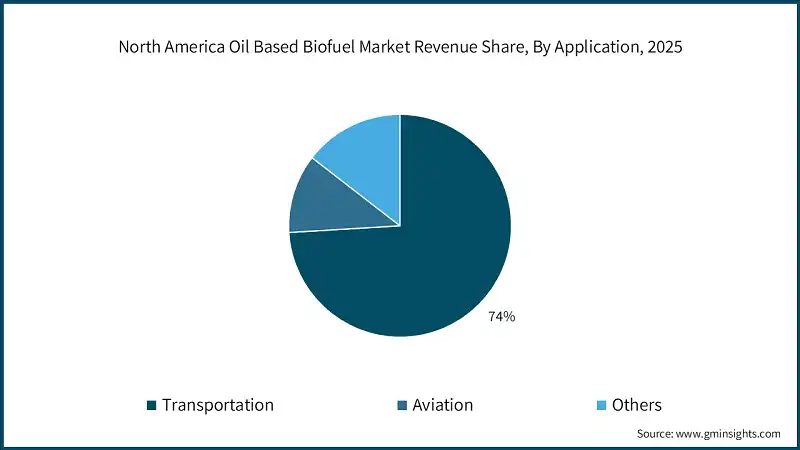
- Based on application, the industry is segmented into transportation, aviation, & others. The transportation application industry held a market share of 74% in 2025 and will grow at a CAGR of 10% by 2035. Transportation continues to represent the largest application segment for oil based biofuels in North America, driven primarily by heavy duty trucking, municipal fleets, construction equipment, and regional freight operations.
- Fleets are increasingly adopting higher blends or neat renewable diesel to meet corporate emissions commitments while preserving vehicle uptime and refueling flexibility, reinforcing transportation’s central role in market demand. In addition, as electrification remains limited for long haul and off road applications, oil based biofuels serve as an immediately deployable decarbonization pathway.
- Oil based biofuels are increasingly penetrating marine vessels, locomotives, cargo handling equipment, and port adjacent drayage operations. For instance, the Port of Seattle’s 2024 environment and sustainability report highlighted expanded use of low carbon fuels in maritime and cargo-handling operations as part of its decarbonization roadmap.
- Aviation application industry will grow at a CAGR of 15% by 2035 and is the fastest growing application for oil-based biofuels, specifically through sustainable aviation fuel derived from waste oils and fats. Airports have emerged as focal points for SAF deployment, acting as aggregators of demand across multiple airlines.
- For instance, the Port of Seattle its goal to supply at least a 10% SAF blend for all flights at SEA Airport by 2028, with ongoing regional planning and infrastructure development documented in its 2024 sustainability reporting.
- Furthermore, the expansion of SAF usage in North America is increasingly enabled by coordinated federal funding and certification initiatives addressing production, blending, storage, and transport constraints. Programs administered by the Federal Aviation Administration and the U.S. Department of Energy focus on bridging the cost and infrastructure gap between conventional jet fuel and SAF.
- Federal grants also reduce risk for airports and fuel distributors by supporting site-specific feasibility studies and logistics upgrades. As federal oversight improves traceability and lifecycle accounting, airlines gain greater confidence in SAF supply integrity. This regulatory and financial backing is translating into practical deployment rather than pilot-scale trials.
- For reference, in October 2025, the Government of Canada announced the introduction of USD 370 million in time-limited, per-liter incentives for domestic biodiesel and renewable diesel producers, effective from January 2026, with the objective of accelerating Canadian biofuel production capacity.
Looking for region specific data?
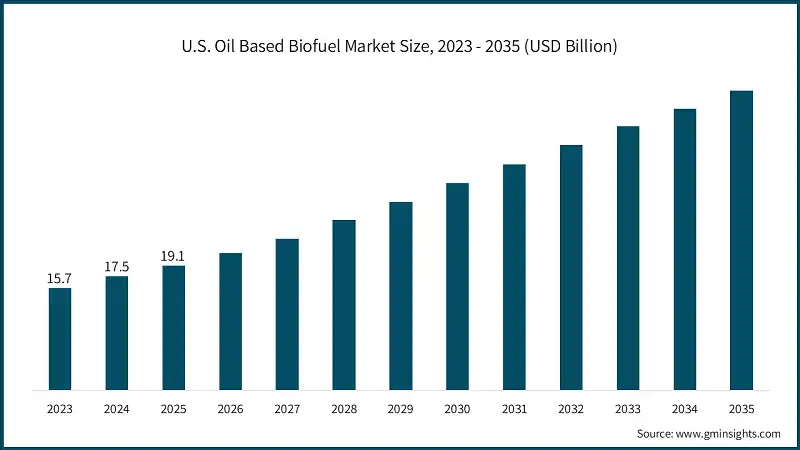
- The U.S. dominated the North America oil based biofuel market with around 93% share in 2025 and generated USD 19.1 billion in revenue. The country’s growth is supported by a combination of federal policy stability and large-scale industrial deployment.
- The introduction of performance based federal tax credits has shifted focus toward low carbon, waste based feedstocks and refinery efficiency improvements. The U.S. market is further distinguished by extensive refinery conversions that leverage existing petroleum infrastructure to produce renewable diesel and SAF at world scale.
- For instance, In July 2025, the U.S. DOE selected 27 innovators and entrepreneurs for the latest cohorts of its Lab-Embedded Entrepreneurship Program (LEEP). The selected participants will be embedded across four U.S. national laboratories, collaborating with extensive networks of scientific, technical, and commercial mentors to advance transformational energy technologies, including innovations that support and complement the oil-based biofuel value chain.
- Canada oil based biofuel market will grow at a CAGR of 9.3% by 2035. The Clean Fuel Regulations establish mandatory lifecycle carbon-intensity reductions for gasoline and diesel sold in Canada, creating sustained demand for biodiesel and renewable diesel.
- Various incentives are designed to improve the cost competitiveness of Canadian biofuel producers relative to U.S. facilities that benefit from federal tax credits and state-level programs. In addition, the country is encouraging capacity utilization, new plant investment, and feedstock aggregation within its borders to promote the product adoption.
- For instance, in January 2026, the Government of Canada, in collaboration with the Advanced Biofuels Canada Association, launched the Biofuels Production Incentive, a measure designed to provide immediate support to safeguard domestic biofuel production capacity and reinforce Canada’s energy security.
- Mexico oil based biofuel market will grow at a CAGR of 4.5% by 2035. The country represents an emerging market for oil based biofuels, characterized by a cautious and state-led approach. Federal energy transition frameworks increasingly recognize biofuels as part of the decarbonization toolkit for transportation and industry.
- Government emphasis on energy sovereignty and fuel affordability is further shaping biofuel adoption, favoring to market growth. Pilot deployments, technical assessments, and refinery trials are laying the groundwork for future scale up, particularly for renewable diesel derived from domestic vegetable oils and waste fats.
- For reference, Mexico’s Secretariat of Energy (SENER) affirmed biofuels as part of the national energy transition strategy, including evaluation of biofuel use and co-processing within existing refinery operations. This will progress from pilot centric activity to selective commercial deployment, primarily linked to state owned energy infrastructure.
North America Oil Based Biofuel Market Share
- The top 5 companies in the North America oil based biofuel industry Neste Corporation, ADM, Valero, Phillips 66, and Chevron Corporation over 40% market share in the year 2025. Phillips 66 holds a leading position in the North America oil based biofuel market, underpinned by large scale renewable diesel and SAF production integrated directly into its refining footprint.
- Valero commands a significant competitive position in the North American oil based biofuel market through its long-standing Diamond Green Diesel platform. The company’s strategy focuses on maximizing utilization of existing refining and logistics assets, enabling it to respond quickly to evolving carbon regulations and airline SAF demand across the U.S.
North America Oil Based Biofuel Market Companies
Major players operating in the North America oil based biofuel industry are:
- ADM
- Bunge Limited
- Cargill Incorporated
- Chevron Corporation
- Crimson Renewable Energy Holdings LLC
- Darling Ingredients Inc.
- ExxonMobil Corporation
- Gevo, Inc.
- Louis Dreyfus Company (LDC)
- Marathon Petroleum Corporation
- Neste Oyj
- Phillips 66
- POET LLC
- Shell plc
- Targray Group
- TotalEnergies SE
- Valero
- Verbio
- Wilmar International Limited
- World Energy LLC
- ADM holds a strong competitive position in the oil-based biofuel landscape, supported by its large-scale bioethanol platform comprising 18 operational facilities with a combined annual production capacity of approximately 1.8 billion gallons. The company with adjusted earnings of USD 452 million recorded in Q2 2025, underscoring resilience amid market volatility and the benefits of ongoing portfolio optimization efforts.
- Chevron Corporation has expanded its participation in oil-based biofuels following the acquisition of Renewable Energy Group (REG), enabling broader utilization of corn oil and waste-derived feedstocks across biodiesel and renewable diesel production. The company evidenced by USD 17.7 billion in net income in 2024 and USD 7.7 billion allocated to low-carbon and energy transition investments during the same year
- Darling Ingredients Inc. has established a strong strategic position in the North American oil-based biofuel market by anchoring its business model around waste-derived feedstocks, including animal fats and used cooking oil. Through its 50:50 joint venture, Diamond Green Diesel, Darling plays a central role in large-scale renewable diesel and sustainable aviation fuel production, benefiting from high-quality, low-carbon input materials and vertically integrated supply chains.
North America Oil Based Biofuel Market Report Attributes
| Key Takeaway | Details |
|---|---|
| Market Size & Growth | |
| Base Year | 2025 |
| Market Size in 2025 | USD 20.5 Billion |
| Market Size in 2026 | USD 22.5 Billion |
| Forecast Period 2026 - 2035 CAGR | 9.1% |
| Market Size in 2035 | USD 49.4 Billion |
| Key Market Trends | |
| Drivers | Impact |
| Stringent carbon-reduction mandates | Stringent carbon-reduction mandates and clean fuel standards across the U.S. and Canada continue to accelerate demand for low-carbon biofuels in transportation, aviation, and industrial applications. |
| Strong government support through tax credits | Strong government support through tax credits, blending obligations, and direct production incentives is reinforcing large-scale investments in biodiesel, renewable diesel, and SAF capacity across the region. |
| Pitfalls & Challenges | Impact |
| Feedstock availability constraints | Feedstock availability constraints and price volatility for waste oils, fats, and crop-based inputs remain a critical challenge, directly impacting production economics and long-term supply stability. |
| Opportunities: | Impact |
| Rapid expansion of sustainable aviation fuel (SAF) | Rapid expansion of sustainable aviation fuel (SAF) adoption presents a high‑value growth avenue, driven by airline decarbonization targets and federal funding for SAF infrastructure and production. |
| Advancements in feedstock diversification | Advancements in feedstock diversification including algae, cover crops, and waste‑based inputs, offer opportunities to reduce lifecycle emissions and alleviate feedstock supply risks. |
| Market Leaders (2025) | |
| Market Leaders |
12% market share |
| Top Players |
|
| Competitive Edge |
|
| Regional Insights | |
| Largest Market | U.S. |
| Fastest Growing Market | Canada |
| Emerging Countries | Mexico |
| Future outlook |
|
What are the growth opportunities in this market?
North America Oil Based Biofuel Industry News
- In January 2026, Pacific Northwest National Laboratory (PNNL) in the U.S. advanced the development of the U.S. bioeconomy by deploying artificial intelligence based models to improve the evaluation of bioproduct performance. By applying AI-driven predictive capabilities, PNNL aims to accelerate production efficiency, shorten development timelines, and lower costs, ultimately supporting the scale up of sustainable fuel technologies and strengthening the bioenergy value chain.
- In June 2025, the governments of Mexico and the U.S. formalized a collaborative agreement focused on biofuels and sustainable development. The partnership outlines coordinated efforts to identify priority areas of cooperation aimed at reducing fossil fuel dependency, advancing clean energy adoption, and enhancing regional energy security through cross-border biofuel initiatives.
- In January 2025, the U.S. Department of Energy’s Bioenergy Technologies Office (BETO) announced up to USD 10 million in funding to support high-impact research and development activities targeting algae cultivation systems and pre-processing technologies, with the objective of strengthening next-generation biofuel feedstock pathways.
This North America oil based biofuel market research report includes in-depth coverage of the industry with estimates & forecast in terms of revenue (USD Million) and volume (Mtoe) from 2022 to 2035, for the following segments:
Market, By Fuel
- Biodiesel
- HVO
- SAF
- Others
Market, By Application
- Transportation
- Aviation
- Others
The above information has been provided for the following countries:
- U.S.
- Canada
- Mexico
Frequently Asked Question(FAQ) :
What is the market size of the North America oil based biofuel in 2025?
The market size was USD 20.5 billion in 2025, with a CAGR of 9.1% expected through 2035, supported by strong government incentives, clean fuel standards, and increasing adoption of low-carbon fuels across transportation and aviation sectors.
What is the projected value of the North America oil based biofuel market by 2035?
The market is expected to reach USD 49.4 billion by 2035, driven by refinery conversions, SAF expansion, and carbon-intensity–based fuel regulations.
What is the estimated market size of the North America oil based biofuel market in 2026?
The market size is projected to reach USD 22.5 billion in 2026, reflecting rising production capacity for biodiesel, renewable diesel (HVO), and sustainable aviation fuel (SAF).
Which fuel segment dominates the North America oil based biofuel market?
The biodiesel segment dominated the market with a 54.2% share in 2025, supported by state-level blending mandates, established distribution infrastructure, and compatibility with existing diesel engines.
What is the growth outlook for renewable diesel (HVO) in North America?
Renewable diesel (HVO) is projected to grow at a CAGR of 11% through 2035, driven by large-scale refinery conversions, low carbon intensity performance, and strong demand from freight and fleet operators.
How fast is the sustainable aviation fuel (SAF) segment expected to grow?
The SAF segment is expected to grow at a CAGR of 13% by 2035, supported by federal funding programs, airline decarbonization targets, and expanding SAF upgrade capabilities at renewable diesel facilities.
Which application segment holds the largest market share?
The transportation segment held a 74% market share in 2025, driven by heavy-duty trucking, municipal fleets, construction equipment, and limited electrification in long-haul transport.
Which is the fastest-growing application segment in the market?
The aviation segment is the fastest-growing, forecast to grow at a CAGR of 15% through 2035, led by rising SAF adoption at major airports and government-backed infrastructure investments.
Which country is expected to grow the fastest in North America?
U.S. dominated the North America oil based biofuel market with around 93% share in 2025 and generated USD 19.1 billion in revenue.
Who are the key players in the North America oil based biofuel market?
Key players include Neste Corporation, ADM, Valero, Phillips 66, Chevron Corporation, Shell plc, ExxonMobil Corporation, World Energy LLC, Darling Ingredients, and TotalEnergies SE.
North America Oil Based Biofuel Market Scope
Related Reports