Summary
Table of Content

North America Off-Shore Crane Market
Get a free sample of this report
Form submitted successfully!
Error submitting form. Please try again.
Thank you!
Your inquiry has been received. Our team will reach out to you with the required details via email. To ensure that you don't miss their response, kindly remember to check your spam folder as well!
Request Sectional Data
Thank you!
Your inquiry has been received. Our team will reach out to you with the required details via email. To ensure that you don't miss their response, kindly remember to check your spam folder as well!
Form submitted successfully!
Error submitting form. Please try again.
North America Off-Shore Crane Market Size
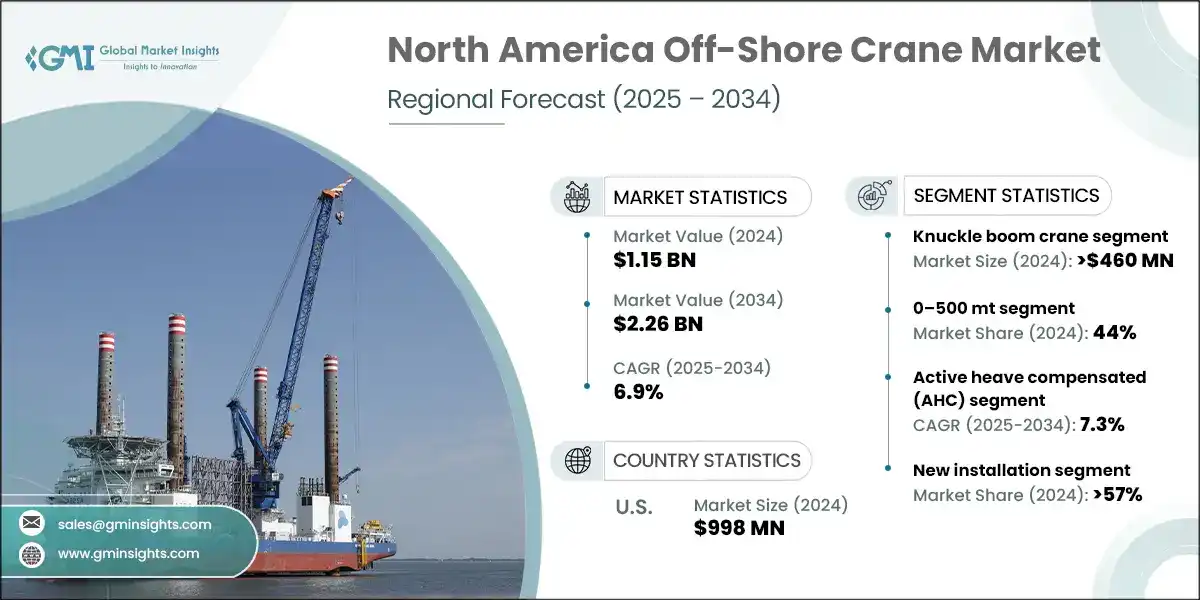
The North America off-shore crane market was estimated at USD 1.15 billion in 2024. The market is expected to grow from USD 1.24 billion in 2025 to USD 2.26 billion in 2034, at a CAGR of 6.9%.
To get key market trends
- Off-Shore cranes represent a vital aid across a diverse range of industries, encompassing oil and gas platforms, floating production units and subsea vessels, Off-Shore wind energy installations, and maritime support ships. Within the United States, the consistent requirement for robust lifting capabilities in the Gulf of Mexico has historically depended upon dependable and long-lasting crane systems designed for handling substantial loads.
- Meanwhile, emerging East Coast wind projects now require cranes designed for turbine installation and cable deployment. In Canada, Off-Shore activity around fields like Hibernia and Terra Nova in Newfoundland & Labrador continues to necessitate equipment built for cold, ice-prone waters.
- The growth of US Off-Shore wind is quantifiable. Projects like Vineyard Wind 1 and South Fork Wind added nearly a gigawatt of capacity in early 2024, and the need for cranes for foundation work, turbine lifts, and cable laying is growing. Plus, older Canadian platforms still need crane upgrades to meet safety and environmental rules.
- In the US, crane use stays strong in the Gulf, even with changing rules. Off-Shore wind is also a big demand driver, especially in New England where leasing programs are opening areas for gigawatts of wind power. Canada's crane needs are dictated by Arctic conditions, requiring durable, frost-proof systems for platform maintenance.
- US wind energy project pipeline anticipates exceeding 52.6 gigawatts by mid-2023, representing a 15% increase, it is anticipated that crane requirements will increase in correlation with the progress of these projects and the installation of wind turbines. Although new wind energy ventures in Canada are somewhat limited, the ongoing maintenance of platforms in Newfoundland & Labrador ensures a consistent demand for contemporary crane technologies compliant with environmental regulations.
North America Off-Shore Crane Market Report Attributes
| Key Takeaway | Details |
|---|---|
| Market Size & Growth | |
| Base Year | 2024 |
| Market Size in 2024 | USD 1.15 Billion |
| Forecast Period 2025 – 2034 CAGR | 6.9% |
| Market Size in 2034 | USD 2.26 Billion |
| Key Market Trends | |
| Drivers | Impact |
| Growth of Off-Shore wind energy projects | Off-Shore wind farms on the US East Coast and Canadian Atlantic are fueling demand for specialized cranes for turbine assembly, blade handling, and subsea cable deployment |
| Revitalization of US Off-Shore oil operations | Crane demand is supported by maintenance and modernization of legacy Off-Shore infrastructure in areas like California and Alaska, as well as redeployment of decommissioned platforms |
| Increasing demand for automated and remotely operated cranes | Operators in harsh and remote Off-Shore zones are adopting semi-autonomous crane systems to enhance safety and reduce dependence on manual intervention |
| Focus on vessel safety and lifting regulations | Strict lifting operation standards from US Coast Guard and Transport Canada are encouraging platform owners and vessel operators to invest in certified, modernized crane systems |
| Pitfalls & Challenges | Impact |
| Limited Standardization Across Crane Platforms | The Off-Shore crane market lacks universal technical standards for newer technologies such as active heave compensation and remote diagnostics. This limits interoperability across vessels and platforms, increases integration costs, and complicates aftermarket servicing. |
| Regulatory hurdles and environmental constraints | Environmental approvals and compliance delays in US and Canadian waters can affect project timelines and delay crane deployment |
| Opportunities: | Impact |
| Digital twin and condition monitoring adoption | Predictive analytics and smart crane systems allow operators to reduce downtime and optimize asset lifespan—becoming a differentiator in harsh Off-Shore conditions |
| Hybrid powered cranes and green Off-Shore operations | Demand for low emission equipment to align with ESG goals in US Off-Shore wind and Canadian oil platforms is opening new market opportunities |
| Expansion in Canadian Off-Shore field developments | New exploration and production in Newfoundland & Labrador and investment in Arctic ready technology are increasing crane installations adapted for icy, remote waters |
| Retrofitting aging Off-Shore platforms | Platform modernization initiatives, especially in Canadian fields and older US sites (e.g., West Coast), offer long term revenue potential for crane retrofits and lifecycle services |
| Market Leaders (2024) | |
| Market Leaders |
13% market share |
| Top Players |
Collective market share in 2024 is 44% |
| Competitive Edge |
|
| Regional Insights | |
| Largest Market | United States |
| Fastest Growing Market | Canada |
| Emerging Market | Newfoundland, Labrador, Louisiana, Maryland, New Jersey |
| Future outlook |
|
What are the growth opportunities in this market?
North America Off-Shore Crane Market Trends
- The Biden-Harris administration's USD 20 billion investment plan for US maritime infrastructure announced in February 2024 is catalyzing demand for Off-Shore and port cranes. Through funding mechanisms like the Bipartisan Infrastructure Law and the Inflation Reduction Act, the focus is on restarting domestic crane manufacturing and modernizing port capabilities, including heavy-lift and container crane deployment.
- The United States Department of Energy is actively contributing to advancements in Off-Shore wind lifting technologies through a USD 41 million investment in a national collaborative effort. This initiative underpins research and development activities focused on crane systems specifically designed for Off-Shore deployments, with the goals of enhancing safety, boosting operational efficiency, and refining the deployment capabilities of vessels utilized for wind turbine installation and maintenance.
- The federal government in 2024, allocated USD 580 million to support 31 discrete port enhancement initiatives dispersed across 15 states. These allocations are currently facilitating the procurement of essential marine cranes, crucial for both cargo management and the prosecution of Off-Shore energy endeavors. To illustrate, the Central Louisiana Regional Port was the recipient of USD 2.5 million, which is being utilized to acquire a 275-ton marine crane. This acquisition will augment cargo throughput capabilities, bolster support for military operations, and simultaneously encourage the adoption of waterborne freight, thereby diminishing emissions.
- Despite the United States Federal Government's suspension of novel Off-Shore wind leasing and authorization processes commencing in 2025, a coalition of eight states has implemented over two dozen legislative measures to maintain forward progress. These actions encompass allocations of capital toward enhancements of port facilities and the cultivation of a skilled labor pool proficient in crane operation. This ensures a sustained demand for Off-Shore crane services, directly correlated to regionally defined objectives for wind energy production and the expansion of associated infrastructure.
North America Off-Shore Crane Market Analysis
Learn more about the key segments shaping this market
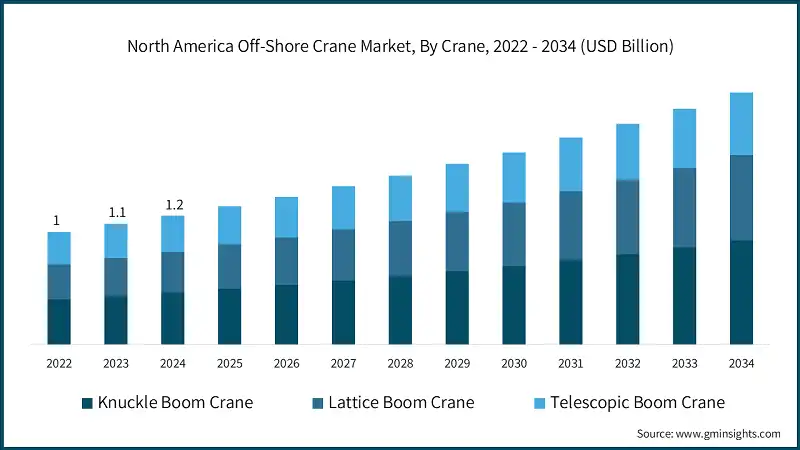
Based on crane, the market is divided into knuckle boom crane, lattice boom crane and telescopic boom crane. The knuckle boom crane segment held over 40% of the market share and generated revenue of USD over 460 million in 2024.
- Knuckle boom cranes are increasingly being used in Off-Shore environments where limited space and precision are required. Jointed boom and portability make them more mobile, particularly in confined environments such as FPSOs, support vessels, and small Off-Shore platforms.
- Supply handling, maintenance work, and person transfers are typical to their application. They provide versatility and safety in varying sea conditions. Because they fold up into a more compact form when not operating, they are particularly convenient where deck space is limited. This makes them a favorite among operators of modular or retrofit systems.
- Lattice Boom Cranes are often used for heavy lifting and large Off-Shore construction projects. They are recognized for their high load capacity and stability. These cranes are vital for assembling large modules, topsides, and subsea components. You can mainly find them on oil and gas platforms and in Off-Shore wind turbine projects, where lifting requirements exceed the capabilities of smaller cranes. However, lattice boom cranes need more deck space and must be permanently installed. This limits their use of small vessels, but they are essential for fixed platforms and heavy-duty tasks.
- Telescopic boom cranes strike a balance between lifting capacity and operational flexibility. These cranes use a hydraulic boom extension mechanism that allows for adjustable reach and easy deployment, which makes them perfect for Off-Shore support vessels and smaller platforms involved in mid-range lifting tasks.
- While they may not have the lifting power of lattice boom cranes or the compact agility of knuckle boom cranes, their ease of operation, relatively low maintenance, and ability to handle various loads make them a popular choice in support roles across Off-Shore operations in both US and Canadian waters.
Learn more about the key segments shaping this market
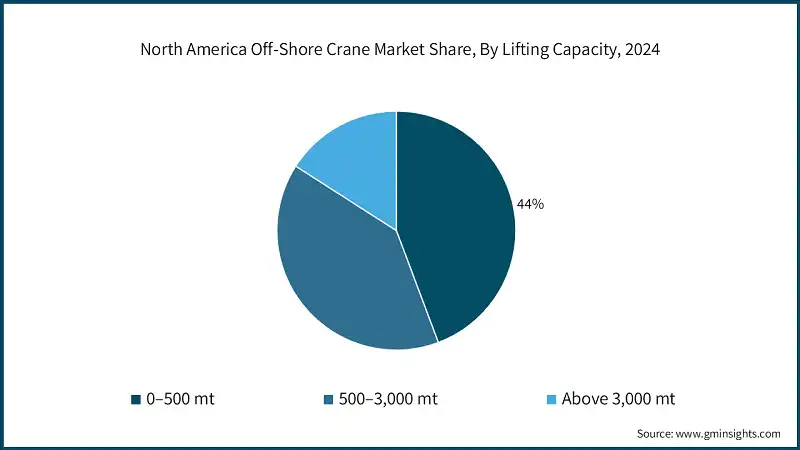
Based on lifting capacity, the North America off-shore crane market is segmented into 0–500 mt, 500–3,000 mt and above 3,000 mt. The 0–500 mt segment held a market share of 44% in 2024 and is expected to grow at a CAGR of 6.1% from 2025 to 2034.
- The 0–500 mt segment includes light duty cranes used mainly for everyday Off-Shore tasks like cargo handling, supply transfers, and light maintenance. These cranes are usually installed on Off-Shore support vessels, FPSOs, and smaller oil platforms where a compact design and moderate lifting capacity work well. Their lower cost, operational flexibility, and easy maintenance make them ideal for routine logistical tasks, especially in shallow or near-shore areas. This segment has steady demand due to the frequent need for general lifting activities in US and Canadian Off-Shore operations.
- The 500 to 3,000 mt category consists of medium to heavy duty cranes used in more demanding Off-Shore roles, such as installing subsea equipment, handling topside modules, and lifting wind turbine components. This segment is gaining popularity as Off-Shore wind projects grow and brownfield developments continue, both needing higher capacity lifting without requiring ultra heavy lift systems.
- The above 3,000 mt segment consists of ultra heavy lift cranes made for the most complex Off-Shore construction and decommissioning tasks. These cranes are usually found on large heavy lift vessels or dedicated installation ships operating in deepwater oil fields or utility scale Off-Shore wind farms. Demand in this segment usually depends on specific projects linked to large developments in areas like the Gulf of Mexico or future deepwater Canadian initiatives.
Based on design, the North America off-shore crane market is segmented into active heave compensated (AHC), passive heave compensated (PHC), and non-compensated. The active heave compensated (AHC) segment held a market share of 42% in 2024 and is expected to grow at CAGR of 7.3% from 2025 to 2034.
- The active heave compensated (AHC) crane segment represents the most advanced category. These cranes use real time motion sensors along with hydraulic or electric control systems to counteract vessel movement and keep loads stable during lifting operations. AHC systems are crucial for deepwater and subsea applications that need precise positioning, such as ROV deployment, subsea module installation, and floating wind turbine assembly. Due to the growing presence of dynamic Off-Shore environments, especially in the Gulf of Mexico and Atlantic Off-Shore wind zones, AHC cranes are increasingly being used on high spec vessels and platforms in the US and Canada.
- In contrast, passive heave compensated (PHC) cranes use mechanical or hydraulic damping systems to absorb motion caused by waves. While they are not as precise as AHC systems, PHC cranes are cost effective for operations where exact positioning is less important. These cranes are often used in midwater lifting or shallow Off-Shore fields where moderate wave action occurs. The PHC segment remains a reliable option for supply vessels, mid-size platforms, and maintenance operations that do not need dynamic load control.
- The non-compensated crane segment includes basic Off-Shore cranes without motion compensation features. These cranes are usually mounted on vessels or platforms operating in calmer waters or conducting static lifting tasks, such as surface cargo handling or equipment transfers under good sea conditions. Although their capabilities are limited, non-compensated cranes are appreciated for their simplicity, low maintenance, and adaptability in budget friendly retrofits or nearshore support roles. Their importance persists in older Off-Shore infrastructure and shallow field operations where environmental forces are minimal.
Based on installation, the North America off-shore crane market is segmented into new installation and replacement/retrofit. The new installation segment held a market share of over 57% in 2024 and is expected to grow at a CAGR of 6% from 2025 to 2034.
- The new installation segment is mainly fueled by Off-Shore infrastructure, especially in Off-Shore wind energy and newly sanctioned oil and gas projects. In the United States, auction of leases and project development along the East Coast such as Maine and New York Bight contributes to the growing demand for cranes that can be integrated into turbine installation vessels, transformer stations, and floating production platforms. Similarly, in Canada, future exploration and production initiatives in border areas such as Newfoundland and Labrador can generate extra demand for high capacity, technically advanced cranes.
- Meanwhile, the replacement/retrofitting segment is pushed by modernizing Off-Shore assets to aging, expanding the life of the platform and ensuring compliance with updated security and operational standards. In mature Off-Shore areas such as Mexico and Eastern Canadian Gulf, many platforms and vessels must undergo upgrading, including replacement of the old crane system. Retrofitting often involves integration of automation, operational capabilities or status monitoring units, allowing operators to reduce shutdowns and increase operating efficiency.
Looking for region specific data?
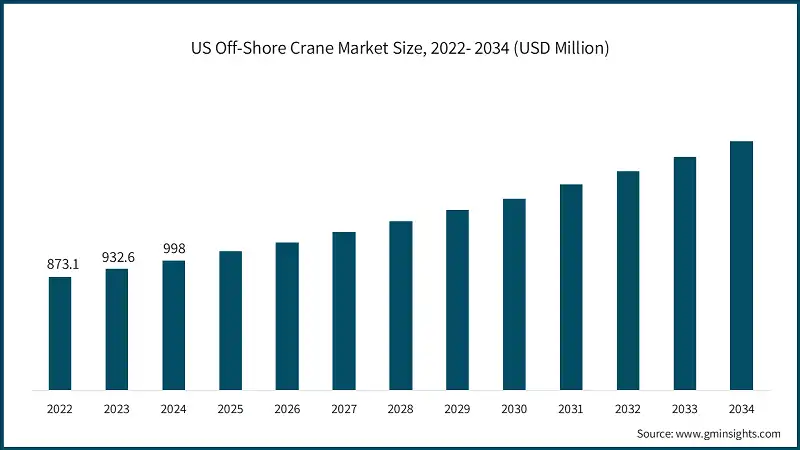
The U.S. accounted for over 86% share in the North America Off-Shore crane market, generated revenue of USD 998 million in 2024.
- Off-Shore wind is booming, boosting demand for specialized cranes and equipment! New York City's South Brooklyn Marine Terminal is becoming a major hub, owing to almost USD 152 million in wind infrastructure investments. It's supporting huge projects like Equinor's Empire Wind 1, which will create over 1,000 jobs and generate 810 MW.
- The New York City Economic Development Corporation (NYCEDC) has allocated USD 18 million towards the refurbishment of the Brooklyn Marine Terminal. This investment encompasses the dismantling of obsolete crane systems, the procurement of a contemporary, electrically powered crane, and essential pier restoration work. This undertaking serves as a prime illustration of strategically directed funding designed to bolster maritime infrastructure, ultimately improving freight processing efficacy and providing support for Off-Shore wind power operations.
- Meanwhile, Massachusetts is pushing forward with port upgrades, like in New Bedford, a key base for wind farms. State funding will further boost the supply chain and workforce.
- Down in Maryland, projects like the MarWin farm (powering 92,000 homes and creating 1,300 jobs) and a larger 1.7 GW initiative with big investments are driving even more activity and boosting the need for those heavy-duty cranes.
- Meanwhile, the East Coast of the US is experiencing a shift in Off-Shore energy due to the rise of Off-Shore wind. States such as New York, Massachusetts, and New Jersey are leading this change. They are backed by the Bureau of Ocean Energy Management's (BOEM) leasing programs and recent regulatory reforms. By 2024, projects like Vineyard Wind and Empire Wind are moving into construction phases, which is driving up the demand for installation vessels that are equipped with specialized Off-Shore cranes.
- The finalization of BOEM and BSEE’s Renewable Energy Modernization Rule in April 2024 made permitting easier and reduced uncertainty, which should speed up construction timelines and increase the need for advanced lifting systems. The US market is expected to see a variety of crane use, with both high-capacity lattice boom systems and motion compensated knuckle boom cranes in high demand.
The market in Canada is expected to experience significant and promising growth from 2025 to 2034.
- The landscape of Canada's Off-Shore crane market is undergoing a transformation, transitioning from its conventional reliance on the petroleum sector towards accommodating the burgeoning Off-Shore wind energy industry. This evolving sector necessitates cranes engineered for operation in the rigorous sub-arctic and glacial environments characteristic of the North Atlantic, placing a premium on resilient engineering and unwavering operational dependability. This alteration signifies escalated investment in sustainable energy infrastructure and the modernization of maritime resources.
- Illustratively, Nova Scotia formally designated its inaugural four Off-Shore wind energy zones in July 2025, with the objective of achieving 5 gigawatts of Off-Shore wind capacity by 2030. This capacity will be crucial for turbine erection and logistical operations.
- Legislative progress is instrumental in enabling Off-Shore wind ventures in Atlantic Canada. The enactment of Bill C-49 in 2024, coupled with provincial statutes such as Newfoundland & Labrador's Bill 90 in 2025, established a definitive legal structure, facilitating project progression and regulatory assurance for Off-Shore renewable energy endeavors.
- For instance, Bill C-49 and Bill 90 work in unison to standardize regulations, thereby expediting the implementation of Off-Shore wind energy. This harmonization provides a foundation for amplified demand for Off-Shore cranes specifically adapted for renewable energy installations.
North America Off-Shore Crane Market Share
- The top 7 companies in the North America off-shore crane industry are Liebherr, KenzFigee, Heila Cranes, Huisman, Cargotec, Konecranes, and NOV contributing over 45.3% of the market in 2024.
- Liebherr Group, a prominent player in the Off-Shore crane sector, maintains a substantial presence in the Gulf of Mexico and is increasingly active in US Off-Shore wind projects. With Swiss origins, the company delivers a broad selection of specialized Off-Shore cranes, such as lattice boom and knuckle boom models, which are engineered to excel in heavy lifting, motion compensation, and are equipped with advanced digital monitoring systems.
- KenzFigee Group, hailing from the Netherlands, has established itself as a reputable provider of tailored Off-Shore lifting systems and modular cranes. The company's contributions to the North American market are marked by its pedestal and knuckle boom cranes, which serve oil platforms and FPSOs, particularly in the waters around Newfoundland and the Gulf of Mexico.
- Heila Cranes SpA, an Italian OEM, specializes in the production of knuckle boom and telescopic boom cranes tailored for marine and Off-Shore applications. In North America, these cranes are frequently found on Off-Shore support vessels operating in the US Gulf and Canada's waters. Their products are esteemed for their reliability and adaptability, particularly in confined spaces.
- Huisman Equipment B.V., which also has its head office in the Netherlands, provides a high-end range of Off-Shore lifting solutions with large capacity cranes, hybrid systems, and a strong emphasis on automation. The company is increasingly aligned with the US Off-Shore wind sector, delivering installation cranes designed for vessels and floating wind pilot projects.
- Cargotec, a company based in Finland, is a major supplier of specialized load handling equipment for the Off-Shore industry through its MacGregor division. With a particular emphasis on motion-compensated crane technology for challenging sea conditions, the company's portfolio consists of Off-Shore cranes, winches, and other deck equipment.
- Konecranes provides lifting solutions for oil platforms and shipyards to the Off-Shore market. The company has a history of providing Off-Shore grade equipment for crucial maintenance and platform upgrade projects, even though it is best known for its port and industrial cranes.
- Houston based National Oilwell Varco (NOV) is a major force in the North American Off-Shore crane market, with a deep specialization in the oil and gas sector. Its lattice boom and pipe handling cranes are standard equipment on many drilling rigs and production platforms throughout the Gulf of Mexico.
North America Off-Shore Crane Market Companies
Major players operating in the North America off-shore crane industry are:
- Cargotec
- Heila Cranes
- Huisman Equipment
- Kenz Figee
- Konecranes
- Liebherr
- Manitowoc Company
- National Oilwell Varco (NOV)
- Palfinger
- Terex
- The leading off-shore crane producers in the North American market are the Liebherr Group, National Oilwell Varco (NOV), and Huisman Equipment B.V. Their strengths lie in integration with technical adaptation, lifecycle support, and their use on Off-Shore platforms, FPSOs, and wind turbine installation vessels. Their role in driving the market is reflected in their widespread use in the US Gulf of Mexico and the growing adoption across US Off-Shore wind projects along the East Coast.
- Specialized maritime and Off-Shore cranes that support modular platform systems and vessel-based operations are the focus of Palfinger AG, Konecranes, and Cargotec (MacGregor). Cranes are popular choices for supply vessels, maintenance vessels, and subsea operations because of their small size, motion compensation capabilities, and remote diagnostics.
- These businesses have robust after sales networks throughout North America and are frequently important suppliers for mid-sized projects needing dependable, portable lifting equipment. Their emphasis on lifecycle services, automation, and retrofit packages enhances their standing in the Off-Shore ecosystem.
North America Off-Shore Crane Market News
- In July 2025, Huisman signed a contract with VARD to deliver a 250mt knuckle boom crane for a newbuild Off-Shore construction vessel commissioned by Dong Fang Off-Shore (DFO). The crane features a below deck winch for easier maintenance demonstrating design innovation that can influence future deployments in North America’s growing Off-Shore wind segment.
- In March 2025, MacGregor, a part of Cargotec, secured a contract to supply a 100-ton active heave compensated (AHC) crane for a Dive Support Vessel owned by Jana Marine Service Company. The crane, scheduled for delivery in Q2 2026, will be integrated at the Guangzhou Salvage shipyard. This development reinforces MacGregor’s position in the North American Off-Shore crane segment, particularly in subsea and deepwater operations where precision lifting is critical.
- In August 2024, Konecranes unveiled its new X series industrial crane, featuring wireless upgrade capability, remote monitoring, and advanced ergonomic controls. The X series reflects broader trends toward digitalization and smart functionality in lifting systems capabilities increasingly applicable in Off-Shore environments. With TRUCONNECT remote diagnostics and software over air updates, Konecranes reinforces its position as a technology forward OEM poised to support evolving Off-Shore crane demands in North America.
- In June 2024, Liebherr launched the LTM 1400 6.1, the world’s most powerful six axle mobile crane, featuring a 70-metre telescopic boom and advanced Y guying system for significantly increased lifting capacity. Liebherr’s continued engineering leadership qualities that influence its Off-Shore crane offerings in North America, particularly for high load, limited space applications on Off-Shore platforms and support vessels.
The North America off-shore crane market research report includes in depth coverage of the industry with estimates & forecasts in terms of revenue (USD Mn/Bn) and Volume (Units) from 2021 to 2034, for the following segments:
Market, By Crane
- Knuckle boom crane
- Lattice boom crane
- Telescopic boom crane
Market, By Mode of Lifting Capacity
- 0–500 mt
- 500–3,000 mt
- Above 3,000 mt
Market, By Design
- Active heave compensated (AHC)
- Passive heave compensated (PHC)
- Non-compensated
Market, By Installation
- New installation
- Replacement/Retrofit
Market, By Application
- Oil & gas platforms
- Off-Shore wind farms
- Subsea operations
- Marine vessels & FPSOs
- Others
The above information is provided for the following regions and countries:
- U.S.
- Alabama
- Alaska
- Arizona
- Arkansas
- California
- Colorado
- Connecticut
- Delaware
- Florida
- Georgia
- Hawaii
- Idaho
- Illinois
- Indiana
- Iowa
- Kansas
- Kentucky
- Louisiana
- Maine
- Maryland
- Massachusetts
- Michigan
- Minnesota
- Mississippi
- Missouri
- Montana
- Nebraska
- Nevada
- New Hampshire
- New Jersey
- New Mexico
- New York
- North Carolina
- North Dakota
- Ohio
- Oklahoma
- Oregon
- Pennsylvania
- Rhode Island
- South Carolina
- South Dakota
- Tennessee
- Texas
- Utah
- Vermont
- Virginia
- Washington
- West Virginia
- Wisconsin
- Wyoming
- Canada
- Alberta
- British Columbia
- Manitoba
- New Brunswick
- Newfoundland and Labrador
- Nova Scotia
- Ontario
- Prince Edward Island
- Quebec
- Saskatchewan
- Northwest Territories
- Nunavut
- Yukon
Frequently Asked Question(FAQ) :
Who are the key players in the North America off-shore crane market?
Key players include Cargotec, Heila Cranes, Huisman Equipment, Kenz Figee, Konecranes, Liebherr, Manitowoc Company, National Oilwell Varco (NOV), Palfinger, Terex.
What are the upcoming trends in the North America off-shore crane market?
Key trends include adoption of digital twin technology, hybrid-powered green cranes for ESG compliance, AI-driven predictive maintenance, and expansion in Canadian off-shore wind developments.
Which country leads the North America off-shore crane market?
The United States held over 86% share with USD 998 million in 2024. Strong off-shore wind development along the East Coast and Gulf of Mexico operations fuel the region's dominance.
What is the growth outlook for active heave compensated (AHC) cranes from 2025 to 2034?
active heave compensated segmnt held 42% market share in 2024 and are projected to grow at 7.3% CAGR till 2034, due to increasing demand for precise positioning in deepwater and subsea applications.
What was the market share of the 0-500 mt lifting capacity segment in 2024?
The 0-500 mt segment held 44% market share in 2024 and is expected to grow at 6.1% CAGR from 2025 to 2034, driven by routine cargo handling and supply transfer operations.
What is the market size of the North America off-shore crane market in 2024?
The market size was USD 1.15 billion in 2024, with a CAGR of 6.9% expected through 2034, owing to expanding off-shore wind energy projects and revitalization of US off-shore oil operations.
What is the projected value of the North America off-shore crane market by 2034?
The North America off-shore crane market is expected to reach USD 2.26 billion by 2034, propelled by off-shore wind farm developments, automated crane adoption, and digital twin technology integration.
How much revenue did the knuckle boom crane segment generate in 2024?
Knuckle boom cranes generated over USD 460 million in 2024, leading the market with over 40% share due to their versatility in confined off-shore environments.
North America Off-Shore Crane Market Scope
Related Reports