Summary
Table of Content

North America Microinverter Market
Get a free sample of this report
Form submitted successfully!
Error submitting form. Please try again.
Thank you!
Your inquiry has been received. Our team will reach out to you with the required details via email. To ensure that you don't miss their response, kindly remember to check your spam folder as well!
Request Sectional Data
Thank you!
Your inquiry has been received. Our team will reach out to you with the required details via email. To ensure that you don't miss their response, kindly remember to check your spam folder as well!
Form submitted successfully!
Error submitting form. Please try again.
North America Microinverter Market Size
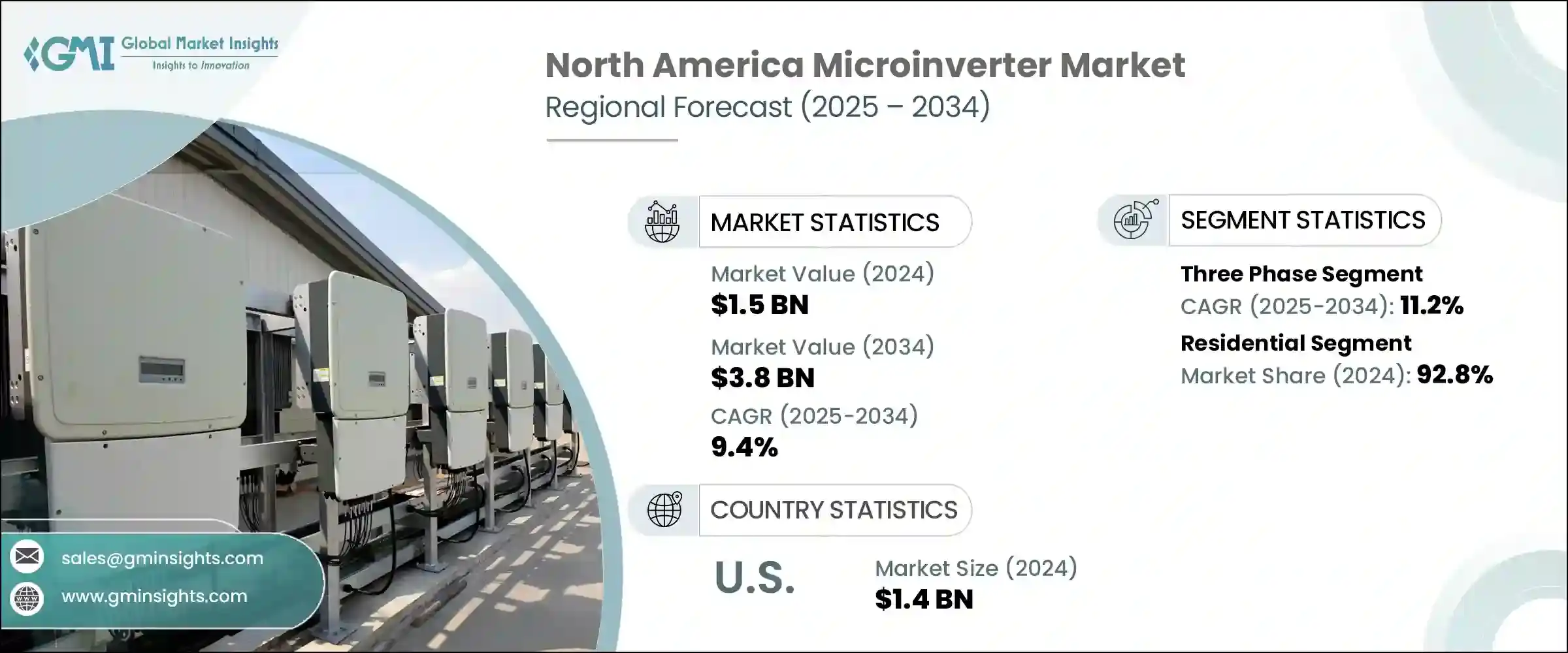
The North America microinverter market size was valued at USD 1.5 billion in 2024 and is estimated to grow at a CAGR of 9.4% from 2025 to 2034. Rising demand for enhanced system monitoring and safety solutions is set to influence product adoption. Microinverter enables real time module-level monitoring, allowing users to track performance and detect issues promptly. This feature not only improves energy yield but also reduces maintenance costs.
North America Microinverter Market Key Takeaways
Market Size & Growth
- 2024 Market Size: USD 1.5 Billion
- 2034 Forecast Market Size: USD 3.8 Billion
- CAGR (2025–2034): 9.4%
Key Market Drivers
- Favorable regulatory inclination toward sustainable energy.
- Increased renewable integration.
- Shift toward clean energy.
Challenges
- Availability of auxiliary technologies.
Get Market Insights & Growth Opportunities
Increasing deployment of residential and small-scale commercial solar PV systems will make microinverters an attractive choice in installations with shading issues, complex roof structure, or multiple orientations, commonly found in urban and sub urban areas across the region. As of May 2024, SEIA reported over 5 million solar installations in the U.S., with 97% being residential rooftop systems. This milestone highlights the rising adoption of distributed solar and the growing demand for microinverters, which enhance performance and protection, driving market growth.
Rising integration of energy storage systems with solar PV is also favoring the product growth. Their compatibility with AC-coupled battery systems simplifies system design and enhances flexibility for homeowners seeking energy independence and resilience amid rising grid outages in regions including California and Texas. Additionally, the strong regional presence of leading manufacturers has enhanced product availability and customer trust, thus bolstering the industry outlook.
Growing regulatory support for rooftop solar and energy resilience programs is driving microinverter adoption, aided by their optimization and compliance-ready safety features. For instance, in July 2024, the U.S. Inflation Reduction Act prompted Enphase Energy to manufacture locally, with 506,000 microinverters shipped in April, qualifying for the 45X production tax credit. Furthermore, microinverters inherently comply with evolving safety standards such as NEC 2017 and NEC 2020 rapid shutdown requirements, which mandate module-level shutdown capabilities for rooftop solar installations leading to bolster the business scenario.
To get key market trends
North America Microinverter Market Trends
- Rising localized energy resilience initiatives and regulatory support for rooftop solar deployment will improve microinverters' penetration. They are ideal for adhering to changing grid codes and building requirements due to their module-level optimization and integrated safety features, leading to enhance the product adoption.
- Ongoing investments by key players in developing advanced technology will create lucrative opportunities for product growth. For instance, in October 2023, Havells Limited launched its groundbreaking product, the Dual Mode Micro Inverter, supported by four U.S. patents. This innovation promises to reshape the solar power landscape by overcoming significant challenges posed by conventional inverters and microinverters. Additionally, rising focus on maximizing space and efficiency in commercial and industrial installations will foster product deployment.
- Growing policy support and financial incentives further bolster market growth. Federal tax credits under the investment Tax credit program and various state-level incentives reduce upfront costs, encouraging more residential and commercial installations where microinverters are preferred for their ease of installation and scalability leading to business expansion. Additionally, North America’s advanced smart grid infrastructure supports two-way power communication, aligns well with microinverters' capabilities in monitoring, remote diagnostics, and grid-responsive functions such as frequency regulation and voltage support leading to propel the product growth.
- Companies are focusing on expanding their presence in the U.S. by complying the regional standards, making the product an attractive choice. For instance, in January 2025, Enphase Energy announced that its IQ8 Microinverters, now comply with the Build America, Buy America (BABA) Act. This compliance enables their use in federal infrastructure projects, such as the EPA's USD 7 billion Solar for All initiative, when manufactured at U.S. contract facilities.
North America Microinverter Market Analysis
Learn more about the key segments shaping this market
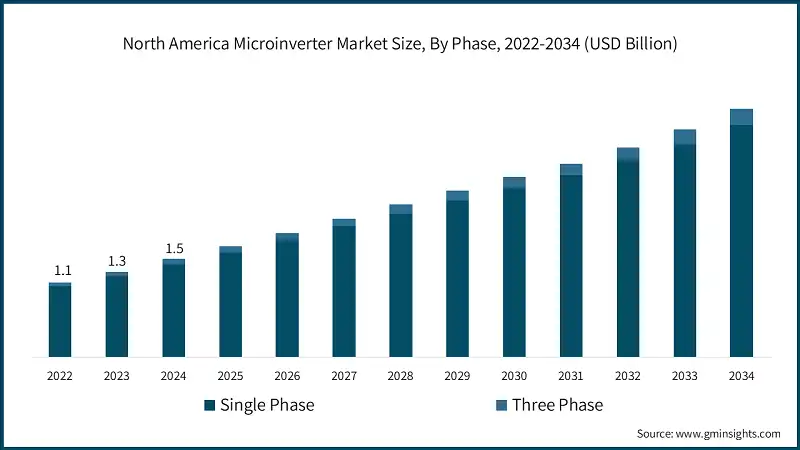
- The North America microinverter industry was valued at USD 1.1 billion, USD 1.3 billion, and USD 1.5 billion in 2022, 2023, and 2024, respectively. Based on phase, the market is segmented into single phase and three phase categories.
- The single phase microinverter segment is set to cross USD 3.4 billion by 2034, on account of its ease of installation, enhanced safety and module-level monitoring. They offer better energy harvest in shaded or complex rooftop conditions, making them ideal for residential solar systems. Additionally, their improved reliability due to no single point of failure, compliance with rapid shutdown regulations and reduced maintenance costs will complement the phase growth.
- Three phase segment is set to grow at a CAGR of 11.2% till 2034. Increasing demand for C&I solar systems requiring higher power output and grid stability will foster multi-phase growth. Companies are favoring product launch as a key strategy to improve dominance in the business. Enphase Energy, Inc. introduced its IQ8 Commercial Microinverters in May 2023 for North America's small-scale commercial solar market. With a 480 W peak output, these inverters support three-phase applications and high-powered solar panels, enhancing installation efficiency and energy harvest.
Learn more about the key segments shaping this market
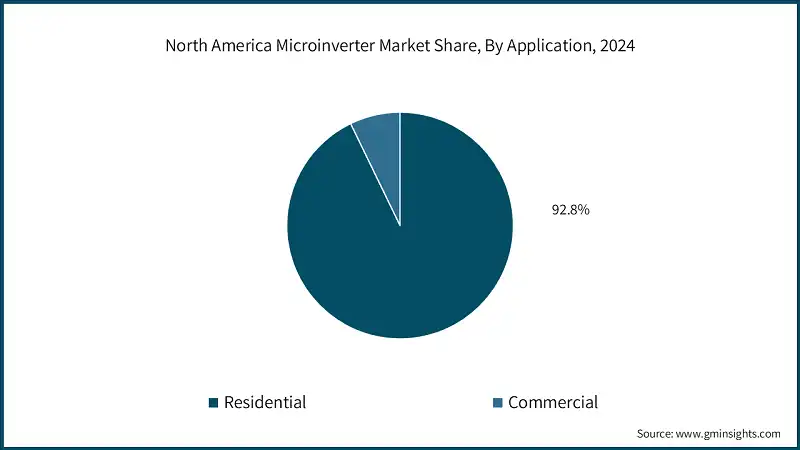
- Based on application, the market is segmented into residential and commercial sectors. The residential application held 92.8% market share in 2024. Increasing demand for inverters having the ability to optimize energy output at the module level, improving system performance on shaded or irregular rooftops, will complement the product growth. Their enhanced safety through rapid shutdown features aligns with regulatory requirements, while simplified installation reduces labor costs, leading to escalate the business trend.
- The commercial segment is expected to grow at a CAGR of 10.2% during 2025 to 2034 on account of its ability to improve energy yield through module-level optimization. Their scalability supports system expansion without major redesign, making them suitable for dynamic commercial needs. Key players are developing a new product line to meet the demand in the region. For instance, in November, Enphase Energy, Inc. introduced its IQ8 Commercial Microinverters for the North American small commercial solar market, offering up to 480 W peak output and compatibility with high-powered solar panels for three-phase applications.

Looking for region specific data?
- The U.S. microinverter market was valued at USD 1.1 billion, USD 1.3 billion, and USD 1.4 billion in 2022, 2023, and 2024, respectively, driven by stringent NEC rapid shutdown requirements, making module level power electronics essential for residential and commercial safety compliance.
- Growing trend toward decentralized energy and energy independence fuels demand for smart, plug-and-play solutions leading to business growth. Additionally, federal and state incentives such as the investment Tax Credit further lower adoption barriers. Increasing preference for high efficiency and low maintenance systems by the U.S. consumer will complement microinverters demand.
- Various growth strategies have been followed by key players to improve their business dominance in the region. For instance, in July 2023, Enphase announced plans to manufacture solar microinverters in the U.S. through a contract manufacturing partnership. Initially, Flex’s South Carolina plant will produce the new IQ8 microinverter for the U.S. market. Once fully operational, Enphase expects a U.S. production capacity of 4.8 to 7.2 GWAC of microinverters annually. Additionally, rising smart home integration amplifies demand for intelligent, scalable solar technologies, leading to propel the industry scenario.
- The Canada microinverter market is expected to reach USD 120 million by 2034, driven by provincial incentives, including British Columbia and Nova Scotia, which offer rebates and feed-in tariff schemes for residential solar systems. Rising environmental awareness and desire for energy independence will stimulate product demand. Additionally, increasing demand for inverters having to ability to function efficiently in colder temperatures, compared to central inverters, will make microinverters well-suited for Canada’s long winter conditions.
North America Microinverter Market Share
- The leading 3 players, including Hoymiles, Enphase Energy, and Sugrow, hold around 37.2% share of the North America microinverter industry. Enphase plans to enhance its market presence by focusing on product innovation, improving microinverter efficiency, and increasing manufacturing capacity. Furthermore, strategic and distribution partnerships support their expansion into key residential and commercial solar markets worldwide.
- Top companies are increasingly bundling their products with energy storage systems, EV chargers and smart energy management platforms. This strategy caters to the rising demand for holistic home and commercial energy solutions. By providing a unified ecosystem, companies provide customers with seamless control, enhanced energy efficiency and backup capabilities during grid outages.
- Additionally, to capitalize on the U.S. Inflation Reduction Act and avoid import tariffs, companies are localizing production. Establishing domestic manufacturing facilities not only reduces lead times and improves supply chain resilience but also qualifies products for federal tax credits and incentives.
North America Microinverter Market Companies
- Hoymiles is one of the industry leaders in the North America microinverter. The company generated USD 80 million in revenue in Q2 2024. It concentrates on scalable and efficient microinverter systems differentiated to suit residential and commercial requirements. Strategic research and development investments and collaborations with regional partners enhance Hoymiles’ product reliability and customer service, driving improvements that support its market growth in key international regions
- Enphase Energy is a prominent player in the North American microinverter market. In the first quarter of 2025, the company reported revenue of USD 356 million. The company’s strategy focuses on expanding into Southeast Asia, integrating with smart energy platforms, and increasing manufacturing capacity in the U.S. to reduce tariff impacts and enhance its global footprint.
Eminent players operating in the North America microinverter industry are:
- APSystems
- Chilicon Power
- Deye Inverter Technology
- Darfon Electronics
- Enphase Energy
- Fimer Group
- Growatt New Energy
- Hoymiles
- NingBo Deye Inverter Technology
- Northern Electric Power Technology
- SMA Solar Technology
- Sparq System
- Sungrow
- Yotta Energy
North America Microinverter Market Report Attributes
| Key Takeaway | Details |
|---|---|
| Market Size & Growth | |
| Base Year | 2024 |
| Market Size in 2024 | USD 1.5 Billion |
| Forecast Period 2025 – 2034 CAGR | 9.4% |
| Market Size in 2034 | USD 3.8 Billion |
| Key Market Trends | |
| Growth Drivers |
|
| Pitfalls & Challenges |
|
What are the growth opportunities in this market?
North America Microinverter Industry News:
- In February 2024, SPARQ Systems Inc., a Canada-based solar microinverter manufacturer, entered into a partnership with JioThings Ltd, the IoT platform of Reliance Industries Ltd’s digital services division, Jio Platforms Ltd. This agreement focuses on the joint development, production, and distribution of microinverters in India. Additionally, SPARQ’s microinverters will be integrated into JioThings’ global IoT solutions.
- In March 2023, Altenergy Power System Inc. entered into a distribution agreement with OSW to supply products across the U.S. and Europe. This strategic collaboration focuses on expanding its global market presence by leveraging innovative multi-module microinverters alongside OSW’s solar product distribution network. This partnership aims to strengthen the company’s footprint and enhance its product portfolio within the microinverter market.
This microinverter market research report includes in-depth coverage of the industry with estimates & forecast in terms of revenue and volume “USD Million & MW” from 2021 to 2034, for the following segments:
Market, By Phase
- Single phase
- Three phase
Market, By Connectivity
- Stand alone
- On grid
Market, By Application
- Residential
- Commercial
The above information has been provided for the following countries:
- U.S.
- Canada
Frequently Asked Question(FAQ) :
How big is the North America microinverter market?
The North America microinverter market was valued at USD 1.5 billion in 2024 and is expected to reach around USD 3.8 billion by 2034, growing at 9.4% CAGR through 2034.
What will be the size of single phase segment in the North America microinverter industry?
The single phase segment is anticipated to cross USD 3.4 billion by 2034.
How much is the U.S. microinverter market worth in 2024?
The U.S. America microinverter market was worth over USD 1.4 billion in 2024.
Who are the key players in North America microinverter market?
Some of the major players in the North America microinverter industry include APSystems, Chilicon Power, Deye Inverter Technology, Darfon Electronics, Enphase Energy, Fimer Group, Growatt New Energy, Hoymiles, NingBo Deye Inverter Technology, Northern Electric Power Technology, SMA Solar Technology, Sparq System, Sugrow, Yotta Energy.
North America Microinverter Market Scope
Related Reports