Summary
Table of Content

North America Medical Imaging Market
Get a free sample of this report
Form submitted successfully!
Error submitting form. Please try again.
Thank you!
Your inquiry has been received. Our team will reach out to you with the required details via email. To ensure that you don't miss their response, kindly remember to check your spam folder as well!
Request Sectional Data
Thank you!
Your inquiry has been received. Our team will reach out to you with the required details via email. To ensure that you don't miss their response, kindly remember to check your spam folder as well!
Form submitted successfully!
Error submitting form. Please try again.
North America Medical Imaging Market Size
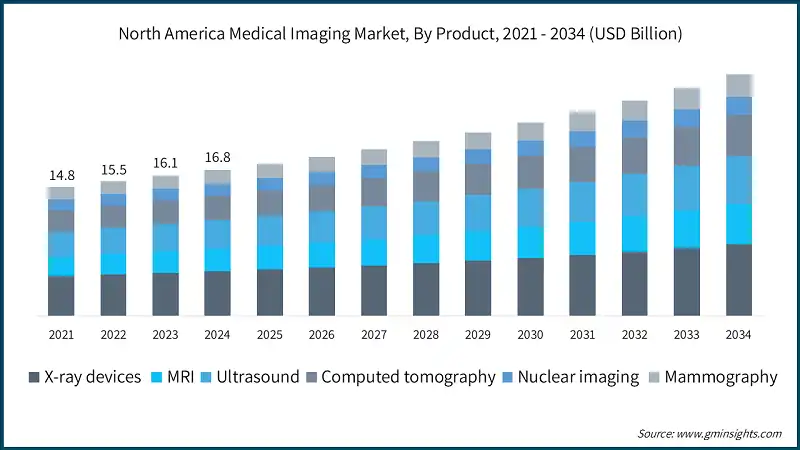
The North America medical imaging market was valued at USD 16.8 billion in 2024 and is projected to grow from USD 17.5 billion in 2025 to USD 27.7 billion by 2034, expanding at a CAGR of 5.2%, according to Global Market Insights Inc.

To get key market trends
The growth of the North America medical imaging market is driven by several factors, including the rising disease burden along with a rapidly growing geriatric population base, technological advancement of medical imaging systems, and growing healthcare expenditure in North America. Medical imaging uses various technologies in order to create visual representations of the interior part of the body for medical intervention and clinical analysis. Key players in this market include GE HealthCare Technologies, Siemens Healthineers, Koninklijke Philips, Canon Medical Systems, and Fujifilm Holdings.
The market value increased from USD 14.8 billion in 2021 to USD 16.1 billion in 2023, largely attributed to the increasing prevalence of various chronic disease conditions such as cancer, cardiovascular diseases, neurological disorders, and other chronic diseases. For instance, an estimated 129 million people in the U.S. have at least one major chronic disease, according to the U.S. Department of Health and Human Services. Moreover, about 5 of the 10 leading causes of death in the U.S. are either preventable or treatable chronic conditions. Over the past 2 decades, the prevalence of these diseases has steadily increased, and this trend is expected to continue. Furthermore, an increasing population of the U.S. is now dealing with multiple chronic conditions simultaneously. Thus, this increasing healthcare burden is fueling the need for timely and accurate diagnosis of the disease condition for appropriate treatment, thereby accelerating the growth of the market across the region.
Additionally, rising demand for organ transplantation creates a need for reliable medical imaging devices, as medical imaging plays a crucial role in nearly every stage of organ transplantation, from evaluating potential donors and recipients to guiding surgical procedures and monitoring the health of transplanted organs post-operation. For instance, according to the United Network for Organ Sharing, there were more than 7,000 living donor transplants and 17,000 deceased donor transplants in the U.S. in 2024, reflecting the growing scale of organ transplantation.
Similarly, in Canada, a total of 2,936 solid organ transplants were performed in 2022, marking a 6.8% increase from 2021. Thus, as organ transplantation procedures become more frequent and complex, the demand for precise and reliable imaging solutions continues to rise, accelerating the growth of the North American medical imaging market.
Medical imaging uses various technologies to create visual representations of the interior parts of the body for medical intervention and clinical analysis. These imaging technologies help healthcare professionals monitor and diagnose diseases, assess injuries, and guide treatment plans by providing detailed images of tissues, organs, and bones. Common medical imaging devices include CT scanner, medical X-ray, magnetic resonance imaging (MRI) systems, ultrasound, and others.
North America Medical Imaging Market Trends
- Technological advancement in medical imaging is a key trend for market growth in the region. These advancements are improving diagnostic accuracy, patient safety, and streamlining clinical workflows with the integration of artificial intelligence, low-dose imaging techniques, and faster image processing. Modern imaging systems are becoming more efficient and effective in clinical settings.
- The Revolution CT Scanner by GE HealthCare exemplifies this progress. It is a cutting-edge CT system designed for speed, precision, and patient safety. The scanner enables whole-organ imaging in a single rotation, significantly reducing motion artifacts and enhancing diagnostic accuracy. It incorporates advanced low-dose technologies such as ASiR-V and Smart Dose to minimize radiation exposure without compromising image quality.
- Therefore, as medical imaging technologies continue to transform, they are changing diagnostic capabilities and clinical outcomes, stimulating the growth of the medical imaging market across the region.
- Additionally, government initiatives and favourable reimbursement policies are playing an important role in increasing the adoption of medical imaging technologies across the region. Public healthcare systems and regulatory bodies across the region are investing in diagnostic infrastructure, subsidizing imaging procedures, and expanding insurance coverage to improve access to advanced imaging services.
- Such supportive frameworks help to reduce the financial burden on patients and healthcare providers and also encourage the widespread deployment of imaging technologies, further accelerating the growth of the medical imaging market.
North America Medical Imaging Market Analysis
Learn more about the key segments shaping this market
The market was valued at USD 14.8 billion in 2021. The market size reached USD 16.1 billion in 2023, from USD 15.5 billion in 2022.
Based on the product, the North America medical imaging market is segmented into X-ray devices, MRI, ultrasound, computed tomography, nuclear imaging, and mammography. The X-ray devices segment dominated the market in 2024. This segment was valued at USD 5.1 billion in 2024 and is projected to reach USD 8.2 billion by 2034, growing at a CAGR of 4.9%. In comparison, the MRI segment, valued at USD 2.6 billion in 2024, is expected to grow to USD 4.6 billion by 2034, with a CAGR of 6%.
- MRI is widely used due to its non-invasive nature, superior soft tissue contrast, and ability to provide detailed anatomical and functional insight without ionizing radiation.
- It is especially valuable in diagnosing neurological, musculoskeletal, cardiovascular, and oncological conditions. The versatility and safety of MRI make it a preferred modality across a broad range of clinical applications.
- For instance, the Siemens MAGNETOM Flow Platform is a compact, helium-independent 1.5T MRI system featuring DryCool technology, AI-powered imaging with Deep Resolve, and intelligent workflow automation. With scalable bore options and patient-friendly features such as BioMatrix Contour coils and ComfortSound audio, it enhances diagnostic precision and comfort, making it highly beneficial for widespread clinical adoption.
- Therefore, such advanced MRI systems are transforming diagnostic capabilities with improved efficiency, sustainability, and patient experience.
- Thus, as healthcare providers seek high-performance imaging solutions, the MRI segment continues to lead the market growth, driven by technological innovation and expanding clinical demand.
Learn more about the key segments shaping this market
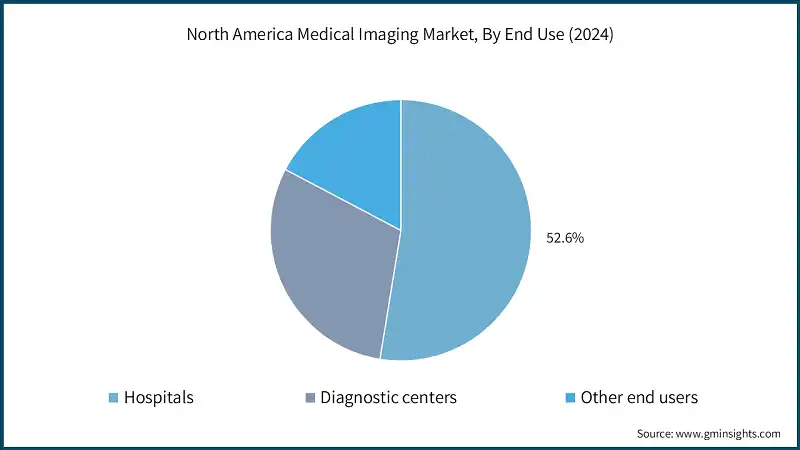
Based on end use, the North America medical imaging market is segmented into hospitals, diagnostic centers, and other end users. The hospitals segment accounted for the highest market share of 52.6% in 2024.
- Hospital represents a rapidly expanding segment in the North American medical imaging market due to their central role in delivering comprehensive diagnostic and treatment services, increasing patient volumes, rising demand for early and accurate diagnosis, and integration of imaging into routine clinical workflows, which are pushing hospitals to invest in advanced medical technologies.
- Additionally, the rising prevalence of chronic disease and the aging population in the region both lead to higher hospitalization rates. These patients often require frequent and detailed imaging for diagnosis, treatment planning, and monitoring, making an advanced imaging system essential in hospital settings.
- Moreover, the hospital also benefits from government funding, reimbursement support, and infrastructure upgrades, making them key adopters of high-end imaging systems in the region.
- Therefore, as hospitals prioritize precision diagnostics and operational efficiency, their growing adoption of advanced imaging solutions is significantly contributing to the expansion of the medical imaging market in North America.

Looking for region specific data?
U.S. dominated the North America medical imaging market, with the highest market share of 90.1% in 2024.
- The aging population is one of the major catalysts for the growth of the market in the U.S. Aging adults are more susceptible to chronic conditions such as cardiovascular disease, cancer, arthritis, and neurological disorders, all of which require frequent and detailed imaging for diagnosis, monitoring, and treatment planning. Thus, as life expectancy rises, the demand for non-invasive high-precision imaging continues to grow.
- For instance, the number of individuals in the U.S. aged 65 and older is projected to increase from 58 million in 2022 to 82 million by 2050, representing a 47% increase, highlighting the growing need for age-related healthcare services, including advanced imaging.
- Moreover, healthcare spending in North America, particularly in the U.S., is steadily increasing, reflecting a growing emphasis on advanced diagnostics and patient care. This surge in expenditure enables greater investment in cutting-edge medical technology, including imaging systems across hospitals and diagnostic centers.
- For instance, in 2023, the U.S. spent USD 4.9 trillion on healthcare, equating to USD 14,570 per person and accounting for 17.6% of the nation’s GDP. This marks a 7.5% increase from the previous year, according to the Centers for Medicare & Medicaid Services (CMS), highlighting the country’s expanding healthcare infrastructure and resource allocation.
- Therefore, as healthcare budgets grow and healthcare systems focus on early disease diagnosis, the demand for advanced imaging technologies continues to rise, accelerating growth in the medical imaging market across the country.
Canada medical imaging market was valued at USD 1.4 billion and USD 1.5 billion in 2021 and 2022, respectively. In 2024 the market size reached USD 1.7 billion from USD 1.6 billion in 2023.
- The rising prevalence of chronic diseases in Canada is a major factor propelling the adoption of medical imaging services, which is estimated to reach USD 1.07 trillion by 2034. Conditions such as cardiovascular disease and cancer require frequent high-resolution imaging for early detection, diagnosis, treatment planning, and ongoing monitoring, making advanced imaging technologies essential in clinical care.
- For instance, as per the data from Statista, cardiovascular diseases are the second leading cause of death in Canada, accounting for 17.2% of all deaths in 2022, with an estimated 76,639 fatalities from major heart-related conditions.
- Similarly, cancer poses a significant health challenge in the country. For instance, according to Statistics Canada, over two in five Canadians are expected to develop cancer in their lifetime, and one in four is expected to die from it.
- Therefore, as the prevalence of chronic disease conditions continues to rise, so does the demand for accurate and technologically advanced medical imaging, thereby fostering the market growth in the country.
North America Medical Imaging Market Share
- Key players, including GE HealthCare Technologies, Siemens Healthineers, Koninklijke Philips, Canon Medical Systems, and Fujifilm Holdings, collectively hold 91% of the North America market share.
- These companies maintain their leadership through diverse product portfolios, strategic collaborations, regulatory approvals, and ongoing innovation. GE HealthCare Technologies Inc. stands out due to their comprehensive range of medical imaging systems, widely adopted in hospitals and diagnostic centers.
- Siemens Healthineers has strengthened its market position through product launches and regulatory approvals. For instance, in June 2023, Siemens Healthineers received FDA clearance for the Magnetom Flow.Ace, its first 1.5 Tesla MR imaging system featuring a closed helium circuit and no quench pipe, reducing helium dependency. With a 60 cm bore, this scanner is also the company’s first MR system designed for both general radiology and veterinary use. It supports a full spectrum of MR applications and leverages AI-based image reconstruction to deliver faster scans with enhanced image quality. The system includes a wide array of contour and specialized MR coils suitable for various human anatomies, along with dedicated coils for veterinary imaging. This regulatory approval strengthens the company’s product portfolio and enhances its competitive position in the market.
North America Medical Imaging Market Companies
Few of the prominent players operating in the North America medical imaging industry include:
- Canon Medical Systems
- Carestream Health
- Esaote
- Fujifilm Holdings
- GE HealthCare Technologies
- Hologic
- Konica Minolta
- Koninklijke Philips
- Samsung Medison
- Shimadzu
- Siemens Healthineers
- Hologic
Hologic, headquartered in the U.S., is a medical technology company specializing in women's health. It offers a comprehensive range of imaging systems, diagnostic tools, and screening technologies. The company's product portfolio is designed to support the detection, diagnosis, and treatment of various health conditions affecting women.
- Koninklijke Philips
Koninklijke Philips is a company engaged in the development, manufacturing, and delivery of innovative solutions across healthcare, lighting, and consumer lifestyle sectors. In healthcare, Koninklijke Philips offers a broad portfolio of products and services, including diagnostic imaging systems, patient monitoring solutions, healthcare informatics, and radiation dose management software. A significant portion of the company’s revenue is generated from the North American market.
- Shimadzu
Shimadzu Medical Systems USA, a subsidiary of Shimadzu, delivers advanced diagnostic imaging solutions across North America, with a strong presence and direct operations in key U.S. regions.
North America Medical Imaging Industry News:
- In July 2025, Siemens Healthineers invested USD 150 million in new projects and expanded U.S. facilities to boost manufacturing and R&D capabilities. This move is expected to strengthen its commitment to the U.S. market, support medical imaging innovation, and enhance supply chain resilience.
- In April 2024, Shimadzu Corporation, through its U.S. subsidiary Shimadzu Precision Instruments (SPI), completed the acquisition of California X-ray Imaging Services (CIS), making CIS a wholly owned subsidiary of SPI. Following the acquisition, CIS was integrated into Shimadzu Medical Systems USA (SMS), the medical systems division of SPI. This strategic move has strengthened Shimadzu’s operational footprint and market presence across North America.
The North America medical imaging market research report includes an in-depth coverage of the industry with estimates and forecast in terms of revenue in USD Million and from 2021 – 2034 for the following segments:
Market, By Product
- X-ray devices
- Digital
- Direct radiography systems
- Computed radiography systems
- Analog
- Digital
- MRI
- Ultrasound
- 2D Ultrasound
- 3D Ultrasound
- Other ultrasounds
- Computed tomography
- Nuclear imaging
- Mammography
Market, By End Use
- Hospitals
- Diagnostic centers
- Other end use
The above information is provided for the following countries:
- U.S.
- Canada
Frequently Asked Question(FAQ) :
Who are the key players in the North America medical imaging market?
Prominent players include Canon Medical Systems, Carestream Health, Esaote, Fujifilm Holdings, GE HealthCare Technologies, Hologic, Konica Minolta, Koninklijke Philips, Samsung Medison, and Shimadzu.
Which country dominated the North America medical imaging market in 2024?
The United States dominated the market with a 90.1% share in 2024, attributed to widespread adoption of advanced imaging technologies and a robust healthcare infrastructure.
What are the key trends in the North America medical imaging industry?
Key trends include advancements in AI-powered imaging, low-dose imaging techniques, faster image processing, and the development of efficient imaging systems like GE HealthCare's Revolution CT Scanner, which enhances diagnostic accuracy and patient safety.
What was the valuation of the X-ray devices segment in 2024?
The X-ray devices segment was valued at USD 5.1 billion in 2024 and is projected to grow to USD 8.2 billion by 2034, at a CAGR of 4.9%.
What was the market share of the hospitals segment in 2024?
The hospitals segment accounted for the highest market share of 52.6% in 2024, driven by the increasing adoption of advanced imaging systems in hospital settings.
What is the projected value of the North America medical imaging market by 2034?
The market is expected to reach USD 27.7 billion by 2034, fueled by innovations in imaging technologies, enhanced diagnostic accuracy, and improved clinical workflows.
What is the market size of the North America medical imaging in 2024?
The North America medical imaging market was valued at USD 16.8 billion in 2024, with a CAGR of 5.2% projected through 2034. Technological advancements, including AI integration and low-dose imaging techniques, are driving market growth.
North America Medical Imaging Market Scope
Related Reports