Summary
Table of Content

North America Hybrid Microgrid Market
Get a free sample of this report
Form submitted successfully!
Error submitting form. Please try again.
Thank you!
Your inquiry has been received. Our team will reach out to you with the required details via email. To ensure that you don't miss their response, kindly remember to check your spam folder as well!
Request Sectional Data
Thank you!
Your inquiry has been received. Our team will reach out to you with the required details via email. To ensure that you don't miss their response, kindly remember to check your spam folder as well!
Form submitted successfully!
Error submitting form. Please try again.
North America Hybrid Microgrid Market Size
- Growing concerns around power reliability are pushing utilities, campuses, and industrial sites across North America to take a closer look at hybrid microgrids. Many now see these systems as a practical way to keep critical operations running when the main grid falters, which in turn strengthens the overall business case. Many organizations also see advantages in having localized oversight, streamlined outage response protocols, and power systems that can balance renewable inputs with storage. These priorities are helping hybrid microgrids gain traction as a dependable part of long‑range continuity planning.
- Increasing focus on resilient electricity supply is accelerating hybrid microgrid adoption as communities look for dependable power during weather related outages and aging infrastructure challenges. For instance, the DOE’s 2024 ERA program included USD 366 million for 17 community-initiated microgrid and clean energy projects in 20 states, emphasizing the importance of reliable, decentralized energy systems and encouraging their adoption in North America.
- The growing use of advanced control software, predictive maintenance tools, and real-time energy management platforms is making hybrid microgrids more appealing to commercial and institutional customers. The software capabilities enable users to fine-tune, automate load decisions, and integrate different assets with less complexity. As grid edge technologies mature, organizations are embracing hybrid microgrids as a modern, data driven approach to energy operations.
The North America hybrid microgrid market was estimated at USD 880.3 million in 2025. The market is expected to grow from USD 1.04 billion in 2026 to USD 1.79 billion in 2035, at a CAGR of 6.2%, according to a recent study by Global Market Insights Inc.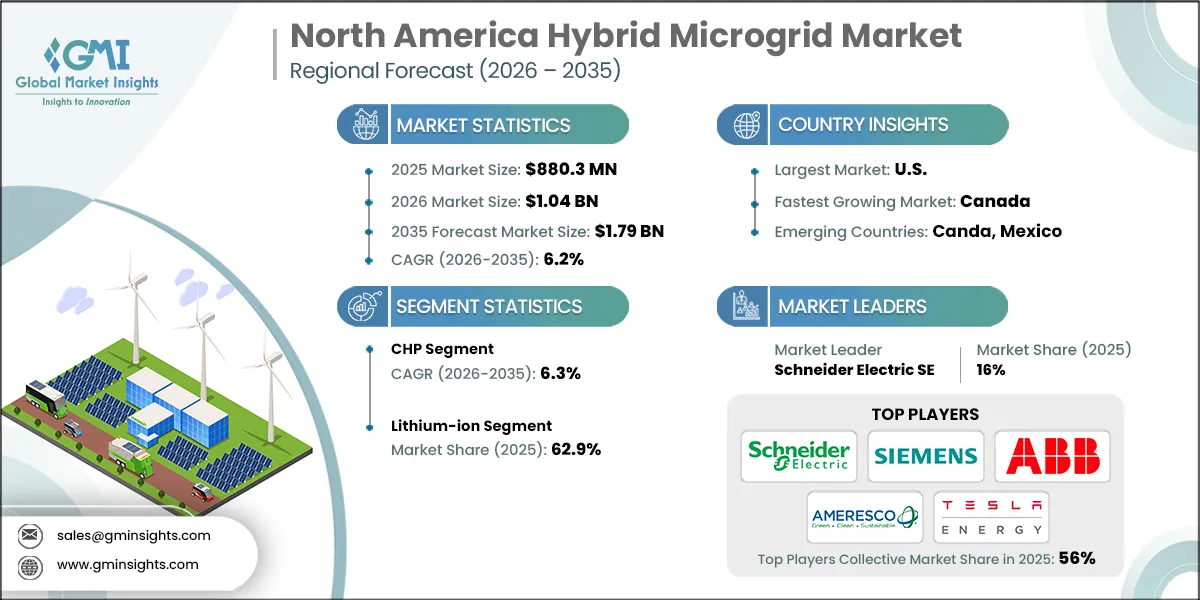
North America Hybrid Microgrid Market Key Takeaways
Market Size & Growth
- 2025 Market Size: USD 880.3 Million
- 2026 Market Size: USD 1.04 Billion
- 2035 Forecast Market Size: USD 1.79 Billion
- CAGR (2026–2035): 6.2%
Regional Dominance
- Largest Market: U.S.
- Fastest Growing Country: Canada
Key Market Drivers
- Rising demand for resilient, reliable power.
- Growing integration of renewable energy sources.
Challenges
- High upfront capital and deployment costs.
- Complex regulatory and permitting landscape.
Opportunity
- Expansion into remote and underserved regions.
- Growing innovation in storage and smart‑grid technologies.
Key Players
- Market Leader: Schneider Electric SE led with over 16% market share in 2025.
- Leading Players: Top 5 players in this market include Schneider Electric SE, Siemens AG, ABB, Ameresco, Tesla Energy, which collectively held a market share of 56% in 2025.
Get Market Insights & Growth Opportunities
To get key market trends
North America Hybrid Microgrid Market Trends
- Growing concerns about energy security are leading many companies and community operators to consider hybrid microgrids as a dependable backup plan. These systems help keep essential services running even when the main grid goes down. With natural disasters and cyber threats becoming more common, on‑site power is increasingly viewed as a smart, long‑term resilience move rather than a secondary upgrade.
- Rising federal funding is strengthening momentum for hybrid microgrids as agencies push for cleaner, more reliable local generation. The DOE’s USD 10.5 million commitment in May 2024 is a key step, directing funding toward microgrid research for underprivileged and Indigenous communities to lower development costs and improve energy resilience. This sustained policy backing is prompting utilities and local governments to expand hybrid microgrid initiatives.
- The increasing interest from the corporate world and the local communities is also leading to an increased adoption of hybrid systems, as many have started to see these systems as a means of reducing operational expenses and improving the reliability of operations while meeting corporate climate goals without necessarily having to upgrade the existing infrastructure.
North America Hybrid Microgrid Market Analysis
Learn more about the key segments shaping this market
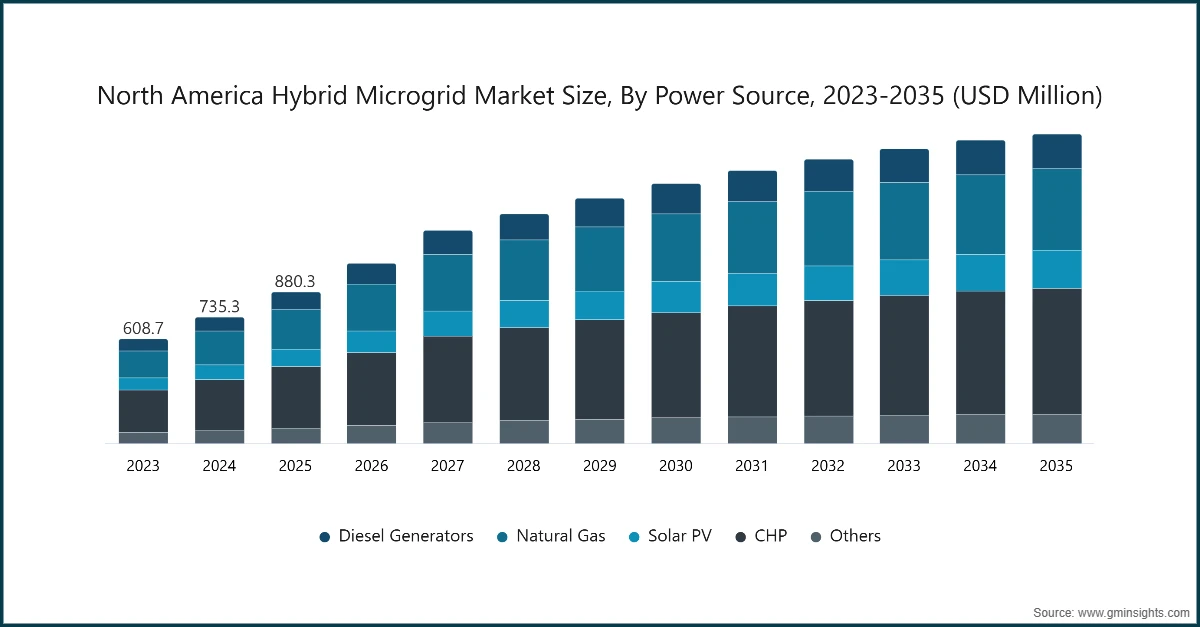
Based on power source, the North America hybrid microgrid market is segmented into diesel generators, natural gas, solar PV, CHP and others. The CHP segment dominated the market, accounting for 40.3% in 2025 and is expected to grow at a CAGR of 6.3% through 2035.
- Increasing reliance on uninterrupted power is pushing North American facilities to pair CHP systems with hybrid microgrids. CHP ensures a constant thermal and electrical power output, whereas the microgrid infrastructure ensures redundancy, distributed control, and smooth islanding during outages. Together, they create a balanced, efficient platform that organizations trust for long term operational continuity and energy planning, leading to strengthen its adoption.
- Moreover, growing interest in energy efficiency is motivating businesses to integrate CHP into hybrid microgrids to reduce fuel waste and improve asset utilization. The combined setup helps facilities capture more value from every unit of energy produced, lowering operating expenses while strengthening resilience. This synergy appeals to companies seeking predictable energy costs and a more strategic approach to energy management.
- Solar PV segment is expected to grow at a CAGR of 6.5% by 2035. Rising adoption of solar PV across North America is reinforcing the value of hybrid microgrids as organizations seek cleaner, more flexible power systems. According to the report from the U.S. Energy Information Administration, solar power contributed more than 50% of new capacity additions in 2025, marking the beginning of a sustained build-out that fits naturally with microgrid architectures. Additionally, increasing pressure to modernize energy infrastructure is pushing stakeholders to use solar based hybrid microgrids that can expand with evolving electricity needs, boosting the power source adoption.
Learn more about the key segments shaping this market
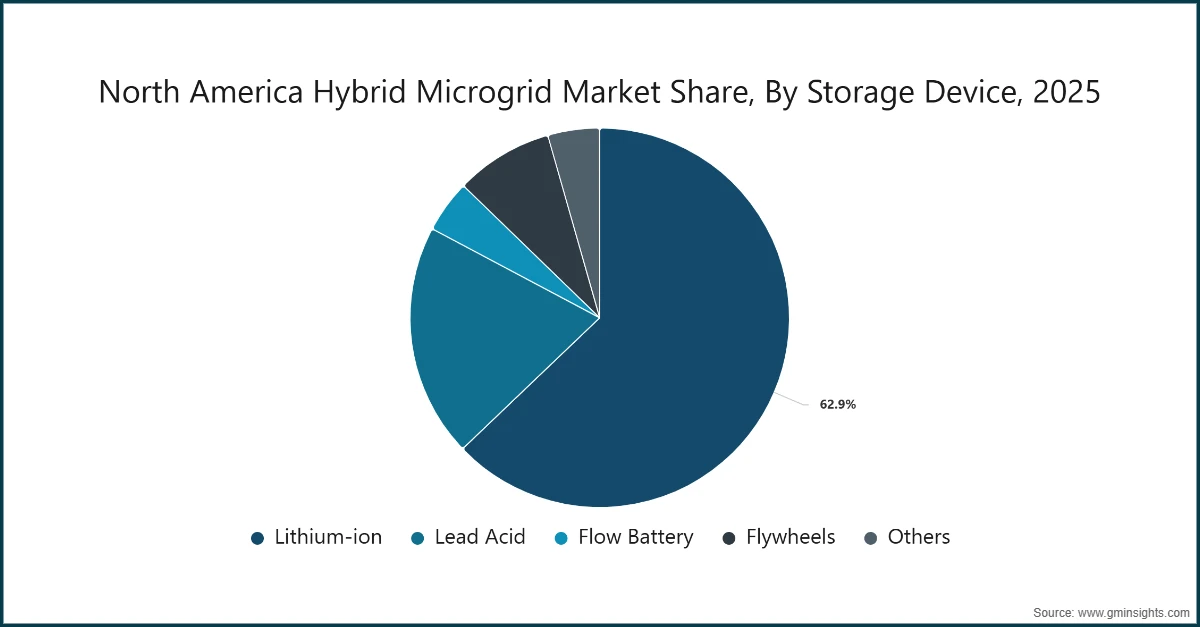
- Increasing demand for dependable storage is leading utilities and businesses to integrate lithium-ion systems into hybrid microgrids for faster response, higher efficiency, and reliable peak shaving. Additionally, the ongoing expansion of lithium‑ion manufacturing capacity in the U.S. is giving organizations more confidence in supply chains and long‑term support, encouraging broader adoption of hybrid microgrids. SEIA’s 2026 outlook notes that the country installed a record 57.6 GWh of storage in 2025, a 30% year‑over‑year increase that highlights the strong momentum behind large‑scale, resilience‑driven lithium‑ion projects.
- Flow battery is set to grow at a CAGR of more than 7.1% in the coming years. The rising focus on long-duration resilience solutions is fueling interest in flow batteries as a complement to hybrid microgrids. The natural safety features, non-flammable electrolyte, and ability to supply a steady multi-hour discharge rate make flow batteries highly suitable for use cases where predictable and risk-averse backup power is critical.
Looking for region specific data?
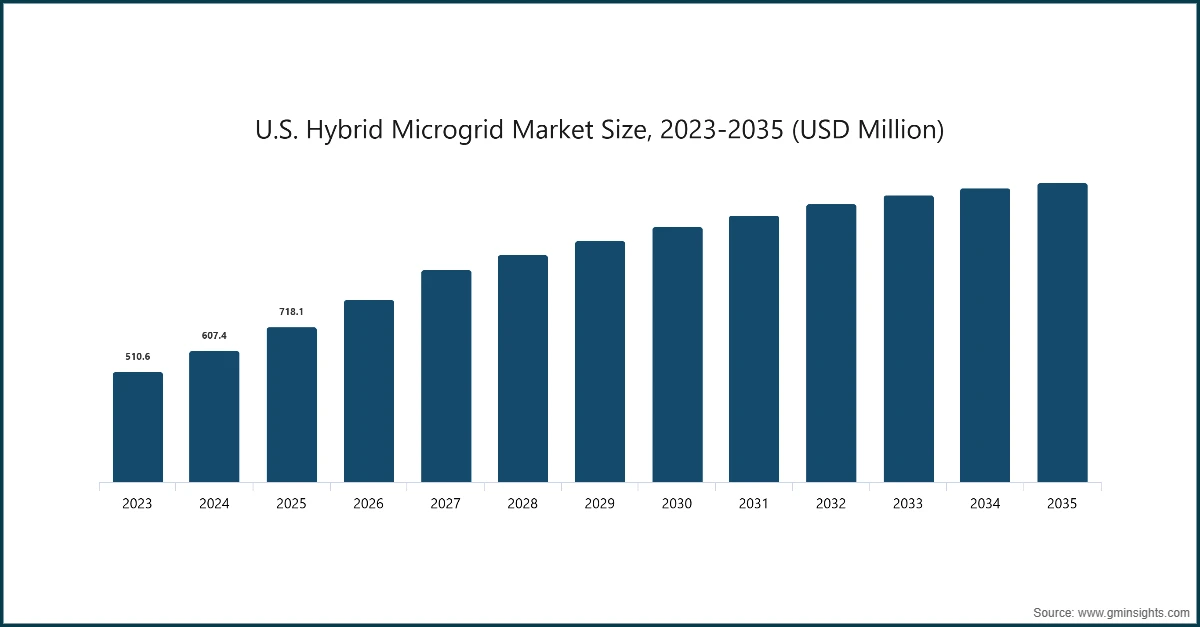
- The U.S. hybrid microgrid market is anticipated to grow by more than USD 1.3 billion by 2035. Expanded support from both federal and state governments is improving the financial outlook for hybrid microgrid deployments. Incentives ranging from the ITC to RPS policies and dedicated grant opportunities are lowering upfront barriers and encouraging long‑term planning. This policy push is making microgrids more attainable and appealing for organizations prioritizing energy resilience.
- Increasing exposure to hurricanes, wildfires, and grid disruptive storms is pushing communities and companies to look for energy systems that can stay operational during crisis conditions. For instance, as per a NOAA report, since 1980, the U.S. has experienced 403 billion-dollar weather disasters, of which hurricanes were the most destructive, causing total losses of more than USD 1.5 trillion, averaging a loss of USD 23 billion per storm. This necessitates the adoption of hybrid microgrids, which offer a dependable, island capable platform that keeps essential services running, making them a practical response to the growing need for resilience across North America.
- The growing emphasis on enhancing energy resilience is fueling the adoption of hybrid microgrids in Canada, especially in remote and northern regions that are prone to power outages and harsh climatic conditions. Organizations and local authorities are increasingly looking towards hybrid microgrids as a means of reducing reliance on diesel, improving operational reliability, and gaining access to a more stable form of locally controlled power.
North America Hybrid Microgrid Market Share
Leading companies are putting more resources into research and development to advance hybrid microgrid technologies. Their work focuses on better energy storage solutions, smoother grid integration, and more responsive control platforms. Many are also partnering with technology firms, energy providers, and universities to speed up innovation. At the same time, major players are expanding their capabilities through targeted mergers and acquisitions, helping them strengthen their portfolios and reach a broader set of customers.
North America Hybrid Microgrid Market Companies
Eminent players operating in the North America Hybrid Microgrid industry are:
- ABB
- Ameresco
- BoxPower Inc
- Caterpillar Inc.
- Clarke Energy
- ENGIE
- FlexGen Power Systems
- General Electric
- HOMER Energy
- Honeywell International
- Langley Holdings
- MTU Solution
- Piller Power Systems
- PowerSecure
- S&C Electric Company
- Schneider Electric SE
- Siemens AG
- Stellae Energy
- Tesla Energy
- Yanmar Holdings Co., Ltd
North America Hybrid Microgrid Market Report Attributes
| Key Takeaway | Details |
|---|---|
| Market Size & Growth | |
| Base Year | 2025 |
| Market Size in 2025 | USD 880.3 Million |
| Market Size in 2026 | USD 1.04 Billion |
| Forecast Period 2026-2035 CAGR | 6.2% |
| Market Size in 2035 | USD 1.79 Billion |
| Key Market Trends | |
| Drivers | Impact |
| Rising demand for resilient, reliable power | Rising concern over grid disruptions and extreme events is accelerating hybrid microgrid uptake, as organizations seek systems capable of operating independently and safeguarding critical operations during emergencies. |
| Growing integration of renewable energy sources | Growing deployment of renewables is driving hybrid microgrid adoption, as businesses and communities require flexible architectures that blend solar, wind, and storage to ensure stable, efficient, low‑carbon energy supply. |
| Pitfalls & Challenges | Impact |
| High upfront capital and deployment costs | High initial investment remains a key barrier, as hybrid microgrids require advanced storage systems, controls, and distributed assets, challenging budget‑constrained users despite long‑term operational savings. |
| Complex regulatory and permitting landscape | Complex permitting, varying state‑level standards, and slow policy updates can delay project execution, making microgrid deployment difficult and discouraging potential adopters across diverse North American jurisdictions. |
| Opportunities: | Impact |
| Expansion into remote and underserved regions | Hybrid microgrids offer major opportunities in remote and Indigenous communities seeking cleaner, more reliable alternatives to diesel, aligning with federal programs that support decentralized, resilient energy solutions. |
| Growing innovation in storage and smart‑grid technologies | Advancements in battery technologies, automation, and control systems create significant growth potential by improving microgrid efficiency, scalability, and renewable integration across commercial, industrial, and community‑scale deployments. |
| Market Leaders (2025) | |
| Market Leader |
16% market share |
| Top Players |
Collective market share of 56% |
| Competitive Edge |
Tesla Energy strengthens hybrid microgrids with Megapack—an integrated, utility‑scale storage system offering 99% uptime, rapid deployment, and strong grid‑stabilization capabilities. Its vertically integrated software and manufacturing scale make Tesla a leading provider for large, renewable‑centric microgrid installations in North America. |
| Regional Insights | |
| Largest Market | U.S. |
| Fastest growing market | Canada |
| Emerging countries | Canada, Mexico |
| Future outlook |
|
What are the growth opportunities in this market?
North America Hybrid Microgrid Industry News
- In August 2026, CleanAI is pushing the hybrid microgrid concept for AI data centers, integrating solar, storage, and gas to avoid the waiting time for interconnection. The strategy allows for faster execution and lower costs, although its current business model is viable only in the unique regulatory setup of Texas.
- In October 2023, the Power Solutions Division of Langley Holdings began a collaborative project to deliver hybrid renewable microgrid systems with Marelli Motori, Bergen Engines, and Piller Power Systems. The collaboration brings together the technical strengths of both companies to deliver a more cost-effective and efficient service to meet existing and future power requirements. The approach also helps reduce emissions, giving customers a cleaner and more resilient alternative to traditional energy systems.
North America hybrid microgrid market research report includes an in-depth coverage of the industry with estimates & forecast in terms of revenue and volume in “USD Million & MW” from 2022 to 2035, for the following segments:
Market, By Connectivity
- Grid connected
- Off grid
Market, By Power Source
- Diesel generators
- Natural gas
- Solar PV
- CHP
- Others
Market, By Storage Device
- Lithium-ion
- Lead acid
- Flow battery
- Flywheels
- Others
Market, By Application, 2022-2035
- Healthcare
- Educational institutes
- Military
- Utility
- Industrial/ commercial
- Remote
- Others
The above information has been provided for the following countries:
- U.S.
- Canada
- Mexico
Frequently Asked Question(FAQ) :
What is the market size of the North America hybrid microgrid market in 2025?
The market was valued at USD 880.3 million in 2025, driven by increasing demand for resilient and reliable power systems across commercial, industrial, and institutional facilities.
What is the current size of the North America hybrid microgrid industry in 2026?
The industry is projected to reach USD 1.04 billion in 2026, supported by rising investments in decentralized energy infrastructure and growing integration of renewable energy with storage systems.
What is the projected value of the North America hybrid microgrid market by 2035?
The market is expected to reach USD 1.79 billion by 2035, growing at a 6.2% CAGR, driven by increasing focus on energy resilience, grid modernization initiatives, and expanding deployment of renewable-integrated microgrid systems.
Which power source segment dominates the North America hybrid microgrid industry?
The CHP (combined heat and power) segment dominated the market with a 40.3% share in 2025, supported by its ability to deliver continuous thermal and electrical power while improving operational efficiency and energy reliability.
Which storage technology leads the North America hybrid microgrid market?
Lithium-ion storage systems led the industry with a 62.9% share in 2025, driven by their fast response time, high efficiency, and growing deployment in grid resilience and peak load management applications.
Which country leads the North America hybrid microgrid market?
The U.S. hybrid microgrid market dominates the regional industry and is expected to expand by more than USD 1.3 billion by 2035. Growth is supported by increasing government incentives, grid modernization programs, and rising need for resilient energy systems during climate-related power disruptions.
Who are the key companies operating in the North America hybrid microgrid industry?
Major companies in the industry include Schneider Electric SE, Siemens AG, ABB, Ameresco, Tesla Energy, Caterpillar Inc., Honeywell International, ENGIE, FlexGen Power Systems, and S&C Electric Company, focusing on advanced control systems, renewable integration, and energy storage technologies.
North America Hybrid Microgrid Market Scope
Related Reports