Summary
Table of Content

North America Fan Coil Unit Market
Get a free sample of this report
Form submitted successfully!
Error submitting form. Please try again.
Thank you!
Your inquiry has been received. Our team will reach out to you with the required details via email. To ensure that you don't miss their response, kindly remember to check your spam folder as well!
Request Sectional Data
Thank you!
Your inquiry has been received. Our team will reach out to you with the required details via email. To ensure that you don't miss their response, kindly remember to check your spam folder as well!
Form submitted successfully!
Error submitting form. Please try again.
North America Fan Coil Unit Market Size
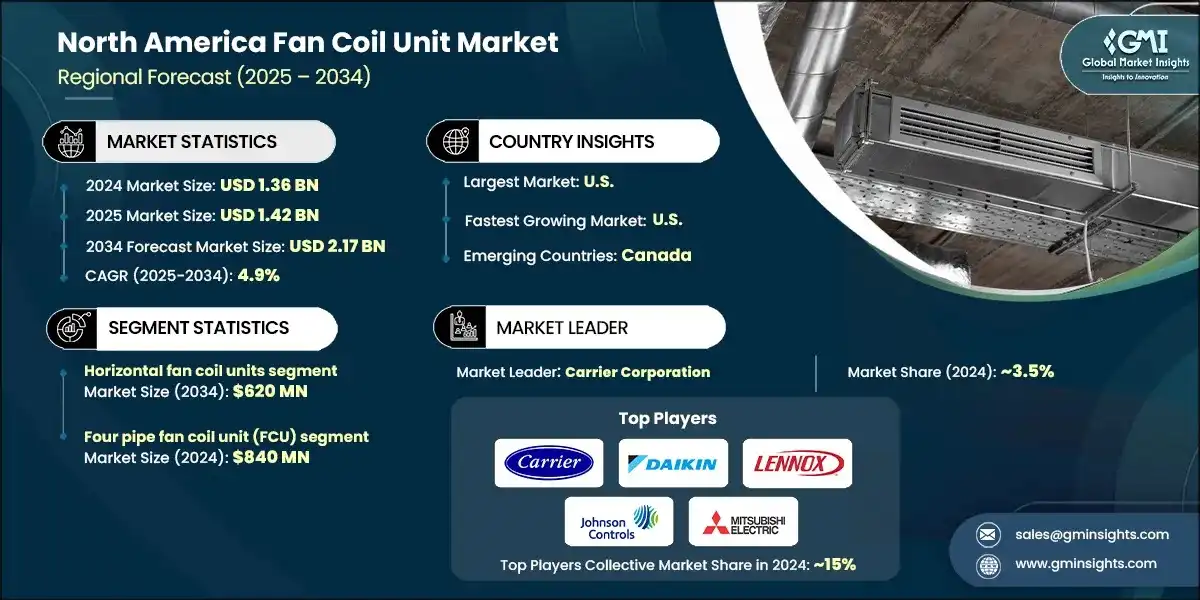
The North America fan coil unit market was estimated at USD 1.36 billion in 2024. The market is expected to grow from USD 1.42 billion in 2025 to USD 2.17 billion in 2034 at a CAGR of 4.9% according to latest report published by Global Market Insights Inc.
North America Fan Coil Unit Market Key Takeaways
Market Size & Growth
- 2024 Market Size: USD 1.36 Billion
- 2025 Market Size: USD 1.42 Billion
- 2034 Forecast Market Size: USD 2.17 Billion
- CAGR (2025–2034): 4.9%
Regional Dominance
- Largest Market: U.S.
- Fastest Growing Region: U.S.
Key Market Drivers
- Stringent Energy Efficiency Regulations.
- Rising Focus on Indoor Air Quality (IAQ).
- Growth in Commercial Construction and Retrofit Projects.
Challenges
- High Initial Capital Costs.
- Complexity in System Design and Integration.
Opportunity
- Integration of Smart and IoT-Enabled FCUs.
- Expansion into Green Building Certifications and Retrofit Programs.
Key Players
- Market Leader: Carrier Corporation led with over 3.5% market share in 2024.
- Leading Players: Top 5 players in this market include Carrier Corporation, Daikin Industries Ltd., Lennox International, Johnson Controls, Mitsubishi Electric Corporation, which collectively held a market share of 15% in 2024.
Get Market Insights & Growth Opportunities
The primary reason for growing interest in demand for fan coil units is energy efficiency regulations established in North America. New guidelines established by the U.S. Department of Energy (DOE) and others require HVAC (heating, ventilation, and air conditioning) appliance manufacturers to develop innovative technology so that their products meet minimum energy performance standards as detailed in Title 10 of Code of Federal Regulations, Section 431 (CFR 431). In addition to reducing energy usage and CO2 emissions, the new standards are expected to produce savings of approximately $33 billion within the next 30 years. For FCUs, which provide heating and cooling to residential and commercial buildings, this means that manufacturers will be forced to create new designs with variable speed motors and optimized heat exchanger designs to meet compliance requirements. This will ultimately create opportunities for innovative manufacturers that produce energy efficient FCUs, which can assist building owners in achieving their sustainability efforts. The DOE estimates that using these new standards will save American consumers between $2.5 billion and $12.2 billion in energy bills over the next 30 years. As a result, building owners will be motivated to purchase FCUs that comply with or exceed the new standard, creating further demand in all commercial and institutional segments of the marketplace.
Indoor air quality (IAQ) has been an increasing trend in commercial building design. According to the U.S. Environmental Protection Agency, Americans spend approximately 90% percent of their time indoors where the concentrations of airborne pollutants may be 2 to 5 times greater than those found outdoors, and poor IAQ has been associated with respiratory illnesses, allergies, and reduced employee productivity.
Therefore, the IAQ has led to stricter requirements for the ventilation and filtration of IAQ in commercial buildings. The use of fan coil units (FCUs) with advanced filtration (HEPA, MERV, etc.) and humidity controllers will assist in meeting IAQ requirements. This trend is indicative of how the building industry is shifting towards wellness-focused buildings. HVAC systems used for providing Thermal Comfort (i.e. heating and cooling) for occupants have now also become a viable means of promoting occupant wellness through the management of the IAQ. Quantitatively, improvements to the IAQ will result in reduced absenteeism, reduced health care costs, and will generate measurable revenues for employers. An example of how to manage IAQ in Federal buildings is found in the General Services Administration (GSA), which has a mission to provide IAQ management as part of their vision for providing high-quality work environments for Federal employees and references ASHRAE Standards 55 and 62.1 for ventilation and thermal comfort to ensure the provision of high-quality work environments to Federal employees and creates a demand for the purchase of FCUs outfitted with integrated air purification technologies.
The level of activity in the commercial construction marketplace in the United States is still strong as indicated by the Census Bureau's report that nonresidential construction activity will reach a total of $736.7 billion by July 2025. There is also a long-term initiative called the U.S. Department of Energy (DOE) Better Buildings Challenge whose goal is to increase the energy performance of commercial and institutional buildings by 20% over a period of ten years. These two areas represent a unique opportunity for both new projects to have energy-efficient equipment included and the opportunity to retrofit older buildings to comply with energy-efficiency standards as well as indoor air quality (IAQ) standards. The retrofit market is particularly important because of the number of older commercial buildings that have simple heating, ventilation, and air conditioning (HVAC) systems that are not in compliance with current codes. According to data from the U.S. Energy Information Administration (EIA), there are approximately 5.9 million commercial buildings in the United States that consume 6.8 quadrillion British thermal units (BTUs) of energy per year. The retrofitting of these buildings with modern energy-efficient fan coil units (FCUs) will provide significant savings in operating costs, as well as reductions in their carbon footprints, thus providing property owners with a strong incentive to invest in these projects.
To get key market trends
North America Fan Coil Unit Market Trends
The HVAC industry is undergoing a significant transformation in product design, driven by energy efficiency and digital integration. The U.S. Department of Energy’s Building Technologies Office emphasizes R&D for next-generation HVAC systems, including grid-interactive and IoT-enabled solutions that optimize energy use and allow predictive maintenance.
- Leveraging motors with variable speeds, upgraded filters and smart sensor technology has allowed manufacturers to create a more sustainable infrastructure in FCUs. This evolution also supports the movement towards using FCUs as part of a smart building vs. as stand-alone units.
- The need for compliance with regulations is driving manufacturers to modify product positioning strategies. For instance, the Department of Energy has changed their air conditioner and heat pump testing procedures to include additional efficiency metrics with the addition of SEER2 & HSPF2. These measurements indirectly change how designers create FCU products. The Section 608 requirement of the Clean Air Act (which is enforced by the EPA) regarding refrigerant management, has encouraged innovation by establishing required refrigerant management that prevents excessive greenhouse gases using low GWP refrigerant products, and ultimately modifies the way FCU systems must be designed/operate to comply. Manufacturers that do not quickly respond to the regulatory standards risk financial penalties, as well as loss of market share; therefore, it is essential for manufacturers to remain agile to respond to these compliance regulations.
- Consumers are increasingly aware of their health and have begun to question the adequacy of indoor air quality products available to the public. Organizations such as the American Lung Association have continued to create greater awareness of the dangers associated with combustion appliance fumes and promote zero-emission requirements. As consumers become more aware of the IAQ benefits and how they relate to sustainability, many suppliers now shift their marketing focus to emphasize these benefits with the use of sustainability marketing strategies, as well as certifications (i.e., ENERGY STAR and LEED). In addition to promoting IAQ products, contractors and OEM manufacturers are now providing service-based solutions, such as maintenance contracts and monthly energy audits, to compete in the highly fragmented marketplace identified in the DOE Better Buildings program. This indicates a transition away from price-based competition towards value proposition-driven offerings that focus on health, efficiency, and compliance with state and federal regulations.
North America Fan Coil Unit Market Analysis

Learn more about the key segments shaping this market
Based on the product type, the market is segmented into horizontal fan coil units, vertical fan coil units, console fan coil units, cassette fan coil units, and EC motor fan coil units. The horizontal fan coil units segment was valued at USD 430 million in 2024 and is projected to reach USD 620 million by 2034.
- Horizontal FCUs are increasingly preferred due to the level of flexibility they offer in terms of installations in both commercial and residential applications, as well as their ability to create maximized usable floor spaces by utilizing ceiling-mounted units. Concealment of horizontal FCUs in false ceilings will allow for a more unified overall building aesthetic and also ensure the effective distribution of air. These features help to match the current trends within modern architectural design, where the ideals are minimal visual obstruction and open layouts, making horizontal FCUs the unit of choice for office buildings, hotels and luxurious residential construction.
- Horizontal FCUs often provide greater access for servicing than other configurations due to the method of installation (i.e., putting them into easily accessible ceiling spaces, compared to vertical shafts or floor mounts that require accessibility). Thus, the reduced servicing time and labor associated with servicing horizontal FCUs provides a distinct advantage for large commercial buildings or facilities that contain multiple units. The standardized designs and universal product availability of most horizontal FCUs further assist in lowering the cost of procurement and installation, also ensuring that they remain the product of choice for any project that is extremely cost-sensitive and will still perform at a high level.
Learn more about the key segments shaping this market
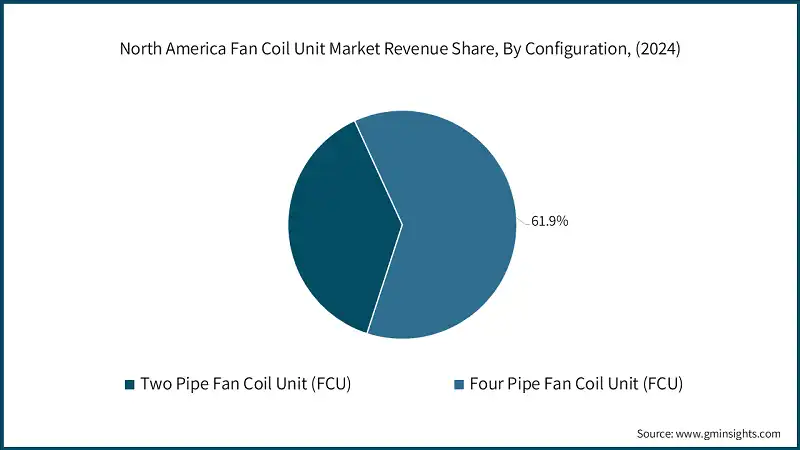
The fan coil unit market by configuration is segmented into two pipe fan coil units (FCU) and four pipe fan coil units (FCU). The four pipe fan coil unit (FCU) segment was worth USD 840 million and has a market share of around 61.9% in 2024.
- The four-pipe fan coil unit (FCU) has become the preferred choice for cooling large buildings due to its ability to provide simultaneous heating and cooling capabilities. Many commercial building types require simultaneous heating and cooling, such as hotels and large-scale offices. This means that while one side of the building needs heat, the opposite side may need cooling. Four-pipe fan coil units can provide both heating and cooling simultaneously, thus allowing for continuous operation and eliminating the delays that occur when switching from one type of system to another. Additionally, the ability to independently control the heating and cooling circuits of each FCU reduces the amount of wasted energy and maximizes the comfort level of occupants during extreme temperature differences and changing occupancy patterns, thus resulting in reduced energy costs and increased comfort level of occupants. Therefore, four-pipe fan coil units represent a solution to the issue of reconciling the needs of Sustainable Design, Regulatory Compliance, and Occupant Comfort; hence, they are the preferred solution for many high-performance projects.
- Four-pipe fan coil units are commonly used in hospitals, luxury hotels, and large corporate offices, where occupant comfort and reliable operation are absolute requirements. Even though four-pipe systems tend to have a higher initial cost than two-pipe systems, the reduced operational disruptions and enhanced flexibility provided by four-pipe systems more than offset the difference in upfront costs, making them the number one choice within markets that are focused on performance rather than on first cost.
Looking for region specific data?
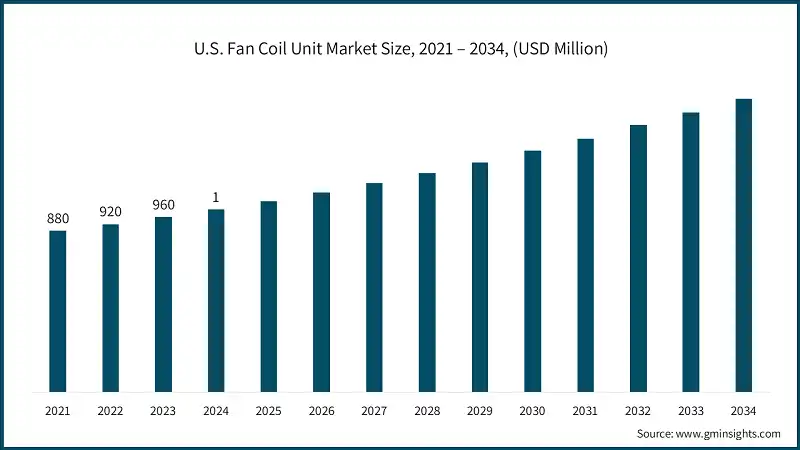
The North America fan coil unit market shows diverse dynamics across countries, shaped by economic development, and sustainability trends. The U.S. market was valued at around USD 1 billion in 2024 and is anticipated to register a CAGR of 4.9% between 2025 and 2034.
- The U.S. leads North America in construction spending, creating a strong demand base for HVAC systems, including FCUs. According to the data reported (November 2025) by U.S. Census Bureau, total construction spending in the country reached over $2 trillion annually, with nonresidential construction accounting for a significant share. This surge is driven by investments in office spaces, healthcare facilities, and hospitality projects, all sectors that heavily rely on FCUs for efficient heating and cooling. The scale and diversity of these projects position the U.S. as the primary growth engine for FCU installations.
- The U.S. Department of Energy (DOE) has enacted new energy-efficiency standards for HVAC systems (particularly commercial air conditioning units and heat pumps). The DOE estimates that these standards will save U.S. consumers $33 billion on their energy bills and reduce 134 million metric tons of CO2 emissions over the next 30 years. These standards promote the use of advanced fan coil units by building owners/developers to achieve compliance with the new standards, as emphasis is placed on sustainability and cost savings, leading to a more rapid replacement of outdated HVAC systems by the market.
- Air quality has also emerged as a national concern in the U.S.; the U.S. Environmental Protection Agency (EPA) reports that Americans spend approximately 90% of their day indoors, where pollutant concentrations are 2-5 times higher than the outdoors. Federal initiatives like the Clean Air in Buildings Challenge encourage the implementation of improved ventilation and filtration standards within commercial and institutional buildings; as such, demand for fan coil units with high-performance filtration and humidity control will increase, further establishing the U.S. as a leader in health-focused HVAC systems.
- Solutions Program from the US Department of Energy is designed to reduce carbon emissions in buildings that currently exist, which represent 70% of the buildings that will continue to be occupied by the year 2050. This Program creates significant potential for upgrading the many FCUs that will be in older buildings through energy-efficient retrofit initiatives. By focusing on both residential and commercial segments, these programs will help ensure continued demand for FCUs in the U.S., making it the largest market for FCUs in North America.
North America Fan Coil Unit Market Share
- The top 5 companies in the fan coil unit industry, such as Carrier Corporation, Daikin Industries, Ltd., Lennox International, Johnson Controls, and Mitsubishi Electric Corporation, hold a market share of 15%.
- The incorporation of IoT-supported Smart FCUs enhances Carrier's position within its market by addressing the growing need for energy-efficient HVAC systems that can be controlled remotely. Smart FCUs are part of a building management system and allow end-users to view real-time energy consumption and control their energy usage more effectively. BMS-enabled FCU systems in Commercial Buildings can reduce overall energy consumption by up to 20%. Additionally, Carrier has established a significant indirect channel to reach many different markets through its extensive network of distributors and service partners. Indoor air quality (IAQ) and Sustainability are key focus areas for Carrier and provide commercial customers with the tools necessary to comply with current Energy Efficiency Standards.
- The cornerstone of Daikin’s strategy is its FUSION 25 management plan that places emphasis on carbon neutrality, customer-connectivity solutions, and creating value via air. Daikin's aggressive growth strategy has been realized through strengthening production and distribution capabilities in emerging markets of growth in regions such as India and North America. Additionally, Daikin expects to continue expanding resources in R&D (research and development), digital transformation, and supply chain resilience over $5 billion. Product innovation for Daikin includes FCUs (fan coil units) utilizing eco-friendly refrigerants and cutting-edge filtration systems, which address regulatory requirements and customer desires for more sustainable indoor environments.
- By incorporating FCUs into the entire smart building ecosystem and benefiting from their extensive knowledge and experience in building automation and control, Johnson Controls improves its offerings and allows users to utilize every feature of those systems through its proprietary platforms such as Metasys, ensuring complete integration of all components. Moreover, the modularity and scalability of all products offered by Johnson Controls were engineered with commercial and institutionally acceptable environments in mind. By designing all of Johnson Controls products around energy optimization, customization and aftermarket service offerings, Johnson Controls guarantees both the continued retention of customers and the operational efficiency of those customers.
North America Fan Coil Unit Market Companies
Major players operating in the North America fan coil unit industry are:
- Aermec
- Carrier Global Corporation
- Climate Control Group (CCG)
- Daikin Industries
- Dunham-Bush
- Fujitsu General Limited
- Gree Electric Appliances
- Johnson Controls International
- Lennox International
- LG Electronics
- Mitsubishi Electric Corporation
- Swegon Group
- Systemair AB
- Trane Technologies
- TROX GmbH
Lennox has adopted a multi-pronged growth strategy focused on product innovation, strategic partnerships, and service expansion. A key move was its joint venture with Samsung HVAC, which led to the launch of advanced ductless mini-split and VRF systems featuring smart connectivity and low-GWP refrigerants. This collaboration allows Lennox to tap into the growing demand for energy-efficient and IoT-enabled HVAC solutions, positioning it strongly in both residential and commercial segments.
Mitsubishi Electric leverages a dual strategy of product innovation and strategic partnerships to maintain its leadership. The company has introduced low-GWP refrigerant-based heat pump systems under its Mitsubishi Electric Trane HVAC US joint venture, meeting new AIM Act requirements while enhancing energy efficiency and cold-climate performance. Furthermore, Mitsubishi Electric continues to pioneer Hybrid VRF systems, which reduce refrigerant use by up to 43% and improve safety and compliance with ASHRAE standards, making them ideal for institutional and commercial applications. On the distribution side, its collaboration with Trane ensures extensive dealer networks and integrated building automation solutions, enabling seamless adoption of advanced HVAC technologies across North America. By focusing on sustainability, regulatory compliance, and strong channel partnerships, Mitsubishi Electric withstands competitive pressures and positions itself as a preferred choice for high-performance, future-ready HVAC solutions.
North America Fan Coil Unit Market Report Attributes
| Key Takeaway | Details |
|---|---|
| Market Size & Growth | |
| Base Year | 2024 |
| Market Size in 2024 | USD 1.36 Billion |
| Market Size in 2025 | USD 1.42 Billion |
| Forecast Period 2025 – 2034 CAGR | 4.9% |
| Market Size in 2034 | USD 2.17 Billion |
| Key Market Trends | |
| Drivers | Impact |
| Stringent Energy Efficiency Regulations | Global HVAC manufacturers are accelerating innovation in fan coil units to meet international energy standards, driving widespread adoption of high-efficiency systems. |
| Rising Focus on Indoor Air Quality (IAQ) | Heightened health awareness worldwide is boosting demand for FCUs with advanced filtration and humidity control, making IAQ a key differentiator in global building design. |
| Growth in Commercial Construction and Retrofit Projects | Expanding commercial infrastructure and retrofit initiatives across emerging and developed economies are fueling large-scale FCU installations, strengthening global market penetration. |
| Pitfalls & Challenges | Impact |
| High Initial Capital Costs | Elevated upfront investment discourages small-scale projects and slows adoption in cost-sensitive regions, limiting overall market expansion. |
| Complexity in System Design and Integration | Technical challenges in integrating advanced FCUs into existing building layouts increase project timelines and costs, reducing market penetration in retrofit segments. |
| Opportunities: | Impact |
| Integration of Smart and IoT-Enabled FCUs | The growing trend toward smart buildings and IoT-based HVAC systems presents a significant opportunity for FCU manufacturers to develop units with intelligent controls, remote monitoring, and predictive maintenance capabilities. |
| Expansion into Green Building Certifications and Retrofit Programs | Increasing adoption of green building standards such as LEED and ENERGY STAR, coupled with government-backed retrofit programs, creates a strong demand for FCUs that meet stringent sustainability criteria. |
| Market Leaders (2024) | |
| Market Leaders |
Market share of ~3.5% |
| Top Players |
Collective market share in 2024 is 15% |
| Competitive Edge |
|
| Regional Insights | |
| Largest Market | U.S. |
| Fastest growing market | U.S. |
| Emerging countries | Canada |
| Future outlook |
|
What are the growth opportunities in this market?
North America Fan Coil Unit Industry News
- In March 2025, Trane introduced its fan coil wall platform with cooling capacity up to 400 kW specifically designed for data center thermal management. This innovation helps the company capture the rapidly growing mission-critical cooling market driven by AI and high-density computing demands.
- In November 2024, AAON purchased a 787,000 square-foot manufacturing facility in Memphis to expand production of thermal management equipment including computer room air handlers for data centers. This expansion helps the company meet surging data center cooling demand and diversify its manufacturing footprint to mitigate operational risks.
- In October 2024, Daikin launched new fan coil unit and air handling unit products for the North American market. This expansion helps the company strengthen its HVAC product portfolio and compete more effectively in commercial building applications.
- In July 2024, Johnson Controls announced a definitive agreement to sell its Residential and Light Commercial HVAC business to Bosch Group for USD 8.1 billion in an all-cash transaction. This divestiture helps Johnson Controls streamline its portfolio, focus on commercial building solutions, and return capital to shareholders while strengthening its balance sheet.
The North America fan coil unit market research report includes in-depth coverage of the industry, with estimates & forecasts in terms of revenue (USD Billion) and volume (Thousand Units) from 2021 to 2034, for the following segments:
Market, By Product Type
- Horizontal fan coil units
- Vertical fan coil units
- Console fan coil units
- Cassette fan coil units
- EC motor fan coil units
Market, By Configuration
- Two pipe fan coil units (FCU)
- Four pipe fan coil units (FCU)
Market, By Air Flow
- Below 500 m³/h
- 500 m³/h - 1000 m³/h
- 1000 m³/h - 1500 m³/h
- 1500 m³/h - 2000 m³/h
- Above 2000 m³/h
Market, By End Use
- Residential
- Commercial
- Office spaces
- Hotels
- Restaurants
- Hospitals
- Retail
- Supermarkets
- Departmental stores
- Brand outlet stores
- Logistics (warehouse)
- Others (manufacturing, etc.)
- Industrial
Market, By Distribution Channel
- Direct sales
- Indirect sales
The above information is provided for the following countries:
- U.S.
- Canada
Frequently Asked Question(FAQ) :
What is the market size of the North America fan coil unit in 2024?
The market size was USD 1.36 billion in 2024, with a CAGR of 4.9% expected through 2034 driven by stringent energy efficiency regulations and rising demand for high-efficiency HVAC systems.
What is the projected value of the North America fan coil unit market by 2034?
The North America fan coil unit market is expected to reach USD 2.17 billion by 2034, propelled by DOE energy standards, indoor air quality focus, and commercial construction growth.
What is the current North America fan coil unit market size in 2025?
The market size is projected to reach USD 1.42 billion in 2025.
How much revenue did the horizontal fan coil units segment generate in 2024?
Horizontal fan coil units generated USD 430 million in 2024 and is projected to reach USD 620 million by 2034, leading due to installation flexibility and space optimization.
What was the valuation of the four pipe fan coil unit (FCU) configuration segment in 2024? The four
pipe FCU segment held 61.9% market share and generated USD 840 million in 2024, dominating due to simultaneous heating and cooling capabilities.
Which country leads the North America fan coil unit market?
The U.S. fan coil unit market is projected to grow at a 4.9% CAGR till 2034, due to strong construction spending and DOE energy efficiency standards.
What are the upcoming trends in the North America fan coil unit market?
Key trends include integration of IoT-enabled smart FCUs with predictive maintenance, advanced filtration for indoor air quality, variable-speed motors, low-GWP refrigerants, and compliance with DOE SEER2/HSPF2 standards and green building certifications.
Who are the key players in the North America fan coil unit market?
Key players include Aermec, Carrier Global Corporation, Climate Control Group (CCG), Daikin Industries, Dunham-Bush, Fujitsu General Limited, Gree Electric Appliances, Johnson Controls International, Lennox International, LG Electronics, Mitsubishi Electric Corporation, Swegon Group, Systemair AB, Trane Technologies, and TROX GmbH.
North America Fan Coil Unit Market Scope
Related Reports