Summary
Table of Content

North America Electrical Bushing Market
Get a free sample of this report
Form submitted successfully!
Error submitting form. Please try again.
Thank you!
Your inquiry has been received. Our team will reach out to you with the required details via email. To ensure that you don't miss their response, kindly remember to check your spam folder as well!
Request Sectional Data
Thank you!
Your inquiry has been received. Our team will reach out to you with the required details via email. To ensure that you don't miss their response, kindly remember to check your spam folder as well!
Form submitted successfully!
Error submitting form. Please try again.
North America Electrical Bushing Market Size
- North American utilities are in a multi‑year grid‑modernization cycle that prioritizes new transmission corridors, reconductoring, and station upgrades. These programs translate directly into higher volumes of transformer, reactor, and switchgear installations, where bushings are essential current‑carrying insulation interfaces. Policy‑linked funding and facilitation mechanisms accelerate large projects and reduce financing friction, improving procurement visibility for long‑lead station components.
- For instance, in January 2025, DOE’s GRIP selections and related materials document federal support aimed at new lines, reconductoring and station equipment that increase transfer capability, accelerating procurement of substation components.
- Capital priorities have shifted decisively toward transmission stations and distribution system upgrades, driving steady consumption of bushings for transformers, breakers, and bus interfaces. Aging asset fleets, urban load growth, and integration of variable resources require capacity additions and equipment replacement programs. Substation rebuilds favor compact, higher‑performance bushing designs that meet stricter insulation and thermal margins while easing installation constraints.
- For example, in November 2024, EIA’s in‑brief analysis shows sustained growth in utility investment, with transmission spending nearly tripling since 2003 and recent increases concentrated in transmission station equipment, poles, and related software categories that directly implicate bushing demand in substations.
- System planners and reliability authorities emphasize increased transfer capability, resource adequacy, and resilience against extreme weather, all of which necessitate substation expansions and reinforcements. These initiatives generate sustained demand for apparatus bushings in autotransformers, phase‑shifting transformers, shunt reactors, HV breakers, and wall bushings. Policy reforms aimed at long‑term regional planning and interregional coordination support larger projects and reduce uncertainties, aligning utilities and ISOs around transparent, forward‑looking build plans.
- For reference, the 2024 LTRA highlights capacity/energy risks and underscores the need for transmission development and regional coordination, steering utilities toward timely network reinforcements that typically include substation equipment replacements and additions.
- Emerging offshore wind hubs and interregional HVDC links require converter stations, large AC/DC transformers, smoothing reactors, and GIS yards each with specialized bushing designs, often resin‑impregnated paper (RIP) or polymeric with DC grading and elevated creepage. Standardization efforts among states and system operators are encouraging common voltage platforms and interface requirements that scale supply chains and shorten procurement cycles.
- Onshore converter stations, export cable terminals, and networked HVDC nodes also prioritize compact footprints and fire safety, favoring dry‑type insulation and composite sheds. These trends open a differentiated market for bushings capable of handling DC stresses, pollution classes, and offshore environmental conditions.
According to a recent study by Global Market Insights Inc., the North America electrical bushing market was estimated at USD 1 billion in 2025. The market is expected to grow from USD 1.1 billion in 2026 to USD 1.8 billion by 2035, at a CAGR of 5.7%.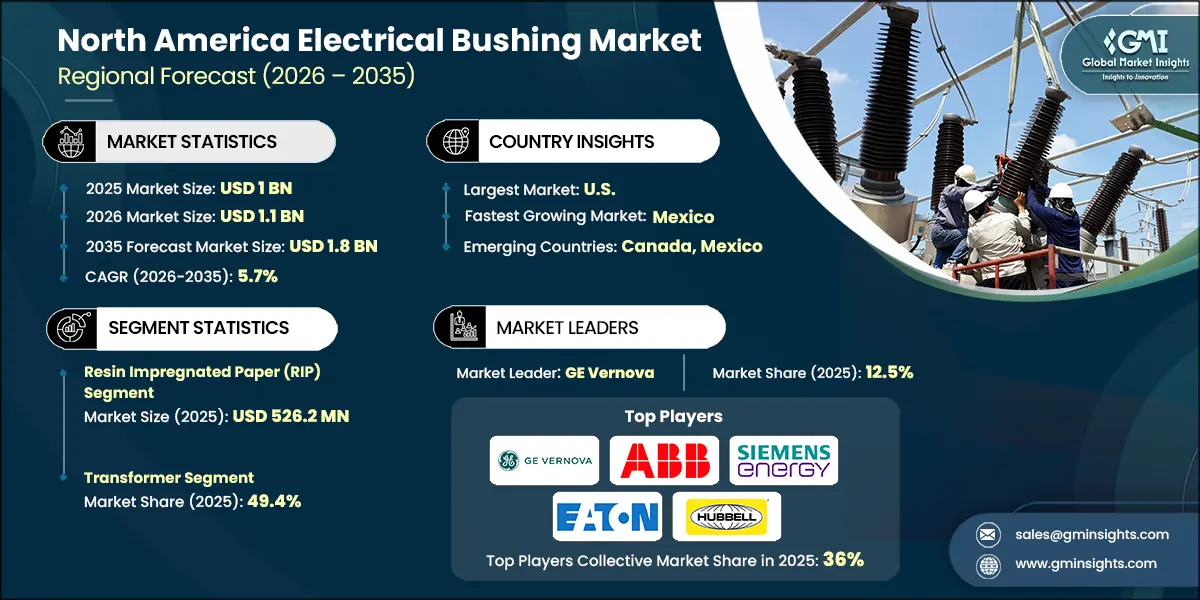
North America Electrical Bushing Market Key Takeaways
Market Size & Growth
- 2025 Market Size: USD 1 Billion
- 2026 Market Size: USD 1.1 Billion
- 2035 Forecast Market Size: USD 1.8 Billion
- CAGR (2026–2035): 5.7%
Regional Dominance
- Largest Market: U.S.
- Fastest Growing Country: Mexico
Key Market Drivers
- Refurbishment of existing grid networks.
- Rapid smart grid adoption.
- Escalating demand for reliable & continuous electricity.
Challenges
- Fluctuating raw material cost.
Opportunity
- Expansion of Renewable Energy Infrastructure.
- Modernization of Aging Substations.
- Rising Adoption of Smart Monitoring Technologies.
Key Players
- Market Leader: GE Vernova led with over 12.5% market share in 2025.
- Leading Players: Top 5 players in this market include GE Vernova, ABB, Siemens Energy, Eaton, Hubbell Power Systems, which collectively held a market share of 36% in 2025.
Get Market Insights & Growth Opportunities
To get key market trends
North America Electrical Bushing Market Trends
- Recent revisions to core bushing standards have sharpened test requirements and clarified application boundaries, pushing utilities to re‑baseline specifications for new builds and replacements. Engineers are prioritizing partial discharge behavior, impulse margins, thermal performance, and seismic robustness. This has a direct effect on sourcing, with a preference for designs validated against the latest standards and accompanied by rigorous factory testing and documentation.
- For illustration, in May 2023, the IEEE standards abstract confirms scope and applicability to liquid‑immersed transformer/reactor bushings, providing a definitive technical baseline for procurement and qualification in current projects.
- North America’s distribution and power transformer supply chains have been under pressure, but recent regulatory adjustments balance efficiency goals with manufacturability and implementation timelines. This improves predictability for transformer production slots and, by extension, bushing procurement for OEM builds and utility spares. Longer compliance horizons and materials flexibility enable factories to plan core materials and component buys more effectively, smoothing order books for associated bushings. As transformer lead times normalize, utilities can realign outage windows and replacement schedules, which stabilizes aftermarket bushing demand and reduces costly expedites that previously plagued project execution.
- For instance, in January 2024, Congressional Research Service (CRS) provided a concise, non‑partisan review of DOE’s proposed regulation history and material considerations (GOES vs. amorphous cores), framing how rule design can influence supply availability and downstream component ordering.
- Load growth from transportation electrification, advanced manufacturing, and hyperscale data centers is prompting utilities to add capacity and reinforce urban and suburban nodes. These projects require compact, high‑reliability substation equipment with enhanced thermal capability, pollution resistance, and maintainability criteria that elevate demand for modern bushing constructions and accessory kits. Substation expansions also accelerate adoption of GIS/GIL, where internal and wall bushings with precise dimensional standards serve as critical interfaces. As planners optimize for footprint, noise, and reliability, bushing specifications increasingly favor RIP/polymeric technologies with better contamination performance and compatibility with online monitoring.
- For reference, in November 2024, EIA noted sustained increase in utility capital spending and highlights recent growth in transmission station equipment outlays, which is aligned with capacity additions serving new electrified loads and data‑center clusters that necessitate high‑performance substation apparatus.
- Utilities operating in high fire‑threat districts are hardening infrastructure with covered conductor, targeted undergrounding, and equipment upgrades that reduce ignition risk and improve survivability. In these environments, bushings with hydrophobic polymeric sheds, higher creepage, and enhanced contamination resistance are favored, particularly for overhead equipment and substation terminations exposed to dust, salt, or smoke. Climate adaptation also raises the bar for temperature ratings, sealing systems, and mechanical robustness under wind and seismic forces.
- For illustration, in January 2025, Southern California Edison’s official wildfire‑safety pages detail grid‑hardening tactics such as covered conductor and targeted undergrounding. These programs necessitate coordinated station upgrades and component choices reinforcing demand for advanced insulators and bushings meeting higher creepage and contamination‑performance expectations.
North America Electrical Bushing Market Analysis
Learn more about the key segments shaping this market
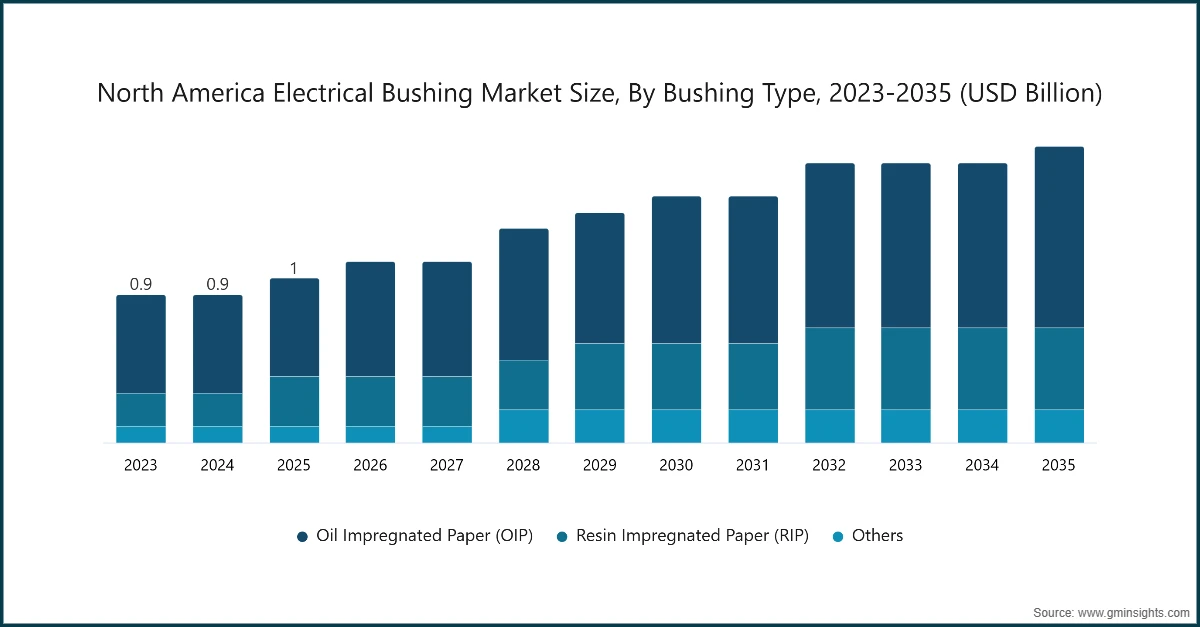
- Based on bushing type, the North America electrical bushing market is segmented into OIP, RIP, and others. The resin impregnated paper segment reached around USD 526.2 million in 2025 and is projected to grow at a growth rate of over 6.5% through 2035.
- RIP designs provide solid, oil‑free dielectric systems with capacitance grading and composite sheds that deliver hydrophobic behavior and longer creepage for coastal, desert, and pollution‑class environments. Their lighter weight, compact envelopes, and favorable seismic characteristics simplify handling and installation on transformers, reactors, and through‑wall terminations. With compatibility for AC and certain DC duties, RIP bushings align with substation modernization, GIS tie‑in points, and high‑reliability feeders. Suppliers offer RIP families across ratings, supporting footprint‑constrained yards and retrofits that aim to reduce maintenance while retaining stringent electrical performance targets.
- Procurement teams consider RIP where dry‑type safety, environmental preferences, and field performance under salt fog or smoke outweigh the legacy familiarity of oil‑paper designs. Current specifications often require conformity to the latest IEEE bushing requirements, rigorous factory testing, and interchangeability with existing terminals. RIP’s compatibility with online diagnostics leakage‑current, temperature sensing, and tan‑δ trending supports digital‑substation strategies and condition‑based maintenance programs, which North American utilities are scaling with grid‑modernization efforts.
- The condenser‑graded, oil‑paper construction delivers proven dielectric strength, robust heat dissipation, and long service life when paired with disciplined monitoring and maintenance programs. OIP offerings span AC and DC applications, with variants for oil‑to‑air, oil‑to‑oil, and oil‑to‑SF₆ interfaces, enabling flexible substation layouts and GIS/GIL interconnections. Their broad voltage coverage including extra‑high and ultra‑high classes supports backbone transmission upgrades, life‑extension projects, and uprates in legacy fleets, keeping interchangeability and dimensional standards central to procurement decisions.
- For illustration, In November 2024, Midwest Energy initiated USD 145 million in DOE‑supported transmission and substation upgrade projects under a USD 97 million Grid Resilience and Innovation Partnerships (GRIP) grant, replacing 150 miles of aging 115‑kV lines and modernizing multiple substations with new protection equipment and digital relays. These upgrades directly reinforce the role of OIP condenser‑graded bushings in backbone transmission rebuilds as utilities pursue higher reliability, improved thermal performance, and long‑life insulation systems.
- Furthermore, utilities increasingly emphasize partial‑discharge behavior, tan‑δ/power‑factor stability, thermal class alignment with transformer windings, and seismic robustness when approving OIP designs. Recent standards and utility revisions push tighter test regimes, documentation traceability, and compatibility with online monitoring hardware. Manufacturers address these requirements through condenser grading precision, optimized current paths, and engineered interfaces for bus ducts or GIS terminals. In practice, OIP bushings are selected for high‑ampacity, elevated basic impulse level (BIL) ratings, and field‑proven reliability in harsh climates.
- The others segment is set to exceed USD 200 million by 2035. Beyond OIP and RIP, solid dielectric capacitor bushings built with cycloaliphatic epoxy cores and composite sheds provide oil‑free, fire‑retardant, and contamination‑resistant alternatives. These designs are engineered for transformers, switchgear, wall/floor penetrations, and breaker interfaces, with capability to retrofit older porcelain units while offering safe failure modes and longer creepage. For medium‑voltage distribution, OEM bushings and bushing wells integrated into pad‑mounted equipment enable shielded, submersible connections aligned to IEEE separable connector standards.
Learn more about the key segments shaping this market
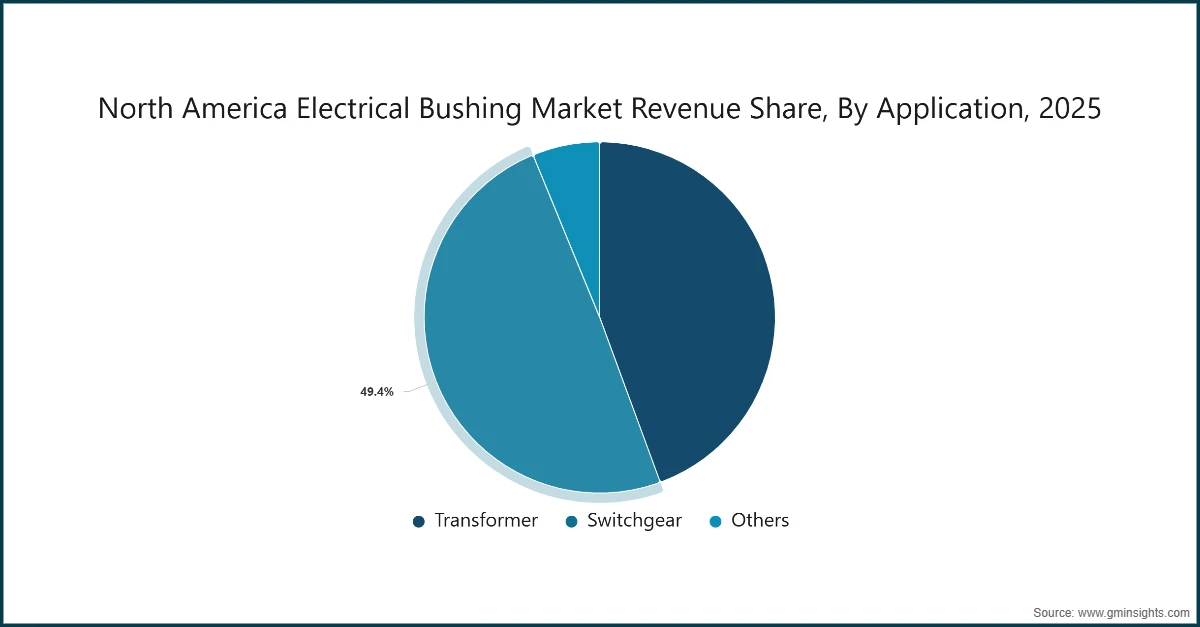
- Based on application, the industry is segmented into transformer, switchgear, and others. The transformer application across the North America electrical bushing market holds a share of 49.4% in 2025 and is projected to grow at a growth rate of over 4.5% through 2035.
- Transformers remain the largest application for electrical bushings, spanning generator step‑up units, autotransformers, shunt reactors, and distribution transformers across utility substations and industrial plants. Condenser‑graded designs (OIP/RIP) enable high dielectric strength, impulse performance, and current‑carrying capability for oil‑to‑air, oil‑to‑oil, and oil‑to‑SF₆ terminations, supporting both open‑air yards and GIS/GIL tie‑ins. As utilities rebuild and reconductor lines, replace aging fleets, and uprate capacity, transformer packages drive steady bushing demand, with specifications emphasizing PD behavior, creepage, and seismic robustness.
- Transformer‑related bushing procurement is reinforced by multi‑year North American grid‑modernization initiatives, including federal facilitation for long‑distance transmission and substation enhancements. These programs convert planning into funded projects, lifting orders for EHV transformer banks and associated bushings. Utilities’ capital outlays increasingly flow to transmission station equipment and supporting software, signaling sustained replacement and expansion cycles that prioritize high‑reliability components. In this context, qualified suppliers with breadth of voltage classes, rigorous factory testing, and documentation traceability are advantaged.
- In medium‑voltage switchgear, bushings enable safe, shielded connections between equipment enclosures and feeder circuits, often using IEEE 386‑compatible interfaces for loadbreak, deadbreak, and separable connectors. Utilities and OEMs specify bushing wells, inserts, and molded designs that meet submersible and dead‑front requirements for pad‑mounted or vault‑mounted gear. Priorities include compact footprints, operator safety, and interchangeability across feeder configurations. As distribution grids adopt automation and protection schemes, bushings must integrate with relays and sensors while maintaining dielectric margins under switching stresses.
- Digital substation practices are reshaping switchgear applications toward sensorized, “smart” bushings that provide data for condition‑based maintenance, especially in dense urban networks and critical facilities. OEM offerings now include monitoring‑enabled bushing interfaces for GIS and metal‑enclosed systems that enhance situational awareness, fault localization, and predictive analytics. These capabilities support utility objectives for reliability, safety, and rapid restoration, aligning with broader grid‑modernization aims. As utilities roll out automation and advanced controls, bushing designs that natively support measurement, communications, and diagnostics reduce retrofit complexity and improve lifecycle value, while maintaining compliance with prevailing application and test standards.
- Beyond transformers and switchgear, the “others” segment covers GIS/GIL connections, through‑wall and floor bushings for substations, oil circuit breakers, and generator terminals. Here, solid‑dielectric and composite options offer oil‑free, fire‑retardant insulation with long creepage and safe failure modes, making them attractive for confined yards, coastal/salt‑fog sites, and seismic zones. These designs also address retrofit needs by matching legacy porcelain geometries while improving contamination performance. In generator leads and wall penetrations, compact envelopes and robust mechanical strength are valued to simplify installation and reduce structural loads. Utilities often pair these selections with digital maintenance programs to minimize planned outage durations.
- Distribution apparatus, such as pad‑mounted transformers, reclosers, regulators, and sectionalizing gear, relies on medium‑voltage bushings and bushing wells that meet submersible, dead‑front, and interchangeability requirements. OEM catalogs provide standardized interfaces, higher BIL options, and copper conductor variants to balance thermal performance with compact dimensions. This supports fleet commonality and faster field replacements, an important consideration as utilities compress outage windows and standardize spares. Aftermarket activity benefits from cross‑reference tools and certified test records that streamline specification checking and acceptance.
Looking for region specific data?
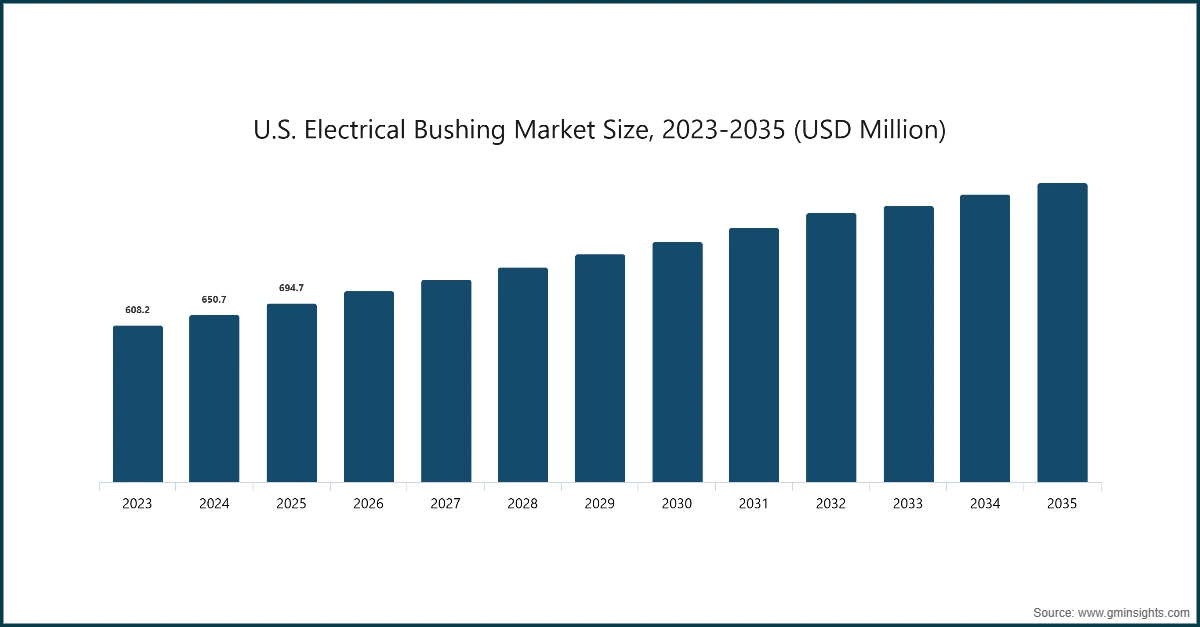
- The U.S. dominated the North America electrical bushing market in North America with around 67% share in 2025 and generated USD 694.7 million in revenue. In the U.S., grid‑modernization policy and planning reforms are converging to expand long‑distance transmission, unlock interregional transfers, and accelerate substation upgrades each a direct pull on high‑voltage bushings for transformers, breakers, and wall penetrations. DOE’s Grid Deployment Office is facilitating siting, financing, and transmission modeling, with plans to expand long‑distance capacity this decade. Meanwhile, regional planning and interconnection reforms under FERC are pushing needed network upgrades from study into execution.
- Rising electrification and fast‑growing data‑center loads are elevating reliability expectations and driving digital substation adoption, favoring monitoring‑ready RIP/composite bushings and higher BIL specifications. DOE’s national transmission analyses and program updates highlight the need to expand transfer capability and deploy state‑of‑the‑art technologies, while GDO award bulletins showcase projects moving from award to construction. EIA’s evidence of sustained station‑equipment spending growth underpins the replacement cycle for aging assets, with utilities specifying PD performance, seismic robustness, and sensor integration.
- For reference, in October 2024, the U.S. Department of Energy advanced large‑scale transmission expansion through its Transmission Facilitation Program, awarding up to USD 1.5 billion in capacity contracts to four major interregional lines and releasing its final National Transmission Planning Study a blueprint emphasizing the need for a 2–3× increase in transmission capacity to manage rising electrification and soaring data‑center loads.
- Canada’s federal programs are catalyzing grid upgrades that translate into steady bushing demand across transformer, GIS, and wall‑bushing applications. Natural Resources Canada’s Smart Renewables and Electrification Pathways (SREPs) Utility Support Stream and Smart Grid initiatives channel funding to grid modernization, storage, and T&D expansions coordinated with the Canada Infrastructure Bank. In Ontario, the IESO’s bulk planning updates and Annual Report point to substantial transmission reinforcements to accommodate electrification and emerging load centers, tightening substation timelines and equipment specifications. This policy‑plus‑planning alignment sustains multi‑year procurement for high‑voltage bushings across Canadian utilities.
- For instance, Hydro‑Québec’s Action Plan 2035 outlines major investments to add new generation, reinforce the 735‑kV backbone, build new lines, and add substations each requiring extensive high‑voltage bushing content for transformer banks and breaker bays. The utility is launching phases to construct hundreds of kilometers of new 735/315‑kV lines and multiple strategic substations to integrate new capacity and improve reliability.
- Mexico’s system planning through SENER’s PRODESEN sets the pathway for transmission expansion and modernization, underpinning multi‑year substation and transformer needs. The Federal Electricity Commission (CFE) is advancing dozens of transmission projects to improve reliability and accommodate new generation, with the IEA noting active expansion and modernization initiatives during 2024 - 2025. As projects progress from planning to construction, demand rises for HV/EHV bushings in new substations, reinforcements of existing nodes, and interconnection corridors, especially in fast‑growing industrial regions prioritized in federal strategies.
- Government announcements indicate significant capital to strengthen the National Transmission Network, including hundreds of new lines and more than five hundred substation works translating into substantial transformer and switchgear bushing procurement. These initiatives target modernization, loss reduction, and resilience while supporting industrial corridors and regional electrification. As CFE executes upgrades and predictive maintenance programs, specifications increasingly emphasize reliability and digital instrumentation compatibility, sustaining aftermarket and new‑build demand for high‑performance bushings across voltage classes.
North America Electrical Bushing Market Share
- The North America electrical bushing industry shows moderate consolidation, with GE Vernova, ABB, Eaton, Siemens Energy, and Hubbell Power Systems collectively accounting for around 36% market share of industry activity in 2025.
- Siemens Energy stands out as a leading force in the North America market, leveraging its deep heritage in grid infrastructure and high‑voltage component engineering. The company is recognized for delivering advanced bushings designed to support transformers, switchgear, and HV assets deployed across utility, industrial, and transmission applications. Siemens Energy emphasizes high‑reliability insulation technologies, integrating robust materials and precision‑engineered designs to enhance performance under demanding load, thermal, and environmental conditions. The company’s focus on digitalization also supports grid modernization efforts, offering bushings compatible with condition‑monitoring systems that help utilities optimize maintenance cycles and extend asset lifetimes.
- ABB emerges as a key participant in the North America Electrical Bushing landscape, drawing on its extensive portfolio in power equipment and grid reliability technologies. The company’s bushing offerings are engineered to support high‑voltage transformers, GIS equipment, and specialized industrial systems, ensuring safe insulation and efficient current transfer across critical applications. ABB prioritizes material innovation, delivering bushings that incorporate advanced resin‑impregnated and condenser core designs aimed at improving thermal stability, dielectric strength, and long‑term operational resilience. Its strong emphasis on quality assurance and rigorous testing standards positions the company as a preferred supplier for utilities undertaking system upgrades, substation refurbishments, and grid expansion projects.
- Eaton serves as an influential participant in the North America electrical bushing market, backed by its extensive experience in electrical equipment manufacturing and power distribution technologies. The company offers a comprehensive range of bushings tailored for transformers, switchgear, and medium‑to‑high‑voltage apparatus used across utility, commercial, and heavy‑industrial sectors.
- Eaton emphasizes safety, durability, and performance in its bushing designs, integrating robust insulation materials and advanced manufacturing processes to support long service life in diverse environmental conditions. Its solutions are particularly aligned with distribution grid modernization, where utilities are upgrading aging networks to enhance reliability, reduce outages, and integrate distributed energy resources. Eaton’s strong footprint across North America enables it to meet diverse customer needs, offering both standardized and application‑specific bushing configurations that comply with regional regulatory and utility‑grade performance requirements.
- GE Vernova stands out as a major contributor to the North America electrical bushing market, supported by its long‑established expertise in power transmission, transformer technology, and high‑voltage grid equipment. The company delivers an extensive portfolio of bushings engineered for power transformers, HV substations, and critical grid assets that require strong dielectric performance and operational reliability. GE Vernova emphasizes advanced insulation designs, integrating materials such as oil‑impregnated paper and resin‑impregnated systems to ensure high thermal endurance, mechanical stability, and long service life under fluctuating load conditions. Its focus on grid modernization aligns closely with North America’s broader infrastructure upgrade initiatives, allowing utilities to pair GE Vernova’s bushings with smart monitoring and diagnostics tools aimed at reducing unplanned outage.
- Hubbell Power Systems establishes itself as a prominent player in the North America Electrical Bushing landscape, building on its extensive legacy in utility‑grade components and distribution‑focused electrical equipment. The company specializes in providing bushings for transformers, switchgear, and a range of MV and HV apparatus, tailored to the needs of utilities, industrial operators, and critical‑infrastructure facilities.
- Hubbell Power Systems prioritizes rugged construction and superior insulation integrity, producing bushings that withstand harsh operating conditions, including extreme climates, heavy mechanical stress, and elevated electrical loads. Its product development approach emphasizes material innovation, employing high‑grade epoxy resins, advanced polymer composites, and precision manufacturing techniques to enhance dielectric strength and reduce maintenance needs. The company’s broad distribution and service presence across North America positions it as a reliable partner for utilities undergoing system hardening, storm resiliency initiatives, and grid modernization.
North America Electrical Bushing Market Companies
Major players operating in the North America electrical bushing industry are:
- ABB
- Barberi Rubinetterie Industriali S.r.l.
- CG Power and Industrial Solutions
- Eaton
- Elliot Industries
- General Electric
- GIPRO
- Hitachi Energy
- Hubbell
- Liyond
- Meister International, LLC
- Maschinenfabrik Reinhausen GmbH
- Nexans
- Polycast
- Poinsa
- PFISTERER Holding SE
- RHM International, LLC
- Siemens Energy
- Trench Group
- Siemens Energy reported an estimated USD 43 billion in revenue for fiscal year 2025. The company remains a strong participant in the North America electrical bushing industry through its advanced high‑voltage insulation technologies, robust engineering capabilities, and long‑proven reliability across transmission and substation assets. Siemens Energy’s bushing portfolio supports utilities undergoing grid modernization, system reinforcement, and renewable energy integration. Its focus on durable materials, enhanced thermal performance, and compatibility with digital monitoring solutions positions it as a preferred partner for utilities seeking long‑life bushings suited for evolving load patterns, environmental stresses, and increasing operational expectations across North American networks.
- Hubbell Incorporated reported approximately USD 5.69 billion in trailing‑twelve‑month revenue ending September 2025. As a key supplier in the North America electrical bushing market, Hubbell Power Systems leverages its strong presence in utility transmission and distribution hardware to deliver rugged bushings designed for demanding field conditions. Its focus on grid resilience, substation modernization, and T&D hardening aligns with accelerating investments by utilities addressing aging infrastructure and rising reliability expectations. Hubbell’s engineering emphasis on durability, environmental resistance, and lifecycle performance supports utilities expanding grid capacity, integrating load growth, and enhancing system dependability, solidifying its role as a trusted provider within North America’s power‑sector supply chain.
- Eaton reported USD 27.4 billion in revenue for full‑year 2025, reflecting strong growth across its electrical businesses. Within the North America electrical bushing market, Eaton provides high‑integrity, safety‑driven bushing solutions engineered for transformers, switchgear, and medium‑voltage equipment used by utilities and industrial facilities. The company emphasizes reliable insulation performance, advanced material technologies, and strong manufacturing quality to meet increasingly stringent grid performance requirements. With modernization initiatives advancing across the region.
North America Electrical Bushing Market Report Attributes
| Key Takeaway | Details |
|---|---|
| Market Size & Growth | |
| Base Year | 2025 |
| Market Size in 2025 | USD 1 Billion |
| Market Size in 2026 | USD 1.1 Billion |
| Forecast Period 2026-2035 CAGR | 5.7% |
| Market Size in 2035 | USD 1.8 Billion |
| Key Market Trends | |
| Drivers | Impact |
| Refurbishment of existing grid networks | Refurbishment of aging grid networks boosts demand for advanced electrical bushings, ensuring safer operation, extended asset life, and improved system reliability. |
| Rapid smart grid adoption | Rapid smart grid adoption accelerates integration of digital substations, increasing need for modern bushings compatible with monitoring, automation, and enhanced performance requirements. |
| Escalating demand for reliable & continuous electricity | Growing reliance on uninterrupted electricity drives utilities to upgrade high‑voltage infrastructure, strengthening demand for durable, high‑performance bushings supporting stable power delivery. |
| Pitfalls & Challenges | Impact |
| Fluctuating raw material cost | Fluctuating raw material costs create pricing instability for electrical bushings, challenging manufacturers’ margins and complicating long‑term procurement planning for North American utilities and OEMs. |
| Opportunities: | Impact |
| Expansion of Renewable Energy Infrastructure | Growing renewable energy installations create demand for advanced bushings supporting higher voltages, improved insulation, and reliable integration of variable generation across expanding transmission networks. |
| Modernization of Aging Substations | Utility initiatives to upgrade outdated substations open opportunities for next‑generation bushings offering enhanced performance, compact designs, and compatibility with digital monitoring systems. |
| Rising Adoption of Smart Monitoring Technologies | Increasing use of real‑time asset monitoring encourages deployment of sensor‑ready bushings designed for predictive maintenance, improved safety, and optimized grid reliability. |
| Market Leaders (2025) | |
| Market Leader |
12.5% Market Share |
| Top Players |
Collective market share of 36% |
| Competitive Edge |
|
| Regional Insights | |
| Largest Market | U.S. |
| Fastest growing market | Mexico |
| Emerging countries | Canada, Mexico |
| Future outlook |
|
What are the growth opportunities in this market?
North America Electrical Bushing Industry News
- In August 2025, Hubbell announced a definitive agreement to acquire DMC Power for USD 825 million, expanding its utility substation and transmission portfolio. The deal strengthens Hubbell Power Systems’ capabilities in high‑voltage connectivity, directly benefiting the bushing ecosystem by enhancing substation infrastructure readiness and T&D project execution.
- In August 2025, Eaton completed the acquisition of Resilient Power Systems Inc., reinforcing its power distribution and infrastructure offerings. This strategic move enhances Eaton’s position in providing advanced electrical components and grid‑support technologies, which complement its bushing‑related applications across transformers and switchgear.
- In April 2025, ABB released a new technical data sheet for its updated bushing portfolio, indicating the commercial rollout of refined bushing designs and specifications. This reflects ongoing product development in high‑voltage insulation components and contributes to modern grid reliability initiatives in North America.
- In February 2026, Siemens Energy finalized plans for a USD 1 billion U.S. manufacturing expansion, including new facilities and enhancements focused on high‑voltage grid components such as transformers and switchgear. This major investment boosts domestic production capacity and indirectly supports the electrical bushing supply chain through expanded grid‑equipment manufacturing.
The North America electrical bushing market research report includes in-depth coverage of the industry with estimates & forecast in terms of volume & revenue (‘000 Units & USD Million) from 2022 to 2035, for the following segments:
Market, By Bushing Type
- Oil Impregnated Paper (OIP)
- Mineral-Based
- Silicon-Based
- Others
- Resin Impregnated Paper (RIP)
- Others
Market, By Insulation
- Porcelain
- Polymeric
- Glass
Market, By Voltage
- Medium Voltage
- High Voltage
- Extra High Voltage
Market, By Application
- Transformer
- Switchgear
- Others
Market, By End Use
- Industries
- Utility
- Others
The above information has been provided for the following countries:
- U.S.
- Canada
- Mexico
Frequently Asked Question(FAQ) :
What is the market size of the North America electrical bushing in 2025?
The market size was estimated at USD 1 billion in 2025, with a CAGR of 5.7% expected through 2035. The growth is driven by grid modernization, increased transformer installations, and policy-linked funding mechanisms.
What is the projected value of the North America electrical bushing market by 2035?
The market is poised to reach USD 1.8 billion by 2035, fueled by advancements in bushing technologies, regulatory adjustments, and rising demand for high-reliability substation equipment.
What is the expected size of the North America electrical bushing industry in 2026?
The market size is projected to reach USD 1.1 billion in 2026.
How much revenue did the resin impregnated paper segment generate in 2025?
The resin impregnated paper segment generated approximately USD 526.2 million in 2025 and is expected to grow at a rate of over 6.5% through 2035.
What was the market share of the transformer application in 2025?
The transformer application held a 49.4% share of the market in 2025, with a projected growth rate of over 4.5% through 2035.
Which country dominated the North America electrical bushing sector in 2025?
The United States dominated the market with a 67% share in 2025, generating USD 694.7 million in revenue, driven by significant investments in grid modernization and substation upgrades.
What are the upcoming trends in the North America electrical bushing market?
Trends include adoption of RIP/polymeric technologies, enhanced contamination resistance, grid-hardening initiatives in fire-prone areas, and increased demand for GIS/GIL bushings with precise dimensional standards.
Who are the key players in the North America electrical bushing industry?
Key players include ABB, Barberi Rubinetterie Industriali S.r.l., CG Power and Industrial Solutions, Eaton, Elliot Industries, General Electric, GIPRO, Hitachi Energy, Hubbell, and Liyond.
North America Electrical Bushing Market Scope
Related Reports