Summary
Table of Content

North America Electric Insulators Market
Get a free sample of this report
Form submitted successfully!
Error submitting form. Please try again.
Thank you!
Your inquiry has been received. Our team will reach out to you with the required details via email. To ensure that you don't miss their response, kindly remember to check your spam folder as well!
Request Sectional Data
Thank you!
Your inquiry has been received. Our team will reach out to you with the required details via email. To ensure that you don't miss their response, kindly remember to check your spam folder as well!
Form submitted successfully!
Error submitting form. Please try again.
North America Electric Insulators Market Size
The rising demand for electricity, efforts to modernize the grid, and efforts taken by various authorities to build a reliable grid and minimize power outages are contributing to the growth of the sector. Government policies and investments in enhancing power grid infrastructure are adding to the growth of the sector. For instance, in August 2024, a major grid upgrade initiative was taken by the U.S. DOE, investing USD 2.2 billion in 18 states to strengthen the grid against climate-related challenges. Some of the key objectives include enhancing over 100 miles of transmission systems and integrating renewable energy sources.
North America Electric Insulators Market Key Takeaways
Market Size & Growth
- 2025 Market Size: USD 881.7 Million
- 2026 Market Size: USD 929.9 Million
- 2035 Forecast Market Size: USD 1.55 Billion
- CAGR (2026–2035): 5.8%
Regional Dominance
- Largest Market: U.S.
- Fastest Growing Country: Mexico
Key Market Drivers
- Rising investments for development of electric infrastructure.
- Refurbishment of existing grid networks.
- Ongoing adoption of smart grid along with initiatives toward clean power generation.
Challenges
- Fluctuating raw material cost.
Opportunity
- Growing investments in grid modernization.
- Expansion of renewable energy projects.
- Rising focus on grid resilience and climate adaptation.
- Technological advancement and material innovation infrastructure development.
Key Players
- Market Leader: Hitachi Energy led with over 14% market share in 2025.
- Leading Players: Top 5 players in this market include Hitachi Energy, Siemens Energy, TE Connectivity, LAPP Insulators, Hubbell, which collectively held a market share of 44% in 2025.
Get Market Insights & Growth Opportunities
Utilities and grid operators are actively replacing traditional insulator units and expanding transmission and distribution networks to support reliable electricity supply, focussing on refurbishment and upgrade activity, further accelerating product demand. Stringent mandates for improving reliability and resilience of grids, and occurrences of extreme weather conditions, have further strengthened capital expenditures on insulator systems used for medium and high-voltage applications.
For example, Transource Energy and BHE Transmission partnered in January 2026 to establish a significant high-voltage transmission line project in Wisconsin, USA, with the objective of enhancing regional grid reliability and resilience by constructing a 200-mile project that would improve regional connectivity and enable renewable energy sources to be integrated into the regional grid for efficient and environmentally friendly power delivery.
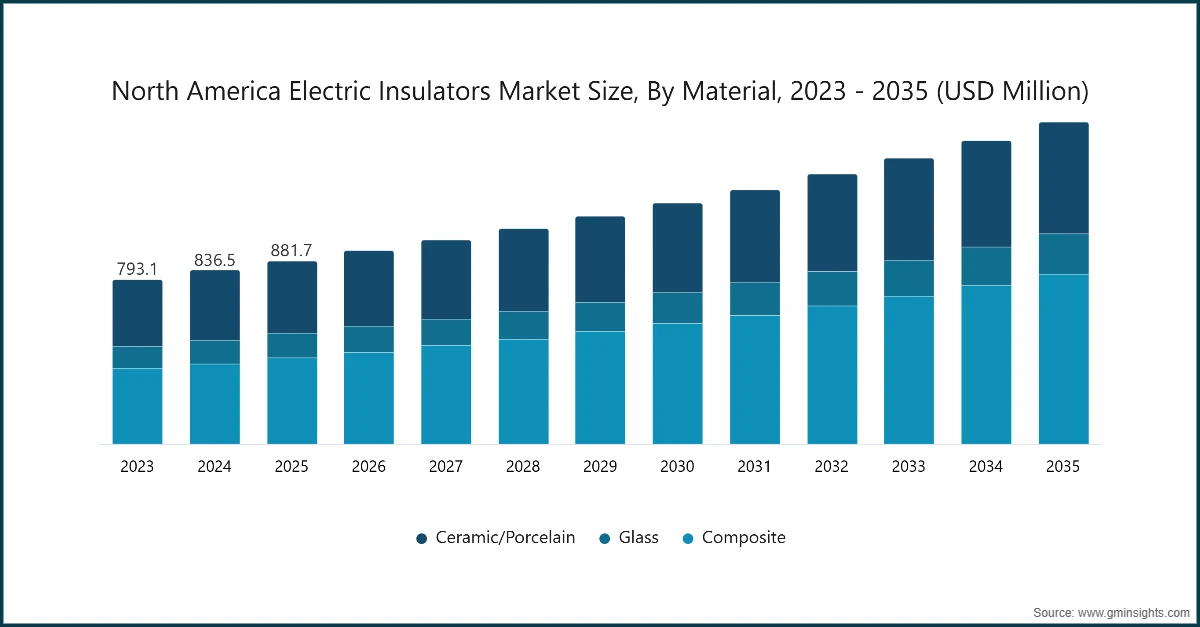
The North America electric insulators market was valued at USD 881.7 million in 2025. The market is expected to grow from USD 929.9 million in 2026 to USD 1.55 billion by 2035, at a CAGR of 5.8% according to a recent study by Global Market Insights Inc.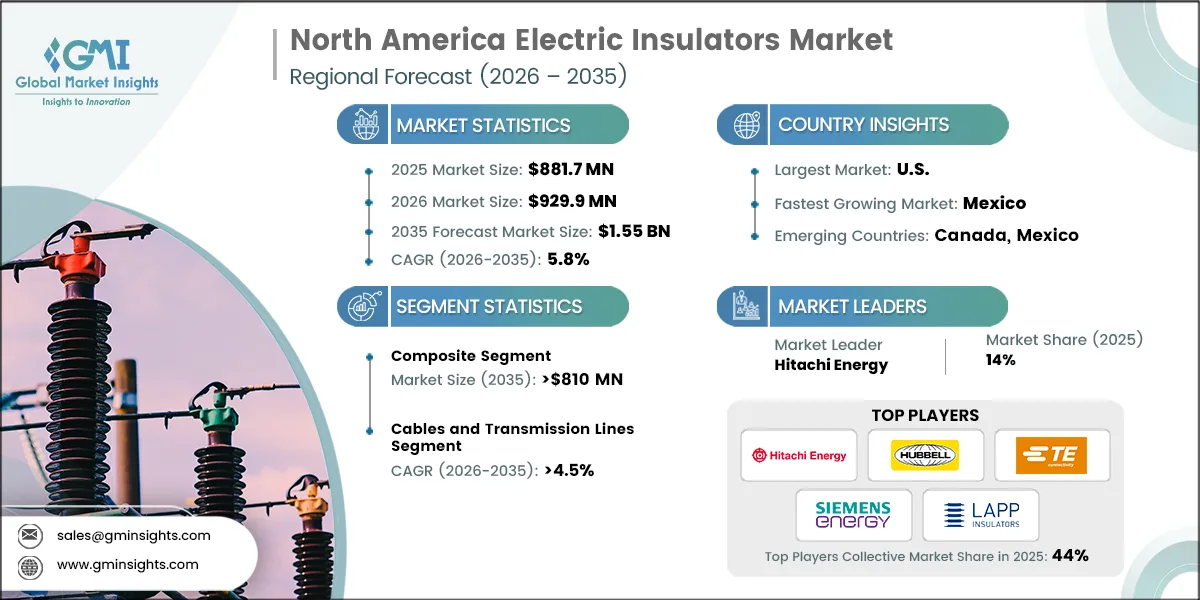
To get key market trends
North America Electric Insulators Market Trends
North America electric insulators industry is poised for growth due to rising electricity demand and the expansion of transmission and distribution grid networks. Respective authorities have introduced initiatives to improve electrical infrastructure in regions susceptible to extreme weather conditions are expected to boost product deployment. Additionally, paradigm shift toward adoption of higher-performance solutions in high-voltage and critical infrastructure along with reliability requirements encouraging utilities and grid operators to invest in certified, high-quality products, further augmenting industry outlook.
For instance, in January 2026, Microsoft collaborated with the Midcontinent Independent System Operator (MISO) to modernize the power grid across the U.S. Midwest, leveraging its cloud and AI technologies to enhance grid planning, forecasting, and real-time operations. Furthermore, increasing deployment of smart grids, investments in strengthening power grid infrastructure and rising demand for energy-efficient units and the replacement of traditional components will augment industry landscape.
North America Electric Insulators Market Analysis
Learn more about the key segments shaping this market
Based on material the composite segment is set to reach over USD 810 million by 2035. The increasing adoption of advanced insulator materials and the ongoing replacement of electrical components in transmission and distribution networks are enhancing the composite insulator market. Continuous expansion and modernization of transmission infrastructure, along with efforts to reduce power interruptions, are further shaping the composite insulators industry outlook.
North America high-voltage electric insulators market is anticipated to grow on account of increasing investments in refurbishing and developing high-voltage electrical infrastructure. Favorable government policies aimed at strengthening the power grid coupled with substantial investments by utilities in expanding high-capacity energy transmission networks, enabling long-distance electrical signal transmission will complementing the industry landscape.
Learn more about the key segments shaping this market
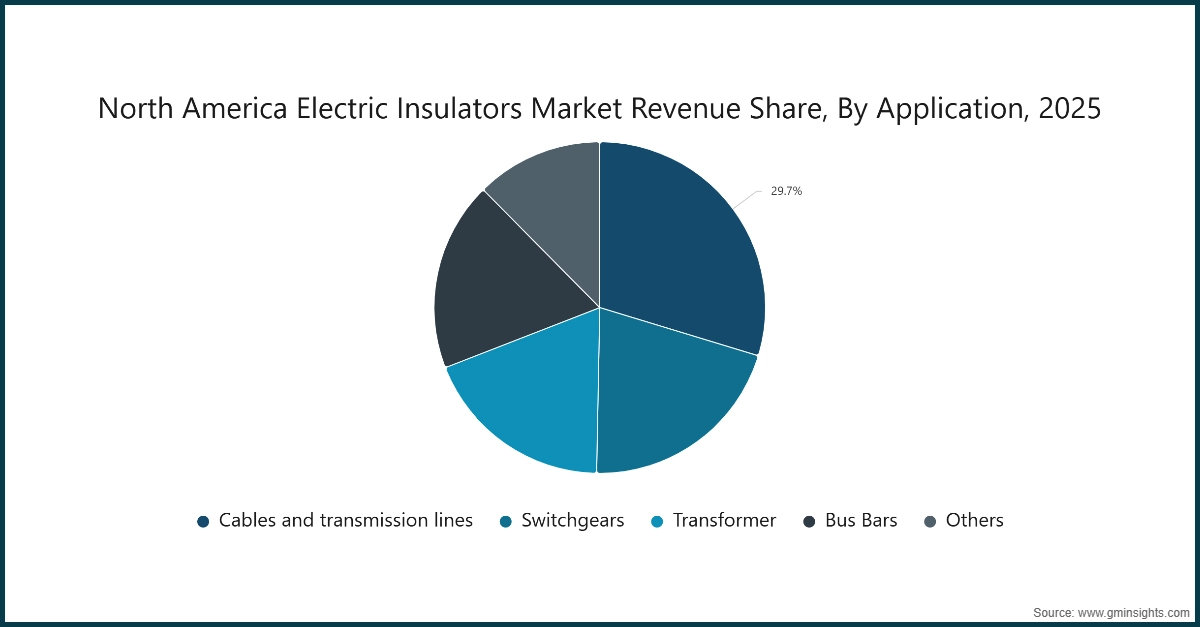
Electric insulators in cables transmission lines are anticipated to witness a CAGR of over 4.5% through 2035. Increased electricity demand along with government support for expansion of grid infrastructure and need for high-capacity transmission lines will complement the industry outlook. These units ensure reliable operation, effectively prevent leakage current, enhance the overall performance of transmission lines and offer environmental resistance, further accelerating product deployment. Ongoing shift towards development of advanced electrical networks, coupled with focus on upgrading aging grid infrastructure will positively influence the industry dynamics.
Looking for region specific data?
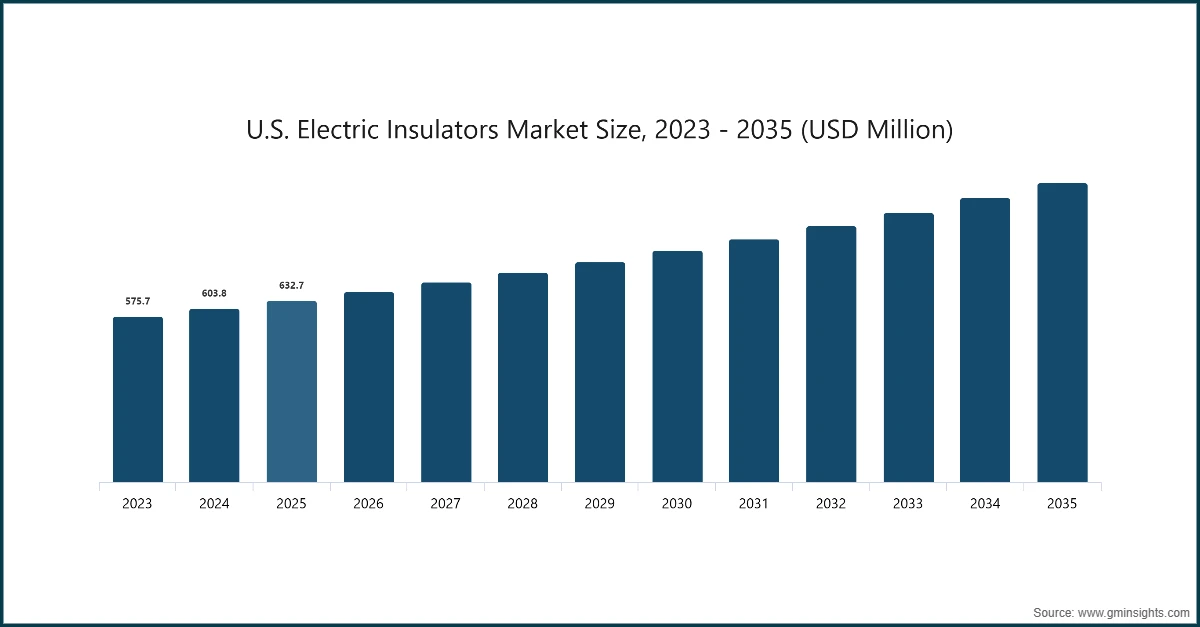
The U.S. leads the North America electric insulators market with around 71.8% share in 2025 and generated USD 632.7 million in revenue. Increased power generation capacity, along with rising demand for reliable electricity and favorable policies to encourage the expansion of power generation capacities will complement the industry landscape. Accelerating expenditure and investments for development of existing grid networks, and expansion of energy grid networks across remote regions, will positively influencing industry growth.
For instance, in May 2025, Grain Belt Express awarded USD 1.7 billion in contracts to U.S. firms Kiewit and Quanta for the construction of the nation’s largest transmission line. Furthermore, stringent regulatory frameworks supporting energy resilience upgrades to aging networks and development of high-voltage and ultra-high voltage transmission projects require advanced insulators delivering high performance and durability in diverse environmental conditions.
Canada electric insulator market is set to grow significantly on account of the flourishing investments in grid modernization and renewable energy integration, coupled with efforts to upgrade aging transmission and distribution infrastructure, driving adoption of advanced materials and designs, including composite and glass insulators. Also, government strategies in upgrading aging grids, increasing transmission infrastructure, and encouraging sustainable energy and interconnectivity in power grids are all accelerating the growth of the industry.
For example, in June 2025, the Ontario government authorities in Canada announced that it would invest in its infrastructure with plans to build two new transmission lines with 160 km each and upgrade two existing ones. This was in a bid to meet increasing energy demands to spur growth in the economy while strengthening energy infrastructure for the future. Furthermore, the increasing use of advanced technology in insulators with composite materials and polymers over other materials like ceramics and glasses in energy efficiency and reducing outages has been contributing to growth in the industry.
North America Electric Insulators Market Share
Major firms within the North American electric insulator market are pursuing easily understandable strategies such as alliances, partnerships or M&A activity to enhance their competitive positions. These strategies allow the companies to enhance their product portfolio, geographical presence, and customer base. In addition, the ongoing strategic collaborations enable industry players to develop & deliver solutions to the customers in the industry.
North America Electric Insulators Market Companies
Some of the key market players operating across the North America electric insulators are:
Asasoft
Comptec
Dow
Elsewedy Electric
Ensto
Gamma Insulators
Global Insulator Group
Hitachi Energy
Hubbell
K-Line Insulators
Lapp Insulators US
Maschinenfabrik Reinhausen
Multico
NGK Insulators
Pfisterer
Polycast
Power Grid Components
PPC Austria
Sediver
Siemens Energy
TE Connectivity
Victor Insulator
North America Electric Insulators Industry News
In January 2026, the pin insulator product line of Ensto has been upgraded to meet the ever-changing quality and safety needs of the contemporary power network, as dictated by the direct feedback of the customers and the recent updates to the international testing standards. It provides improved durability, reliability, and lifespan to meet the needs of contemporary overhead lines.
In June 2025, Power Grid Components announced that its Newell division has partnered with GAMMA Insulators to supply composite distribution insulators. This collaboration aims to enhance product offerings and deliver reliable, high-performance solutions for utility applications, supporting the growing demand for durable and efficient components in power distribution networks.
In February 2025, Insulation Technology Group, a portfolio company of TJC LP, acquired Cerisol Isoladores Ceramicos SA to enhance its production capacity as well as strengthen its global service network. The acquisition highlights ITG's focus on improving porcelain technology to deliver innovative insulation products to cater to the rising needs of the electrical grid infrastructure around the world.
In December 2024, Contune International Co., Ltd. remarked an achievement with the successful shipment of an advanced thermal‑mechanical testing system to Mexico, further underscoring its strength in delivering high‑performance testing technologies. The newly supplied equipment is expected to support improved production workflows and more robust quality assurance for composite insulator manufacturing across the region.
The North America electric insulators market research report includes in-depth coverage of the industry with estimates & forecast in terms of “USD Million” from 2022 to 2035 for the following segments:
Market, By Material
Ceramic/porcelain
Glass
Composite
Market, By Voltage
High voltage
Medium voltage
Low voltage
Market, By Application
Cables and transmission lines
Switchgears
Transformer
Bus Bars
Others
Market, By Product
Pin Insulators
Suspension insulators
Shackle insulators
Other insulators
Market, By End-Use
Residential
Commercial & Industrial
Utilities
Market, By Rating
≤ 11 kV
> 11 kV to ≤ 22 kV
> 22 kV to ≤ 33 kV
> 33 kV to ≤ 72.5 kV
> 72.5 kV to ≤ 145 kV
> 145 kV to ≤ 220 kV
> 220 kV to ≤ 400 kV
> 400 kV to ≤ 800 kV
> 800 kV to ≤ 1,200 kV
> 1,200 kV
Market, By Installation
Distribution
Transmission
Substation
Railways
Others
The above information has been provided for the following countries:
U.S.
Canada
Mexico
Frequently Asked Question(FAQ) :
What is the market size of the North America electric insulators in 2025?
The market size was USD 881.7 million in 2025, with a CAGR of 5.8% expected through 2035, driven by rising electricity demand, grid modernization efforts, and government investments in power infrastructure.
What is the projected value of the North America electric insulators industry by 2035?
The North America electric insulators market is expected to reach USD 1.55 billion by 2035, propelled by expansion of transmission and distribution networks, adoption of high-performance insulator solutions, and increasing deployment of smart grids.
What is the current North America electric insulators industry size in 2026?
The market size is projected to reach USD 929.9 million in 2026.
What is the growth outlook for the composite segment ?
The composite segment is set to reach over USD 810 million by 2035, driven by increasing adoption of advanced insulator materials.
What is growth outlook for electric insulators segmnet from 2026 to 2035?
Electric insulators in cables and transmission lines are anticipated to witness a CAGR of over 4.5% through 2035, supported by government backing for grid infrastructure expansion, and the shift toward advanced electrical network development.
Which country leads the North America electric insulators market?
The U.S. leads the North America electric insulators market with approximately 71.8% share in 2025. Accelerating expenditure on grid development, stringent regulatory frameworks, and high-voltage transmission projects are key growth drivers in the country.
What are the key trends shaping the North America electric insulators market?
Key trends include increasing deployment of smart grids, rising adoption of composite and polymer-based insulators over traditional ceramic and glass materials, and growing investments in high-voltage and ultra-high voltage transmission projects to support renewable energy integration.
Who are the key players in the North America electric insulators market?
Key players include Asasoft, Comptec, Dow, Elsewedy Electric, Ensto, Gamma Insulators, Global Insulator Group, Hitachi Energy, Hubbell, K-Line Insulators, Lapp Insulators US, NGK Insulators, Pfisterer, Siemens Energy, TE Connectivity, and Victor Insulator, among others.
North America Electric Insulators Market Scope
Related Reports