Summary
Table of Content

North America E-bikes Market
Get a free sample of this report
Form submitted successfully!
Error submitting form. Please try again.
Thank you!
Your inquiry has been received. Our team will reach out to you with the required details via email. To ensure that you don't miss their response, kindly remember to check your spam folder as well!
Request Sectional Data
Thank you!
Your inquiry has been received. Our team will reach out to you with the required details via email. To ensure that you don't miss their response, kindly remember to check your spam folder as well!
Form submitted successfully!
Error submitting form. Please try again.
North America E-bikes Market Size
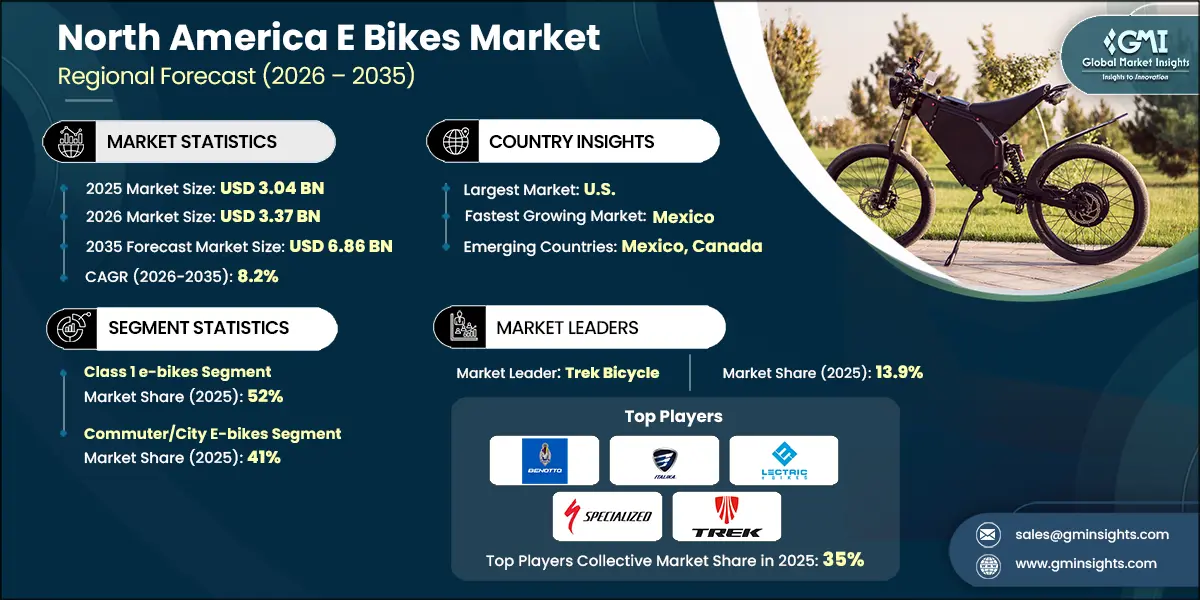
The North America e-bikes market was estimated at USD 3.04 billion in 2025. The market is expected to grow from USD 3.37 billion in 2026 to USD 6.86 billion in 2035, at a CAGR of 8.2%, according to latest report published by Global Market Insights Inc.
North America E-bikes Market Key Takeaways
Market Size & Growth
- 2025 Market Size: USD 3.04 Billion
- 2026 Market Size: USD 3.37 Billion
- 2035 Forecast Market Size: USD 6.86 Billion
- CAGR (2026–2035): 8.2%
Regional Dominance
- Largest Market: US
- Fastest Growing Country: Mexico
Key Market Drivers
- Increase in government incentives and rebates.
- Surge in urban commuting and micromobility adoption.
- Rise in fuel prices and transportation costs.
- Increase in health and wellness awareness.
Challenges
- High initial purchase cost.
- Limited public charging infrastructure.
Opportunity
- Rise in demand for cargo and utility e-bikes.
- Increase in e-bike sharing and subscription services.
- Growth in integration with public transit systems.
- Increase in municipal infrastructure projects.
Key Players
- Market Leader: Trek Bicycle led with over 13.9 % market share in 2025.
- Leading Players: Top 5 players in this market include Benotto, Italika, Lectric eBikes, Specialized Bicycle Components, Trek Bicycle, which collectively held a market share of 35% in 2025.
Get Market Insights & Growth Opportunities
The accelerating adoption of electric bicycles across North America is fundamentally reshaping urban mobility, recreational cycling, and last-mile transportation ecosystems. E-bikes integrating electric motors, lithium-ion batteries, power electronics, and connected control systems are increasingly positioned as practical alternatives to internal combustion vehicles for short-to-medium distance travel. Their ability to reduce commuting costs, emissions, and congestion has elevated e-bikes from niche recreational products to mainstream mobility solutions influencing transportation planning and supply chains.
E-bike system components such as motors (hub and mid-drive), battery packs, controllers, sensors, and lightweight frames have become the core enablers of range, reliability, rider comfort, and regulatory compliance. As manufacturers shift from conventional pedal bicycles to purpose-built electric platforms, these components are no longer treated as add-ons but as tightly integrated systems that determine product differentiation, lifecycle cost, and performance consistency across urban, cargo, and recreational use cases.
For instance, in May 2024, in Philadelphia, the Indego bike share system reported that e-bike ridership increased an astonishing 43% year-over-year while classic bike trips as part of the Indego system declined. More than 50% of all trips on Indego in Philadelphia are now performed on e-bikes and the e-bike ridership surge is particularly with lower income users.
The North America e-bikes market is also benefiting from rising investment and strategic collaborations between bicycle brands, battery suppliers, electronics manufacturers, and software providers. Vertical integration strategies, including in-house battery pack assembly, customized motor-controller tuning, and localized final assembly, are enabling manufacturers to improve quality control, manage costs, and respond more effectively to evolving safety and performance standards. Such collaborations accelerate product development cycles while reducing exposure to overseas supply disruptions.
Manufacturer are increasingly emphasizing durability testing, thermal management, and lifecycle optimization to ensure long-term performance under diverse climatic and usage conditions. Advances in battery management systems, smart charging solutions, and reinforced frame designs are extending battery life, improving rider safety, and supporting higher payload capacities particularly for cargo and fleet-oriented e-bikes. This system-level optimization enhances warranty confidence and supports adoption among urban commuters, delivery operators, and shared mobility providers.
Post-pandemic shifts in transportation preferences, combined with rising fuel costs and sustainability goals, have further strengthened the North America e-bikes market. Federal, state, and municipal initiatives promoting active transportation, emissions reduction, and domestic manufacturing are supporting e-bike adoption through incentives, infrastructure investment, and procurement programs. These policies are encouraging local assembly, battery sourcing, and workforce development, reinforcing the scalability and resilience of the regional e-bike supply chain.
Regionally, the United States represents the largest and most dynamic market within North America, driven by growing urban congestion, expanding bike-lane infrastructure, and strong demand for commuter and cargo e-bikes. Canada is witnessing steady growth supported by sustainability policies and recreational cycling culture, while Mexico is emerging as a manufacturing and assembly hub serving regional demand. Across North America, increasing focus on safety standards, battery certification, and product traceability is driving demand for higher-quality motors, advanced batteries, and compliant electronic control systems.
In addition, the North America e-bikes market is transitioning from early adoption to a more structured, component-driven ecosystem where performance optimization, supply chain localization, and regulatory alignment play a central role. As e-bikes become embedded in daily mobility and logistics networks, component innovation and system integration will remain critical to sustaining market growth and long-term value creation.
To get key market trends
North America E-bikes Market Trends
Cargo and utility e-bikes are experiencing strong adoption across North America as urban logistics, delivery services, and families seek efficient, low-emission alternatives to cars and vans. Their ability to carry heavy loads, navigate congested streets, and reduce operating costs has made them particularly appealing for last-mile delivery and small business operations. This segment is driving both product innovation and fleet-oriented solutions, supporting broader urban mobility goals.
In June 2025, shared micromobility operator Bird announced a major expansion of its electric scooter and e‑bike fleet across U.S. cities including Denver, Atlanta, Nashville, Los Angeles, and Austin underscoring growing demand for e‑bikes as urban mobility alternatives. These new vehicles are designed to appeal to short urban trips and first‑/last‑mile needs in major metro areas.
Manufacturers are increasingly integrating mid-drive motors and advanced drivetrains to improve torque, efficiency, and overall ride quality. These systems provide better hill-climbing capability, balanced weight distribution, and longer drivetrain life compared to traditional hub motors. The shift is especially notable in commuter, cargo, and premium e-bike segments, where reliability and performance consistency are essential for high-frequency usage and professional fleet operations.
Battery safety has become a key focus for e-bike OEMs and regulators in North America, driven by consumer awareness and safety concerns. Manufacturers are prioritizing certified lithium-ion packs, advanced battery management systems, and thermal protection mechanisms to meet UL and regional standards. This ensures compliance, enhances rider confidence, and reduces fire or failure risks, particularly in dense urban environments and shared or fleet-based operations.
E-bikes are becoming integral to fleet and shared mobility solutions in North America. Corporations, delivery companies, and municipal programs are adopting e-bikes for sustainable, efficient transportation, often supported by subscription models or telematics-enabled fleet management. This growth encourages investment in durable designs, connected monitoring, and predictive maintenance solutions, ensuring reliability and longevity for high-usage urban and commercial applications.
North America E-bikes Market Analysis
 Learn more about the key segments shaping this market
Learn more about the key segments shaping this market
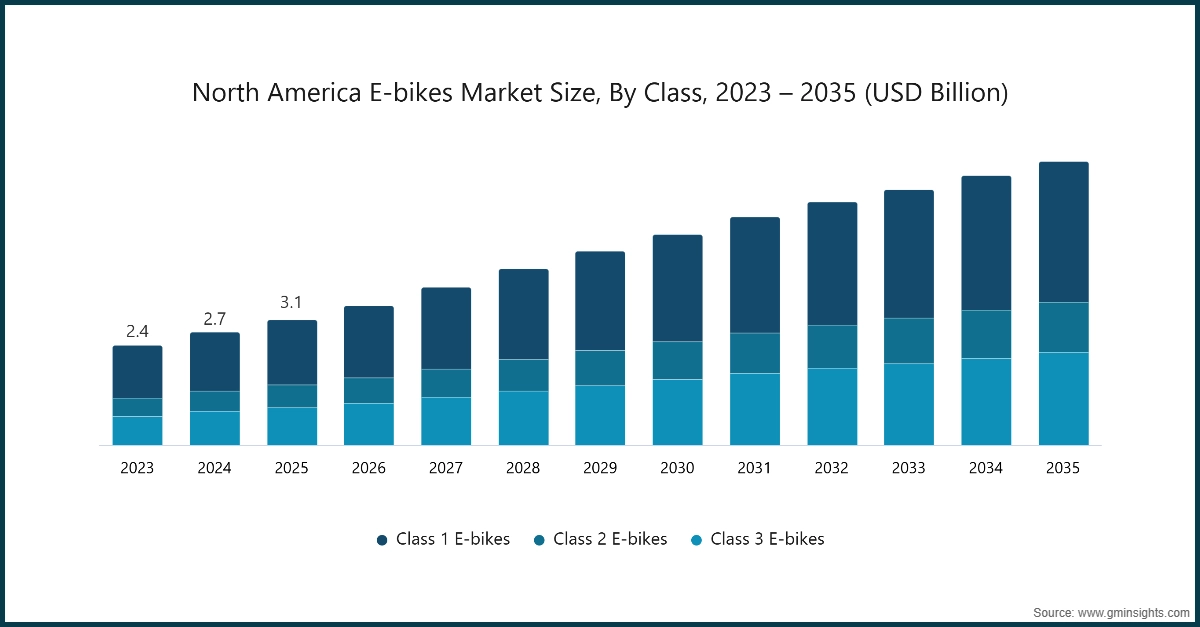
Based on class, the U.S. e-bike market is divided into Class 1 e-bikes, Class 2 e-bikes, Class 3 e-bikes, Cargo e-bikes, and Folding e-bikes. The Class 1 e-bikes segment accounting for around 52% market share in 2025 and is expected to grow at a CAGR of over 7.2% through 2035.
- The North America e-bikes industry is largely dominated by Class 1 e-bikes due to their broad regulatory acceptance and suitability for everyday use. Class 1 e-bikes provide pedal assistance only and cap assisted speeds at 20 mph, allowing them to be used on most bike lanes, multi-use trails, and urban cycling infrastructure. This regulatory clarity makes Class 1 models especially attractive to commuters, recreational riders, and municipalities seeking low-risk, widely compliant electric mobility solutions.
- Additionally, Class 1 e-bikes closely replicate the riding experience of traditional bicycles while offering enhanced range and reduced rider fatigue. Their lower power output supports longer battery life, improved safety perception, and easier maintenance. These advantages drive higher consumer trust, stronger retail adoption, and preference among bike-share programs, reinforcing Class 1 e-bikes as the dominant category across North America.
- For example, in October 2025, PeopleForBikes announced that 17,686 miles of trails across the United States were opened to Class 1 pedal-assist eMTBs the largest single-year increase in trail access for this class of e-bike, reflecting how trail policy is adapting to favor Class 1 models on recreational networks.
- The Class 3 E-bikes segment is expected to experience a faster growth of more than 9.2% over the forecast period, driven by rising demand for high-speed electric mobility solutions for longer-distance commuting. Class 3 e-bikes, which provide pedal assistance up to 28 mph, are increasingly preferred by suburban commuters seeking faster travel times and reduced dependence on cars. Their ability to cover longer distances efficiently makes them suitable for replacing car trips in low-density and suburban regions.
Learn more about the key segments shaping this market
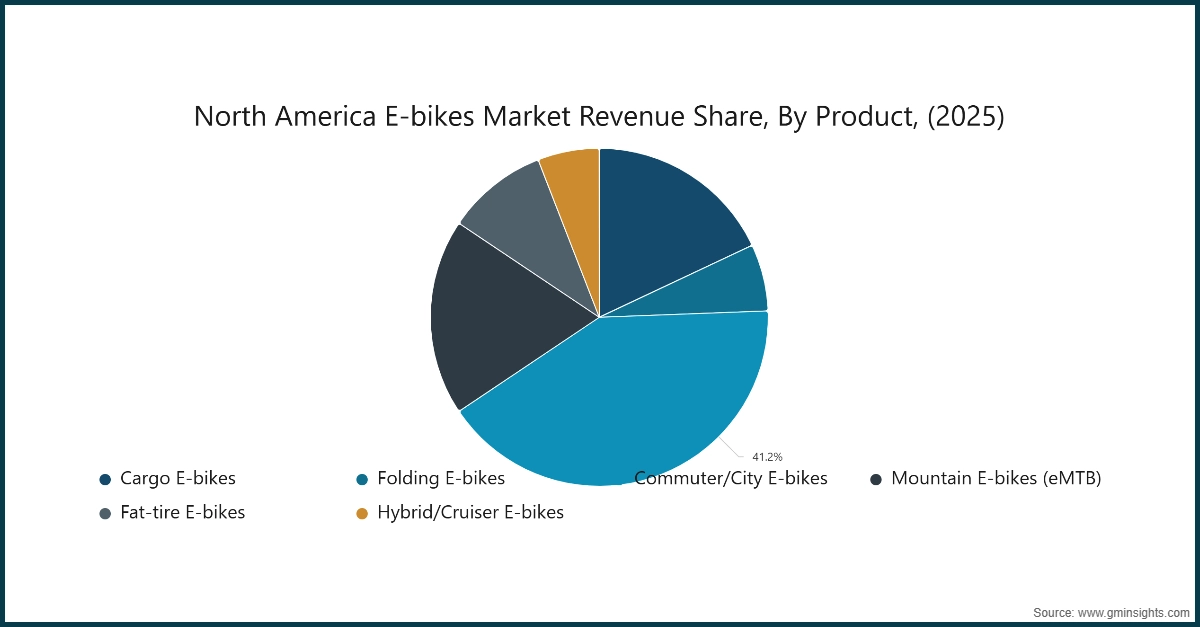
Based on product, the North America e-bikes market is segmented into cargo e-bikes, folding e-bikes, commuter/city e-bikes, mountain e-bikes (EMTB), fat-tire e-bikes, and hybrid/cruiser e-bikes. The commuter/city e-bike segment dominates the market accounting for around 41% share in 2025 and is expected to grow at a CAGR of over 8.7% from 2026-2035.
- The North America e-bikes market is dominated by the commuter and city e-bikes segment due to growing urban congestion, rising transportation costs, and increasing demand for efficient last-mile mobility solutions. Commuter e-bikes offer a practical balance of speed, range, and comfort, making them well suited for daily travel to work, educational institutions, and transit hubs. Their compatibility with existing bike lanes and urban infrastructure further supports widespread adoption across major metropolitan areas.
- Additionally, commuter and city e-bikes appeal to a broad consumer base, including first-time riders, older users, and professionals seeking reliable alternatives to cars and public transport. Advances in lightweight frames, integrated batteries, and safety features enhance everyday usability. Growing employer commuter programs and shared mobility initiatives also reinforce this segment’s leading position within the North America e-bikes market.
- For example, in November 2025, iconic U.S. e-bike brand Pedego Electric Bikes formed a strategic partnership with smart e-bike innovator Urtopia to create New Pedego Holdings Inc. This alliance aims to revitalize Pedego’s product line, expand its dealer network across the U.S. and Canada, and introduce new smart-connected e-bike models beginning in 2026.
- The cargo e-bikes segment is expected to experience a faster growth of more than 9.4% over the forecast period, driven by the rapid expansion of last-mile delivery, urban logistics, and small business transportation needs. E-commerce growth, same-day delivery expectations, and rising fuel and vehicle ownership costs are encouraging businesses to adopt cargo e-bikes as efficient, low-emission alternatives to vans for short-distance deliveries in dense urban areas.
Based on sales channel, the North America e-bikes market is divided into online, and offline. The online segment held the major market share in 2025.
- The online segment is the largest market segment in the North America e-bikes market because it offers consumers greater product accessibility, price transparency, and convenience compared to traditional retail channels. Online platforms allow buyers to compare specifications, prices, and customer reviews across multiple brands, enabling informed purchase decisions. Direct-to-consumer models also help manufacturers reduce distribution costs, offer competitive pricing, and reach customers in regions with limited access to specialized e-bike retailers.
- Additionally, online sales channels support rapid market expansion through nationwide delivery, flexible financing options, and bundled after-sales services such as extended warranties and home delivery. Many leading e-bike brands leverage digital marketing, virtual product demonstrations, and customer support tools to enhance the buying experience. These factors collectively position online channels as the dominant distribution segment in the North America e-bikes market.
- For example, in June 2025, online e-bike marketplace Upway launched a major online sale offering up to 60% off e-bikes from well-known brands like Cannondale, Specialized, and Aventon, with free delivery and warranty. This type of promotion shows how online platforms are driving high consumer engagement and sales volume.
- The offline segment is expected to grow with a CAGR of more than 8.9% due to consumers’ preference for physical interaction with e-bikes before purchase. Many buyers value the ability to test ride models, assess ergonomics, and experience motor performance firsthand, which is particularly important for high-value commuter, cargo, and performance e-bikes. Physical stores also provide immediate access to accessories, spare parts, and professional assembly services, enhancing customer confidence and satisfaction.
Based on motor, the market is divided into hub motor, and mid-drive. The hub motor segment dominated the North America e-bikes market.
- The hub motor segment dominates the market due to its simplicity, reliability, and cost-effectiveness. Hub motors are integrated into the front or rear wheel, reducing mechanical complexity and minimizing maintenance requirements compared to mid-drive systems. This makes them highly appealing for urban commuters, casual riders, and recreational users who prioritize ease of use and low upkeep. Additionally, hub motors provide quiet operation and smooth pedal assistance, enhancing the overall riding experience for a broad range of consumers.
- The segment’s dominance is further reinforced by widespread availability across affordable and mid-range e-bike models, enabling manufacturers to cater to price-sensitive customers. The ease of installation, compatibility with various bike frames, and robust performance for city commuting and short-distance rides collectively position hub motors as the preferred choice in North America’s e-bike market.
- The mid-drive segment is expected to grow with a CAGR of more than 9% due to increasing demand for high-performance, long-range, and off-road capable e-bikes. Mid-drive motors, positioned at the crank, provide better weight distribution, improved torque, and efficient power transfer, making them ideal for steep inclines, mountain biking, and cargo hauling. These technical advantages appeal to enthusiasts, professional riders, and users seeking premium e-bikes for challenging terrains or heavy-duty applications.
Looking for region specific data?
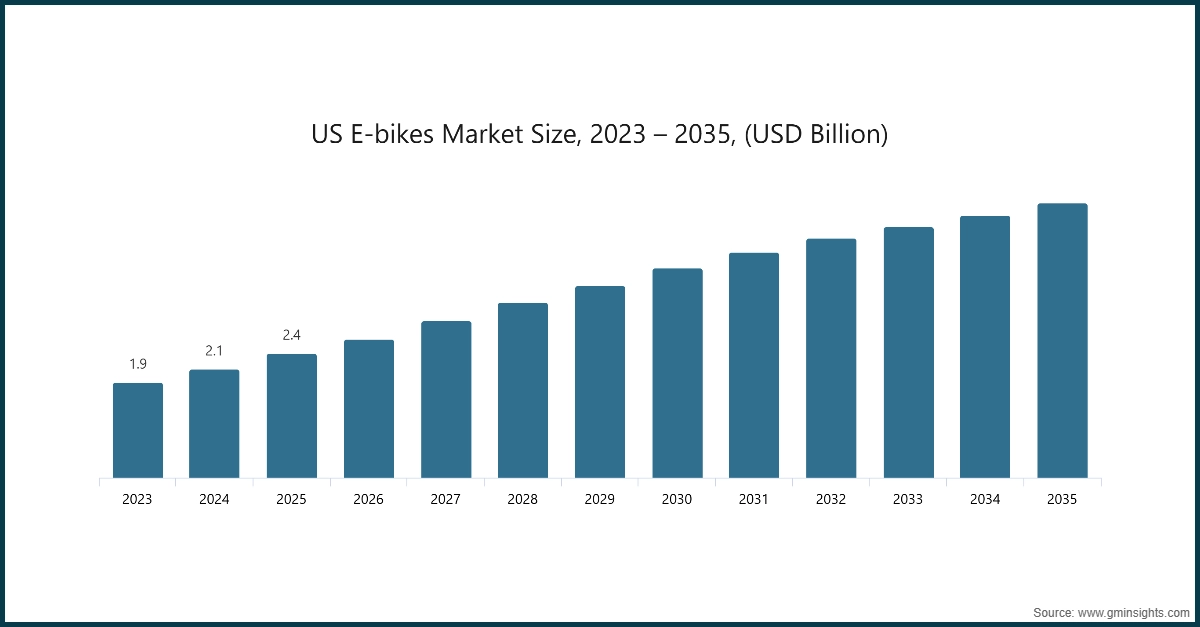
The US E-bikes market is expected to experience significant and promising growth from 2026-2035.
- The US market is experiencing robust growth due to increasing demand for sustainable and cost-effective urban mobility solutions. Rising traffic congestion, higher fuel prices, and the desire for eco-friendly transportation options have encouraged commuters to adopt e-bikes as practical alternatives to cars for short- and medium-distance travel. Additionally, technological advancements in motor efficiency, battery range, and integrated control systems have improved ride quality, making e-bikes more appealing to a broader audience, including daily commuters, recreational riders, and families.
- Market growth is further supported by government incentives, grants, and infrastructure investments promoting cycling and active transportation. Shared mobility programs, corporate fleet adoption, and the expansion of cargo and utility e-bikes are also driving sales. Strong local assembly and supply chain diversification help manufacturers meet rising demand efficiently while ensuring quality and regulatory compliance.
- For instance, in December 2024, California (CA) launched the E-Bike Incentive Project, allowing low-income individuals to obtain vouchers for up to $2,000 to support the use of clean and available methods of mobility. The program emphasized cargo and adaptive e-bikes, reinforcing California's efforts to provide equitable mobility alternatives to its residents and sustainability initiatives designed to reduce harmful emissions.
- Canada is emerging as a strong growth market for North America e-bikes due to increasing urbanization, rising environmental awareness, and government policies promoting sustainable transportation. Cities such as Toronto, Vancouver, and Montreal are expanding bike lanes and cycling infrastructure, making e-bikes a practical option for commuting, errands, and recreational use. Rising fuel costs and traffic congestion are also motivating consumers to adopt e-bikes as an affordable, low-emission alternative to cars for short- and medium-distance trips.
California dominated the West US e-bikes market and is expected to experience significant and promising growth from 2026-2035.
- California is emerging as a major growth engine of the U.S. e-bike market due to its strong policy support for zero-emission transportation and active mobility. The state’s dense urban centers, high fuel prices, and persistent traffic congestion are encouraging commuters to adopt e-bikes as practical alternatives to cars for daily travel. Extensive investment in bike-lane infrastructure across cities such as Los Angeles, San Francisco, and San Diego has further improved safety and usability, accelerating consumer adoption across commuter and recreational segments.
- Growth is also supported by California’s consumer incentives, employer-backed commuter programs, and high penetration of delivery and shared mobility services. Rising demand for cargo and utility e-bikes among last-mile delivery operators and small businesses, combined with strong consumer awareness of sustainability, positions California as a leading contributor to overall U.S. e-bike market expansion.
- For instance, in July 2025, Ava Community Energy launched one of the nation’s largest e-bike rebate programs with $10 million in funding for Alameda County residents. The program offers instant rebates of $400–$1,500 for new e-bike purchases, expanding access and demonstrating strong institutional support for e-bike adoption in California.
- Washington is emerging as a strong growth market for Western e-bikes due to its well-developed cycling culture, progressive transportation policies, and strong emphasis on sustainable mobility. Cities such as Seattle, Bellevue, and Tacoma have invested heavily in protected bike lanes, multi-use trails, and urban cycling infrastructure, making e-bikes a convenient option for daily commuting. Rising traffic congestion, high fuel costs, and environmental awareness are further encouraging residents to shift toward electric bicycles for short- and mid-distance travel.
Illinois dominated e-bikes market in Midwest US and is expected to experience significant and promising growth due to expanding cycling infrastructure, growing environmental consciousness, and supportive state policies.
- Illinois has seen promising development in the urban e-bike market, particularly in Chicago, where they are finding success in recreation and delivery services, which makes them popular for many different applications. Illinois has built up a significant e-bike economy through its investment in trails and green mobility initiatives, which has propelled their broader acceptance and adoption.
- Minnesota is emerging as the fastest growing market for e-bikes in the Midwest in part because of its active outdoor culture that is increasingly being supported by government clean transportation incentives. The state’s Department of Natural Resources has now opened up multi-use trails to e-bikes, which has encouraged more residents and tourists to engage in electric mobility.
- For instance, in January 2023, Ride Illinois and the Active Transportation Alliance held a campaign aimed at creating a statewide e-bike rebate program to make e-bikes more affordable and accessible. The program allows for clean mobility and aims to decrease traffic and emissions throughout Illinois.
Florida dominated Southeast US e-bikes market and is expected to experience significant and promising growth from 2026 to 2035.
- Florida has seen promising development in the e-bike market, particularly in urban commuting, tourism, and recreational mobility. The state’s flat terrain, warm climate, and extensive coastal cities make e-bikes highly suitable for daily travel and leisure use. Metropolitan areas such as Miami, Orlando, Tampa, and St. Petersburg are witnessing growing adoption of e-bikes as convenient alternatives for short-distance trips, helping reduce congestion in densely populated and tourist-heavy zones.
- Growth is further supported by expanding bike-friendly infrastructure, including multi-use paths, waterfront trails, and urban cycling networks. E-bikes are also gaining traction in hospitality, rental, and shared mobility segments, serving tourists and local residents alike. Increasing interest in cargo and utility e-bikes for neighborhood services and last-mile deliveries is reinforcing Florida’s role as an emerging and diverse e-bike market within the U.S.
- For example, in October 2025, Florida-based e-bike company AMZcycle officially introduced six new electric bike models designed for different riding conditions and everyday use illustrating local industry growth and product diversification in the state’s market.
New York dominated the Northeast US e-bikes market and is expected to experience significant and promising growth from 2026-2035.
- New York is emerging as a major growth engine of the U.S. e-bike market due to increased urban congestion, new bike infrastructure, and the rise of consumer preferences for clean and efficient commuting alternatives. As one of the most densely populated cities in the U.S., New York has seen an increase in personal e-bike ownership, shared mobility programs, and public infrastructure changes in the micromobility sector.
- With the growing number of protected bike lanes, the move away from car dependency, increasing fuel prices, and the NYC DOT's micromobility pilot programs and tax incentives, we are seeing more and more commuters using e-bikes for travel instead of cars. The market is specifically taking off for commuters within boroughs like Manhattan and Brooklyn as cases of demand creation.
- There is also a large segment of consumer e-bike use in New York leveraged by delivery workers and gig economy riders, which helps build an aftermarket and service demand. E-bike retailers and brands have increased availability and service in the region due to increased demand and interest.
- For instance, in June 2025, the NYC DOT and FDNY launched a new pilot program called the USD 2 million E-Bike Trade-In, which gave over 400 delivery workers free e-bikes and batteries that were UL-certified, if they surrendered their uncertified bikes/batteries. The E-Bike Trade-In pilot program’s objectives are to improve safety and reduce the risks of fire and include mandatory safety training, along with pushing the NYRs’ overall agenda for safer micromobility.
Texas dominated Southwest US e-bikes market and is expected to experience significant and promising growth from 2026 to 2035.
- The South US is emerging as dynamic growth region amid the evolving e-bike market due to rising urbanization, cycling infrastructure, and its enviable weather, allowing for year-round enjoyment wherever there is paved space. The region’s larger cities, which undergo extensive low-density development as a result of urban sprawl, are improving cycling infrastructure, while people's growing awareness of sustainable transport is facilitating e-bike use by commuter and recreational riders.
- Texas is leading the way in the regional growth as it inherently has a massive population, on-going pro-active transportation policies, and sustained investment in active mobility infrastructure. Living and travel at the expense of cycling infrastructure is considerable in urban areas of Texas, like Austin and Dallas, with rapidly expanding multimodal transport networks supported by shared e-bike programs. E-bikes are growing in popularity by leisure users, commuters, and fleets, encouraging growth in personal e-bike mobility infrastructure.
- For instance, in May 2024, Texas based MOD Bikes launched the MOD Black, a full suspension adventure e-bike offered with a 750W hub motor, capable of reaching speeds of 28 mph and with ranges of 100 miles. The bike is built for urban and off-road terrain, has torque sensors to provide pedal assistance, hydraulic braking systems and smart accessories for every rider, including wireless turn signals, which demonstrates more than a passing interest in e-bikes.
North America E-bikes Market Share
The top 7 companies in the market are Trek Bicycle, Specialized Bicycle Components, Aventon, Pedego, Italika, Lectric eBikes, Benotto contributed around 36.4% of the market in 2025.
Trek focuses on a diversified e-bike portfolio, spanning commuter, urban, mountain, and performance models. Its strategy emphasizes premium quality, dealer network expansion, and brand loyalty, coupled with investments in service centers and test-ride experiences. Trek also integrates smart connectivity features and high-performance battery systems, targeting both urban commuters and recreational riders while maintaining strong after-sales support.
- Specialized leverages high-performance technology, innovation, and brand prestige to capture premium market segments. Its strategy includes advanced battery and motor integration, connected e-bike features, and dealer network optimization. Specialized emphasizes product differentiation through mountain, urban, and commuter e-bikes, along with marketing campaigns highlighting performance, reliability, and lifestyle appeal.
- Aventon’s strategy centers on direct-to-consumer (D2C) online sales and affordable, stylish commuter e-bikes. It focuses on foldable and city-friendly designs, battery efficiency, and social media-driven marketing campaigns. Aventon also partners with micromobility programs and offers subscription or financing options, targeting urban riders and first-time e-bike buyers.
- Pedego emphasizes premium comfort, cruiser-style urban e-bikes, and lifestyle branding. Its strategy includes expanding retail locations, dealer partnerships, and test-ride programs, highlighting ease-of-use, safety, and family-friendly designs. Pedego also invests in community engagement, customer loyalty programs, and electric cruiser innovations to maintain leadership in commuter and recreational e-bike segments.
- Italika focuses on value-driven, commuter and cargo e-bikes for North America. Its strategy relies on durable design, efficient battery use, and low-cost pricing, targeting budget-conscious urban and suburban consumers. Italika also works on expanding its distribution channels, offering replacement parts and localized support to enhance adoption in secondary markets.
- Lectric focuses on budget-friendly, foldable, and D2C e-bikes, emphasizing online sales, fast delivery, and wide accessibility. Its strategy includes leveraging social media and e-commerce promotions to drive adoption among urban commuters and first-time buyers. Lectric also invests in easy-to-use designs and battery efficiency to strengthen brand recognition in the mass-market segment.
- Benotto’s strategy targets entry-level and commuter e-bikes through affordable pricing and lightweight design. The company focuses on attracting urban riders and cost-conscious consumers, with limited high-performance offerings. Benotto leverages dealer partnerships in select regions and emphasizes reliability and brand familiarity to compete with more established North American and European brands.
North America E-bikes Market Companies
Major players operating in the North America E-bikes industry are:
Trek Bicycle
- Specialized Bicycle Components
- Aventon
- Pedego
- Italika
- Lectric eBikes
- Benotto
- Yuba Bicycles
- Cannondale
- Rad Power Bike
- North American e-bike manufacturers and component suppliers are increasingly adopting digital manufacturing, AI-enabled production monitoring, and data-driven design tools to improve reliability, performance, and efficiency across motors, batteries, controllers, and frame components. Machine-learning analytics optimize battery management, motor calibration, and ride-assist algorithms, while digital twins simulate structural integrity, battery thermal behavior, and energy consumption, reducing prototyping time, enhancing product quality, and accelerating market rollout of high-performance urban, commuter, and cargo e-bikes.
- Strategic collaborations and partnerships among e-bike OEMs, battery suppliers, component manufacturers, software developers, and urban mobility operators are reshaping the North America ecosystem. These initiatives integrate advanced battery chemistry, lightweight frame materials, and smart connectivity features, enabling faster commercialization of high-capacity, long-range, and IoT-enabled e-bikes. Joint ventures and co-branding agreements reduce supply chain risk, stabilize component costs, expand distribution networks, and support the adoption of sustainable, technologically advanced e-bikes across urban and suburban market.
North America E-bikes Market Report Attributes
| Key Takeaway | Details |
|---|---|
| Market Size & Growth | |
| Base Year | 2025 |
| Market Size in 2025 | USD 3.04 Billion |
| Market Size in 2026 | USD 3.37 Billion |
| Forecast Period 2026-2035 CAGR | 8.2% |
| Market Size in 2035 | USD 6.86 Billion |
| Key Market Trends | |
| Drivers | Impact |
| Increase in government incentives and rebates | Federal and state programs, such as tax credits and purchase subsidies, reduce the upfront cost of e-bikes, making them more affordable. These incentives encourage adoption among commuters and recreational users, accelerating market growth across both urban and suburban regions. |
| Surge in urban commuting and micromobility adoption | Rising traffic congestion and limited parking in cities are pushing commuters to adopt e-bikes. Urban micromobility initiatives, bike lanes, and dedicated cycling infrastructure make e-bikes an efficient, environmentally friendly alternative for daily travel, boosting market penetration. |
| Rise in fuel prices and transportation costs | Increasing gasoline prices and higher costs of public transit drive consumers to cost-efficient alternatives. E-bikes provide low operational expenses and reduced dependency on cars, positioning them as a practical solution for daily commuting and urban mobility. |
| Increase in health and wellness awareness | Growing focus on active lifestyles and physical fitness is encouraging people to use e-bikes for exercise and recreation. Users can enjoy cycling with pedal assistance, making fitness accessible to wider age groups and health-conscious consumers. |
| Pitfalls & Challenges | Impact |
| High initial purchase cost | Premium e-bikes often cost significantly more than traditional bicycles, limiting affordability for budget-conscious consumers. High upfront prices remain a barrier, particularly for first-time buyers and mass-market adoption in lower-income urban areas |
| Limited public charging infrastructure | Sparse availability of charging stations restricts long-distance and multi-day e-bike use. Lack of infrastructure can deter potential buyers concerned about battery depletion during commuting or recreational trips. |
| Opportunities: | Impact |
| Rise in demand for cargo and utility e-bikes | Businesses and households are increasingly using cargo e-bikes for last-mile deliveries, groceries, or carrying children. This expands the market beyond commuters, creating demand for high-capacity, durable models. |
| Increase in e-bike sharing and subscription services | Shared e-bike programs and subscription models provide low-cost access, encourage trial usage, and attract new consumers, particularly in urban areas where ownership may be less convenient. |
| Growth in integration with public transit systems | Collaborations with transit agencies enable seamless last-mile connections. E-bikes complement buses and trains, increasing adoption and supporting urban mobility strategies. |
| Increase in municipal infrastructure projects | Cities investing in dedicated bike lanes, e-bike parking, and charging stations make cycling safer and more convenient. Infrastructure development encourages adoption, particularly in urban and suburban areas with high traffic density. |
| Market Leaders (2025) | |
| Market Leader |
13.9 % market share |
| Top Players |
Collective Market Share in 2025 is 35% |
| Competitive Edge |
|
| Regional Insights | |
| Largest Market | US |
| Fastest growing market | Mexico |
| Emerging countries | Mexico, Canada |
| Future outlook |
|
What are the growth opportunities in this market?
North America E-bikes Market News
In January 2026, global e‑mobility brand Yadea showcased two new e‑bike models, FATBOY and FLO, at CES 2026 in Las Vegas, targeting urban and cross‑terrain segments and reinforcing its North American expansion strategy with technology‑led product offerings.
|- In December 2025, e‑bike maker Heybike exhibited multiple new e‑bike models at Electrify Expo events in New York City and Dallas, drawing strong consumer interest and test‑ride engagement while highlighting performance and comfort across its product lineup.
- In November 2025, Pedego Electric Bicycles and Urtopia announced the creation of New Pedego Holdings Inc., combining Pedego’s established U.S. and Canadian retail footprint with Urtopia’s smart e‑bike technology to strengthen product design, supply chain efficiency, and leadership in North American e‑mobility markets.
- In July 2025, Bird and Segway partnered to launch a next‑generation shared micromobility fleet across North America, introducing co‑developed electric scooters and e‑bikes aimed at improving urban transportation performance, safety, and sustainability in key cities.
- In May 2025, Veo debuted the first dockless cargo e‑bike in North America—the Apollo Cargo designed to carry up to 100 pounds, with deployments in Washington, D.C., and Columbus, Ohio, and plans to make 50% of its fleet cargo‑capable by 2030.
The North America E-bikes market research report includes in-depth coverage of the industry with estimates & forecasts in terms of revenue ($Bn), shipment (Units) from 2022 to 2035, for the following segments:
Market, By Class
- Class 1 E-bikes
- Class 2 E-bikes
- Class 3 E-bikes
Market, By Product
- Cargo E-bikes
- Folding E-bikes
- Commuter/City E-bikes
- Mountain E-bikes (eMTB)
- Fat-tire E-bikes
- Hybrid/Cruiser E-bikes
Market, By Sales Channel
- Online
- Offline
Market, By Motor
- Hub Motor
- Mid-Drive
Market, By End Use
- Commuting/daily transportation
- Recreation/leisure
- Delivery/commercial applications
The above information is provided for the following regions and countries:
- US
- Northeast
- Connecticut
- Maine
- Massachusetts
- New Hampshire
- New Jersey
- New York
- Pennsylvania
- Rhode Island
- Vermont
- Southeast
- Alabama
- Arkansas
- Delaware
- Florida
- Georgia
- Kentucky
- Louisiana
- Maryland
- Mississippi
- North Carolina
- South Carolina
- Tennessee
- Virginia
- West Virginia
- Midwest
- Illinois
- Indiana
- Iowa
- Kansas
- Michigan
- Minnesota
- Missouri
- Nebraska
- North Dakota
- Ohio
- South Dakota
- Wisconsin
- Southwest
- Arizona
- New Mexico
- Oklahoma
- Texas
- West
- Alaska
- California
- Colorado
- Hawaii
- Idaho
- Montana
- Nevada
- Oregon
- Utah
- Washington
- Wyoming
- Northeast
- Canada
- Ontario
- Quebec
- British Columbia
- Alberta
- Manitoba
- Other Provinces
- Mexico
Frequently Asked Question(FAQ) :
What is the market size of the North America e-bikes in 2025?
The market size was USD 3.04 billion in 2025, with a CAGR of 8.2% expected through 2035 driven by increasing government incentives, surge in urban commuting and micromobility adoption.
What is the projected value of the North America e-bikes market by 2035?
The North America e-bikes market is expected to reach USD 6.86 billion by 2035, propelled by advanced battery systems, lightweight frames, high-efficiency motors, IoT connectivity, and expansion of cargo and utility e-bike segments.
What is the current North America e-bikes market size in 2026?
The market size is projected to reach USD 3.37 billion in 2026.
What was the market share of Class 1 e-bikes segment in 2025?
Class 1 e-bikes dominated the market accounting for around 52% market share in 2025 and are expected to grow at a CAGR of over 7.2% through 2035, driven by broad regulatory acceptance and suitability for everyday use.
What was the market share of commuter/city e-bikes segment in 2025?
Commuter/city e-bikes dominated the market accounting for around 41% share in 2025 and are expected to grow at a CAGR of over 8.7% from 2026-2035, driven by growing urban congestion and demand for efficient last-mile mobility solutions.
What is the growth outlook for the cargo e-bikes segment from 2026 to 2035?
Cargo e-bikes are expected to grow at over 9.4% CAGR till 2035, driven by rapid expansion of last-mile delivery, urban logistics, e-commerce growth, and businesses adopting them as low-emission alternatives to vans.
Which country leads the North America e-bikes market?
The US e-bikes market is expected to experience significant and promising growth from 2026-2035, due to increasing demand for sustainable and cost-effective urban mobility solutions.
What are the upcoming trends in the North America e-bikes market?
Key trends include strong adoption of cargo and utility e-bikes for urban logistics and last-mile delivery, increasing integration of mid-drive motors and advanced drivetrains for improved torque and efficiency.
Who are the key players in the North America e-bikes market?
Key players include Trek Bicycle, Specialized Bicycle Components, Aventon, Pedego, Italika, Lectric eBikes, Benotto, Yuba Bicycles, Cannondale, and Rad Power Bike.
North America E-bikes Market Scope
Related Reports