Summary
Table of Content

North America Diabetes Care Devices Market
Get a free sample of this report
Form submitted successfully!
Error submitting form. Please try again.
Thank you!
Your inquiry has been received. Our team will reach out to you with the required details via email. To ensure that you don't miss their response, kindly remember to check your spam folder as well!
Request Sectional Data
Thank you!
Your inquiry has been received. Our team will reach out to you with the required details via email. To ensure that you don't miss their response, kindly remember to check your spam folder as well!
Form submitted successfully!
Error submitting form. Please try again.
North America Diabetes Care Devices Market Size
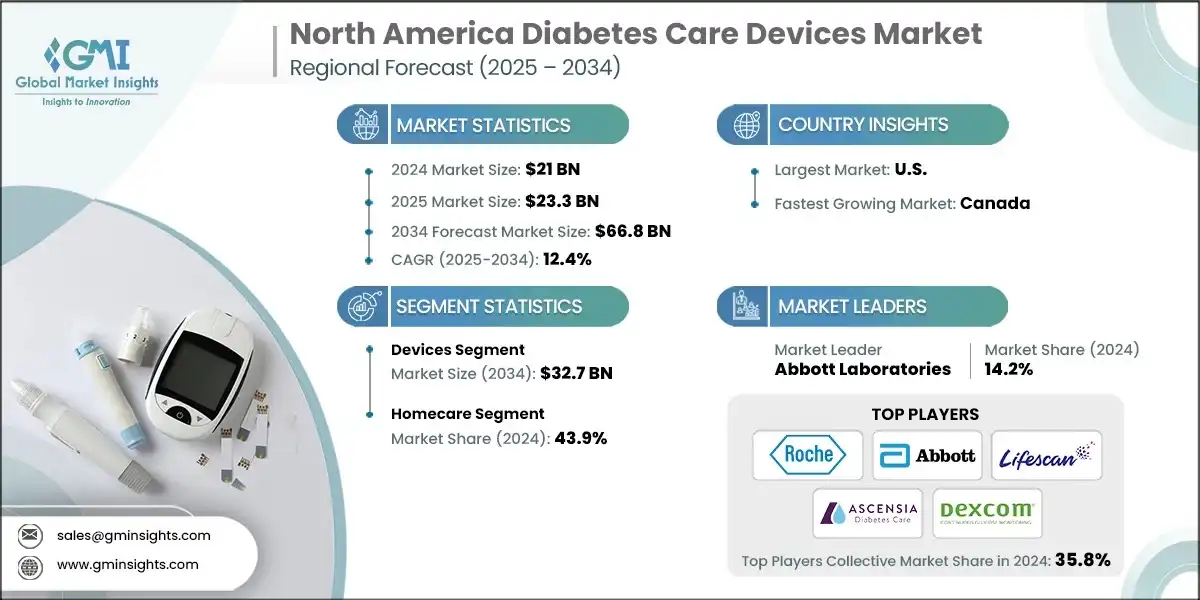
The North America diabetes care devices market was valued at USD 21 billion in 2024 and is projected to grow from USD 23.3 billion in 2025 to USD 66.8 billion by 2034, expanding at a CAGR of 12.4%, according to the latest report published by Global Market Insights Inc. This steady growth is stimulated by various factors such as growing prevalence of diabetes across the North America, rising technological advancements in diabetes care devices, and increased healthcare spending and accessibility. Major companies in the industry include F. Hoffmann-La Roche, Abbott Laboratories, Ascensia Diabetes Care, LifeScan, and Dexcom.
To get key market trends
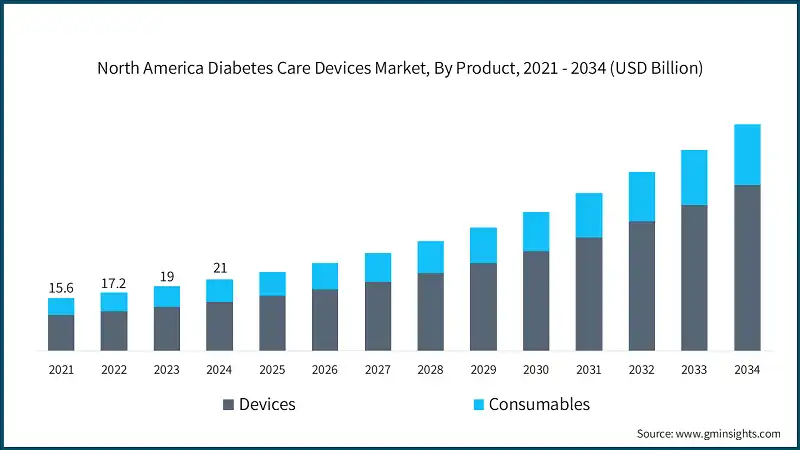
The market increased from USD 15.6 billion in 2021 to USD 19 billion in 2023, largely due to the rising technological advancement in diabetes care devices that have enhanced accuracy convenience and patient engagement innovations such continuous glucose monitors, which was valued at USD 10.9 billion in 2024, smart insulin delivery system, and a integrated mobile platform have not only improved disease management but also expanded the user pays by making care more accessible and personalised. These advancements are accelerating the market growth by making diabetes care smarter, more connected and patients centric.
Rising prevalence of diabetes across regions which have significantly expanded the demand for effective monitoring and management solutions, as more individuals are diagnosed with diabetes the need for advanced care devices such as glucose monitors insulin delivery system and digital health platform continue to grow driving innovation and investment in the region. For instance, in the U.S. alone 38.4 million people of all ages or 11.6 of all population had diabetes. This substantial patient base highlights the urgent need for scalable diabetes care technology. Therefore, this increasing burden of diabetes is accelerating diabetes care devices market growth.
Diabetes care devices refer to a range of medical devices designed to help individuals with diabetes manage their condition effectively. These devices play a crucial role in monitoring blood glucose levels, administering insulin, and overall diabetes management.
North America Diabetes Care Devices Market Report Attributes
| Key Takeaway | Details |
|---|---|
| Market Size & Growth | |
| Base Year | 2024 |
| Market Size in 2024 | USD 21 billion |
| Market Size in 2025 | USD 23.3 billion |
| Forecast Period 2025 - 2034 CAGR | 12.4% |
| Market Size in 2034 | USD 66.8 billion |
| Key Market Trends | |
| Drivers | Impact |
| Growing prevalence of diabetes | Drives higher demand for monitoring and treatment devices, expanding the overall market size and encouraging innovation. |
| Rising technological advancements in North America diabetes care devices | Boosts adoption of smart, connected tools, improving patient outcomes and fueling competition among manufacturers. |
| Pitfalls & Challenges | Impact |
| High cost of diabetes care devices | Limits accessibility for low-income patients and slows adoption of advanced technologies, especially in homecare settings. |
| Opportunities: | Impact |
| Growth of mobile health and digital platforms | Creates new avenues for remote monitoring and personalized diabetes management. Moreover, it enhances patient engagement and data sharing. Additionally, it supports the expansion of home-based care and real-time decision-making. |
| Market Leaders (2024) | |
| Market Leaders |
14.2% |
| Top Players |
Collective market share in 2024 is 35.8% |
| Competitive Edge |
|
| Regional Insights | |
| Largest market | U.S. |
| Fastest growing market | Canada |
| Future outlook |
|
What are the growth opportunities in this market?
North America Diabetes Care Devices Market Trends
- Technology innovation is reshaping diabetes care across North America. Devices such as continuous glucose monitors and closed-loop insulin delivery systems are making management more precise and less invasive for patients.
- These advancements are not only improving outcomes but also driving demand. As people seek more convenient and accurate tools, companies are investing heavily in R&D, leading to a surge in new product launches.
- Integration with mobile apps and cloud-based platforms is enabling real-time data sharing with healthcare providers. This connectivity is enhancing personalized care and accelerating adoption across hospitals, clinics, and home settings.
- For instance, Novo Nordisk offers the FlexTouch, a disposable, pre-filled insulin pen designed with a patient-centric approach. Its ergonomic design requires low injection force, making it easier for people with limited hand strength to use. The pen ensures consistent and accurate dosing and supports various insulin formulations, reflecting the company’s commitment to evolving diabetes care.
- Similarly, F. Hoffmann-La Roche manufactures the Accu-Chek line of glucose monitoring devices, including blood glucose meters and insulin delivery systems. Designed for both clinical and home use, these products feature easy-to-read displays, fast and accurate readings, and compatibility with digital health platforms highlighting Roche’s focus on reliable, user-friendly technology.
- Thus, these technological advancements are positively contributing to the adoption among the patients, fostering market growth.
North America Diabetes Care Devices Market Analysis
Learn more about the key segments shaping this market
The North America market was valued at USD 15.6 billion in 2021. The market size reached USD 19 billion in 2023, from USD 17.2 billion in 2022. Based on the product, the market is segmented into devices and consumables. The device segment is further segmented into blood glucose monitoring devices and insulin delivery devices. The blood glucose monitoring devices segment dominated the market in 2024, holding the largest share due to the widespread adoption across homecare setting, diagnostic centers, and hospitals. This segment was valued at USD 8.5 billion in 2024 and is projected to reach USD 32.7 billion by 2034, growing at a CAGR of 14.7%. In comparison, the insulin delivery devices segment, valued at USD 6.1 billion in 2024, is expected to grow to USD 16.1 billion by 2034.
- Blood glucose monitoring devices help individuals with diabetes track and manage their blood sugar levels over time. This segment includes self-monitoring tools such as blood glucose meters, continuous glucose monitors (CGMs), testing strips, and lancets.
- It dominates the diabetes care monitoring market due to its widespread adoption, ease of use, and essential role in disease management. Rising diabetes prevalence, growing awareness, and ongoing technological advancements continue to drive demand for accurate and user-friendly solutions.
- The integration of digital platforms and mobile apps has further enhanced real-time data sharing with healthcare providers, enabling more personalized care. Innovations in sensor technology and non-invasive methods are also expected to fuel future market growth.
- For example, Abbott Laboratories offers a comprehensive range under its FreeStyle brand. This includes traditional blood glucose monitors such as FreeStyle Lite, Freedom Lite, and Optium/Precision Neo, as well as the FreeStyle Libre CGM series, which features arm-worn sensors lasting up to 14 days.
Learn more about the key segments shaping this market
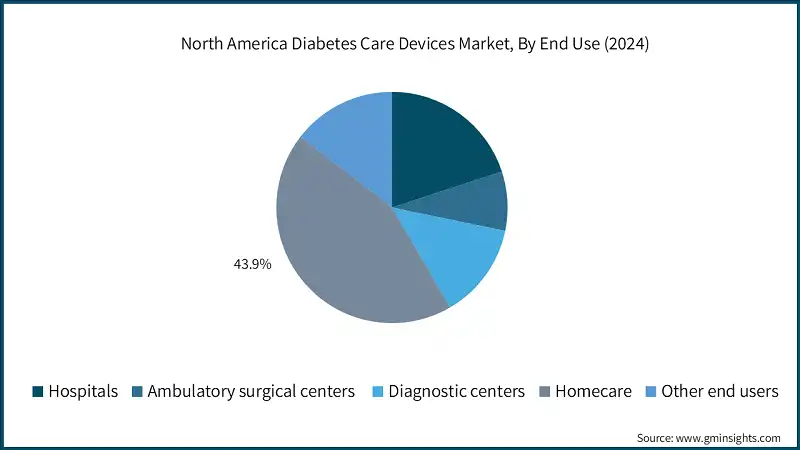
Based on end use, the North America diabetes care devices market is segmented into hospitals, ambulatory surgical centers, diagnostic centers, homecare, and other end users. The home care segment accounted for the market share of 43.9% in 2024.
- Many people with diabetes prefer to self-manage their condition at home due to the comfort and flexibility it offers. Home monitoring reduces clinic visits, saving time and easing anxiety.
- Easy-to-use devices such as glucometers and wearable monitors support this shift, allowing individuals to track their condition and make informed decisions about diet, medication timing, and physical activity.
- For example, Ascensia Diabetes Care offers the Contour Next blood glucose meter, known for its high accuracy, fast results, and user-friendly interface. Paired with digital apps, it enables users to easily track and share glucose data, making it a reliable tool for both daily and long-term management.
- As a result, the growing preference for home-based diabetes care especially among the elderly is driving strong growth in the North American home-use diabetes devices market.
Looking for region specific data?
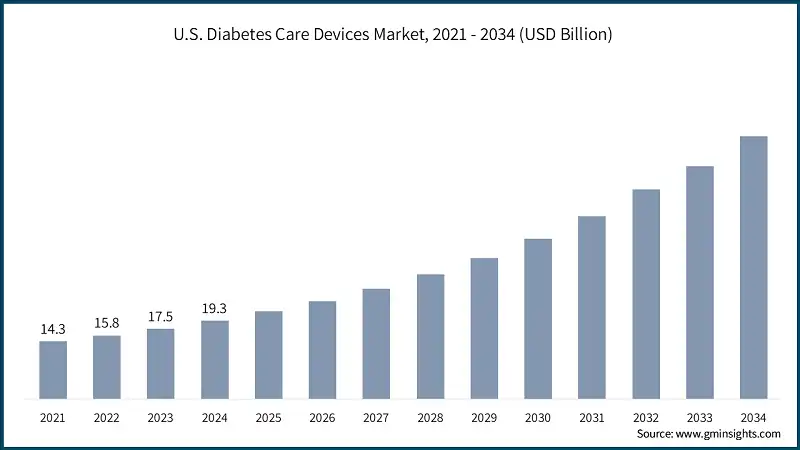
U.S. Diabetes Care Devices Market The U.S. diabetes care devices market was valued at USD 14.3 billion and USD 15.8 billion in 2021 and 2022, respectively. In 2024 the market size reached USD 19.3 billion from USD 17.5 billion in 2023. Canada diabetes care devices market accounted for USD 1.7 billion in 2024 and is anticipated to show lucrative growth over the forecast period. Few of the prominent players operating in the North America diabetes care devices industry include: Abbott Laboratories is a healthcare company recognized for its innovative contributions to diabetes care through advanced monitoring technologies. The company focuses on developing user-friendly, accurate, and connected solutions that support both clinical and personal diabetes management. Abbott emphasizes accessibility and real-time tracking to help individuals manage their condition more effectively. Its flagship product, the FreeStyle Libre system, is a continuous glucose monitor that provides real-time readings without routine fingersticks, offering convenience and improved control for users. B. Braun Melsungen is a healthcare company known for its contributions to diabetes care through reliable and clinically focused solutions. The company emphasizes safety, precision, and ease of use in its product designs, catering to both professional and personal care settings. B. Braun integrates its diabetes care tools with broader patient management systems to support consistent monitoring and treatment. Its product, the Omnitest blood glucose meter, offers accurate readings and a simple interface, making it suitable for everyday use by individuals managing diabetes. Medtronic is a healthcare company known for its advanced diabetes care solutions that combine technology, precision, and patient-centered design. The company focuses on developing automated insulin delivery systems and smart injection tools that simplify diabetes management. Medtronic’s offerings support both clinical and personal use, helping users maintain better glucose control with less effort. Its flagship product, the MiniMed 780G system, features automated insulin adjustments every five minutes and meal detection technology, making it one of the most intuitive and responsive insulin pump systems available.Canada Diabetes Care Devices Market
North America Diabetes Care Devices Market Share
North America Diabetes Care Devices Market Companies
North America Diabetes Care Devices Industry News
The North America diabetes care devices market research report includes in-depth coverage of the industry with estimates and forecast in terms of revenue in USD Million and from 2021 - 2034 for the following segments:
Market, By Product
- Device
- Blood glucose monitoring devices
- Self-monitoring blood glucose meters
- Continuous glucose monitors
- Insulin delivery devices
- Insulin pumps
- Tubed pumps
- Tubeless pumps
- Pens
- Reusable
- Disposable
- Other insulin delivery devices
- Insulin pumps
- Blood glucose monitoring devices
- Consumables
- Testing strips
- Lancets
- Pen needles
- Standard
- Safety
- Syringes
- Insulin pumps consumables
Market, By End Use
- Hospital
- Ambulatory surgical centers
- Diagnostic centers
- Homecare
- Other end use
The above information is provided for the following countries:
- U.S.
- Canada
Frequently Asked Question(FAQ) :
Who are the key players in the North America diabetes care devices market?
Key players include Abbott Laboratories, F. Hoffmann-La Roche, LifeScan, Ascensia Diabetes Care, Dexcom, Medtronic, Insulet, Eli Lilly, Novo Nordisk, and Tandem Diabetes Care.
What are the upcoming trends in the North America diabetes care devices industry?
Key trends include integration of mobile health platforms, AI-powered monitoring, wearable continuous glucose monitors, and adoption of closed-loop insulin delivery systems for personalized and connected care.
What is the current North America diabetes care devices market size in 2025?
The market size is projected to reach USD 23.3 billion in 2025.
What is the projected value of the North America diabetes care devices market by 2034?
The market is expected to reach USD 66.8 billion by 2034, fueled by rising healthcare spending, increasing adoption of connected solutions, and growth of mobile health platforms.
How much revenue did the blood glucose monitoring devices segment generate in 2024?
Blood glucose monitoring devices generated USD 8.5 billion in 2024, leading the industry due to widespread adoption across homecare, hospitals, and diagnostic centers.
What was the valuation of the insulin delivery devices segment in 2024?
The insulin delivery devices segment was valued at USD 6.1 billion in 2024.
Which country leads the North America diabetes care devices market?
The U.S. held the largest share with USD 19.3 billion in 2024. Growth is driven by rising healthcare spending, improved access to advanced technologies, and increasing adoption of CGMs and insulin pumps.
What is the market size of the North America diabetes care devices industry in 2024?
The market size was USD 21 billion in 2024, with a CAGR of 12.4% expected through 2034 driven by growing prevalence of diabetes and rapid adoption of advanced monitoring technologies.
North America Diabetes Care Devices Market Scope
Related Reports