Summary
Table of Content

North America Cooling Meters Market
Get a free sample of this report
Form submitted successfully!
Error submitting form. Please try again.
Thank you!
Your inquiry has been received. Our team will reach out to you with the required details via email. To ensure that you don't miss their response, kindly remember to check your spam folder as well!
Request Sectional Data
Thank you!
Your inquiry has been received. Our team will reach out to you with the required details via email. To ensure that you don't miss their response, kindly remember to check your spam folder as well!
Form submitted successfully!
Error submitting form. Please try again.
North America Cooling Meters Market Size
- Cooling meters measure thermal energy in HVAC systems and calculate energy consumption by noting the temperature difference between the supply and return flows and the volume of fluid passing through the system. They support fair billing in multi-tenant buildings based on their actual consumption. Integration with IoT platforms and building automation systems will help to provide real-time analytics.
- Regular energy audits, introduction of benchmarking policies, and incentives for sub-metering help consumers to track and optimize energy consumption. Cooling meters are essential as they help reduce energy waste and improve energy efficiency. State level mandates like California’s Title 24 building energy standards and New York’s Local Law 97, emphasize reducing carbon emissions in buildings.
- Rapid urbanization in large metropolitan areas across the region will boost the demand for HVAC systems. Ongoing move towards smart grid technologies along with rising integrated into Building Management Systems (BMS), enabling real-time energy monitoring, fault detection, and optimized performance will positively impact the industry statistics.
- Ongoing expansion of the district cooling systems that use cooling meters to track and allocate energy usage in cities with large infrastructure investments will complement the industry landscape. Furthermore, key industry players are focused on sustainability and reducing their carbon footprint, thereby contributing to the business dynamics.
The North America cooling meters market Size was valued USD 525.6 million in 2025. It is anticipated to grow from USD 551.9 million in 2026 to USD 839.8 million by 2035, growing at a CAGR of 5.3%, according to Global Market Insights, Inc.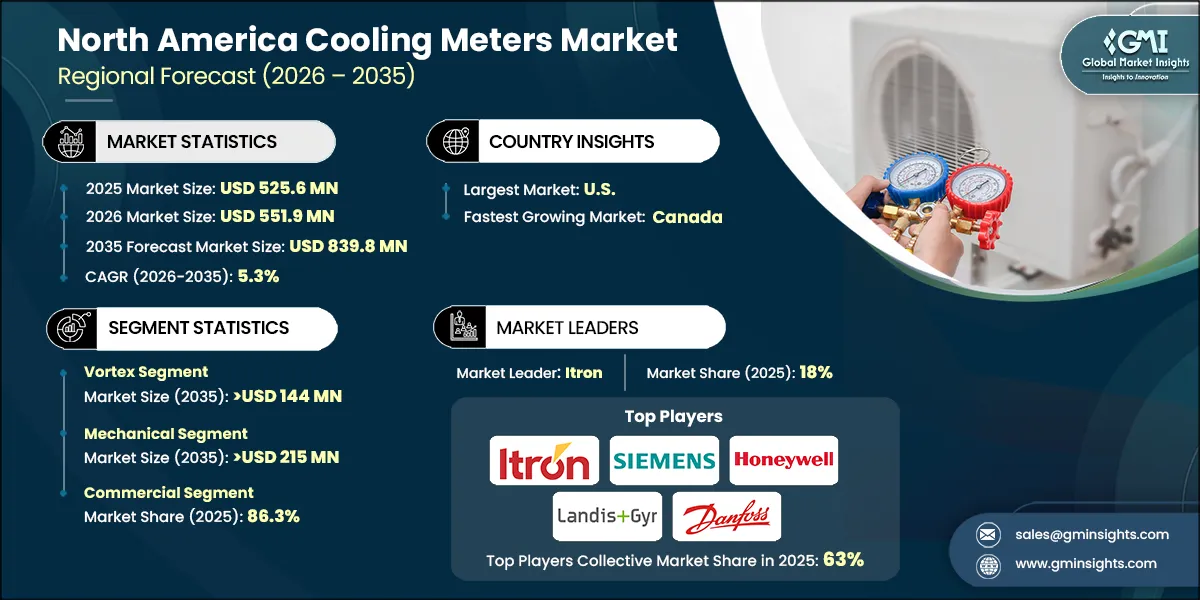
North America Cooling Meters Market Key Takeaways
Market Size & Growth
- 2025 Market Size: USD 525.6 Million
- 2026 Market Size: USD 551.9 Million
- 2035 Forecast Market Size: USD 839.8 Million
- CAGR (2026–2035): 5.3%
Regional Dominance
- Largest Market: U.S.
- Fastest Growing Country: Canada
Key Market Drivers
- Growing inclination to adopt sustainable solutions.
- Favorable government efforts to develop zero emission buildings.
- Surging requirement for cooling solutions across hot climate regions.
Challenges
- Technical limitation during extreme weather conditions.
- High Initial Installation and Integration Costs.
Opportunity
- Growth of smart building and energy management systems.
- Incentives and regulations to support energy efficiency.
Key Players
- Market Leader: Itron led with over 18% market share in 2025.
- Leading Players: Top 5 players in this market include Itron, Siemens, Honeywell International, Landis+Gyr, Danfoss, which collectively held a market share of 63% in 2025.
Get Market Insights & Growth Opportunities
To get key market trends
North America Cooling Meters Market Trends
- Minimized energy production costs help consumers to opt for advanced metering solutions to evaluate consumption and enhance billing management, leading to market growth. Growing emphasis on individualized and automated billing adoption will augment the use of smart cooling meters. However, key challenges associated with accuracy, long-term stability, and device protection in hot and humid environment might hamper industry expansion to some extent. Furthermore, introduction of innovative meters that offer high immunity against extreme weather conditions and enhanced performance will create lucrative business prospects.
North America Cooling Meters Market Analysis
Learn more about the key segments shaping this market
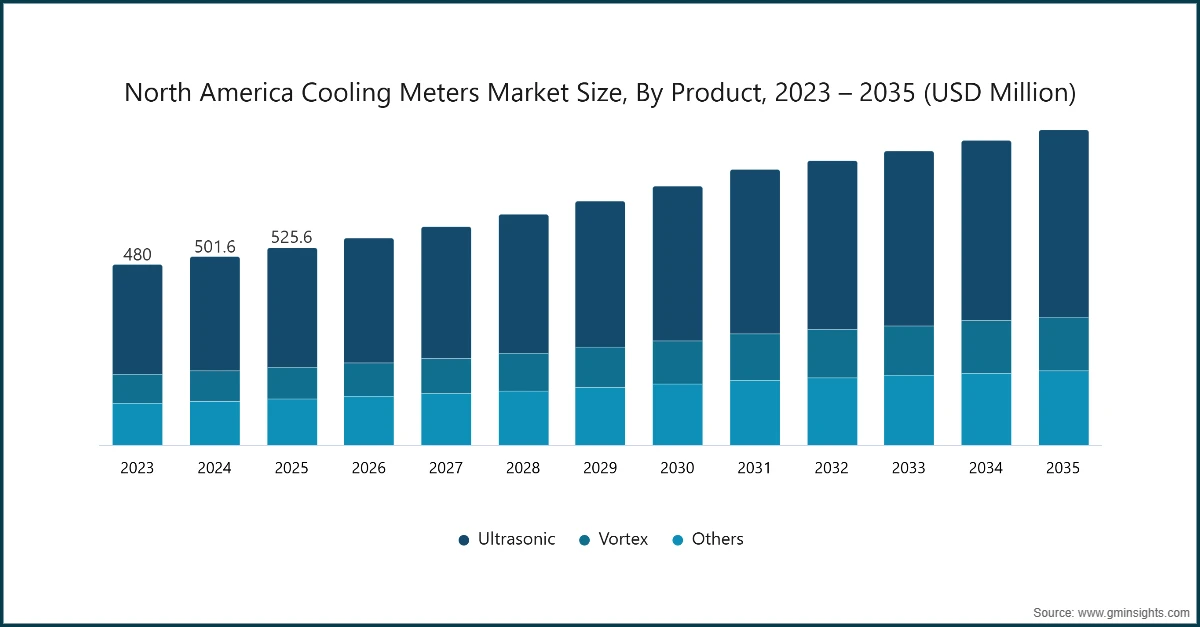
Based on product, the North America Cooling Meters market is segmented into vortex, ultrasonic and others.
- Vortex is anticipated to grow by more than USD 144 Million by 2035 owing to key advantages comprising eliminating the need for an electric power supply, among others. The cooling meters are further utilized for switch cabinet cooling, convective cooling of high-speed tools, and the air conditioning of protective suits thereby, augmenting the product demand. In addition, shift in preference for advanced cooling equipment offering data monitoring in real-time to reduce energy bills will propel the meters sales in the coming times.
Learn more about the key segments shaping this market
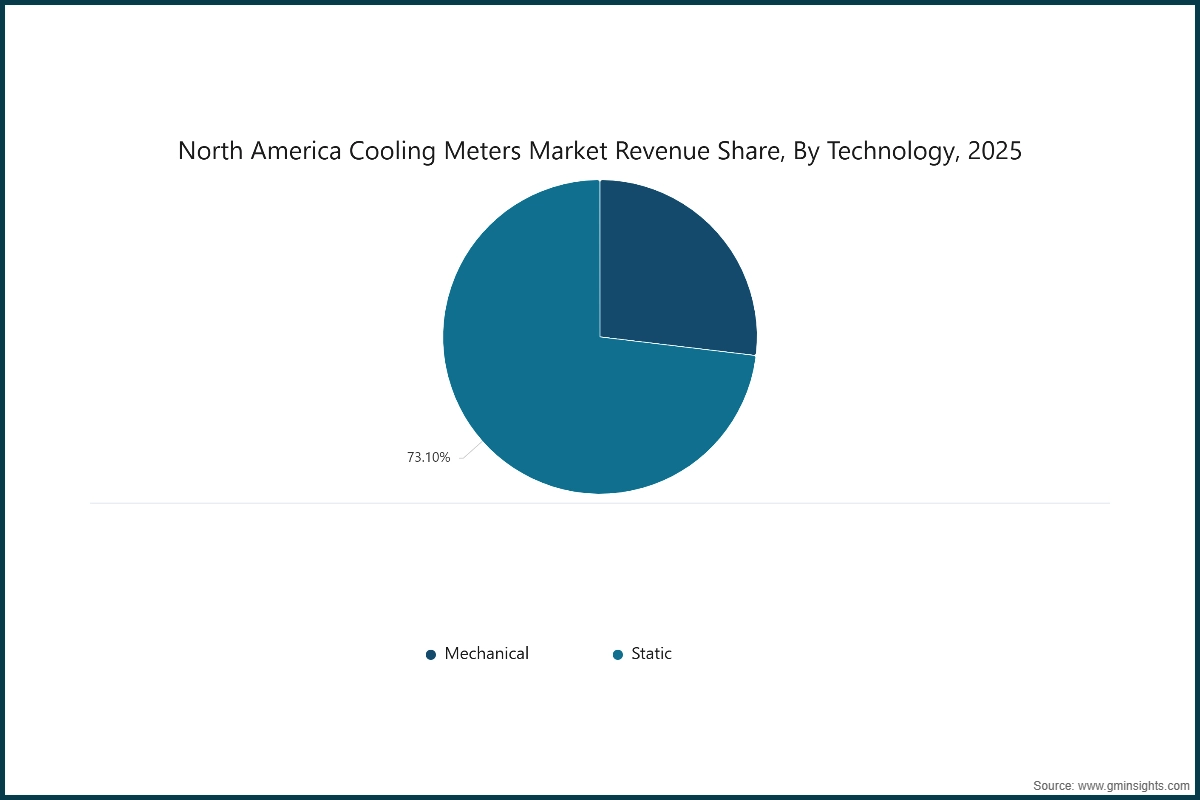
Based on technology, the North America cooling meters market is segmented into mechanical and static.
- Mechanical is anticipated to grow more than USD 215 Million by 2035 primarily in cost sensitive applications including residential and small commercial projects. Utilization in older buildings or legacy systems that may not require high levels of accuracy or frequent data monitoring on account of easy integration will boost the business scenario. Moreover, growing compliance with energy efficiency measures will significantly fuel the industry statistics.
Based on application, the North America Cooling Meters market is segmented into residential, commercial and industrial.
- Commercial cooling meters held a market share of 86.3% in 2025 and will grow more than 5% by 2035. Strong focus on mitigating the carbon footprint, growing demand for precise renewable energy monitoring solutions along with introduction of government initiatives comprising the Federal Building Performance standard will drive the business scenario. Additionally, growing adoption of advanced metering solutions in small commercial establishments will complement the business landscape.
Looking for region specific data?
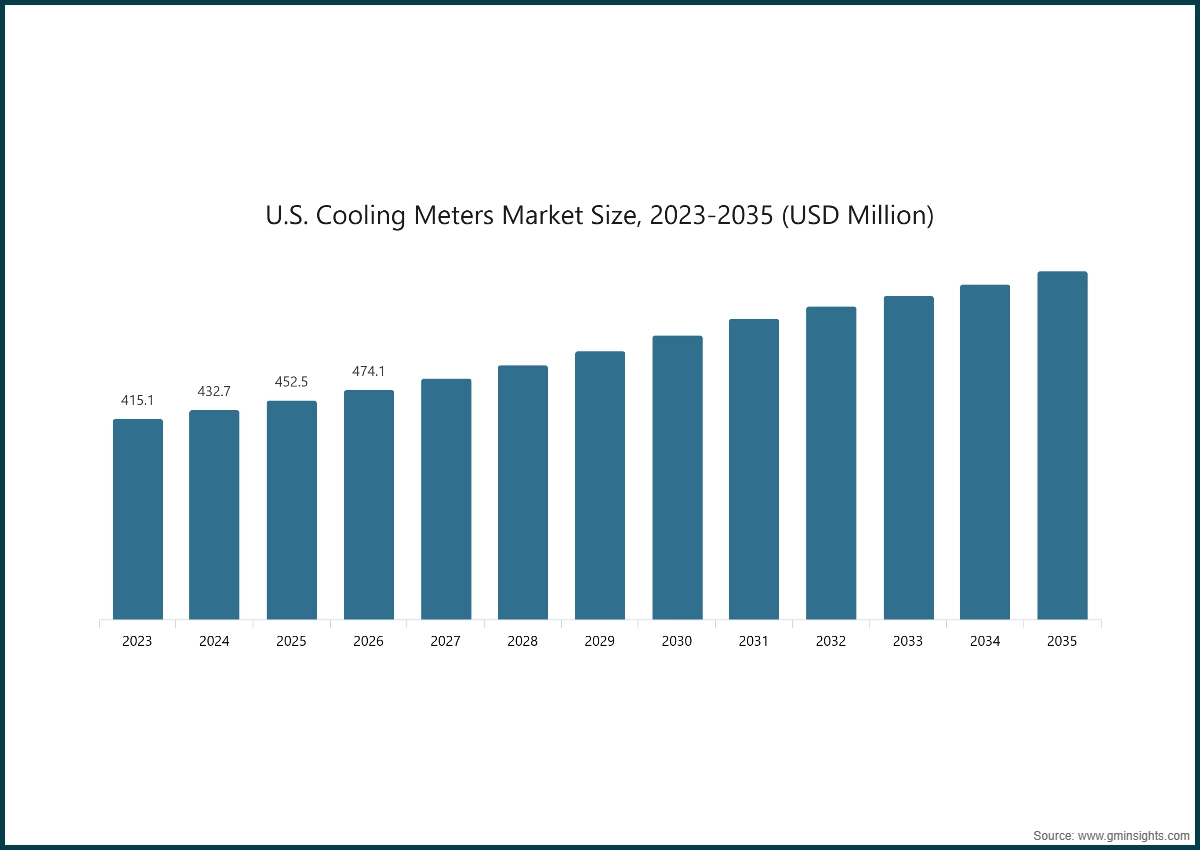
The U.S. cooling meters market is set to grow more than USD 710 million by 2035 driven by a combination of regulatory, technological, and market factors aimed at improving energy efficiency and reducing cooling costs.
- Rising sustainability initiatives, with businesses and building owners increasingly aiming to meet energy efficiency standards set by entities including the U.S. Department of Energy (DOE) will stimulate the industry statistics. Availability of low cost and carbon electricity and strategic ventures among the developing countries is set to impact the industry growth. Moreover, significant penetration across large commercial and industrial facilities where these HVAC systems account for a large portion of energy use is set to drive the business outlook.
North America Cooling Meters Market Share
- Product reach expansions and strategic collaborations are being undertaken by the key companies to strengthen their market presence. Growing inorganic ventures between third party distributors, manufacturers and end users will stimulate the product adoption. In addition, increasing awareness about energy bill reduction and consumption optimization is set to influence the regional industry statistics.
North America Cooling Meters Market Companies
Eminent players operating in the North America Cooling Meters industry are:
- Apator SA
- Axioma Metering
- Badger Meter, Inc.
- B METERS s.r.l.
- Danfoss A/S
- Diehl Stiftung & Co. KG
- Honeywell International Inc.
- Itron, Inc.
- Integra Metering
- Kamstrup A/S
- Landis+Gyr AG
- QMC Metering Solutions
- RB Flowmeter
- Schneider Electric SE
- Secure Meters Ltd.
- Siemens AG
- Sontex SA
- Xylem, Inc.
- ZENNER International GmbH & Co. KG
- ista Energy Solutions Limited
North America Cooling Meters Market Report Attributes
| Key Takeaway | Details |
|---|---|
| Market Size & Growth | |
| Base Year | 2025 |
| Market Size in 2025 | USD 525.6 Million |
| Market Size in 2026 | USD 551.9 Million |
| Forecast Period 2026-2035 CAGR | 5.3% |
| Market Size in 2035 | USD 839.8 Million |
| Key Market Trends | |
| Drivers | Impact |
| Growing inclination to adopt sustainable solutions | Constant efforts to reduce energy consumption, lower carbon emissions, and improve overall building efficiency, by governments, businesses, and property owners will contribute to market growth. Cooling meters support in measuring and tracking the actual amount of energy used for chilled water systems and air conditioning, making it easier to monitor performance and identify waste, driving the business momentum. |
| Favorable government efforts to develop zero emission buildings | Introduction of building codes along with energy performance standards, and incentive programs by federal, state, and local authorities to encourage lower carbon footprints will lead to market growth. Shifting focus on reducing energy use and adopting clean energy sources along with increasing requirement for accurate measurement and monitoring of energy consumption will augment the demand for high rated products. |
| Surging requirement for cooling solutions across hot climate regions | Rising demand for cooling solutions in hot climate regions and growing reliance on air conditioning in areas with consistently high temperatures, such as the southern United States will drive the adoption of cooling meters. Cooling meters help to accurately measure and manage cooling energy use, allowing users to control expenses and improve system performance. Rising requirement for better monitoring and cost allocation in regions where air conditioning is essential for operations is set to stimulate the industry momentum. |
| Pitfalls & Challenges | Impact |
| Technical limitation during extreme weather conditions | Cooling systems often operate under maximum load for extended periods especially in areas with very high temperatures, hurricanes, or heavy storms. These conditions affect the accuracy and reliability of the product, affecting the product performance. They can further have communication failures in remote monitoring systems, and thus present need for higher maintenance requirements. Increasing concerns about long-term durability, calibration accuracy, and additional service costs, can slow down broader product adoption in the region. |
| High Initial Installation and Integration Costs | Modifications to piping systems and additional hardware like communication modules and data platforms to upgrade existing buildings might affect the product adoption. Low return on investment delays decision-making and adoption of cooling meters. Further, retrofitting is a complex and labor-intensive process and increases the overall project cost, leading to slow market growth. |
| Opportunities: | Impact |
| Growth of smart building and energy management systems | Increasing demand for cooling meters to provide accurate, real‑time energy usage data will complement the business landscape. They can be integrated into systems to identify inefficiencies, monitor energy, and reduce consumption and operating costs, contributing to the industry momentum. |
| Incentives and regulations to support energy efficiency | There are several rebates, tax credits, and financial support for energy‑saving upgrades offered by federal, state, and utility programs support investment in efficient meters, thereby complementing the product penetration. Introduction of sustainability standards will increase the demand for precise energy measurement leading to market growth. |
| Market Leaders (2025) | |
| Market Leader |
18% market share |
| Top Players |
Collective market share in 2025 is 63% |
| Competitive Edge |
Danfoss is known for its wide product range including power electronics, industrial automation and HVAC controls. The company had a operational EBITA margin of 10.6% in the first half of 2025. Further, it launched LEAP 2030, a long‑term growth strategy which is focused on value creation and global expansion, supporting the company goals. |
| Regional Insights | |
| Fastest growing market | Canada |
| Future outlook |
|
| Largest Market | U.S. |
What are the growth opportunities in this market?
North America Cooling Meters Industry News
- Landis+Gyr introduced Revelo Cellular grid sensor, equipped with ability to add grid edge computing and sensing capabilities in an advanced meter. The product was commercially available in 2025 and can be easily connected to the company's cloud operating system. The sensor comes in a variety of forms and is compatible with many models and can early detect hot socket conditions.
- Xylem Inc. introduced a new residential meter with progressed grid edge abilities. The new Stratus IQ™ meter from Sensus, a Xylem brand, is getting the grid to next level smart. Further, its enlarged data set and robust processor will enable utilities to pull more system diagnostics, providing them with a powerful health check of their distribution system and addressing concerns about the electricity usage.
- ZENNER International GmbH and Minol ZENNER Connect have been working in partnership within the Minol-ZENNER-Group to digitalize the energy conversion. Further, the companies with given energy suppliers, municipal utilities, municipalities, and the housing industry will provide the end users with an all-inclusive infrastructure.
North America Cooling Meters market research report includes an in-depth coverage of the industry with estimates & forecast in terms of volume and revenue in “USD Million & ‘000 Units” from 2022 to 2035, for the following segments:
Market, By Product
Ultrasonic
Vortex
- Others
Market, By Technology
Mechanical
- Static
Market, By Application
Residential
Commercial
- Industrial
The above information has been provided for the following countries:
- U.S.
- Canada
Frequently Asked Question(FAQ) :
What is the market size of the North America cooling meters market in 2025?
The market size was valued at USD 525.6 million in 2025, with a CAGR of 5.3% expected through 2035, driven by increasing adoption in cost-sensitive applications and compliance with energy efficiency measures.
What is the projected value of the North America cooling meters market by 2035?
The market is expected to reach USD 839.8 million by 2035, supported by advancements in energy-efficient technologies and growing demand for integration in legacy systems.
What is the projected size of the U.S. cooling meters market by 2035?
The U.S. cooling meters market is anticipated to exceed USD 710 million by 2035, driven by regulatory measures, technological advancements, and efforts to reduce cooling costs.
How much revenue is the vortex cooling meters segment expected to generate by 2035?
The vortex cooling meters segment is projected to grow by more than USD 144 million by 2035, owing to benefits such as eliminating the need for an electric power supply and applications in diverse cooling scenarios.
What are the key challenges in the North America cooling meters market?
Challenges include ensuring accuracy, maintaining long-term stability, and protecting devices in hot and humid environments, which may hinder market growth to some extent.
What are the upcoming trends in the North America cooling meters market?
Key trends include the adoption of smart cooling meters for automated billing, the introduction of innovative meters with high weather resistance, and a shift toward advanced cooling equipment with real-time data monitoring capabilities.
Who are the key players in the North America cooling meters market?
Key players include Apator SA, Axioma Metering, Badger Meter, Inc., B METERS s.r.l., Danfoss A/S, Diehl Stiftung & Co. KG, Honeywell International Inc., Itron, Inc., Integra Metering, Kamstrup A/S, and Landis+Gyr AG.
North America Cooling Meters Market Scope
Related Reports