Summary
Table of Content

North America Class 6 Truck Market
Get a free sample of this report
Form submitted successfully!
Error submitting form. Please try again.
Thank you!
Your inquiry has been received. Our team will reach out to you with the required details via email. To ensure that you don't miss their response, kindly remember to check your spam folder as well!
Request Sectional Data
Thank you!
Your inquiry has been received. Our team will reach out to you with the required details via email. To ensure that you don't miss their response, kindly remember to check your spam folder as well!
Form submitted successfully!
Error submitting form. Please try again.
North America Class 6 Truck Market Size
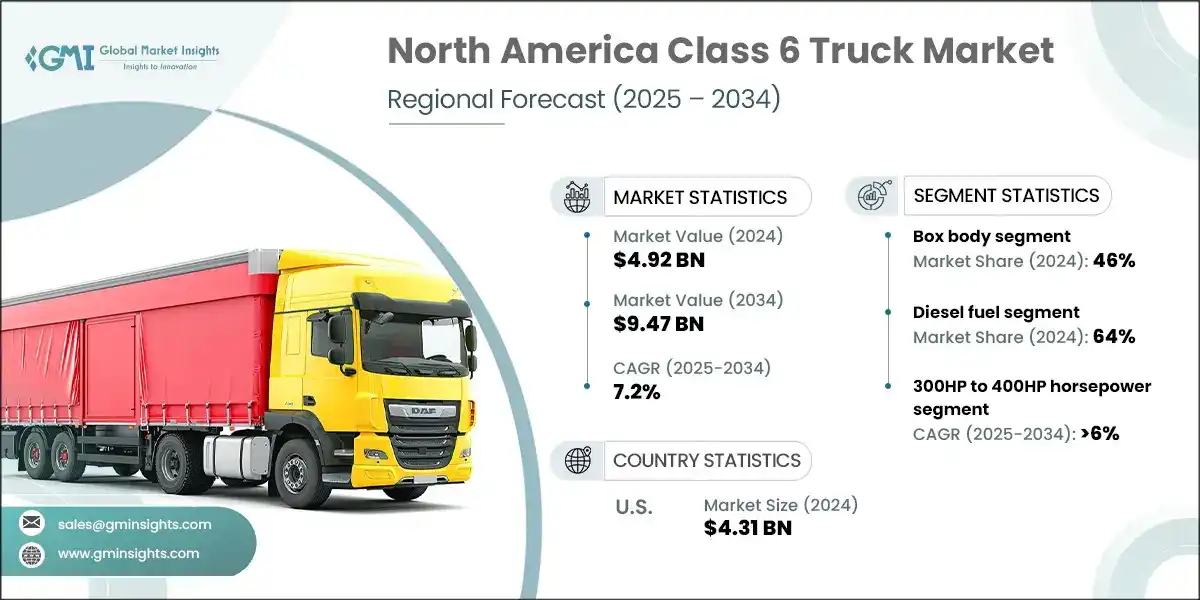
The North America class 6 truck market size was estimated at USD 4.92 billion in 2024. The market is expected to grow from USD 5.07 billion in 2025 to USD 9.47 billion in 2034, at a CAGR of 7.2%.
North America Class 6 Truck Market Key Takeaways
Market Size & Growth
- 2024 Market Size: USD 4.92 Billion
- 2034 Forecast Market Size: USD 9.47 Billion
- CAGR (2025–2034): 7.2%
Key Market Drivers
- Rise in last-mile delivery demand.
- Surge in electrification initiatives.
- Increase in fleet modernization efforts.
- Growth in infrastructure projects.
Challenges
- High Upfront Costs.
- Charging Infrastructure Gaps.
Opportunity
- Expansion of clean fleet mandates.
- Adoption of leasing and subscription models.
- Integration of connected vehicle platforms.
- Commercialization of hydrogen fuel-cell Class 6 trucks.
Key Players
- Market Leader: PACCAR led with over 23% market share in 2024.
- Leading Players: Top 5 players in this market include Daimler Truck, Ford, Hino Motors, PACCAR, Volvo Trucks, which collectively held a market share of 50% in 2024.
Get Market Insights & Growth Opportunities
- The North America class 6 truck market is changing rapidly, buoyed by increased need for regional freight movement, last-mile delivery, and vocational use. Fleet Operators are clearly deciding on medium duty for several reasons such as balancing power, payload, and fuel efficiency, Class 6 has become the workhorse for urban logistics, in municipal fleets, and for infrastructure services.
- Electrification, telematics-enabled fleets, and emissions regulations are creating the framework for this paradigm shift in Class 6 trucks. For instance, in October 2023, Daimler Truck North America began building the electric Freightliner eM2 also designed for urban delivery with a range up to 250 miles. It is the second fully electric truck introduced by DTNA following eCascadia.
- COVID-19 accelerated e-commerce via last mile delivery and created demand for Class 6 trucks for logistics firms. Companies like Amazon and FedEx have rapidly modernized and amped up their own connected medium-duty fleets in extraordinary amounts of investments geared toward predictive maintenance, real-time monitoring, and competitive class 6 fleets.
- Fleet electrification incentives and other grants at the state level continue to be widespread. The utilities and municipalities include electric Class 6 truck purchases in their sustainability goals. Total platform innovations continue to delineate brand competitiveness in Class 6 trucks and beyond.
- The U.S. leads the class 6 truck market due to vast logistics network that includes urban delivery systems coupled with acceptance from industries like construction, utilities, and e-commerce. The U.S. also has a lot of manufacturing exposure through OEMs like Ford, Freightliner, and Navistar as well as support at the state level for fleet electrification.
- Canada is the fastest growing market due to increased investment in green transportation and infrastructure, and financial incentives for the purchase of zero-emission commercial vehicles. The demands of logistics are growing in Canada as provinces come to increasingly tight emissions regulations, and demand for versatile, medium-duty trucks is growing in urban and remote capacities.
To get key market trends
North America Class 6 Truck Market Trends
- Fleet electrification and regulatory mandates are impacting truck design and next purchase decisions, and this is quickening with new emissions legislation such as the U.S. EPA Phase 3 GHG standards and California's Advanced Clean Fleets rule. OEMs have started offering battery-electric trucks such as Freightliner and Workhorse for delivery use. This direction includes sustainability goals, total cost of ownership and public incentives.
- For instance, in September 2023, Workhorse started production on its W56 fully electric chassis in Indiana, its first purpose-built Class 5/6 EV. With a range of 150 miles, a payload of 10,000lbs, and over 1,000cf of cargo capacity this vehicle will have full step-van units arriving later that same year.
- OEMs have also evolved their telematics, diagnostics and ADAS for Class 6 trucks, whereby telematics and diagnostics have become a standard feature for increased fleet uptime. Features such as Freightliner's connected eM2 or the PACCAR combo smart fleet systems have been developed to provide fleet operators with metrics that allow for optimized maintenance strategies combined with predictive maintenance and real-time tracking to create safe, efficient, and low-cost fleet operations.
- For instance, in March 2025, Geotab announced a partnership with Daimler Truck North America, offering integrated telematics for connected Freightliner trucks with engines provided by Cummins, thus reducing time lost by real-time diagnostics to improve fleet efficiency.
- The interest in the upfitted, purpose-built Class 6 trucks has increased primarily in construction, utilities, and municipal-related industries. OEMs are now providing modular chassis platforms with specifications for snowplows, refuse trucks, mobile workshops. Ford and Navistar are teaming with upfitters to market full vocational packages to meet a new demand for flexibility and multi-role activities in operating environments.
- In March 2023, Navistar introduced the International S13 Integrated Powertrain for vocational trucks. The 13L engine has an integrated 14-speed automatic manual transmission (AMT) and factory PTO. This new powertrain approach simplifies the upfit process, allows for enhanced efficiency for fleets operating in the construction, utility, and municipal business functions.
- The fleet operators, particularly small and medium-sized businesses, have taken streamline fleet management through no-code powered two-sided dashboard interfaces. Telematics aka vendors and OEMS provide plug-and-play platforms, and some have drag-and-drop customized workflows and real-time analytics. This is democratizing fleet control and allowing non-technical managers to improve route optimization, emissions tracking, vehicle health management, and others.
- For instance, in October 2023, Volvo Trucks North America launched Volvo Connect, an easy-to-use fleet management portal that provides real-time data on overall fuel use, vehicle health, safety metrics, and others. With remote diagnostics, OTA updates, and exportable reports etc., combinations of features will allow for easier overall operations for non-technical users, helping fleets reduce downtime and improve efficiency.
North America Class 6 Truck Market Analysis
Learn more about the key segments shaping this market
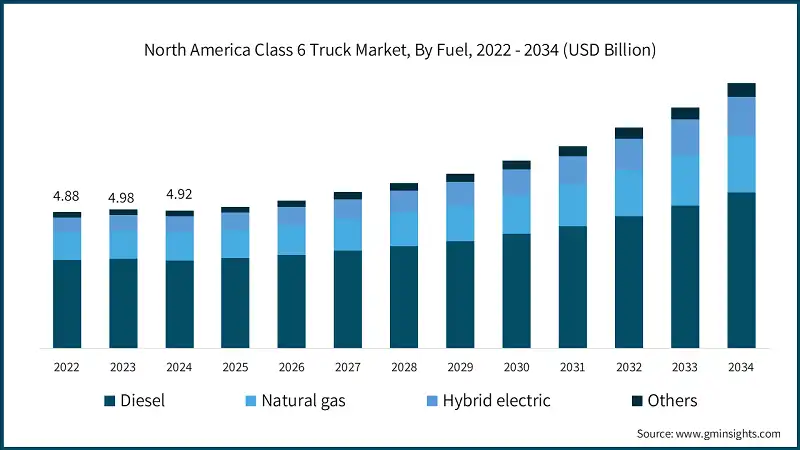
Based on fuel, the North America class 6 truck market is divided into diesel, natural gas, hybrid electric, and others. The diesel fuel segment dominated the market accounting for around 64% in 2024 and is expected to grow at a CAGR of over 6% through 2034.
- Diesel- powered trucks dominate the North America class 6 truck market due to their existing infrastructure, performance characteristics, and overall cost for long- haul and heavy- duty jobs. Most fleets are existing diesel fueled, while diesel has the advantage of a well-established fueling network, mature technology, and improved operational range.
- The major OEM diesel offering of Freightliner, International and Ford has maintained a slight lead, despite impending more environmental compliance and fueling efficiencies over time. Diesel trucks have been around the longest, and good old- fashioned diesel trucks, unlike other fuel options have never been outlawed in North America.
- Hybrid- electric powered trucks are the fastest growing fuel segment, and with a CAGR of over 10% till 2034. Fleet operators are increasingly focused on improved sustainability and compliance in their fleet designs to meet regulation. The technology of hybrid is generally understood as various integrations including diesel or gasoline engines paired with electric motors to improve fuel consumption and reduce emissions.
- The North America class 6 truck market growth is led primarily in urban applications of last-mile delivery, municipal services, and others, and arguably due to corporate ESG obligations. OEM options including hybrid models optimized duty cycles for class 6 trucks appeared, despite being niche.
- Natural gas-powered trucks have slowly established some traction in very niche applications such as waste management or urban transit in specifically lower tailpipe emissions and quieter operations but still struggle to maintain refueling infrastructures and the initial cost is more than other conventional fuel powered vehicles. The number of regional utilities and their fleets, sustainably focused large fleet operators, remain the early adopters of natural gas power.
- For instance, in July 2025, Daimler Truck stressed diesel's ongoing validity in North America, with its dependable performance and profitability for vocational fleets, while simultaneously balancing zero-emission investments pursuant to its “Stronger 2030” long-term strategy.
Learn more about the key segments shaping this market
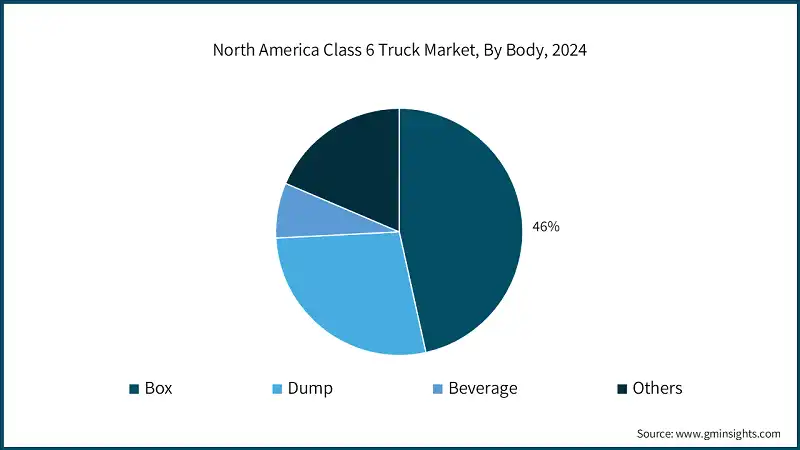
Based on body, the North America class 6 truck market is segmented into box, dump, beverage, and others. The box body segment dominates the market with 46% share in 2024 and is expected to grow at a CAGR of over 7% from 2025-2034.
- The box body segment completely dominates the North America class 6 truck market, and is absolutely critical in the regional logistics, retail distribution, and e-commerce supply chains. Box body design firmly establishes on-road confidence with the enclosed and well-structured body construction for secure transporting goods across all verticals, including retailing, wholesale, and consumer shipping such as FedEx, UPS, Amazon, and others.
- The dump body segment is the fastest growing and has responded favorably to heightened infrastructure funding, the general expansion of construction, and what seems endless expansion of municipal services. Dump trucks haul bulk goods prepared for favorable movement on-road, such as gravel, sand, or waste. Dump trucks with a box body are being distributed in various configurations to add some clever usage for urban construction when servicing public works with emphasis on efficiency.
- Beverage trucks, as well as any other body built with specialized delivery service, complement the industry but represent a much smaller share of the overall market and remain easier to service niches as a general service-oriented industry. More specifically, beverage trucks address critical or niche sectors that include food and beverage logistics or utility servicing, although these also remain stable in terms of applicability but less within the fleet turnover established as our fleet expands.
- For instance, in March 2024, Daimler delivered its first electric Freightliner eM2 box trucks to PITT OHIO, demonstrating the strategic role of box trucks in urban logistics, and fleet electrification.
Based on horsepower, the North America class 6 truck market is segmented into 200HP to 300HP, and 300HP to 400HP. The 300HP to 400HP horsepower segment is expected to dominate the market with 57% share in 2024 and is expected to grow at a CAGR of over 6% from 2025-2034.
- The North America class 6 truck market is dominated by the 300HP to 400HP segment, as it is well suited for heavy-duty applications such as regionally haul, vocational kind of fleets, construction logistic work and so on. This horsepower range is preferred by large corporations and municipalities, as it allows flexibility in power versus efficiency characteristics when grappling with different types of surfaces, terrain and respective payloads. OEMs adopting this range as the standard, irrespective of weight, within a medium-duty platform have different types of operational flexibility.
- The 200HP to 300HP segment is the fastest growing segment, as new demand is coming in from urban delivery, last mile logistics, and lightweight vocational applications. Fleet operators, whether public or private, but mainly small and mid-size fleets, and e-commerce operators prefer this horsepower range to maximize fuel efficiency and maneuverability within limited and or highly congested areas.
- For instance, the Freightliner M2 106 Plus, a top-selling medium-duty truck in North America, can be configured with engine options up to 360 hp, including Cummins B6.7 and Detroit DD13 options. Positioned in the 300–400 hp range, it is ideal for high-demand applications like box trucks, dump trucks, and various utility trucks.
Based on axle, the North America class 6 truck market is segmented into 4X2, 6X4, and 6X6. The 4X2 axle type dominates the market.
- The 4X2 axle type dominates the market as the operating costs can be lower compared to other axle type configurations, the drivetrain is simplified, and it is highly suited for urban and regional haulage. Logistics, retail, and last-mile delivery fleets have favored the 4X2 configuration, and it can all translate into less fuel being used and cost more effective maintenance. OEMs continue to support fleet dominance in 4X2 axle type configurations, building many unique 4X2 models with telematics, ADAS, and connected vehicle technologies.
- The 6X4 Axle Type is the fastest growing segment within the class range as fast growth is fueled from increasing demand from vocational segments such as construction, municipal and utility sectors. This is mainly due to the traction and heavy-load benefits that are very well suited for demanding or uneven terrains. Other factors such as infrastructure funding have created a perfect storm for the segment currently, construction fleet owners are further experimenting with fleet renewal programs that may include and fully integrate both unique 6X4 axle configuration vehicles with telematics and other AEQ's.
- The 6X6 Axle Type, considered niche, is gaining traction sporadically from specialized segments such as the military, emergency response and extreme off-road operations vehicles. The 6X6 with all wheel drive has also raised performance and operational handling experiences with a combination of unmatched traction in very challenging terrains. The challenges include indiscriminate snow, difficult mud and extreme steep grades. Overall, the adoption of the 6X6 axle vehicle type has been limited by cost and complexity in design. It can be indispensable when traction, or maximum performance is of the utmost consideration and priority.
Based on application, the market is categorized into freight delivery, utility services, construction & mining, and others. Freight delivery is the dominant segment in the North America class 6 truck market.
- Freight delivery is the dominant in Class 6 truck space when considering North America drivers such as e-commerce became mainstream, retail distribution exploded, development of cities continued, and others. Both large logistics companies and last-mile delivery companies view utilizing medium-duty trucks increasingly as they relate to regional, planned and direct routes, as well as city access.
- Some Class 6 trucks support an array of box bodies, refer bodies, dry vans and are well suited to high frequency delivery cycles. Companies are looking to integrate intelligent telematics systems in conjunction with fleet electrification, as a conduit to increase operational efficiency, and, in support of measurable sustainability goals especially in metropolitan settings.
- Construction and mining is the fastest growing due to infrastructure development, increased housing demand and public investment to expand transportation and utilities. The construction and mining usage really are looking to ruggedize Class 6 trucks for applications for hauling debris, as well as, hauling materials and supporting utility on-site work.
- The utility services and other niche segments will continue steady growth to leverage existing use, but overall freight delivery and construction/mining should command the greatest scale and acceleration respectively going forward. Continued fleet modernization and electrification mandates as well as application specific innovations to leverage specificity continue to drive demand across these core end-use applications.
- For instance, in July 2024, Hight Logistics added additional Volvo VNR Electric Trucks to their all-electric fleet to service port drayage in California. The new trucks can service an operating range from a low of 20 miles up to a high of 140 miles so they can operate based on a zero emissions assessment for each destination.
Looking for region specific data?
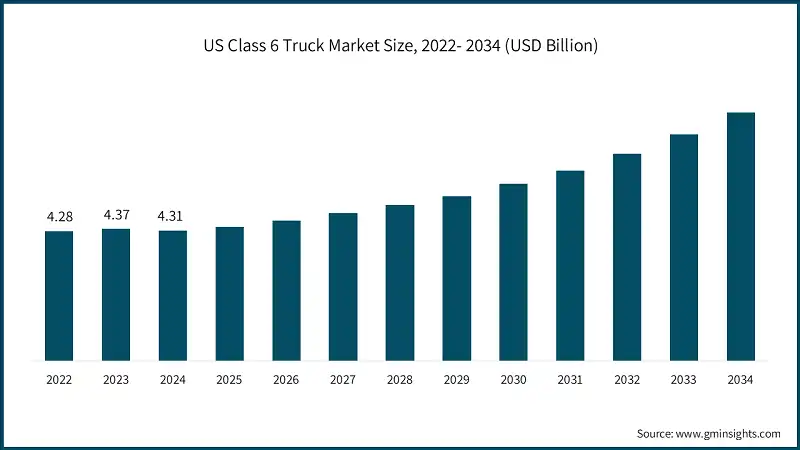
US dominated the class 6 truck market in North America with around 87% share in 2024 and generated USD 4.31 billion in revenue.
- US leads the market, with its considerable and well-established logistics infrastructure supported by a nationwide highway network and advanced freight handling systems ensuring continuous demand for the trucks in regional, urban, and last mile freight movement.
- Major OEM's, such as Daimler's Freightliner, Navistar, and Paccar either are U.S. based or have substantial operations in the US. leading to a strong, accessible supply chain, frequent product innovation, and a healthy aftermarket service ecosystem that is branded to Class 6 fleets.
- The rapid urbanization in US cities and increasing volumes of e-commerce activity in cities has led to a need for medium duty trucks capable of making a lot of stops, navigating tighter route configurations, and performing deliveries that must meet time constraints. Class 6 trucks are purpose-built for this situation.
- Fleets in the U.S. are some of the earliest adopters of telematics, connected vehicle systems, and digital fleet dashboards to enhance operational effectiveness, reduce costly downtime, and maximize vehicle utilization. These items are advantageous when managing a large Class 6 truck fleet across several states.
- For instance, in April 2023, Navistar delivered the first all-electric International eMV Class 6 refrigerated truck to Sysco, with ePower and ePTO for complete zero-emission refrigeration. Sysco's goal is to electrify 35% of its U.S. fleet by 2030, in support of its sustainability plan.
The class 6 truck market in the Canada is expected to experience significant and promising growth from 2025-2034.
- Canada is becoming the fastest growing region in the North American market for mid-size trucks, spurred on by a need to modernize fleet, sustainability and emerging infrastructure investments. With sustainability plans in both federal and provincial governments evolving into stricter cap and trade policies with growing references for greener alternatives, it is expected to drive demand for efficient and electric trucks in the mid-size segment.
- British Columbia and Quebec are the provinces leading the electrification of Canada, as their provincial governments develop and provide a base layer, as well as additional regionally focused rebates and tax incentives for electric trucks. The rebates and tax incentives are closely developed with the climate action plans of both provinces, including targeted plans to achieve net-zero emissions by 2050.
- Major logistics enterprises like Purolator and Canada Post are already finding modes to deploy electric and hybrid vehicles into their fleets and demonstrate and achieve sustainability plans while deploying electric and hybrid mid-size trucks.
- Partnerships with US based OEMs are allowing fleets to build local, manageable distribution are taking advantage of the better supply chain along with the available vehicles and growing regional partnerships to access larger brands.
- Federal government incentives, along with the iMHZEV Program, which is focused on high meaning incentives for stakeholders, is also ushering in the adoption of electric vehicles to fleets, as they receive vehicle purchase rebates up to C$200,000, per vehicle purchased through the iMHZEV program.
- For instance, in March 2023, Purolator announced a USD 1 billion investment to electrify 60 percent of its last mile delivery fleet in Canada by 2030, to include 3500 electric vehicles, along with the major modifications to 60+ terminations which will allow and support its goal of evolving logistics and delivery systems.
North America Class 6 Truck Market Share
- The top 7 companies in the North America class 6 truck industry are Freightliner, Ford, PACCAR, Navistar, Volvo Trucks, Hino Motors, and Isuzu Commercial Truck contributing around 77% of the market in 2024.
- Freightliner has a strong presence in Class 6 with their exciting M2 106 Plus configuration. When you think of Freightliner you think of reliability, customization, and advanced telematics. As part of Freightliner's focus on sustainable solutions they have introduced their all-electric Class 6 truck, the EM2, which is geared toward urban deliveries, yet another item on the supply chain towards achieving zero emissions in logistics.
- Ford has their F-650 Class 6 truck that is used for many vocational and municipal applications. Ford offers the truck in gasoline and diesel versions along with a large dealer network and strong aftermarket support. Ford relies on the truck being built for commercial users who want durable vehicles that are fleet ready.
- PACCAR's brands (Kenworth and Peterbilt) are industry leaders in the Medium-Duty Truck segment. The Kenworth T280 and Peterbilt Model 536 are their Class 6 trucks. Both are offered with a customizable chassis or their proprietary offerings. Kenworth and Peterbilt both offer advanced safety systems and optional telematics. PACCAR is also committed to making investments in electrification and smart fleets.
- Navistar's Class 6 line of trucks is the International MV Series which is designed for utility work, delivery or municipal work. Navistar emphasizes driver comfort, vocational upfits and integrated powertrains in their international trucks. They are focused on being part of the solution that will support fleet electrification strategies in North America with their all-electric Class 6 eMV.
- Volvo is mainly a heavy-duty truck body manufacturer, Volvo has entered the medium-duty market with the VNR Electric truck, which sometimes qualifies as a Class 6 vehicle for regional and drayage purposes. Volvo emphasizes sustainability, telematics, and total cost-of-ownership advantages in its fleet solutions.
- Hino markets the L Series (L6) for the Class 6 truck segment because of its reputation for durability and smooth riding quality. Hino is keen on helping fleets electrify their operations in two ways. Firstly, Hino has EV dealer programs for its dealers, and second, Hino has a flexible body configuration.
- Isuzu has a good low cab forward (LCF) design and commercial truck portfolio. Isuzu's F-Series (FTR, FVR) is recognized as a Class 6 truck. With the FVR EV, Isuzu claimed the ability to travel at least 235 miles. As it electrifies Class 6 trucks, Isuzu is leaning into maneuverability, urban delivery, and serviceability.
North America Class 6 Truck Market Companies
Major players operating in the North America class 6 truck industry are:
- Daimler Truck
- Ford
- Hino Motors
- Isuzu Commercial Truck
- Lion Electric
- Mack Trucks
- Navistar
- PACCAR
- Peterbilt Motors
- Volvo Trucks
- Freightliner, through its parent company Daimler Truck North America, is the largest player in the Class 6 space, through the versatile M2 106 Plus and all-electric eM2, both targeting urban logistics solutions with advanced telematics and Detroit ePowertrains.
- Navistar has built its portfolio of heavy and medium duty trucks using a purpose-built vocational model like the International MV Series, and non-distributed electric model eMV, and user-friendly PTO combined with full telematics functions.
- Volvo Trucks main emphasis was on heavy-duty trucks in the Class 6 space and is establishing a presence in the regional Class 6 with the introduction of VNR Electric, which encourages zero-emission operations with a strong emphasis on advanced fleet diagnostics using Volvo Connect.
- Ford leads the pack when it comes to vocational fleets with their F-650, offered in both diesel and gasoline models complementing their extensive dealer network and commitment to after-sales service. PACCAR's Kenworth and Peterbilt brands respond to the many applications that exist in Class 6 with vehicles like the Kenworth T280 and the Peterbilt 536 featuring advanced smart safety systems, made-to order chassis, and growing EV options. PACCAR is also developing its digital platforms and EV readiness across their fleets.
- Hino produces a L6 Class 6 truck for vocational and municipal purposes and they recently announced their L6e EV that uses a SEA Electric driveline to support the sustainability initiatives of city municipalities. They are carefully navigating this transition with their InclusEV dealer program. Isuzu is well known for its low cab forward (LCF) models; they sell the F-Series (FTR/FVR) and in 2024 launched their FVR EV with a distance range of 235 miles. Isuzu also profess their intentions to perform on maneuverability and urban delivery in ease of maintenance.
North America Class 6 Truck Market Report Attributes
| Key Takeaway | Details |
|---|---|
| Market Size & Growth | |
| Base Year | 2024 |
| Market Size in 2024 | USD 4.92 Billion |
| Forecast Period 2025 - 2034 CAGR | 7.2% |
| Market Size in 2034 | USD 9.47 Billion |
| Key Market Trends | |
| Drivers | Impact |
| Rise in last-mile delivery demand | Drives increased purchases of Class 6 trucks optimized for urban delivery routes and tighter logistics timelines. |
| Surge in electrification initiatives | Boosts demand for zero-emission Class 6 trucks, aligning with environmental policies and fleet sustainability goals. |
| Increase in fleet modernization efforts | Encourages replacement of aging fleets with tech-enhanced, fuel-efficient, and regulation-compliant Class 6 models |
| Growth in infrastructure projects | Raises demand for medium-duty trucks in construction, utility, and public works segments across the region. |
| Pitfalls & Challenges | Impact |
| High Upfront Costs | The premium pricing of electric Class 6 trucks and advanced tech limits adoption among smaller fleets and cost-sensitive buyers. |
| Charging Infrastructure Gaps | Limited availability of commercial EV charging stations hampers fleet electrification and operational scalability across regional and urban routes. |
| Opportunities: | Impact |
| Expansion of clean fleet mandates | Government zero-emission mandates compel public and private fleet operators to purchase electric or alternative fuel Class 6 trucks. |
| Adoption of leasing and subscription models | Flexible acquisition models reduce CAPEX barriers, enabling faster fleet expansion and adoption among startups and last-mile operators. |
| Integration of connected vehicle platforms | Fleet digitization enhances route optimization, uptime, and maintenance, creating added value for smart Class 6 truck platforms. |
| Commercialization of hydrogen fuel-cell Class 6 trucks | Hydrogen-powered Class 6 trucks promise long range and fast refueling, opening new market segments beyond battery-electric capabilities. |
| Market Leaders (2024) | |
| Market Leaders |
23% Market Share |
| Top Players |
Collective market share in 2024 is 50% |
| Competitive Edge |
|
| Regional Insights | |
| Largest Market | US |
| Fastest Growing Market | Canada |
| Emerging Country | |
| Future Outlook |
|
What are the growth opportunities in this market?
North America Class 6 Truck Industry News
- In March 2025, Isuzu announced its first battery electric Class 5 and 6 trucks with the 2025 NRR EV and FVR EV. With a distance range of up to 235 miles, both models will be classified for urban and regional deliveries, and they are slated to start production in mid-2025.
- In April 2024, Daimler Truck launched its new brand of medium-duty electric trucks in the U.S under the name RIZON. It is offering Class 4 to 6 models with up to 160 miles of range which are designed for urban delivery applications. The RIZON truck was unveiled during ACT Expo and will be available through a dedicated dealer network.
- In March 2023, the electric medium-duty truck segment really stood out at the NTEA Work Truck Week. Workhorse introduced the Class 5-6 W56 van with 150 miles range, while Mack launched MD Electric Class 6/7 truck with 230 miles of range. This event demonstrated upward momentum in the push for the adoption of EV technology in the work truck segment.
- In March 2023, Mack, Hino, and Isuzu unveiled products ranging from 230 miles of range (Mack's MD Electric) to Hino's M5e and L6e launching in 2024, and Isuzu's N-Series EV offering an anticipated 235 miles of range.
The North America class 6 truck market research report includes in-depth coverage of the industry with estimates & forecasts in terms of revenue ($Bn) and volume (Units) from 2021 to 2034, for the following segments:
Market, By Fuel
- Diesel
- Natural gas
- Hybrid electric
- Others
Market, By Body
- Box
- Dump
- Beverage
- Others
Market, By Horsepower
- 200-300 HP
- 300-400 HP
Market, By Axle
- 4X2
- 6X4
- 6X6
Market, By Application
- Freight delivery
- Utility services
- Construction & mining
- Others
The above information is provided for the following regions and countries:
- U.S.
- Northeast US
- Connecticut
- Maine
- Massachusetts
- New Hampshire
- New Jersey
- New York
- Pennsylvania
- Rhode Island
- Vermont
- Midwest US
- Illinois
- Indiana
- Iowa
- Kansas
- Michigan
- Minnesota
- Missouri
- Nebraska
- North Dakota
- Ohio
- South Dakota
- Wisconsin
- South US
- Alabama
- Arkansas
- Delaware
- Florida
- Georgia
- Kentucky
- Louisiana
- Maryland
- Mississippi
- North Carolina
- Oklahoma
- South Carolina
- Tennessee
- Texas
- Virginia
- West Virginia
- Washington D.C.
- West US
- Alaska
- Arizona
- California
- Colorado
- Hawaii
- Idaho
- Montana
- Nevada
- New Mexico
- Oregon
- Utah
- Washington
- Wyoming
- Canada
- Alberta
- British Columbia
- Manitoba
- New Brunswick
- Newfoundland and Labrador
- Nova Scotia
- Ontario
- Prince Edward Island
- Quebec
- Saskatchewan
Frequently Asked Question(FAQ) :
What is the market size of the North America class 6 truck in 2024?
The market size was estimated at USD 4.92 billion in 2024, with a CAGR of 7.2% expected through 2034. The growth is driven by increasing demand for regional freight movement, last-mile delivery, and vocational applications.
What is the projected value of the North America class 6 truck market by 2034?
The market is poised to reach USD 9.47 billion by 2034, fueled by fleet electrification, regulatory mandates, and advancements in telematics and diagnostics.
How much revenue did the diesel fuel segment generate in 2024?
The diesel fuel segment generated approximately 64% of the market revenue in 2024 and is expected to witness over 6% CAGR through 2034.
What was the market share of the box body segment in 2024?
The box body segment dominated the market with a 46% share in 2024 and is set to expand at a CAGR of over 7% till 2034.
What is the growth outlook for the 300HP to 400HP horsepower segment from 2025 to 2034?
The 300HP to 400HP horsepower segment is expected to maintain its dominance with a 57% market share in 2024 and observe around 6% CAGR up to 2034.
Which country leads the North America class 6 truck sector?
The United States leads the market with an 87% share in 2024, generating USD 4.31 billion in revenue.
What are the upcoming trends in the North America class 6 truck market?
Key trends: fleet electrification, emissions compliance, telematics and ADAS advancements, modular chassis platforms, and no-code fleet management for SMBs.
Who are the key players in the North America class 6 truck industry?
Major players include Daimler Truck, Ford, Hino Motors, Isuzu Commercial Truck, Lion Electric, Mack Trucks, Navistar, PACCAR, Peterbilt Motors, and Volvo Trucks.
North America Class 6 Truck Market Scope
Related Reports