Summary
Table of Content

North America Carbon Credit Market
Get a free sample of this report
Form submitted successfully!
Error submitting form. Please try again.
Thank you!
Your inquiry has been received. Our team will reach out to you with the required details via email. To ensure that you don't miss their response, kindly remember to check your spam folder as well!
Request Sectional Data
Thank you!
Your inquiry has been received. Our team will reach out to you with the required details via email. To ensure that you don't miss their response, kindly remember to check your spam folder as well!
Form submitted successfully!
Error submitting form. Please try again.
North America Carbon Credit Market Size
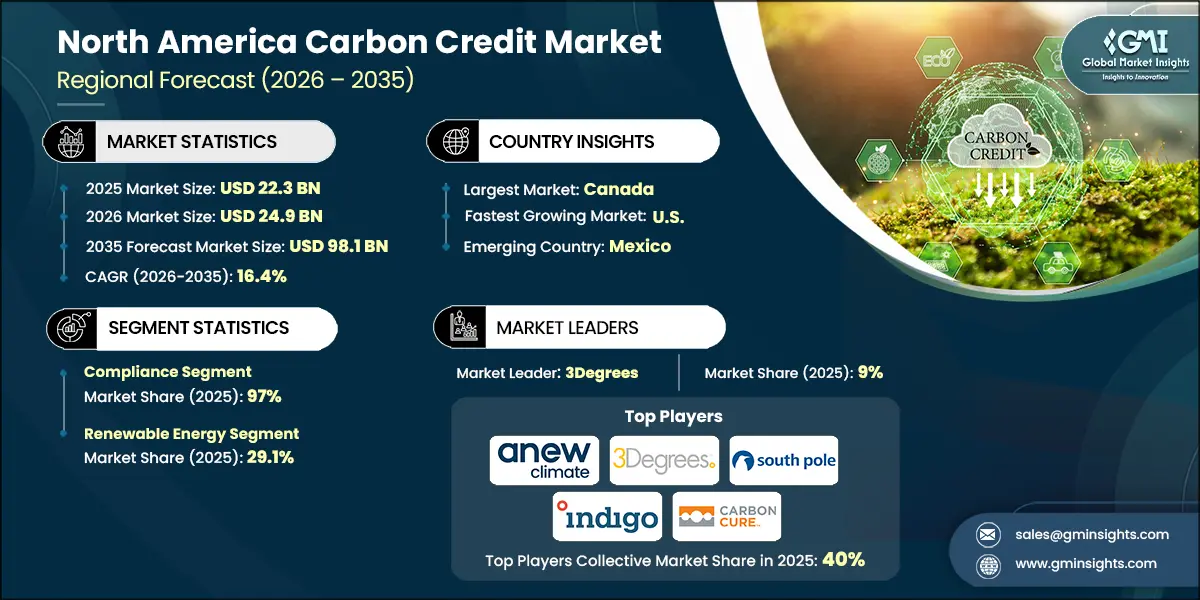
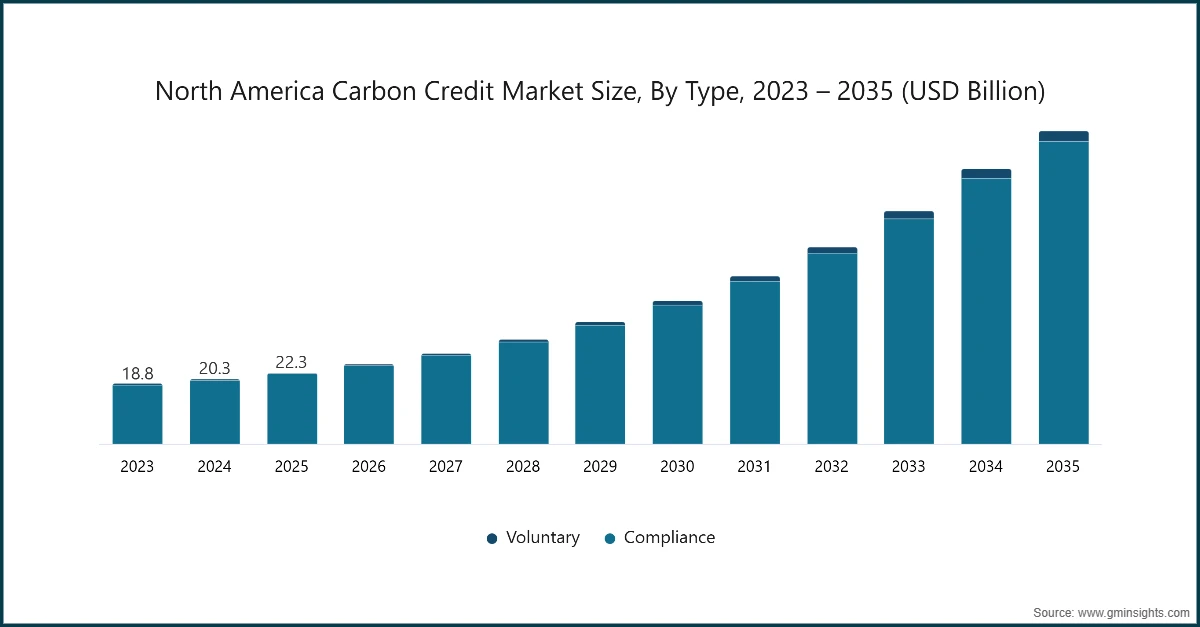
The North America carbon credit market was estimated at USD 22.3 billion in 2025. The market is expected to grow from USD 24.9 billion in 2026 to USD 98.1 billion in 2035, at a CAGR of 16.4%, according to a recent study by Global Market Insights Inc.
North America Carbon Credit Market Key Takeaways
Market Size & Growth
- 2025 Market Size: USD 22.3 Billion
- 2026 Market Size: USD 24.9 Billion
- 2035 Forecast Market Size: USD 98.1 Billion
- CAGR (2026–2035): 16.4%
Regional Dominance
- Largest Market: Canada
- Fastest Growing Country: U.S.
Key Market Drivers
- Increasing inclination towards biodiversity and conservation goals.
- Growing number of carbon standards.
Challenges
- Falsified emission data.
Opportunity
- Growing corporate net‑zero commitments.
- Digital MRV technologies.
Key Players
- Market Leader: 3Degrees led with over 9% market share in 2025.
- Leading Players: Top 5 players in this market include Anew Climate, 3Degrees, South Pole, Indigo AG, CarbonCure, which collectively held a market share of 40% in 2025.
Get Market Insights & Growth Opportunities
- Strengthening power sector-decarbonization standards along with adoption of methane reduction policy momentum is augmenting the market dynamics across the region. The power-sector regulations are pushing utilities toward deeper decarbonization, supported by clearer federal and state frameworks.
- For instances, in February 2026, the U.S. department of treasury along with Internal Revenue Service (IRS) announced proposed regulations for domestic clean fuel production, determining 45Z credit eligibility under the one Big Beautiful Bill Act (OBBBA).
- The regulatory momentum compels companies to examine new compliance technologies including carbon capture, co‑firing alternatives, process efficiency upgrades, and continuous emissions monitoring. These developments indirectly support the carbon credit ecosystem by institutionalizing rigorous measurement and verification standards that high-quality voluntary credits also depend upon.
- As utilities modernize fleets and transition to cleaner baseload options, they cultivate a climate where transparent emissions reductions, durable storage pathways, and technology‑based solutions find stronger commercial grounding, ultimately fortifying market trust in credit integrity.
- For reference, in April 2024, the U.S. EPA finalized a suite of carbon pollution standards for fossil-fuel power plants, establishing technology-based limits and long-term decarbonization requirements for major emitting units.
- North America is a cornerstone of the carbon credit market combining regulatory frameworks, corporate leadership, and technological advancements to drive growth. Its commitment to innovation and sustainability ensures that carbon markets remain credible, scalable, and impactful.
- North America’s influence extends beyond its borders through climate finance and partnerships. Many U.S. and Canadian corporations fund carbon projects in developing countries, supporting global emission reduction efforts while meeting their own sustainability goals. This international engagement strengthens the voluntary market and accelerates climate action worldwide.
- For instance, in February 2026, Voyager Ventures secured a funding of USD 275 million for energy and climate infrastructure. The investment is aimed at concentrating on foundational technologies across energy, materials, manufacturing, AI, mobility, the built environment, and carbon management across various regions including North America.
- North America leads in developing advanced solutions like carbon capture and storage (CCS), direct air capture, and digital platforms for carbon accounting and verification. These innovations enhance transparency and credibility in carbon markets, attracting global buyers seeking high-quality credits.
- Methane regulations across the U.S. and Canada are intensifying, giving rise to improved monitoring systems, leak detection protocols, and upstream operational reforms. North American regulators are sharpening methane quantification standards as these policy signals help normalize the precision needed in voluntary carbon markets.
- For reference, in November 2024, the U.S. EPA advanced final rules under its Methane Emissions Reduction Program, including Waste Emissions Charge provisions and Subpart W reporting updates to increase accuracy of methane measurement across oil and gas infrastructure.
To get key market trends
North America Carbon Credit Market Trends
- Multi‑State market design improvements through RGGI coupled with tightening of regional regulations including California’s cap‑and‑invest architecture will bolster he market growth. The regional greenhouse gas Initiative continues to refine multi‑state carbon market design, promoting predictable cap trajectories, transparent auction processes, and reinvestment frameworks that benefit local economies.
- RGGI’s governance mechanisms also provide a replicable playbook for other jurisdictions considering carbon trading, which indirectly influences the voluntary space by increasing stakeholder familiarity with allowance design, monitoring expectations, and compliance reporting.
- For reference, in September 2024, RGGI states released updated cap‑trajectory modeling for the ongoing Program Review, followed by the July 2025 announcement of strengthened caps through 2037 and affordability mechanisms. The program’s evolution enhances overall market literacy and confidence in both compliance and voluntary instruments.
- California’s carbon market continues to shape North American climate governance through progressive tightening of allowance budgets, enhanced oversight mechanisms, and steadily updated offset protocols. These amendments reinforce robust monitoring, verification, and permanence expectations for offset projects.
- For instance, in October 2024, CARB issued notices outlining proposed amendments for 2026 onward, including major allowance removals and updates to offset protocols, supported by the 2024 Standardized Regulatory Impact Assessment and multiple public workshops.
- Canada’s Clean Fuel Regulations have formalized a large-scale crediting mechanism that rewards measurable lifecycle emission reductions from fuels and associated projects. By embedding credit creation into national policy with strong verification and clear reporting categories, the CFR introduces long-term predictability for developers and buyers.
- For instance, in June 2024, Canada released its first annual clean fuel regulations credit market data report, while the government maintained detailed compliance guidance and the CATS digital tracking platform. This clarity supports cross‑border market understanding, enhances data accessibility, and encourages investment in advanced fuel pathways and carbon‑intensity‑reducing technologies.
- Federal incentives are creating a wave of investable carbon capture, utilization, sequestration, and clean‑fuel projects across North America. These credit frameworks significantly reduce risk for capital-intensive technologies while enforcing strict lifecycle accounting, monitoring obligations, and transparent documentation practices.
- From 2024–2026, the IRS issued updated registration requirements for Section 45Z clean fuel credits and detailed lifecycle analysis and reporting procedures for Section 45Q, including Notice 2024‑60 and updated Form 8933.
- As more developers pursue CCS, DAC, and low‑carbon fuel projects under these tax credits, the voluntary carbon market benefits from a maturing pipeline of scientifically validated, durable reductions and removals. This interlinkage strengthens the credibility of high‑durability credit categories and establishes clearer expectations for MRV, permanence, and third‑party review among buyers and project proponents.
North America Carbon Credit Market Analysis
 Learn more about the key segments shaping this market
Learn more about the key segments shaping this market
Based on type, the North America carbon credit market is segmented into voluntary and compliance. Compliance carbon credit industry dominated by 97% of the market share in 2025 and is set to grow at a CAGR of 16% by 2035. Tighter federal emissions rules for existing coal units and new gas turbines are reshaping compliance markets by requiring major emitting facilities to adopt technology‑based standards such as CCS, fuel switching, or operational upgrades.
- For instance, in May 2025, Verra launched a new rulebook for generating carbon credits from the early phase-out of coal power plants that are replaced with cleaner energy sources. This trend solidifies a policy foundation that encourages innovation and reinforces pathways for future compliance markets or hybrid systems.
- Governments are intensifying methane regulation due to the gas’s high global‑warming potential. The U.S. methane rules including the Waste Emissions Charge framework and Subpart W reporting updates are pushing oil and gas operators to implement advanced methane detection, quantification, and abatement technologies.
- For reference, in December 2025, the government of Canada delivered climate competitiveness strategy commitment to lower methane emission. The enhanced methane regulations will work in favor for clean technology investments to reduce methane emissions, supporting over 130 methane abatement companies across Canada.
- North America voluntary carbon credit market will grow at a CAGR of 21% by 2035. High‑durability carbon removal is emerging as the most influential trend in the voluntary carbon market, driven by large corporate buyers who now prioritize permanence, measurability, and third‑party verification.
- Organizations across technology, aviation, and finance are shifting away from conventional avoidance offsets and toward removals including DAC, bio‑geochemical mineralization, biomass‑with‑storage, and engineered long‑storage solutions. This shift is driven by increasing scrutiny of traditional offsets, stakeholder pressure for more credible climate contributions, and the desire to align with science‑based frameworks.
- For reference, in May 2024, Microsoft reported record carbon‑removal agreements and emphasized durability, net negativity, lifecycle verification, and third‑party scientific review in its published procurement criteria, demonstrating a continental shift toward long‑storage removals.
- Airlines are becoming major voluntary‑market influencers by operationalizing structured climate strategies that combine operational efficiency, sustainable aviation fuel (SAF), and durable carbon removals. Due to SAF supply shortages and rising regulatory pressure, airlines increasingly incorporate high‑quality carbon removals for their residual emissions.
- For instance, in 2024-2025, United Airlines expanded SAF usage, strengthened environmental strategy, and via its Sustainable Flight Fund invested in Heirloom with rights to purchase up to 500,000 tons of DAC‑based carbon dioxide removal for future SAF production or permanent storage.
Learn more about the key segments shaping this market
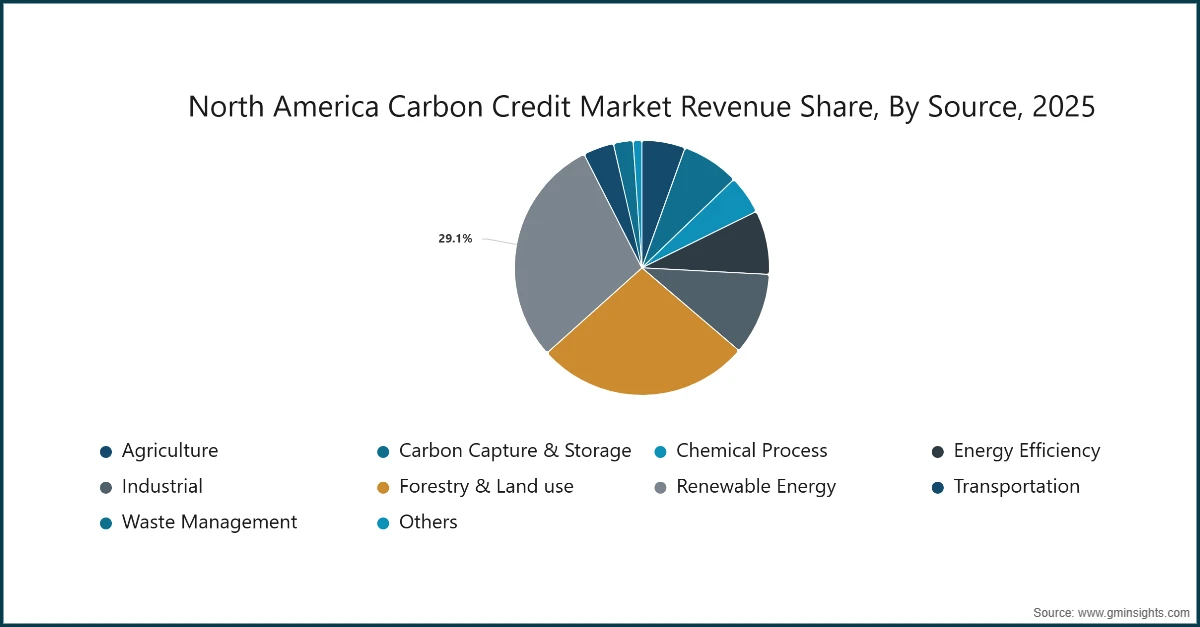
Based on source, the North America carbon credit market is segmented into Agriculture, carbon capture & storage, chemical process, energy efficiency, industrial, forestry & land use, renewable energy, transportation, waste management, and others. Renewable energy market held a market share of 29.1% in 2025 and will grow at a CAGR of 15.7% by 2035.
- Renewable‑energy expansion reduces grid‑level emissions intensity, enabling more accurate carbon accounting for electricity‑dependent industries. This strengthens the long‑term foundation for both voluntary and compliance‑integrated renewable‑energy credit markets.
- Renewable‑energy‑driven carbon credits remain essential in regions where fossil‑based electricity still dominates. For instance, Amazon’s 2024 Sustainability Report highlighted major renewable‑energy investments, including utility‑scale solar projects in North America designed to cut operational emissions and supply carbon‑free electricity.
- Forestry & land use carbon credit market will grow at a CAGR of 16.7% by 2035. Shifting from simple conservation to high‑integrity, measurement‑driven management practices is augmenting the business landscape. With rising concerns about additionality and leakage, the region is prioritizing forestry credits tied to quantifiable carbon‑stock improvements with transparent baselines.
- For instance, in January 2025, Chestnut entered into a long-term offtake agreement with Microsoft to supply more than 7 million tons of carbon removal credits over the next 25 years. Through this initiative, the project aims to rejuvenate approximately 60,000 acres of land by planting over 35 million native and diverse hardwood and softwood trees.
- Industrial will grow at a CAGR of 17% by 2035. Industrial emitters across the region face intensifying regulatory and societal pressure to demonstrate measurable decarbonization progress. Updated protocols for industrial gases, methane capture, and high‑impact chemical processes are reshaping expectations for verification and permanence.
- For reference, in January 2026, the government of Mexico and Association of Maquiladoras Index Juarez organized a carbon tax forum to assists for the potential introduction of a carbon tax in Chihuahua, Mexico. At the conference, Mexico pledged to achieve net GHG reductions between 364 and 404 million tons of CO₂ by 2035, a 31% to 37% cut from business-as-usual projections.
- The CCS segment was valued at USD 1.6 billion in 2025. Power producers and heavy industry are integrating CCS to meet long‑term decarbonization obligations, supported by maturing geological storage assessments and monitoring protocols. For instance, in January 2026, Gevo's North Dakota plant issued more than 500,000 engineered carbon-dioxide removal certificates (CORCs), since CCS activities began in June 2022.
Looking for region specific data?
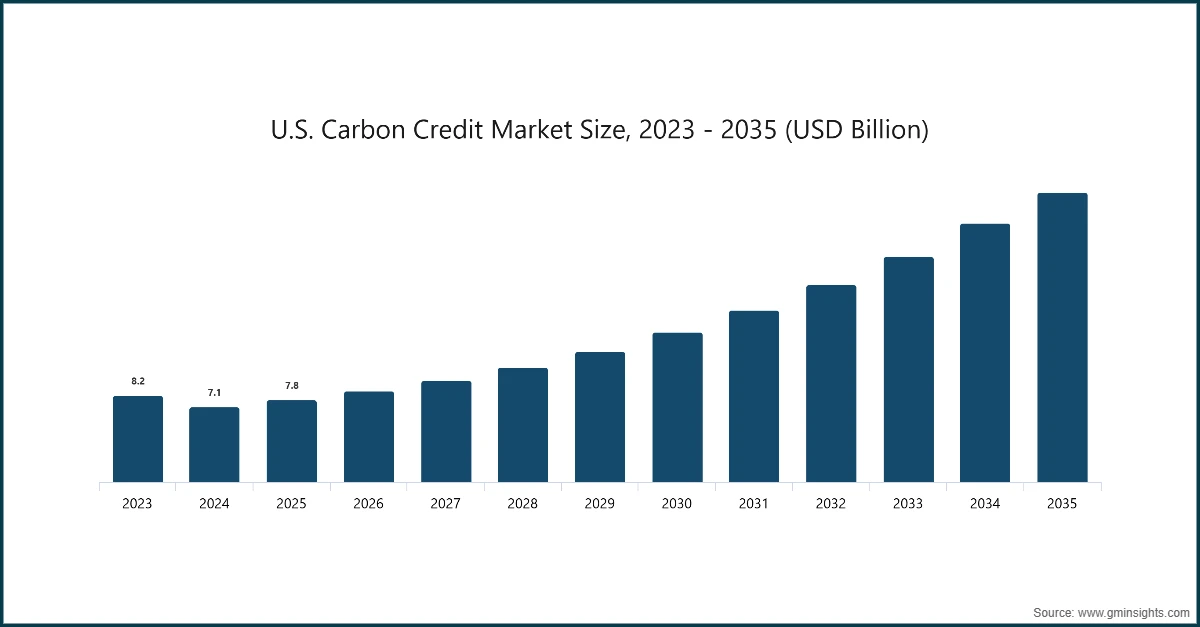
The U.S. catered a market share of around 34% in 2025 across North America region and generated USD 7.8 billion in revenue. The U.S. is experiencing a significant shift toward stronger regulatory enforcement paired with rapid technological scaling, which together are reshaping the quality and volume of carbon credit supply.
Federal agencies are tightening greenhouse‑gas regulations across the power, industrial, and methane‑emitting sectors, requiring facilities to adopt advanced monitoring, reporting, and abatement technologies. For instance, in May 2024, the U.S. Department of Energy selected 24 semifinalists for the Carbon Dioxide Removal Purchase Pilot Prize, committing up to USD 35 million in CDR credit purchases and defining rigorous MRV expectations for U.S. removal markets.
- This dual pathway of regulation and innovation strengthens the credibility of U.S. carbon credits, supports durable removal markets, and increases standardization in measurement and verification. As a result, the U.S. is becoming the anchor of high‑integrity carbon credit development in the region, driven by clear compliance signals and strong public‑sector participation.
- Canada carbon credit market will reach at USD 68 billion by 2035, driven by its comprehensive, lifecycle-based Clean Fuel Regulations (CFR), which formalize a national credit system backed by transparent reporting, digital tracking, and strict verification standards.
- The CFR has become a central driver of Canadian decarbonization efforts, incentivizing reductions across fuel producers, industrial entities, and transportation operators. Unlike fragmented voluntary systems, Canada’s federally managed framework ensures consistency, data integrity, and public reporting, attributes valued by multinational buyers seeking credible credits within the region.
- For instance, in November 2025, the government of Canada during the United Nation’s 30th Climate Change Conference (COP30), reinforced its commitment towards advancing carbon markets, methane reductions, clean energy partnerships, and international adaptation at COP30.
- Mexico carbon credit market will grow at a CAGR of 14.8% by 2035. The country is advancing its carbon credit market through a combination of sustainable‑finance mobilization, national forestry programs, and initiatives aimed at structuring its voluntary carbon market.
- Mexico is scaling forest‑landscape programs targeted at reducing emissions from deforestation and land degradation, enabling future supplies of jurisdictional‑level reduction credits. In addition, nationwide research and analysis are underway to characterize the voluntary carbon market and identify mechanisms for transparency, quality assurance, and regional project development.
- For instance, in February 2024, Mexico launched the Eco Crédito Sustentable program to finance over 1,000 projects aimed at reducing carbon footprints across industrial, commercial, and service sectors, supported by the Ministry of Finance, SEMARNAT, and NAFIN. The program will mobilize significant private investment and achieve up to 100,000 tons of CO₂e in mitigation.
North America Carbon Credit Market Share
- The top 5 companies in the North America carbon credit market including Anew Climate, 3Degrees, South Pole, Indigo AG, and CarbonCure held over 40% market share in the year 2025. Anew Climate occupies a dominant, market‑shaping position due to its wide footprint across nature‑based offsets, renewable natural gas credits, CCS‑linked credits, and engineered removals.
- 3Degrees continues to be an anchor in the North American voluntary carbon market owing to its long operational history and reputation for delivering high‑integrity offset solutions. It has been recognized as a leading supplier of voluntary U.S. offsets and has supported corporate climate strategies across hundreds of organizations.
- CarbonCure provides a technology‑driven pathway to carbon credits by mineralizing captured CO₂ in concrete. Their credits are backed by robust measurement and verification under the Verra VM0043 methodology, and their delivery ledger shows a steady stream of credit issuances and retirements to major North American buyers throughout 2024.
North America Carbon Credit Market Companies
Major players operating in the North America carbon credit industry are:
- 3Degrees
- Anew Climate
- Bluesource
- Carbon Clean
- Carbon Direct
- Carbon Collective
- CarbonCure
- Climeworks
- Conservation International
- Enel X
- Everland
- Green Mountain Energy
- Indigo Ag
- South Pole
- Sterling Planet
- Terrapass
- The Nature Conservancy
- Verra
- WGL
- Xpansiv
- 3Degrees is recognized as a leading supplier of voluntary U.S. carbon offsets, having launched more than 50 U.S. offset projects and actively managing more than 25 long‑term project portfolios across forestry, waste, and land‑use categories.
- South Pole is a global climate‑solutions and carbon‑project developer with an extensive North American footprint centered on climate consulting, high‑quality project sourcing, and environmental certificate services. In addition, the firm employs more than 750 staff across 30+ countries and provides U.S. and Canadian corporates access to diversified portfolios of nature‑based and technology‑based carbon credits.
- Carbon Direct is a U.S.‑based science‑driven carbon management company with a growing role in the North America carbon credit market through its advisory services, carbon‑removal procurement expertise, and proprietary digital MRV technologies.
North America Carbon Credit Market Report Attributes
| Key Takeaway | Details |
|---|---|
| Market Size & Growth | |
| Base Year | 2025 |
| Market Size in 2025 | USD 22.3 Billion |
| Market Size in 2026 | USD 24.9 Billion |
| Forecast Period 2026-2035 CAGR | 16.4% |
| Market Size in 2035 | USD 98.1 Billion |
| Key Market Trends | |
| Drivers | Impact |
| Increasing inclination towards biodiversity and conservation goals | Rising corporate and regulatory focus on ecosystem restoration and conservation is boosting demand for biodiversity‑linked carbon credits in North America. |
| Growing number of carbon standards | The expansion of recognized carbon standards is enhancing market credibility and enabling wider project participation across the region. |
| Pitfalls & Challenges | Impact |
| Falsified emission data | Instances of inaccurate or manipulated emissions reporting undermine market integrity and pose a significant challenge to trust and compliance. |
| Opportunities: | Impact |
| Growing corporate net‑zero commitments | This is creating increased demand for high‑quality, verified carbon credits, opening new opportunities for advanced project developers. |
| Digital MRV technologies | Expansion of digital MRV technologies such as blockchain and AI is enabling more transparent credit verification, fostering new market entrants and investment pathways. |
| Market Leaders (2025) | |
| Market Leader |
Market Share of: 9% |
| Top Players |
Collective Market Share of: 40% |
| Competitive Edge |
|
| Regional Insights | |
| Largest Market | Canada |
| Fastest growing market | U.S. |
| Emerging countries | Mexico |
| Future outlook |
|
What are the growth opportunities in this market?
North America Carbon Credit Industry News
- In November 2025, Carbon Direct acquired Pachama, a solution provider of digital tools that integrates in the voluntary carbon credit market. This will assist the company in carbon project monitoring, reporting, and verification (MRV), thereby adding to the overall carbon credit market.
- In March 2025, Amazon launched carbon credit service through sustainability hub that will be available to its U.S. supply chain partners, enterprise customers and Climate Pledge signatories with certain emissions reporting, net-zero targets and decarbonization strategies.
- In March 2025, the government of Canada decided to invest in the next generation projects of Canadian-made, clean, affordable nuclear energy. This will include over a maximum of USD 304 million over a period of four years to finance the design projects, indirectly adding to the overall market growth across the country.
This North America carbon credit market research report includes in-depth coverage of the industry with estimates & forecast in terms of revenue (USD Million) from 2022 to 2035, for the following segments:
Market, By Type
- Voluntary
- Compliance
Market, By Source
- Agriculture
- Carbon capture & storage
- Chemical process
- Energy efficiency
- Industrial
- Forestry & land use
- Renewable energy
- Transportation
- Waste management
- Others
The above information has been provided for the following countries:
- U.S.
- Canada
- Mexico
Frequently Asked Question(FAQ) :
What was the market size of the North America carbon credit market in 2025?
The market size was USD 22.3 billion in 2025, with a CAGR of 16.4% projected through 2035, driven by regulatory tightening, multi-state market design improvements, and advancements in carbon offset protocols.
What is the projected value of the North America carbon credit market by 2035?
The market is expected to reach USD 98.1 billion by 2035, fueled by strengthened cap-and-trade mechanisms, enhanced compliance frameworks, and increased adoption of renewable energy and carbon capture technologies.
What is the projected size of the North America carbon credit market in 2026?
The market is expected to grow to USD 24.9 billion in 2026.
What was the market share of the compliance carbon credit segment in 2025?
The compliance carbon credit segment dominated the market with a 97% share in 2025 and is projected to grow at a CAGR of 16% by 2035.
What was the market share of the renewable energy segment in 2025?
The renewable energy segment held a 29.1% market share in 2025 and is expected to grow at a CAGR of 15.7% by 2035.
Which country dominated the North America carbon credit market in 2025?
The United States led the market with a 34% share in 2025, generating USD 7.8 billion in revenue. The country is experiencing a shift toward stricter regulatory enforcement and rapid technological advancements, reshaping the carbon credit supply landscape.
Who are the key players in the North America carbon credit market?
Major players include 3Degrees, Anew Climate, Bluesource, Carbon Clean, Carbon Direct, Carbon Collective, CarbonCure, Climeworks, Conservation International, Enel X, and Everland.
North America Carbon Credit Market Scope
Related Reports