Summary
Table of Content

North America Blinds and Shutters Market
Get a free sample of this report
Form submitted successfully!
Error submitting form. Please try again.
Thank you!
Your inquiry has been received. Our team will reach out to you with the required details via email. To ensure that you don't miss their response, kindly remember to check your spam folder as well!
Request Sectional Data
Thank you!
Your inquiry has been received. Our team will reach out to you with the required details via email. To ensure that you don't miss their response, kindly remember to check your spam folder as well!
Form submitted successfully!
Error submitting form. Please try again.
North America Blinds and Shutters Market Size
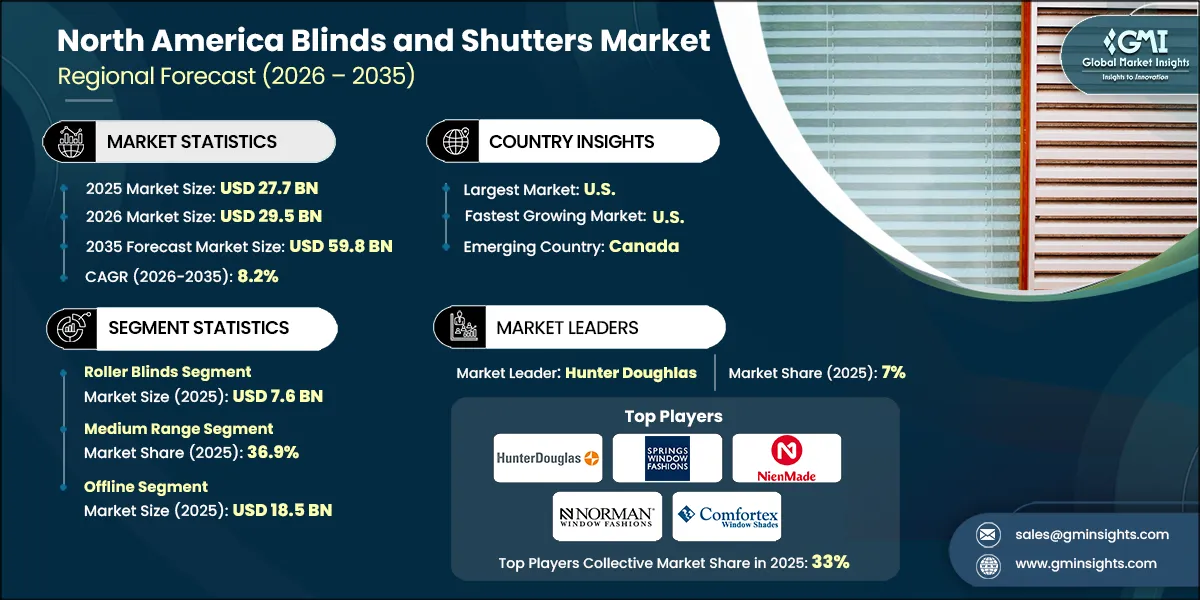
The North America blinds and shutters market was estimated at USD 27.7 billion in 2025. The market is expected to grow from USD 29.5 billion in 2026 to USD 59.8 billion in 2035, at a CAGR of 8.2%, according to latest report published by Global Market Insights Inc.
North America Blinds and Shutters Market Key Takeaways
Market Size & Growth
- 2025 Market Size: USD 27.7 Billion
- 2026 Market Size: USD 29.5 Billion
- 2035 Forecast Market Size: USD 59.8 Billion
- CAGR (2026–2035): 8.2%
Regional Dominance
- Largest Market: U.S.
- Fastest Growing Country: U.S.
Key Market Drivers
- Rising home renovation and interior design consciousness.
- Energy efficiency and sustainability mandates.
- Expansion of smart home integration.
Challenges
- Intense price competition.
- Supply chain vulnerabilities and raw material volatility.
Opportunity
- Expansion into eco-friendly and recycled materials.
- Customization and direct-to-consumer digital channels.
Key Players
- Market Leader: Hunter Douglas led with over 7% market share in 2025.
- Leading Players: Top 5 players in this market include Hunter Douglas, Springs Window Fashions, Nien Made Enterprise Co. Ltd., Norman Window Fashions, Comfortex Window Fashions, which collectively held a market share of 33% in 2025.
Get Market Insights & Growth Opportunities
Over the past few years, home improvement and interior design have become increasingly popular, and as a result, the way consumers view window coverings has shifted from blinds and shutters to being viewed as an accessory to beautify their home. As a result, window coverings are now being used to coordinate with the other elements of your home, thereby creating a cohesive theme.
Consequently, there is now a wider variety of window coverings available to consumers. In addition to premium finishes, many styles and colors are available which can be customized to accommodate the different styles of window coverings being designed or built today; this allows manufacturers the opportunity to create multiple collections of product lines to appeal to all tastes in home design. Many of these products include premium finishes with the ability to customize for today's modern, minimalistic, or luxurious interior style. Therefore, manufacturers have many different collections that will appeal to different consumer tastes and design styles.
Another reason why this has changed in the last few years is due to the increase in social media and the availability of home improvement videos and blogs where people can see how their preferred types of blinds and shutters can be used in a variety of different ways to enhance the beauty of their homes.
In addition, consumers now want their blinds and shutters to enhance the overall look and feel of their homes and make them an integral part of their renovation projects, therefore creating an opportunity for brands to present themselves as design partners with consumers by offering consultation and customized services in order to help them create a beautiful and unique interior design.
Additionally, there has been an increase in demand for environmentally responsible, eco-friendly products made from bamboo, recycled fabric and woods that have been sourced responsibly due to the growing number of green building codes and certifications available.
Governments and the construction industry are implementing tighter regulations on the construction of energy-efficient residences and promoting the use of blinds and shutters as a component in Living an environmentally-responsible lifestyle.
Smart home technology is growing quickly, providing manufacturers of blinds and shutters with the opportunity to create an automatic way of operating their products rather than a manual. Motorized and automated systems, which have voice assistants and mobile apps, have become very attractive to consumers who are savvy about technology. By using smart blinds, you can get schedule for your blinds to open and close, know the amount of light that enters your home from a location away from the home, and connect to a Home Energy Management System (HEMS) to have optimal efficiency. Convenience and comfort are two of the main reasons why smart blinds are becoming popular. Currently, smart home blinds are a distinct and rapidly growing sector of the market.
To get key market trends
North America Blinds and Shutters Market Trends
The integration of IoT-enabled automation in blinds and shutters is redefining the industry, shifting from basic manual control to intelligent, predictive systems.
- The North American blinds and shutters market is experiencing a transformative phase, driven by a growing consumer preference for premium products. Buyers are prioritizing quality, durability, and sophisticated designs over basic functionality and affordability. Homeowners are increasingly investing in hardwood shutters, natural woven materials, high-grade aluminum finishes, and designer fabric collections. This trend is particularly prominent in urban areas, where aesthetic appeal and functionality are equally valued.
- Automated and motorized window treatments, once considered luxury items, have now become mainstream due to the widespread adoption of smart home technologies. These products are increasingly compatible with popular home automation platforms such as Amazon Alexa, Google Home, Apple HomeKit, and advanced building management systems used in commercial spaces.
- Environmental sustainability is a critical factor influencing purchasing decisions in the blinds and shutters market. Consumers are actively seeking eco-friendly options, prompting manufacturers to innovate in materials and production processes.
- Modern interior design trends are significantly shaping the development of blinds and shutters. Slimmer slat profiles, concealed mounting hardware, cassette headrails that hide mechanical components, and fabric options in soft, muted tones are becoming standard offerings.
- Consumers are increasingly seeking window treatments that provide multifunctional benefits beyond traditional light control and privacy. This demand is driving innovation in the market, with manufacturers introducing versatile products tailored to diverse lifestyle needs.
- The convergence of advanced manufacturing technologies and sophisticated digital configuration tools has revolutionized product personalization in the blinds and shutters market. Features such as custom sizing, fabric selection, and motorization options are now accessible to mainstream consumers, breaking the traditional association of personalization with premium market segments.
North America Blinds and Shutters Market Analysis
Learn more about the key segments shaping this market
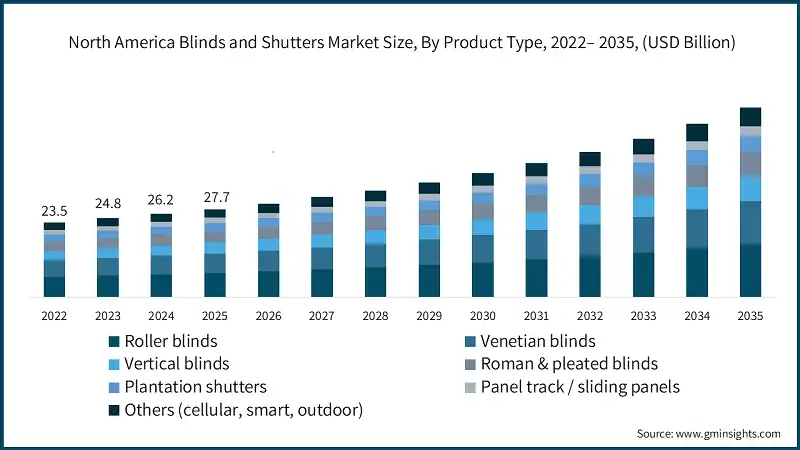
Based on product type, the market is divided into roller blinds, venetian blinds, vertical blinds, roman & pleated blinds, plantation shutters, panel track/sliding panels and others (cellular, smart, outdoor). In 2025, roller blinds held the major market share, generating a revenue of USD 7.6 billion.
- Roller blinds have established commanding market leadership within the broader window treatments category, driven by their exceptional versatility, streamlined aesthetics, and functional adaptability across diverse application environments. Their minimalist design profile aligns perfectly with contemporary interior preferences emphasizing clean lines and uncluttered visual presentations, making them equally suitable for modern residential spaces, corporate offices, hospitality venues, and healthcare facilities.
- The manufacturing economics underlying roller blind production further reinforce market dominance, as relatively simple construction requirements enable competitive pricing across budget segments while accommodating extensive customization possibilities in fabrics, patterns, opacity levels, and technological integrations. Fabric innovation has dramatically expanded roller blind functionality to include specialized performance characteristics such as thermal insulation, acoustic dampening, antimicrobial treatments, and flame retardancy certifications required for commercial installations.
Learn more about the key segments shaping this market
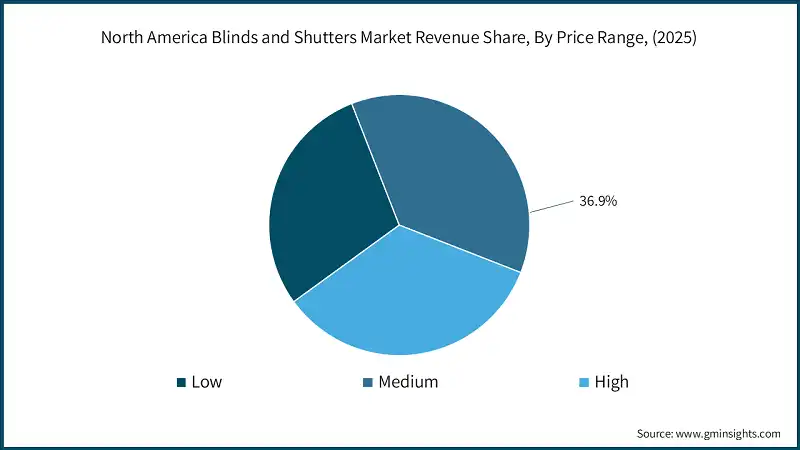
Based on price range, the market is segmented into low, medium, high. The medium range segment held the largest share, accounting for 36.9% of the North America blinds and shutters market in 2025.
- The medium price range segment commands the largest market share within the blinds and shutters industry, representing the critical intersection where quality expectations, aesthetic aspirations, and budget constraints converge for the majority of purchasing decisions. Consumers within this segment typically seek products offering meaningful improvements over basic entry-level options in terms of material quality, design sophistication, and operational durability, without requiring substantial financial commitments associated with premium or luxury tiers.
- Manufacturers targeting the medium segment have developed increasingly sophisticated value propositions that incorporate design elements and functional features previously exclusive to premium categories, effectively democratizing access to style-forward window treatments. Improved fabric selections, enhanced color palettes, reliable motorization options, and respectable warranty coverage characterize medium-range offerings that deliver compelling value equations for discerning consumers conducting comparison research before purchase decisions.
Based on the distribution channel, the market is segmented into online and offline. In 2025, offline segment held a major market share, generating a revenue of USD 18.5 billion.
- Despite accelerating digital commerce adoption across retail categories, offline distribution channels maintain decisive dominance in blinds and shutters sales, reflecting fundamental product characteristics and consumer purchasing behaviors that favor physical retail experiences. The tactile nature of window treatment selection, where fabric textures, material weights, color accuracy, and light filtering properties significantly influence purchasing decisions, creates inherent advantages for showroom environments enabling hands-on product evaluation.
- The complexity of proper window treatment specification further reinforces offline channel strength, as measurement precision requirements and installation considerations often necessitate professional involvement that brick-and-mortar retailers are uniquely positioned to provide.
Looking for region specific data?
U.S. Blinds and Shutters Market
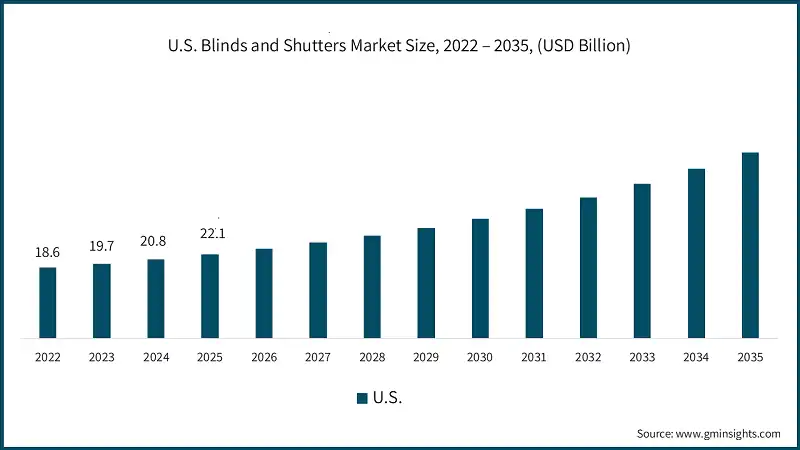
In 2025, the U.S. dominated the North America market, accounting for around 79.7% and generating around USD 22.1 billion revenue in the same year.
- North America maintains a commanding position within the North America blinds and shutters market, underpinned by robust residential construction activity, extensive home renovation culture, and high consumer spending capacity that collectively drive substantial demand volumes across product categories.
- Established retail infrastructure encompassing major home improvement chains, specialty window covering retailers, and extensive dealer networks ensure widespread product accessibility, while sophisticated e-commerce platforms operated by leading brands provide convenient purchasing alternatives for digitally oriented consumers seeking efficiency and competitive pricing.
Canada Blinds and Shutters Market
Canada blinds and shutters market is expected to grow at 7% during the forecast period.
- The Canadian blinds and shutters market is shaped by a strong emphasis on aesthetics, energy efficiency, and convenience. Homeowners increasingly view window coverings not just as functional elements but as integral parts of interior design, driving demand for stylish and customizable options. The market benefits from Canada’s climate, where insulating blinds and shutters help regulate indoor temperatures, reducing energy costs.
North America Blinds and Shutters Market Share
Hunter Douglas Inc. is leading with 7% market share. Hunter Douglas N.V., Springs Window Fashions, Nien Made Enterprise Co. Ltd., Norman Window Fashions, Comfortex Window Fashions. The collective market share in 2025 is 33%, indicating moderately fragmented market concentration. These prominent players are proactively involved in strategic endeavors, such as mergers & acquisitions, facility expansions & collaborations, to expand their product portfolios, extend their reach to a broad customer base, and strengthen their market position.
Hunter Douglas has a clear competitive edge, driven by its innovation in smart and motorized solutions. The company’s strong brand equity and premium positioning allow it to dominate both residential and commercial segments.
Springs Window Fashions stands out for its scale and customization capabilities, particularly in North America. Its competitive edge lies in offering a wide range of mid-range and premium products under well-known brands like Bali and Graber. The company excels in project-based solutions for commercial spaces and provides strong after-sales support, which builds customer trust.
North America Blinds and Shutters Market Companies
Major players operating in the North America blinds and shutters industry are:
- 3 Day Blinds LLC
- Comfortex Window Fashions
- Coulisse B.V.
- Draper, Inc.
- Hunter Douglas N.V.
- Lafayette Interior Fashions
- Lutron Electronics
- Maxxmar Window Fashions
- Nien Made Enterprise
- Norman Window Fashions
- Rollease Acmeda
- Skandia Window Fashions
- Springs Window Fashions
- Timber Blinds
- Vista Products
Nien Made Enterprise Co. Ltd advantage is rooted in its manufacturing scale and cost efficiency, making it one of the largest suppliers of blinds and shutters. The company benefits from economies of scale and a strong export network, enabling competitive pricing without compromising quality.
Norman Window Fashions stands out for its strong focus on craftsmanship and premium quality, particularly in wood and faux wood shutters. Its competitive edge lies in offering highly customizable products that combine durability with aesthetic appeal, catering to consumers who value luxury and sustainability. Norman emphasizes eco-friendly practices, such as responsibly sourced materials and low-VOC finishes, which resonate with environmentally conscious buyers.
Comfortex stands out in the North American blinds and shades market through its strong focus on company offers a wide range of highly customizable window treatments, including cellular shades, roller shades, and motorized solutions, catering to diverse consumer preferences.
North America Blinds and Shutters Market Report Attributes
| Key Takeaway | Details |
|---|---|
| Market Size & Growth | |
| Base Year | 2025 |
| Market Size in 2025 | USD 27.7 Billion |
| Market Size in 2026 | USD 29.5 Billion |
| Forecast Period 2026 - 2035 CAGR | 8.2% |
| Market Size in 2035 | USD 59.8 Billion |
| Key Market Trends | |
| Drivers | Impact |
| Rising home renovation and interior design consciousness | Consumers increasingly view blinds and shutters as design elements rather than mere functional accessories. This trend drives demand for stylish, customizable options that complement modern interiors. Brands focus on premium finishes, diverse color palettes, and bespoke solutions to cater to homeowners seeking aesthetic upgrades. Social media and influencer-driven home décor trends further amplify this shift. |
| Energy efficiency and sustainability mandates | Governments and consumers are prioritizing energy-saving solutions, making thermal-insulating blinds and eco-friendly materials essential. Products that reduce heat gain and optimize natural light are gaining traction. Manufacturers are adopting recycled fabrics, sustainable wood, and low-VOC finishes to meet green building standards. Sustainability is now a core differentiator in the market. |
| Expansion of smart home integration | Smart blinds and shutters are becoming integral to connected living. IoT-enabled systems allow automated light control, voice commands, and app-based scheduling, enhancing convenience and energy efficiency. Integration with platforms like Alexa and Google Home positions these products as premium lifestyle solutions. This segment is expected to see rapid growth as smart home adoption accelerates. |
| Pitfalls & Challenges | Impact |
| Intense price competition | The North America blinds and shutters market is highly fragmented, with numerous regional and local players competing. This creates intense price pressure, forcing manufacturers to balance affordability with innovation. Premium brands struggle to justify higher costs, while low-cost alternatives erode margins and brand loyalty. |
| Supply chain vulnerabilities and raw material volatility | The supply chains for components like aluminum, wood, and fabrics remain vulnerable to disruptions caused by geopolitical tensions, shipping delays, and fluctuating raw material prices. These challenges lead to unpredictable production costs and delivery timelines, impacting profitability and customer satisfaction. |
| Opportunities: | Impact |
| Expansion into eco-friendly and recycled materials | Growing consumer awareness of sustainability creates a strong demand for blinds and shutters made from recycled fabrics, bamboo, and responsibly sourced wood. Manufacturers can differentiate by offering certified green products that align with energy-efficient building standards and eco-conscious lifestyles. |
| Customization and direct-to-consumer digital channels | Personalization is becoming a key purchase driver, with customers seeking tailored designs, colors, and smart features. Direct-to-consumer (D2C) platforms and digital configurators enable brands to offer seamless customization, reduce dependency on traditional retail, and build stronger customer relationships through online engagement. |
| Market Leaders (2025) | |
| Market Leaders |
7% market share |
| Top Players |
|
| Competitive Edge |
|
| Regional Insights | |
| Largest market | U.S. |
| Fastest growing market | U.S. |
| Emerging countries | Canada |
| Future outlook |
|
What are the growth opportunities in this market?
North America Blinds and Shutters Market News
- In October 2025, Comfortex aligned with new cordless shade safety standards and capitalized on rising demand for motorized and eco-friendly window treatments, positioning itself as a tech-forward and sustainable brand.
- In January 2025, Hunter Douglas Inc. launched Aura Illuminated shades integrating LED lighting and smart home compatibility.
- In 2025, 3 Day Blinds LLC maintained strong reputation for fast turnaround and premium custom blinds/shutters. Expanded motorized options and Tilt Magic system for shutters.
The North America blinds and shutters market research report includes in-depth coverage of the industry with estimates & forecasts in terms of revenue (USD Billion) and volume (Million Units) from 2022 to 2035, for the following segments:
Market, By Product Type
- Roller blinds
- Venetian blinds
- Vertical blinds
- Roman & pleated blinds
- Plantation shutters
- Panel track / sliding panels
- Others (cellular, smart, outdoor)
Market, By Material
- Blinds
- Fabric
- Wood
- Aluminum
- Plastic
- Composite
- Shutters
- Wood (basswood, cedar)
- Vinyl/PVC
- Composite
- Aluminum
Market, By Type
- Manual
- Motorized
- Smart / IoT-enabled
Market, By Price Range
- Low
- Medium
- High
Market, By Distribution Channel
- Online
- E-commerce
- Company websites
- Offline
- Specialty stores
- Retail stores
- Others (interior design studios & boutiques, etc.)
The above information is provided for the following regions and countries:
- North America
- U.S.
- Canada
Frequently Asked Question(FAQ) :
What was the market size of the North America blinds and shutters market in 2025?
The market size was USD 27.7 billion in 2025, with a CAGR of 8.2% expected through 2035, driven by increasing consumer preference for premium products and the adoption of smart home technologies.
What is the projected value of the North America blinds and shutters market by 2035?
The market is expected to reach USD 59.8 billion by 2035, fueled by advancements in IoT-enabled automation and growing demand for automated window treatments.
What was the revenue generated by roller blinds in 2025?
Roller blinds generated USD 7.6 billion in revenue in 2025, holding the largest market share among product types.
Which price range segment dominated the market in 2025?
The medium price range segment dominated the market in 2025, accounting for 36.9% of the total market share.
Which country led the North America blinds and shutters market in 2025?
The United States led the market in 2025, accounting for approximately 79.7% of the market share and generating around USD 22.1 billion in revenue.
What are the key trends in the North America blinds and shutters industry?
Key trends include the integration of IoT-enabled automation, the mainstream adoption of motorized window treatments, and a shift towards premium materials such as hardwood, natural woven materials, and designer fabrics.
Who are the major players in the North America blinds and shutters market?
Major players include 3 Day Blinds LLC, Comfortex Window Fashions, Coulisse B.V., Draper, Inc., Hunter Douglas N.V., Lafayette Interior Fashions, Lutron Electronics, Maxxmar Window Fashions, Nien Made Enterprise, Norman Window Fashions, and Rollease Acmeda.
North America Blinds and Shutters Market Scope
Related Reports